Removal of Arsenate from Aqueous Solution Using
Nanoscale Iron Particles
連興隆,國立高雄大學土木與環境工程學系副教授 袁菁,國立高雄大學土木與環境工程學系副教授 卓裕盛,國立高雄大學土木與環境工程學系大學專題生 江姿幸,國立中山大學環境工程研究所碩士生 計畫編號:NSC 92-2211-E-390-003、NSC92-2211-E-390-005-
摘要
本計畫利用批次試驗,進行奈米零價鐵金屬去除水中五價砷之研究。奈米零價鐵 金屬為粒徑小於 100 nm 之鐵顆粒,已被證實可有效去除環境中多種類之污染 物。本研究利用 SEM-EDX、XRD、BET 比表面積分析儀與界達電位測定儀(Laser Zee Meter)等多種設備,鑑定奈米鐵金屬與五價砷反應前後之鐵金屬表面之變化 情形。SEM-EDX 分析顯示五價砷為鐵金屬表面所吸附,而 XRD 的結果則證實 五價砷與奈米零價鐵反應 7 天後,生成多種的氧化鐵,包括 lepidocrocite、 magnetite、maghemite。界達電位的測定結果指出,奈米零價鐵的表面等電位點 出現在 pH4.4 左右。奈米零價鐵對五價砷的吸附量隨 pH 的降低而增加,此一結 果應與在低 pH 條件下,奈米鐵表面帶正電有利於吸附帶負電之五價砷(H2AsO4-, HAsO42-)有關。奈米零價鐵對五價砷的 Langmuir 飽和吸附量為 38.2 mg/g,將飽 和吸附量與吸附劑之比表面積標準化後,將有助於瞭解零價鐵之種類與反應接觸 時間等等因子對影響吸附量的重要性。 關鍵字:砷、環境奈米技術、零價鐵、吸附、水污染Introduction
Groundwater resources contaminated by elevated levels of arsenic either through natural or anthropogenic sources have been reported in many countries including Bangladesh, West Bengal, Chile, Mexico, Taiwan, and parts of the United States (Nordstrom 2002). Arsenic is classified as a Group A carcinogen by the United
States Environmental Protection Agency and has been associated with a multitude of other non-cancer health effects such as black-foot diseases (Borum et al. 1994). In Taiwan, arsenic hazard is a significant public concern, partially because of the past scared black-foot diseases. To reduce the public health risk from arsenic uptake, the
Taiwanese limit for drinking water has been set at 10 g/L.
Arsenic occurrence in natural water is mostly found in inorganic forms as tri-valent arsenite (As(III)) and penta-valent arsenate (As(V)) (Cullen and Reimer 1989). Arsenic speciation is highly dependent of redox potential and pH. Under
oxidizing conditions, As(V) is predominant and is in the form of oxyanions (H2AsO4-,
HAsO42-) in a wide pH conditions. Under reducing conditions, arsenic occurs
mostly as As(III) and the uncharged arsenite species H3AsO30 predominates at pH less
than about 9.2.
Many technologies have been developed for arsenic removal from drinking water supplies including chemical precipitation, ion exchange, and adsorption techniques
using various adsorbents such as activated alumina, iron oxide (e.g.,Dixit and Hering
2003), and zero-valent iron (e.g., Lackovic et al. 2000; Nikolaidis et al. 2003; Lien and Wilkin 2005). The use of zero-valent iron for effective removal of arsenic has recently received attention. Studies have shown that zero-valent iron may serve as reactive media for permeable reactive barriers to remove arsenic in the subsurface
(e.g.,Su and Puls 2001, 2004) and may be used in small-scale drinking water systems
for rural areas (Lackovic et al. 2000). It has been found that the removal of arsenic in zero-valent iron systems involves complicated processes including surface adsorption, precipitation, co-precipitation, and redox reactions (Lackovic et al. 2000; Lien and Wilkin 2005). The formation of corrosion products of iron is believed to play an important role in arsenic removal mechanisms (Manning et al. 2002; Su and Puls 2004).
Nanoscale iron particles, an innovative extension of conventional zero-valent iron technology, have shown excellent performance for remediation of a wide array of contaminants (Zhang 2003). Interests on the nanoscale iron particles have been growing rapidly over last 3-4 years and mostly been focused on the degradation of chlorinate organic solvents. However, studies on the use of nanoscale iron particles for arsenic removal are still limited (Kanel et al. 2005). Because of their small particle size (<100 nm) and high reactivity, they could be directly injected into subsurface to remediate arsenic contamination. Recent field tests have demonstrated promising prospective for in situ remediation (Zhang 2003).
The objectives of this study were aimed at (i) assessing the effectiveness of nanoscale iron particles for removal of arsenate, (ii) characterizing nanoscale iron particles and identifying their corrosion products in arsenic solutions, (iii)
investigating effects of pH and initial arsenic concentrations on arsenic removal, and (iv) determining the maximum arsenic adsorption capacity of nanoscale iron particles.
Experimental Section
Materials and Chemicals
All chemicals were reagent grade or better and used without further purification. Deionized water was used for preparation of all reagent solutions.
Synthesis of nanoscale iron particles was achieved by adding 1:1 volume ratio of NaBH4 (0.25 M) into FeCl36H2O (0.045 M) solution at 22±1°C with vigorously mixing as describing by Lien and Zhang (2005). Ferric iron was reduced by borohydride according to the following reaction:
4Fe3+ +3BH4- +9H2O4Fe0+3H2BO3- +12H+ +6H2 (1)
Solid-Phase Characterization
Characterization of nanoscale iron particles was conducted by using X-ray diffraction (XRD), scanning electron microscopy (SEM), a surface area analyzer and a zeta potential instrument. XRD measurements were performed using a Rigaku X-ray diffractometer (Rigaku Co.) at 40 kV and 40 mA with a copper target tube radiation
(Cu K1) producing X-rays with a wavelength of 1.54056 Å . Samples were placed
on a quartz plate and were scanned from 20 to 80° (2θ) at a rate of 2° 2θ/minute. Morphological analysis of nanoscale iron particles was performed by SEM using a Hitachi S-4300 microscope (at 10 kV) with energy-dispersive X-ray (EDX) analysis. The specific surface area of nanoscale iron particles was measured by
Brunauer-Emmett-Teller (BET) N2 method using a COULTER SA 3100 surface area
analyzer (Coulter Co.).
Zeta potential of nanoscale iron particles in aqueous solutions was measured by a Laser Zee Meter (Pen Kem Inc, model 3.0). The solution contained 0.2 g/L
nanoscale iron particles and 10-2 M NaClO4. Prior to analysis, the solution pH was
adjusted by adding 1.0 M HNO3 or KOH, and was shaken for 24 hours.
Batch Tests
Stock solutions of 1000 mg/L As(V) were prepared from reagent-grade
Na2HASO47H2O in deionized water. For the study of pH effects on arsenic removal,
the experiments were carried out in plastic reaction vessels containing 0.1 g/L nanoscale iron particles in 100 mL of arsenic solution at 221 C. Two initial arsenic concentrations (5.2 and 11.1 mg/L) were used in the study and the solution pH was adjusted by 1 M HCl or NaOH. For the study of adsorption isotherms, plastic
reaction vessels containing 0.25g nanoscale iron particles in 200 mL of arsenic solution were performed at pH 7.0 and 221 C. The solution pH was controlled only at the beginning of the reaction using 1 M HCl or NaOH. For both studies, reaction vessels were placed on a rotary shaker (100 rpm) and the contact time of reactions was set at 120 hours to ensure the equilibrium was established.
Arsenic Analysis
Chemical analysis for arsenic was carried out using an inductively coupled plasma-optical emission spectrometry (ICP-OES, PerkinElmer Optima 2000DV).
Prior to analysis, samples were filtered through 0.2 m filters and acidified with 3%
HNO3.
Results and Discussion
Characterization of nanoscale iron particles and their corrosion products
The SEM image of nanoscale iron particles shows that they are comprised of spherical particles assembled in chains (Fig. 1). The nanoscale iron particles have an average size diameter in the range of 50-100 nm. The size of particles is consistent with previous studies and the observation of chain structure of nanoscale iron particles is in agreement of the study conducted by Nurmi et al (2005). A specific surface area of
nanoscale iron particles was in an average of 33.5 m2/g as measured by BET surface
analyzer.
Fig 1. SEM image of the fresh nanoscale iron particles.
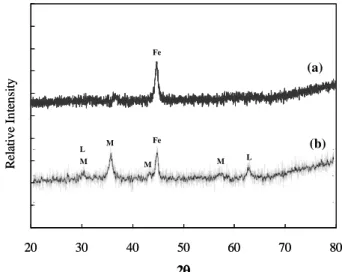
The results of XRD analysis of fresh and As(V)-treated nanoscale iron particles are shown in Fig. 2. The XRD pattern of fresh nanoscale iron particles showed a
major characteristic peak at 44.7 degrees 2 indicating the presence of elemental iron.
After reactions with arsenic for 7 days, corrosion products including lepidocrocite, magnetite and/or maghemite were found at the surface of As(V)-treated nanoscale iron particles according to the XRD analysis. Adsorption of arsenic onto the particle
surface was further confirmed by SEM-EDX analysis. Samples were taken when nanoscale iron particles reacted with 100 mg/L of arsenic at 7 days. As shown in Fig. 3, the EDX spectrum indicated the presence of arsenic at the surface of As(V)-treated nanoscale iron particles. The elemental composition by weight percent of the As(V)-treated samples was determined by a quantitative analysis of EDX. The ratio of Fe:O:As was 87.1:11.5:1.4.
Fig.2. XRD patterns of (a) fresh and (b) As(V)-treated nanoscale iron particles.
Peaks are due to zero-valent iron (Fe), lepidocrocite (-FeOOH) (L), and
magnetite/maghemite (Fe3O4/-Fe2O3) (M).
Fig. 3. SEM-EDX spectrum of As(V)-treated nanoscale iron particles.
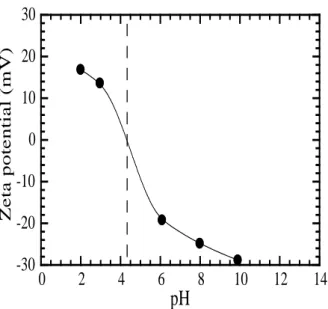
In order to investigate the surface charge of the solids, the zeta potentials of nanoscale iron particles were measured as a function of pH as shown in Fig. 4. The nanoscale iron particles are positively charged up to around pH 4 and then become negatively charge. Hence, the zero point of charge was determined to be at pH 4.4. In other words, the nanoscale iron particles possess a positive surface charge at lower pH (< pH 4.4) and a negative surface charge when the solution pH is greater than 4.4.
2 0 500 1000 1500 2000 2500 3000 3500 4000 4500 5000 20 30 40 50 60 70 80 R el at iv e In te n si ty 2 0 500 1000 1500 2000 2500 3000 3500 4000 4500 5000 20 30 40 50 60 70 80 R el at iv e In te n si ty Fe Fe L M M M M L (a) (b)
Fig. 4. Zeta potential of nanoscale iron particles as a function of pH.
Effect of pH on arsenic removal
Adsorption of As(V) onto nanoscale iron particles as a function of pH from 2 to 12 is illustrated in Fig. 5. Arsenate adsorption on the solids decreased with increasing pH. Similar trends have been found in several previous studies using various iron oxides (Dixit and Hering 2003). At pH 2.2, nanoscale iron particles adsorbed maximum amounts of arsenic. However, only approximately 40% and 50% removal efficiency were achieved when initial arsenic concentrations were 5.2 and 11.1 mg/L, respectively. This may be attributed to the very low dosage of nanoscale iron particles (0.1 g/L) in the system. Nevertheless, the increase of removal efficiency at higher initial concentration suggests the adsorption of arsenic onto iron surface is dependent on arsenic concentrations.
Fig. 5. Arsenic adsorption onto nanoscale iron particles at various pH and initial arsenic concentrations. -30 -20 -10 0 10 20 30 0 2 4 6 8 10 12 14 Z e ta p o te n ti a l ( m V )
pH
0 10 20 30 40 50 60 2 4 6 8 10 12 14 Co = 11.1 ppm Co = 5.2 ppm A rs e n ic u p ta k e ( m g A s/ g ) pHThe nanoscale iron particles that have a high affinity for arsenate at lower pH can be attributed to the positive surface charge of the solids as measured by zeta potential (Fig. 4). H2AsO4- is dominant at low pH (2.2 < pH < 6.9) while at higher pH, HAsO42- becomes dominant (6.9 < pH < 11.5). As a result, the electrostatic attraction between H2AsO4- and the positively charged particle surface occurred at lower pH whereas the electrostatic repulsion between HAsO42- and the negatively charged particle surface took place as increasing pH.
Arsenic adsorption capacity
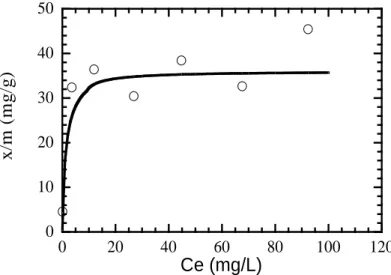
The adsorption of arsenic onto the nanoscale iron particles showed nonlinear behavior (Fig. 6) and can be described by the Langmuir equation:
e e m KC 1 KC q m x (2)
where x/m (mg/g) is the amount of arsenic adsorbed, qm (mg/g) is the maximum
adsorption capacity, K (L/mg) is the adsorption constant, and Ce (mg/L) is the
equilibrium concentration of arsenic in the solution. The equation (r2 = 0.98) gives a
value of the maximum adsorption capacity (38.2 mg/g) and the sorption constant (1.06 L/mg).
Fig. 6. Adsorption isotherm for arsenate by nanoscale iron particles at pH 7.0.
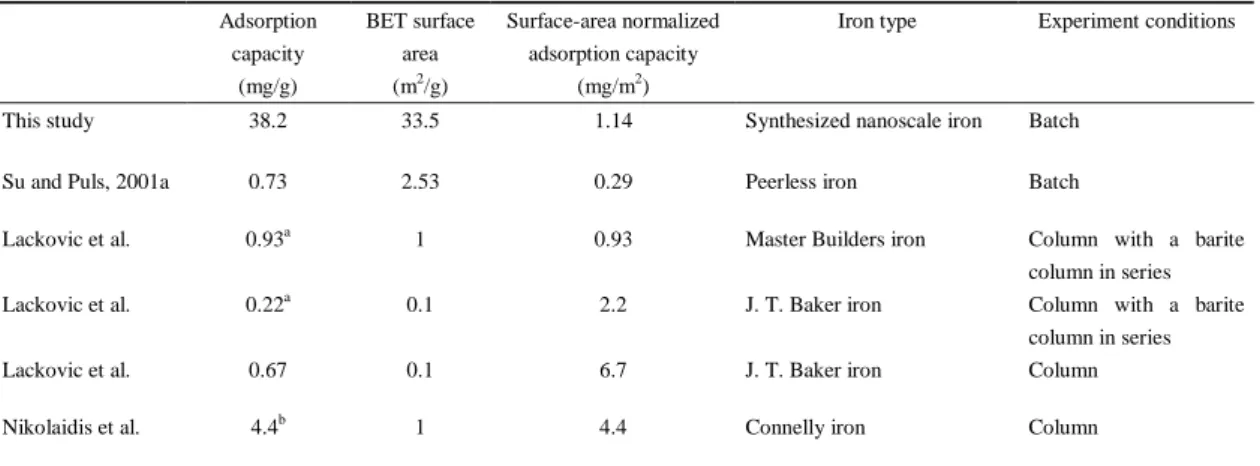
The adsorption capacity can further be expressed as a unit area basis by normalizing to specific surface areas of adsorbents. Accordingly, the arsenic adsorption capacity per unit area of nanoscale iron particles was determined to be 1.14 mg/m2. Compared with other studies as listed in Table 1, it was found that the
0 10 20 30 40 50 0 20 40 60 80 100 120 x /m ( m g /g ) Ce (mg/L)
surface-area normalized adsorption capacity of nanoscale iron particles is higher than that of Peerless iron. The adsorption isotherms on both iron were examined by batch tests (Su and Puls 2001). Because the arsenic removal by iron involved complicated surface interaction, many variables may influence the arsenic adsorption capacity such as iron types, pretreated procedures and the contact time during experiments. The effect of iron filing type that caused different adsorption capacity has been reported (Lackovic et al. 2000). Furthermore, the surface-area normalized adsorption capacity obtained from column tests is generally greater than that estimated from batch tests. This may imply the importance of the contact time between iron and arsenic in obtaining the maximum adsorption capacity. In general, the contact time for arsenic and iron to reach equilibrium is in the range of a few hours to a few days in batch experiments. However, columns tests allow a longer period of time for iron corrosion products to be better generated. The iron corrosion products such as iron oxide are believed to be responsible for the arsenic removal through adsorption and/or precipitation. The iron oxide with porous and incoherent nature on iron leading to increase of the surface area may allow continues adsorption of arsenic. Nikolaos and co-workers (2003) have reported an increase of surface area for reactive media containing iron filings and sand from 1 m2/g at initial conditions to 37.8 m2/g after reactions.
Table 1. Comparison of arsenate removal capacity with different studies
a
The presence of SO42- may decrease the adsorption capacity.
b
Capacity was expressed as mg As per g of media containing both iron and sand.
Adsorption capacity (mg/g) BET surface area (m2/g) Surface-area normalized adsorption capacity (mg/m2)
Iron type Experiment conditions
This study 38.2 33.5 1.14 Synthesized nanoscale iron Batch Su and Puls, 2001a 0.73 2.53 0.29 Peerless iron Batch Lackovic et al. 0.93a
1 0.93 Master Builders iron Column with a barite column in series Lackovic et al. 0.22a
0.1 2.2 J. T. Baker iron Column with a barite column in series Lackovic et al. 0.67 0.1 6.7 J. T. Baker iron Column Nikolaidis et al. 4.4b
Conclusions
The present study on the removal of arsenate suggests that nanoscale iron particles can serve as an effective remedial reagent with high arsenic removal capacity. In particular, the following conclusions can be drawn:
1. Nanoscale iron particles are comprised of spherical particles assembled in chains.
The nanoscale iron particles have an average size diameter in the range of 50-100
nm and a specific surface area in an average of 33.5 m2/g.
2. The XRD analysis revealed that iron corrosion products including lepidocrocite,
magnetite and/or maghemite were formed at the surface of As(V)-treated nanoscale iron particles after reactions with arsenic for 7days. The presence of arsenic on iron surface was also indicated by SEM-EDX analysis.
3. Adsorption of arsenic is dependent on pH and initial arsenic concentrations.
Arsenic adsorption on the surface of nanoscale ion particles decreased with increasing pH. Higher initial arsenic concentration showed a higher amount of arsenic adsorbed.
4. The adsorption of arsenic onto the nanoscale iron particles can be described by
the Langmuir equation. The maximum adsorption capacity was determined to be about 38.2 mg/g. The surface-area normalized adsorption capacity of nanoscale iron particles is higher than that of commercial grade iron conducted in batch tests. However, a higher surface-area normalized adsorption capacity was found for commercial grade iron when experiments were conducted in column tests.
References
Blowes DW, Ptacek CJ, Benner SG, McRae CWT, Bennet TA, Puls RW. 2000.
Treatment of inorganic contaminants using permeable reactive barriers. J. Contaminant Hydrol. 45: 123-137.
Cullen WR, Reimer KJ. 1989. Arsenic speciation in the environment. Chem. Rev.
89: 713-764.
Dixit S, Hering JG. 2003. Comparison of arsenic(V) and arsenic(III) sorption onto
iron oxide minerals: Implications for arsenic mobility. Environ. Sci. Technol. 37: 4182-4189.
Kanel SR, Manning B, Charlet L, Choi H. 2005. Removal of arsenic(III) from
groundwater by nanoscale zero-valent iron. Environ. Sci. Technol. 39: 1290-1298.
zero-valent iron. Environ. Eng. Sci. 17: 29-39.
Lien H-L, Zhang W-X. 2005. Hydrodechlorination of chlorinated ethanes by
nanoscale Pd/Fe bimetallic particles. J. Environ. Eng. 131: 4-10.
Lien H-L, Wilkin RT. 2005. High-level arsenite removal from groundwater by
zero-valent iron. Chemosphere 59: 377-386.
Manning BA, Hunt ML, Amrhein C, Yarmoff JA. 2002. Arsenic(III) and arsenic(V)
reactions with zerovalent iron corrosion products. Environ. Sci. Technol. 36: 5455-5461.
Nikolaidis NP, Dobbs G.M, Lackovic JA. 2003. Arsenic removal by zero-valent iron:
field, laboratory and modeling studies. Wat. Res. 37: 1417-1425.
Nordstrom DK. 2002. Worldwide occurrences of arsenic in ground water. Science
296: 2143-2145.
Nurmi JT, Tratnyek PG, Sarathy V, Baer DR, Amonette JE, Pecher K, Wang C, Linehan JC, Matson DW, Penn RL, Driessen MD. 2005. Characterization and
properties of metallic iron nanoparticles: Spectroscopy, electrochemistry, and kinetics. Environ. Sci. Technol. 39:1221-1230.
Su C, Puls RW. 2001. Arsenate and arsenite removal by zerovalent iron: Kinetics,
redox transformation, and implications for in situ groundwater remediation. Environ. Sci. Technol. 35: 1487-1492.
Su C, Puls RW. 2004. Significance of iron(II,III) hydroxycarbonate green rust in
arsenic remediation using zerovalent iron in laboratory column test. Environ. Sci. Technol. 38: 5224-5231.
Zhang W-X. 2003. Nanoscale iron particles for environmental remediation: an