Materials Science and Engineering B79 (2001) 247 – 250
Letter
Morphology and electrochemical properties of LiMn
2O
4powders
derived from the sol – gel route
Chung-Hsin Lu *, Susanta Kumar Saha
Department of Chemical Engineering, National Taiwan Uni6ersity, Taipei,106Taiwan, ROC
Received 4 September 2000
Abstract
Spinel-lithium manganese oxide (LiMn2O4) powders are prepared by the sol – gel method using polyvinyl alcohol (PVA) in this
study, and evaluated as a positive electrode material for Li-ion batteries. PVA helps to maintain the homogeneity of the system in the precursors and thereby facilitates the formation of monophasic powders. The average primary particle size of the calcined LiMn2O4powders decreases with an increase in the amount of PVA used in solution. Increasing the amount of PVA also results
in a rise in the discharge capacity at 25°C because of the large interface area of small particles. On the other hand, the discharge capacity of the small LiMn2O4particles suffers markedly capacity fading when the batteries are operated at elevated temperatures.
© 2001 Elsevier Science B.V. All rights reserved.
Keywords:Homogeneity; Sol – gel method; Polyvinyl alcohol; Li Mn2O4
www.elsevier.com/locate/mseb
1. Introduction
Nowadays, the demand for rechargeable batteries with high energy density and high voltage has increased rapidly due to the advancement and popularity of portable electronic devices. Lithium manganese oxide (LiMn2O4) is a promising cathode material for lithium
ion batteries because of its low cost and lower toxicity compared with the layered oxides LiCoO2and LiNiO2. For the consideration of practical application, it is important to produce LiMn2O4 powders with excellent
capacity and cyclability. The electrochemical properties of LiMn2O4 powders strongly depend on its synthesis process. The LiMn2O4powders are usually prepared by
the solid-state reaction [1 – 8]. This process requires extensive mechanical mixing, extended grinding, and prolonged heating time. These synthesis conditions in-evitably result in the unexpected grain growth of the spinel particles. To achieve good efficiency of Li
utiliza-tion at high current rates and improve the reliability of lithium secondary batteries, several chemical methods have been introduced to synthesize cathode materials with good homogeneity, uniform morphology and a narrow size distribution. The chemical methods such as co-precipitation [9], emulsion drying [10,11], sol – gel [12] and the Pechini process [13] have been developed to obtain the homogeneous LiMn2O4 powders with small
average particle size.
For simplifying the synthesis process, we have devel-oped a new sol – gel method for preparing the spinel LiMn2O4 powder with high capacity and good cycling
behavior. In this process, appropriate ratios of cations are dissolved in water, and then the aqueous solution is mixed with polyvinyl alcohol (PVA) solution. The solu-tion is evaporated from gel and subsequently dried to become precursor powder. The purpose of the study is to prepare homogeneous and monophasic LiMn2O4
powder. The charge – discharge characteristics of the cathode are also evaluated to examine the effects of particle size on the capacity and stability of LiMn2O4 powders.
* Corresponding author. Fax: + 886-2-3623040.
0921-5107/01/$ - see front matter © 2001 Elsevier Science B.V. All rights reserved. PII: S 0 9 2 1 - 5 1 0 7 ( 0 0 ) 0 0 5 3 0 - 4
C.-H. Lu, S.K. Saha/Materials Science and Engineering B79 (2001) 247 – 250
248
2. Experimental
A solution containing a stoichiometric mixture of reagent grade lithium nitrate and manganese nitrate hexahydrate was firstly prepared. The concentration of the solution was maintained at 1 M with respect to metal ions. An aqueous solution of PVA was prepared by dissolving it in deionized water. The PVA solution was then added into the mixed metal nitrate solution with thorough stirring. The molar ratio of the metal ions to vinyl alcohol monomer units of PVA in the starting solution was maintained at 1:2 (sample A) and 2:1 (sample B), respectively. The resulting viscous solu-tion of metal nitrate and PVA mixture was evaporated with continuous stirring. The evaporated mass was then heated at various temperatures ranging from 400°C to 800°C.
TG/DTA studies of the evaporated powders were performed at a heating rate of 10°C min− 1in air. The
FTIR spectra of the evaporated and heated powders were recorded from 400 to 2000 cm− 1. An X-ray
diffractometer with Ni-filtered CuKaradiation was used for the identification of the crystalline phases of the heat-treated powders. Transmission electron micro-scopic studies of the heat-treated powders were carried out using an electron microscope. The electrochemical behavior of the obtained LiMn2O4 powders was
exam-ined in a test cell. Lithium foil was used as the anode. 1 M LiPF6 in ethylene carbonate/dimethyl carbonate
(volume ratio = 1:1) was used as the electrolyte solu-tion. Cells were charged and discharged at 0.2 mA cm− 2within the potential range of 3.0 and 4.3 V.
3. Results and discussion
Results of TG/DTA analysis indicate the formation of lithium manganese oxide at 400°C, at which temper-ature the precursor has attained a stable weight on TGA curve. This observation is also supported by the FTIR results. Only two characteristic vibrational bands at 495 and 610 cm− l, which correspond to metal
oxy-gen bonds, are observed in the spectra of the powder heat-treated at 400°C or higher temperature. Fig. 1 shows the XRD patterns of LiMn2O4 powders of
sam-ples A and B calcined at 700°C and 800°C in air. It is confirmed by the XRD patterns that only spinel LiMn2O4 crystalline phase is formed in sample A at
both temperatures. All diffraction peaks for these cal-cined powders are assigned to the diffraction indices of LiMn2O4 spinel phase. However, the 700°C calcined powder of sample B exhibits both spinel LiMn2O4 phase and a trace of Mn2O3phase. This impurity phase completely disappears after calcining the sample at 800°C. Precursor powder of sample B is assumed to be less homogeneous which may be the reason for the appearance of Mn2O3 impurity phase at low
tempera-tures. Sufficient amount of PVA is required for the formation of polymer matrix with a whole range of homogeneously trapped metal ions in gel [14,15]. When the amount of PVA is insufficient, the homogeneity of the cation ions in the gel is poor (such as in sample B); therefore, certain regions lack of lithium ions will pro-duce Mn2O3 phase. Furthermore, homogeneous
distri-bution of the metal ions in the precursor powder reduces the diffusion distance among cation ions during heat treatment. This also accelerates the formation of monophasic spinel LiMn2O4
Fig. 2 shows the transmission electron micrographs of 800°C-calcined powders of samples A and B. Cal-cined powders of both systems are loosely bound ag-glomerates of nanosized particles with a spherical morphology. 800°C-calcined powder of sample A is comparatively smaller than that of sample B. The aver-age primary particle sizes of calcined samples A and B are 50 and 120 nm, respectively. The above observa-tions reveal that the powder prepared by this method has much smaller particle size and narrower particle size distribution than that obtained by solid state [8] and other solution method [10]. During the heating of the precursor powder, CO, CO2, and H2O are generated by the decomposition of organic species, which facili-tate the formation of the dispersed and nanosized parti-cles [16,17]. With a decrease in the amount of PVA used in sample B, the amount of generated gases is decreased, thereby resulting in an increase in the parti-cle size.
Fig. 3 shows the charge – discharge curves of 800°C-calcined powders of sample A as the cathode material operated at 25°C and 55°C. All the samples exhibit two Fig. 1. XRD patterns for the (a) 700°C- and (b) 800°C-calcined
powders obtained from precursor solutions having the molar ratio of the metal ions to the monomer units of PVA equal to 1:2 (sample A) and 2:1 (sample B).
C.-H. Lu, S.K. Saha/Materials Science and Engineering B79 (2001) 247 – 250 249
Fig. 2. Transmission electron micrographs of 800°C-calcined LiMn2O4powders from solutions having the molar ratio of the metal
ions to the monomer units of PVA equal to (a) 1:2 (sample A) and (b) 2:1 (sample B).
LiMn2O4 powders. When the particle size is reduced,
the overall surface area is increased. Thus, the cathode composed of small particles with large interface area can provide more lithium ions for diffusion, and there-fore the specific capacity is increased.
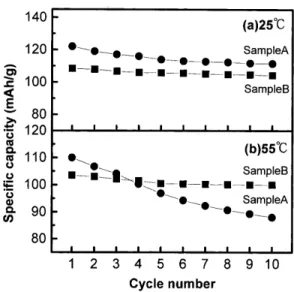
Variation of the specific discharge capacity with the cycle number is elucidated in Fig. 5. As shown in Fig. 5(a), the capacity losses over 10 cycles for the 800°C-calcined LiMn2O4 powders obtained from samples A and B at 25°C are 10% and 4% of the initial discharge capacity, respectively. When the operation temperature is raised to 55°C, the capacity loss for sample B over 10 cycles is around 4%; however, the capacity loss for sample A is markedly increased to 20%. Apparently, sample A suffers serious capacity fading at elevated
Fig. 3. Cycling charge/discharge curves over the potential range of 3.0 to 4.3 V at a current density of 0.2 mA cm− 2 using LiMn
2O4.
800°C-calcined powders of sample A, operated at (a) 25°C and (b) 55°C.
Fig. 4. Cycling charge/discharge curves over the potential range of 3.0 to 4.3 V at a current density of 0.2 mA cm− 2 using LiMn
2O4.
800°C-calcined powders of sample B, operated at (a) 25°C and (b) 55°C.
plateaus in the discharge curves. This is due to two-step reduction and oxidation process, which is a characteris-tic of lithium manganese oxide spinel [18,19]. The charge – discharge profile (Fig. 3(a)) shows that the elec-trochemical behavior of the powder exhibits an initial discharge capacity of 124 mA h g− 1 at 25°C. An
elevated temperature operation at 55°C reduces the initial discharge capacity to 111 mA h g− 1. The
charge – discharge electrochemical behavior of 800°C-calcined powders of sample B is illustrated in Fig. 4. The initial discharge capacity is relatively lower with respect to sample A at both operation temperatures of 25°C and 55°C. The initial discharge capacity of sample B at 25°C is 109 mA h g− 1, and is reduced to 104 mA
h g− 1 at 55°C. The variation of initial charge –
dis-charge capacity for different samples is considered to result from the difference in the particle size of
C.-H. Lu, S.K. Saha/Materials Science and Engineering B79 (2001) 247 – 250
250
Fig. 5. Variation of the specific discharge capacity with the cycle number for 800°C-calcined powders of samples A and B at (a) 25°C and (b) 55°C.
The average particle size of LiMn2O4 powder decreases
with an increase in the PVA amount used in the precursor solution. The obtained powders exhibit good electrochemical properties as cathode materials for the application to Li-ion batteries. LiMn2O4 particles with small particle size have large initial discharge capacity at room temperature, but fast fading rate of capacity at elevated temperature of operation. Controlling the par-ticle size of LiMn2O4 during synthesis processes is
important for raising the discharge capacity and im-proving the cyclability at elevated temperatures.
References
[1] G. Pistoia, A. Antonini, R. Rosati, D. Zane, Electrochem. Acta 41 (1996) 1683.
[2] K. Miura, A. Yamada, M. Tanaka, Electrochem. Acta 41 (1996) 249.
[3] J.M. Tarascon, D. Guyomard, Electrochem. Acta 38 (1993) 1221.
[4] J.N. Reimers, J.R. Dahn, J. Electrochem. Soc. 139 (1992) 2091. [5] C.D.W. Jones, E. Rossen, J.R. Dahn, Solid St. Ionics 68 (1994)
65.
[6] J. Barker, R. Kockbang, M.Y. Saidi, Solid St. Ionics 89 (1996) 25.
[7] J.M. Tarascon, E. Wang, F.K. Shokoohi, W.R. McKinnon, S. Colson, J. Electrochem. Soc. 137 (1991) 2859.
[8] Z. Jiang, K.M. Abraham, J. Electrochem. Soc. 143 (1996) 1591. [9] X. Qiu, X. Sun, W. Shen, N. Chen, Solid St. Ionics 93 (1997)
335.
[10] K.T. Hwang, W.S. Um, H.S. Lee, J.K. Song, K.W. Chung, J. Pow. Sources 74 (1998) 169.
[11] S.T. Myung, H.T. Chung, J. Pow. Sources 84 (1999) 32. [12] Y.H. Ikuhara, Y Iwamoto, K. Kikuta, S. Hirano, J. Mater. Res.
14 (1999) 3102.
[13] W. Liu, K. Kowal, G.C. Farrington, J. Electrochem. Soc. 143 (1996) 3590.
[14] S.K. Saha, A. Pathak, P. Pramanik, J. Mater. Sci. Lett. 14 (1995) 35.
[15] M.A. Gulgun, M.H. Nguyen, W.M. Kriven, J. Am. Ceram. Soc. 82 (1999) 556.
[16] S.K. Saha, P. Pramanik, Brit. Ceram. Trans. 94 (1995) 123. [17] S.K. Saha, P. Pramanik, Nanostru. Mater. 8 (1997) 29. [18] M.M. Thackeray, W.I.F. David, P.G. Bruce, J.B. Goodenough,
Mater. Res. Bull. 18 (1993) 461.
[19] Y.M. Choi, S.I. Pyun, Solid St. Ionics 99 (1997) 173. temperatures. The faster capacity fading for sample A
is possibly related to smaller particle size of LiMn2O4
powders. Small particles provide more surface area for lithium ions to diffuse in and out of the host structure; however, the large surface area also enhances the reac-tivity between LiMn2O4 particles and electrolyte, which
reduces the structure stability of the spinel phase during charge – discharge cycling. Consequently, optimization of the particle size of LiMn2O4 powders by different
synthesis processes is crucial for increasing the dis-charge capacity and tailoring the cyclability at elevated temperatures.
4. Conclusions
Spinel LiMn2O4 powders have been synthesized by a
sol – gel method using an aqueous solution of metal nitrates containing PVA as a gelling agent. The LiMn2O4 powders obtained by this process have an
uniform morphology with a narrow size distribution.