國 立 交 通 大 學
管理學院科技管理學程
碩 士 論 文
技術創新及分散式資本主義之熱力學解析
A Thermodynamic Perspective on Innovation and
Distributed Capitalism - A Conceptual Paper
研究生:沈博仁
指導教授:徐作聖 博士
技術創新及分散式資本主義之熱力學解析
A Thermodynamic Perspective on Innovation and Distributed Capitalism -
A Conceptual Paper
研 究 生:沈博仁 Student:Po Jen Shen
指導教授:徐作聖 Advisor:Dr. Joseph Z. Shyu
國 立 交 通 大 學
管 理 學 院 科 技 管 理 學 程
碩 士 論 文
A Thesis
Submitted to Institute of Management of Technology College of Management
National Chiao Tung University in partial Fulfillment of the Requirements
for the Degree Program of Master of Business Administration
in
Management of Technology June 2014
Hsinchu, Taiwan, Republic of China
i
技術創新及分散式資本主義之熱力學解析
學生:沈博仁 指導教授:徐作聖 博士
國立交通大學管理學院科技管理學程
摘要
隨著經濟知識日益分岐、分散以及創新導向。尤其是在這資訊氾濫的知識經濟時 代,一種以菁英為基礎及橫向協作為主的分散式市場機制,逐漸取代了中央化、 集中化的市場機制。 本研究提供了以熱力學觀點下用以解析市場機制所需之必要背景知識以及工具。 由熱力學所衍生出的信息理論被使用來作為分析工具,此工具證明在分析特定序 列,尤其是時間序列下之變數及信息時是可行的。這些工具及指標可用以評量一 個數列的混亂程度,以及兩個以上數列之間的相關程度。 本研究進一步探討的探討在熱力學觀點下之技術創新及分散式資本主義,特別是 在龐大市場下多樣性產品及供應之策略服務創新。其中使用兩種不同的統計熱力 學情境,即費米和玻色兩個不同的模型。 結果顯示,玻色模型可模擬並代表一個傳統不可區分的市場,也就是較趨近一個 靜態、機會均等的中央化、集中化的市場機制。而費米模型則代表一個逐步發展 之可區分的市場,較接近一個機率非均等的分散式市場,充滿著機會且有著最高 的效率。 關鍵字: 統計熱力學、信息理論、分散式資本、「熵」ii
A Thermodynamic Perspective on Entrepreneurship and Distributed
Capitalism - A Conceptual Paper
Student: Po Jen Shen Advisor: Dr. Joseph Z. Shyu Institute of Management of Technology National Chiao Tung University
ABSTRACT
Because economic knowledge is increasingly more dispersed, centrifugal, distributed and innovation-driven, an elite-based and lateral collaboration-centric model of distributed market mechanism forecloses the conventional aggregated and centralized market mechanism, particularly, in an era of knowledge economy with information overflows.
This research provides essential background knowledge and tools to analysis markets behavior in thermodynamic perspective. The derived information theory is used as a tool that is proved useful to analyze variables/information in specified series, namely, time series. These tools/metrics can be used to judge randomness of a series
information and dependency of two (or more) series information.
The research also explores a thermodynamic perspective on innovation and
distributed capitalism, in particular, strategic service innovation with sizable market diversity and supplies. Two different scenarios are employed, namely, Boson, and Fermion models of statistical thermodynamics.
The results exhibit that Boson models represent conventional indistinguishable markets that are close to centralized/aggregated markets in generic static and equally partitioned with chances. In the meanwhile, the Fermion models represented
progressive distinguishable markets that are close to distributed markets in non-equiprobable states for maximum effectiveness with full of chances.
iii
致謝
首先,誠摯的感謝指導教授徐作聖博士,兩年前一個偶然的機會,我得以進入交 通大學管理學院科技管理學程。在這段時間裡,感謝老師悉心的教導,使我能夠 獲得大量的知識及正確的研究態度。 “做學問不能有任何禁忌” 的一席話,讓我 體認對學習新知識永遠不怕挑戰的態度。會永遠記得在每次您安排的聚會中快樂 的大口吃肉、喝酒及暢意聊天的那段日子,在此再次表達對您的感謝。 感謝實驗室的學長及同學。貓學長,謝謝您這段時間內協助解決所遇到的困難 及經驗的傳承。Kris 學長、阿豬學長,謝謝您們所傳授的許多知識以及人生經驗。 謝謝同學小史、文姝以及布朗學長,兩年之間在各個科目間無私的合作,讓我們 順利地通過各個科目的考驗;也謝謝碩班同學們,小柯、Pinky、昌儒及廷諺的 各項協助。當然,最為恭喜的莫過於大家都能順利完成論文及學業,有幸認識各 位以及兩年來一起做研究的經歷,將是我一生中至為珍惜的瑰寶。 最後感謝我的家人們;父親、母親、老哥還有那一對讓我永遠感到幸福及驕傲的 兒女;當然,最重要的是感謝我最親愛的老婆。謝謝你們這一段時間以來的包容 及體諒。尤其是面對那個長久以來過分自負的我,在失業及學業雙重壓力下莫名 的壞脾氣。還有,如此相處融洽的所有家族成員們,即便我曾經絕望的覺得,在 經歷過至親過世的傷痛後,這份羈絆將蕩然無存,在大家的努力下,這個龐大的 家族仍得以愉悅及融洽的延續這沉重的羈絆。能與你們成為家人是我此生最幸運 的事情,謝謝你們一直的陪伴與支持。 謝謝所有這兩年來支持我走過人生最低潮的所有人,讓我能無後顧之憂地完成學 業。在此再次致上無限的謝意!iv
Table of contents
摘要... i ABSTRACT ... ii 致謝...iii Table of contents ... iv List of tables ... viList of figures ... vii
1. Introduction ... 1 1.1 Background ... 1 1.2 Research motivation... 2 1.3 Research objectives ... 3 1.4 Research contribution ... 4 2. Literature review ... 4 2.1 History of econophysics ... 5
2.2 Market behavior and thermodynamics... 6
2.3 Distributed capitalism ... 8
3. Methodology ... 9
3.1 Entropy and thermodynamics ... 9
3.1.1 Thermodynamic systems ... 9
3.1.2 Entropy ... 12
3.1.3 The fundamental laws of thermodynamics ... 14
3.2 Statistical thermodynamics ... 16
3.2.1 Description in microscopic - molecular model ... 16
3.2.2 Basic definition of statistical mechanics ... 17
3.2.3 Entropy in statistic thermodynamics ... 19
3.2.4 Dilute systems ... 20
3.2.5 Conditions for applicability ... 21
3.3 Information theory - information entropy ... 23
4. Results ... 28
4.1 Network economy and distributed capitalism... 28
4.2 Market channel and radio communication technologies ... 32
4.3 A thermodynamic perspective on distributed capitalism ... 35
4.3.1 Distributed model and thermodynamic principles of information platform ... 36
v
4.3.2 Distribution of molecules in statistical thermodynamics ... 38
4.3.3 Statistics - Fermi-Dirac statistics ... 41
4.3.4 Statistics - Bose-Einstein statistics ... 42
4.3.5 Properties of dilute systems ... 44
4.3.6 Market implications from thermodynamic analysis ... 45
5. Conclusions ... 48
vi
List of tables
Table 1 Interactions of thermodynamic systems ... 10
Table 2 Calculated Entropy, Mutual Information and distance ... 28
Table 3 Economics of Integration ... 29
Table 4 Aggregated vs. Distributed Capitalism ... 31
vii
List of figures
Figure 1 A generic thermodynamic system ... 9
Figure 2 An illustration about Irreversible Transformation ... 12
Figure 3 Carnot engine diagram ... 15
Figure 4 Degenerate states in a quantum system ... 18
Figure 5 The effect of increased mass on energy level spacings ... 21
Figure 6 The effect of lowering the temperature on the distribution of particles among energy levels... 22
Figure 7 The effect of increased pressure on energy level spacing ... 23
Figure 8 Quantify a waveform into information ... 23
Figure 9 Venn Diagram ... 26
Figure 10 Discrete information - Change in GDP per capita and 0.03-2*Change in unemployment rate by Age, 2000-2013, Taiwan ... 27
Figure 11 Centralized vs. Distributed Marketing ... 30
Figure 12 FDMA, TDMA and CDMA Technology ... 33
Figure 13 Access methods in FDMA, TDMA and CDMA ... 34
Figure 14 Centralized vs. Distributed Marketing in point of view from communication technologies ... 35
Figure 15 Innovation and specialized platform ... 38
Figure 16 Particles in different type ... 39
Figure 17 Property for bosons and fermions over wave functions ... 40
Figure 18 Fermions distribution... 41
Figure 19 Entropy S - Fermions distribution ... 42
Figure 20 Bosons distribution ... 43
Figure 21 Entropy S - Bosons distribution ... 43
Figure 22 Scenario: Fermions, gd = 500 ... 44
Figure 23 Scenario: Bosons, gi= 250 ... 45
1
1. Introduction
1.1 Background
Powered by Sir Isaac Newton’s mathematical method and vision of universe developed in 17th century, the new physics described a universe governed by stated rules which can made exquisitely accurate predictions and descriptions. These predictions and descriptions eliminated surprises and unexpects. Furthermore, these provided ways to explain the operation of the world.
In the late 18th century, the dawn of the market era and the onset of the First Industrial Revolution, the founding fathers of economics – Adam Smith, Jean-Baptiste Say and the like – looked into the new field of physic to fashion these new theories of the workings of the marketplace. Exalted Newton's systematizing of the physics of the universe as "the greatest discovery that ever was made by man," Adam Smith enthusiastically borrowed metaphors from Principia and Newton's other works to fashion classical economic theory. Smith and followers sought to find similarly
predictability in economics. The incentive-based “Invisible Hand” of classical
economics plays the roles of gravity in classical physics, which insisted that the economic systems should adjust the supply and demand to one another spontaneously and precipitously, therefore to reach an equilibrium state eventually.
Paradoxically, the economic history is actually full of surprises and unexpects.
Especially, as economic knowledge is getting increasingly more dispersed, centrifugal, distributed and innovation-driven, an elite-based and lateral collaboration-centric model of distributed market mechanism forecloses the conventional aggregated and centralized market mechanism, particularly, in an era of knowledge economy with information overflows.
2
1.2 Research motivation
Ignoring in all luminous achievement of classical economics, there were an
unbridgeable gap to explain market behaviors by such Newtonian physics approach as reasons elaborated below:
1. When describing such science of market behavior, it is not avoidable to discuss about human behavior. In such case, the surprises that arise from free will and human creativity are not neglectable.
The miracles forbidden in Newtonian physics are not only routine in economics; they constitute the most important and bountiful addition of information to the system. In an economy, however, everything useful or interesting depends on agents of change called entrepreneurs. Such deficiency makes it a challenging problem when explaining intermittently continued innovations and revolutions, such as the Second Industrial Revolution based on Fossil Fuels and ICT
technologies and forming the Third Industrial Revolution which based on distributed capitalism.
2. The classical Newtonian mechanics, equations encompass and describe change
(speed and location) - the initial state and final state. It's not necessary to describe the agent of this change, such as passage of time and the irreversibility of events. In Newton's cosmology, all mechanical processes are in theory reversible and the laws of matter in motion make no allowance for the passage of time.
But real economic activities are all about the irreversibility of events, for
example, how energy and material resources are harnessed, transformed, utilized used up and discarded. And, most of cases, passage of time need to be taken into consideration.
3
3. Classical Newtonian mechanics is based on equations that related to the behavior of a large system of object to its properties and to the forces exerted on it. Many attempts have been made to apply the accurate models for describing the human behavior, due to complexity of human interactions; can typically be modeled only at the level of a single person.
The mutual relationship between local individual behavior and global social structure, therefore, makes the human behavior representation as a complex topic. Just like much 19th-century physics has been re-evaluated as the "classical limit" when trying to deal with incompatibilities of particles in quantum level (in the field of quantum chaos), the more general quantum mechanics in
statistical mechanics was developed in 20th century which superseded classical mechanics and which contains it as a special case. However, based on the concept of universality in statistical physics, an assumption is that this universality applies in the study of complex human systems.
In the new information era, modern capitalism is an information system governed by the irregular bits and surprises, by the name of entrepreneurship. Disorder,
disequilibrium, chaos and noise of market inhibit the creative acts that engender growth - probabilities with skill, and randomness with structure are key. An
entrepreneur needs a channel that in most critical respects does not drastically change amid transmission. That is, models developed that based on classical Newtonian mechanics are deficient to explain such market behavior. A different approach is necessary for further research.
1.3 Research objectives
The objective of this study is trying to provide a thermodynamic with statistical mechanics (statistical thermodynamic) perspective on distributed capitalism. It is
4
remarkable that modern statistical physics theories may be used for the study of collective behavior of components, e.g., human molecules or kinetic molecules. The study widely integrates with cross-disciplinary Work on Knowledge Service, such as Economics, Technology Management, Statistical Thermodynamics, Information Theory and Marketing Strategy, to explain the constituent elements of technology
management. That is, to explain how the nature of technology may change the ways
that the commercialization process is managed, a step further, to portray entrepreneurship, distributed capitalism, and industrial innovation from a thermodynamic perspective.
1.4 Research contribution
The ultimate goal of this research is to develop a convergent system of
entrepreneurial innovation for continual growth. With the advent of digital technology and information infrastructure, individualized supplies with coded registry and
privileged channels of marketing, the existance of the system ensures the adherence to the thermodynamic laws and concepts of entropy to provide and develop
corresponding strategies for entrepreneurship facing modern distributed markets. With the information technology and a thermodynamic perspective, the high-entropy supply-side of entrepreneurship and innovation can be tapped into a converged market channel by a low-entropy carrier of stable PEST environment. With the well
management and control by the system, it is expectable that more innovations of technologies or marketing channels can be created from rhetoric into reality.
2. Literature review
5
applications of physics to different fields, econophysics is an interdisciplinary research fields that applies physics methods for solving problems in economics and market behavior. In this research, we used thermodynamics to study properties of complex market behavior of distributed capitalism.
2.1 History of econophysics
In 1870, French-Italian civil engineer Vilfredo Pareto did a dissertation on ‘The Fundamental Principles of Equilibrium in Bodies’, and two decades later, came be believe that people in socioeconomic systems are types of ‘vibrating’ molecules governed by rational mechanics, the study of forces of equilibrium and movement - general equilibrium theory in economics is based on the physical concept
of mechanical equilibrium.
In 1929, Italian engineer and theoretical physicist Ettore Majorana completed his MS in physics under Italian theoretical physicist Enrico Fermi. He wrote his ‘The Value of Statistical Laws in Physics and Social Sciences’, wherein he derives a radioactivity and quantum mechanics based theory of sociology. Majorana based on nuclear decay mechanisms, gleaned the tentative view that social theory is not the result of
deterministic causal mechanism, but rather of indeterminism, a role of the dice so to speak, in the same way that the energy emission of radioactivity is unpredictable. That is, Majorana clearly elaborated the unpredictability of Social Science and treat
statistical mechanism as solution.
The term “econophysics” was coined by the theoretical physicist Eugene Stanley, at the conference Dynamics of Complex Systems held in Calcutta in 1996, to describe the large number of papers written by physicists in the problems of markets.
Econophysics was started in the mid-1990s by several physicists working in the subfield of statistical mechanics. Unsatisfied with the traditional explanations and
6
approaches of economists - which usually prioritized simplified approaches for the sake of soluble theoretical models over agreement with empirical data - they applied tools and methods from physics, first to try to match financial data sets, and then to explain more general economic phenomena. Libb Thim (2013) gave an introduction and history of evolution about field of econophysics based ‘econoengineering’ with focus on the nature of economic behavior.
In econophysics, the random use of powerful equations by physicists to construct and attempt solutions on economic problems has recently been dubbed 'toolism'. Most of studies use these powerful equations just to solve specific problems rather to find a theory indispensable to the whole structure that it has to be put in its place.
2.2 Market behavior and thermodynamics
The origin of thermodynamics is in the 19th century when practitioners, engineers and scientists like James Watt (1736–1819), Sadi Carnot (1796–1832), James Prescott Joule (1818–1889), Rudolph Clausius (1822– 1888) and William Thomson (the later Lord Kelvin, 1824–1907) wanted to understand and increase the efficiency at which steam engines perform useful mechanical work. From the very beginning, this endeavor has combined the study of natural systems and the study of engineered systems – created and managed by purposeful human action – in a very peculiar way, which is rather unusual for a traditional natural science such as physics.
Not surprisingly then, the laws of thermodynamics were found by economists to be concepts with considerable implications for economics.For instance, economists like Kenneth Boulding (1966), Robert Ayres and Allen Kneese (1969), and Nicolas Georgescu-Roegen (1971) turned to thermodynamics when they wanted to analyze economy-environment inter-actions in an encompassing way, and analytically root the economy in its biogeophysical basis.
7
In a first step, the Materials Balance Principle was formulated based on the
thermodynamic Law of Conservation of Mass (Boulding, 1966; Ayres and Kneese, 1969; Kneese et al., 1972). In view of this principle, all resource inputs that enter a production process eventually become waste. By now, this is an accepted and undisputed piece of resource, environmental and ecological economics.
At the same time, Georgescu-Roegen (1971) developed an elaborate and extensive critique of economics based on the laws of thermodynamics, and in particular the Entropy Law, which he considered to be ‘the most economic of all physical laws’ (Georgescu-Roegen, 1971, p. 280). His contribution initiated a heated debate on the question whether the Entropy Law – and thermodynamics in general – is relevant to economics (Burness et al., 1980; Daly, 1992; Kåberger and Månsson, 2001; Khalil, 1990; Lozada, 1991; 1995; Norgaard, 1986; Townsend, 1992; Williamson, 1993;
Young, 1991; 1994).While Georgescu-Roegen had, among many other points,
formulated an essentially correct insight into the irreversible nature of transformations of energy and matter in economies, his analysis is to some extent flawed by wrongly positing what he calls a ‘Fourth Law of Thermodynamics’ (Ayres, 1999). It may be for this reason that the Second Law and the entropy concept have not yet acquired the same undisputed and foundational status for resource, environmental and ecological economics as have the First Law and the Materials Balance Principle.
But as Georgescu-Roegen’s work and the many studies under his leadship have shown, the Entropy Law, properly applied, yields insights into the irreversible nature of economy-environment interactions that would be not available otherwise
(Baumgärtner et al., 1996). Both the First and the Second Laws of Thermodynamics therefore need to be combined in the study of how natural resources are extracted, used in production, and give rise to emissions and waste, thus leading to integrated models of ecological-economic systems (e.g. Baumgärtner, 2000a, 2003, 2004, 2005;
8
Faber et al., 1995; Perrings, 1987; Ruth, 1993, 1999; Annila and Salthe, 2009).
2.3 Distributed capitalism
Zuboff and Maxmin (2002), in their book "The Support Economy", elaborated that firms no longer "create" value; they can only strive to realize the value that already exists in individual space. In this way, distributed capitalism further expands the concept of ownership. In contrast to managerial capitalism, distributed capitalism means that ownership and control are dispersed, shared by individual end consumers. And, in Zuboff's article (2010) , "Creating value in the age of distributed capitalism" , she further explained the distributed capitalism which encompasses the myriad ways in which production and consumption increasingly depend on distributed assets, distributed information, and distributed social and management systems.
The convergence of Communications and Energy Regimes created industrial revolutions. In the book "The Empathic Civilization", Jeremy Rifkin (2010)
considered the latest phase of communication and energy regimes - that of electronic telecommunications and fossil fuel extraction - as bringing people together on the nation-state level based on democratic capitalism, but at the same time creating global problems, like climate change, pandemics, and nuclear proliferationin. Rifkin predicted that the new global economy will be based upon renewable energy, which is called as distributed capitalism because these energy sources are dispersed rather than centralized. They are best controlled by individuals or small communities. This will entail a very different power structure from fossil fuel, financial capitalism and the new structure is networked and decentralized.
Further described in Rifkin's book (2011) “The Third Industrial Revolution”, a more
distributed and collaborative industrial revolution is forming, and leading to a more
9
innovations are competing with markets and challenging proprietary business operations.
3. Methodology
With thermodynamic theories, we can argue that market behaviors always involve matter, energy, entropy and information. Moreover, the aim of many market activities is to achieve a certain structure. In this manner, we can apply the theories in
non-equilibrium thermodynamics, in which structure formations call dissipative structures form, and information theory, in which information entropy is a central construct, to the modeling of economic activities in which the natural flows of energy and material function to create scarce resources. And, a market activity may be described as a dissipative/distributed system, which flourishes by consuming free energy in transformations and exchange of resources, goods and services.
3.1 Entropy and thermodynamics
3.1.1 Thermodynamic systems
The basic concept in thermodynamics is the thermodynamic system. Refer to Figure 1, a precisely defined region between
the inside and the outside of the system under study. Everything in the universe except the system is known as
its surroundings. The system is separated from the remainder of the universe by a boundary. Transfers and exchanges of energy
Figure 1 A generic thermodynamic system
Source: Thermodynamic. In Wikipedia. Retrieved June 10, 2014, from http://en.wikipedia.org/wiki/Thermodynamics
10
(work, heat) or matter between the system and its surroundings take place across this boundary. Thermodynamics distinguishes classes of systems by their boundary sectors described as:
• Isolated systems: Systems are completely isolated from their environment. They do not exchange energy or matter with their environment. In practice, a system can never be absolutely isolated from its environment, because there is always at least some slight coupling, such as gravitational attraction. • Closed systems: Systems are able to exchange energy (heat and work) but
not matter with their environment. A greenhouse is an example of a closed system exchanging heat but not work with its environment. Whether a system exchanges heat, work or both is usually thought of as a property of its
boundary.
• Open systems: Systems has a part of its boundary that allows transfer of energy as well as matter between it and its surroundings. A boundary part that allows matter transfer is called permeable. An engine is an example of an open system. In this case, fuel is provided to engine and it produces power that is given out, thus there is exchange of mass as well as energy. The engine also emits heat which is exchanged with the surroundings exchange both energy and matter with their surrounding environment.
Table 1 Interactions of thermodynamic systems
Type of system Mass flow Work Heat
Open systems Closed systems Isolated systems
Source: Thermodynamic. In Wikipedia. Retrieved June 10, 2014, from http://en.wikipedia.org/wiki/Thermodynamics
11
A system is said to be in thermodynamic equilibrium when there is complete
absence of driving forces for change in the system. Technically, the various
potentials of the system are at their minimum, such that there are no spatial variations of any of the intensive variables within the system.
• Intensive variables are quantities which do not change when two separate but identical systems are coupled.
• Extensive variables, in contrast, are quantities whose value for the total system is simply the sum of the values of this quantity in both systems. For example, temperature, pressure and chemical concentration are intensive
variables while mass and volume are extensive ones. As long as there are spatial
variations in, say, temperature within a system, it is not yet in thermodynamic equilibrium, but there exists a potential for change. The equilibrium state is characterized by a uniform temperature throughout the system.
Consider an isolated system that undergoes a transformation over time between some initial equilibrium state and some final equilibrium state, either by interaction with its environment or by interaction between different constituents within the system. If the final state is such that no imposition or relaxation of constraints upon the isolated system can restore the initial state, then this process is called irreversible. Otherwise the process is called reversible.
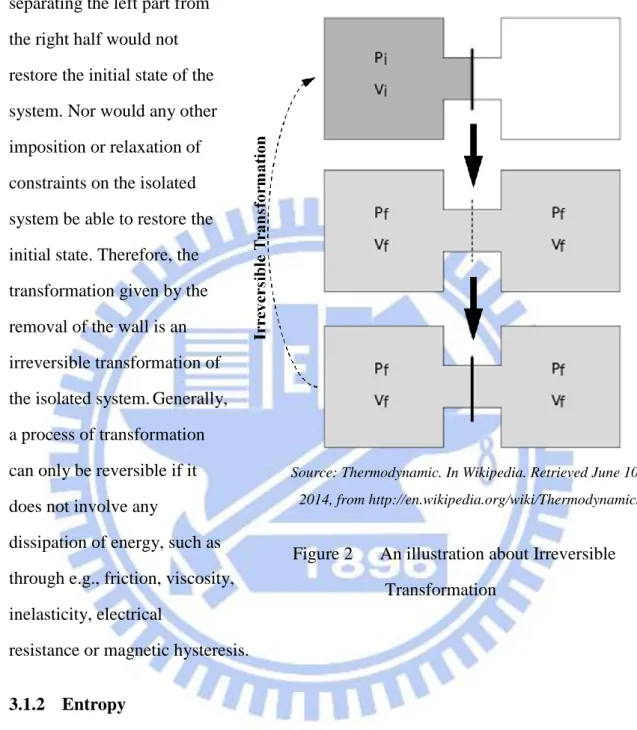
Take Figure 2 as an example, at some initial time a gas is enclosed in the left part of an isolated box; the right part is separated from the left part by a wall and is empty. Now, the separating wall is removed. The molecules of the gas will then evenly distribute themselves over the entire volume of the box. The thermodynamic equilibrium of the final state is characterized by a uniform density of molecules throughout the entire volume. Reintroducing the wall into the isolated system
12
separating the left part from the right half would not restore the initial state of the system. Nor would any other imposition or relaxation of constraints on the isolated system be able to restore the initial state. Therefore, the transformation given by the removal of the wall is an irreversible transformation of the isolated system.Generally, a process of transformation can only be reversible if it does not involve any
dissipation of energy, such as through e.g., friction, viscosity, inelasticity, electrical
resistance or magnetic hysteresis.
3.1.2 Entropy
The analysis which led to the concept of entropy began with the work of French mathematician Lazare Carnot who in his 1803 paper Fundamental Principles of Equilibrium and Movement proposed that in any machine the accelerations and shocks of the moving parts represent losses of moment of activity. In other words, in any natural process there exists an inherent tendency towards the dissipation of useful energy.
Figure 2 An illustration about Irreversible Transformation
Source: Thermodynamic. In Wikipedia. Retrieved June 10, 2014, from http://en.wikipedia.org/wiki/Thermodynamics
13
In the 1850s and 1860s, German physicist Rudolf Clausius objected to the supposition that no change occurs in the working body, and gave this "change" a mathematical interpretation by questioning the nature of the inherent loss of usable heat when work is done, e.g. heat produced by friction. Clausius described entropy as
the transformation-content, i.e. dissipative energy use, of a thermodynamic system or working body of chemical species during a change of state. This was in
contrast to earlier views, based on the theories of Isaac Newton, that heat was an indestructible particle that had mass.
Such process transforming energy or matter, a certain amount of energy is irreversibly transformed into heat. To describe this irreversibly trans-formation of energy: if a certain amount of heat dQ is reversibly transferred to or from a system at temperature
T, then ∆S defines the change in entropy S. Then, the change in entropy was defined
for a thermodynamically reversible process as
T dQ S rev [1]That is, in thermodynamics, entropy (usual symbol S) is a measure of the number of specific ways in which a thermodynamic system may be arranged, often taken to be a measure of progressing towards thermodynamic equilibrium. Entropy can also be interpreted as an indicator for the system's capacity to perform useful work or, energy that is no longer usable. The higher the value of entropy, the higher the amount of energy already irreversibly transformed into heat, the lower the amount of free energy of the system and the lower the system's capacity to perform work. Expressed the other way round, the lower the value of entropy, the higher the amount of free energy in the system and the higher the system’s capacity is for performing work.
Further interpretation about useful work and energy to perform, entropy can be applied in concept to express a measure of the lack of qualities including order,
14
interconnection, arrangement, useful information and nonrandomness. In
contrast, the term "negentropy" is used as a measure of order.
The entropy of an isolated system never decreases, because isolated systems
spontaneously evolve towards thermodynamic equilibrium, the maximum entropy. Systems which are not isolated may decrease in entropy. Since entropy is a state function, the change in the entropy of a system is the same whether a process going from one defined state to another is reversible or irreversible, but irreversible processes increase the entropy of the environment.
3.1.3 The fundamental laws of thermodynamics
The First law of thermodynamics: The increase in internal energy of a closed
system is equal to the difference of the heat supplied to the system and the work done by it: ΔU = Q - W.
In simple words, in an isolated system (which may or may not be in equilibrium) the total internal energy is conserved. That is, in any real process, the energy of the universe is constant.
This means that energy can be neither created nor destroyed. However, it can appear in different forms, such as heat, chemical energy, electrical energy, potential energy, kinetic energy, work, etc. For example, when burning a piece of wood or coal the chemical energy stored in the fuel is converted into heat. In an isolated system the total internal energy, i.e. the sum of energies in their particular forms, does not change over time. In any process of trans-formation only the forms in which energy appears change, while its total amount is conserved.
The second law of thermodynamics: heat cannot spontaneously flow from a colder
15
unidirectional character of transformations of energy and matter. With any
transformation between an initial equilibrium state and a final equilibrium state of an isolated system, the entropy of this system increases over time or remains
constant. It strictly increases in irreversible transformations, and it remains constant
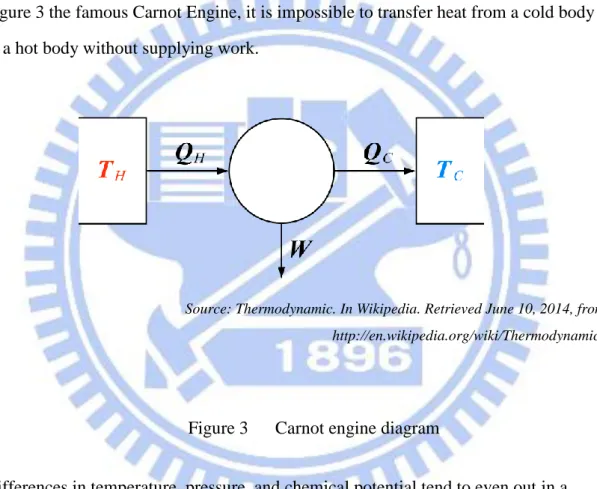
in reversible transformations, but it cannot decrease. Which implies, it is impossible to convert heat into work without wasting some at a lower temperature, as shown in Figure 3 the famous Carnot Engine, it is impossible to transfer heat from a cold body to a hot body without supplying work.
Source: Thermodynamic. In Wikipedia. Retrieved June 10, 2014, from http://en.wikipedia.org/wiki/Thermodynamics
Differences in temperature, pressure, and chemical potential tend to even out in a physical system that is isolated from the outside world. Entropy of an isolated system that is not in equilibrium tends to increase over time, eventually approaching to a maximum at equilibrium, that is, minimum value of useful energy.
Advencely speaking, for an isolated system, any organized structure is not stable. It need to disorganize the surrounding to maintain its organization, in the end, death is a natural process to disorganize itself.
16
3.2 Statistical thermodynamics
In physics, there are two types of mechanics usually examined: classical
mechanics and quantum mechanics. Whereas ordinary mechanics only considers the
behavior of a single state, in quantum statistical mechanics introduces the statistical ensemble, which is a large collection of virtual, independent copies of the system
in various states.
As a branch of mathematical physics, statistical mechanics is using probability theory, the average behavior of a mechanical system where the state of the system is
uncertain. A common use of statistical mechanics is in explaining
the thermodynamic behavior of large systems.
Classical thermodynamics is difficult to explain concepts in microscopic level, however statistical mechanics shows how these concepts arise from the natural uncertainty that arises about the state of a system when that system is prepared in practice. The benefit of using statistical mechanics is that it provides exact methods to connect thermodynamic quantities to microscopic behavior. Statistical mechanics also makes it possible to extend the laws of thermodynamics to cases which are not
considered in classical thermodynamics, for example microscopic systems and other mechanical systems with few degrees of freedom. With statistical mechanics, which treats and extends classical thermodynamics is known as statistical thermodynamics. Applied these laws to chemical problems, it bridged the gap between the
microscopic realm of atoms and molecules and the macroscopic realm of classical thermodynamics. Statistical thermodynamics demonstrates how the thermodynamic
parameters of a system, such as temperature and pressure, are related to microscopic
behaviors of such constituent atoms and molecules.
17
About microscopic model, there is a basic definition: we cannot distinguish (or observe) behaviors of molecular without perturbing their energies; and once we have done this they are no longer degenerate and the problem is changed. Such property about indistinguishability is a “microscopically separate state” or microstate. All of these individual microstates produce the same "macroscopically observable state" or
macrostate.
One of the first successful attempts to use a microscopic model to explain
macroscopic behavior was the kinetic molecular theory of gases, associated with such
names as Maxwell and Boltzmann. This model was based on as simple a molecular picture as could be imagined.
• Molecules are points (or at most, hard spheres)
• The only energy that molecules possess is kinetic energy of motion; moreover, any kinetic energy is possible
• Molecules do not exert any influence upon one another except at the moment of impact; when they do collide, they do so elastically
Actually, all three of these assumptions are wrong. Truth is more complicated: • Molecules are grossly misshapen objects
• The possess many and complex forms of internal energy; moreover, the
available energy states are quantized
• Molecules exert long-range forces on one another, for which “collision” is interactions that do not lead to reaction. Elastic collision is even more unrealistic.
3.2.2 Basic definition of statistical mechanics
18
various molecular states describable by wave functions Økof various energies and spatial distributions. Where a wave function (also named a state function) in quantum mechanics describes the quantum state of a system of one or more particles, and contains all the information about the system. The measurable property of the bulk system will depend upon how many molecules are occupying which of these states. If we know the distribution of molecules among their possible states, we can calculate these properties. And, with this distribution it is possible to calculate properly the quantities we are seeking.
Large numbers of these states will have so nearly the same energy that they can be grouped into one energy level and treated together. Assume now that we have nj molecules of energy ɛj. Let the number of wave functions having an energy ɛj be gj. This gj is known as the degeneracy or the statistical weight of energy level ɛj , as shown as Figure 4.
Source: Adapted from R. E.. Dickerson, “Molecular Thermodynamics”, W. A. Benjamin (1969)
The fundamental principle of statistical mechanics is that, energy considerations aside, Figure 4 Degenerate states in a quantum system
19
one microstate is just as probable as any other one. Therefore, the probability of occurrence of any given macrostate ( )
j
n
P is proportional to the number of possible
microstates ( ) j n W , as written below: ) ( on distributi the produce to particles ishable indistingu arranging of ways of number total macrostate per s microstate of number ) ( ) ( j n n n W P j j
3.2.3 Entropy in statistic thermodynamics
We shortly define the entropy S of an arrangement of particles, to be a measure of the uniqueness of the arrangement. Since a given distribution is proportional to the number of ways of obtaining that distribution
) ( ) (nj Wnj
P [2]
To form the probability of a distribution we should divide the number of ways of producing the given distribution by the total number of ways of producing all possible distributions. Take poker as an example, there are 3,744 different ways of obtaining a full house, and, there are 2,598,960 different possible five-card hands. That is, the relative probability of being dealt a full house is 0.00144.
Since we would like to measure simply by the number of different ways by which the distribution can be obtained,
j
n
W . We shall define a quantity, known as another
definition under statistical mechanics of entropy S, proportional to the logarithm of the number of ways of obtaining a given distribution
nj k W nj
S ln [3]
The constant k in Equation [3] can be any quantity, but for convenience, it would be assigned as Boltzmann's constant, 1.3806488 × 10⁻²³ m2 kg s-2 K-1. And the standard unit of entropy is
20
There is only one way of constructing a perfectly ordered system, W = 1, that is, entropy = 0. At the other extreme, the number of ways of obtaining a totally
disordered system tends toward infinity for system containing many particles. As
the number of particles increases, the entropy of such a system also tends to infinity. Clearly, entropy can never be negative, because entropy in negative is
meaningless in terms of probabilities.
The entropy can be calculated in a form of “configurational entropy”, the entropy of mixing. Since the configurational entropy of the pure substances before mixing is zero and the mole fractions of components are always less than one. So, the entropy of mixing is always positive. In any mixing operation, the entropy of the disorder of the system increases, so that mixing always leads to more probable states. This fact leads to the conclusion that mixing should be irreversible.
3.2.4 Dilute systems
Systems in which the degeneracy of each level far exceeds the number of objects in that level, or which gj >> nj , are known as dilute systems.
For dilute systems, gj > nj or that the ratio gj /nj is large. Define the dilution ratio
particles over sum states over sum n q [4] Derived from Maxwell-Boltzmann particle,
n q e n q n g kT j j j/ [5] Because the exponential term is always greater than one, then we can say
.... 3 3 2 2 1 1 0 0 n g n g n g n g n q [6] In other words, in the most probable distribution, the higher up the energy ladder one
21
goes, the more states are available per particle or the greater the dilution. If the dilution ratio of the ground state is great enough that one can forget about different types of distribution properties and use an single simplfied statistics, the the same will also be true for all the higher energy levels.
3.2.5 Conditions for applicability
As mass increases like Argon, it will have more states then Helium in lower mass because its energy levels are more closely spaced than are those of Helium. In general, heavier particles will have more closely spaces energy levels as illustrated in Figure 5.
Source: Adapted from R. E.. Dickerson, “Molecular Thermodynamics”, W. A. Benjamin (1969)
Thinking in entropy, entropy increases as molecular weight increase since it leads to
the energy level to be more closely spaced (image of the particle in a box), and both dilution ratio and W increase.
Figure 5 The effect of increased mass on energy level spacings
22
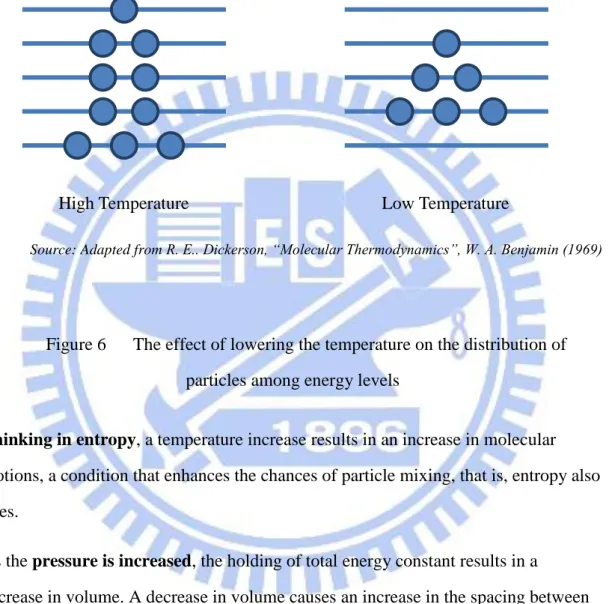
As the temperature is lowered, the total energy of the particles is lowered, thus forcing them to trickle down from upper energy level and fill up the bottom ones, as illustrated in Figure 6.
Source: Adapted from R. E.. Dickerson, “Molecular Thermodynamics”, W. A. Benjamin (1969)
Thinking in entropy, a temperature increase results in an increase in molecular
motions, a condition that enhances the chances of particle mixing, that is, entropy also rises.
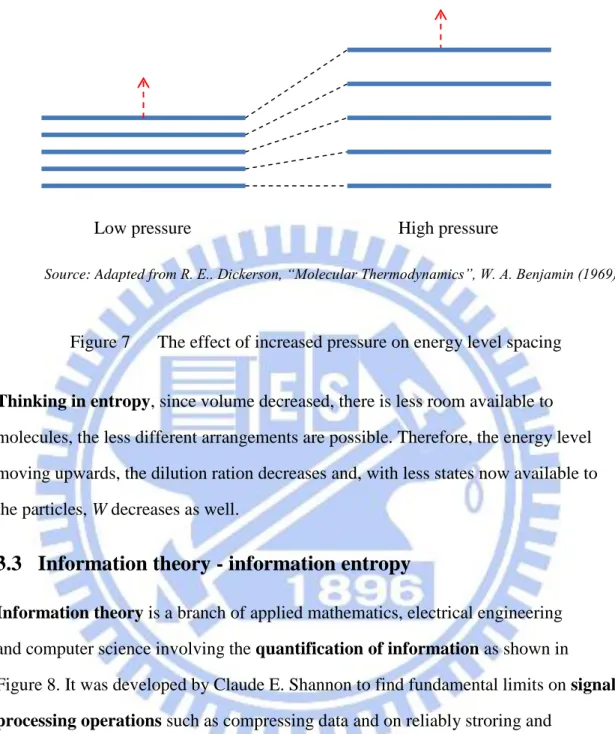
As the pressure is increased, the holding of total energy constant results in a
decrease in volume. A decrease in volume causes an increase in the spacing between energy levels, so that under conditions of constant total energy, the particles are forced to drop down into lower quantum states, as illustrated in Figure 7.
High Temperature Low Temperature
Figure 6 The effect of lowering the temperature on the distribution of particles among energy levels
23
Source: Adapted from R. E.. Dickerson, “Molecular Thermodynamics”, W. A. Benjamin (1969)
Thinking in entropy, since volume decreased, there is less room available to
molecules, the less different arrangements are possible. Therefore, the energy level moving upwards, the dilution ration decreases and, with less states now available to the particles, W decreases as well.
3.3 Information theory - information entropy
Information theory is a branch of applied mathematics, electrical engineering
and computer science involving the quantification of information as shown in Figure 8. It was developed by Claude E. Shannon to find fundamental limits on signal
processing operations such as compressing data and on reliably stroring and
communicating data.
Figure 8 Quantify a waveform into information
Figure 7 The effect of increased pressure on energy level spacing High pressure
24
A key measure of information is entropy, which is usually expressed by the average number of bits needed to store or communicate one symbol in a message.
Information theory is based on probability theory and statistics. The most important quantities of information are
• Entropy: the information in a random variable, it indicates how easily message data can be compressed while the latter can be used to find the communication rate across a channel.
• Mutual information: indicates the amount of information in common or dependence between two random variables.
The theory can be explained in continuous or discrete domain.
Entropy H(X)
• For quantities of information, giving a discrete random variable X as a measure of the amount of uncertainty associated with the value of X
X is the set of all messages {x
1, …, xn} that X could be
p(x) is the probability of x, where xX
Entropy H of X is defined as:
X x p ( x ) p ( x ) H ( X ) l o g [7]• For a continuous random variable X with probability density function fX
Entropy H of X is defined as:
H(X)
fX(x)log fX(x)dx [8]Joint Entropy H(X,Y)
• Consider two discrete random variables X and Y, Joint Entropy H(X,Y) are the entropy of their pairing: (X,Y) defined as:
25
x , y p ( x , y ) p ( x , y ) -H ( X , Y ) l o g [9]• Consider two continuous random variable X and Y with probability density fX
and fY. The joint probability density of X and Y will be fX,Y.
The joint entropy of X and Y is defined as: H(X,Y)-
fX,Y(x,y)l o gfX,Y(x,y)d x d y[10]
Conditional Entropy H(X|Y)
• Consider two discrete random variables X and Y, the conditional entropy of X given Y is defined as the average conditional entropy over Y:
x , y Y y x X p y y x p p ( x , y ) -y x p y x p y p Y) H(X ) ( ) , ( log ) | ( log ) | ( ) ( -| [11]• Consider two continuous random variable X and Y with probability density fX
and fY. The conditional probability density of X and Y will be fX,Y.
The conditional entropy of X and Y is defined as:
d x d y y f y x f y x f Y X H Y Y X Y X ) ( ) , ( l o g ) , ( -) | ( , , [12]Mutual Information I(X;Y)
Mutual information measures the amount of information that can be obtained about one random variable by observing another.
• Consider two discrete random variables X and Y, the mutual information of X and Y is defined as:
x , y p x p y y x p p ( x , y ) Y X I ) ( ) ( ) , ( l o g ) ; ( [13]• Consider two continuous random variables X and Y, the mutual information of X and Y is defined as:
d x d y y f x f y x f y x f Y X I Y X Y X Y X ) ( ) ( ) , ( l o g ) , ( -) ; ( , , [14]26
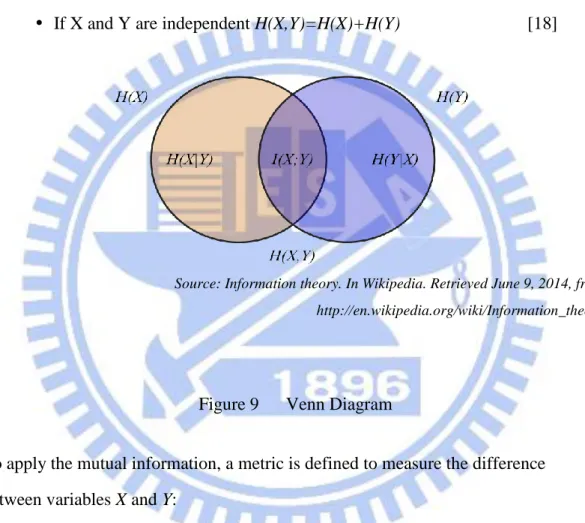
A Venn diagram as Figure 9 shows all possible logical relations.
H(X|Y)=H(X,Y)-H(Y) [15]
H(Y|X)=H(X,Y)-H(X) [16]
I(X;Y) = H(X)-H(X|Y) = H(Y)-H(Y|X) = H(X,Y)-H(X|Y)-H(Y|X) [17]
If X and Y are independent H(X,Y)=H(X)+H(Y) [18]
Source: Information theory. In Wikipedia. Retrieved June 9, 2014, from http://en.wikipedia.org/wiki/Information_theory
To apply the mutual information, a metric is defined to measure the difference between variables X and Y:
d(X,Y) = H(X,Y)-I(X;Y)=H(X)+H(Y)-2I(X;Y)=H(X|Y)+H(Y|X) [19] And, a normalized variant D is defined as:
D(X,Y)=d(X,Y)/H(X,Y)=1-I(X;Y)/H(X,Y) [20]
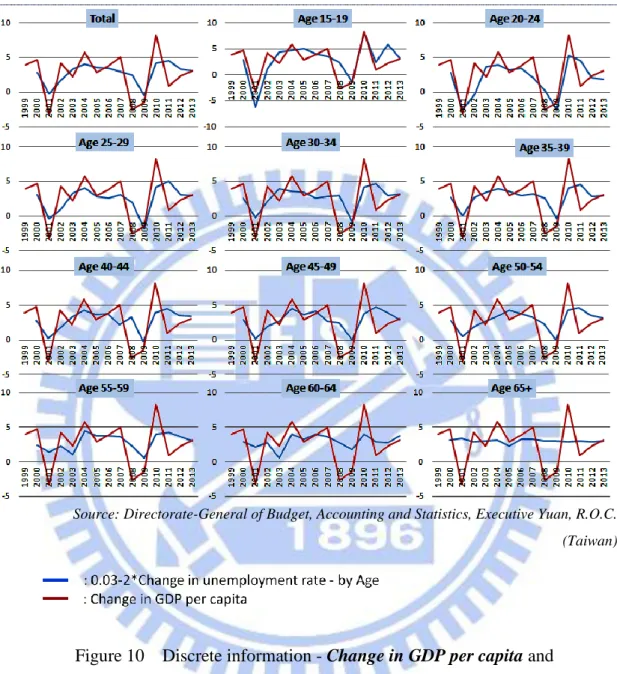
A brief demonstration between two discrete information - Change in GDP per capita and 0.03-2*Change in unemployment rate by Age of Taiwan 2000-2013 - is shown
27
in Figure 10.
Source: Directorate-General of Budget, Accounting and Statistics, Executive Yuan, R.O.C. (Taiwan)
Figure 10 Discrete information - Change in GDP per capita and 0.03-2*Change in unemployment rate by Age, 2000-2013, Taiwan
28
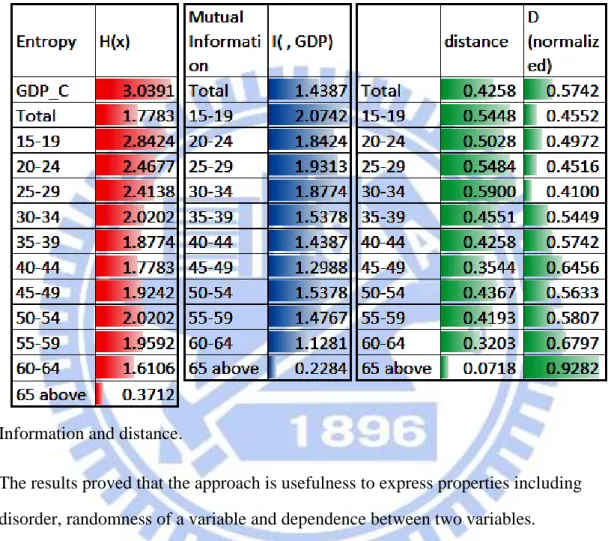
Based on the information above, corresponding entropy, mutual information and distance of variables were calculated as Table 2Table 2 Calculated Entropy, Mutual
Information and distance.
The results proved that the approach is usefulness to express properties including disorder, randomness of a variable and dependence between two variables.
4. Results
4.1 Network economy and distributed capitalism
The convergence of communications and energy regimes created industrial revolutions. Steam Engine, electricity and utility industry (telegraph, railroad…etc) formed the First Industrial Revolution in 18th - 19th century. Carried over to 19th – 20th
29
century, mass production, fossil fuel and ICT technologies formed the Second Industrial Revolution. Along with the First and Second Industrial Revolution, the
centralized, aggregated and rationalized business model and enterprises established
for decades. Vertical economies of scale became the defining feature and gigantic
business operation became the norm.
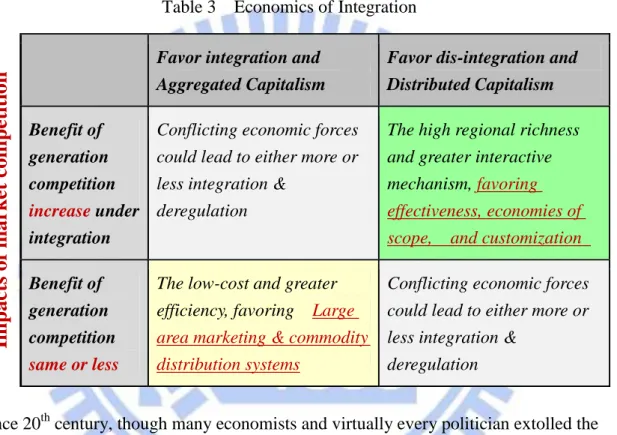
Table 3 Economics of Integration
Im
pa
cts
o
f m
a
rk
et c
o
m
pet
iti
o
n
Favor integration and Aggregated Capitalism
Favor dis-integration and Distributed Capitalism Benefit of generation competition increase under integration
Conflicting economic forces could lead to either more or less integration &
deregulation
The high regional richness and greater interactive mechanism, favoring effectiveness, economies of scope, and customization
Benefit of generation competition
same or less
The low-cost and greater efficiency, favoring Large area marketing & commodity distribution systems
Conflicting economic forces could lead to either more or less integration &
deregulation
Since 20th century, though many economists and virtually every politician extolled the virtues of the small business, but market behavior of commerce and trade operated in opposite way in real world. The centralized, aggregated and rationalized business model is still in dominant, especially in energy, communication and automobile related fields and companies. Moving into the new information era, a new genre of professional administrators took to the helm of these giant new enterprises. A
distributed capitalism is emerging. As shown in Table 3, a list about impacts of
market competition explained favor and benefit of aggregated/distributed capitalism with increase/less integration.
30
A more distributed and collaborative industrial revolution is forming, the partial shift from markets to networks brings with it a different business orientation as shown in Figure 11 below. Web technology has its innovation towards distributed market on pursuing market richness in nature, which is is completely different from
traditional marketing towards centrialized market on pursuing market reach.
Source: Adapted P. Evans, T.S. Wurster, “Blown to Bits”, Harvard Business School Press (2000)
A comparison between centralized/aggregated and distributed capitalism is listed as Table 4 below.
31
Table 4 Aggregated vs. Distributed Capitalism
Aggregated Capitalism Distributed Capitalism Knowledge
Base
Supply & Cost driven; Centralized vertical bureaucrat
Knowledge based; Dispersed lateral & multiple organisms for emerging markets
Strategy & Structure
Linear Hierarchical Centralization for “Market Reach”;
Concentrated capitalization, standardized and modularized
Networked Constellation and Curation for “Market Richness”;
Dispersed & Specialized
Capitalization; non-standardized nor modularized
Marketing Strategy
STP strategy employed & dictated by dominant firms; 4P strategy; Brand name and belief marketing; Centralized
Management
CRM-based frequent producer-user interactions to create innovation; brand names and experience marketing; Democratization of
Creative Innovation Industrial
Structure Oligopoly
Undefined (amorphous) or emerging structures of industry; Mesh
networks
Sources of Competitive Advantage
Low-cost Leadership via size advantage; or differentiation via R&D and/or market leadership
Advantages in resources, market share, and technology are key
Knowledge-intensity, network based economies, closed-linked with key suppliers, and network-size; Market
Innovation via customization and individualization of product; Key
Institutions
Marketing and MIS Networks; Supply-chain & clustering
CRM and database manipulation for advantage; required global network connectivity
Source: Adapted from G. Gilder, “Knowledge and Power”, Regnery Publishing, Washington DC
32
basic principles of:
• Opening (Open proprietary assets) • Peering (Peer production for a price)
• Sharing (Mass lateral collaboration through Platform) • Globalizing (Act globally)
There are some features for successful innovations such as
• Serendipitous and combinatorial innovation resulting from mass collaboration is one what global economy truly embraces • Specializing platforms allow porous interactions among network
collaborators, and are to replace monolithic, self-contained, inward focused marketing that conventional marketing insists
• Demand-side management (DSM) is as critical as supply-side entrepreneurship
4.2 Market channel and radio communication technologies
G. Gilder (2013), in his book "Knowledge and Power: The Information Theory of
Capitalism and How it is Revolutionizing our World", contends that capitalism is not
chiefly an incentive system but an information system, and follows with an inept and irrelevant explanation of Claude Shannon's information theory and radio communication technologies been applied in digital mobile phone systems.
With the advent of digital communication technology that based on the information theory of Alan Turing and Claude Shannon, mobile phones took a big leap forward. The biggest advantage of the digital technology is that any data whether it is a voice, a text or a picture can be converted into bits and bytes. They are different from earlier various analog signals whether radio or TV, the difference between these signals was
33
that of different frequencies and modulations, that is, the characteristic feature of an analog signal is the shape of transmission curve.
Digital mobile phone transmits only two symbols (1 and 0). It is the complex circuits inside that convert the analog information to digital and vice versa.
There are three universal technologies used by Digital mobile phone networks for information transmission.
• FDMA (Frequency Division Multiple Access): puts each call on a separate
frequency.
• TDMA (Time Division Multiple Access): assigns each call a certain portion of time on a designated frequency.
• CDMA (Code Division Multiple Access): gives a unique code to each call and spreads it over the available frequencies.
Source: Wonder Whizkids. Mobile Phone Features. Retrieved June 14, 2014, from http://www.wwk.in/mobile-phones?start=2
34
Refer to Figure 12, a discription over FDMA, TDMA and CDMA technologies in conversation analogy. It is easier to understand the difference among these
technologies.
Refer to Figure 13, an illustration about the access methods in FDMA, TDMA and CDMA. It is easy to find that CDMA is easier to gain more efficiency in point of view from spectral usage.
Source: Adapted from Sky DSP. Chapter 1. Retrieved June 14, 2014 from http://www.skydsp.com/publications/4thyrthesis/chapter1.htm
Analogize to marketing service type. CDMA gives a unique code to each call which makes it possible to be in uniqueness and customization, that is, distributed network capitalism. In the meanwhile, FDMA puts each call on a separate frequency which make the property close to traditional centralized/aggregated capitalism as arranged in Figure 14.
35
Source: Adapted P. Evans, T.S. Wurster, “Blown to Bits”, Harvard Business School Press (2000)
4.3 A thermodynamic perspective on distributed capitalism
The objective of the thermodynamic approach is, to explore the likehood explosion in a network-based market structure, including:
• A novel business model to portray the market structure as a function of different types of innovation
• A design algorithm of marketing channels in accordance with typology of products or/and services
• An optimized product-market condition upon which mass innovation can be achieved
Figure 14 Centralized vs. Distributed Marketing in point of view from communication technologies
36
• The best market structures that would accommodate varying degrees of innovations
• A measure of entropic loss is used as a parameter to gauge the likelihood of market saturation and collapse
4.3.1 Distributed model and thermodynamic principles of information platform
In distributed marketing model, information drives business processes, creating viable business model for profitability. As the free market mechanism tends to favor
divergence of customer preferences, the Say's low of classical economics claims the opposite, the law actually applies to aggregate, economy-wide supply and demand. A more accurate phrase is "aggregate supply creates its own aggregate demand." This interpretation means that the act of production adds to the overall pool of aggregate income, which is then used to buy a corresponding value of production - although most likely not the original production.
As elaborated in Table 4, there are clear differences between aggregated and distributed models.
In thermodynamic perspective over traditional marketing, • On the supply-side:
Entropy is a measure of disorder, or freedom of choice, amid the
entrepreneurial exercises, i.e. the greater the entropy on the supply-side, the greater the room for maneuvering the strategic entrepreneurship.
• On the demand-side:
Entropic loss always is accompanied with a change in the form of energy. The greater conversion efficiency, the greater the entropic loss - lost to the environment (closed systems), or embedded in product or service (open
37
systems) to be consumed.
Irreversibility of the entropic loss is likely to create a detrimental effect on environment, because it leaves less room for additional entropic losses, e.g. carbon emissions and global warming.
Economic systems are open systems. Whereas economies of scale stress the criticality of high-order vertical chain integration, scope economies externalize resources to increase system disorder, as elaborated in section 3.2.3 about definition of entropy, that is, to increase entropy. And, explained in section 3.1.3 about the second law of thermodynamics, treat a specified economic system as isolated thermodynamic system, the entropy of this system strictly increases in irreversible transformations, and it remains constant in reversible transformations, but it cannot decrease. In the case that the phenomenon fail to be controlled by market mechanism, as the total entropy is completely exhausted, that is, the system will fall into a stable & equilibrium state cannot carry any useful information and there is no room for creativity. Therefore, there is an urgent need for demand side managementto conform to the high entropy supply-side of entrepreneurship and innovation. Predictability and order are not spontaneous and cannot be left to “invisible hand”. It takes a low-entropy carrierto bear high-entropy information in modern distributed capitalism. The low-entropy carriers are the effects of leadership in the public (policy for stable political and economic environment) and private(market and business practices) sectors alike to exercise wisdom and courage, embodying a hierarchic principle to enable the high-entropy creations of successful capitalism.
According to description above, the ultimate goal of the distributed model is to
develop a convergent system of entrepreneurial innovation for continual growth. Prior to its full deployment, animated partially polarized and specialized platforms are
38
needed to expedite the convergence, as show in Figure 15.
Source: adapted from H. Chesbrough, Presentation of the Minnesota LES, May 18, 2006
The stochastic view on information: The stream of high-entropy bits in a message flows through a low-entropy determined channel by multiple specialized platforms. Information economy is defined as surprise (entrepreneurship), is the overthrow, not the attainment, of equilibrium. The environment to well incubate innovation is what matters most.
Information technology allows individualization, personalization, codification of product-markets to create high-entropy randomness in the supply-side, and with a low-entropy channels and specialized platforms, entrepreneurial creativity and
distributed operationsbecome a reality.
4.3.2 Distribution of molecules in statistical thermodynamics
Based on properties of molecules, in statistical mechanism, not all distributions are possible and not all possible distributions are equally probable. There are physical
39
limitations upon the ways in which molecules can be distributed among energy states (or ways in which energy can be partitioned among molecules). Moreover, not all possible distributions are equally probable.
Consider a system of three particles, each with individual wave functions øk. Then to a first approximation the wave function of the three-particle system can be built up as a sum of triple products of individual wave functions
j k l l k j jkl a (1) (2) (3) 123 [21]Since the individual particles do not have labels, any acceptable system wave function must be in form that |Ψ|2 is unchanged by a formal exchange of numbering of any two particles. This means that the wave function itself must be either symmetrical or antisymmetrical with respect to such an exchange
Ψ
132 = +/- Ψ123 [22]
The fundamental particles – electrons, neutrons and protons – are all antisymmetric. While composite particles - nuclei, atoms, molecules - are antisymmetric if they are built up from an odd number of fundamental particles and symmetric if from an even number. In summary, antisymmetric particles are known as Fermi-Dirac particles or
“fermions”. And, symmetric particles are known as Bose-Einstein particles or “bosons” as shown in Figure 16.
Source: R. E.. Dickerson, “Molecular Thermodynamics”, W. A. Benjamin
40
Two fermions cannot occupy the same wave function. If they did, then an interchange of the labels designating these two particles would leave the system wave function completely unchanged, and its behavior would be symmetrical. Therefore we can say that each wave function of an energy level is either empty or filled with no more
than one particle (0 or 1). Total number of particles in this energy level ni must be equal to or less than the degeneracy of the level gi. That is, for fermions, it is
meaningless if n > g. For bosons no such restriction exists, and any number of
bosons may be piled into one single wave function as illustrated in Figure 17.
Source: R. E.. Dickerson, “Molecular Thermodynamics”, W. A. Benjamin
In simplified, imaging that there are several energy levels in a system, each level has distribute nj identical objects and gj boxes. Then, the core research of distribution is:
how many ways can one distribute nj identical objects among gj boxes.
Therefore, research topics can be narrowed down to:
• Which of the many conceivable distributions (nj) are physically possible? • What are the relative probabilities of occurrence of those distributions that
can exist?