4 104
IEEE TRANSACI'IONS ON
MAGNETICS, VOL. 30, NO. 6, NOVEMBER 1994
PREPARATION
AND
MAGNETIC PROPERTIES OF (Co,Zn)-DOPED
r-Fez03
PARTICLES
C.H.
Lin
P.C.Ku0
8 J.A.
Chen,
Y.D.
Yao,
Dept.
of Materials Science, Tsing Hua Univ., Hsinchu, Taiwan
Institute
of Materials Science, Taiwan Univ., Taipei, Taiwan
Institute
of
Physics, Academic Sinica, Taipei, Taiwan.
Abstract-idation tenrperatures and ti- of Fe304 to produce (Co,Zn)-doped r-Fez03 particles were examined in this study to relate these two parameters to void, particle size, saturation magnetization, coercivity, and squareness. The effect of Zn/Co ratio on magnetization and coercivity of the particles was also studied.
The partial substitution of Zn for Co in 8-r-Fez03 in- creased the U value and environmental stability, but de- creased the iH, and the squareness of T-Fez03.
INTRowcrIoN
Co-r-Fez03 particles, which find extensive application in high desity reoxding media, are produced by the dehydra- tion, reduction, and oxidation of wet-chemically prepared u-
FeoOH. The addition of Zn, which was produced by absorbing
Co and Zn ions on the surface of r-Fez03' ' - ' I , has been found to be capable of increasing the stability of Co-r-FezO3 par- ticles. A preliminary studyc3', in which Co and Zn ions were initially absorbed on the surface of U-FeOOH instead of T-
Fez03 and then through the dehydration, reduction, and oxi- dation processes, has shown that (CO,Zn)-r-Fez03 partides have some interesting magnetic properties. In this article a further study is undertaken on the preparation of (Co,Zn)- doped r-FezO3 particles by the oxidation of (Co,Zn)-FesO4 and their magnetic properties.
EXPERIHENTAL
Acicular (CO,Zn)-doped Fe304 particles containing 5 and 8 wt% of of Co and Zn ions in total (Co+Zn+Fe) and having various Zn/Co ratios were produced by first wet-chemically synthesizing U-FeOOH particles. This was next followed by adding CO and Zn ions onto the surface of the u-FeoOH par- ticles, dehydrating u-FeOOH to form cy-FezO3, and reducing u-Fez03 to form Fe304 by hydrogen.
parative prooedures are reported elsewherec 33.
Various ternperatures and times were used to oxidize (CO, Zn)-FesO4 particles.
the complete oxidation temperature of r-Fe304 is 252"C, oxi- dation tmperatures ranging from 320 to 420°C were selected.
VSn were used to examine the particles.
The details of the pre-
Because DTA analysis indicated that
After the preparations of the particles, XRD, TM, and
RESVLTS AM) DISCUSSION
The U value (saturation magnetization) of T-Fez03 indi- cated in Figure 1 and 2 was found to decrease with increases
of both the oxidation temperature ranging from 310°C to 420°C for 1.5 hrs and oxidation time ranging from 1 to 53 hrs at 350°C. XRD analysis indicates that this phenomena occurred because s ~ n e Of the T-Fez03 was transformed into a-Fez03. The U value of T-Fez03 illustrated in Figure 3 was found to
increase with the Zn/Co ratio ranging from 0 to 0.7 since cobalt zinc ferrite has higher magnetic moments than pure
aobalt ferrite. The Q value of lowest curve in Figure 1 and
Figure 2, which contained no zinc ion, decreased more rapiely than other (Co,Zn)-r-Fez03 at high temperature region. This would imply the effect of zinc is to increase the high tern- perature stability of Co-r-Fez03, i.e., the resistance of r- Fez03 to @-Fez03 transformation. The U values of (CotZn)-r- FezO3(8wt%) given in Figure 3 were always slightly smaller than those of (Co,Zn)-doped T-Fez03(5wt%).
difficult to explain since the U values of pure coO.Fe~03(80 emu/g) is larger than that of pure r-FezOz(76 em~/g)'~'. It may be due to scnne nonmagnetic phase, which can not be de- tected by XRD analysis, existing in the (Co,Zn)-doped r-FezO3.
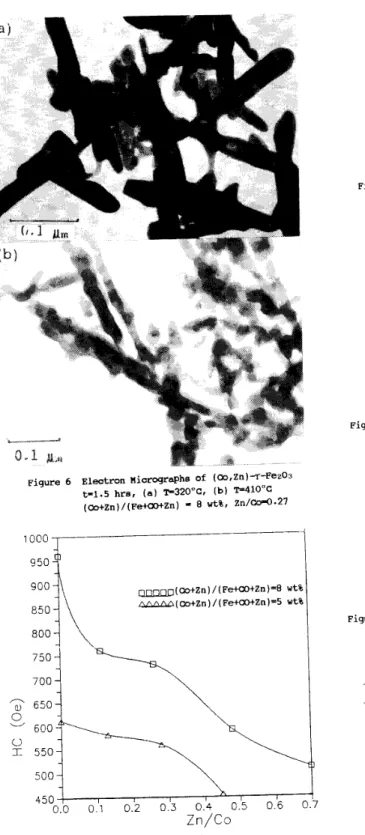
The iH,(coercivity) of (CO,Zn)-doped r-Fez03 (Figure 4 and Figure 5) increased with a higher oxidation temperature or longer oxidation time of Fe304 because more Do diffuses inside ?--Fez03 and fonns more cobalt ferrite which has higher coercivity than pure r-FezO3.
u-FezO3, which was produced either at a higher oxidation ternperature or a longer oxidation period, mignt introduce a stress field in the sample and subsequently increase the
i H , value of r-Fez03. The removal of pores (Figuire 6) at a higher oxidation temperature removes the demagnetizing field and, subsequently, also increases the coercivity of r-FezOs. The iH, of the sample was found to increase with an in- creasing ( W Z n ) content. However, it would decrease with an increasing Zn/@ ratio because of a large anisotropy wnstant of ccbalt ferrite and the addition of zinc ion de- creases ita anisotropic constant(K1).
was found to have the same properties as iH,, whioh increases with either a higher oxidation temperature or longer oxida- tion time of Fe304.
MA analysis in Figure 10 shows that the partial substi- tution of Zn for CO in co-doped T-Fez03 particles stabilized r-Fez03 because the transformation temperature from 7-Fez03 to u-FezO3 increased with Zn/Co ratio. The iH, of the (Cot
Zn)-doped r-Fez03 (Figure 11) increased with the aging time at 60°C in air within 90 days because of r-Fez03 oxidation. doped Fez03 in this study, the magnetic properties were found
to be similar to those of previous works'
'-".
This phenomena is
A trace amount Of
The squareness of (Co,Zn)-doped r-Fez03 (Figure 8 and 9 )
Although a different method was used to produOe (Co,Zn)-
CONCLUSIONS
The U value of (Co,Zn)-r-Fez03 decreased with increased of both the oxidation temperature and oxidation time of FesO4. The U value of r-FenOo increased with the Zn/Co ratio but decreased with the (CBtZn) content. The partial substi- tution of Zn for CO in CO-r-FezO3 increased the resistance of r-Fez03 to u-FezO3 transformation.
The iH, and squareness of (Co,Zn)-doped r-FezO3 increased
0018-9464/94$4.00 Q 1994 IEEE
4105
-
>
800 - 0 7 5 0 : 5 7 0 0 - 0 6 5 0 -0
-600
-
5 5 P -_ 500 - -l A 0,72
Z 0 QP
LT 6 4 3 ~ ~ 320 330 340 350 360 370 380 390 400 410s
0 XI DATl 0
I\J
TE
M
P ERATU RE(
"C)
m
'
6 4 3 k - Z ~ 330 34-0 350 360 3$0 3hO 340 460 2 0s
m
0 XI DATl 0
I\J
TE
M
P ERATU RE(
"C)
Figure 1 s value of (Co,Zn)-~-Fez03 related to various oxidation temperatures Of r-Fez03 (oxidation time = 1 hr, (CotZn)/(FeMDtZn) = 8 ut%)
I=
d S O ! I I I
,
I I I I,
3 1 5 9 13 17 21
25
29 3 3 3741
45 4i
OXIDATION TIME
(hr)
Figure 2 Q value of (Co,Zn)-r-FezOs related to various oxidation t i m a of f-Fez03 (oxidation tenper- ature
-
350"C, (co+Zn)/(FeMDtZn) = 8 ut%)2
cc 68 &L&U (co+Zn)/(FeMDtZn)=8 wt%5
60I
l....q
( ~ Z n , ) / ( F ~ n ) = ; ut%1
cn 0.0 0.1 0.2 0.3 0.4 0.5 0.6 0.7
Zn/Co (weight ratio)
Figure 3
,
,
value of (Co,Zn)-r-Fez03 related to various Zn/Co ratios (l'=35OoC, b1.5 h m )with a higher oxidation tenperature or longer oxidation time
of ~ e 3 0 4 beaause of the fonmtion of more cobelt ferrite, the stress field of a-FezOs, and the removal of pores. The iH,
of
f-Fez03 was increase with an increasing (CotZn) content,decreased with an increasing Zn/@ ratio because of snmller
K I value of zinc ferrite.
The partial subetitution of Zn for ~o in ~o-r-Fez03 in- creased the Q value and environmental stability, but de-
creased the ,He and squareness of r-Fez03.
[l] 0 . Kaganowicz, E.F. Hooking and J.W. Robinson, IEEE
[21 A. Roueset, C. Bonino, M. Gougeon and P. Mollard, ibid. 131 P.C. K w and J.A. &en, J. Hatl. &i., pp.817, 1993. [41 B.D. Cullity, Introduiction to Magnetic Materials, 1972,
Trans. Magn. MAO-11, pp.1194, 1975.
MAG-23, pP.77, 1987.
pp. 190-201 1200 I
1000
4
/
450
I
300 3 0 3iO 320 3iO 3AO 3$0 3 f 0 3AO 340 460
0x1
DATION
TEMPERATURE(
"C
3
Figure 4 i€Ie value of (Co,Zn)-r-Fez03 related to various oxidation hnperatures of r-Fez03 (oxidation time = 1.5 hrs, (Co+Zn)/(FeMXwZn) = 8 ut%)
850 , A 8 0 0
-
0 ,7500
-
>
>
700-
650 -~ --7-T
V&um
ZnyCo=0.48 5 5 0 7 , 1 5 9 I 13 I 17 21 25 I 29 I 33 I 37 41 45OXIDATION
TIME
(Hr)
Figure 5 iH, value of (CO,Zn)-r-FezOs relatcd to varicils oxidation times of f-Fez03 (oxidatiori tenrper. ature = 350"C, (Co+Zn)/(FeMDtZn) = 8 vt%)
4106 450
!
I I I Ix
I0.0
0.1 0.2 0 . 3 0.4 0.5 0.6 (Zn/Co
0.8 v, LC 0.6 W Z Z04l 3110 310 3jO 340 360 3 k 0 3 f 0 3& 340 460 A i 0 OXIDATION TEMPERATURE ~~("C)
Figure 8 Squareness of (Co,Zn)--FezO3 related t4 various oxidation tenperatures of ?-Fez03 (oxidation time = 1.5 hrs, (Cc+Zn)/(Feeco+Zn) = 8 wt%)
4
i
5
4
1'3 1'7211
25 29 33 37 \ 4 1 45 49 OXIDATION TIME ( h r jFigure 9 Squareness of (Co,Zn)-~-FezOa related to various oxidation times of T-Fez03 (oxidation temper- ature = 350"C, (cotZn)/(Feeco+Zn) = 8 Wt%)
Figure 10 Transfornvltion temperature of (Co,Zn)?-Fez03
t4 u-FezO3 (Cc+Zn)/(FetcoeZn) = 5 Wt%)
Zn/Co=O Z n / C o = 0 . 1 3 Z n / C o = 0 . 2 8
e
Z n / C o = 0 . 4 54&; 20 AGING $0 40 TIME
5z---6b
(Doys)7b do
Je
Figure 11 Environmental stability of iH, in open airat 6OoC, (Cc+Zn)/(FeKxnZn) = 5 wt%)