行政院國家科學委員會補助專題研究計畫成果報告
※※※※※※※※※※※※※※※※※※※※※※※※
※
二氫二醇去氫
在乳癌的臨床意義以及其在乳癌癌細胞中的
※
※
生理病理調控並與乙型環氧
、抗藥性和 HER2/neu
※
※
基因之交互作用
※
※
Clinical significance of dihydr odiol dehydr ogenase expr ession in br east cancer※
※
and the pathophysiological r egulation of DDH in br east cancer cells and※
※
the inter actions with COX-2, mdr -1 and HER2/neu gene expr essions※
※ ※
※※※※※※※※※※※※※※※※※※※※※※※※※
計畫類別:
þ
個別型計畫
□整合型計畫
計畫編號:NSC89-2314-B-039-037-
執行期間:
89 年 08 月 01 日至
90 年 07 月 31 日
計畫主持人: 王 惠 暢
共同主持人: 周寬基 ([email protected])
林智一
黃璇華
劉敏
本成果報告包括以下應繳交之附件:
□赴國外出差或研習心得報告一份
□赴大陸地區出差或研習心得報告一份
□出席國際學術會議心得報告及發表之論文各一份
□國際合作研究計畫國外研究報告書一份
執行單位:中國醫藥學院附設醫院 乳房外科、病理部與醫學研究部
國家衛生研究院與台北榮民總醫院合作病房
署立苗栗醫院 病理部
中
華
民
國
90 年
10 月
30 日
行政院國家科學委員會補助專題研究計畫成果報告
計畫編號:NSC89-2314-B-039-037-
執行期限:89 年 08 月 01 日至 90 年 07 月 31 日
主持人: 王惠暢 中 國 醫 藥 學 院 附 設 醫 院 乳 房 外 科
共同主持人:周寬基 中 國 醫 藥 學 院 附 設 醫 院 醫 學 研 究 部
([email protected])
林智一 中 國 醫 藥 學 院 附 設 醫 院 病 理 部
黃璇華 署立苗栗醫院 病 理 部
劉敏 國 家 衛 生 研 究 院 與 台 北 榮 民 總 醫 院 合 作 病 房
計畫參與人員:曾令名 台北榮民總醫院 乳房外科
賴伶雅 中國醫藥學院附設醫院 醫學研究部
姜淑芬 中國醫藥學院附設醫院 醫學研究部
關智尤 中國醫藥學院附設醫院 醫學研究部
張婉若 中國醫藥學院附設醫院 病 理 部
一、中文摘要 本 計 畫 是 以 研 究 二 氫 二 醇 去 氫 (DDH) 與 Her2/neu 基因表現在乳癌的臨床 意義為主題。以螢光原位基因偵測法 (FISH) 檢測 107 個乳癌病理切片,我們發現 36 位 有 Her2/neu 基因放大的現象 (33.6%)。以 免疫組織染色法,則發現有 49.5% (53/107) 的乳癌病人表現 DDH,而僅有 29.1% (21/72) 的乳癌之轉移淋巴結表現 DDH。第二型過 氧 化 (COX2) 的 表 現 卻 有 57.9% (62/107)。COX2 的表現與 Her2/neu 基因放 大以及 DDH 和 mdr-1 的表現成正比,但是 與 PCNA、topoisomerase II 和 FHIT 的表現 並無密切的關係。癌細胞中二氫二醇去氫 之高度表現者比低表現者其淋巴結轉移與 腫瘤復發的機率都要高。而癌細胞中二氫二 醇去氫 之高度表現者之抗藥性更顯著地 比低表現者高出許多 (p = 0.002)。因此我們 認為乳癌病人 DDH 的高度表現和腫瘤期 別、淋巴血管轉移和抗藥性有關。 關鍵詞:二氫二醇去氫、
乳癌細胞、免 疫組織化學染色、基因表現 ABSTRACTIn this study we investigated expressions of dihydrodiol dehydrogenase (DDH) and
HER2/neu gene in patients with breast cancer. By fluorescent in situ hybridization (FISH), amplification of HER2/neu gene was detected in 36 patients. By using
immunohistochemistry, we measured DDH expressions in 107 patients with breast cancer. Furthermore, expression of DDH was
confirmed by immunoblotting and RT-PCR. Relation between DDH expression and clinical parameters was analyzed by statistical analysis. DDH overexpression was detected in 49.5% of pathological sections (53/107) and in 29.1% of metastatic lymph nodes (21/72). Interestingly, expression of cyclooxygenase 2 (COX2) was detected in 62 patients (57.9%), and COX2 expression was correlated with amplification of HER2/neu gene and DDH as well as mdr-1 expressions, but not related to PCNA, topoisomerase II or FHIT gene
expressions. Compared with patients who had DDH overexpression in tumors, patients with low DDH expression had significantly lower incidence of lymph node metastasis and tumor recurrences. Interestingly, drug response rate was also significantly better in patients with low DDH expression than in those with DDH overexpression (p = 0.002). In conclusions,
for patients with breast cancer, DDH overexpression was correlated with tumor stages, lymphovascular invasion, and poor drug response.
Keywords: dihydrodiol dehydrogenase, breast cancer, immunohistochemistry, gene
expression, pathophysiological regulation
二、緣由與目的
Breast cancer is the second leading cause of cancer mortality worldwide among women. Most of the patients died were at the late stage of the disease when they were diagnosed.1 However, some patients who were diagnosed at the early stage, and cared with the adequate surgical resection still died of cancer with the early recurrence and metastasis.2 Breast cancer that metastasized beyond regional lymph nodes or has recurred after primary treatment (advanced breast cancer) becomes more incurable. Concomitant inflammation will even aggravate the seriousness of the disease.
Interestingly, epidemiological evidences showed that the use of nonsteroidal
antiinflammatory drugs (NSAIDs), e.g., aspirin, indomethacin, and sulindac, could reduce not only the risk of breast cancers,3 but also the risks of gastric, colorectal, and lung,4 further support the concept that inflammation and carcinogenesis are intimately related. The detailed mechanism of how NSAIDs reduce the risk of cancer development, however, remains to be determined. It is clear though that cyclooxygenases, the key enzymes in converting arachidonic acid to prostanoids, are targets of NSAIDs.5
In fact, beside cyclooxygenases, interconversion of prostanoids could be catalyzed by prostaglandin (PG) F synthase, a member of aldo-keto reductase family.6 Recently, by using differential display to examine specimens of non-small cell lung cancer and lung cancer cell lines, we have identified overexpression of dihydrodiol dehydrogenase (DDH) that was not detected in the corresponding normal lung tissue.7 DDH is also a member of aldo-keto reductases that catalyzes NADP-mediated oxidation of trans-dihydrodiols. In human
liver, at least four isoforms of the enzyme (DDH1-DDH4) have been identified in the cytoplasm with monomeric mass of 36 kDa. Among these hepatic DDHs, DDH1 and
DDH2 exhibit PGF synthase activity by converting PGD2 into 9α,11β-PGF2.8
Detection of DDH overexpression in breast cancer cells would then provide an alternative link between chronic inflammation and carcinogenesis, and, possibly, the disease manifestation of breast cancer.
In this study, we used
immunohistochemical method to determine the expressions of DDH and Her2/neu gene in surgical specimens from patients with breast. DDH expression in breast cancer was
confirmed by immunoblotting and reverse transcription-polymerase chain reaction (RT-PCR). The correlation between clinicopathological parameters and DDH expression and the prognostic significance of DDH expression in patients with breast cancer were evaluated.
三、結果
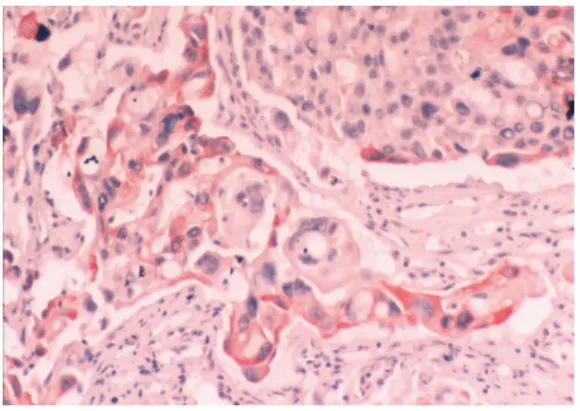
As determined by immunohistochemistry, 53 patients (49.5%) were positive for DDH overexpression (Fig. 1), and DDH was also detected in 29.1% of metastatic lymph nodes (21/72). Expression of DDH was confirmed by immunoblotting and RT-PCR (Fig. 2A & 2B). By FISH, HER2/neu gene amplification was detected in 36 patients (Fig. 3).
Interestingly, COX2 expression was detected in 62 patients (57.9%), and HER2/neu gene amplification was correlated with COX2, DDH and mdr-1 expressions, but not related to expressions of
Fig. 1 Representative example of DDH
expression in breast cancer cells detected by immunohistochemistry. DDH expression was not detected in the normal stroma (original
magnification × 200).
(A)
1 2 3 4 5 6 7 8 9 10 C
(B) M 1 2 3 4 5 6 7 8 9 10
Fig. 2 Detection of DDH overexpression in
breast cancer by (A) immunoblot analysis and (B) RT-PCR.
Fig. 3 Representative example of HER2/neu
gene amplification in breast cancers detected by FISH method. In the upper panel, breast cancer cells have two normal copies of
HER2/neu gene, and in the lower panel, breast cancer cells have amplification of HER2/neu gene (original magnification × 640).
PCNA, FHIT or topoisomerase II (Table 1). Nucleotide sequence of the DNA fragments from seven breast cancers matched with that of DDH3: XM_011858.1 Human aldo-keto reductase family 1, member C3 (DDH3) (AKR1C3), identities = 591/598 (98%). 四、討論
The results presented above demonstrate that gene amplification of HER2/neu gene in breast cancer correlated with overexpression of DDH, COX2 and mdr-1. Patients with DDH overexpression in breast cancer cells
have significantly higher incidence of the early tumor recurrences that are frequently
Table 1 Correlation of HER2/neu gene
amplification with biological factors
Copies of Her2/neu gene 2 3-5 or >5 P COX2 + 36 26 0.033 - 35 10 DDH + 26 27 <0.001 - 45 9 mdr-1 + 32 26 0.008 - 39 10 PCNA + 14 9 0.881 - 59 27 FHIT + 37 14 0.196 - 34 22 Topo II + 9 8 0.202 - 62 28
associated with the poor prognosis. Normally, DDH converts mutagenic PAH into catechol in the liver. Further oxidation of catechol could form PAH
o-quinones that can rapidly conjugate with
glutathione. However, DDH is not regularly expressed in the normal human breast. In addition to PAH metabolism, DDH could also be involved in drug detoxification. Shen et al9
has shown that ethacrynic acid-induced drug-resistant human colon cancer cells could express high level of DDH. An elegant study by Ax et al10 further demonstrated that anthracycline resistance in human stomach cancer cells could be mediated via DDH by altering daunorubicin into a less toxic
daunorubicinol. However, intracellular events between DDH and drug function are yet to be elucidated. A variety of evidence suggests that DDH expression could be responsible for drug inactivation. In particular, chemical structures among anticancer drugs, e.g., adriamycin, VP-16 and mitoxantrone, and
PAH-derivatives that are highly similar further indicate the possibility. Our results
DDHs
DDH1/2
DDH
showed not only the refractory mechanism of daunorubicin in breast cancer chemotherapy, but also the clinical association of DDH expression as a prognostic marker in breast cancer cells that correlated with disease progression and survival of patients with breast cancer. 五、計畫成果自評 1. 自從發現肺癌細胞高度表現自從發現 肺癌細胞高度表現 DDH 後本實驗室更 著手進行研究其他腫瘤; 2. 不同腫瘤表現不同 DDH 的亞型; 3. DDH1 及 DDH2 與抗藥性比較有關係; 4. 此抗藥性與 mdr-1 的表現無關。 六、參考資料
1. Harris JR, Morrow M, Bonadonna G. Cancer of the breast. In Devita VT Jr, Hellman S, Rosenberg SA, eds. Cancer: Principles and Practice of Oncology. 4th
ed. Philadelphia, PA: JB Lippincott Co; 1993:1264-1332.
2. Rowlings PA, Williams SF, Antman KH, et al. Factors correlated with
progression-free survival after high-dose chemotherapy and hematopoietic stem cell transplantation for metastatic breast cancer.JAMA 1999;282:1335-1343.
3. Thun MJ, Namboodiri MM, Calle EE, Flanders WD, Heath CW, Jr. Aspirin use and risk of fatal cancer. Cancer Res
1993;53:1322-1327.
4. Schreinemachers DM, Everson RB. Aspirin use and lung, colon, and breast cancer incidence in a prospective study.
Epidemiology 1994;5:138-146.
5. Subbaramaiah K, Zakim D, Weksler BB, Dannenberg AJ. Inhibition of
cyclooxygenase: a novel approach to cancer prevention. Proc Soc Exp Biol Med 1997;216:201-210.
6. Watanabe K, Fujii Y, Nakayama K, et al. Structural similarity of bovine lung prostaglandin F synthase to lens epsilon-crystallin of the European
common frog. Proc Natl Acad Sci U S A
1988;85:11-15.
7. Hsu NY, Ho HC, Chow KC, Lin TY, Shih CS, Wang LS, Tsai CM.
Overexpression of Dihydrodiol
Dehydrogenase as a Prognostic Marker of Non-Small Cell Lung Cancer. Cancer Res 2001;61:2727-2731.
8. Hara A, Matsuura K, Tamada Y, Sato K, Miyabe Y, Deyashiki Y, Ishida N. Relationship of human liver dihydrodiol dehydrogenases to hepatic
bile-acid-binding protein and an oxidoreductase of human colon cells.
Biochem. J 1996;313:373-376.
9. Shen H, Kauvar L, Tew KD. Importance of glutathione and associated enzymes in drug response. Oncol Res
1997;9:295-302.
10. Ax W, Soldan M, Koch L, Maser E. Development of daunorubicin resistance in tumour cells by induction of carbonyl reduction. Biochem Pharmacol 2000;59: