Crystalline Polymethacrylates Containing
Tolane-Based Mesogenic Side Groups
CHANG-JYH HSIEH,' SHIH-HSIUNG WU,' GING-HO HSIUE,'* and CHAIN-SHU HSUZ
'Department of Chemical Engineering, National Tsing Hua University, Hsinchu, Taiwan 30043, Republic of China, 'Department of Applied Chemistry, National Chiao Tung University, Hsinchu, Taiwan 30050, Republic of China
SYNOPSIS
The synthesis and characterization of nine polymethacrylates containing 4-alkoxy-4I-tri- fluoromethyltolane, 4-alkoxy-4'-cyanotolane, and 4-alkoxy-4'-nitrotolane side groups were described in this study. The phase behavior of the prepared monomers and polymers was characterized by differential scanning calorimetry, optical polarizing microscopy, and x- ray diffraction. All of the obtained monomers exhibit no mesophase, while most of the synthesized polymers reveal enantiotropic mesomorphism. The polymethacrylate containing 4-propanyloxy-4'-nitrotolane side groups was the only one which shows no mesomorphic behavior. Both the spacer length and the nature of terminal groups have profound influence on the phase transition temperatures and thermal stability of the mesophase. The polymers with longer spacers tend to form a more ordered mesophase with a wider temperature range. Among three polymers with the same spacer length, the polymer with a trifluoromethyl terminal end group is inclined t o form a more ordered mesophase than the other two polymers. No side chain crystallization occurred for all obtained polymers. 0 1994 John Wiley & Sons, Inc.
Keywords: liquid crystal polymer polymethacrylate tolane
I NTRO DU CTI 0 N
Side-chain liquid crystalline polymers ( side-chain LCPs) are of both theoretical and practical interest because they combine the anisotropy of liquid crys- tals with properties of the polymeric backbone. Some new applications based on these materials have been reported.'-5 Examining the relationship between their chemical structures and mesomorphic prop- erties has been one very important for the study of side-chain LCPs.
Tolane, which possesses extended conjugation, has been widely used for the synthesis of low molar mass liquid crystals with high Re- cently, Percec et al. reported some new tolane-based liquid crystals and liquid crystalline polymers by us- ing phase transfer P d ( 0 ) /Cu ( I ) catalyzed coupling
* To whom all correspondence should be addressed.
Journal of Polymer Science: Part A Polymer Chemistry, Val. 32,1077-1085 (1994) 0 1994 John Wiley & Sons, Inc. CCC OsS7-624X/94/Osl077-09
reacti~ns.''-'~ This study is to present the synthesis and characterization of side-chain liquid crystalline polymethacrylates containing 4-alkoxy-4'-trifluo- romethyltolane, 4-alkoxy-4'-cyanotolane and 4-al- koxy-4'-nitrotolane in the mesogenic side groups. Both the monomers and the polymers were char- acterized by differential scanning calorimetry, op- tical polarized microscopy, and x-ray diffractometry. The effects of terminal groups as well as spacer length on the mesomorphic properties of the ob- tained polymers are discussed.
EXPERIMENTAL
Materials
Bis (triphenylphosphine )palladium( 11) chloride, tri-
phenylphosphine, 2
-
methyl - 3 - butyn-
2-
01 ( all from Janssen, Belgium), copper ( I ) iodide (from Merck) and all other reagents (from Aldrich) were used as received. Tetrahydrofuran ( T H F ) was first refluxedover potassium and then distilled under nitrogen. Chloroform was dried by refluxing over calcium hy- dride followed by distillation. 2,2'-Azoisobutyroni- trile ( AIBN) (from Janssen) was freshly recrystal- lized from methanol (below 40°C).
Techniques
'H-NMR spectra were obtained with a Bruker AM- 400 spectrometer. All spectra were recorded in CDC13 solution with TMS as the internal standard, unless otherwise stated. IR spectra were measured on a Perkin-Elmer 842 infrared spectrometer. Purity was determined by high-performance liquid chromatog- raphy (HPLC) with a Spectra-Physics LC instru- ment. Preparative gel permeation chromatography (GPC) was run on a Spectra-Physics LC instrument for separating unreacted monomers from polymers. The molecular weights of the polymers were deter- mined by a Viscotek 200 GPC equipped with a dif- ferential refractometer and a viscometer. A set of four Ultrastyragel linear columns was used with T H F as eluent at a flow rate of 1 mL/min. The number- and weight-average molecular weight ( M , and
n?,)
were determined relative to polystyrene standards. A Dupont 910 differential scanning cal- orimeter (DSC), equipped with a 9900 computer system, was used for determination the thermal transitions which were read at the maximum of their endothermic or exothermic peaks. Heating and cooling rates were 10"C/min in all of these cases. Glass transition temperatures(T,)
were read at the middle of the change in heat capacity. The transi- tions were collected from the second heating and cooling scans, unless otherwise specified. A NikonMicrophot-FX optical polarized microscope equipped with a Mettler FP 8 2 hot stage and a Met- tler FP 80 central processor were applied toward observing thermal transitions and anisotropic tex- tures. X-ray diffraction measurements were per- formed with a Rigaku powder diffractometer using nickel-filtered CuKa radiation.
Synthesis of Monomers and Polymers
The synthesis of monomers and polymethacrylates is outlined in Scheme 1.
4-Bromo- 1
-
(3-hydroxypropanyloxy) benzene, 4-Bromo- I - (6-hydroxyhexanyloxy) benzene and 4-Bromo- 1-
( 1 1 -hydroxyundecanyloxy) benzeneAll three compounds were synthesized by the eth- erification of 4-bromophenol with corresponding o-
bromoalkan-1-01 or w-chloroalkan-1-01. An example
H M CH,+Cl + H O e B r m I KOH, DMSO HOCCH,-bO Br m H3 Pd(PPhd2C12 H3 PPh3 HCZ- -OH, CUI
J
E
FH3 H O + C H , - + O ~ C = C m-
5:
-OH CH3 NaOH ,TolueneI
HO+CH,+O+C=C m - H Pd(PPh3,C12 PPh31
B r e X , CuI H O I C H + O + C ~ C mo
x
I A-
IXA: m = 3,6,11; x = CF3, CN, NO2 H,C=C, Et3N, THF COCl' ,CH,I
'CH3 H 2 C = C ~ C O O C C H , + O - ~ C m E C X IM - IXM: rn = 3.6.1 1; x = CF,, CN, NOz IP-
IXP : m = 3.6.1 1; x = CF3, CN, NOzScheme 1. Synthesis of polymethacrylates IP-IXP.
of this procedure is given below. A mixture of 4- bromophenol ( 10.0 g, 57.8 mmol)
,
potassium hy- droxide (3.20 g, 57.8 mmol), and dimethyl sulfoxide(100 mL) was heated to 65°C. Then 6-chloro-l-
hexanol (8.70 g, 63.6 mmol) was added dropwise. The obtained solution was stirred at 65°C for 18 h, and cooled to room temperature. The solvent was distilled under reduced pressure. The obtained crude product was dissolved in ethyl acetate and washed with dilute potassium hydroxide, water, and dried over anhydrous magnesium sulfate. After the solvent was removed in a rotary evaporator, the residue was purified by column chromatography [silica gel, a
mixture of chloroform and T H F (10 : 1 v / v ) as eluent] to yield 13.4 g (85.2%) of colorless oily product. 'H-NMR (CDC13): 6 = 1.34-1.77 [m; 8H, (t;2H, -CCHz-O-), 6.70 and 7.30 (q;4H, aro- matic protons). 4-Bromo-1- (3-hydroxypropanyl- oxy ) benzene was obtained with 82.0% yield, color- less oily product. 'H-NMR ( CDC13) : 6 = 1.96 (m;2H, -CI-I,-O-), 6.75 and 7.32 (q;4H, aromatic protons )
.
4-Bromo-1- ( ll-hydroxyundecany- 1oxy)benzene was obtained with 89.4% yield, mp 43°C. 'H-NMR (CDC13): 6 = 1.30-1.82 [m;18H, (t;2H, - CH2 - 0 - ) , 6.70 and 7.31 (q;4H, aro- matic protons). - (CHZ)4-], 3.60 (t;2H, HO-CHZ-), 3.86 -C€Iz-), 3.70 (t;2H, HO-CHZ-), 3.90 (t;2H, - (CEI,)g-1,
3.63 (t;2H,HO-CHZ-), 3.88 4-(3-Hydroxy-3-methyI-l-butynyl)-l- (3-hydroxypropanyloxy) benzene, 4- (3-Hydroxy-3-methyl- 1 -butynyl)- 1-
(6-hydroxyhexanyloxy)benzene, and 4- (3-Hydroxy-3-methyl- 1-butyny1)- 1- ( 1 I-hydroxyundecany1oxy)benzeneAll three compounds were synthesized by coupling reaction of 2-methyl-3-butyn-2-01 with correspond- ing aryl bromides. An example is outlined below. To a solution of 4-bromo-1- (6-hydroxyhexanyl- oxy) benzene, ( 18.0 g, 66.0 mmol), 2-methyl-3-bu- tyn-2-01 (6.70 g, 79.0 mmol), and dry triethyla- mine (50 mL) in T H F (100 m L ) . Bis(tri- phenylphosphine) palladium( 11) chloride (0.33 g ) ,
copper ( I ) iodide (0.33 g ) , and triphenylphosphine
(0.66 g ) were added." The mixture was heated to 60°C for 8 h. After cooling to room temperature, the solution was filtered and the solvent was evaporated under reduced pressure to dryness. The obtained crude product was purified by column chromatog- raphy [silica gel, a mixture of chloroform and T H F ( 6 : 1 v / v ) as eluent] to yield 12.4 g (68.0%) of white crystals. mp 83°C. MS: 276 (M'). 'H-NMR
( CDC13) : 6 = 1.40-1.81 [ m;8H, - (CH,), -
1,
1.603.95 (G2H,-CEz-0-), 6.79 and 7.36 (q;4H, aromatic protons). 4- (3-Hydroxy-3-methyl-l-b~-
tynyl) -1- ( 3-hydroxypropanyloxy ) benzene was ob- tained with 70.2% yield, mp 112OC. 'H-NMR (m;2H, -C&-), 3.71 (t;2H, HO-CE2-), 4.01 (t;2H, - CE12 - 0 - )
,
6.79 and 7.36 (q;4H,aro-matic protons). 4- ( 3-Hydroxy-3-methyl-l-b~-
tynyl ) - 1- ( 11- hydroxyundecanyloxy ) benzene was obtained with 73.5% yield, mp 79°C. 'H-NMR
( CDC13): 6 = 1.31-1.82 [m;18H, - ( C&)9- ],1.61
[ s ; ~ H , - (CH,)Z], 3.66 (t;2H,HO-C&-),
(CDCl3): 6 = 1.60 [s;6H, - (C&)2], 1.95
[ s;6H, - (C&),], 3.65 (t;2H,HO-C&-), 3.95
(t;2H, - C& - 0 - ) , 6.80 and 7.35 (q;4H, aro-
matic protons).
[ 4- (3- Hydroxypropanyloxy) phenyl] acetylene,
[ 4- (6-Hydroxyhexanyloxy)phenyl] acetylene, and
[ 4- ( 1 1 -Hydroxyundecanyloxy)phenyl] acetylene
All compounds were synthesized by deprotection of the protected aryl acetylides. An example is given as follows. 4- ( 3-Hydroxy-3-methyl-1-butynyl) -1- (6-hydroxyhexanyloxy) benzene ( 12.0 g, 43.0 mmol) was dissolved in dried toluene ( 150 mL) in a reaction vessel equipped with a Dean-Stark trap and a reflex condenser; then the sodium hydroxide (1.70 g, 43.0 mmol) was added." The mixture was heated to re- flux for 3 h. After the reaction time, the reaction mixture was cooled to room temperature, washed with water, and dried over anhydrous magnesium sulfate. The toluene was removed and the resulting solid was purified by column chromatography [silica gel, a mixture of chloroform and T H F (12 : 1 v / v ) as eluent] to yield 6.40 g (68.3% ) of light yellow crystals; mp 49.0"C. MS: 218 ( M + ) . 'H-NMR
( CDC13) : 6 = 1.42-1.80 [ m;8H, - (CH,), - ],2.97 3.94 (t;2H, - CHz- 0 - ) , 6.79 and 7.40 (q;4H,
aromatic protons )
.
[ 4- ( 3-Hydroxypropany- loxy ) phenyl] acetylene was obtained with 72.0% yield, mp 55°C. 'H-NMR ( CDC13): 6 = 1.94 (m;2H, (s;lH, -C=C-E), 3.64 (t; 2H, HO-CHZ-),--€I,-), 2.97 (s;lH, -C=C-EI), 3.70 (t;2H, HO-CFIZ-), 4.05 (t;2H, -CI3z-O-), 6.80 and 7.41 (q;4H, aromatic protons). [ 4- ( 11-Hy- droxyundecanyloxy ) phenyl] acetylene was obtained with 75.3% yield, mp 53°C. 'H-NMR (CDC13): 6
= 1.30-1.80 [ m;18H, - (CH2)g- 1, 2.98 (s;lH,
(t;2H, -C€I,-O-), 6.79 and 7.40 (q;4H, aro- matic protons )
.
-C=C-H), 3.65 (t;2H, HO-CFIZ-), 3.95
1
-
[ 4- (w-Hydroxyalkanyloxy)phenyl] -2-(4-trif1uoromethylphenyl)acetylene ( / A - / / / A ) , 1
-
[ 4- (w-Hydroxyalkanyloxy)phenyl] -2-(4-cyanopheny1)acetylene IVA-VIA), and 1
-
[ 4- (w-Hydroxyalkanyloxy)phenyl] 2-(4-nitrophenyl) acetylene (VllA -IXA)
All nine compounds were prepared by the same method. An example of this procedure is given be- low. To a solution of [ 4- (6-hydroxyhexanyl- oxy)phenyl] acetylene (2.20 g, 10.0 mmol) and 4- bromobenzonitrile (2.20 g, 12.0 mmol) in dry tri- ethylamine ( 10 mL) and tetrahydrofuran (40 mL) ,
bis (triphenylphosphine )palladium( 11) chloride (0.05 g) , copper ( I ) iodide (0.05 g) and triphenyl-
phosphine (0.10 g ) were added. The mixture was heated to reflux for 5 h, then cooled to room tem- perature. After filtration to remove precipitated material, the solvent of the filtered solution was evaporated under reduced pressure. The obtained crude product was purified by column chromatog- raphy [silica gel, a mixture of chloroform and THF
(30 : 1 v / v ) as eluent] to yield 2.30 g (71.4%) of white crystals. The 'H-NMR chemical shifts for all synthesized compounds together with their melting temperatures and yields are presented in Table I.
1- [ 4- (w-Methacryloyloxyalkanyloxy)phenyl] -2-
(4-trifluoromethylphenyl)acetylene (IM-IIIM),
1
-
[ 4- (w-Methacryloyloxyalkanyloxy)phenyll-2- (4-cyanopheny1)acetylene (IVM-VIM), and 1- [ 4- (w-Methacryloyloxyalkanyloxy)phenyl] -2-(4-nitropheny1)acetylene (VIIM-IXM)
All methacrylate monomers IM-IXM were synthe- sized by the esterification of the corresponding al- cohols IA-IXA, with methacryloyl chloride. An ex- ample is given as follows. 1- [ 4- (6-Hydroxyhexan- yloxy)phenyl] -2- (4-cyanopheny1)acetylene ( 1.50 g,
4.70 mmol) was dissolved in a mixture of dried THF
(30 mL) and triethylamine ( 1.01 g, 9.98 mmol)
.
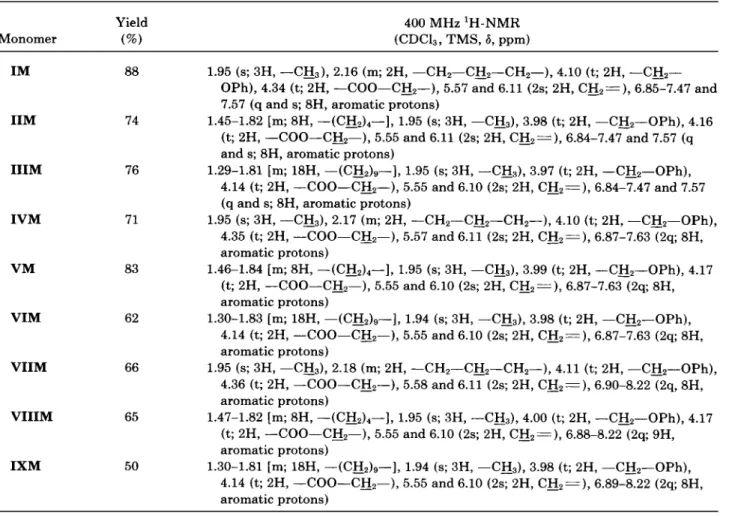
Af- ter the solution was cooled in an ice-water bath toO"C, and methacryloyl chloride (0.74 g, 7.05 mmol) was added dropwise. The reaction mixture was al- lowed to warm slowly to room temperature and stirred overnight. The product was obtained by being poured into water, filtered, dried under vacuum, and purified by column chromatography (silica gel, chloroform as eluent) to yield 1.51 g (83%) of white crystals. The yields and 'H-NMR chemical shifts of all monomers are summarized in Table 11.
Synthesis of Polymethacrylates IP-IXP
The free radical polymerizations of the monomers were carried out in a Schlenk tube under nitrogen. The polymerization tube, which contained a chlo- roform solution of a monomer
(lo%,
wt/vol) and an initiator (AIBN, 1 wt% vs. monomer), was de- gassed under vacuum, and finally filled with nitro- gen. All polymerizations were carried out at 65°Cfor 24 h. After the reaction time, the obtained poly- mers were precipitated in methanol, filtered, purified
Table I. Characterization of 4-(w-Hydroxyalkanyloxy)tolanes (IA-IXA)
Yield mP Compound (%) ("(2) IA IIA IIIA IVA VA VIA VIIA VIIIA IXA 75 82 70 73 71 81 63 74 68 139 115 110 123 127 102 89 123 100 1.97 (m; 2H, -CH,-), 3.74 (t; 2H, HO-CH,-), 4.10 (t; 2H, -CHZ-OPh), 6.85-7.48 and 7.57 (q and s; 8H, aromatic protons)
3.98 (t; 2H, -CH,-OPh), 6.84-7.47 and 7.57 (q and s; 8H, aromatic protons)
3.97 (t; 2H, -CH,-OPh), 6.84-7.48 and 7.57 (q and s; 8H, aromatic protons)
1.96 (m; 2H, -CH,-), 3.75 (t; 2H, HO-CH,-), 4.12 (t; 2H, -CH,-OPh), 6.85-7.61 (2q; 8H, aromatic protons) 1.42-1.81 [m; 8H, -(CH2)4-], 3.65 (t; 2H, HO--CH,-), 3.97 (t; 2H, -CH,-OPh), 6.85-7.61 (29; 8H, aromatic protons) 1.32-1.80 [m; 18H, -(CH,),-], 3.64 (t; 2H, HO--CH,-), 4.10 (t; 2H, -CH,-OPh), 6.85-7.60 (2q; 8H, aromatic protons) 1.96 (m; 2H, -C&-), 3.75 (t; 2H, HO-C&-), 4.10 (t; 2H, -CH,-OPh), 6.86-8.22 (2q; 8H, aromatic protons) 1.43-1.82 [m; 8H, -(C132)4-]r 3.65 (t; 2H, HO-CH2-), 4.00 (t; 2H, -CH,-OPh), 6.87-8.22 (2q; 8H, aromatic protons ) 1.32-1.80 [m; 18H, -(CH,),--], 3.64 (t; 2H, HO-CH,-), 3.99 (t; 2H, -CH2-OPh), 6.88-8.22 (2q; 8H, aromatic protons) 1.40-1.83 [m; 8H, -(CH.J4-], 3.66 (t; 2H, HO--CH,-), 1.30-1.81 [m; 18H, -(CH,),--], 3.65 (t; 2H, HO-CH,-),
Table 11. Characterization of Monomers IM-IXM Yield Monomer (%) 400 MHz 'H-NMR (CDCL, TMS, 6, ppm) IM IIM IIIM IVM VM VIM VIIM VIIIM IXM 88 74 76 71 83 62 66 65 50 1.95 (s; 3H, -CH3), 2.16 (m; 2H, -CH2-CHZ-CH2-), 4.10 (t; 2H, -C&-
OPh), 4.34 (t; 2H, -COO-C13z-), 5.57 and 6.11 (2s; 2H, CHz=), 6.85-7.47 and 7.57 (q and s; 8H, aromatic protons)
1.45-1.82 [m; 8H, -(CH,),-], 1.95 ( s ; 3H, -CH,), 3.98 (t; 2H, -CH,-OPh), 4.16 (t; 2H, -COO-CH,-), 5.55 and 6.11 (2s; 2H, C&=), 6.84-7.47 and 7.57 (q and s; 8H, aromatic protons)
1.29-1.81 [m; 18H, -(CH,),-], 1.95 ( s ; 3H, -CH3), 3.97 (t; 2H, -CH,-OPh), 4.14 (t; 2H, -COO-CH,-), 5.55 and 6.10 (2s; 2H, CH,=), 6.84-7.47 and 7.57 (q and s; 8H, aromatic protons)
1.95 ( s ; 3H, -C&), 2.17 (m; 2H, -CH2-CHZ-CH2-), 4.10 (t; 2H, -CH,-OPh), 4.35 (t; 2H, -COO-CH,-), 5.57 and 6.11 (2s; 2H, CH2=), 6.87-7.63 (2q; 8H, aromatic protons) 1.46-1.84 [m; 8H, - ( C ~ z ) 4 - l , 1.95 ( s ; 3H, -CH3), 3.99 (t; 2H, -CH,-OPh), 4.17 (t; 2H, -COO-CE,-), 5.55 and 6.10 (2s; 2H, CH,=), 6.87-7.63 (2q; 8H, aromatic protons) 1.30-1.83 [m; 18H, -(CH2),-], 1.94 (s; 3H, -CH3), 3.98 (t; 2H, -CH,-OPh), 4.14 (t; 2H, -COO-CI3,-), 5.55 and 6.10 (2s; 2H, CH,=), 6.87-7.63 (29; 8H, aromatic protons) 1.95 ( s ; 3H, -C€13), 2.18 (m; 2H, -CH2-CH2-CH2-), 4.11 (t; 2H, --C€l,-OPh), 4.36 (t; 2H, -COO-CH2-), 5.58 and 6.11 (2s; 2H, CH,=), 6.90-8.22 (29, 8H, aromatic protons) 1.47-1.82 [m; 8H, -(C132)4-], 1.95 ( s ; 3H, -CB3), 4.00 (t; 2H, -CH2-OPh), 4.17 (t; 2H, -COO-CI3,-), 5.55 and 6.10 (2s; 2H, CH,=), 6.88-8.22 (2q; 9H, aromatic protons) 1.30-1.81 [m; 18H, -(CH,)g-], 1.94 ( s ; 3H, -CH3), 3.98 (t; 2H, -CI3,-OPh), 4.14 (t; 2H, -COO-CH,-), 5.55 and 6.10 (2s; 2H, CH2=), 6.89-8.22 (2q; 8H, aromatic protons)
by several reprecipitations from T H F solutions into methanol, and further purified by preparative GPC if deemed necessary.
RESULTS AND DISCUSSION
The synthesis of the methacrylate monomers and intermediary compounds is outlined in Scheme 1. All of the rigid rod-like tolanes were prepared via the coupling reaction of [ 4- (w-hydroxyalkanyl- oxy ) phenyl ] acetylenes and aryl halides in the pres- ence of a palladium complex and a copper ( I ) salt. The methacrylate monomers IM-IXM were syn-
thesized by a simple esterification reaction of the corresponding alcohols of tolane compounds with methacryloyl chloride. The purity of the obtained products was demonstrated via column chromatog- raphy as being high after purification. Typical ther- mal behavior of the monomers is shown in Figure 1 with VIM functioning as an example. The monomer
exhibited only melting and crystallization transi-
tions on both heating and cooling when the sample was heated to around 110°C (curves A and B )
.
If the heating temperature was raised to as high as 180°C (curve C ) , one exothermic peak (148°C) would be observed. This exothermic peak was at- tributed to the thermal polymerization of the mono- mer. Two distinct transitions at 12 and 104°C were observed both in the subsequent cooling and heating scans. One was the glass transition and the other was the liquid crystalline-isotropic transition, as observed by a batonnet smectic A texture found on the optical polarized microscope. On the other hand, the isotropization temperature of the thermally po- lymerized sample was lower than that of the polymer obtained by free radical polymerization. This lower temperature could have been due to a much lower molecular weight achieved by the thermally poly- merized sample. Table I11 summarizes the thermal transitions and the corresponding enthalpy changesof all monomers without thermal polymerization. All of the monomers exhibited no mesomorphic be- havior.
0 d
I
.o W A H 10.38 A H ~ 0 . 4 1 104Figure 1. DSC thermograms (lO"C/min) of monomer VIM: ( A ) and ( B ) , heating to 100°C ( A ) then cooling down ( B ) ; ( C ) , heating to 180°C and then isothermal for 24 h; ( D ) and ( E ) , cooling and heating scans after the thermal treatment of ( C ) ; AH unit in kcal/mol.
The free radical polymerization of the methac- rylate monomers was performed in chloroform using AIBN as initiator (Scheme 1). The unreacted monomers were first removed by several reprecipi- tations from tetrahydrofuran solution into methanol and then separated by preparative GPC if necessary. The polymers were therefore obtained with a high purity. The polymers were therefore obtained with a high purity. The molecular weights and thermal transitions of all obtained polymers are reported in Table IV. The degree of polymerization
(m)
of all synthesized polymers was observed in this table as being higher than 35. Thermotropic behavior of aside-chain LCP has been well-documented as nor- mally being molecular weight independent when its
DP
is higher than 10." All of the polymers exceptfor VIIP showed mesomorphic behavior. Among
three polymers containing three methylene units in their spacers, both polymers IP and IVP exhibited
respectively an enantiotropic nematic phase while polymer VIIP showed no mesomorphic behavior.
The nature of the terminal group obviously played a very important role in the formation of meso- morphic behavior. The characteristic schlieren ne-
matic texture exhibited by polymer IVP is presented in Figure 2.
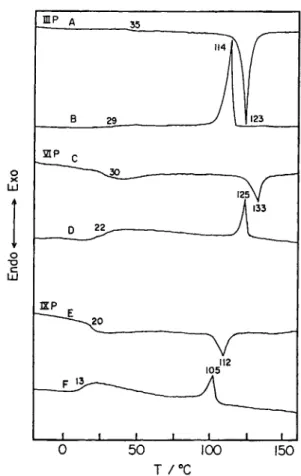
Figure 3 depicts the DSC traces of the three poly- mers containing six methylene units in their spacers. All of the three polymers exhibited a glass transition and a liquid-crystalline to isotropic phase transition on both DSC heating and cooling scans. Polymer
IIP containing a trifluoromethyl terminal group ex-
hibited a smectic phase which could not be discrim- inated by optical microscopy observation. Polymer
VP containing a cyano terminal group presents a
smectic A phase; meanwhile, polymer VIIIP con- taining a nitro terminal group shows a nematic phase. The nature of the terminal groups apparently has a pronounced effect on the mesophases formed. Among those three polymers with the same spacer length, the polymer with trifluoromethyl terminal group tends to form a more ordered mesophase. This result also sufficiently correlates with the low molar mass LCs for the same terminal groups as those in previous
Table 111.
Enthalpy Changes of Monomers IM-IXM
Phase Transitions" and the Corresponding
Phase Transitions ["C (corresponding enthalpy changes, kcal/mol) ] Heating Monomer mb Xb Cooling IM IIM IIIM IVM VM VIM VIIM VIIIM IXM 3 6 11 3 6 11 3 6 11 k 93.2 (8.40) i i 64.8 (7.34) k k 75.2 (11.22) i i 60.4 (10.83) k k 73.9 (13.77) i i 55.0 (13.52) k k 78.0 (7.57) i i 31.3 (1.87) k k 88.1 (8.84) i i 65.7 (8.77) k k 83.7 (11.95) i i 70.3 (9.98) k k 105.1 (5.52) i i 71.7 (5.22) k k 74.0 (8.10) i i 47.0 (8.31) k k 89.5 (11.69) i i 73.3 (12.30) k a k = Crystalline, i = isotropic. m, X, according to Scheme 1.
Table IV. Molecular Weight, Phase Transitions," and the Corresponding Enthalpy Changes of Polymers IP-IXP Phase transitions [ "C (corresponding enthalpy changes, Heating Cooling GPC kcal/mrub)] - Polymer mc X" M n M J M n DP I P IIP IIIP IVP V P VIP VIIP VIIIP IXP 3 6 11 3 6 11 3 6 11 14,130 17,390 24,660 22,540 39,110 40,130 12,910 36,500 18,230 2.0 1.4 2.1 1.3 1.4 1.9 1.9 1.6 2.1 36 40 49 65 101 88 35 90 38 R 78.2 n 98.0 (0.12) i i 89.2 (0.12) n 72.2 g e: 52.6 s 102.8 (1.96) i i 89.5 (1.99) s 49.7 g g 34.5 s 122.9 (3.49) i i 113.8 (3.53) s 28.6 g g 75.4 n 102.4 (0.11) i i 92.7 (0.12) n 71.4 g g 50.0 sn 123.8 (0.42) i i 118.9 (0.40) SA 44.5 g g 29.6 sn 133.0 (0.79) i i 125.4 (0.76) SA 22.2 g g 77.0 i i 71.3 g e: 47.7 n 78.6 (0.141 i i 70.3 (0.15) n 42.7 g g 19.7 SA 111.7 (0.60) i i 104.7 (0.56) SA 12.6 g
a g = glassy, s = smectic, n = nematic, i = isotropic.
mru = mole repeating unit. ' rn, X, according to Scheme 1.
Figure 4 illustrates the DSC traces of the poly- mers containing 11 methylene units in their spacers. All of the three polymers exhibited a glass transition and an enantiotropic smectic phase. Polymer IIIP
displayed a smectic phase, while VIP and IXP ex-
hibited a smectic A phase. The typical focal-conic
Figure 2.
polymer IVP: typical texture obtained a t 90°C.
Optical polarizing micrograph displayed by
smectic A texture exhibited by polymer VIP is
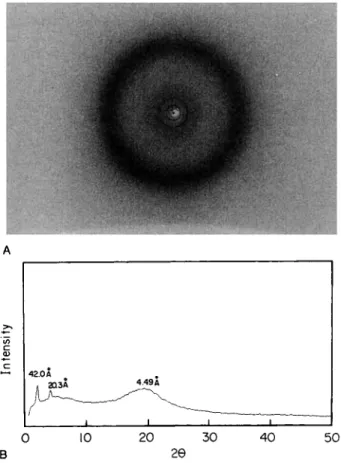
shown in Figure 5. Figure 6 presents the x-ray dif- fraction diagrams obtained from powder sample IXP
at 30°C. A broad reflection was observed at about
4.49
A
which corresponds to lateral spacing of two mesogenic side groups. Additionally, a sharp first- order reflection was found at 42.0A
along with a second-order reflection at 21.3A
which correspond to smectic layers. An additional interesting remark refers to the fact that the average layer spacing is approximately 1.4 times larger than the actual mo- lecular length. It is well-known that interdigitated bilayer smectic A structures usually occur for the smectogens that have molecular structures contain- ing a terminal cyano or nitro Furthermore, among three different polymers with the same spacer length, the one with cyanotolane-based mesogen notably has the highest isotropization temperature. This phenomena could be due to the conjugating effect induced by the cyano group with the tolane moiety, leading to a longer mesogenic core than the::
W 01
E
53 Xp A VP c D 0 50 100 150 T 1 ° CFigure 3. Normalized DSC traces of ( A ) IIP, second heating scan; ( B ) IIP, second cooling scan; ( C ) VP, sec- ond heating scan; ( D ) VP, second cooling scan; ( E ) VIIIP, second heating scan; and ( F ) VIIIP, second cool- ing scan.
In this study, only three varieties of spacer length, i.e., m = 3, 6, and 11, were used for preparing each
series of polymers containing a same terminal group. An investigation of the true spacer effect on the me- somorphic behavior of the obtained polymers would be insufficient. However, according to the data re- ported in Table IV, among each series of polymers,
the one with 11 methylene units in the spacers al- ways exhibits a more orderly mesophase with a wider temperature range and has a large value for the en- thalpy of isotropization than the others. Further- more, no side chain crystallization occurred in all cases of polymer-even though 11 methylene units were used as spacers. This is especially important for a side-chain liquid crystalline polymer containing such a rigid rod-like mesogen.
In conclusion, a series of new polymethacrylates containing 4-alkoxy-4'-trifluoromethyltolane, 4-al- koxy-4'-cyanotolane, and 4-alkoxy-4'-nitrotolane side groups were prepared. Most of the obtained
::
W 01
U15
ii2 105 I 1 I I I I I 0 50 100 I50 T 1°CFigure 4. Normalized DSC traces of ( A ) IIIP, second heating scan; ( B ) IIIP, second cooling scan; ( C ) VIP, second heating scan; ( D ) VIP, second cooling scan; ( E ) IXP, second heating scan; and ( F ) IXP, second cooling scan.
polymers exhibited enantiotropic mesophases. Both the spacer length and the terminal group played quite significant roles on the nature of mesophase
Figure 5.
polymer VIP: typical texture obtained a t 120OC. Optical polarizing micrograph displayed by
12.06 4.49A /
\
1 0 10 20 30 40 50 0 28Figure 6. ( A ) Wide-angle x-ray diffraction pattern of polymer IXP a t 30°C; ( B ) x-ray diffractometer diagram of polymer IXP a t 30°C.
formed. The polymers with a trifluoromethyl ter- minal group were found to tend to form a more or- derly mesophase. The polymers with 11 methylene units in their spacers, revealed a more orderly me- sophase with a wider temperature range of meso- phase than the others. Furthermore, side chain crystallization did not occur for all of the polymers prepared in this study.
The authors are grateful to the National Science Council of the Republic of China (NSC-82-0511-E007-01) for its financial support of this work.
REFERENCES AND NOTES
1. L. L. Chapoy, Recent Advances in Liquid Crystalline Polymers, Elsevier, London and New York, 1985.
2. C. B. McArdle, Side Chain Liquid Crystal Polymers,
Blackie, Glasgow and London, 1989.
3. B. A. Jones, J. S. Bradshaw, M. Nishioka, and M. L. Lee, J . Org. Chem., 49,4947 (1984).
4. M. A. Apfel, H. Finkelmann, G. M. Janini, R. J. Lamb, B. H. Luhmann, A. Price, W. L. Roberts, T. J. Shaw, and C. A. Smith, Anal. Chem., 5 7 , 6 5 1 (1985).
5. J. S. Bradshaw, C. Schregenberg, H. C. Karen, K. E. Markides, and M. L. Lee, J. Chromatogr., 3 5 8 , 95
(1986).
6. H. Kelker and R. Hatz, Handbook of Liquid Crystals,
Verlag Chemie, Weinheim, 1980, p. 91.
7. G. Bauer, Mol. Cryst. Liq. Cryst., 6 3 , 45 (1981).
8. Y. Goto, K. Kitano and T. Ogawa, Liq. Cryst., 5 , 225
9. C. Viney, D. J. Brown, C. M. Dannels, and R. T. Twieg,
10. S. Greenfield, D. Coates, E. Brown, and R. Hittich,
11. C. Pugh and V. Percec, J . Polym. Sci. Part A: Polym.
12. C. Pugh and V. Percec, Mol. Cryst. Liq. Cryst., 1 7 8 ,
13. C. Pugh, C. Tarnstrom, and V. Percec, Mol. Cryst.
14. C. Pugh and V. Percec, Chem. Mater., 3,107 (1991 ). 15. C. Pugh, S. K. Anderson, and V. Percec, Liq. Cryst.,
1 0 , 229 (1991).
16. V. Percec and R. Rodenhouse, J . Polym. Sci. Part A: Polym. Chem., 2 9 , 15 (1991).
17. V. Percec, G. Johansson, and R. Rodenhouse, Mac- romolecules, 2 5 , 2563 ( 1992).
18. D. E. Ames, D. Bull, and C. Takundwa, Synthesis, 364
(1981).
19. V. Percec and C. Pugh, Side Chain Liquid Crystal Polymers, C. B. McArdle, Ed., Blackie, Glasgow and London, 1989, chapter 3.
20. G. H. W. Milburn, C. Campbell, A. J. Shand, and A. R. Werninck, Liq. Cryst., 8 , 623 (1990).
21. C. J. Hsieh and G. H. Hsiue, Liq. Cryst., in press. 22. G. W. Gray and J. W. Goodby, Smectic Liquid Crystals,
Textures and Structures, Leonard Hill, 1984, chapter 1.
23. A. J. Leadbetter, J. L. A., Durrant, and M. Rugman,
Mol. Cryst. Liq. Cryst., 3 4 , 231 (1977).
24. G. W. Gray and J. W. Goodby, Smectic Liquid Crystals, Textures and Structures, Leonard Hill, 1984, chapter 10. (1989). Liq. Cryst., 1 3 , 95 (1993). Liq. Cryst., 1 3 , 301 (1993). Chem., 28,1101 (1990). 193 ( 1991). Liq. Cryst., 1 9 5 , 185 (1991). Received M a y 13, 1993 Accepted October 4, 1993


![Table IV. Molecular Weight, Phase Transitions," and the Corresponding Enthalpy Changes of Polymers IP-IXP Phase transitions [ "C (corresponding enthalpy changes, Heating Cooling GPC kcal/mrub)] - Polymer mc X" M n M J M n DP](https://thumb-ap.123doks.com/thumbv2/9libinfo/7939122.157476/7.918.97.829.129.581/molecular-transitions-corresponding-enthalpy-polymers-transitions-corresponding-polymer.webp)