Temperature dependence of time-resolved photoluminescence spectroscopy in
InAs/GaAs quantum ring
C. H. Lin, H. S. Lin, C. C. Huang, S. K. Su, S. D. Lin, K. W. Sun, C. P. Lee, Y. K. Liu, M. D. Yang, and J. L. Shen
Citation: Applied Physics Letters 94, 183101 (2009); doi: 10.1063/1.3130741
View online: http://dx.doi.org/10.1063/1.3130741
View Table of Contents: http://scitation.aip.org/content/aip/journal/apl/94/18?ver=pdfcov Published by the AIP Publishing
Articles you may be interested in
Shape dependent carrier dynamics in InAs/GaAs nanostructures J. Appl. Phys. 106, 113522 (2009); 10.1063/1.3267851
Temperature dependence of exciton complexes photoluminescence spectra in self-assembled InAs/GaAs quantum rings
J. Appl. Phys. 106, 104314 (2009); 10.1063/1.3260235
Time-resolved photoluminescence spectroscopy of subwetting layer states in In Ga As Ga As quantum dot structures
J. Appl. Phys. 100, 054316 (2006); 10.1063/1.2345464
Carrier transfer in self-assembled coupled InAs/GaAs quantum dots J. Appl. Phys. 88, 7162 (2000); 10.1063/1.1323516
Time-resolved photoluminescence in self-assembled InAs/GaAs quantum dots under strictly resonant excitation
Appl. Phys. Lett. 76, 76 (2000); 10.1063/1.125661
This article is copyrighted as indicated in the article. Reuse of AIP content is subject to the terms at: http://scitation.aip.org/termsconditions. Downloaded to IP: 140.113.38.11 On: Wed, 30 Apr 2014 15:04:54
Temperature dependence of time-resolved photoluminescence
spectroscopy in InAs/GaAs quantum ring
C. H. Lin,1,2H. S. Lin,2C. C. Huang,1S. K. Su,2S. D. Lin,2K. W. Sun,1,a兲 C. P. Lee,2 Y. K. Liu,3M. D. Yang,3and J. L. Shen3
1
Department of Applied Chemistry, National Chiao Tung University, Hsinchu 30010, Taiwan 2
Department of Electronics Engineering and Institute of Electronics Engineering, National Chiao Tung University, Hsinchu 30010, Taiwan
3
Department of Physics, Chung Yuan Christian University, Chung-Li 32023, Taiwan
共Received 4 December 2008; accepted 13 April 2009; published online 4 May 2009兲
We present detailed experimental results of the temperature dependence of continuous wave and time-resolved photoluminescence共PL兲 spectroscopy in self-assembled InAs/GaAs quantum dot and quantum ring nanostructures. A dramatic increase in PL decay time of the excited and ground states is observed in InAs quantum rings at high temperature. We speculate that the longer PL lifetime in quantum rings is due to the interplay among the dark states, ground states, and the reduced wave function overlapping between electrons and holes. A rate equation model is proposed to interpret the observed temperature dependence of the ground state exciton lifetime. © 2009 American Institute of Physics.关DOI:10.1063/1.3130741兴
Self-assembled semiconductor nanostructures with a size and shape that can be tailored and controlled to tune their electrical and optical properties have attracted substantial re-search attention. In particular, InAs on GaAs 共001兲 self-assembled quantum structures is one of the most studied sys-tems. For example, the morphological changes in quantum dot共QD兲 grown by molecular beam epitaxy 共MBE兲 due to a thin GaAs cap have been reported.1–7 Quantum rings共QRs兲 can be obtained by covering a layer of QDs with a thin cap, followed by subsequent annealing. Due to its unique rota-tional symmetry, the nanoring structure exhibits many inter-esting properties such as the Aharonov–Bohm effect,8 large and negative excitonic permanent dipole moments,9and high oscillator strength of the ground state transition.10 Ring-shaped nanostructures have been extensively studied experimentally11–16 and theoretically17–21 since their discov-ery. Lorke et al.12 observed a ground state transition as an optical 共noncontact兲 approach from angular momentum ᐉ = 0 toᐉ=1 when a magnetic field is applied perpendicular to the plane of the rings. The electronic structure in the QR complexes was analyzed using the microphotoluminescence 共micro-PL兲 technique.13
The interplay between the exciton radiative recombination and the electronic carrier tunneling in the presence of a stationary electric field was investigated and reported by Alén et al.14 Recently, a shape-dependent electronic structure and exciton dynamics were reported by Gomis et al.11 in quantum structures with different geom-etries such as a dot, dash, and camel hump. In their studies, an increase in radiative lifetime with temperature was ob-served and attributed to the thermalization between ground state and the first excited dark state. A three-dimensional confinement was also found to be very efficient in producing a strong emission band, and the radiation lifetime measured at a low temperature is below 1 ns in all cases. More re-cently, a PL decay time of less than 1 ns was also reported by Sanguinetti et al.16 in concentric QRs. Both vertical and
lat-eral confinements play an important role in the room tem-perature performance of optoelectronic devices based on these nanostructures. The understanding of carrier dynamics in these nanostructures is therefore of extreme relevance.
In this paper, we report on the cw and time-resolved PL spectroscopy of the excited and ground states of self-assembled InAs nanostructures with QD and QR shapes. We observe the strong dependence of PL decay time on the tem-perature in both the excited and ground states of QRs. A rate equation model is proposed and is found to agree well with the PL dynamics observed.
The GaAs QD samples studied in this work were grown on GaAs 共001兲 substrates by MBE. The QDs were formed by depositing 2.6 ML of InAs with a growth rate of 0.056 m/h at a growth temperature of 520 °C under As2
atmosphere. QDs have an average base diameter of about 20 nm and a height of 2 nm. For the preparation of QR samples, after dot growth was completed, a thin partially capping layer of 2 nm was deposited on the dots with a 1 m/h growth rate at 520 ° C. Followed by an annealing process under As2 flux from 5 to 30 s at the same temperature, the
QD structures can be transformed into QR structures after the annealing processes. Figures 1共a兲 and 1共b兲 show the atomic force microscopy 共AFM兲 images of samples with nanostructures of QDs and QRs. The QD and QR samples have areal densities of ⬃3.4⫻1010 and 2⫻1010 cm−2,
re-spectively. The final QR shape has a base width of⬃60 nm, a height of⬃1 nm, and an inner diameter of 30 nm. Figure
1共c兲shows the cross-sectional transmission electron micros-copy 共XTEM兲 image of the QR sample. The QR appears as two dark-gray lobes 共InAs rich兲 corresponding to a cut through the middle of the ring. The sizes determined by XTEM matched AFM results.
We performed time-resolved measurements for the above samples under nonresonant excitation in the GaAs bar-rier. The sample was placed in a closed-cycled helium dewar. A diode-pumped Ti:sapphire laser was used to excite steady-state PL. The signal was dispersed by a 0.18 m double spec-trometer and detected by a TE-cooled InGaAs photodetector. a兲Author to whom correspondence should be addressed. Electronic mail:
APPLIED PHYSICS LETTERS 94, 183101共2009兲
0003-6951/2009/94共18兲/183101/3/$25.00 94, 183101-1 © 2009 American Institute of Physics
This article is copyrighted as indicated in the article. Reuse of AIP content is subject to the terms at: http://scitation.aip.org/termsconditions. Downloaded to IP: 140.113.38.11 On: Wed, 30 Apr 2014 15:04:54
For the time-resolved measurements, a pulsed diode laser was used as the excitation source at a wavelength of 635 nm. The pulse duration was 50 ps with a repetition rate of 5 MHz and an excitation density in the range of 1 – 100 W/cm2. The
time-resolved PL signal was analyzed with a 0.55 m spec-trometer and detected by a microchannel photomultiplier with a time correlated single photon counting setup. The overall spectral resolution and system response were 0.1 meV and 300 ps.
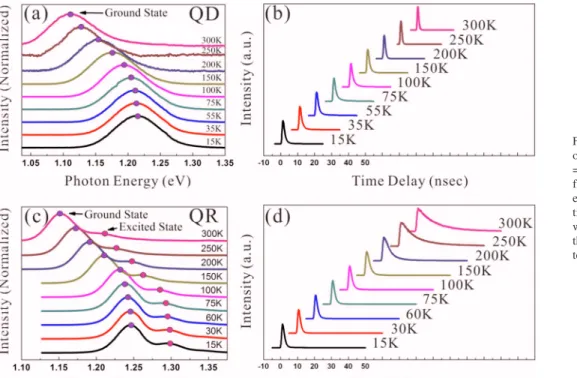
The ground state energies of the QD and QR are 1.21 and 1.25 eV at 15 K, respectively, as shown in Figs.2共a兲and
2共c兲. The barrier and wetting layer emission are observed
clearly at around 1.51 and 1.43 eV for both samples. More information can be obtained following the PL excitation den-sity dependence for each sample. The state filling of the ex-cited state transition can be observed for the QRs by increas-ing the pumpincreas-ing power. We can identify the contributions to the PL of QR’s first and second excited states at 51.5 and 94.6 meV above the ground state, respectively.
Figures2共b兲and2共d兲show the temperature evolution of the PL transient at ground state energy from T = 15 K to T = 300 K for the QD and QR samples, respectively. The de-tection energies were always fixed at the PL peaks at differ-ent temperatures, as indicated by dots shown in Figs. 2共a兲 and 2共c兲. A fast rise time of the order of instrumental reso-lution indicates that there is no phonon bottleneck effect in both samples. The experimental transient decay curves do not reveal saturation effects at a low excitation power as used here and can be described by single exponential functions. The decay time of the QD ground state was about 1.1 ns at a low temperature, which dropped to less than 0.5 ns when the temperature reached 300 K. Surprisingly, the temperature de-pendence of the decay time behaved quite differently for QR structures. For example, the decay lifetime of QRs became longer with the increasing temperature and reached 10.5 ns at room temperature. In Fig.3共a兲, we plotted the temperature dependence of the decay time for both samples. It is clear that at temperature above 150 K, the exciton dynamics change dramatically in the QRs. In Fig.3共b兲the temperature evolution of the PL transient at the excited states of QRs also shows similar behavior.
The behavior of the excitons at a high temperature de-serves greater attention. Its origin is possibly due to the ther-mal population of dark states 共states that can neither be ac-cessed by absorbing photons nor relax to other energy states nonradiatively兲, competing with the exciton radiative recom-bination ground state. It has been argued that due to the presence of piezoelectric/strain potential and a large asym-metry in the ring profiles, there is reduction in the overlap between the electron and hole wave functions.18,21 Such
FIG. 1. 共Color online兲 AFM images of 共a兲 QD, 共b兲 QR, and 共c兲 XTEM image of QR.
FIG. 2.共Color online兲 CW PL spectra of 共a兲 QDs and 共c兲 QRs from T = 15 K to T = 300 K. PL transient from T = 15 to 300 K at ground state energy of共b兲 QDs and 共d兲 QRs. Detec-tion energies of time-resolved spectra were fixed at PL peaks indicated by the dots shown in共a兲 and 共c兲 at all temperatures.
183101-2 Lin et al. Appl. Phys. Lett. 94, 183101共2009兲
This article is copyrighted as indicated in the article. Reuse of AIP content is subject to the terms at: http://scitation.aip.org/termsconditions. Downloaded to IP: 140.113.38.11 On: Wed, 30 Apr 2014 15:04:54
separation causes a reduction in exciton oscillator strength, and a longer decay time is expected for ring structures. We speculate that, at a temperature above 150 K, the electrons and holes tend to occupy states with reduced wave function overlapping, which leads to the slowing down of PL decay time in QRs.
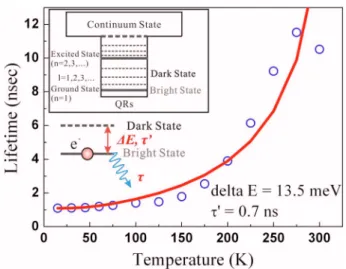
The energy level scheme representative of our proposed model is depicted in Fig.4. By using a simplified two-level model 共as shown in the inset of Fig. 4兲, the temperature
dependence of the decay time curve of QR can be fitted quite well with parameters⌬E=13.5 meV and
⬘
= 0.7 ns共energy separation and relaxation time between the dark state and ground state, respectively兲. The temperature dependence of the PL lifetime agrees well with the proposed rate equation model of the dark state and exciton ground state. At present, an explanation for the dark excited states is still missing and more experiments and detail calculations are required to clarify the issue.In conclusion, we have measured the temperature depen-dence of the PL transients for MBE-grown QD and QR nanostructures. The longer PL lifetime observed at a high temperature in QRs is attributed to the occupation of dark states and the reduced wave function overlapping between electrons and holes, which resulted in the suppression of ra-diative emission and longer exciton lifetime.
This work was supported by the National Science Coun-cil of Republic of China under Contract No. NSC 96-2112-M-009-024-MY3 and the MOE ATU program.
1H.-S. Ling and C.-P. Lee,J. Appl. Phys. 102, 024314共2007兲.
2S. Suraprapapich, S. Panyakeow, and C. W. Tu, Appl. Phys. Lett. 90,
183112共2007兲.
3D. Granados, J. M. Garcia, T. Ben, and S. I. Molina,Appl. Phys. Lett. 86,
071918共2005兲.
4P. Offermans, P. M. Koenraad, J. H. Wolter, D. Granados, J. M. Garcia, V.
M. Fomin, V. N. Gladilin, and J. T. Devreese, Appl. Phys. Lett. 87,
131902共2005兲.
5D. Granados and J. M. Garcia,Appl. Phys. Lett. 82, 2401共2003兲. 6T. Raz, D. Ritter, and G. Bahir,Appl. Phys. Lett. 82, 1706共2003兲. 7A. Lorke, R. J. Luyken, J. M. Garcia, and P. M. Petroff, Jpn. J. Appl.
Phys., Part 1 40, 1857共2001兲.
8M. Grochol, F. Grosse, and R. Zimmermann, Phys. Rev. B 74, 115416
共2006兲.
9R. J. Warburton, C. Schulhauser, D. Haft, C. Schäflein, K. Karrai, J. M.
Garcia, W. Schoenfeld, and P. M. Petroff, Phys. Rev. B 65, 113303
共2002兲.
10H. Pettersson, R. J. Warburton, A. Lorke, K. Karrai, J. P. Kotthaus, J. M.
Garcia, and P. M. Petroff,Physica E共Amsterdam兲 6, 510共2000兲.
11J. Gomis, J. Martinez-Pastor, B. Alén, D. Granados, J. M. Garcia, and P.
Roussignol,Eur. Phys. J. B 54, 471共2006兲.
12A. Lorke, R. J. Luyken, A. O. Govorov, J. P. Kotthaus, J. M. Garcia, and
P. M. Petroff,Phys. Rev. Lett. 84, 2223共2000兲.
13T. Kuroda, T. Mano, T. Ochiai, S. Sanguinetti, K. Sakoda, G. Kido, and N.
Koguchi,Phys. Rev. B 72, 205301共2005兲.
14B. Alén, J. Martinez-Pastor, D. Granados, and J. M. Garcia,Phys. Rev. B
72, 155331共2005兲.
15B. Alén, J. Bosch, D. Granados, J. Martinez-Pastor, J. M. Garcia, and L.
Gonzalez,Phys. Rev. B 75, 045319共2007兲.
16S. Sanguinetti, M. Abbarchi, A. Vinattieri, M. Zamfirescu, M. Gurioli, T.
Mano, T. Kuroda, and N. Koguchi,Phys. Rev. B 77, 125404共2008兲.
17N. A. J. M. Kleemans, I. M. A. Bominaar-Silkens, V. M. Fomin, V. N.
Gladilin, D. Granados, A. G. Taboada, J. M. Garcia, P. Offermans, U. Zeitler, P. C. M. Christianen, J. C. Maan, J. T. Devreese, and P. M. Koen-raad,Phys. Rev. Lett. 99, 146808共2007兲.
18A. O. Govorov, S. E. Ulloa, K. Karrai, and R. J. Warburton,Phys. Rev. B
66, 081309共2002兲.
19G. Piacente and G. Q. Hai,Phys. Rev. B 75, 125324共2007兲.
20J. Simonin, C. R. Proetto, Z. Barticevic, and G. Fuster,Phys. Rev. B 70,
205305共2004兲.
21J. A. Barker, R. J. Warburton, and E. P. O’Reilly,Phys. Rev. B69, 035327
共2004兲. FIG. 3.共Color online兲 共a兲 Temperature dependence of the PL decay time of
QD and QR ground states. 共b兲 PL transients from T=15 to 300 K at first excited state energy of QRs. Detection energies were fixed at excited state peaks as indicated by the dots shown in Fig.2共c兲at all temperatures.
FIG. 4.共Color online兲 Schematic of the dark states and ground states model and the fitting of QR’s decay time curve with a state energy separation of 13.5 meV and relaxation time of 0.7 ns.
183101-3 Lin et al. Appl. Phys. Lett. 94, 183101共2009兲
This article is copyrighted as indicated in the article. Reuse of AIP content is subject to the terms at: http://scitation.aip.org/termsconditions. Downloaded to IP: 140.113.38.11 On: Wed, 30 Apr 2014 15:04:54