Optical vortex pumped solid-state Raman laser
Yoshihiro Nishigata*
a, Cheng-Yeh Lee
b, Yuji Miyamoto
a, Katsuhiko Miyamoto
a,
Yung-Fu Chen
b, Takashige Omatsu
aa
Graduate School of Advanced Integration Science, Chiba Univ./ 1-33 Yayoi-cho, Inage-ku, Chiba,
263-8522, JAPAN;
bDepartmentof Electrophysics, National Chiao Tung Univ./ Hsinchu
30010,Taiwan
ABSTRACT
A vortex Raman laser pumped by the order optical vortex mode was demonstrated. The first- and the second-Stokes waves that lased at the first-order optical vortex mode were generated. Considering the spatial intensity overlap between the pump and the first-Stokes beam, and between the first- and second-Stokes beams, the generation of a topological charge of 1 in the Stokes fields could be theoretically predicted.
Keywords: Laser, Vortex, Raman
1. INTRODUCTION
Optical vortices [1-5] are beams that carry orbital angular momentum and exhibit an annular spatial profile. Orbital angular momentum is characterized by lħ, where l is an integer, and is the so-called topological charge. Recently, optical vortices have attracted intense attention, and have been widely employed for various applications, such as quantum entanglement [6], super-resolution microscopes [7], optical tweezers [8-10], trapping and guiding of cold atoms [11-13], optical testing [14], and material processing [15-18]. It is important that the wavelengths of solid-state lasers can be extended to new spectral lines for a number of useful applications. Until now, frequency conversion of optical vortex beams has been demonstrated through various second-order nonlinear optical processes, for example second-harmonic generation [19, 20], sum-frequency generation [21, 22], and optical parametric oscillation [23-25]. In addition to these processes, Stimulated Raman scattering (SRS) is also a well-known method for frequency conversion. An optical vortex beam at the first-Stokes wavelength has been directly created in a Nd:GdVO4 Raman laser [26]. It has been demonstrated by using a cavity mirror that has a defect spot. Furthermore, various SRS vortex beams with a different order can be obtained by converting higher-order Herimite-Gaussian modes in the Stokes field via a π/2 cylindrical-lens mode converter [27]. However, to the best of our knowledge, the generation of a SRS vortex beam pumped by an optical vortex beam has not been achieved.
In the present work, we pumped a Raman laser cavity by a 532-nm optical vortex with a topological charge of l = 2. The first- and second Stokes emissions that had an annular spatial profile were experimentally generated. Interferogram patterns of the first- and second-Stokes waves were observed as optical vortices.
2. EXPERIMENTAL SETUP
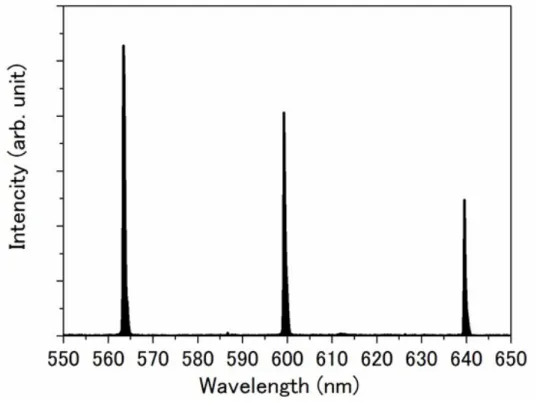
The experimental setup is shown in Fig. 1. A 532-nm pulsed laser was used as a pump beam. The 532-nm Gaussian beam was converted to an optical vortex beam with a topological charge of l = 2 through a spiral phase plate. The 532-nm optical vortex beam was focused by a lens with a focal length of 500-mm, and inputted to a Raman-active medium that was a 60-mm long Ba(NO3)2 crystal. Because the Raman shift of a Ba(NO3)2 crystal is 1046 cm−1 [28], the wavelengths of the Stokes light could be estimated to be 563 (first-Stokes), 599 (second-Stokes), and 639 nm (third-Stokes) from 532 nm as a fundamental wavelength. A front mirror (M1) was flat and had a high transmissibility (T > 90%) at 532 nm and a high reflectivity (R > 99%) in the range of 560-660 nm. M2 was the output coupler, which was a flat mirror with reflectivity of 99.1% at 532-nm, 38.3% at 563-nm, 55.7% at 599-nm, and 13.22% at 639-nm. A lens with a focal length of 500 mm was inserted into the resonator to stabilize the cavity.
Solid State Lasers XXVI: Technology and Devices, edited by W. Andrew Clarkson, Ramesh K. Shori, Proc. of SPIE Vol. 10082, 1008203 · © 2017 SPIE · CCC code: 0277-786X/17/$18 · doi: 10.1117/12.2249961
Proc. of SPIE Vol. 10082 1008203-1
i
r I r550 560 570 580 590 600 610 620 630 640 650
Wavelength (nm)
532mu
SPP
Iwo
Ba(NO3)2
000
Figure 1. The experimental setup of the Raman laser.
3. EXPERIMENTAL RESULTS AND DISCUSSIONS
The first-, second- and third-Stokes light was generated as shown in Fig. 2. The optical conversion efficiencies from the pump beam to the first-, second- and third-Stokes outputs were measured to be 16.4%, 6.6% and 1.7%, respectively. The first- and second-Stokes emissions were annular intensity profiles, while the third-Stokes was the Gaussian mode.
Figure 2. Spectrum data of the Stokes outputs.
The topological charge of the first- and the second-Stokes waves were verified by the self-reference interferogram pattern. A forked fringe having 2 legs was measured in both Stokes emissions. This indicates that the first- and the second- Stokes output beams had a topological charge of 1.
Proc. of SPIE Vol. 10082 1008203-2
We theoretically analyzed the reason why the topological charge of 1 was generated for the first- and second-Stokes light by estimating the spatial overlap ratio between the pump and the Stokes output, because the Raman gain can be defined by the spatial intensity overlap between the pump and the Stokes light in Raman-active media. The cavity mode of the Stokes beam could be calculated by using the ABCD matrix law.
In this experimental setup, the pump beam radius was observed to be 250um. The overlap ratio between the pump and the first-Stokes of l = 1 was 94.6% on the calculation. If the first-Stokes beam was l = 2, overlap ratio would be 78.2%. Thus, the first-Stokes beam should lase at the first-order optical vortex mode. Similarly, the second-Stokes beam should lase at the first-order optical vortex mode because the overlap ratio between the first- and second-Stokes emissions is 99.9% in this case.
4. CONCLUSIONS
A vortex Raman laser pumped by an optical vortex beam was demonstrated. The topological charge of the Raman laser output is defined by the intensity overlap ratio between the pump and Stokes light in the cavity.
REFERENCES
[1] L. Allen, M. W. Beijersbergen, R. J. C. Spreeuw, and J. P. Woerdman, “Orbital angular momentum of light and the transformation of Laguerre-Gaussian laser modes,” Phys. Rev. A 45(11), 8185–8189 (1992).
[2] G. Indebetouw, “Optical vortices and their propagation,” J. Mod. Opt. 40(1), 73–87 (1993).
[3] M. Padgett, J. Courtial, and L. Allen, “Light’s orbital angular momentum,” Phys. Today 57(5), 35–40 (2004). [4] M. S. Soskin and M. V. Vasnetsov, “Singular optics,” in Progress in Optics 42, 219–276. E. Wolf, ed.,
(Elsevier, North-Holland, (2001).
[5] A. M. Yao and M. J. Padgett, “Orbital angular momentum: origins, behavior and applications,” Adv. Opt. Photon. 3(2), 161–204 (2011).
[6] A. Mair, A. Vaziri, G. Weihs, and A. Zeilinger, “Entanglement of the orbital angular momentum states of photons,” Nature 412, 313-316 (2001).
[7] S. Bretschneider, C. Eggeling, and S. W. Hell, “Breaking the Diffraction Barrier in Fluorescence Microscopy by Optical Shelving,” Phys. Rev. Lett. 98(21), 218103 (2007).
[8] N. B. Simpson, K. Dholakia, L. Allen, and M. J. Padgett, “Mechanical equivalence of spin and orbital angular momentum of light: an optical spanner,” Opt. Lett. 22(1), 52-54 (1997).
[9] K. T. Gahagan and G. A. Swartzlander, “Optical vortex trapping of particles,” Opt. Lett. 21(11), 827-829 (1996).
[10] M. P. MacDonald, K. Volke-Sepulveda, L. Paterson, J. Arlt, W. Sibbett, and K. Dholakia, “Revolving interference patterns for the rotation of optically trapped particles,” Opt. Commun. 201(1-3), 21-28 (2002). [11] Y. Song, D. Milam, and W. T. Hill, “Long, narrow all-light atom guide,” Opt. Lett. 24(24), 1805-1807 (1999). [12] X. Xu, K. Kim, W. Jhe, and N. Kwon, “Efficient optical guiding of trapped cold atoms by a hollow laser beam,”
Phys. Rev. A 63(6), 063401 (2001).
[13] T. Kuga, Y. Torii, N. Shiokawa, T. Hirano, Y. Shimizu, and H. Sasada, “Novel Optical Trap of Atoms with a Doughnut Beam,” Phys. Rev. Lett. 78(25), 4713-4716 (1997).
[14] P. Senthilkumaran, “Optical phase singularities in detection of laser beam collimation,” Appl. Opt. 42(31), 6314-6320 (2003).
[15] J. Hamazaki, R. Morita, K. Chujo, Y. Kobayashi, S. Tanda, and T. Omatsu, “Optical- vortex laser ablation,” Opt. Express 18(3), 2144-2151 (2010).
[16] T. Omatsu, K. Chujo, K. Miyamoto, M. Okida, K. Nakamura, N. Aoki, and R. Morita, “Metal microneedle fabrication using twisted light with spin,” Opt. Express 18(17), 17967-17973 (2010).
[17] K. Toyoda, K. Miyamoto, N. Aoki, R. Morita, and T. Omatsu, “Using optical vortex to control the chirality of twisted metal nanostructures,” Nano Lett. 12(7), 3645-3649 (2012).
[18] F. Takahashi, K. Miyamoto, H. Hidai, K. Yamane, R. Morita, and T. Omatsu, “Picosecond optical vortex pulse illumination forms a monocrystalline silicon needle,” Scientific Reports 6, 21738 (2016).
Proc. of SPIE Vol. 10082 1008203-3
[19] K. Dholakia, N. B. Simpson, M. J. Padgett, and L. Allen, “Second-harmonic generation and the orbital angular momentum of light,” Phys. Rev. A 54(5), R3742-R3745 (1996).
[20] J. Courtial, K. Dholakia, L. Allen, and M. J. Padgett, “Second-harmonic generation and the conservation of orbital angular momentum with high-order Laguerre-Gaussian modes,” Phys. Rev. A 56(5), 4193-4196 (1997). [21] A. Beržanskis, A. Matijošius, A. Piskarskas, V. Smilgevičius, and A. Stabinis, “Conversion of topological
charge of optical vortices in a parametric frequency converter,” Opt. Commun. 140(4-6), 273-276 (1997). [22] A. Beržanskis, A. Matijošius, A. Piskarskas, V. Smilgevičius, and A. Stabinis, “Sum-frequency mixing of
optical vortices in nonlinear crystals,” Opt. Commun. 150(1-6), 372-380 (1998).
[23] M. Martinelli, J. A. O. Huguenin, P. Nussenzveig, and A. Z. Khoury, “Orbital angular momentum exchange in an optical parametric oscillator,” Phys. Rev. A 70(1), 013812 (2004).
[24] T. Yusufu, Y. Tokizane, M. Yamada, K. Miyamoto, and T. Omatsu, “Tunable 2-μm optical vortex parametric oscillator,” Opt. Express 20(21), 23666-23675 (2012).
[25] K. Furuki, M. T. Horikawa, A. Ogawa, K. Miyamoto, and T. Omatsu, “Tunable mid-infrared (6.3-12 μm) optical vortex pulse generation,” Opt. Express 22(21), 26351-26357 (2014).
[26] A. J. Lee, T. Omatsu, and H. M. Pask, “Direct generation of a first-Stokes vortex laser beam from a self-Raman laser,” Opt. Express 21(10), 12401-12409 (2013).
[27] C. Y. Lee, C. C. Chang, C. Y. Cho, P. H. Tuan, and Y. F. Chen, “Generation of Higher Order Vortex Beams From a YVO4/Nd:YVO4 Self-Raman Laser via Off-Axis Pumping With Mode Converter,” IEEE J. Sel. Topics Quantum Electron. 21(1), 1600305 (2015).
[28] E. O. Ammann and C. D. Decker, “0.9‐W Raman oscillator,” J. Appl. Phys. 48(5), 1973-1975 (1977).
Proc. of SPIE Vol. 10082 1008203-4