2
Marine Drugs
3 ISSN 1660-3397 4 www.mdpi.com/journal/marinedrugs 5 Article 6Bioactive Cembranoids from the Soft Coral Sinularia crassa
7
Chih-Hua Chao 1,2, Kuei-Ju Chou 1, Chiung-Yao Huang 1, Zhi-Hong Wen 1,3, Chi-Hsin Hsu 1,3,
8
Yang-Chang Wu 4, Chang-Feng Dai 5, and Jyh-Horng Sheu 1,3,*
9
1 Department of Marine Biotechnology and Resources, National Sun Yat-Sen University, Kaohsiung 10
804, Taiwan; E-Mails: [email protected] (C.-H.C.); [email protected] (K.-J.C.); 11
[email protected] (C.-Y.H.) 12
2 Chinese Medicinal Research and Development Center, China Medical University and Hospital, 13
Taichung 404, Taiwan, ROC 14
3 Asian Pacific Ocean Research Center, National Sun Yat-sen University, Kaohsiung 804, Taiwan 15
E-Mails: [email protected] (Z.-H.W.); [email protected] (C.-H.H.) 16
4 College of Chinese Medicine, China Medical University, Taichung 404, Taiwan 17
E-Mail: [email protected] (Y.-C.W.) 18
5 Institute of Oceanography, National Taiwan University, Taipei, Taiwan; 19
E-Mail: [email protected] (C.-F.D.) 20
* Author to whom correspondence should be addressed; E-mail: [email protected] (J.-H.S.) 21
Received: / Accepted: / Published:
22 23
Abstract: Eight new cembranoids, crassarines A–H (1–8) were isolated from a Formosan
24
soft coral Sinularia crassa. Compounds 1–3 represent the rare cembranoids with a 1,12-oxa-25
bridged tetrahydrofuran ring, while 4 and 5 are the firstly discovered 1,11-oxa-bridged 26
tetrahydropyranocembranoids. The absolute configuration of 6 was determined using the 27
Mosher’s method. Compounds 6 and 8 were found to significantly inhibit the expression of 28
both pro-inflammatory iNOS and COX-2 proteins at 10 µM, respectively, while compounds 29
were found to be non-cytotoxic toward the selected human liver cancer cells. 30
Keywords: Sinularia crassa; crassarines A–H; anti-inflammatory
31 32
1. Introduction
33
Soft corals were proven to be a rich source of terpenoids [1]. We previously have isolated a series of 1
bioactive cembrane- [2–4] and norcembrane- [5–8] diterpenoids from the Formosan soft corals of the 2
genus Sinularia. Although this genus has been well studied regarding bioactive constituents, previous 3
investigations on an Indian soft coral Sinularia crassa (Tixier-Durivault, 1951) had resulted in the 4
isolation of only a sphingosine and a steroid possessing anti-inflammatory [9,10] and 5α-reductase 5
inhibitiory activities [11], respectively. This prompted us to investigate the bioactive compounds from 6
the Formosan soft coral S. crassa and the present study has led to the isolation of eight new 7
cembranoids, crassarines A–H (1–8, see Chart 1) from the ethanolic extract of this organism. The 8
structures of these compounds have been established by extensive spectroscopic analysis and chemical 9
method. The anti-inflammatory activity of 1–8 to inhibit up-regulation of the pro- inflammatory iNOS 10
(inducible nitric oxide synthase) and COX-2 (cyclooxygenase-2) proteins in LPS (lipopolysaccharide)-11
stimulated RAW264.7 macrophage cells and the cytotoxicity of compounds 4–8 against a panel of 12
cancer cell lines including human liver carcinoma (HepG2 and HepG3), human breast carcinoma 13
(MCF-7 and MDA-MB-231), and human lung carcinoma (A-549) were evaluated in order to discover 14
bioactive natural products. 15
Chart 1. The structures of crassarines A–H (1–8).
16 O R1 R 2 O OR3 O R1 R 2 O OH R1 O R2 1 R1= CH3, R2= OH, R3= H 1aR1= CH3, R2= OH, R3= Ac 2 R1= OH, R2= CH3, R3= Ac 3 R1= OH, R2= CH3, R3= CHO 4 R1= OH, R2= CH3 5 R1 = CH3, R2= OH 6 R1= OH, R2= H 7 R1= H, R2= OH 1 2 3 4 5 6 7 8 9 10 11 12 13 14 15 16 17 18 19 20 8 O O 17
2. Results and Discussion
18
The ethanolic extract of the soft coral S. crassa was partitioned between EtOAc and H2O to afford 19
the EtOAc-soluble fraction, which was subjected to silica gel column chromatography. The fractions 20
containing terpenoids were selected based on characteristic peaks of methyl groups in the 1H NMR 21
spectrum. These fractions were subsequently subjected to a series of chromatographic separations to 22
afford pure compounds 18. 23
The HRESIMS of crassarine A (1) exhibited a pseudomolecular ion peak at m/z 361.2353 [M+Na], 24
consistent with a molecular formula of C20H34O4, appropriate for four degrees of unsaturation. The IR 25
spectrum of 1 showed a broad absorption band at 3461 cm1 and a strong absorption band at 1698 cm1, 26
implying the presence of hydroxy and carbonyl groups. The latter was identified as a ketone 27
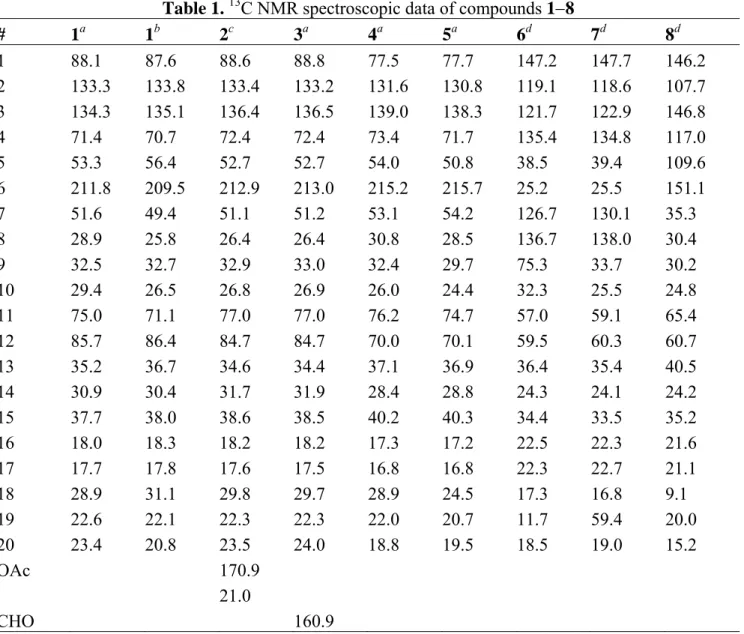
functionality from the carbon resonance at δ 211.8 (Table 1). In addition, carbon resonances at δ 133.3 28
(CH) and 134.3 (CH) were attributed to the presence of an 1,2-disubstituted double bond. The above 29
functionalities accounted for two of the four degrees of unsaturation, suggesting a bicyclic structure in 30
1. By interpretation of 1H1H COSY correlations, it was possible to establish three partial structures
31
from both H-7 and H3-19 to H-8, H-8 to H-11, H2-13 to H2-14, and both H3-16 and H3-17 to H-15. 32
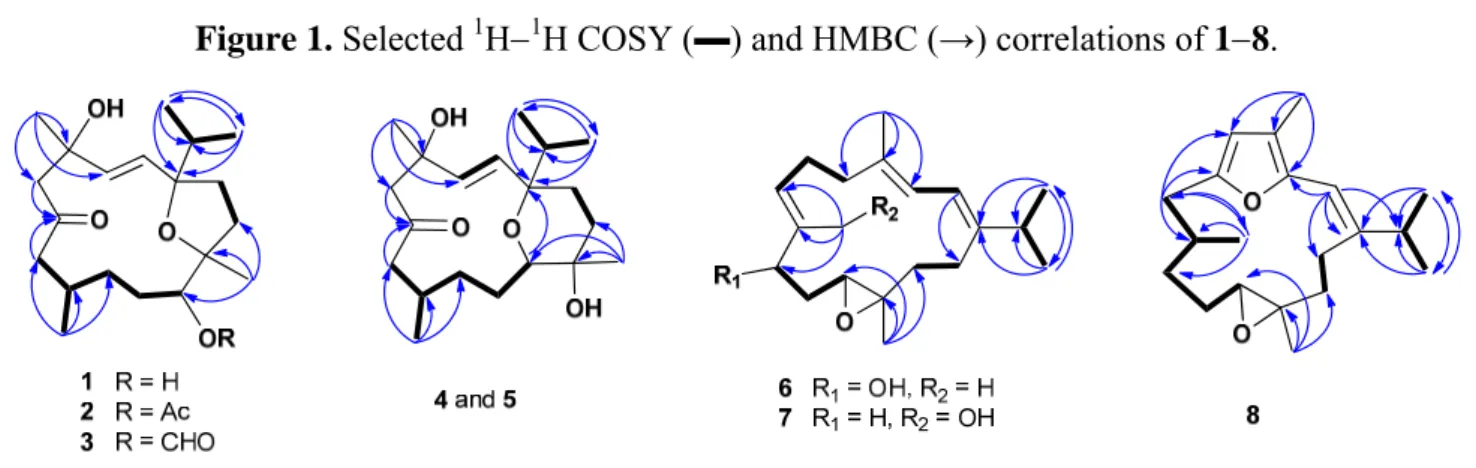
Subsequently, these partial structures were connected by the HMBC correlations (Figure 1). According 1
to the downfield-shifted carbon chemical shifts at δ 88.1 (C-1, C), 75.0 (C-11, CH), and 85.7 (C-12, C) 2
[12] as well as the HMBC correlations from H3-20 to C-11, C-12, and C-13 and H3-16 (or H3-17) to C-3
17 (or C-16), C-15, and C-1, an ether linkage between C-1 and C-12 forming a tetrahydrofuran (THF) 4
ring and a hydroxy group at C-11 were assigned for 1. The location of C-6 ketone was suggested from 5
the carbon resonances of the adjacent methylenes at δ 53.3 (C-5) and 51.6 (C-7). This was further 6
confirmed by the HMBC correlations from both H2-7 and H2-5 to C-6. In addition, the HMBC 7
correlations from H3-18 to C-3, C-4, and C-5 helped to locate the C-2/C-3 double bond and a hydroxy 8
group at quaternary C-4 (δ 71.4). Hence, the planar structure of 1, a cembranoid possessing a 1,12-9
bridged tetrahydrofuran ring, was established as shown in Figure 1. 10
11
Table 1. 13C NMR spectroscopic data of compounds 18
12 # 1a 1b 2c 3a 4a 5a 6d 7d 8d 1 88.1 87.6 88.6 88.8 77.5 77.7 147.2 147.7 146.2 2 133.3 133.8 133.4 133.2 131.6 130.8 119.1 118.6 107.7 3 134.3 135.1 136.4 136.5 139.0 138.3 121.7 122.9 146.8 4 71.4 70.7 72.4 72.4 73.4 71.7 135.4 134.8 117.0 5 53.3 56.4 52.7 52.7 54.0 50.8 38.5 39.4 109.6 6 211.8 209.5 212.9 213.0 215.2 215.7 25.2 25.5 151.1 7 51.6 49.4 51.1 51.2 53.1 54.2 126.7 130.1 35.3 8 28.9 25.8 26.4 26.4 30.8 28.5 136.7 138.0 30.4 9 32.5 32.7 32.9 33.0 32.4 29.7 75.3 33.7 30.2 10 29.4 26.5 26.8 26.9 26.0 24.4 32.3 25.5 24.8 11 75.0 71.1 77.0 77.0 76.2 74.7 57.0 59.1 65.4 12 85.7 86.4 84.7 84.7 70.0 70.1 59.5 60.3 60.7 13 35.2 36.7 34.6 34.4 37.1 36.9 36.4 35.4 40.5 14 30.9 30.4 31.7 31.9 28.4 28.8 24.3 24.1 24.2 15 37.7 38.0 38.6 38.5 40.2 40.3 34.4 33.5 35.2 16 18.0 18.3 18.2 18.2 17.3 17.2 22.5 22.3 21.6 17 17.7 17.8 17.6 17.5 16.8 16.8 22.3 22.7 21.1 18 28.9 31.1 29.8 29.7 28.9 24.5 17.3 16.8 9.1 19 22.6 22.1 22.3 22.3 22.0 20.7 11.7 59.4 20.0 20 23.4 20.8 23.5 24.0 18.8 19.5 18.5 19.0 15.2 OAc 170.9 21.0 CHO 160.9
a Spectra were measured in CDCl
3 (100 MHz). b Spectra were measured in pyridine-d5 (100 MHz). c Spectra were 13
measured in CDCl3 (125 MHz). d Spectra were measured in C6D6 (100 MHz). 14
15 16
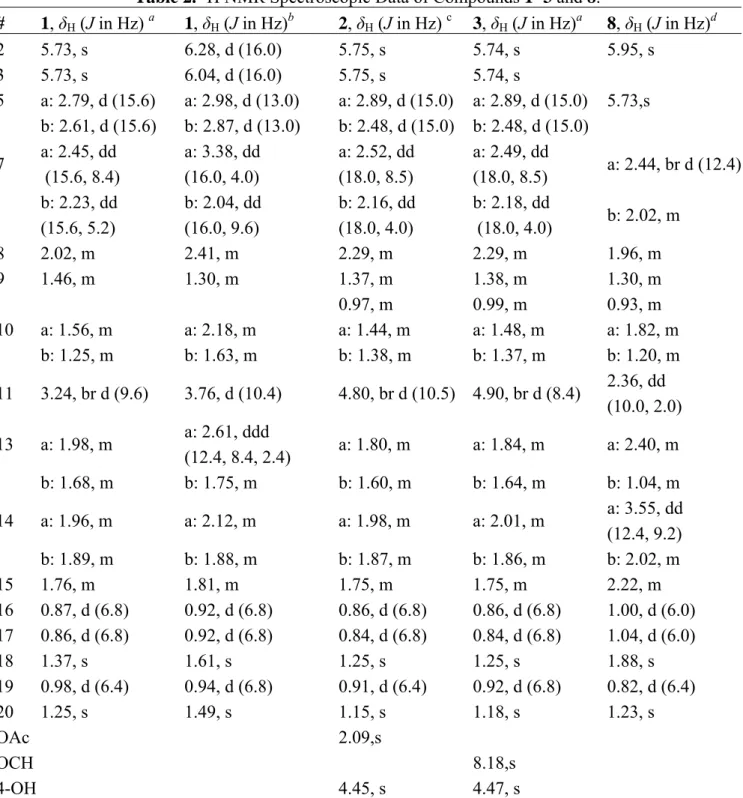
Table 2. 1H NMR Spectroscopic Data of Compounds 13 and 8. 1 # 1, δH (J in Hz) a 1, δH (J in Hz)b 2, δH (J in Hz) c 3, δH (J in Hz)a 8, δH (J in Hz)d 2 5.73, s 6.28, d (16.0) 5.75, s 5.74, s 5.95, s 3 5.73, s 6.04, d (16.0) 5.75, s 5.74, s 5 a: 2.79, d (15.6) a: 2.98, d (13.0) a: 2.89, d (15.0) a: 2.89, d (15.0) 5.73,s b: 2.61, d (15.6) b: 2.87, d (13.0) b: 2.48, d (15.0) b: 2.48, d (15.0) 7 a: 2.45, dd (15.6, 8.4) a: 3.38, dd (16.0, 4.0) a: 2.52, dd (18.0, 8.5) a: 2.49, dd (18.0, 8.5) a: 2.44, br d (12.4) b: 2.23, dd (15.6, 5.2) b: 2.04, dd (16.0, 9.6) b: 2.16, dd (18.0, 4.0) b: 2.18, dd (18.0, 4.0) b: 2.02, m 8 2.02, m 2.41, m 2.29, m 2.29, m 1.96, m 9 1.46, m 1.30, m 1.37, m 1.38, m 1.30, m 0.97, m 0.99, m 0.93, m 10 a: 1.56, m a: 2.18, m a: 1.44, m a: 1.48, m a: 1.82, m b: 1.25, m b: 1.63, m b: 1.38, m b: 1.37, m b: 1.20, m 11 3.24, br d (9.6) 3.76, d (10.4) 4.80, br d (10.5) 4.90, br d (8.4) 2.36, dd (10.0, 2.0) 13 a: 1.98, m a: 2.61, ddd (12.4, 8.4, 2.4) a: 1.80, m a: 1.84, m a: 2.40, m b: 1.68, m b: 1.75, m b: 1.60, m b: 1.64, m b: 1.04, m 14 a: 1.96, m a: 2.12, m a: 1.98, m a: 2.01, m a: 3.55, dd (12.4, 9.2) b: 1.89, m b: 1.88, m b: 1.87, m b: 1.86, m b: 2.02, m 15 1.76, m 1.81, m 1.75, m 1.75, m 2.22, m 16 0.87, d (6.8) 0.92, d (6.8) 0.86, d (6.8) 0.86, d (6.8) 1.00, d (6.0) 17 0.86, d (6.8) 0.92, d (6.8) 0.84, d (6.8) 0.84, d (6.8) 1.04, d (6.0) 18 1.37, s 1.61, s 1.25, s 1.25, s 1.88, s 19 0.98, d (6.4) 0.94, d (6.8) 0.91, d (6.4) 0.92, d (6.8) 0.82, d (6.4) 20 1.25, s 1.49, s 1.15, s 1.18, s 1.23, s OAc 2.09,s OCH 8.18,s 4-OH 4.45, s 4.47, s
a Spectra were measured in CDCl
3 (400 MHz). b Spectra were measured in pyridine-d5 (400 MHz). c Spectra were measured 2
in CDCl3 (500 MHz).d Spectra were measured in C6D6 (400 MHz). 3
4
The E geometry for the C-2/C-3 double bond was deduced. from a 16.0 Hz coupling constant (Table 5
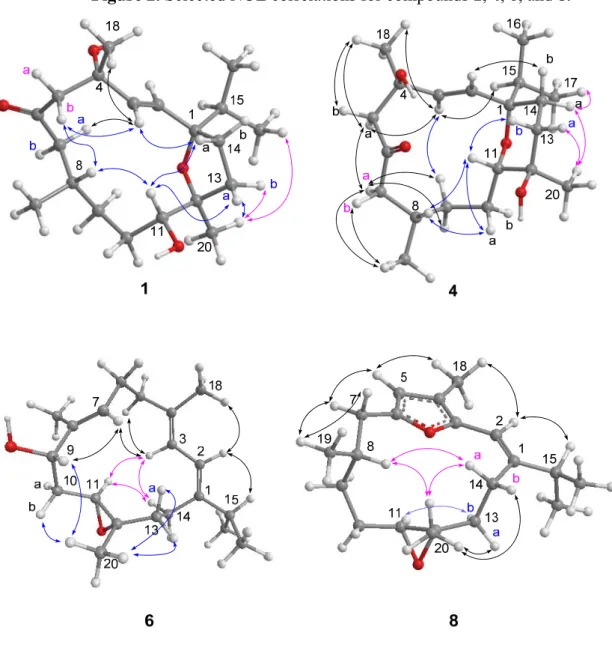
1) between H-2 and H-3. The relative configuration of 1 was determined by the interpretation of NOE 6
correlations (Figure 2). The NOE correlations between H3-20/H3-16 (or H3-17), H-11/H-13a (δH 2.61), 7
H-11/H-8, and H3-20/H2-13 suggested the 1S*,8S*,11R*,12S* configuration as depicted in Figure 2. In 8
addition, the NOE correlations observed for H-2 with both H-15 and H3-18 and for H3-18 with H-3 9
suggested the 4S* configuration. In order to understand the orientation of 4-OH and 11-OH, the 10
pyridine-induced solvent shifts were measured [13,14]. The significant differences of chemical shifts 11
(Δδ = δCDCl3 – δC5D5N ) due to pyridine-induced deshielding effect of hydroxy group were observed 1
for H-7a (Δδ = – 0.93 ppm), H3-20 (Δδ = – 0.24 ppm), and H-13a (Δδ = – 0.63 ppm) (Table 2), 2
suggesting that 4-OH is close to H-7a, and the 11-OH is not only close to H-13a but also gauche-3
oriented to H3-20, as shown in Figure 2. To determine the absolute configuration, we applied the 4
Mosher’s method on 1. However, we were unable to prepare the corresponding Mosher esters of 1 by 5
usual reaction conditions [3,4]. This might be due to the steric hindrance of THF ring adjacent to C-11. 6
Figure 1. Selected 1H1H COSY (▬) and HMBC (→) correlations of 18.
7
8 9
HRESIMS analysis of crassarine B (2) provided a molecular formula of C22H36O5 ([M+Na] m/z 10
403.2463). The 1H and 13C NMR spectroscopic data of 2 were close to those of 1. A comparison of 11
NMR spectroscopic data of 2 with those of 1 indicated that 2 possesses an acetoxy group [δC 170.9 (C), 12
δC 21.0 (CH3); δH 2.09], which was suggested to be attached at C-11 due to the downfield-shifted 13
proton resonance at δH 4.08 (1H, br d, J = 10.5 Hz, H-11) in comparison with the relevant case of 11-14
OH analogue 1 (δH 3.24, 1H, br d, J = 9.6 Hz, H-11). The structure elucidation of 2 was accomplished 15
by an extensive analysis of its 2D NMR correlations, which led to the establishment of its planar 16
structure, as shown in Figure 1. Except for the C-11 substituent and the THF ring in both compounds 1 17
and 2, the differences were observed for the chemical shifts of protons and carbons around the C-4 18
asymmetric center, in particular those of H3-18 (δH 1.37 and δC 28.9 for 1; δH 1.25 and δC 29.8 for 2). 19
These observations suggested that the configuration at C-4 in 2 should be opposite to that in 1. 20
Moreover, 1 and 2 shared the same NOE correlations around asymmetric centers C-1, C-8, C-11, and 21
C-12. To confirm the above elucidation, 1 was acetylated to obtain 1a, which displayed different 1H 22
NMR spectrum to that of 2 (see Experimental). Consequently, 2 was determined to be the 4-epi-11-O-23
acetyl derivative of 1. The 13C and 1H NMR spectral data of 3 are very similar to that of 2 (Tables 1 24
and 2); however, 1H NMR spectrum of 3 showed a singlet at δ 8.18 which correlates with carbon 25
signal at δ 160.9 in the HSQC spectrum, indicatingthe presence of a formyloxy group at C-11 in 3. On 26
the basis of the above data, 3 was identified as the 11-O-formyl derivative of 2. Literature review 27
showed that this is the first cembranoid with a formyloxy functionality. 28
Crassarine D (4) possesses the same molecular formula as that of 1. The 13C NMR data (Table 1) of 29
4 were mostly similar to those of 1, except for those of sp3 oxygenated carbons, suggesting that they
30
vary mainly in heterocyclic ring. The upfield shift for H-11 from δ 3.24 (1H, br d, J = 9.6 Hz) in 1 to δ 31
3.02 (1H, d, J = 8.8 Hz) in 4 indicates that an ether linkage should be located between C-1 and C-11 to 32
form a tetrahydropyran (THP) ring. The HMBC correlation from H-11 to C-1 (δ 77.5, C) confirmed 33
the presence of this THP ring in 4, rather than the THF ring in 1. The detailed analysis of the 34
correlations observed in the COSY, HMBC, and HSQC spectra further assigned all the spectroscopic 1
data and established the planar structure of 4 (Figure 1). The E geometry of C-2/C-3 double bond was 2
also deduced from the coupling constant (16.0 Hz) between H-2 and H-3. NOE correlations between 3
H3-20/H-14a, H3-17/H-14a, H3-20/H-13a, and H-11/H-13b suggested that H-11 is an axial proton and 4
oriented oppositely to H3-20. Both H-11 and H-8 were suggested to be positioned on the same face 5
based on the observation of NOE correlations between H-11/H-8, H-8/H-10a, and H-10a/H-11. In 6
addition, H-3 showed NOE correlations with both H3-18 and H-15 (Figure 2), revealing that H3-18 7
should be pointed toward the same orientation as that of the isopropyl group. Consequently, the 8
1S*,4R*,8S*,11S*,12R* configuration was suggested for 4. 9
10
Figure 2. Selected NOE correlations for compounds 1, 4, 6, and 8.
11 12 13 14 15 16 17
Table 3. 1H NMR Spectroscopic Data of Compounds 47. 1 # 4a, δH (J in Hz) 5a, δH (J in Hz) 6b, δH (J in Hz) 7b, δH (J in Hz) 2 5.81, d (16.0) 5.58, d (16.0) 6.06, d (10.4) 6.08, d (10.8) 3 5.89, d (16.0) 6.07, d (16.0) 5.90, dd (10.4, 1.2) 6.02, d (10.8) 5 a: 2.80, d (16.0) a: 3.01, d (16.6) 2.04, m 2.00, m b: 2.72, d (16.0) b: 2.41, d (16.6) 7 a: 2.39, dd (13.6, 11.2) a: 2.46, dd (11.6, 2.8) 2.10, m a: 2.13, m b: 2.16, dd (13.6, 2.4) b: 2.07, dd (12.0, 11.6) b: 2.00, m 8 1.92, m 1.96, m 5.50, dd (7.2, 6.0) 5.26, dd (9.2, 5.2) 9 a: 1.32, m a: 1.56, m 4.00, dd (8.0, 3.2) a: 2.36, m b: 1.18, m b: 0.99, m b: 2.29, m 10 a: 1.49, m a: 1.57, m a: 1.99, m a: 1.72, m b: 1.19, m b: 1.26, m b: 1.67, m b: 1.64, m 11 3.02, d (8.8) 3.19, d (10.4) 2.87, dd (7.6, 6.0) 3.00, dd (6.8, 5.2) 13 a: 1.74, m a: 1.72, m a: 1.85, m a: 1.91, m b: 1.57, m b: 1.51, m b: 1.52, m b: 1.62, m 14 a: 1.68, m a: 1.65, m a: 2.23, m a: 2.40, m b: 1.59, m b: 1.59, m b: 1.92, m b: 1.90, m 15 1.77, m 1.80, m 2.16, m 2.21, m 16 0.78, d (6.8) 0.80, d (7.0) 0.99, d (6.8) 1.00, d (6.8) 17 0.91, d (6.8) 0.90, d (7.0) 0.99, d (6.8) 0.99, d (6.8) 18 1.37, s 1.38, s 1.65, s 1.63, s 19 0.98, d (6.4) 1.00, d (6.4) 1.40, s 3.93, d (12.0) 3.89, d (12.0) 20 1.11, s 1.15, s 1.12, s 1.15, s
a Spectra were measured in CDCl
3 (400 MHz). b Spectra were measured in C6D6 (400 MHz). 2
3
Crassarine E (5) has the same molecular formula as that of 4. The 1H and 13C NMR spectroscopic 4
data as well as the proton coupling patterns of 5 are similar to those of 4. A comparison of NMR 5
spectroscopic data of 5 with those of 4 showed some differences in chemical shifts for protons and 6
carbons neighboring C-4 and C-8, suggesting that they are epimeric at either C-4 or C-8. The NOE 7
correlation between H3-18 and H-2 in 5, instead of H3-18 and H-3 in 4 (Figure 2) suggested that 8
compound 5 is a 4-epimer of 4. 9
Crassarine F (6) was assigned a molecular formula of C20H32O2, according to the HRESIMS and 10
NMR spectroscopic data (Tables 1 and 3). The IR absorption band at 3300 cm1 revealed the presence 11
of hydroxy group. A tetrasubstituted 1,3-butadiene [δH 6.06 (1H, d, J = 10.4 Hz) and 5.90 (1H, dd, J = 12
10.4, 1.2 Hz); δC 147.2 (C), 135.4 (C), 121.7 (CH), and 119.1 (CH)], a trisubstituted double bond [δH 13
5.50 (1H, dd, J = 7.2, 6.0 Hz); δC 136.7 (C), and 126.7 (CH)], and a trisubstituted epoxide [δH 2.87 (1H, 14
dd, J = 7.6, 6.0 Hz); δC 59.5 (C) and 57.0 (CH)] were also evident. Above NMR signals suggested 6 to 15
be the 1,3-diene cembranoid with an epoxy functionality [15]. The 11,12-epoxy group was assigned by 16
the HMBC correlations from H3-20 to C-11, C-12, and C-13 and H2-14 to C-1, C-2, and C-13 (Figure 17
1). The COSY cross peaks of H2-10/H-11 and H2-10/H-9 as well as the HMBC correlations from H3 -18
19 to C-7, C-8, and C-9 assigned the hydroxy group at C-9 (δC 75.3, CH). These findings and the 1
detailed COSY and HMBC correlations established the planar structure of 6, as shown in Figure 1. The 2
relative configuration of 6 was determined by the interpretation of NOESY spectrum. The crucial NOE 3
correlations (Figure 2) between H-2/H3-18, H-2/H-15, and H-9/H-7 indicated the E geometry for all 4
double bonds and suggested a s-trans geometry for the 1,3-diene. NOE correlations between H-11/H-3, 5
H-11/H-14a, and H-3/H-14a showed that these protons should be pointed toward the core of 14-6
membered ring. Furthermore, the absence of NOE correlation between H-11 and H3-20 and the 7
presence of correlation between H-9 and H3-20 suggested the 9S*,11S*,12S* configuration, as 8
depicted in Figure 2. The absolute configuration of 6 was determined by the application of Mosher’s 9
method [16,17]. The (S)- and (R)-MTPA esters of 6 (6a and 6b, respectively) were prepared using the 10
corresponding (R)- and (S)-MTPA chloride, respectively. The determination of chemical shift 11
differences for the protons neighboring C-9 led to the assignment of the 9S configuration in 6 (Figure 12
3). Thus, the absolute configuration of 6 was determined as 9S, 11S, 12S. 13
14
Figure 3. 1H NMR chemical shift differences of MTPA esters of 6.
15
16
. 17
The HRESIMS data of crassarine G (7) revealed a molecular formula of C20H32O2, the same as that 18
of 6. The IR spectrum of 7 disclosed the presence of hydroxy group (νmax 3434 cm–1). A comparison of 19
the NMR spectroscopic data of 7 (Tables 1 and 2) with those of 6 revealed that the hydroxy-containing 20
methine (C-9) in 6 was replaced by a sp3 methylene in 7. It was also found that resonances appropriate 21
for H3-19 in 6 were absent from the 1H and 13C NMR spectra of 7 and replaced by signals for a 22
hydroxymethyl group [δH 3.93 and 3.89 (each 1H, d, J = 12.0 Hz); δC 59.4 (CH2)]. Careful inspection 23
of the 2D NMR spectra of 7 confirmed the above elucidation. 24
The HRESIMS and 13C NMR spectroscopic data of crassarine H (8) established a molecular 25
formula of C20H30O2 and six degrees of unsaturation. The 13C NMR spectrum showed the presence of a 26
trisubstituted double bond [δC 146.2 (C) and 107.7 (CH)] and a trisubstituted epoxide [δC 65.4 (CH) 27
and 60.7 (C)]. In addition, the carbon resonances at δC 9.1 (CH3, C-18), 151.1 (C, C-6), 146.8 (C, C-3), 28
109.6 (CH, C-5), and 117.0 (C, C-4) are attributed to the presence of a 2,5-dialkyl-3-methylfuran [18]. 29
This furan moiety and the trisubstituted double bond were found to be conjugated according to the 30
downfield-shifted proton resonance of H-2 at δ 5.95 (1H, s) [18]. This was further confirmed by the 31
HMBC correlations from H-2 to C-1, C-3, C-14, and C-15, H3-18 to C-3, C-4, and C-5, and H-5 to C-3, 32
C-4, and C-6. The above data together with the detailed inspection of the COSY and HMBC 1
correlations of 8 established its planar structure (Figure 1). The relative configuration of 8 was 2
determined mainly by the assistance of the NOESY experiment. The key NOE correlations between H-3
2 and both H-15 and H3-18 indicated an E geometry of C-1/C-2 double bond (Figure 2). The trans 4
epoxy group was deduced by the NOE correlations between H-11/H-13b and H3-20/H-13a. In addition, 5
H-8 showed an NOE correlation with H3-20, instead of H-11, suggesting the 8S*,11S*,12S* 6
configuration for 8. 7
8
Figure 4. Effect of compounds 1–8 at 10 µM on the LPS-induced pro-inflammatory iNOS and on
9
COX-2 protein expression of RAW264.7 macrophage cells by immunoblot analysis (A) Immunoblots 10
of iNOS and β-actin. (B) Immunoblots of COX-2 and β-actin. The values are means ± SEM (n = 6). 11
The relative intensity of the LPS alone stimulated group was taken as 100%. *Significantly different 12
from LPS alone stimulated group (*P < 0.05). aStimulated with LPS. bStimulated with LPS in the 13
presence of 1–8 (10 µM). 14
15
The anti-inflammatory activity of diterpenoids 1–8 against the accumulation of pro-inflammatory 16
iNOS and COX-2 proteins in RAW264.7 macrophage cells stimulated with LPS was evaluated using 17
immunoblot analysis. At a concentration of 10 µM (Figure 4), 8 was found to significantly reduce the 18
levels of iNOS protein (35.8 ± 10.7%), compared with the control cells stimulated with LPS only. At 19
the same concentration, 6 could reduce COX-2 expression (65.6 ± 6.2%) by LPS treatment. 20
Cytotoxicity of diterpenoids 4–8 against HepG2, HepG3, MCF-7, MDA-MB-231, and A-549 cancer 21
cell lines was also evaluated. The results showed that the tested compounds were found to be inactive 22
toward the above cancer cell lines. 23
24
3. Experimental Section
25
3.1. General Experimental Procedures
26
The melting point was determined using a Fisher-Johns melting point apparatus. Optical rotations 27
were determined with a JASCO P1020 digital polarimeter. IR spectrum was obtained on a JASCO 28
FT/IR-4100 spectrophotometer. The NMR spectra were recorded on a Bruker AVANCE 300 FT-NMR 29
(or Varian 400 MR NMR/Varian Unity INOVA 500 FT-NMR) instrument at 300 MHz (or 400/500 1
MHz) for 1H (referenced to TMS, δH 0.00 ppm, for both CDCl3 and C5D5N and 7.15 ppm for C6D6) 2
and 75 MHz (or 100/125 MHz) for 13C (referenced to δC 77.0 for CDCl3, to 128.0 ppm for C6D6, and 3
to internal TMS at δC 0.0 ppm for C5D5N). ESIMS were recorded by ESI FT-MS on a Bruker APEX II 4
mass spectrometer. Silica gel 60 (Merck, 230400 mesh) and LiChroprep RP-18 (Merck, 40–63 μm) 5
were used for column chromatography. Precoated silica gel plates (Merck, Kieselgel 60 F254, 0.25 6
mm) and precoated RP-18 F254S plates (Merck, 1.05560) were used for TLC analyses. High-7
performance liquid chromatography (HPLC) was performed on a Hitachi L-7100 pump equipped with 8
a Hitachi L-7400 UV detector at 210 nm and a semi-preparative reversed-phase column (Merck, Hibar 9 Purospher RP-18e, 5 μm, 250 × 10 mm). 10 11 3.2. Animal Material 12
The soft coral Sinularia crassa was collected by hand using scuba off the coast of Sansiantai, 13
Taitung county, in July 2008, at a depth of 10 m, and was stored in a freezer. This soft coral was 14
identified by one of the authors (C.-F. D.). A voucher specimen (specimen no. SST-03) was deposited 15
in the Department of Marine Biotechnology and Resources, National Sun Yat-sen University. 16
17
3.3. Extraction and Isolation
18
The frozen bodies of S. crassa (1.1 kg fresh wt) were minced and extracted exhaustively with EtOH 19
(3 × 2 L). The organic extract was concentrated to an aqueous suspension and was further partitioned 20
between EtOAc and H2O. The EtOAc extract (17.0 g) was fractionated by open column 21
chromatography on silica gel using n-hexane–EtOAc and EtOAc–MeOH mixtures of increasing 22
polarity to yield 32 fractions. Fraction 19, eluting with n-hexane–EtOAc (5:1), was further separated 23
by silica gel column chromatography with gradient elution (n-hexane–EtOAc, 24:1 to 0:1) and 24
followed by RP-18 open column (MeOH–H2O, 50 % to 100%) to yield three subfractions (19A–19C). 25
Subfraction 19A was subjected to RP-18 HPLC (MeOH–H2O, 90%) to obtain compound 8 (2.2 mg). 26
Similarly, compounds 2 (1.1 mg) and 3 (1.0 mg) were obtained from subfraction 19C using RP-18 27
HPLC (MeOH–H2O, 75%). Subfraction 19B was fractionated over silica gel using gradient elution (n-28
hexane–EtOAc, 24:1 to 0:1) to yield three subfractions (19B-1–19B-3). Compounds 4 (3.4 mg) and 5 29
(2.3 mg) were obtained from subfractions 19B-1 and 19B-2, respectively, using RP-18 HPLC (MeOH– 30
H2O, 66%). Subfraction 19B-3 was subjected to normal phase HPLC (n-hexane–EtOAc, 2:1) to obtain 31
1 (2.3 mg). Fractions 22 to 24, eluting with n-hexane–EtOAc (1:1), were combined and further
32
separated over silica gel column chromatography (n-hexane–EtOAc, gradient elution, 18:1 to 0:1) to 33
give a residue containing terpenoids. This residue was separated over RP-18 column chromatography 34
using gradient elution (MeOH–H2O, 50% to 100%) to obtain two subfractions (23A and 23B). 35
Subfraction 23A was further purified by RP-18 HPLC (MeOH–H2O, 75%) to yield compound 6 (1.8 36
mg). In the same manner, compound 7 (8.7 mg) was obtained from subfraction 23B using RP-18 37
HPLC (MeOH–H2O, 80%). 38
Crassarine A (1): colorless oil; [α]24D –93(c 0.20, CHCl3); IR (KBr) vmax 3461, 2963, 2928, 2873, 1
1698, 1455, 1380 cm−1; 1H NMR and 13C NMR data, see Tables 1 and 2; ESIMS m/z 361 [M+Na]+; 2
HRESIMS m/z 361.2353 [M+Na]+ (calcd for C20H34O4Na, 361.2355). 3
Crassarine B (2): colorless oil; [α]24D –13 (c 0.11, CHCl3); IR (KBr) vmax 3288, 2957, 2925, 2855, 4
1732, 1698, 1453, 1372, 1237 cm−1; 1H NMR and 13C NMR data, Tables 1 and 2; ESIMS m/z 403 5
[M+Na]+; HRESIMS m/z 403.2463 [M+Na]+ (calcd for C22H36O5Na, 403.2460). 6
Crassarine C (3): colorless oil; [α]24D –45 (c 0.10, CHCl3); IR (KBr) vmax 3483, 2955, 2925, 2855, 7
1725, 1698, 1455, 1375, 1171 cm−1; 1H NMR and 13C NMR data, Tables 1 and 2; ESIMS m/z 389 8
[M+Na]+; HRESIMS m/z 389.2302 [M+Na]+ (calcd for C21H34O5Na, 389.2304). 9
Crassarine D (4): colorless oil; [α]24D –48 (c 0.34, CHCl3); IR (KBr) vmax 3386, 2955, 2925, 2855, 10
1716, 1458, 1268, 1036 cm−1; 1H NMR and 13C NMR data, Tables 1 and 3; ESIMS m/z 361 [M+Na]+; 11
HRESIMS m/z 361.2354 [M+Na]+ (calcd for C20H34O4Na, 361.2355). 12
Crassarine E (5): colorless oil; [α]24D –27 (c 0.23, CHCl3); IR (KBr) vmax 3453, 2957, 2925, 2855, 13
1713, 1458, 1261, 1044 cm−1; 1H NMR and 13C NMR data, Tables 1 and 3; ESIMS m/z 361 [M+Na]+; 14
HRESIMS m/z 361.2357 [M+Na]+ (calcd for C20H34O4Na, 361.2355). 15
Crassarine F (6): colorless oil; [α]24D –63 (c 0.18, CHCl3); IR (KBr) vmax 3300, 2960, 2926, 2857, 16
1668, 1458, 1380, 1255, 1036 cm−1; 1H NMR and 13C NMR data, Tables 1 and 3; ESIMS m/z 327 17
[M+Na]+; HRESIMS m/z 327.2302 [M+Na]+ (calcd for C20H32O2Na, 327.2300). 18
Crassarine G (7): colorless oil; [α]24D –41 (c 0.73, CHCl3); IR (KBr) vmax 3434, 2959, 2928, 2872, 19
1671, 1459, 1383, 1011 cm−1; 1H NMR and 13C NMR data, Tables 1 and 3; ESIMS m/z 327 [M+Na]+; 20
HRESIMS m/z 327.2302 [M+Na]+ (calcd for C20H32O2Na, 327.2300). 21
Crassarine H (8): colorless oil; [α]24D –12 (c 0.22, CHCl3); IR (KBr) vmax 2955, 2922, 2855, 1458, 22
1380 cm−1; 1H NMR and 13C NMR data, Tables 1 and 2; ESIMS m/z 325 [M+Na]+; HRESIMS m/z 23
325.2145 [M+Na]+ (calcd for C20H30O2Na, 325.2143). 24
25
3.4. Acetylation of 1
26
To a stirring solution of compound 1 (0.1 mg) in pyridine (1 mL) was successively added excess 27
acetic acid anhydrous (0.2 mL). After the mixture was stirred over night at rt, H2O (0.3 mL) was added, 28
and this mixture was subsequently extracted with EtOAc (5 × 6 mL). The combined EtOAc extract 29
was successively washed with saturated aqueous NaHCO3 and brine. The organic layer was dried over 30
anhydrous Na2SO4 and concentrated to give a residue, which was chromatographed on silica gel with 31
n-hexane-EtOAc (2:1) as eluent to afford 1a (0.1 mg) which showed a [M+Na]+ peak at m/z 403 in 32
ESIMS spectrum. Selected 1H NMR (CDCl3, 300 MHz) spectrum of 1a: δ 5.89 (1H, d, J = 15.9 Hz, H-33
2 or H-3), 5.77 (1H, d, J = 15.9 Hz, H-2 or H-3), 4.83 (1H, br d, J = 9.9 Hz, H-11), 2.95 (1H, d, J = 34
15.0 Hz, H-5a), 2.46 2.56 (2H, m, H-5b, H-7a), 2.08 (3H, s, OCOCH3), 1.37 (3H, s, H3-18), 1.20 (3H, 35
s, H3-18 ), 0.85 0.89 (9H, overlapped, H3-19, H3-16, and H3-17). 36
37
3.5. Preparation of (S)- and (R)-MTPA Esters of 6
38
To a solution of 6 (0.5 mg) in pyridine (0.4 mL) was added (R)-MTPA chloride (25 μL), and the 39
mixture was allowed to stand for 3 h at room temperature. The reaction was quenched by the addition 40
of 1.0 mL of H2O, and the mixture was subsequently extracted with EtOAc (3 × 1.0 mL). The EtOAc 1
layers were combined, dried over anhydrous MgSO4, and evaporated. The residue was subjected to 2
short silica gel column chromatography using n-hexane−EtOAc (8:1) to yield the (S)-MTPA ester, 6a 3
(0.3 mg). The same procedure was used to prepare the (R)-MTPA ester, 6b (0.4 mg from 0.5 mg of 1), 4
with (S)-MTPA chloride. Selected 1H NMR (CDCl3, 300 MHz) of 6a: δ 7.38−7.50 (5H, m, Ph), 6.14 5 (1H, d, J = 11.4 Hz, H-2), 6.00 (1H, d, J = 11.4 Hz, H-3), 5.61–5.71 (2H, overlapped, H-7 and H-9 ), 6 3.69 (1H, d, J = 12.0 Hz, H-11), 3.56 (3H, s, OMe), 1.80 (3H, s, H3-18), 1.39 (3H, s, H3-19), 1.10 (3H, 7 s, H3-20), 1.07 (3H, d, J = 6.9 Hz, H3-16 or H3-17), 1.03 (3H, d, J = 6.9 Hz, H3-16 or H3-17); selected 8 1H NMR (CDCl 3, 300 MHz) of 6b: δ 7.38−7.50 (5H, m, Ph), 6.13 (1H, d, J = 11.4 Hz, H-2), 5.98 (1H, 9 d, J = 11.4 Hz, H-3), 5.67–5.78 (2H, overlapped, H-7 and H-9 ), 3.70 (1H, d, J = 10.2 Hz, H-11), 3.52 10 (3H, s, OMe) 1.78 (3H, s, H3-18), 1.22 (3H, s, H3-19), 1.13 (3H, s, H3-20), 1.12 (3H, d, J = 6.9 Hz, H3 -11 16 or H3-17), 1.03 (3H, d, J = 6.7 Hz, H3-16 or H3-17). 12 13 3.6. Cytotoxicity Testing 14
Cell lines were purchased from the American Type Culture Collection (ATCC). Cytotoxicity assays 15
were performed using the MTT [3-(4,5-dimethylthiazole-2-yl)-2,5-diphenyltetrazolium bromide] 16
colorimetric method [19]. 17
18
3.7. In Vitro Anti-inflammatory Assay
19
Macrophage (RAW264.7) cell line was purchased from ATCC. In vitro anti-inflammatory activities 20
of tested compounds were measured by examining the inhibition of lipopolysaccharide (LPS) induced 21
upregulation of iNOS and COX-2 proteins in macrophage cells using western blotting analysis [20,21]. 22
23
4. Conclusions
24
Cembranoids with a 1,12-oxa-bridged THF ring, such as compounds 1–3, are rare in natural 25
products. Incensole [22], incensole oxide [23], and incensole acetate [24] are the cembranoids of this 26
class which were isolated from frankincense, the resin produced by the plant Boswellia carteri. It is 27
also noteworthy that the formyloxyl cembranoid, such as 3, and the 1,11-oxa-bridged 28
tetrahydropyranocembranoids, such as 4 and 5, were discovered for the fist time. 29
30
Acknowledgments
31 32
This work was supported by grants from the National Science Council of Taiwan (NSC98-2113-M-33
110-002-MY3) and Ministry of Education (98C031702) awarded to J.-H. S. 34
35
References
36 37
1. Blunt, J.W.; Copp, B.R.; Munro, M.H.G.; Northcote, P.T.; Prinsep, M.R. Marine natural products. 38
Nat. Prod. Rep. 2011, 28, 196–268.
2. Su, J.-H.; Ahmed, A.F.; Sung, P.-J.; Chao, C.-H.; Kuo, Y.-H.; Sheu, J.-H. Manaarenolides A–I, 1
diterpenoids from the soft coral Sinularia manaarensis. J. Nat. Prod. 2006, 69, 1134–1139. 2
3. Chao, C.-H.; Wen, Z.-H.; Wu, Y.-C.; Yeh, H.-C.; Sheu, J.-H. Cytotoxic and anti-inflammatory 3
cembranoids from the soft coral Lobophytum crassum. J. Nat. Prod. 2008, 71, 1819–1824. 4
4. Lu, Y.; Huang, C.-Y.; Lin, Y.-F.; Wen, Z.-H.; Su, J.-H.; Kuo, Y.-H.; Chiang, M.Y.; Sheu, J.-H. 5
Anti-inflammatory cembranoids from the soft corals Sinularia querciformis and Sinularia 6
granosa. J. Nat. Prod. 2008, 71, 1754–1759.
7
5. Tseng, Y.-J.; Ahmed, A. F.; Dai, C.-F.; Chiang, M. Y.; Sheu, J.-H. Sinulochmodins A−C, three 8
novel terpenoids from the soft coral Sinularia lochmodes. Org. Lett., 2005, 7, 3813–3816. 9
6. Ahmed, A. F.; Su, J.-H.; Kuo, Y.-H.; Sheu, J.-H. Scabrolides E−G, three new norditerpenoids from 10
the soft coral Sinularia scabra. J. Nat. Prod., 2004, 67, 2079–2082. 11
7. Ahmed, A. F.; Shiue, R.-T.; Wang, G.-H.; Dai, C.-F.; Kuo, Y.-H.; Sheu, J.-H. Five novel 12
norcembranoids from Sinularia leptoclados and S. parva. Tetrahedron, 2003, 59, 7337–7344. 13
8. Sheu, J.-H.; Ahmed, A. F.; Shiue, R.-T.; Dai, C.-F.; Kuo, Y.-H. Scabrolides A−D, four new 14
norditerpenoids isolated from the soft coral Sinularia scabra. J. Nat. Prod., 2002, 65, 1904–1908. 15
9. Radhika, P.; Rao, P. R.; Archana, J.; Rao, N. K. Anti-inflammatory activity of a new sphingosine 16
derivative and cembrenoid diterpene (lobohedleolide) isolated from marine soft corals of 17
Sinularia crassa Tixier-Durivault and Lobophytum species of the Andaman and Nicobar Islands.
18
Biol. Pharm. Bull., 2005, 28, 1311–1313.
19
10. Anjaneyulu, V.; Radhika, P. Two new sphingosine derivatives from Sinularia crassa Tixier-20
Durivault of the Andaman and Nicobar Islands. Indian J. Chem., 1999, 38B, 457–460. 21
11. Radhika, P.; Cabeza, M.; Bratoeff, E.; García,G. 5α-Reductase inhibition activity of steroids 22
isolated from marine soft corals. Steroids, 2004, 69, 439–444. 23
12. König, G.M.; Wright, A.D. New cembranoid diterpenes from the soft coral Sarcophyton 24
ehrenbergi. J. Nat. Prod. 1998, 61, 494–496.
25
13. Demarco, P. V.; Farkas, E.; Doddrell, D.; Mylari, B. L.; Wenkert, E. Pyridine-induced solvent 26
shifts in the nuclear magnetic resonance spectra of hydroxylic compounds. J. Am. Chem. Soc., 27
1968, 90, 5480–5486. 28
14. Ahmed, A. F.; Wu, M.-H.; Wang, G.-H.; Wu, Y.-C.; Sheu, J.-H. Eunicellin-based diterpenoids, 29
australins A−D, isolated from the soft coral Cladiella australis. J. Nat. Prod., 2005, 68, 1051– 30
1055. 31
15. Ahmed, A.F.; Wen, Z.-H.; Su, J.-H.; Hsieh, Y.-T.; Wu, Y.-C.; Hu, W.-P.; Sheu, J.-H. Oxygenated 32
cembranoids from a Formosan soft coral Sinularia gibberosa. J. Nat. Prod. 2008, 71, 179–185. 33
16. Ohtani, I.; Kusumi, T.; Kashman, Y.; Kakisawa, H. High-field FT NMR application of Mosher's 34
method. The absolute configurations of marine terpenoids. J. Am. Chem. Soc., 1991, 113, 4092– 35
4096. 36
17. Randazzo, A.; Bifulco, G.; Giannini, C.; Bucci, M.; Debitus, C.; Cirino, G.; Gomez-Paloma, L. 37
Halipeptins A and B: two novel potent anti-inflammatory cyclic depsipeptides from the vanuatu 38
marine sponge Haliclona species. J. Am. Chem. Soc., 2001, 123, 10870–10876. 39
18. Williams, D.; Andersen, R. J. Cembrane and pseudopterane diterpenes from the soft coral 40
Gersemia rubiformis. J. Org. Chem., 1987, 52, 332–335.
19. Alley, M.C.; Scudiero, D.A.; Monks, A.; Hursey, M.L.; Czerwinski, M.J.; Fine, D.L.; Abbott, B.J.; 1
Mayo, J.G.; Shoemaker, R.H.; Boyd, M.R. Feasibility of drug screening with panels of human 2
tumor cell lines using a microculture tetrazolium assay. Cancer Res. 1988, 48, 589–601. 3
20. Jean, Y.-H.; Chen, W.-F.; Sung, C.-S.; Duh, C.-Y.; Huang, S.-Y.; Lin, C.-S.; Tai, M.-H.; Tzeng, 4
S.-F.; Wen, Z.-H. Capnellene, a natural marine compound derived from soft coral, attenuates 5
chronic constriction injury-induced neuropathic pain in rats. Br. J. Pharmacol. 2009, 158, 713– 6
725. 7
21. Jean, Y.-H.; Chen, W.-F.; Duh, C.-Y.; Huang, S.-Y.; Hsu, C.-H.; Lin, C.-S.; Sung, C.-S.; Chen, I.-8
M.; Wen, Z.-H. Inducible nitric oxide synthase and cyclooxygenase-2 participate in anti-9
inflammatory and analgesic effects of the natural marine compound lemnalol from Formosan soft 10
coral Lemnalia cervicorni. Eur. J. Pharmacol. 2008, 578, 323–331. 11
22. Corsano, S.; Nicoletti, R. The structure of incensole. Tetrahedron, 1967, 23, 1977–1984. 12
23. Nicoletti, R.; Forcellese, M. L. The structure of incensole-oxide. Tetrahedron, 1968, 24, 6519– 13
6525. 14
24. Boscarelli, A.; Giglio, E.; Quagliata, C. Structure and conformation of incensole oxide. Acta. 15
Cryst., 1981, B37, 744–746.
16 17
Samples Availability: Not available.
18
© 2011 by the authors; licensee MDPI, Basel, Switzerland. This article is an open access article 19
distributed under the terms and conditions of the Creative Commons Attribution license 20
(http://creativecommons.org/licenses/by/3.0/). 21