
The Naked Image Detection Based on Automatic White Balance Method
5
0
0
全文
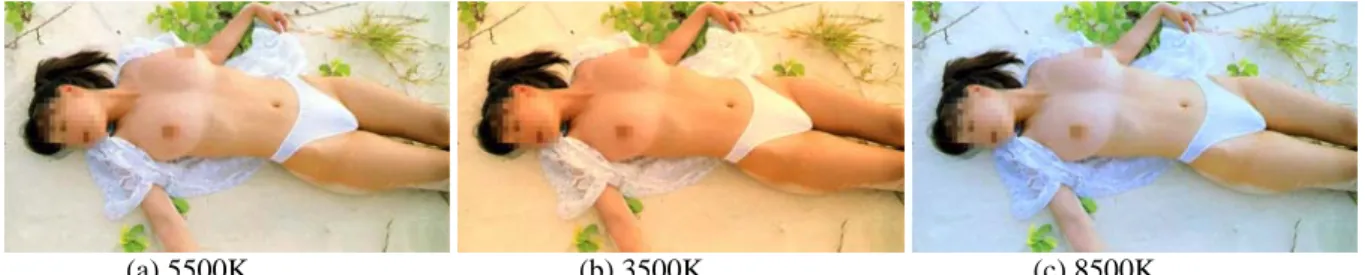
(2) individually. The distribution of human skin in the color space would also deviate with the different color temperature. If the skin color model cannot tolerate the deviation, a lot of naked images would be omitted. On the contrary, if the skin color model accommodates the deviation, a lot of non-skin objects like wood, desert sand, rock, foods, and the skin or fur of animals in the background of image would be detected in the skin detection phase and deteriorates the system performance. To develop a robust naked image detection system we emphasize two issues: the promotion of the skin detection accuracy and the use of low-level whereas reliable geometrical constraints on skin regions. For the skin detection part, we propose the skin tone sampling algorithm based on automatic white balance method. The goal of white balance is to correct the image such that it looks as if it is taken in the canonical light. First, the uniform skin chromatic distribution is established manually from the skin images taken under the canonical light. After the target image is corrected by the white balance method, the non-skin objects of the target image can be filtered out by the uniform skin chromatic distribution. As the performance of the naked image detection extremely depends on the accurate skin segmentation and there exist various non-skin materials with skin like chroma, these ambiguities should be excluded from as exhaustively as possible. An appropriate feature to play this role is the coarseness because the skin property is very smooth. Regions satisfying the above both conditions are called the smooth skin regions. Investigating a mass of adult images we induce several properties. First, for delighting viewers the protagonist area should be significant. Second, to harmonize with the frame the protagonist should appear around the center. Third, the aspect ratio of the human body should be in a reasonable range. To consider these properties simultaneously, the back propagation neural network is utilized to integrate them into a classifier to examine if the smooth skin region is a naked body. Subsequently, the face detection procedure is used to filter out the mug shot since it meets all the above requirements. Because the target image has been corrected by the automatic white balance method based on the canonical light, it means the skin color deviation resulting from the special lighting can be accommodated without sacrificing the accuracy. The utilization of the roughness feature can further reject confusion from non-skin stuff thus our skin detection approach can get not only high detection rate but also high detection precision. In addition, because of the extraction of geometrical constraints about naked bodies from the low-level primitives, which are more reliable, instead of the high-level ones, the overall system can achieve satisfactory naked image detection performance. In section two, the skin tone sampling algorithm based on automatic white balance method is introduced. The post-processing employed to enhance the system accuracy is presented in section three. Section four demonstrates the experimental results. Finally, we make conclusions in section five.. 2. Skin Tone Sampling Algorithm based on Automatic White Balance Method. Automatic white balance is one of the most important keys for an image to achieve high quality. Human eyes have the ability to adjust their spectral response to overcome the different color temperature conditions and achieve the color consistency, but the cameras do not. When a white object is illuminated under a low color temperature, it will appear reddish in the stored image. Likewise, it will appear bluish under a high color temperature. By our observation, most of the naked images utilize the characteristic of color temperature to alter skin color to make nude look more charming. However, skin color altering also makes the distribution of human skin color deviate in the color space. The Fig. 1 and Fig. 2 prove the results. The image taken under the 5500K for color temperature is shown as Fig. 1(a). The Fig. 1(b) and Fig. 1(c) show the images of Fig. 1(a) taken under the 3500K and 8500K. We obtain the three skin regions from Fig. 1(a), Fig. 1(b) and Fig. 1(c) individually. And, the area and position for the three regions are the same. Then, we choose the YCbCr to present the distribution of skin color. The Fig. 2 shows the results. In this figure, the red, green and blue zones show the skin color distributions of three skin regions for 3500K, 5500K and 8500K respectively. If the target image could be corrected by white balance method to the same canonical color temperature before segmenting the skin object, the drawback of skin color deviation would be warded off. Based on this consideration of color consistency, we proposed the skin tone sampling algorithm based on automatic white balance method.. 2.1. Automatic White Balance Method In this section, we will introduce the automatic white balance method. Generally, an automatic white balance method is divided into two steps. First is the estimation of the color temperature. The illumination condition is estimated by picking out gray color points from an image. The color of points has a little deviation under a noncanonical light source. Second, adjusting R channel gain and B channel gain to realize the automatic white balance adjustment. However, the crucial point is the estimation of color temperature, and its accuracy directly affects the second step’s correctness. Existing automatic white balance methods can be divided into two categories. First are the global algorithms that use all pixels of an image for color temperature estimation. Second are the local algorithms because only these pixels which satisfy some special conditions are concerned. The method adopted by our paper is based on the [6]. They proposed a novel method to decide the dynamic threshold to detect the reference white points in an image. According to our experiments, the correction effect of this method is excellent.. - 991 -.
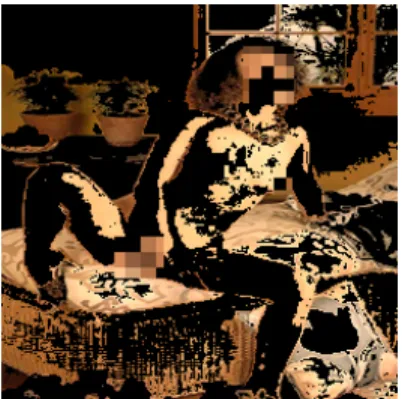
(3) checked. The post processes include the following four parts.. 2.2. The Uniform Skin Tone To separate the luminance component from the chromatic one, there are many color spaces can be chosen, such as TSL, HIS, YUV, CIE Lab, CIE Luv, and YCbCr etc. Because the YCbCr space performs this well we choose the CbCr components as the uniform chromatic distribution bases. For the establishment of the uniform skin chromatic distribution, we firstly collect the training images with human skin that are taken under the canonical light. Second, we utilize the categories of human skin in the training images to establish the uniform skin chromatic distribution, and denoted as H. An example is shown in Fig. 3. To fit the skin distribution more completely, the principal component analysis (PCA) is applied to H. We can get two eigenvectors and then obtain the minimum elliptic skin chromatic distribution containing H like Fig. 4. The fitting result is denoted as H e . The source’s image is shown in Fig. 5. It is segmented out by setting the pixels with chromas in H e to one and others are set to zero and the result is shown in Fig. 6. Then, the source’s image is corrected by automatic white balance. It is shown in Fig. 7. We use the above method to segment out the skin objects and the result is shown in Fig. 8. According to the comparison between Fig. 6 and Fig. 8, the correct ratio of skin detection is indeed improvable. For the image of Fig. 8, we also get its binary image and denoted as S. The performance of the naked image detection extremely depends on the accurate skin segmentation. Since the skin property is very smooth, we utilize the roughness feature to further reject confusion from nonskin stuff with skin like chroma. The roughness is calculated from the extreme number. First, we get an intensity image I from the test image. And, we create an extreme image X with the same size of I and each element is set to zero. For each pixel of I, if it is an extreme the corresponding element in X is set to one. Subsequently, the X is divided into blocks with size 8x8. If the extreme number of a block is less than a threshold value t, that block is set to one. Otherwise, that block is reset to zero. Therefore, the zero-block in X represents the rough region, whereas the one-block in X corresponds to the smooth region. The coarseness binary image corresponding to the Fig. 7 is demonstrated in Fig. 9. The smooth skin region SSR can be obtained by the multiplication of S and X. B. B. B. B. 3. The Post-processing. Part 1. Maximum Area Feature To further separate the body from the skin like background in the SSR we apply the opening operation for the SSR and get the outcome OSS. We locate the body area by picking out the maximum object, denoted as Max_O, from the OSS. The area of Max_O is denoted as AMO. The occupation ratio of AMO in I is viewed as the first feature. The maximum skin object area corresponding to the Fig. 7 is shown in Fig. 10. Part 2. Location Feature The location of Max_O is utilized to check if the area is close to the image center, we used the gravity center as the feature of location. Part 3. Shape Feature To make the explanation more convenient we use two figures for examples. Applying the principal component analysis (PCA) to the Max_O in Fig. 11, we can get two eigenvectors. By projecting the Max_O to the two eigenvectors, we can obtain a minimum rectangle containing the Max_O like Fig. 12. Assume the lengths of two sides of the rectangle R are L and W (and L≧W). The aspect ratio Q can be computed by: W_avg = Area(Max_O)/L (1) Q = L/W_avg (2) The aspect ratio Q is viewed as the third feature. Part 4. Mug Shot Verification We refer to [7] for detecting face from the Max_O. If the ratio of the face area to the Max_O area is less than a threshold value, the test image is viewed as a naked image. Otherwise, the test image is considered not a naked image.. 4. Experimental Results Images were collected from the Internet. There are 150 human naked images and 300 non-naked images. The naked set comprises Caucasians, Blacks and Asians. The non-naked set comprises clothed people, nature scenes, buildings, wood, foods, rock, desert sand, and animals. For the naked test images, the detection rate is 81%. For the non-naked test images, the detection rate is 93%. The overall correction rate is 89%.. 5. Conclusion. Investigating a mass of naked images we generalize several features. The first is that the body occupies a significant portion of the image. Second, the position of the body is almost near to the image center. Third, the body shape is usually not elongate too much. To consider these features simultaneously, the back propagation neural network is used to integrate them into a classifier. If the target image passes the classifier, the mug shot feature is. In this paper, we propose a new naked image detection algorithm. Our method enhances two issues. One is about how to overcome the chromatic deviation coming from the special lighting without at the cost of increasing false alarm. For this issue, we propose the skin tone sampling algorithm based on automatic white balance method to achieve it. The other issue is about how to use low-level whereas reliable geometrical constraints to further inspect. - 992 -.
(4) the skin regions. For this issue, we derive three geometrical primitives including area, position, and shape. Then, the back propagation neural network is used to integrate them into a classifier. Finally, the mug shot exclusion procedure is utilized to further promote the system performance. The experimental results show our method is satisfactory for naked image detection.. 6. References: [1].. [2].. [3].. [4]. [5]. [6].. A. Bosson, G.C. Cawley, Y. Chian, R. Harvey, “Non-retrieval: blocking pornographic images,” Proc. Intl. Conf. on the Challenge of Image and Video Retrieval, Lecture Notes in Computer Science, Springer-Verlag, London, 2383:50-60, 2002. B. Jedynak, H. Zheng, M. Daoudi, “Statistical Models for Skin Detection,” IEEE Workshop on Statistical Analysis in Computer Vision, in conjunction with CVPR 2003 Madison, Wisconsin, June 16-22, 2003. H. Zheng, M. Daoudi and B. Jedynak, “Blocking Adult Images Based on Statistical Skin,” Electronic Letters on Computer Vision and Image Analysis, Volume 4, Number 2, pp. 1-14, 2004 D.A. Forsyth and M.M. Fleck, “Body plans,” Conf. Computer Vision and Pattern Recognition, pp. 678-683, 1997. D. Forsyth and M. Fleck, “Automatic detection of human nudes,” International Journal of Computer Vision, 32(1), pp. 63-77, 1999. Ching-Chih Weng, Chen, H. and Chiou-Shann Fuh, “ A novel automatic white balance method for digital still cameras ,” IEEE International Symposium on Circuits and Systems, Vol. 4, pp. 3801-3804, 2005. Yao-Hong Tasi and Yea-Shuan Huang, “Fast Hierarchical Face Detection,” IEEE 2003 International Conference on Multimedia and Expo, pp. 301-304, 2003. T. T. [7].. (a) 5500K. (b) 3500K. (c) 8500K. Fig. 1: The images for the different color temperature.. Fig. 2: The skin chromatic distributions for the different color temperature.. Fig. 3: The skin chromatic distributions. - 993 -. Fig. 4: The elliptic skin chromatic distributions.
(5) Fig. 5: The Source Image.. Fig. 6: The skin objects of Fig.5.. Fig. 7: The corrected Image.. Fig. 8: The skin objects of Fig. 7.. Fig. 9: The smooth Image.. Fig. 10: The maximum skin object.. Fig. 12: The minimum rectangle containing the maximum object.. Fig. 11: The maximum object.. - 994 -.
(6)
數據
相關文件
• The start node representing the initial configuration has zero in degree.... The Reachability
On another level, though, the similarities to the research world are strong: you succeed by building networks, the glue that holds relationships together is the values that you
• Extension risk is due to the slowdown of prepayments when interest rates climb, making the investor earn the security’s lower coupon rate rather than the market’s higher rate.
• A delta-gamma hedge is a delta hedge that maintains zero portfolio gamma; it is gamma neutral.. • To meet this extra condition, one more security needs to be
• Extension risk is due to the slowdown of prepayments when interest rates climb, making the investor earn the security’s lower coupon rate rather than the market’s... Prepayment
• As all the principal cash flows go to the PAC bond in the early years, the principal payments on the support bond are deferred and the support bond extends... PAC
了⼀一個方案,用以尋找滿足 Calabi 方程的空 間,這些空間現在通稱為 Calabi-Yau 空間。.
In the algorithm, the cell averages in the resulting slightly non-uniform grid is updated by employing a finite volume method based on a wave- propagation formulation, which is very
