
Pergamon Printed Copyright in Great Britain. 0 1994 Eltier All rights reserved Science Ltd 0277-5387/W 57.00 + 0.00
SYNTHESIS, REDOX PROPERTIES AND REACTIVITIES OF
RUTHENIUM@) COMPLEXES OF l,l’-BIISOQUINOLJNE
(BIQN) AND X-RAY CRYSTAL STRUCTURE OF [Run(terpy)(BIQN)(C1)]C104 (terpy = 2,2’: 6’,
2”-TERPYRIDINE)
WING-YIU YU, WINGCHI CHENG and CHI-MING CHEt
Department of Chemistry, The University of Hong Kong, Pokfulam Road, Hong Kong and
YU WANG
Department of Chemistry, National Taiwan University, Taipei, Taiwan (Received 8 March 1994 ; accepted 10 May 1994)
Abstract-The syntheses of the complexes [Ru”(terpy)(BIQN)Cl]C104 (1) and [Ru” (terpy)(BIQN)(OH2)](C104)2 (2) are described. The structure of 1 has been established by X-ray crystallography. The dihedral angle between the two isoquinoline rings is 37.4”. In aqueous solution, [Ru”(terpy)(BIQN)(OH,)](ClO,), shows two reversible/quasi-reversible oxidation couples assigned to the oxidation of ruthenium(I1) to ruthenium(II1) and ruthenium(II1) to ruthenium(IV). [Ru”(terpy)(BIQN)(OH,)](ClO4), is an active catalyst for the oxidation of alkenes by PhIO.
2,2’-Bipyridine and its substituted derivatives are useful ligands for the generation of highly oxidizing Ru===O complexes.‘,2 Studies by Meyer and Che and their coworkers revealed that the ,??’ and reac- tivities of [Ru”(terpy)(L-L)O]‘+, (terpy = 2,2’, 6’,2”-terpyridine, L-L = substituted 2,2’-bipyri- dines) are affected by substituents on the 2,2’-bipyri- dine ring. ‘b*2d With 6,6’-dichloro-2,2’-bipyridine, which has an electron withdrawing substituent, it has been possible to prepare a relative robust and active ruthenium catalyst for alkane oxidation by tert-butylhydroperoxide.2dT3
We are interested in the coordination chemistry of 1, l’-biisoquinoline,4~S a ligand which has the combined structural features of 2,2’-bipyridine and 2,2’-bis(diphenylphosphino)-l,l’-binaphthyl (BINAP). Regardless of the numerous studies on binaphthylic ligands and their metal complexes in asymmetric organic synthesis,6 related studies on BIQN and its derivatives are sparse. The title ligand, because of its robust nature towards oxi-
tAuthor to whom correspondence should be addressed.
dative degradation and its potential C2 chirality, may be useful in the design of new RuzO catalyst for organic oxidation. Herein is described the synthesis, molecular structure and reactivities of some ruthenium(I1) complexes of BIQN. The [Ru (terpy)(BIQN)(H20)12+ complex has been found to catalyse alkene epoxidation by PhIO.
6 7 7’ 6’
EXPERIMENTAL Materials
RuC13 l 3H20 (Johnson Matthey) was used as
received. Trifluoroacetic acid (99O/,, Aldrich) was
2964 WING-YIU YU et al.
purified by distillation under nitrogen. Silver(I) tri- fluoromethanesulphonate and silver(I) perchlorate were dried in vucuo. Water was twice distilled from KMnO,. Isocarbostiril(98%, Aldrich) was used as received. Other common reagents were analytical grade. Iodosylbenzene was prepared by alkaline hydrolysis of iodosylbenzene diacetate (98%, Ald- rich). Ru(terpy)C1,7 and 1, 1 ‘-biisoquinoline4 were prepared by literature methods.
Syntheses
[Ru”(terpy)(BIQN)C1]C104 (1). A mixture of Ru(terpy)Cl, (0.2 g), BIQN (0.2 g), lithium chloride (0.1 g) and triethylamine (1 cm3) in aqueous ethanol (75% ethanol/water 25% v/v, 200 cm3) was refluxed for 4 h. The solution was filtered after cooling to room temperature. The volume of the filtrate was reduced to ca 15 cm3, and the complex was deposited as a deep purple solid which was collected on a frit and washed with distilled water (10 cm3). The perchlorate salt was obtained by the metathesis reaction of [Ru”(terpy)(BIQN)Cl]Cl with LiC104 in an acetone solution. The product was re- crystallized by slow diffusion of diethyl ether into acetonitrile solution (yield z 85%). RuC~~N~H~~C~~O~. MeCN, Found : C, 54.5, H, 3.2, N, 11.1. Calc.: C, 54.8, H, 3.4, N, 10.9%. UV- visible [in MeCN, I,,/nm (s,&dm3 mol-’ cm-‘)] :
273 (23,000), 316 (29,000), 370 (lO,OOO), 543 (9900). [Run(terpy)(BIQN)(H,0)](C104), (2). A mix- ture of [Ru”(terpy)(BIQN)Cl]Cl (0.1 g) and sil- ver(1) perchlorate (0.2 g) in aqueous acetone (75% acetone/25% water v/v, 25 cm3) was refluxed for 1 h. The resulting solution was filtered to remove the insoluble AgCl. The volume of the red filtrate was reduced to ca 5 cm3, and the mixture was cooled overnight in a refrigerator. The [Ru”(terpy) (BIQN)(H,O)](ClO,), complex was deposited as a dark-red microcrystalline solid (yield x 70%). RuC~~N,H,,C~,O~. Found : C, 49.4, H, 3.2, N, 8.5. Calc. : C, 49.1, H, 3.1, N, 8.7%. UV-visible [in 0.1 M CF3C02H, &,,,/nm (s,,,/dm3 mol-’ cm-‘)]: 272 (21,500), 315 (28,000), 380 (lO,lOO), 532 (10,300).
Oxidation of alkene by iodosylbenzene catalysed by an aqua-ruthenium(ZZ) complex
In a typical experiment, a mixture of alkene (0.1 g) and 2 (25 mg) in dichloromethane (10 cm’) was stirred at room temperature. Iodosylbenzene (0.1 g) was added to the mixture, which was then stirred for 8-l 2 h. A blank containing the same amount of solvent, substrate and iodosylbenzene but without the metal catalyst was simultaneously stirred under
the same condition. After addition of internal stan- dard, the aliquot was analysed by gas-liquid chro- matography, and the product yields were calculated based on the amount of iodobenzene formed. Physical measurements
Elemental analyses of the complexes were per- formed by Butterworth Laboratories. Infrared spectra were recorded in Nujol mulls on a Nicolet 20SXC FT-IR spectrophotometer and electronic absorption spectra on a Milton Roy 3000 spec- trophotometer. Cyclic voltammetry was performed with a Princeton Applied Research (PAR) Model 273 Potentiostat. For electrochemical measure- ments in aqueous solutions, the reference electrode was the saturated calomel electrode (SCE).
GLC analyses were done on a Hewlett-Packard model HP 5890 Series II Chromatograph equipped with a flame ionization detector. Quantification of gas chromatographic components were performed on a Hewlett-Packard HP 3393 Series II integrator. Capillary column model HP 17 (phenyl methyl crosslink) was used to analyse the oxidation prod- ucts of styrene, cyclohexene, cyclooctene and nor- bornene. Identification of the oxidation products of cis-/trans-stilbene were performed by ‘H NMR spectroscopy on a Jeol270 FT-NMR spectrometer with TMS as the internal standard. The singlet res- onance for epoxide protons of tram- and cis-stil- bene oxide are at 3.85 and 4.34 ppm respectively. Quantification of the oxidized products was done by comparing the singlet resonance for the methyl protons of m-toluic acid at 2.3 ppm.
X-Ray structure analysis
Complex 1: MeCN, C35H~aN&l~04Ru, A4 = 766.6, space group P2,lc, a = 15.825(5), b = 16.960(4), c = 12.198(2) A, /3 = 102.28(2)“, U = 3199(l) A3, D, = 1.59 g ~m-~, Z = 4, F(OOO) = 1552, ~(Mo-K,) = 6.97 cm-‘. The diffraction data (h, f k, f I; 5612 unique data) were measured at 24°C on a CAD-4 diffractometer (graphite-monochromatized MO-K, radiation, 1 = 0.7107 A) in the bisecting mode up to 2e,,, = 50”. Convergence for 4129 reflections ( 1 F0 1 >, 2.0~ 1 F,, I) was reached at RF = 0.044, R, = 0.035 and S = 2.85. The final difference map showed residual extrema in the range -0.570 to
+ 0.700 e A-‘.
The ruthenium atom was located from a Pat- terson map, and the coordinates of other non- hydrogen atoms were derived from successive Four- ier difference syntheses. All non-hydrogen atoms were subjected to anisotropic refinement. Hydrogen
Ru” complexes of BIQN
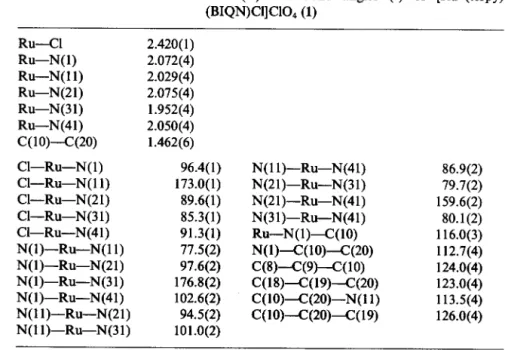
atoms were included at idealized positions with a fixed isotropic thermal parameter. Selected bond distances and angles are given in Table 1.
RESULTS AND DISCUSSION Synthesis, characterization and electrochemistry
There has been only one structural report on metal complexes of l,l’-biisoquinoline in which the ligand adopts a q2-p1 coordination mode. Previously, Dai and co-workers’ reported the prep- aration and molecular structure of a dinuclear pal- ladium(I1) complex with BIQN acting as a bridging ligand. Presumably, the unfavourable steric repul- sion between the H8 ad H8’ atoms of BIQN dis- favours it from acting as a chelating bidentate ligand. Recently, the synthesis and molecular struc- ture of [Pt(BIQN)Cld has been reported.* In this work, the preparation of [Ru”(terpy)(BIQN)Cl]Cl and [Ru11(terpy)(BIQN)(OH2)]2+ followed the reported procedures for the respective syntheses of [Ru”(terpy)(L”L)Cl]Cl and [Ru”(terpy)(L^L) (H,O)](CIO,), where L^L = bipyridine and substi- tuted bipyridine. In previous studies, Ru’“-0x0 complexes of polypyridines such as [Ru’“(terpy) (tmen)012+ (tmen = N,N,N’N’-tetramethyl-1,2- diaminoethane)9 and [Ru’“(terpy)(6,6’-Cl,-bpy)O] Cl04 (6,6’-C12-bpy = 6,6’-dichloro-2,2’-bipyri- dine)2d were prepared by Ce’” oxidation of the corresponding aqua-ruthenium(I1) complexes in aqueous solution. Similar reaction of [Ru” (terpy)(BIQN)(H20)](C10.J2 with Ce’” in water
was tried. A yellowish green product, presumably [Ru11(terpy)(BIQN)O](C104)2, was obtained. How- ever, this species is not long lived enough for full characterization and therefore no further study has been made.
Figure 1 shows the UV-visible spectrum of 2 in 0.1 M trifluoroacetic acid. The broad and intense absorption at &, = 550 nm is attributed to metal- to-ligand charge-transfer transition, d,(Ru) + P&terpy)/BIQN). Complex 2 exhibits similar electrochemical behaviour as [Ru”(terpy) (tmen)(H20)12+ 9 and [Ru”(terpy)(6,6’-Cl,-bpy) (H20)]2+.2d A typical cyclic voltammogram of 2 in aqueous solution with edge-plane pyrolytic graphite as the working electrode is shown in Fig. 2. At pH = 1 .l, a reversible couple (I) at 0.85 V vs SCE is observed, and it is assigned to Ru”‘/Ru”. The reversibility is based on the observed current ratio (i,,/i, x 1) and the peak-to-peak separations (A&, x 60 mV), both of which are independent of scan rates (5&200 mV s-l). An irreversible oxi- dation wave at 0.96 V vs SCE is also observed, and it becomes more reversible at higher pH. The .&? values for both couples shift cathodically by about 60 mV per pH unit as shown by the Pourbaix plots given in Fig. 3. With reference to previous studies on other oxo-ruthenium(IV) systems, the following electrode reactions are suggested :
Couple I
[Ru111(terpy)(BIQN)(OH)]2+ +H+ +e- e
[Ru”(terpy)(BIQN)(OH2)12+ (1)
Table 1. Selected bond distances (A) and bond angles (“) of [Ru”(terpy)
(BIQN)Cl]ClO, (1) Ru-Cl 2.420( 1) Ru-N( 1) 2.072(4) Ru-N( 11) 2.029(4) Ru-N(21) 2.075(4) Ru-N(31) 1.952(4) Ru-N(41) 2.050(4) C(lO)-C(20) 1.462(6) Cl-Ru-N( 1) 96.4( 1) N( 1 l)-Ru-N(41) 86.9(2) Cl-Ru-N( 11) 173.0(l) N(21)-Ru-N(31) 79.7(2) Cl-Ru-N(21) 89.6(l) N(21)-Ru-N(41) 159.6(2) Cl-Ru-N(31) 85.3(l) N(31)-Ru-N(41) 80.1(2) Cl-Ru-N(41) 91.3(l) Ru-N(l)X(lO) 116.0(3) N( l)-Ru-N( 11) 77.5(2) N(l)-C(lO)-C(20) 112.7(4) N(l)-Ru-N(21) 97.6(2) C(8)--C(9)-C(lO) 124.0(4) N(l)-Ru-N(31) 176.8(2) C(18)-C(19)-C(20) 123.0(4) N( I)-Ru-N(41) 102.6(2) C(lO)-C(20)-N(11) 113.5(4) N( 1 I)-Ru-N(21) 94.5(2) C(lO)-C(2O)-C(19) 126.0(4) N(l l)-Ru-N(31) 101.0(2)
2966 WING-YIU YU et al.
Wavelength/rim
Fig. 1. UV-visible absorption spectrum of [Ru(terpy)(BIQN)(OH,)]*+ in 0.1 M CF3C02H.
I I I I
1.2 0.8 0.4 0
hvvvs SCE
Fig. 2. Cyclic voltammogram of [Ru(terpy)
WQWOH,)12+ in 0.1 M CF3C02H. Scan rate = 100 mV s -’ ; working electrode, edge-plane pyrolytic
graphite electrode. l.O-
l
*\
“,
1.
0.8 -l
qpw4Im
0.6 -l
\l
\, .\. ‘wl
\ 0.4 - Ruo/(II) .\ 0.2 - I I I I I I I I 1 0 123456789 PHFig. 3. Pourbaix diagram for the Run’/Ru” and Ru’“/
Run’ couples of [Ru(terpy)(BIQN)(OH,)]*+ in aqueous
solutions.
Couple II
[Ru’“(terpy)(BIQN)O]‘+ +H+ +e- _
[Ru”‘(terpy)(BIQN)(OH)]2+. (2) Interestingly, the J!? values for both the [Ruiv
(~rpy)(BIQN)Q12+/[Ru~(terpy)(BIQN)(QH)lZ+
and
W”(terpy)Owy)Ol” I [Ru”‘(terpy)(bpy)(OH)l*+
lb
couples are comparable despite the difference in structural feature between BIQN and bpy.Structure af[Ru”(terpy)(BIQN)Cl]C104
Figure 4 shows a perspective view of the [Ru” (terpy)(BIQN)Cl] + cation with atomic numbering. The coordination around ruthenium is a distorted octahedron with the terpy ligand in a meridional configuration. As in the case of [Pt(BIQN)C12],8 the BIQN ligand adopts a q2-pI coordination mode. The measured dihedral angle of 37.4” between the two isoquinoline rings is close to the value of 37” found in the related Pt(BIQN)Cl,.’
Catalytic oxidation of alkenes by iodosylbenzene [Ru”(terpy) (BIQN) (H,O)] (ClO,), has been found to mediate oxidation of alkenes by PhIO at room temperature. The results of catalytic oxi- dation of alkenes are summarized in Table 2. No significant oxidation was observed. Addition of PhIO to a mixture of 2 and alkene in dichloro- methane did not cause any significant colour change, and at the end of every reaction PhI02 was obtained. Presumably, it was formed according to equation (3).
2967
C6
Fig. 4. A perspective view of the [Ru(terpy)(BIQN)Cl]+ cation.
[Ru”(terpy)(BIQN)(H~O)l(CIO,),
2 PhIO b PhI02 + Phi (3)
Oxidation of styrene gives styrene oxide and benz- aldehyde in a ratio of approximately 2 : 1. Chan- ging the solvent from dichloromethane to acetone increases the yield of benzaldehyde with the styrene oxide to benzaldehyde ratio becomes 1 : 1. No cata- lytic oxidation is observed when acetonitrile is used as solvent. This is not unexpected since aceto- nitrile is known to form a stable complex with ruthenium(I1).
Norbornene and cyclooctene are oxidized to exo- norbomene oxide and cyclooctene oxide respec- tively. Endo-norbomene oxide nor any rearranged products, norcamphor and 4-cyclohexene car- boxyaldehyde, were not detected. Oxidation of cis- stilbene gives both cis-epoxide and truns-epoxide in a ratio of 3 : 1. With cyclohexene, the reaction proceeds predominantly via allylic oxidation to afford cyclohexenone (26%), yet a significant yield
of cyclohexene oxide (12%) is found. This is in contrast to most stoichiometric oxidation of cyclohexene by monooxoruthenium(IV) where in most cases cyclohexenone and cyclohexenol are the only products.2d,‘o
For each reaction studied, more than 85% of the ruthenium complex was recovered. The styrene oxide to benzaldehyde ratio is sensitive to the amount of the catalyst used. When the catalyst loading is 6.2 mg, the yields of benzaldehyde and styrene oxide based on the amount of Phi formed are 16% and 1.6% respectively. Thus the ratio of styrene oxide to benzaldehyde is 1 : 10, which is significantly different from that of 2 : 1 when the amount of catalyst is 25 mg.
Figure 5 shows the time course plot for the oxi- dation of styrene. The reaction is completed within 4-5 h and no induction period has been observed. The rate of formation of styrene oxide (k,) and benzaldehyde (ki,) are 0.47 and 0.23 pmol min-’ respectively. The overall rate of consumption of PhIO (ktota,), monitored by the formation of Phi, is 3.67 pmol min-‘. The k, value is nearly twice that of kb and this is in line with the styrene oxide to benzaldehyde ratio of 2 : 1 found after the reaction.
The rate of disproportionation of iodosylbenzene (kdisp) to PhI02 and Phi is determined by stirring PhIO with 2 alone under similar reaction conditions, and is 3.0 pmol min-‘. The summation of k,, k,, and kdisp is 3.7 pmol min-‘. This value is close to the value k,,,, of 3.67 pmol min-’ described above. This suggests that there would be no reaction pathway other than epoxidation, C=C cleavage and PhIO disproportionation (Scheme I).
General comment
There are several reports on the use of ruthenium catalysts for the oxidation of alkenes in literature. Groves and co-workers” reported that truns- dioxoruthenium(V1) of tetramesitylporphyrin is capable of catalysing aerobic epoxidation of alkenes. Several catalyst/oxidant -systems such as RuCl, * 3H,O/IO; I2 and Ru’i-phosphines/OCl- or IO; or PhIO also promote oxidative cleavage of
PhI& + Phi LxsplvpoliioMtton
Styreoe + PM0 - Styrooe oxi& + Phi Epoddation
Benzddehydc + PM C=C deawage Scheme 1.
2968 WING-YIU YU et al.
Table 2. Results of oxidation of alkenes by iodosylbenzene in CHzClz catalysed by [R~**(terpy)(BIQN)(H~0)](C10~)~. Condition : Ru catalyst, 25 mg; alkene, O.lg;
PhIO, 0.1 g Substrate Solvent Norbornene dichloromethane cis-Cyclooctene dichloromethane Cyclohexene dichloromethane trans-Stilbene dichloromethane cis-Stilbene dichloromethane Styrene dichloromethane Styrene acetone Products (yield %) exo-2,3-epoxynorbomane (36%) cis-cyclooctene oxide (21%) cyclohexene oxide (12%) cyclohex-2-01 (9.7%) cyclohex-Zone (26.6%) trans-stilbene oxide (28%) benzaldehyde (9%) cis-stilbene oxide (11.5%) truns-stilbene oxide (3.9%) benzaldehyde (22.6%) styrene oxide (26.7%) benzaldehyde (16.2%) styrene oxide (21%) benzaldehyde (19%)
“Products were identified and quantified by gas chromatography, and the yield
is based on the amount of iodobenzene formed.
360 r
I
IodobeaEelleFig. 5. Plots of the amount of organic products versus time for the oxidation of styrene by PhIO in dichloro-
methane with [Ru(terpy)(BIQN)(OH,)](ClO& as cata-
lyst.
C=C bondsI We have also reported that an aqua- ruthenium(I1) complex such as [Ru”(terpy)(6,6’- Cl,-bpy)
W,0)1 ‘+ 2d
(66’~Cl,-bpy = 6,6’-dichloro- 2,2’-bipyridine) catalyses oxidation of alkenes by tert-butylhydroperoxide.It has been our long term goal to develop a cata- lytic oxidation cycle via a non-porphyrin ruthenium-oxo intermediate (Scheme 2). Based on the result of electrochemical studies, the [RtP (terpy) (BIQN) (O)]” complex, if generated, should be a competent oxidant. However, in the present study, [Ru’“(terpy)(BIQN)(O)]*+ should not be the sole reactive intermediate. Here, oxidation of cis- stilbene is non-stereospecific. This is quite incom- patible with that found in the stoichiometric oxi- dation of cis-stilbene by most Ru’“=O complexes of polypyridines where in most cases cis-stilbene oxide is the major product. This marked dis- crepancy cannot justify an oxo-ruthenium(IV) intermediate alone.
2969
F%I
PhIO
Scheme 2.
Epoxidation by PhIO is not necessarily initiated
by a redox-active metal complex. Valentine and co- workersI showed that some non-redox active metal salts can also catalyse alkene epoxidation by iodo- sylbenzene. The catalytic ability was explained on the basis of the Lewis acidity of the metal ion. It has been suggested that oxidation could be initiated through coordination of PhIO to a metal ion.
Here we found a Ru”-aqua complex of l,l’-biiso- quinoline, which can mediate alkene epoxidation by PhIO. Because of the potential C, chirality of the chelating BIQN, it may be of interest to prepare optically active ruthenium(II)-BIQN complexes. However, attempts to resolve the [Ru (terpy)(BIQN)(H,O)]*+ complex have so far been unsuccessful.
Acknowle&ements-We acknowledge support from the
Hong Kong Research Grants Council and The Uni- versity of Hong Kong. W.-Y. Yu is the recipient of a fellowship administered by the Sir Edward Youde Foun- dation. W.-C. Cheng acknowledges the award of Crou- cher studentship administered by Croucher Foundation, Hong Kong. 6. 7. 8. 9. 10. 11. REFERENCES 12.
(a) B. A. Moyer and T. J. Meyer, Znorg. Chem. 1981, 13.
20,436 ; (b) A. Llobet, P. Doppelt and T. J. Meyer,
Znorg. Chem. 1988, 27, 514; (c) A. Dovletoglou, S. 14.
A. Adeyemi, M. H. Lynn, D. J. Hodgson and T. J. Meyer, J. Am. Chem. Sot. 1990,112,8989.
(a) C. M. Che, K. Y. Wong, W. H. Leung and C.
K. Poon, Znorg. Chem. 1986,25,345 ; (b) C. M. Che and W. H. Leung, J. Gem. Sot., Chem. Commun.
1987, 173 ; (c) C. M. Che, W. H. Leung and C. K.
Poon, J. Chem. Sot., Chem. Commun. 1987, 1376 ; (d) C. M. Che, C. Ho and T. C. Lau, J. Chem. Sot.,
Dalton Trans. 1991, 1901; (e) C. M. Che, W. H.
Leung, C. K. Li and C. K. Poon, J. Chem. Sot.,
Dalton Trans. 199 1, 379.
T. C. Lau, C. M. Che, W. 0. Lee and C. K. Poon,
J. Chem. Sot., Chem. Commun. 1988,1406.
M. Tiecco, L. Testaferrii, M. Tingoli, D. Chianelli and M. Montanucci, Synthesis 1984,736.
L. X. Dai, Z. H. Zhou, Y. Z. Zhang, C. Z. Ni, M. Z. Zhang and Y. F. Zhou, J. Chem. Sot., Chem. Commun. 1987, 1760.
R. Noyori and H. Takaya, Act. Chem. Res. 1990,23, 345.
B. P. Sullivan, J. M. Calvert and T. J. Meyer, Znorg. Chem. 1980,19,1404.
L. K. Cheng, K. S. Yeung, C. M. Che, M. C. Cheng, and Y. Wang, Polyhedron 1993,12,1201.
C. Ho, T. C. Lau and C. M. Che, J. Chem. Sot., Dalton Trans. 1990, 967.
W. K. Seok, J. C. Dobson and T. J. Meyer, Znorg.
Chem. 1988,27,3.
J. T. Groves and R. Quinn, J. Am. Chem. Sot. 1985, 107,579o.
C. Eskenazi, G. Balavoine, F. Meunier and H. Rivi- ere, J. Chem. Sot., Chem. Commun. 1985, 1111. M. Bressan and A. Morvillo, Znorg. Chem. 1989,28, 950.
(a) R. B. VanAtta, C. C. Franklin and J. S. Valentine,
Znorg. Chem. 1984,23,4121; (b) Y. Yang, F. Died-
erich and J. S. Valentine, J. Am. Chem. Sot. 1991, 113,7195.
![Fig. 1. UV-visible absorption spectrum of [Ru(terpy)(BIQN)(OH,)]*+ in 0.1 M CF3C02H](https://thumb-ap.123doks.com/thumbv2/9libinfo/8681308.197213/4.781.174.637.77.347/fig-uv-visible-absorption-spectrum-ru-terpy-biqn.webp)
![Fig. 4. A perspective view of the [Ru(terpy)(BIQN)Cl]+](https://thumb-ap.123doks.com/thumbv2/9libinfo/8681308.197213/5.783.65.377.84.452/fig-perspective-view-ru-terpy-biqn-cl.webp)
~](https://thumb-ap.123doks.com/thumbv2/9libinfo/8681308.197213/6.781.150.633.150.677/table-results-oxidation-alkenes-iodosylbenzene-chzclz-catalysed-terpy.webp)
