Hydrogenic
impurity
states
in quantum
dots
and quantum
wires
D.
S.
Chuu,C.
M. Hsiao, and W.N.
Mei*Department
of
Electrophysics, National Chiao Tung University, Hsinchu, Taiwan, Republicof
China(Received 14 January 1992;revised manuscript received 24March 1992)
The energies ofhydrogenic impurity states with an impurity atom located at the center ofaquantum
dot and on the axis ofaquantum-well wire are studied. These two systems are all assumed to have an infinite confining potential. In the caseofthe quantum dot, the impurity eigenfunctions are expressed in
terms ofWhittaker functions and Coulomb scattering functions. The calculated ground-state energy of
the impurity approaches the correct limit ofthree-dimensional hydrogen atom as the radius ofthe quan-tum dot becomes very large. In the case ofthe quantum-well wire, analytical solutions can be obtained if
we divide the space into atwo-dimensional subspace (perpendicular to the axis ofthe quantum-well wire) and a one-dimensional subspace (parallel tothe axis ofthe quantum-well wire). The calculated ground-state energy ofthe quantum-well wire approaches the ground-state energy ofthe shallow-impurity atom located on the surface as the radius ofthe wire becomes infinite. Variations ofthe state energies with the radius ofthe quantum dot and the quantum-well wire are obtained.
I.
INTRODUCTIONIn the past ten years, impurity states in various confined systems, such as quantum wells, quantum-well wires, and quantum dots, have been a subject
of
extensive investigations in basic and applied research. ' Quasi-two-dimensional (quasi-2D) quantum wells have been widely studied and applied to various semiconductor de-vices, such as high-electron-mobility transistors. Quasi-one-dimensional systems, such as quantum-well wires, are known to have the advantageof
high mobility and suppressionof
carrier scattering. The emission line for quantum well wires was observed to be two to three times broader than thatof
the two-dimensional quantum wells and occurred at 6—
10-meV higher binding energy.Studies
of
quantum dots or quantum-we11 wires are very interesting problems because specific propertiesof
these lower-dimensional structures can be easily achieved by varying the radiusof
the quantum dot or the quantum-well wire. An electron bound to an impurity atom located at the centerof
the quantum dot or on the axisof
the quantum-well wire may appear to be unaffected by the boundary when the radius is very large and behaves very much like an impurity atom in the three-dimensional case. However, as the radius is re-duced, spatial confinement begins tocause the kinetic en-ergyof
the electron to increase due to the uncertainty principle and eventually it may overcome the attractive potential between the electron and the impurity atom; thus the total energy may change from negative to posi-tive at a certain radiusof
the confining system and finally diverges to infinity as the radius approaches zero. More-over, the effective strengthof
the Coulomb interaction between the electron and the impurity atom depends on the geometric dimensionof
the system and isenhanced as the sizeof
the system is reduced. Thus, in quantum-well wires or quantum dots the effective strengthof
the Coulomb interaction can be changed by varying the ra-diusof
the quantum-well wire or the quantum dot.Con-versely, dramatic changes in the binding energies may serve as a clear signal for changes in the effective dimen-sion
of
quantum-well wires orquantum dots.Upon reduction
of
the geometric dimension, the confinementof
electron motion becomes a pronounced effect. The physical propertiesof
electrons in quantum-well wires or quantum dots are thus very different from those in the bulk. The impurity state in aquantum-well wire (or a quantum dot) has a spectrum composedof
sub-bandsof
one- (or zero-) dimensional single-particle states. Each subband is continuous as a functionof
the wave vector and the energy gap between subbands is deter-mined by the splittingof
the levels in the confining sys-tern. The densityof
state (DOS)of
electrons in each sub-band is proportional toE'
for the bulk and is a con-stant for agiven quantum well. The DOS isproportional toE
' for a quantum-well wire, while it behaves like a 5function for a quantum dot.Many theoretical works have been devoted to the study
of
the propertiesof
impurity states in various confining systems. Lee and Spector have calculated the bind-ing energies for the bound statesof
a hydrogenic impuri-ty placed on the axisof
a cylindrical quantum-well wireof
infinite confining potential. Later, Bryant ' im-proved the model calculation by assuming afinite barrier for the confining potential with the impurity on and off the axisof
the cylinder wire. The binding energies forthe bound statesof
hydrogenic impurity in a quantum-well wireof
GaAs surrounded byGa,
Al As have been found to be 2—3 times larger than those in comparable two-dimensional wells.' In the calculationof
the hydro-genic impurity states, a variational principle with a trial wave function which takes into account the confinementof
the carriers in the quantum-well wire or the quantum dot was usually employed. ' ' Zhu, Xiong, and Gu' used hydrogenic-effective-mass theory to study donor states in a spherical GaAs-Ga& Al As quantum dot.Exact
solution and quantum-level structures were ob-tained. In the investigationof
the behaviorof
the46 HYDROGENIC IMPURITY STATES IN QUANTUM DOTS
AND.
..
3899 genlike impurity states in a small quantum-well wire, theeffects
of
disorder were also taken into account. ' Zhao etal.
studied the collective excitationsof
edge-state electrons in a quasi-one-dimensional quantum-well wire under a large transverse magnetic field. The plasmon modes for both intrasubband and intersubband excita-tions were found. Briggs and Leburton'
employed a Monte Carlo simulationof
multisubband quasi-one-dimensional quantum-well wire. In their calculation, effectsof
polar-optical-phonon and inelastic acoustic-phonon scattering have been included. Although many works have investigated various aspectsof
the electronic properties in the lower-dimensional structures as men-tioned above, a full theoretical understandingof
these bound states and their binding energies isstill lacking.In this paper we present a detailed formulation for the state energies
of
a hydrogenic impurity located at the centerof
a quantum dot and or a quantum-well wire. Variationsof
the state energies with the radiusof
quantum-well wires and quantum dots are presented.BR+2
BR+
1 A,L(L+1)
4 (4)
where A,
=2pZe
/equia
and R(aa)=0.
If
we further write R (g)=
g'F(g),
thenEq.
(3) can be rewritten asr
-'
—(L+
l)'
F"(g)+
—
—
+
—
+
4
g g2F(g)=0
. (5)Equation (5) is the Whittaker equation with the solu-tions as
states is possible. Therefore, one can study solutions
of
the Schrodinger equation in two regions. (1)For
E
&0,
the solutions can be expressed in termsof
%hittaker functions. (2}For
E
)
0, the solutions can be expressed in termsof
the Coulomb-scattering wave functions, as can be seen in the following:(1)Negative-energy region,
E
&0.
We first set)=a,
r, witha
= —
8pE/A &0.
ThenEq.
(3) becomesII.
FORMULATION A. Quantum dotConsider a hydrogenic impurity located at the center
of
a spherical dot which is confined by an infinite spheri-calpotential well with radiusa.
The Hamiltonianof
this system can be written asV
—
+
V(r)
2p H' where 0,r(a
V()='
„)
F2L(g)=e
~ g+'4(L
+1
—
A,,2L+2,
g),
orF
(g)—
e—g/2(L+1—
X4(
L+1
—
—
A,,2L+2—
,g),
where4
isthe conAuent hypergeometric function4(a,
b,x)
=1+
—
a—
x
+
a(a+1)1
x
2+
b 1 b(b
+
1)2!
a(a+1)(a+2)
(a+k)1
b(b
+
1)(b
+2)
(b+k)(k
+1)!
xx
k+1+
Hence, R (g)
of
Eq. (4) can be expressed as(6a}
(6b)
(6c)
and
p,
e,andZ
are the effective mass, dielectric constant, and core charge.V(r)
is the confining potential. The Schrodinger equation forH
in spherical coordinates(r,8, p) for
r
&acan be written as orR(g)=g
'F&L(g)=e
~~ g4(L+1—
A,,2L+2,
g),
(7a)a'
2a'
1 a . a sinO 2p Brrs„r
sin8 ~8=e
&~ g 4&(L+1
—
A,, 2L—
+2,
g) .—
(7b)+
2p Qy.2r
BrL(L+1)
Ze=
ER
(r),
(3)with R
(a)
=0.
Since the motionof
the electron is confined inside the dot, the existenceof
positive boundB2
Z2
+
+
—
qI=EV
(2)r
sin OByand
0'(r
=a,
8,
y)
=0
because the potential is infinite forr
&a.
%'(r,8,g)
may be separated into the product R (r)8(8)g(q&),as in the caseof
the hydrogen atom,8(8)
is the associated Legendre polynomial, andg(y)
=e'
m=0, +1,
+2
... .
The differential equation for the radi-al part R(r)
can be obtained as follows:Since we require the wave function to be finite every-where, the wave function must bein the form
of
Eq. (7a) forL
)
0
or Eq.(7b)forL
&0,i.e.
,R
(g)
=e
~ g'I @(ILI+
1—
A.,2IL+2,
g').
(7c)4(L
+1
—
A.,2L+2,
aa)
=0
and the total energy
of
the system may begiven as pZ2e4262/2 g2
(8) Because
I.
represents the total angular momentum, which is always positive, ~L~ can be replaced byL
in the above solution. The valueof
A, can be determined from theboundary condition R
(g=aa)
=0,
which isequivalent to settingIt
is easy to prove that4
is an even functionof
A.; thus,we need only consider the case where A,
)
0.
(2} Positive-energy region,
E
&0.
First setg=ar,
wherea
=
2p—E/fi
&0;
thenEq.
(3) becomesB'
2B
2p Brr
BrL(L+1)
R(
) ZeR(
)=0
r2 E'r (16) 8 R 2 BR 2i}L(L+1)
where n
=
pZ—e /equia
and R(aa
)=0.
If
we further set R (g)=g
'F(g),
thenEq.
(10)becomesComparing with the modified Bessel equation
2
By
Byx
+(1
—
2s)x+[(s
—
ya
)+a
yx
jy=0,
Bx
F"(g)+
1— —
F(g)
=0
.Equation
(11}
is a Couloinb equation. ' The solutionsof
Eq. (11)
areF„L(g)
andG„I (():
F„z(g)=e
'&g+'4(L
+1
i',
2L—
+2,
2ig),
(12a)Ro(r)
=r
'
J
21/2
8pZe r
eR (18)
we obtain s
=
—,', y=
—,',
a
=(8mZe
)/(eiii ), anda =(2L
+
1) . Thus, the radial function forL=0,
which isfinite as r~0,
can be written asG„L(g)
=FI
(ri,g)In(2()+
+8L(i},
g),
PL r} (12b)
To
satisfy the boundary conditionRo(a)=0,
we require thatwhere
4
is the confluent hypergeometric function as shown inEq.
(6c).F„r
(g) can be expressed in another form as(SpZe /eh' )a
=x;
where
x;
are rootsof
the Bessel functionJ1.
The radial function forL
=
1can be written asF,
,i(k}
=k'
"c'I.
(n0»
where
41
(ri,g)is defined as(12c)
Ri(r)=r
'J
2 1/2 8pZe r equi (19) R(g)=g 4L(i},
g) . (13)The value
of
g can be determined from the boundary con-ditionCLg,
",
pZe
a—
—
0,
eA g
and the total energy
of
the system may begiven asA L( )gk L—
i-k=L+1
withAL+1=1,
AL+i(i})
=ri/(L
+1)
and
(k
+L
(k
L
—
1)
Ak=—
2riAk,
(i})
—
Aki(i})
for
k)L+2.
SinceG„L(g)
is singular at(=0,
onlyF„L(g)
is used as the solutionof
the system. Hence, R(g} of Eq.
(10)may be written asB.
Quantum wireConsider now an impurity located on the axis
of
an infinitely high cylindrical quantum well with radius d. The Hamiltonian for this system can be expressed as+
Bx By AB2I
IBzZ2
+
V(p),
er (20a) The boundary conditionR,
(a)
=0
y~~ld~SpZe /equi )a
=y;
where y; are the roots
of
the Bessel functionJ3.
After substituting the valuesof x;
and y; we can obtain the turning points.For
example, 1s-state energy becomes positive when the radius is less than1.
8325ao and 2p-state energy becomes positive when the radius is less than5.
088 31ao,where ao isthe Bohr radius. From the above discussion, one can also note that the core charge and effective mass will effect the valueof
the turning point and a larger effective mass or core charge will yield a smaller turning pointof
the energy.pZ2e4 1
2E.2g2 ~2 (15) where
Since 4&L
(i},
g) is an even functionof
il, we only need to considerg)
0.
(3) The turning point in energy from
E
&0
toE
&0.
The turning point for the bound-state energy changing from positive tonegative can be obtained by settingE
=0
in Eq. (3):0,
p~d
I'(p)=
')d
and
r
=(x
+y
+z
)',
p=(x
+y )'~;
m, and mi are the transverse mass and longitudinal massof
the electron inside the well; eis the dielectric constantof
the wire ma-terial; and Ze is the core charge. The axisof
the wire isHYDROGENIC IMPURITY STATES IN QUANTUM DOTS
AND.
.
. 3901 along the zdirection.To
solve the Schrodinger equationfor the Hamiltonian defined in
Eq.
(20a),we first perform a coordinate transformation:x
=x',
y=y',
z=(m,
/m()'/ z'
. The Hamiltonian inEq.
(20a) then becomesrepresents aquantum-circle system in which a
2D
hydro-genic impurity islocated atthe centerof
an infinite circu-lar well. The solutions for this quantum-circle problem can be obtained in a similar way as discussed in the preceding section. The eigenfunctions for the quantum-circle system may be divided into two cases.(1)
For
E
&0,
Z2
,+I'(p')
.
(20b) ip(02)( ~ )—
)/24(lmI+1/2 g X@(
lml+I
—
~,
21m1+2,
g);
(23a)H
=H()1(p)+H()2(a)+H
(a
p)
where (20c) Here,r'=(x'
+y'
+z'
)'/
andp'=p=(x'
+y'
)'
For
convenience, we shall drop the prime forthe coordi-nate variables from now on. Now we rewrite the Hamil-tonian in the following form:(2)for
E
)
0,'(x,
y;a)=g
4
)/2(g,g),
(23b) where4
)/2(g, g) is defined inEq.
(12d}. The turning point for the energy fromE
)
0
toE
&0
in the quantum-circle system may be determined, as in the caseof
the quantum dot, by setting(}'
pe'
H()1(P)=
2m Qz ezf2
Q2 Q2 H()2(a)=
+
2mt ~z ~y 2 2 2 peae
ze 6z 6p 6rae
+
v(p),
6'p (20d) (20e) (20f) and d 'J
0 2 '1/2 8pZ
d'
=0
for m=0,
eA ' 1/2 8p
Z
d'
=0
for m=1.
eA0,
p~d
I'(p)=
')d
and
a
andp
are the unknown parameters which are to be treated as variational parameters and can be determined later. DecomposingH
into Hpi and H02 inEq.
(20c)is equivalent to dividing the space into two-dimensional (perpendicular to the axis) and one-dimensional (parallel to the axis) subspaces. Letus takeHp(a, p)
Hpi(p)+H02(a)
as the unperturbed Hamiltonian and regard
H'(a,
p)
as the perturbation term (which can be adjusted as a small term by varying the parametersa
andp).
The unper-turbed ground-state wave function and the unperturbed ground-state energy for the HamiltonianHp(a, P)
may be written as(I)(lml+1
—
A,,2lml+2,
ad)=0
.
(2}
For
E
&0,
(23c)
@m
—
1/2(9~ad }The eigenvalues may then be given as E(p2)( ) )MZ2e4 1
2/2 g2
(23d)
(23e)
The first-order energy correction can now beobtained as
EEg"(a,
p)=()pg
'(r;a,
p)lH'(a,
p)l%''(r;a,
p) )
The requirement that )Il'
'(x,
y;a)
=0
at boundaryof
thecircle implies the following: (1)
For
E
&0,
)p''(r;a,
p)=%'
"(z'p))p'
'(x
y'a)
E(0)(p)
—
E(01)(p)+E(02)(
(21a) (21b) Ae=
()P('(x,
y;a)
)Ii( 2)(x,y;a)
)
respectively, where (11'
"(z;p)
is the ground-state wavefunction
of
the 1D hydrogen atom (Hp, ), and'(x,
y;a)
is the ground-state wave functionof
the 2D hydrogen atom in a circular well (H02).For
the 1D hy-drogen atom, the eigenfunction and eigenvalueof
the ground state may be given asZe
—
()Il''(r;a,
P)
)Ii')(r;a,
P))
.
(23f)EP
The second term on the right-hand side (rhs) in the above equation can be integrated analytically togive
'Pg
"(z;P)=&2co
lzl exp(—
colzl),
4 mte E(01)(p) (22a) (22b)
(
2 mte4'"'('p
=
'p'
ez (23g)where
co=(2m,
e /eA }P The Hami.ltonian inEq.
(20e)The third term
of
Eq.
(23f}can be reduced to a one-variable integral and readily integrated over ztogivef
(Q2
3/2)2 2 —2coz R (p)pdp2 dz[x
+y
+(m
/m )z]'
=(2''3~~)2
f
R2(p)
dp ~—,'[Nr
r(2''p)
N—„+,(2''p)]
0—
—,'[H„,
(2''p)
—
H
+,
(2''p)+m.
'(p/2)'[1
(v+
—,'
)]
']
',
(23h)where
co'=(ml/m,
)co;H„(p) andN„(p)
are the Struve functions and Neumann functions, respectively. Using Eqs. (23g) and (23h), and after performing some numeri-cal integrations, the total-state energy, up to the first-order correction, may in principle be obtained asE (a,
P)=E'
"(P)+E'
'(a)+QE'"(a,
P),
(23i) which contains parametersof
a
andP.
The optimum valuesof
cc andP
can be determined by noting that the total HamiltonianH
in Eq. (20b) or (20c)does not con-tain the parametersa
orP
so that the exact eigenvaluesof H
should be independentof
a
andP.
However, in most cases occurring in practice, one cannot obtain the exact eigenvaluesof
the Hamiltonian H, and only an ap-proximate solution is attainable. Thus, in the perturba-tion treatment, the valuesof
a
andP
can be chosen so that the approximate total-energy eigenvalue inEq.
(23i) should be least sensitive to the parametersa
andP.
This is equivalent to the following conditions:BE„BE„
=0
and=0
.Ba (24)
By using Eq. (24), the values
of
a
andP
can be deter-mined. Thus, the total-state energyof
the quantum wire can beobtained.III.
RESULTSAND DISCUSSIONSFigure 1 shows the variation
of
the calculated 1s(n
=1,
L
=0),
2s (n=2
L
=0),
and 2p (n=2
L
=1)
CC 10— O lD CJI Q)c
5—);:I
15 2s 2p l ''~.W I I 1Q 15Radius (uni ts of ao)
FIG.
1. 1s-, 2s-,and 2p-state energies ofa hydrogenic impuri-ty located atthe center ofaconfining sphere as a function ofthe radius ofthe confining sphere. %'*and ao are the effectiveryd-berg energy and the effective Bohr radius.
Eb E&o Eo (25)
where
E,
o isthe ground-state energyof
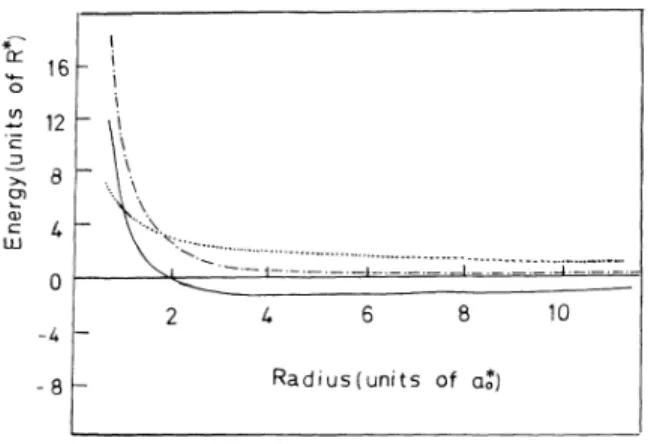
the spherical well without the impurity and Eo is the ground-state energy with the impurity inside the we11. Figure 2 presents theEb Eo and
E
&o as a functionof
the dot radius r. SinceE
&o is proportiona1 to the reciprocalof
the squareof
thedot radius, one can see that
E,
o is large except when thewell width isvery large. The corresponding binding ener-gy
of
the Coulomb potential is proportional to the re-ciprocalof
the radiusof
dot. One can note that Eb ap-proaches a large value as rbecomes very small, since the -state energiesof
a hydrogenic impurity located at the centerof
a quantum dot for the given dot radius. The en-ergy is expressed in termsof
the effective Rydberg%*=e
/(2eao ), where@=K'
Ep is the dielectric con-stantof
free space, and the radius is expressed in termsof
the effective Bohr radius (ao=e
/(pe
), where@=a,
mo, witha,
the ratioof
the effective massof
electrons in different material to the bare electron mass. In the calcu-lation, the mo and E'p are assumed to be the free-electronmass and dielectric constant
of
free space. One can see from the figure that the energyof
the 1s state becomes negative when the dot radius is larger than1.
833ao and approaches1%',
which is the energyof
the n=1
state for the free-space hydrogen atom. The energyof
the 2s state becomes negative as the dot radius becomes larger than6.125ao.
As the radiusr
becomes larger than15ao,
the energyof
the 2s state in the quantum dot approaches the value0.25%'
of
the 2sstate in the free space. A simi-lar situation can be observed in the caseof
the 2p state. The 2p stateof
the spherical dot has positive energy as the radius becomes smaller than5.088ao.
These two states are degenerate in the free hydrogen atom and split from each other as the radiusof
the dot becomes smaller than8ao.
While the radiusof
the dot is larger than 10a o, they become almost degenerate and approach0.25%",
which is the energyof
the n=2
state for the free-space hydrogen atom. One can also note that as the radiusof
the quantum dot decreases, the state energy in-creases. Furthermore, the energy increment forthe excit-ed state is much more pronounced than thatof
the ground state. As the radius r approaches zero, the state energy increases infinitely.The binding energy Eb
of
the hydrogenic impurity is defined as the energy difference between the ground-state energyof
the spherica1-well system without the impurity and the ground-state energyof
the spherical-well system with the impurity,i.
e.,46 HYDROGENIC IMPURITY STATES IN QUANTUM DOTS
AND.
. .
3903 l 16— O 12 CXl Lc
LU 10 Radius(units of ci,*)FIG.
2. The 1s-state energy (solid line), binding energy (dot-ted line), and kinetic energy (i.e., without the impurity, brokenline) of the hydrogenic impurity located at the center of a
confining sphere as the functions ofthe radius ofa confining
sphere.
electron is pushed toward the center
of
the spherical well by the confining potential asr
approaches zero. Chu, Xiong, andGu'
performed a hydrogenic-effective-mass theory to calculate donor-state energies in a spherical quantum dot.To
compare their result with ours, com-pareFig.
1of
Ref.
17with the broken curvesof
ourFig.
2. For
an infinite-potential well, the ground-state energy without the impurity obtained by Chu, Xiong, and Gu is around2.
5%'
1.
5%',
1.
0%',
and0.
SJ7'
for adot radiusof 2ao,
2.5ao,
3ao,
and4ao,
respectively. These results agree completely with our corresponding values shown inFig. 2. To
compare the ground-state binding energy for both works, one notes that the results forVo=
Do do notdiffer much from
V0=80%"
or40%*
for a dot radius larger than 2ao in the workof
Chu etal.
Therefore, we may compare the results shown inFig.
2of Ref.
17with the dotted curveof
ourFig. 2. For
example, one can see our calculated binding energy is around2.
6A'
and2.
0%'
for a dot radiusof 2.
0ao and3.0ao,
which are in very good agreement with those obtained by Chu, Xiong, andGu.
' The same degreeof
agreement exists between our first excited state and thatof
Chu, Xiong, and Gu. From Figs. 1 and 2of Ref.
17,one may easily find the excited-state energy without the impurity and the excited-state binding energyof
the quantum dot. The difference between these two values yields the excited-state energyof
the impurity located inside the dot. The excited-state energyof
Chu, Xiong, and Gu can be ob-tained easily as-3.
5%*,
1.
9%*,
and1.
3% for adot ra-diusof 2ao, 2.5ao,
and3.
0ao,
respectively. These values are in good agreement with ours shown in the dotted curveof
Fig. 1.
Consider now a donor located at the centerof
a GaAs quantum dot. From ourFig.
2,one ob-tains the ground-state binding energyEb-4.
6%=24.
4 meV for the dot radius R=
lao (Eb=
1%*=5.
3 meV for R=
~
).
Ferreira da Silva' calculated the impurity states in a quantum-well wireof
GaAs-Ga& Al As. They ob-tained the ground-state binding energy EI,-24
meV for a wire radiusof
lao.
The fact that theground-state-O
8-E Ch
c
4 GaAs---—
InAs 6 8 10 4 ~ ~ 0 % 4 4 p&dius(units of ao)FIG.
3. The 1s-state (L =O,n=1)
energy (in meV) ofahy-drogenic impurity located at the center ofsemiconductor GaAs (dashed line) dot and InAs (solid line) dot as a function ofthe radius ofthe dot. ao isthe effective Bohrradius.
impurity binding energy
of
a quantum dot isalmost equal to thatof
a quantum-well wire reflects the fact that the geometrical difference becomes less important as the ra-diusof
the dot or wire becomes equalto
the radiusof
the impurity atom.Figure 3presents the ground-state energies
of
an im-purity atom located in GaAs and InAs quantum dots. The valuesof a,
and a area,
=0.
067 and~=13.
13 for GaAs, anda,
=0.
023 and~=14.
6 for InAs. FromFig.
3,one can see that our calculated ground-state energiesof
an impurity located in GaAs and InAs quantum dots for a very large radiusof
the confining system approach the correct limits5.
3 and1.
47 meV for the bulk GaAs and InAs semiconductors.In the case
of
the quantum-well wire, insteadof
spheri-cal symmetry, there is cylindrical symmetry. Figure4
shows the ground-state energyof
a hydrogenic impurity located on the axisof
a cylindrical wire as a functionof
the wire radius. As the radius becomes very large, the impurity should behave like a free hydrogen atom with the ground-state energyof
1 Ry. However, our resultshows that for larger radii, our calculated energy ap-proaches
0.
22 Ry, not 1 Ry. The inconsistency is dueto
the dividing
of
the space into two orthogonal subspaces. The 1D subspace (the one-dimensional hydrogen atom) requires that the electron wave function vanish at posi-tion z=0,
while in the real case the electron wave func-tion should vanish at the wire surface. This means that the methodof
dividing the space into 1D and 2D sub-spaces forces the creationof
an additional node at z=0
plane. This is equivalent to saying that we considered a half-cylindrical wire. Thus, as the radiusof
the half-cylindrical wire becomes very large, our ground-state en-ergy should approach the ground-state energyof
a surface-impurity system. In the surface-impurity case, the lowest state isthe 2PO stateof
the free hydrogen atomdue to the surface selection rule. This explains why our ground-state energy for the quantum wire is
0.
22 Ryin-lA CFl L CLl 2— IJJ
)
0) E 4 C) C7) EV C LLI Radius(units ofao*) 1 T 4 6 8 Radius(units of a',)FIG.
4. The ground-state energy (solid line) and the binding energy (broken line) ofa hydrogenic impurity located at the axis ofa cylindrical wire asa function ofthe radius ofthe wire.%*
and ao are the effective rydberg and the effective Bohr radius.
FIG.
5. The ground-state energy (in meV, solid line) and thebinding energy (in meV, broken line) ofa hydrogenic impurity
located at the axis ofa silicon cylindrical wire as a function of the radius ofthe wire. ao isthe effective Bohr radius.
stead
of
1Ry. Figure 5 shows the ground-state energyof
a hydrogenic impurity located at the axisof
a Si quantum wire. When the radius is very large, our calculated ground-state energy approaches the ground-state energy10.
7 meVof
the surface impurityof
a Si semiconductor. On the contrary, the binding energies for the Si bulk semiconductor is around 28.6 meV. Bryant' used a vari-ational trial wave function to calculate the binding ener-gyof
ahydrogenic impurity placed on the axisof
a cylin-drical quantum-well wire. He found a setof
even and odd z-parity states. The binding energyof
the lowest odd z parity state is lower than thatof
the lowest even z parity state. When the wire radius becomes very small, Bryant found that the binding energyof
the lowest even z-parity state approaches 1Ry. To
compare our quantum wire shown inFig.
4 with thoseof
Bryant, ' one should note that our results are similar to the odd z-parity caseof
Bryant because our wave function vanishes at z=0,
which is equivalent to the caseof
the odd z-parity wave functionsof
Bryant.' The binding energiesof
the lowest even z-parity state for GaAs wi.re in the workof
Bryant (Fig. 2of Ref.
10) are around 5.0%',
3.4R*,
2.2%*,
and1.
9%* (1%'
=
5.3 meV) while the binding energiesof
the lowest odd z-parity state are around1.
0%*, 0.7%*,
0.
6%',
0.
55%*,
and0.
4%'
for the wire radius equals to0.
5ao,
1Oao,1.5a0,
2.0ao,
and3.
0a0(lao
—
100 A—
200ao).
Our corresponding results shown in Fig. 4 are around1.
1%",0.
7537*,0. 65%*,
0. 59%',
and0. 5%'
for the wire radii equal to
0.
5ao, 1.0ao, 1.5ao, 2.0ao,
and3.
0ao.
Therefore, our results agree very reasonably with thoseof
the lowest odd z-parity state.IV. CONCLUSION
We obtained the analytical solutions for the state ener-gies
of
an impurity located inside a quantum dot and a quantum wire. A methodof
dividing the space into a one-dimensional subspace and a two-dimensional sub-space has been employedto
solve the impurity-state ener-gies for a quantum wire. Whittaker functions and the scattering Coulomb wave functions are used in the caseof
quantum dots.It
is found that as the radiusof
the quantum dot or the quantum-well wire becomes very large, the eigenenergies approach the corresponding state energiesof
the free-space hydrogen atom and become positive when the radiusof
the dot or wire is small. Al-though the present method has only been applied to infinite-confining-potential systems, when the confining potential is finite, one may employ an approximate method for the finite well or use direct numerical calcu-lation.ACKNOWLEDGMENT
This work was supported by National Science Council, Taiwan, Republic
of
China.Onleave from University ofNebraska, Omaha, Nebraska. ~R. Dingle, H.L.Stormer, A.C.Goassard, and W. Wiegmann,
Appl. Phys. Lett. 33,665(1978).
2H. Sakaki, Jpn.
J.
Appl. Phys. 19, L735 (1980);P.M. Petroff, A. C. Gossard,R.
A. Loan, and W. Wiemann, Appl. Phys. Lett. 41,645 (1982)~P.
F.
Yuh andK.
L.Wang, Appl. Phys. Lett. 49,1738(1986). 4J.Lee and H. N. Spector,J.
Appl. Phys. 54, 3921 (1983);57,366(1985).
5V.
K.
Arora, Phys. Rev.B23, 5611 (1981).6M.A.Reed,
J.
N.Aggarwal,R.
J.
Matyi,T.
M.Moore, and A. E.Wetsel, Phys. Rev.Lett. 60,535(1988).7Ch. Sikorski and U.Merkt, Phys. Rev. Lett.62,2164(1989). 8G.W.Bryant, Phys. Rev.B37,8763(1988).
G.W.Bryant, Phys. Rev.B 31,7812 (1985). oG. W.Bryant, Phys. Rev.B29,6632(1984).
J.
W. Brown and H. N. Spector,J.
Appl. Phys. 59, 1179 (1986).E.
A. de Andrada e Silva,I.
C.da Cunha Lima, and A. Fer-reira da Silva, Phys. Rev.8
37,8537(1988).'
F.
A.P.Osorio, M. H.Degani, and O.Hipolito, Phys. Rev.8
37,1402(1988).
' MH.Degani and O.Hipolito, Phys. Rev. B35, 9345 (1987).
46 HYDROGENIC IMPURITY STATES IN QUANTUM DOTS
AND.
.
.
3905' T.Kodama, Y.Osaka, and M.Yamanishi, Jpn.
J.
Appl. Phys.24, 1370(1985).
J.
L.Zhu,J. J.
Xiong, andB.
L.Gu, Phys. Rev. B 41,6001 (1990).' A.D'Andrea and
R.
Del Sole, Solid State Commum. 74, 1121 {1990).' A. Ferreira da Silva, Phys. Rev.B 41,1684(1990).
H. L.Zhao, Y.Zhu, L.%'ag, and S.Feng, Phys. Lett. A 142, 36(1989).
S.Briggs and
J.
P.Leburton, Phys. Rev.B
38, 8163 (1988).22A.Gold and A.Ghazali, Phys. Rev.B41,7626(1990). Y.Z.Hu, S.W. Koch, and D.
B.
TraThoai, Mod. Phys. Lett.B4, 1009(1990)~
Y.Zhu and S.Zhou,
J.
Phys. A21,1361(1988).25L.Banyai,
I.
Galbraith, C.Ell, and H.Haug, Phys. Rev.B36, 6099(1987).T.
Kodama andY.
Osaka, Jpn.J.
Appl. Phys. 25, 1875{1986).W.
Y.
Lai and S.DasSarma, Surf. Sci. 170, 43 (1986). SK.B.
Wong, M. Jaros andJ.
P.Hagon, Phys. Rev.B35,2463{1987).
J.
Cibert,P.
M.Petrol; G.J.
Dolan, D.J.
%'erder, S.J.
Pear-ton, A.C.Gossard, andJ.
H.English, Superlatt. Microstruct. 3,35(1987).3oA.Jeffrey, Table
of
Integrals, Series, and Products (Academic,New York, 1980),p. 1059.
3~Handbook
of
Mathematical Function With Formulas, Graphs,and Mathematical Tables, Natl. Bur. Stand. Appl. Math. Series No. 55, edited by A. Abramowitz and
I.
A. Stegun, (U.S.GPO, Washington, D.C., 1964), Chap. 14,p. 538.32S.Wolfram, Mathematica, ASystem forDoing Mathematics by
Computer (Addison-Wesley, Reading, MA, 1988).