September 2013
Let’s “Read Their Lips”!: An Empirical Study Probing the
Effects of Adopting Shadowing in an EFL Classroom
Shih-fan Kao
Abstract
This study probed into the effects of shadowing on students‘ listening comprehension, speaking proficiency and their response to and attitudes towards the skill. Subjects consist of 28 freshman students from a private technical college with lower intermediate to intermediate level of English proficiency and the participants are given a weekly 20-minute lecture for two semesters. All participants took a TOEIC test on the listening and speaking sections before and after the experiment. Paired-samples t-test was conducted to check the statistical significance in the participants‘ pre and post mean scores. In addition, if the mean scores reach statistical significance, the eta squared may suggest the correlation between shadowing and post test, and shadowing skill can further explain the measures of variance in the scores. Individual interviews were conducted to survey participants' attitudes towards shadowing. After one-year shadowing lecture the results indicate that 28 participants have shown significant improvements in their listening comprehension and speaking proficiency. The eta squared also suggests that shadowing has significant effect on the improvements. Moreover, the qualitative findings also indicate that the participants hold more positive attitudes towards shadowing lecture in terms of language improvements, motivation to learn, and changes in English learning. As a result, the findings suggest that shadowing is an effective method to provide EFL learners with enormous amount of language input and opportunities for spoken English. The paper concludes with discussions of the pedagogical implications of the research findings, author's views on the shadowing and the limitations of the study.
Keywords: Shadowing, listening comprehension, speaking proficiency, EFL, interpretation
Assistant Professor, Department of Applied Foreign Languages, Jinwen University of Science and
Technology.
第八期,頁 111-134 二○一三年九月
讓我們一起來『跟述』吧!:
一個檢測在英語教室裏使用跟述效果的實驗研究
高士凡
摘要
本論文的主要目的在檢試課堂上使用跟述方法來增進英語聽說能力的效果,並 了解學生對於跟述教學的反應與態度。二十八位時為一私立科技大學應英系一年級 的學生參與本研究,參與者的英文程度為中初級至中級,他們接受為期一學年的跟 述練習(每週二十分鐘)。參與者在跟述教學的開始前及結束後均接受多益聽說測 驗。在資料分析方面,成對樣本 t 檢定來檢測前測與後測的帄均數是否有統計上顯 著的不同。此外,如帄均數達統計上的顯著不同,規模效應值(eta squared)也用來進 一步檢定跟述教學與後測進步成績之間的關聯強度,及進步成績有多少的變異量可 由跟述教學來解釋。二十八參與者也個別接受一次訪談以了解他們對跟述教學的態 度及看法。統計結果顯示出:在經過一年的跟述教學後,二十八參與者在英語聽說 能力均有顯著的進步;規模效應值也顯出跟述教學對此顯著的進步有重大的影響。 另外,訪談的質性資料也顯示參與者在語言上的進步、動機興趣的提升、英語學習 的改變三方面均表達他們對跟述教學的正面態度與想法。因此,本論文的結果指出: 跟述教學是有效的英語習得方法,能提供大量的語言輸入和口說機會。最後,本論 文也探討研究結果可給予的教學啟示,作者本身對跟述教學的觀點,和研究本身的 限制。 關鍵詞:跟述、英語聽力、英語口語能力、英語為外國語言、口譯 景文科技大學應用外語系助理教授。 到稿日期:2013 年 7 月 10 日;確定刊登日期:2013 年 11 月 12 日;最後修訂日期:2013 年 11 月 25 日。Introduction
It is a great idea to state the background and purpose of this study with my own personal experience and story. Having been out of school for eight years, I decided to go to an American university in the Midwest for graduate studies. As a non-English major (political science) in college, I was truly worried about my general English proficiency. I was especially worried about my speaking ability since I would study in an English-related field, Teaching English to Speakers of Other Languages (TESOL). A senior Taiwanese couple (Walter and Yvonne) who had a great command of English (both of their TOEFL1 scores were over 650 in the pencil-and-paper version) kindly offered me an original learning method: speaking what I hear while watching a TV program or a movie. They told me that they had been watching TV programs (especially 30-minute sitcoms standing for situation comedies) three hours a day since they had arrived in the United States. Moreover, they repeated what the characters said and mimicked the tones and intonations immediately after they heard the words. I was very surprised at Yvonne‘s speaking fluency; she was one of a few people I met who spoke English almost like a native speaker though she was raised and educated in Taiwan and had never been to an English-speaking country until she was 25. Walter, who was a then doctoral student in industrial engineering, jokingly called this approach ―read their lips.‖ The couple highly recommended this method to me because it worked wonderfully for them.
In my days (the 1980s), ―repeat after me‖ was widely used by English teachers in Taiwan and it is still popular in some ESL/EFL (English as a second/foreign language) classrooms. However, I had never heard of the ―read their lips‖ method. It was very novel to me. Because I really admired the couple‘s English proficiency, I tried to ―read their lips‖ since then, and I, in addition to heavy loads of graduate studies, watched TV shows almost two hours a day. That was in 1998, September. During those days, sitcoms like
Family Matters, Friends, Seinfeld, Will and Grace, etc. were my favorites. In addition, the
campus cable programs had many reruns of previous popular sitcoms such as Family Ties (the most popular TV sitcom during the 1980s), Saved by the Bell, and Doogie Howser,
M.D. These sitcoms were wonderful material for English learning. The shows were
incredibly hilarious, and the language in them was plain and easy to understand in terms of the linguistic aspects and culture background. However, listening was one thing, and speaking (―reading their lips‖) another. I understood at least over 70% of these shows. However, at the beginning, I could hardly repeat over 30% of what I heard though I already had a TOEFL score of 603. I did ―read their lips‖ almost every day and was not sure (or noticed) if I was making great strides in listening or speaking. By doing it on a daily basis, gradually I could simultaneously repeat 70%-95% of what I heard in a sitcom, depending on the speed, length, and clarity of the language. Also, I did notice that I spoke faster and did not have to first organize a sentence on my mind every time I spoke English. In other words, being able to speak English more intuitively, I did not think about grammar and sentence structures too much, as I usually did before, every time I produced an utterance. More interestingly, I found that doing ―read their lips‖ actually helped me not only pay more attention to listening and speak more fluently but also organize what I heard and understand the meanings better. After one semester, I went to New York City to
1
TOEFL stands for Test of English as a Foreign Language. For the past five decades, it has been a mandatory, standardized proficiency test for non-native speakers who want to go to college (both at the undergraduate and graduate level) in the United States. The admission scores varied from school to school and program to program. During the 1990s, the admission scores for graduate school usually ranged from 550 to 600 (with 677 the highest).
visit my friend studying law at New York University. When hearing me speaking English in some public places, she said that she was very surprised at my improvements in speaking because it had been just one semester.
After finishing my graduate studies for a few years, I gradually found that Walter‘s so-called ―read their lips‖ method is actually also known as ―shadowing,‖ one of the most commonly used methods in the training of professional interpreters. In fact, previous research studies showed that shadowing could improve language learners‘ speaking ability in terms of intonation, accent, speed, and even a sense of collocations (Mackintosh, 1991). For years, I have been reflecting on my own experience and thinking about how to adopt shadowing in my own class because many Taiwanese students do not have many chances to speak English even in the classroom, let alone outside the classroom. Shadowing provides students with both large amounts of listening input and many opportunities to produce English output.
For these reasons, this study was conducted to probe whether or not shadowing can improve the listening and speaking ability of students with low-intermediate or intermediate levels of English at a private technological university. Moreover, it also investigated into participants‘ attitudes and reactions toward to the shadowing method used in an English conversation class.
Literature Review
It is necessary to first mention interpreting before we review Shadowing. Generally speaking, interpretation or interpreting is a type of product of communication from one language into another language. When doing interpretation either consecutively or simultaneously, interpreters hardly have time to entirely digest their input and they usually have to make an instant reaction (interpretation) of the aural input (Bathgate, 1985).
With the advent of advanced technology, the whole world has become a global village. International relations rely more on cross-cultural communication now than ever. In other words, interpretation is in great demand for the reasons of politics, economy, etc. For this reason, interpreters play an important role in this global communication. To train qualified or professional interpreters, many institutes and universities offer a wide variety of courses and training programs on interpreting at either undergraduate or mostly, graduate level.
For interpreters, bilingual (or multilingual) language proficiency is certainly crucial and mandatory though it is more than just language ability that makes a highly professional interpreter. Many researchers proposed different methods, techniques or activities for interpreting programs to enhance interpreters‘ language ability (Lambert, 1992; Mackintosh, 1991; Van Dam, 1989; Wu, 1999). These programs have one thing in common: They all include Shadowing as a basic and important method to improve interpreters‘ language proficiency and interpreting skills.
What is Shadowing exactly? It means that the trainees of interpretation or interpreters repeat verbatim what they hear immediately after listening to the aural input, often without waiting for the completion of a meaning unit, or even a word in a sentence. The repeating could be the native language of the trainees/interpreters or a foreign language though it often refers to the latter.
Originally, Shadowing was used to treat stuttering, which is a disorder affecting the fluency of speech, in the field of language or speech therapy. The stutterers follow the words spoken by the speech therapist. Shadowing produced dramatic results in speaking fluency (Kelham & McHale, 1966). The studies showed that 90% reduction in stuttering occurred under some conditions like Shadowing (Andrews et al, 1982; Guitar, 2005).
Later, Shadowing is usually included in a training program of interpretation because the interpreters, like stutterers, also have to listen and speak at the same time. In addition, research showed that the ability to shadow the input of a foreign language could be a strong predictor of a person‘s potential to become an efficient simultaneous interpreter (Lambert, 1992; Schweda Nicholson, 1990).
Here it should be noted that there are differences among interpreting, Shadowing, and traditional repetition drills (―repeat after me‖ or ―repeat after the CD‖) in the ESL/EFL classroom. Interpreters often listen to one language (source language) and speak another language (target language) with the same meanings of the source language. However, while also listening and speaking at the same time, people who are doing Shadowing do not take the source language ideas and convert them into the target language structures. In other words, both the source language and target language are involved in interpreting, whereas there is only the source language involved in Shadowing. In this case, the language output is different (Lin, 2009).
In addition, the main difference between traditional ―listen and repeat‖ drills and Shadowing is that in the former method, students listen while usually looking at a written script and repeat after listening to a complete sentence by often looking at the script too, while, in the latter, students listen without looking at a written script and repeat word by word without waiting for the completion of a sentence (Lin, 2009). That is, with the traditional repetition, students just read a sentence out loud by looking at the words of the sentence. Students pay less attention to listening since they can look at the words. On the other hand, with Shadowing, students need to listen more attentively because there are no written words they can look at, and almost speak out the sentence they hear simultaneously. Thus, compared to the traditional ―listen and repeat,‖ Shadowing is a more demanding task in listening and speaking though it does not involve reading.
For these reasons, Shadowing is almost always a compulsory training technique in interpreting courses due to its nature of simultaneity (listening and speaking a language at the same time). It is believed that Shadowing can train both pre-service and in-service interpreters to eliminate distraction when listening and speaking at the same time and to improve pronunciation and enunciation (Schweda Nicholson, 1990).
Since Shadowing (listening and speaking simultaneously) imposes a certain load on the cognitive capacities of the shadower, it is an acquired skill and is more than just listening and speaking (Lambert, 1991). For this reason, researchers provided instructors, trainees, interpreters, or even people who just want to practice Shadowing to enhance their language proficiency with some considerations. First of all, shadowers‘ language proficiency should be taken into consideration. Mackintosh (1991) suggested that the materials chosen for Shadowing should be fairly slow and easy. Also, the chosen materials are preferably representative of the work that interpreters will be performing (Schweda Nicholson, 1990). For example, with many international meetings on business, interpreting instructors should choose topics, dialogues, and texts related to business meetings, participants and situations involved.
Second, a common problem with Shadowing is that shadowers are easily, especially at the beginning stage of practice, distracted by the sound of their own voice (Schweda Nicholson, 1986). This is particularly true when people are shadowing a second or foreign language together in a classroom. On the other hand, Shadowing in one‘s native language tends to be much easier for the beginners than in a second or foreign language. For this reason, it is methodologically better to begin with Shadowing in the native language. It will also slowly but surely help trainees or shadowers without advanced level of foreign language proficiency build confidence.
trainees before they start to try it on their own. After explanations and demonstrations by instructors, shadowers might still have some problems and cannot identify them on their own. In such cases, Schwweda Nicholson (1990) suggested instructors demonstrate what shadowers are doing and what shadowers should be doing. Instructors are responsible for clear and correct Shadowing techniques.
As discussed above, imitating other people‘s speaking and shadowing aloud provides learners with a great deal of oral practice to improve speaking fluency, and it is a good way to practice pronunciation and intonation patterns (Graves & Graves, 1994). Actually, Shadowing also provides learners with large amounts of aural input from listening and the concept of input is ―perhaps the single most important concept‖ in the field of second language acquisition (Gass, 1997, p.1). Without input, successful second language acquisition cannot happen at all (Wong, 2003). Thus, in the field of interpretation, Shadowing is considered an elementary skill, taught to help pre-service interpreters feel comfortable with concurrent listening and speaking, and served as the preparation for consecutive or simultaneous interpretation. Although Shadowing has received much attention in the field of interpretation, it has not received much notice in the ESL/EFL education yet. I recently read Lin‘s study (2009) about exploring the effectiveness of Shadowing in an EFL program in a junior high school in Taiwan. Based on an EFL project, Lin taught English to 25 eighth graders (with a beginning level of English proficiency) by using the Shadowing approach for five weeks (a total of 25 hours). The results showed that the Shadowing program helped the participants improve their listening and speaking. However, few studies about utilizing Shadowing in the English classroom to enhance students‘ aural and oral skills have generally been conducted across all the educational levels in Taiwan. Similarly, there is a paucity of empirical research regarding how Shadowing can be applied in the English classrooms of technological universities as well.
As a result, this study was conducted to explore the possibility and outcome of using Shadowing in an EFL classroom at a private university of science and technology. It aimed to find answers to two research questions:
1. Are there significant improvements in listening comprehension and speaking proficiency after the student participants received the one-year treatment of Shadowing? In other words, does Shadowing have a significant impact on participants‘ progress in listening comprehension and speaking proficiency?
2. What are the students‘ attitudes and reactions toward the one-year treatment of Shadowing?
Method
For most researchers, generalizability is often one of the major concerns in research. However, generalizability is not just about an adequate sample size. Merriam (1998) suggested that a thorough description of the context, setting, and participants is helpful to those who are interested in making decisions about whether generalizability could be suitable in other settings. Dornyei (2007) also thought that after an appropriate description of the research sample, readers could better decide whether the generalization of the findings is legitimate. For these reasons, this methodology section has four subsections. The first two depict the participants and context of this study, and instruments and materials adopted, both of which can add to the generalizability of the findings presented afterwards (Creswell, 2009, 2012). The latter two describe the procedures during the data collection, and data analysis summarizing the procedures of data processing.
Participants
The participants were 28 first-year applied-English majors, including seven males and 21 females, at a private university of science and technology in Taipei. All the 28 participants were taking an intermediate, two-hour English conversation class under the instruction of the author of this paper during the 2010 academic year. Due to the nature of the course, the English conversation class was conducted in a language laboratory where it had audio and visual equipment. The age of the student participants ranged from 18 to 20. Judging from their entrance exam scores, their English proficiency was considered low-intermediate to intermediate level (C. L. Kwan, personal communication, September 28, 2010).
In addition, the 28 student participants had some common background. First of all, they all started to learn English no later than ten years of age, with some doing it before six. For this reason, all the participants had learned English in regular schools at least over eight years before this study was conducted. Moreover, though majoring in different disciplines previously in vocational high schools, they all were interested in English after going to college and hoped that they would pursue careers related to the English language such as English teachers, translators or interpreters, flight attendants, and receptionists in a foreign company. Last, they had never been taught or heard of the Shadowing method while all of them had been taught the traditional ―repeat after me‖ method in elementary or high schools.
The teacher researcher (thereafter the instructor)2 in this study worked as the instructor teaching the English conversation class as well as the researcher conducting this research data with regard to Shadowing. He had already been teaching English-related classes for eight years when this study was being conducted. As a lifelong EFL learner, he usually tried various activities to stimulate his and students‘ motivation to keep acquiring English and use the language outside the classroom. One of his major goals in English education was that his students would keep using the English language after leaving his classroom and even school. This was the first time he adopted Shadowing in his own classroom based on his personal experience and previous studies as discussed in the first two sections.
Instruments and Materials
Shadowing Materials. The considerations of adopting Shadowing discussed aforementioned indicate that the content of the Shadowing material should be easy (because students need to listen and speak at the same time) and relevant to students‘ life or jobs (because students would be greatly motivated by something they are interested in). Furthermore, the language and recording speed of the materials should be suitable for students‘ level of language proficiency. For these reasons, the instructor adopted six articles from an EFL book Reading People for Better Reading (Brand, 2009). The difficulty level of the adopted articles (an intermediate level) was close to that of the participants‘ textbook adopted in the conversation class. Brand‘s book included 28 terse biographies of influential people. The instructors let the student participants choose six biographies they preferred because self-selected materials would certainly motivate their learning. The student participants chose biographies of Barack Obama (the President of the US), Aung San Suu Kyi (the democracy fighter in Myanmar), J. K. Rowing (the
2 Researchers have different opinions on if using the first singular pronoun is appropriate in a research
study. Generally, most researchers agree that using a neutral term is more suitable for a quantitative study such as an experimental study, whereas using the first singular pronoun a qualitative study such as an ethnographical study (Creswell, 2009). This study adopted a mixed methods approach combining the quantitative with qualitative methods. However, to be neutral and consistent, ―the instructor‖ was used throughout the Method section.
author of Harry Potter series), Jerry Yang (the founder of Yahoo), Michelle Kwan (the figure skating champion), and Tiger Woods (the leading golfer). All six influential people that interested the 28 student participants were living people who were famous and often made headline news. The six chosen articles were also in audio form on a CD recorded by native speakers of English.
Syllabus for the Shadowing Treatment. The Shadowing treatment lasted for one academic year. The English conversation class ran two hours per week and there were 36 weeks during the entire academic year. Generally speaking, the instructor and the student participants completed one biographical reading via the Shadowing method only using five weeks. In other words, the participants shadowed another new article every five weeks. Every week, the instructor spent the first 20 minutes of the weekly conversation class leading the participants to practice Shadowing on a selected article to improve listening ability and speaking fluency.
Before anything went further, the instructor explained what Shadowing was and modeled it every time he asked the student to do a new activity. For example, the instructor, at the beginning, showed participants how to shadow a short Chinese passage (both the instructor and participants‘ native language was Chinese) and asked the participants to practice in the same way to have a clear idea about what Shadowing is. Then the instructor shadowed a short and easy English passage and again asked the participants to do the same thing.
After the participants knew better what Shadowing was and why they would do in the first 20 minutes of each class meeting, they started to shadow the chosen articles mentioned above. Take the class meeting using the first paragraph of the Obama article (see Appendix A) for example. For each class meeting, there were usually four major steps involved in order to shadow a paragraph.
First of all, the instructor showed the text of the target paragraph of the Obama article on the monitors and played the recording of the paragraph to the participants two to three times to make sure that they identified the pronunciation of words in the paragraph. It should be noted that the class was conducted in a language laboratory; for this reason, every student had a monitor in front of him/her. Also, in this step, the instructor briefly explained some linguistic items, cultural background that the participants might not be familiar with, and the meaning of the paragraph.
Then, still with the text of the paragraph on the monitors, the instructor played the recording and led the participants to read aloud the paragraph two times by looking at the text on the monitors. For the first time, the instructor played the recording of a sentence, paused the recording, and read aloud the sentence, and then the participants repeated that sentence. The second time both the instructor and participants read aloud all the sentences in the recording together without any pauses. It should be noted that the first practice in this step was similar to ―repeat after me‖ and the second was like simultaneous Shadowing except for looking at the text. The purposes of this step were to try to match the participants‘ visual words with audio words and let them speak aloud to train their tongue muscles.
Third, the instructor completely turned off the monitors and guided students to shadow the recording consecutively. In other words, the instructor played the recording, paused after one complete sentence, and asked them read it aloud. This time, the participants practiced ―consecutive‖ Shadowing without looking at the written text.3
3 The instructor coined the word ―consecutive‖ here. From previous studies concerning Shadowing, we
cannot find a collocation of consecutive Shadowing. It seems that in the field of interpretation, Shadowing is supposed to be simultaneous. However, the instructor thought the step of ―consecutive Shadowing‖ would lay the groundwork for the participants to do ―simultaneous Shadowing.‖
Last, still with no text on the monitors, the instructor played the recording without any pauses, and asked the participants to put on the earphones and shadow what they heard simultaneously. When the participants put on earphones and shadowed what they heard individually, the voice interference from others would have been reduced to a minimum. While students were shadowing what they heard, the instructor was also walking around the classroom (to check if every student opened his/her mouth) as well as shadowing what he heard with the class (to encourage students to do Shadowing). This step was actually the Shadowing method usually included in the training program for professional interpreters. However, these 28 student participants could not compare to professional interpreters or trainees in terms of background knowledge and English proficiency. For these reasons, the first three steps were very important to let the participants shadow the target paragraph without much difficulty eventually. In fact, the first three steps took less time than the instructor had expected maybe because the difficulty level of the text suited participants‘ level of English proficiency. Depending on the time allowed, the participants often did simultaneous Shadowing two or three times.
Overall, each class meeting went through the above four steps. Usually, one to two paragraphs of an article was covered each week depending on the length of the paragraph, and one article was completed after five weeks. After one article was done, the instructor sent the entire article with its audio file to the participants via the school digital system. It was hoped that the participants would shadow the completed article(s) on their own as many times as possible outside the classroom. During the year of the treatment, the instructor always encouraged the participants to do this: If they felt that they had not spoken any English today, just shadow the completed article(s) a few times to train their oral fluency (actually, it trained their listening comprehension as well while doing this).
In the first article (the Obama article), a few student participants still had difficulty keeping up with the recording speed simultaneously. However, they all did much better and shadowed what they heard more fluently after the first Shadowing article. After one academic year, the participants finished shadowing the six self-chosen biographical articles of influential people in class.
Pre-test and Post-test. The pre-test was administered before the one-year treatment of Shadowing. The pre-test was a proficiency test based on a TOEIC (Test of English for International Communication) test. TOEIC is an English proficiency test for non-native speakers of English, and mainly measures the kind of English used in everyday activities. Considering limited time for one class meeting, the listening section was a reduced version of a TOEIC mock test (Rilcy, 2008) and included two parts: Short Conversations (SC, 30 items), and Short Talks (ST, 30 items). Participants‘ listening raw scores (0-60 points) on the TOEIC test were used as the scores for the listening section of the pre-test.
The speaking section of the TOEIC mock test had 11 questions including five parts: Read a Text Aloud (2 questions), Describe a Picture (2 questions), Respond to Questions (3 questions), Respond to Questions Using Information Provided (3 questions), Propose a Solution (1 question), and Express an Opinion (1 question). According to Educational Testing Service (ETS, 2009),4 these five parts precisely measure test-takers‘ speaking ability in terms of pronunciation, intonation and stress, grammar, vocabulary, cohesion, relevance of content and completeness of content. Technically speaking, the assessment of the speaking ability was more subjective and thus harder. For this reason, two well-trained
4 ETS is a nonprofit testing organization and advances quality and equity in education for people worldwide
by creating assessments based on rigorous research. It develops, administers and scores more than 50 million tests annually, including the TOEFL (Test of English as a Foreign Language) and TOEIC tests, in more than 180 countries, at more than 9,000 locations worldwide.
native speaking English teachers from Acme Language Institute (ALI),5 a language school in Taiwan, were employed to score the participants‘ speaking ability. Both English-speaking teachers were also certified IELTS raters. The two independent raters could increase the inter-rater reliability of the speaking score (Richards & Schmidt, 2010). By following the scoring rubrics by ETS, each rater assigned a raw score (0-17 points) to each participant, and each participant got an average score for the speaking section of the pre-test.
Right after the one-year treatment of Shadowing, the 28 participants took the post-test. To increase the test reliability, the same TOEIC test items on the pre-test were used again for the post-test. The one-year interval between two tests was considered reasonable and strongly reliable because it could avoid any memory effect (Worthen, White, Fan, & Sudweeks, 1999). In addition, no participants would pay extra efforts for the post-test because they did not get the results of the pre-test either. At the very beginning of this study, they were already told that the results of the pre-test and post-test and interview data were used only for academic research in a confidential way and not related to their final scores in the English conversation course.
The pre-test and post-test were compared to determine whether or not the 28 participants made significant progress in the listening comprehension and speaking proficiency after the one-year treatment of Shadowing.
Interviews. Interviews are important sources to check the trustworthiness of a study (Rubin & Rubin, 1995). To be flexible and to explore possible emerging issues, the questions in the interviews were open-ended and less structured (Appendix B). During the last three weeks of the treatment, each participant was interviewed once and each interview conducted in Chinese lasted about 10 minutes. The interview questions were about the participants‘ overall attitudes and reactions toward the Shadowing treatment. Their advice and experiences could also offer suggestions for EFL teachers who want to adopt Shadowing in the future.
Procedures
The entire study began in mid-September 2010. The instructor spent the first two class meetings administering the pre-test, and explaining and modeling simple Shadowing activities. As depicted above, the Shadowing treatment lasted for one academic year and the participants finished shadowing six biographical articles of influential people. The post-test and interviews were conducted during the last three weeks of the spring semester. During the entire period of the Shadowing treatment, there were no forms of assessment. The instructor just led participants to do Shadowing in the first 20 minutes of each conversation class. The data collection officially ended in late June 2011.
Data Analysis
To test the null hypothesis that there was no significant difference between the means for the pre-test and the post-test, a paired-samples t-test (two-tailed) in Statistical Package for Social Science (SPSS) was run and the alpha decision level was set at .05. If the null hypothesis was rejected at p < .05 and the research hypothesis that the two means for the pre-test and the post-test were significantly different was accepted, eta squared (effect size) would also be calculated to indicate the strength of association between the Shadowing treatment and the improvements in listening and speaking on the post-test. In other words,
5 ALI was a private English school that mainly helped learners take English standardized tests such as
TOEFL, TOEIC and IELTS (International English Language Testing System). Besides, ALI also offered over 25 specific English courses such as Journalistic English, Business English, English Etymology, and English Writing, to name just a few. I has been affiliated with ALI since 2004 and conducting a few studies with teachers at ALI. The institute had many qualified English teachers. With its permission, I employed two experienced English teachers to help me score the speaking section on the pre-test and post-test.
eta squared could be interpreted as the percentage of the variance in the dependent variables (in this case, the improvements on the post-test) explained by the independent variable (in this case, the one-year treatment of Shadowing).
As for the qualitative data from the interviews, they were collected to attempt to cross-validate the quantitative findings. The qualitative data explored participants‘ attitudes toward the one-year treatment of Shadowing and were characterized into different striking themes if there were any. All the interviews were first transcribed into Chinese and checked by the participants to confirm the accuracy (Creswell, 2012). Then they were examined, coded, and sorted into themes that expressed details of the participants‘ thoughts. For easier coding and privacy protection, the female participants were simply named from G1 to G21 and male participants from B1 to B7.
Results and Discussion
This section includes two subsections. The first subsection shows the results of the pair-samples t-tests and interviews as well as interprets the findings, and is further divided into the quantitative and qualitative data. The second discusses pedagogical implications from the findings.
Quantitative Data
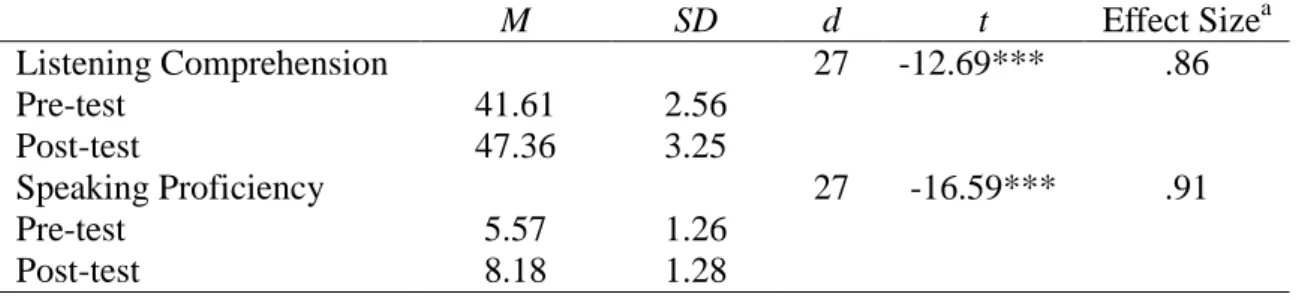
Table 1 shows the descriptive statistics and significance of differences for listening comprehension and speaking proficiency between the pre-test and post-test.
Table 16
Paired-Samples t-tests of the Participants’ Performance on Listening Comprehension and Speaking Proficiency of the Pre-test and Post-test (N28)
M SD d t Effect Sizea Listening Comprehension 27 -12.69*** .86 Pre-test 41.61 2.56 Post-test 47.36 3.25 Speaking Proficiency 27 -16.59*** .91 Pre-test 5.57 1.26 Post-test 8.18 1.28 *** p < .001. a Eta squared.
A descriptive mean comparison between the pre-test and post-test for listening comprehension indicated that the 28 student participants of this study, after one-year treatment of Shadowing, did perform better on the post-test. The participants scored better on the post-test than the pre-test by 5.75 points in listening comprehension. In addition, the results of the t-test showed that this mean difference for listening comprehension was statistically significant (p < .001). It meant the 5.75 points difference in means on the listening comprehension section of the TOEIC test between the pre-test (in which the 28 participants did not receive the Shadowing treatment) and the post-test (in which the 28 participants received the Shadowing treatment for one academic year) probably did not occur by chance alone (99.9 percent sure). That is, after the one-year Shadowing treatment, there was a statistically significant improvement in the listening comprehension section of the TOEIC test from the pre-test (M = 41.61, SD = 2.56) to the post-test [M =
6
SPSS printouts usually provide several tables with a great many statistic data for paired-samples t-tests. However, many statistics are not necessary in reporting the findings. Thus, Table 1 was constructed by following the statistic requirements of American Psychology Association (American Psychology Association, 2009; Dornyei, 2007; Nicol & Pexman, 1999).
47.36, SD = 3.25, t(27) = -12.69, p < .001].
Similarly, the participants also performed better in speaking proficiency by 2.61 points on the post-test. Moreover, the paired-samples t-test also showed that there was a significant difference in speaking proficiency (p < .001) between the pre-test and the post-test. Statistically speaking, the mean difference (2.61 points) in speaking proficiency between the two tests probably did not occur by chance alone (99.9 percent sure). For this reason, the inferential statistics confirmed again that after the one-year treatment, there was a statistically significant improvement in the speaking section of the TOEIC test from the pre-test (M = 5.57, SD = 1.26) to the post-test [M = 8.18, SD = 1.28, t(27) = -16.59, p
< .001]. Many applied statisticians have warned researchers that statistical significance only
means that an observed phenomenon is most probably true in the population (and not just in the sample); thus, what is true in the sample may not necessarily be important (Dornyei, 2007; Pallant, 2007). With very large sample sizes even tiny differences between two groups or tests could easily reach statistical significance. However, these ―significant differences‖ may have no practical or theoretical importance. For this reason, it has been highly suggested that after a significance level is reached, effect sizes be computed for a study as well to provide information about the magnitude (of the treatment) on an observed phenomenon (Dornyei, 2007).
For these reasons, though the results presented above had already told us that the differences in listening comprehension and speaking proficiency between the pre-test and post-test were very unlikely to occur by chance, it did not yet tell much about the magnitude of the intervention‘s effect (in this case, the one-year treatment of Shadowing). So far, we can only state that there is only a 0.1 percent probability that the observed differences in listening comprehension and speaking proficiency between the pre-test and post-test occurred by change alone. We do not know how strong the Shadowing treatment has on the improved differences.
Thus, to avoid over-interpreting the t-test results, statisticians usually suggest that researchers calculate the ―effect size‖ (also known as ―strength of association‖) and the most commonly used effect size statistic has been eta squared. Eta squared7 is often calculated to provide an indication of the magnitude of the differences between two variables (not just whether the differences could have occurred by chance). The value of eta squared can range from 0 to 1 and represents the proportion of variance in the dependent variable that is explained by the independent or intervention variable (Pallant, 2007). The eta squared from Table 1 (the right column) was .86 for listening comprehension and .91 for speaking proficiency. The guidelines proposed by Cohen (1988) showed that both of the eta squared values were very large. As a result, the one-year treatment of Shadowing had a large effect on the improvements in listening comprehension and speaking proficiency on the post-test. It also meant that, on the post-test, 86 % of the variance in listening comprehension and 91% of the variance in speaking proficiency on the post-test could be explained by the one-year treatment of Shadowing. It was obvious that the Shadowing treatment truly had a large impact on the progress in listening comprehension and speaking proficiency on the post-test.
Both the above descriptive and inferential statistics displayed that there were significant improvements in listening comprehension and speaking proficiency on the post-test after the 28 student participants received the one-year treatment of Shadowing.
7
Cohen (1988) provided the following guidelines to interpret the strength of eta squared: 0.01=small effect, 0.06=moderate effect, 0.14=large effect.
Furthermore, eta squared values showed that the treatment had a large effect on the improvements on the post-test and thus large amounts of variances in listening comprehension and speaking proficiency on the post-test could be accounted for by the Shadowing treatment. Therefore, the quantitative data confirmed the power of the Shadowing treatment with statistical significance and large effect sizes.
Qualitative Data
The interviews were conducted to explore participants‘ attitudes and reactions toward Shadowing after the treatment. These qualitative data were analyzed, assembled and categorized by the nature of similarities. Generally speaking, three major themes were emerged and categorized. The first theme was about language improvement, second affective enhancement, and third changes in English learning. Thus, this part is discussed in terms of the three striking themes as follows.
Language Improvements. The first and foremost theme from the interview data was that all the 28 student participants reported that they improved their listening comprehension and speaking proficiency, especially in pronunciation and fluency, after the treatment. Listening-wise, the participants thought that they developed a habit of listening to English without reading texts after the Shadowing treatment, whereas previously, they could not continue to listen to English recording for long without looking at the written texts. They even jokingly said that their previous habit of ―listening‖ was more like a mixture of listening and reading with more weight on reading. Listening to English materials without texts really helped them improve their listening comprehension ability. Although the participants could look at the text scripts of the recording in the first two steps of the Shadowing syllabus as described above, the first two steps were designed mainly to help them do consecutive and simultaneous Shadowing subsequently. For this reason, the instructor placed much more emphasis on the last two steps (doing Shadowing without scripts). All they had to do in the last two steps were just listen and shadow what they heard. With the help of the first two steps in the syllabus, the participants could better understand the meaning, sentence structures, vocabulary and idioms of the recording, and even cultural background, all of which helped them build ability and confidence in shadowing what they heard in the last two steps. In other words, the Shadowing syllabus helped them listen better and thus make improvements in listening comprehension. Here are two of the excerpts related to this point.
For some reason, I can ―just listen‖ to English recordings now. Previously, I was used to listening to English materials while looking at the scripts. Without a script, I couldn‘t listen to the recording for too long. I am surprised that I don‘t need scripts anymore after shadowing those articles about influential people. (Participant G2) I used to depend on written texts to understand a recording or repeat a sentence; without texts, I couldn‘t concentrate on listening very well. However, now I can concentrate on just listening, and it seems that listening without looking at texts actually improves my listening ability. (Participant B6)
Speaking-wise, the participants reported that previously, they were shy to speak English due to poor grammar, pronunciation, fluency, etc. They seldom spoke English actively unless it was necessary (like being required in class or taking a speaking test). However, after the Shadowing treatment, they spoke out fairly actively when they heard something in English, and this happened more often than ever. Like the improvements in listening comprehension, they felt that Shadowing also helped them speak better and make improvements in speaking confidence and proficiency. When they understood what
they heard better, they tended to speak better as well. Below are some related excerpts from the interviews:
I don‘t know why. Previously, I was used to first looking at a sentence and then reading it out loud as most students did in class. But now I need to listen to the recording (of the sentence) first. In other words, I‘ve changed my habit: Now I feel more comfortable that I speak out a sentence after I listen to it. I know it sounds weird, but I do need listening first in order to better improve my speaking. I think that the Shadowing treatment unconsciously changed my habit. And, the new habit really lets me speak better. (Participant G12)
I think I do speak better now. Before the Shadowing treatment, I seldom spoke English either in public or in private. I often thought too much about grammar and sentence structures every time I needed to speak English. This resulted in my unwillingness to speak English. However, now I feel more comfortable to speak English and I do it more often too. Also, I feel that I can just speak out the English words without thinking too much about correct grammar and sentence structures. I know nothing about the theory of Shadowing but it does miraculously help me speak English more fluently and naturally. That‘s my feeling. (Participant G15)
In addition, 25 participants (89% of the student participants) believed that large amounts of English input received via tasks from the Shadowing process contributed to their improvements in listening comprehension and speaking proficiency. Due to Taiwan‘s EFL context (where English is not spoken), how to have adequate English exposure indeed stays as one of the major problems to most English learners. For this reason, Shadowing is a feasible alternative to creating a speaking environment. As some participants stated as follows:
I still remember that in the very beginning of the Conversation class, the teacher asked us how often we speak English and most of the students said that they seldom speak the language on a daily basis. Honestly speaking, I had ―almost never‖ spoken English since I learned English, especially outside the classroom, before the teacher asked us the question. I considered my English above the average though I didn‘t speak it in real life. However, at that time, I was a bit shocked by my own answer: ―almost never.‖ Then I was wondering: how can I improve my English if I don‘t even use it every day? It seems impossible to make it via just a few English classes in school, right? I felt then that I needed to create my own language exposure and doing Shadowing has been one of the major tasks to me since then. Now I do feel that I‘ve listened to and spoken a lot of English after the one-year treatment of Shadowing. (Participant G8)
I do think that of all the English-related activities in all the English courses I was taking during my freshman year, Shadowing was the method that let me receive most English input and produce most English output. In other English classes, teachers often used Chinese to explain grammar or vocabulary items, or translated the reading passages. Even though a few classes were conducted in most English, the teachers usually did most talking and there were the same students who dominated the interactions or conservations with the teachers. Most students like me just kept silent and did not speak much English. Of course, some teachers led us to do ―repeat after me,‖ but that was more like ―reading‖ rather than ―speaking‖ a sentence aloud.
However, with the steps the instructor used in Shadowing, everyone needed to listen carefully to the English recordings with and without scripts. Moreover, everyone needed to listen to and speak what he/she heard at the same time for many times. At first, I thought it was impossible for us to listen and speak at the same time and Shadowing sounded a strange method. I mean, who will listen and speak English at the same time? But, we did it after following the step-by-step syllabus! The entire process gave us a large amount of English input; it also gave us an opportunity to produce English output. For this reason, I believed that the English exposure we had from Shadowing was much more than that in other classes. (Participant G21)
Two more intriguing findings were found along the same line here and they should be noted as well. First, 13 participants (almost 50%) reported that the part they did not like most was the first step of the syllabus when the instructor was explaining the meaning, sentence structures, and vocabulary and phrases of the target paragraphs. The reason was that they thought the first step was a little mechanic and dull as they often did in other English classes. Another possible explanation for this was that the Shadowing articles were suitable for their literacy level. These participants did not really need the instructor‘s further explanations on the articles. That is to say, they did not need much emphasis on linguistic aspects.
Second, after shadowing the six biographical articles of influential people, 16 participants (57%) reported that they almost memorized the written texts and could shadow the article with the recordings almost at the same time. They felt that they spoke more fluently after Shadowing but they did not know why. This interesting finding was consistent with Chang‘s observation on her friends (2003). Chang stated that she observed people around her who could speak English like native speakers and she sorted these people into a few categories like people who made many foreign friends, people who insisted on using English in school or a certain period of time during a day, people who loved to watch English movies and TV shows (with or without English captions), etc. One category was that some people (who spoke English natively or almost natively) did one thing outside the classroom: Since the first day they began to learn English, they just memorized all the readings taught in class by reading them aloud numerous times. In this regard, the experience of the 16 participants was similar to that of this category described by Chang. It is fairly possible for EFL learners to speak English more fluently and intuitively if they keep shadowing what they hear, or reading aloud something they are interested in and then memorized them unconsciously on a daily basis.8
As a result, it was not surprising that the student participants performed significantly better in the listening comprehension and speaking proficiency of the post-test since they truly felt that they listened and spoke better after receiving large amounts of listening input and producing a great deal output during the treatment.
Affective Enhancement. It was fairly surprising that all the 28 participants
unanimously reported that the Shadowing treatment interested them and motivated them in learning English to some extent. The entire Shadowing syllabus motivated the participants to listen and speak English at the same time because of its novelty. Not a
8 This finding was actually consistent with my personal experience too. As I mentioned it in the
Introduction section, after doing ―read their lips‖ for one semester, I went to New York City to visit my friend who was studying there during my first winter break. When my friend was surprised at my improvement in speaking, she asked me how I could speak more fluently after just four months. She was wondering if I hired an American tutor or hung out with Americans very often, none of which I did at that time. When I told my friend that I just ―read their lips‖ every day, she was even more surprised at how this simple method could help non-native speakers speak more fluently and intuitively.
single one of them had ever heard of Shadowing before the treatment. In my opinion, young students were usually more open to a new learning method, especially when the method was confirmed effective by previous literature. Shadowing was also more interesting and challenging than the traditional ―repeat after me‖ drills because more mental efforts were involved in the Shadowing tasks. Interestingly, the participants also felt that they were using the English language for a real purpose instead of just repeating something mechanically. For instance, they felt that they were more like telling a story of Obama rather than just speaking or repeating what they heard from the recordings while shadowing the Obama article. In this regard, Participant G16 expressed how she felt about Shadowing while shadowing the Obama article:
I‘d never heard of Shadowing before, frankly speaking; however, it‘s an innovative method for me after the teacher introduced it to the class. At first, I couldn‘t get used to it because I had to listen to and speak English, a foreign language, at the same time. But, I started to love this method after just a few weeks. You might not believe this, but I feel like I was telling a story or delivering a speech while doing Shadowing. This made me feel that I was actually using the English language for a real purpose like telling people a story instead of just listening and speaking robotically at the same time. Take the Obama article for example. While shadowing the article, I felt like I was telling others Obama‘s fabulous life story though I knew it was the writer‘s ideas not mine. My point here is that Shadowing made me feel that I was using the language with my own feelings and intonations instead of listening to something in English and speaking what I just heard at the same time. Let‘s face the fact: Most people including myself don‘t use English often, especially the aspect of speaking, outside the classroom because we simply don‘t need to use it in the most cases of real life. Thus, the entire Shadowing treatment let me feel that I was using English for real purposes, and it enhanced my interest in learning English as well as motivated me to use English outside the classroom.
Participant G16 was not alone in this aspect; all the other participants had similar feelings as hers to some degree. Indeed, compared to the traditional ―repeat after me‖ approach, Shadowing provided relatively more authentic situations to the student participants. Most researchers and practitioners in the field of second or foreign language acquisition have agreed that a second/foreign language is best learnt when it is used for real purposes or communication (Brown, 2007). For these reasons, I think that Shadowing is not only a method that trains EFL learners to listen and speak simultaneously and then improves EFL learners‘ listening comprehension and speaking proficiency but also a relatively authentic source that provides them with more input to listen to and opportunities to speak, which an EFL country such as Taiwan usually lacks. In other words, Shadowing can compensate for the inadequacy of language exposure in Taiwan. Thus, EFL teachers in Taiwan can use Shadowing to build up students‘ confidence and facilitate their learning in listening and speaking.
Changes in English Learning. The third theme from the interview data was
categorized as changes in English learning. It meant that most student participants adjusted or even totally changed their learning habits, attitudes, styles, or methods after the Shadowing treatment. Before the treatment, they were all used to the ―repeat after me/CD‖ method since it was widely used in the English classrooms. They were all accustomed to repeating an English sentence by looking at the text after they heard the sentence read by the teacher or played by the CD. The findings showed that the first big change in English learning was that the participants felt now they prefer or need to first
listen to audio input (without texts) to produce output (speaking), while previously they needed to look at the script before they spoke English. As quoted above, Participant G12 said, ―I know it sounds weird, but I do need listening first in order to better improve my speaking. I think that the Shadowing treatment unconsciously changed my habit. And, the new habit really lets me speak better.‖
The second change in the participants‘ attitudes toward learning English was that they became more independent EFL acquirers after the Shadowing treatment. From my experience and observation, I have noticed that many adult EFL learners in Taiwan have been complaining about the local English education. These complaints usually include the exam-based orientation, over-emphasis on the rote memorization of grammar and vocabulary, lack of environment for using English particularly in the speaking aspect, a dearth of native English-speaking teachers (or so-called foreign teachers), inadequacy of teaching hours in school, incompetence of English teachers, ineffectiveness of teaching methods (one of the harshly criticized methods has been almost always ―Grammar Translation Method,‖ whereas one of the critically acclaimed methods ―Communicative Language Teaching‖), poor quality of English textbooks, etc., to name just a few (C. L. Kwan, personal communication, September 28, 2010). These complaints are all true to a certain degree. However, shouldn‘t the adult learners take full responsibility for their own learning? Using these complaints as excuses for not learning English well only block them from improving their English and moving on. Conversely, I have met many people who were born, raised and educated in Taiwan (a so-called EFL context), but they turned out to be great English learners. Some of them (for example, Walter and Yvonne mentioned in the Introduction section) even spoke English almost natively. People might think that Walter and Yvonne were native speakers of English if they just heard their voice. How could these people possibly achieve a native or native-like English proficiency in Taiwan where all the aforementioned learning difficulties have existed for years? They did have one thing in common: They all tried hard to create their English environments (language exposure) with their own preferred learning methods all the time. In other words, they all considered themselves autonomous English acquirers. Similarly, I found out that all the participants in this study changed their attitudes or ideas about learning English after the treatment. It was that not only they considered Shadowing an effective method but also they re-thought their experiences of English learning and adjusted their learning in the future. Here are two quintessential excerpts in this regard from the interviews.
When I was in elementary or high school, I thought that my English would be great only if I went to live or study in the US, or met great English teachers. I blamed Taiwan‘s English education for my mediocre English. However, after this year, especially after the Shadowing treatment, I gradually found that I was wrong to expect my English to become great automatically and simply by having some wonderful teachers or great textbooks. We often complain that Taiwan doesn‘t have an environment of using English, but we still can see that many people around us have a good command of English. Most people seem to ignore that it should be the learners instead of the teachers, textbooks, or other factors who take full responsibility for their final achievements. People may wonder: Then why do we need English teachers or classrooms if we really can improve our English just via self-studies or using English every day outside the classroom? It might sound a little philosophical, but in my opinion, a good English teacher or a classroom is like an inspiration. The teacher or classroom should give us some innovative and effective learning methods or ideas, and we (as learners) decide to adopt or not adopt them
outside the classroom to improve our English. I did meet some people who speak English very well, and I found that these people had some things in common. For instance, they all did a lot of outside-the-classroom activities with some effective methods that fit their learning styles. In this class, I was happy that our instructor introduced the Shadowing method and led us to practice it at the beginning of every class meeting for the whole year. I think the entire Shadowing treatment sort of changed my learning habit and ideas of speaking English because now I shadow what I hear quite often. Of course, the English input I receive should be fitting to my level too as the instructor said in class many times; otherwise, I can‘t shadow it smoothly. I know in Taiwan, it is almost impossible to speak English very often or every day; however, with Shadowing, I do feel that I speak English every day. (Participant B2)
I was really into the instructor‘s personal story when in the first class meeting, he was telling us about his ―read their lips‖ almost two hours a day in the US. I also love to watch American movies and TV shows. After the Shadowing treatment, I found that I do this very often. If I watch the movies or shows on DVD‘s, I sometimes turn off the Chinese subtitles and just listen attentively to the movies/shows. Besides, if some scenes are really easy, interesting, or impressive, I not only turn off the Chinese subtitles but also shadow what I hear. I wrote down some interesting expressions too! I never did one of them before the Shadowing treatment. I just watched the movies/shows by looking at the Chinese subtitles and my ears were almost 99% off to the English sound. Looking back, I feel that I was more like ―reading‖ American movies and TV shows instead of ―watching‖ them. Overall, I do enjoy my new learning habit. Also, after the treatment, I‘ve gradually realized that learning a language, especially a foreign language such as English, is a lifelong process because there is always room for improvement. (Participant G20) I really enjoy the two above excepts because how many college students of this generation are as reflective as Participant B2 and as enthusiastic as in using English as Participants G20 (turning off the Chinese subtitles, shadowing the interesting scenes, or writing down idiomatic expressions that interested her)? Furthermore, I cannot agree more with what the two participants said above because I had the similar feelings when I started to ―read their lips‖ while watching American sitcoms in the late 1990s. After studying in the US for a few months, I realized that an English environment was an important factor but it was not the only factor to acquire a native-like English proficiency. I found that many international students who went to the United States for a few years had not yet acquired a great command of English ability. The main reason was simple: They did not use the language every day. The American environment might give them enough language exposure but they did not utilize it for some reasons. Therefore, it is the adult learners who should take full responsibility for their English learning. They may expose themselves to many effective learning methods and see what fit their learning styles instead of simply relying on teachers, classes, textbooks, etc. In this regard, the findings showed that Shadowing is one of these effective learning/teaching methods. 24 participants (86%) said that they would surely keep practicing Shadowing after the treatment.
As a result, the qualitative data concluded that the participants had positive attitudes and reactions toward the Shadowing treatment. After the treatment of shadowing the six self-chosen articles, the participants felt that it became easier for them to listen and speak at the same time. They also spoke English more intuitively and confidently without too