People Recognition for Entering & Leaving a Video Surveillance Area
1
Da-Jinn Wang, 2Chao-Ho (Thou-Ho) Chen, 3Tsong-Yi Chen, 4Chien-Tsung Lee Department of Information Management
National Kaohsiung Marine University Kaohsiung, Taiwan 811, R.O.C
1
Department of Electronic Engineering, National Kaohsiung University of Applied Sciences,
Kaohsiung, Taiwan 807, R.O.C
{2thouho, 3chentso, 41096305110}@cc.kuas.edu.tw
Abstract—We proposed a people recognition method
for moving people of entering & leaving a video surveillance area employing the spatial-based of single- pedestrian image in conjunction with color vector. The spatial-based is used because it is difference location for variance parts of the body. A histogram-based framework is used to describe the color vector of variance parts of the moving people. The moethod is able to tracking and identification successfully the moving people in different outdoor environment based on variance of samples. The experimental results illustrate that the method can automatically tracking and identification based on the moving people for entering & leaving a video surveillance area.
Keywords- color-vector,object tracking ,people recognition. I. INTRODUCTION
At present, the DVR (digital video recorded) system that replace traditional analog closed-circuit system. System of intelligent surveillance is essential for surveillance of security. But surveillance of security is still need controlled by guards. The guards need spend a lot of time to look at screen. That situation usually makes guards to feel tired for their body and mind to reduce efficiency of maintaining safety. Therefore, we proposed a people recognition method for moving people of entering & leaving a video surveillance area to assist security management, i.e., the early fire-alarming system [1] and the intelligent vehicle counting system [2] for traffic surveillance.
The study on tracking of moving people, [3] adopt Kalman-filter based active contour model for tracking of nonrigid objects in combined spatio-velocity space. Its advantage is the computational complexity can be reduced, but its drawback is that the initial contour is usually very difficult. [4] use a small regional characteristics of the single indoor track will be part of image pixels belonging to the body is divided into different regions, through the follow-up of these small regions to complete the entire human body tracking.[5] use the stick figure established a human model for the single-lens imageing sequences to track the human body. The shortcomings of this method is done for tracking pedestrians can only appear in the surveillance of the region to give pedestrians a tracking tag, they can not give the same tracking tag.
In the previous literature for people recognition that to identify all the feature of the static image extraction and recognition, and people were taken by a specific point of view, e.g., face recognition [6], fingerprint verification [7], etc. However, in this paper have to extraction and
recognition the feature from the moving people, which has increase the difficulties of recognition. Therefore, we assume that moving people must be through the implementation of specific regional and rcognition.
II. THE PROPOSED ALGORITHM
In order to implement the tracking and recognition module, the proposed method uses the adaptive background subtration [8] to detect the moving object of an image.
The block diagram of the proposed tracking and identification method of moving people is described in Fig. 1. The details of each step in the proposed method will be discussed in the following sections.
Fig. 1 The proposed algorithm. III. FEATURE MODEL
Discussed in this paper are for pedestrians, most of the pedestrians in the observation can be found, if the human visual system to identify pedestrians are based mainly on the wearing of clothing color and texture features, and the color of clothing and pants are differences. Therefore, we combine the characteristics of color and distribution of spatial as recognition of the feature of pedestrians.
A. Spatial-based
Based on the differences between color in various parts of the body. Division based on the size ratio of the body [9] will be retrieved by a single-pedestrian image, is divided into three non-overlapping region of head area, torso area, and 2009 Fourth International Conference on Innovative Computing, Information and Control
The Tabel 1 denote the experimental results for the test video sequences. In the proposed method has good accuracy. However, exposure to the pedestiran light is non-uniform, and easily affect the results of identification. When the color is similar for wearing clothes, it will also result in erroneous identification.
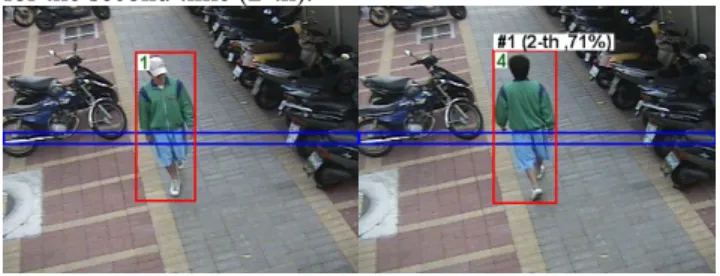
pattern that when crossing at the specific area. If the result of recognition has highest similar rate and high than 55% with recorded in the database, show that corresponds to the matching label, and similar rate. On the contrary, it is first time for the single-people pattern that without any associated information. For example, the blue bounding-box is the specific area for recognition in Fig. 6. When pedestrians through specific area and the identification of people implemented. If there is no target on its similar, the judge for the first time and do not show the additional information, i.e., Fig. 6(a). Contrariwise, similar to target, the show the result of identification, i.e., the black text of the white region in Fig. 6 (b).
Table 1. Accuracy rate of people recognition. Number of Pedestrian Correctly identify the number of pedestrian Accuracy Rate Park 16 15 93.7% Shop 19 15 79% Plaza 36 30 83.3% V. EXPERIMENTAL RESULTS
A theoretical analysis about the proposed people tracking and identification method has been given in the above section, and the implementation in several representative situations. The tested video sequences of size 320×240 pixels captured by color CCD camera and save as AVI file. The algorithm implemented in C# Language with a Intel® Core™2 1.86GHz microprocessor, 3GB RAM. The experimental results shown in Fig.6 and Fig.7.
VI. CONCLUSIONS
In this paper, we presented a people recognition method for moving people of entering & leaving a video surveillance area. The color feature of the pedestrian’s clothing or wear is used to label each person followed by the general merge-split phenomenon or crossed the specific area based procedure to track and identify the people. Futher improvements could be to obtain more features model and to enhance the robustness for people rcognition. In addition, performing the proposed method to realize multi-camera is also interesting for future researches.
Fig. 6 describe the same pedestrians appeared at different times in the same surveillance area, were labeled as 1 and 4. The main difference is whether or not to wear hats. The black text in white region, describe the results of identification in Fig. 6(b). Where the result denote label 4 with the label 1 (#1) similar and 71% similarity and appear for the second time (2-th).
REFERENCES
[1] T.H.(C.H.) Chen, Y.H. Yin and S.F. Huang, “The Smoke Detection for Early Fire-Alarming System Based on Video Processing”, IEEE International Conference on Intelligent Information Hiding and Multimedia Signal Processing (IIHMSP), Pasadena, USA, December 2006, pp. 427-430.
[2] T.H.(C.H.) Chen, Y.F. Lin, T.Y. Chen, “Intelligent Vehicle Counting Method Based on Blob Analysis in Traffic Surveillance”, IEEE International Conference on Innovative Computing, Information and Control (ICICIC-07), Kumamoto, Japan, September 2007, pp.5-7. [3] N. Peterfreund, “Robust tracking of position and velocity with
Kalman snakes”, IEEE Transactions on Pattern Analysis and Machine Intelligence, vol. 21, no. 6, June 1999, pp. 564-569.
(a) (b)
Fig. 6 The results of identification: (a) wearing a hat; (b) not wearing a hat.
[4] C. R. Wren, A. Azarbayejani, T. Darrell and A. P. Pentland, ”Pfinder: Real-Time Tracking of Human Body”, IEEE Transactions on Pattern Analysis and Machine Intelligence,vol.19,no.7, July 1997, pp. 780-785.
Fig. 7 describe the same pedestrians appeared at different times in the same surveillance area, were labeled as 16 and 29. The black text in white region, describe the results of identification in Fig. 7(b). Where the result denote label 29 with the label 16 (#16) similar and 93% similartiy and appear for the third time (3-th).
[5] I.A. Karaulova, P.M. Hall, A.D. Marshall, “A hierarchical model of dynamics for tracking people with a single video camera”, In Proc British Machine Vision Conference,Bristol,UK, September 2000, pp. 352-361.
[6] B. Heisele, P. Ho, J. Wu and T. Poggio, “Face recognition: component-based versus global approaches”, Computer Vision and Image Understanding, vol. 91, July 2003, pp. 6-21.
[7] A.Jain, L. Hong and R. Bolle, “On-line fingerprint verification”,IEEE Trans. On Pattern Analysis and Machine Intelligence, vol. 19,No. 4, April 1997, pp. 302-314.
[8] S. McKenna, S. Jabri, Z. Duric, A. Rosenfeld, and H. Wechsler, “Tracking groups of people”, Computer Vision and Image Understanding, 2000, vol. 80, pp. 42-56.
[9] P.H. Chen, “A novel hand-held object detection method and its application of the surveillance system”,National Taiwan University of Science and Technology, 2005.
(a) (b)
Fig. 7 The resluts of identification: (a) first time for label 16;
(b) third time for label 29. [10] Rafael C. Gonzalez, Richard E. Woods, Digital Image Processing 2/e,New Jersey:Prentice Hall, 1996, pp295-302.