CHARACTERIZATION OF Al
2O
3COMPOSITES CONTAINING
NANO-Mo PARTICULATES III: ATMOSPHERIC REACTIONS
OF Mo
Tsung-Ming Wu
⫹, Chih-Lung Chen* and Wen-Cheng J. Wei*
⫹Materials and Electro-Optics Research Division, Chung-Shan Institute of Science and Technology
(CSIST), Taiwan 325, Republic of China *Institute of Materials Science and Engineering, National Taiwan University, Taiwan 106, Republic of China
(Received December 20, 1999) (Accepted in revised form December 25, 2000)
Keywords: Mo; Al2O3; Composite; Oxidation; Sublimation; Reaction kinetics
Introduction
In metal-reinforced ceramic matrix composites, the metal phase has been used in the forms of continuous fibers, [1,2] flakes [3], spheres [4] or particles [5–7] All of them can reinforce the ceramic matrix by different mechanisms.
In our previous work [6] a novel process was used for the preparation of dense Mo/Al2O3
composites. This process included dissolving Mo-oxide and spray-drying ammonium molybdate solution, followed by hydrogen reduction and hot-pressing at 1400°C. The composites contain Mo particulate sized from 30 nm to 40m embedded in Al2O3matrix. Nano-sized Mo grains are mostly
found engulfed in submicrometric Al2O3 grains, but submicron Mo grains are located at the grain
boundaries of Al2O3. The properties of the composites were reported [7] that have ca. 30% increase in
toughness and fracture strength.
The size of the Mo grains appears to increase as its content in the Al2O3composite is above 5 vol%.
When the content of Mo in the composite is greater than a critical fraction of 16 vol%, the Mo phase forms a continuous network. The metallic phase may form an oxide scale in an oxidizing atmosphere below 400°C. Moreover, the newly formed MoO3may sublimate at temperatures above 475°C under
various vacuum conditions. The details on the oxidation kinetics mechanism of pure Mo from 550 to 1700°C were studied. The oxidation followed parabolic rate law, showing an activation energy of ca. 150 kJ/mole. [8]
This study used pure Mo, MoO3powder compacts and Mo/Al2O3composites, exposed to an
oxidizing atmosphere under various temperatures to explore the reaction kinetics of the nano-composites of Mo/Al2O3. The purpose of this study has three aspects. First to understand the
oxidation kinetics of the composites, then to see how the states (volume fraction) of the Mo influence the oxidation reactions. Finally, to investigate the evolution of the microstructure of the composites so to determine the limitations of the composites when they are used at high temperatures and in oxidizing atmospheres.
1359-6462/01/$–see front matter. © 2001 Acta Materialia Inc. Published by Elsevier Science Ltd. All rights reserved. PII: S1359-6462(01)00669-8
Experimental Materials
Mo powder (Climax Specialty Metal Co., USA) and MoO3powder (Climax Molybdenum Co., USA)
were used for this study, with the properties of the pure materials as shown in Table I. The details of the preparation of Mo/Al2O3composites was reported in previous papers. [6,7]
Characterization
The oxidation of Mo and its oxide MoO3 was first studied to explore their basic characteristics.
Die-pressed cylinders of the powders, 50 mm (D) [⫻ 5 mm (H), were prepared for thermogravimetric analysis (TGA). The similar contour of the samples was prepared to avoid the deviation in arranging the oxidation rate for kinetics analysis. The TGA experiments were conducted using CAHN 2000 at temperatures between 300 to 850°C in a flowing gas atmosphere, either air or oxygen at ca. 1 atm, to establish a steady gas profile. Samples were changed whenever the weight loss reached 5% to ensure similar reaction conditions.
The samples were treated and examined by using SEM instruments (JEOL Mini-SEM, Japan and Philips XL 30-SEM, Netherlands).
To measure the oxidation rate, dense Mo/Al2O3composites (⬎98.5% theoretical density) were cut
into cubes and hung in the TGA hot zone same as described previously [11] in an isothermal process. Whenever the recorder shows a steady-state mass change, the rate of oxidation (Si) at the temperature
is derived. Preliminary experiment indicated that the sample remain virgin-like when less than 5% mass change was accumulated. In this study, the rate of mass change per unit time per unit surface area (mg/sⴱm2) was choose as parameter. In other words, the reaction occurred in the surface layer instead of throughout the whole body of the samples.
Impurity (ppm) Cu:10, Fe:52, Mg:7, Ti:1, Sn:1, Si:1, Pb:1,
(supplied by vendors) Mg⬍10, Mn⬍10, W⬍250, Ni:1, K:52, Na:11
Ti⬍10, Sn⬍10, Si⬍148, S⬍10, Pb⬍10, Ni:35
Properties Black powder, non-dissolvable Gray-white powder, limit
in water, oxidizing dissolvable in water,
Results and Discussion Oxidation of Mo
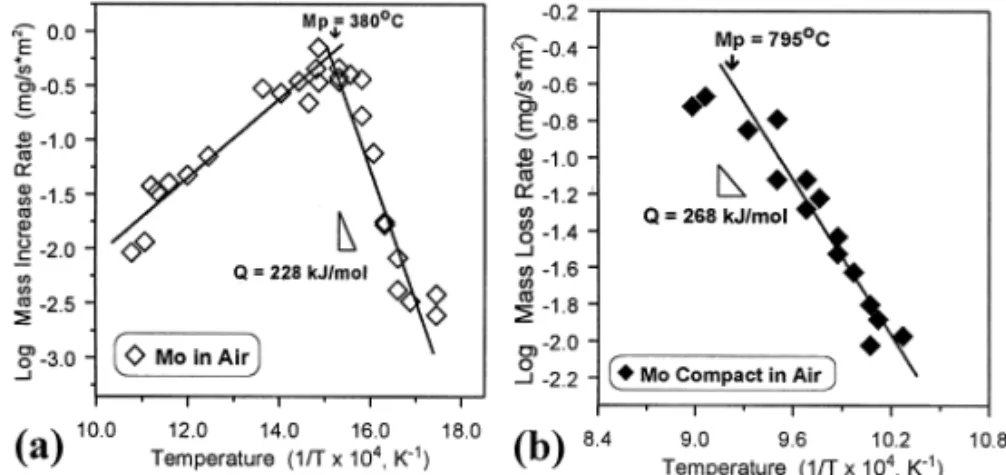
The mass change of the pure Mo exposed in air between 300 to 850°C are shown in Fig. 1. It demonstrated a positive rate (mass gain) below 650°C, and negative rate (mass loss) when the temperature exceeded 650°C. The data can be transformed to Fig. 2 in the form of Arrhenius’ plot of log(Si) vs. 1/T, derived as eq.(1).
Si⫽ Soexp
冉
⫺Q
RT
冊
(1)where Q is activation energy of the reaction and R is the gas constant (8.314 J/molⴱK), Sois a rate
constant and T is the reaction temperature.
The Arrhenius’ plot (Fig. 2(a)) among its mass gain period (300 to 650°C), can be separated into two segments. The first part increases with respect to the temperature in the lower region (300 to 380°C). This can be explained as a result of the oxide scale formed, yielding a passive product on its surface. The activation energy of the oxidation reaction over this temperature interval is calculated to be 228 kJ/mol, which is differ from the reported activation energy of oxidation about 150 kJ/mol by Gorbounova et al., [9] who conducted the test in vacuum condition, not in atmosphere.
Figure 1. Reaction rate of Mo compacts exposed in air at various temperatures.
Figure 2. Arrhenius plot of the mass increase rate of Mo compacts tested at the temperatures (a) below 650°C, (b) above 650°C in air.
At higher temperatures (380 to 650°C), the mass gain did not increase with temperature, rather reducing to zero at 650°C. Theoretically, the rate of chemical reaction can only accelerate by elevation of temperature. The decreasing trend of the rate from 380 to 650°C could indicate another parallel reactions happened. [8] The overall reaction could include the oxidation of Mo and the evaporation of its oxide. The decaying rate from 380 to 650°C occurred when the evaporation was accelerated by temperature more than that of the oxidation of Mo.
Figure 2(b) shows the activation energy of the mass loss proceedings above 650°C is 268 kJ/mol. There are two possibilities. The first is based on a faster sublimation rate of oxide than Mo oxidation. Under this condition, all oxide produced from the oxidation of Mo should be depleted in the following sublimation process. In other words, the rate of sublimation is equaled to that of oxidation. So they should have the same activation energy in Figs. 2(a) and 2(b). But this is not the case happened. The second case is a faster rate of oxidation than that of oxide sublimation. In other words, more oxide is produced and less oxide is sublimated. This is probably the case because the values of the activation energy in our study are distinguishable. That indicates the sublimation is not controlled by the rate of oxidation, but rather proceeds freely. More discussions shall present in the following section.
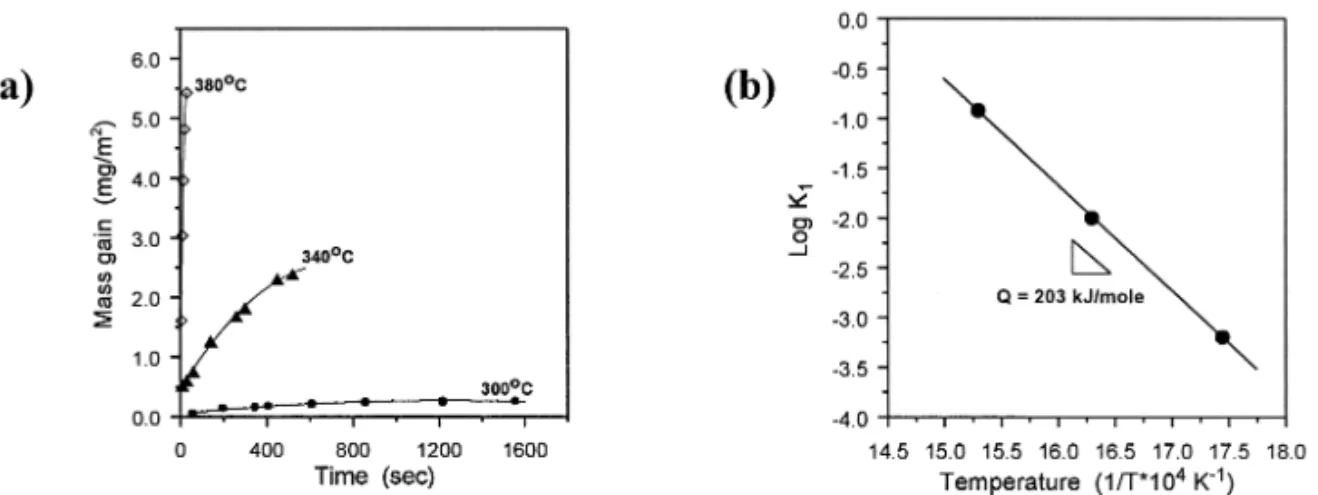
A detail analysis of the oxidation of Mo compacts between 300 to 380°C is shown in Fig. 3. The mass gain due to the oxidation obeys a parabolic law, and can be drawn as a function shown in Fig. 3(a). Consequently, a set of reaction rate constant K1can be obtained as eq. (2) and plotted as a function of
1/T to find its activation energy:
S⫽ K*1t 1/ 2
(2) here S is the instant reaction rate (mass change per surface area and time). The slope of the line shown in Fig. 3(b) is the best fitting of the reaction constants at various temperature show an activation energy of 203 kJ/mol, which is close to that derived in Fig. 2(a).
Sublimation of MoO3
The compacts were thermally treated in air or pure oxygen to monitor their sublimation rate, as shown in Fig. 4. Almost all data are fitted in the same straight line and the activation energy of 270 kJ/mol is calculated. The derived activation energy of the sublimation in Fig. 4 is fairly close to that of Fig. 2(b). This strongly supports our suggestion that the sublimation of molybdenum oxide is a sequential step following the oxidation of Mo. The kinetics can be summarized in following steps:
Figure 3. (a) Mass of mass change of Mo compacts exposed in air at various temperatures. (300°C, 340°C, and 380°C), (b) Arrhenius plot of reaction constant of Mo compact versus the various temperatures in air.
1. The oxidation of Mo begins at 300°C and the oxide scale is formed;
2. The sublimation of oxide begins at 380°C, proceeding together with the oxidation reaction; 3. The oxidation process increases the mass of Mo compact and the sublimation decreases it. The
concurrent rates of the oxidation and sublimation determines the overall mass change, resulting mass loss at the temperatures over 650°C.
Oxidation of Mo/Al2O3Composites
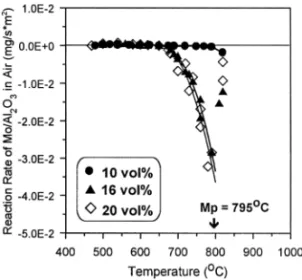
Figure 5 shows the oxidation of Mo/Al2O3composites. The 10 vol% Mo shows a very slight mass gain
at lower temperatures, and mass loss happens when approaching the melting temperature (795°C) of MoO3. The trend of mass change coincided with previous study in Fig. 1. However, the richer (16 and
20 vol%) Mo composites have an apparent mass loss when tested just above 650°C. It is realized that 16 vol% Mo is critical to construct a network and may offer channels for the sublimation.
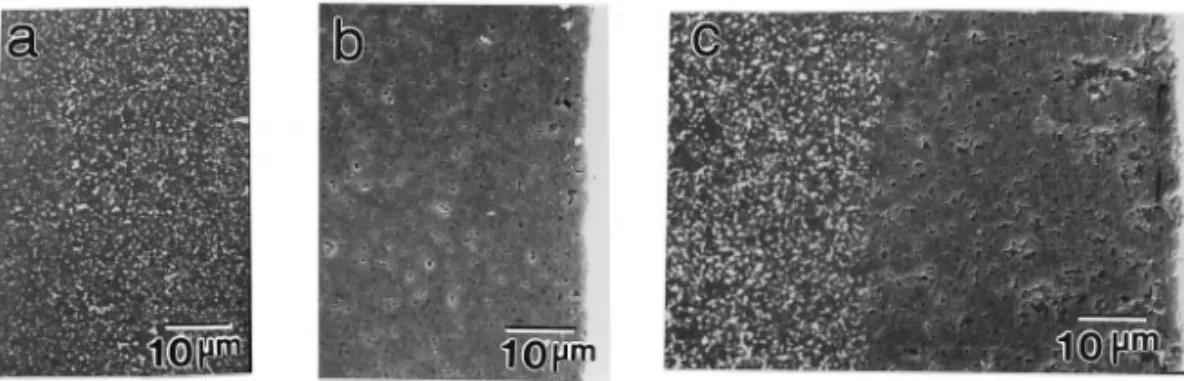
Figure 6 shows the cross-sections of two composite. Some Mo network were found in the 20 vol% samples (Fig. 6(c)), in contrast to isolated Mo in the lean (10 vol%) samples. Clearly, the critical Mo content to form a network is the main reason to cause such a substantial difference in thermal property (Fig. 5). The negligible mass change of the lean (10 vol%) Mo samples under 795°C is due to the
Figure 4. Arrhenius plot of mass loss rate of MoO3compacts tested in pure O2or in air.
isolation of the Mo from contacting oxygen. However, the oxidation phenomena changes after the MoO3 turns to liquid phase at 795°C. The capillary action of molten MoO3 may enhance the
sublimation rate.
In contrast, the data of rich Mo (16 vol% and above) samples in Fig. 5 are well fitted to that of previous experience as shown in Fig. 1, with an apparent mass loss beginning at 650°C. The Mo on the outer surface of the Mo/Al2O3composites is oxidized and then sublimated, leaving channels for further
supply of oxygen. Figure 7 shows the rate of the 20 vol% Mo composite and that of pure Mo compact for comparison. The similar activation energy for both cases indicate that the Al2O3does not alter the
oxidation/sublimation mechanism of embedded Mo, except by reducing its magnitude due to the compact of matrix alumina. Figure 7 indeed prove the fact that the composite does not change the intrinsic oxidation properties for molybdenum.
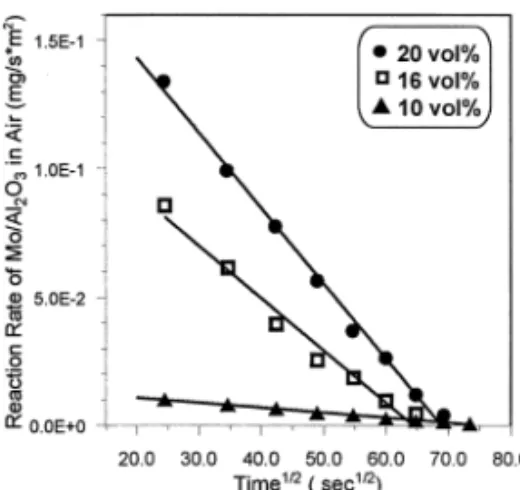
Figure 8 is a long-period trace of the oxidation of the composites. There could be a factor influencing the oxidation of Mo grains far from the surface. The rate of these samples is accurate inversely proportional to the square root, indicating that the gas transportation within the composite is the controlling factor for the whole reaction.
Conclusion
The Mo phase is oxidized above 300°C in atmosphere, and the newly formed MoO3tends to sublimate
above 380°C. The oxidation and sublimation reactions of Mo in air or in pure oxygen atmosphere are
exposed to air at 730°C for 2 hr.
a thermally activated process. The oxidation follows a parabolic law and shows an activation energy of 203–228 kJ/mol. The activation energy of the sublimation at temperatures greater than 650°C is about 268 kJ/mol. The sublimation becomes vigorous enough to result in mass loss for the overall reaction when the temperature exceeds 650°C.
The oxidation of the Mo/Al2O3composites shows similar behaviors as the pure Mo. The composites
with 10 vol% Mo are hardly oxidized. However, the composite with 16 vol% or more Mo exhibits the oxidation and sublimation reactions similar to pure Mo compacts. The surface of the ⱖ16 vol% Mo composites exhibits a porous appearance after oxidized. The results suggest the Mo/Al2O3composites
with the composition of Mo not exceeding 16 vol% may provide a reasonable resistance to oxidation up to 950°C in air.
Acknowledgment
The authors thank the funding by NSC in Taiwan (NSC 88 –2216-E-002– 028), and to acknowledge a kindly offer of equipment by CSIST.
References
1. S. Baskaran, S. D. Numm, and J. W. Halloran, J. Am. Ceram. Soc. 77(5), 1256 (1994). 2. L. A. Simpson and A. Wasylyshyn, J. Am. Ceram. Soc. 54(1) 56 (1971).
3. Y. Waku, M. Suzuki, Y. Oda, and Y. Kohtoku, J. Ceram. Soc. Jpn. 103, 702 (1995). 4. D. T. Rankin, J. J. Stiglich, D. R. Petrak, and R. Ruh, J. Am. Ceram. Soc. 54(6), 277 (1971). 5. M. Nawa, T. Sekino, and K. Niihara, J. Mater. Sci. 29, 3185 (1994).
6. W. J. Wei, S. C. Wang, and F. H. Cheng, Nanostruct. Mater. 10(6), 965 (1998). 7. S. C. Wang and W. J. Wei, Nanostruct. Mater. 10(6), 983 (1998).
8. E. A. Gulbransen, K. F. Addrew, and F. A. Brassart, J. Electrochem. Soc. 110(9), 952 (1963).
9. K. M. Gorbounova, and V. A. Arslambekov, 6th Reunion De La Societe De Chimie Physique, May 29 –June 1, Paris, France (1956).
10. Encyclopedia of Chemical and Chemical Engineering, pp. 645– 647, Shaw-Yuan Press (1989). 11. W. J. Wei and T. M. Wu, Carbon, 32(4), 605 (1994).