
Fast and Efficient Image Indexing Using Binary Color Histogram
14
0
0
全文
(2) Abstract The color histogram has played an important role on pattern recognition, image indexing, and many other applications. One of the major obstacles for applying color histograms is the intimidating storage and computational requirements due to its high dimension nature. In contrast to the conventional multi-valued color histogram, we propose a simplified binary color histogram in the HSV color space for image indexing. Similarity calculation can therefore be made using the Hamming metric. Preliminary experimental results show that good retrieval performance can be achieved with the proposed scheme. Further improvements by adaptive thresholding are currently under development.. Keywords: color histogram, image indexing, content-based image retrieval. 2.
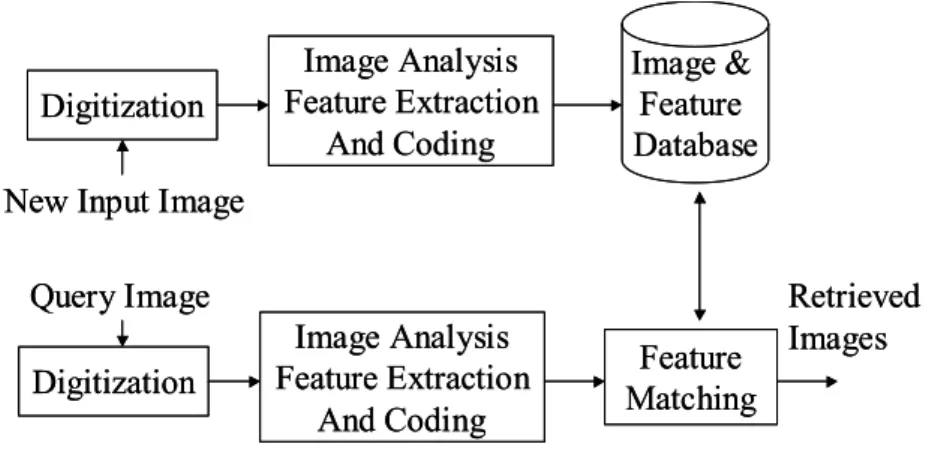
(3) Introduction The fast developments of digital technology and the proliferation of Internet make many new multimedia services possible. As more and more images are accessible and vital to human understanding, efficient indexing, searching, and retrieval for images are imperative for realizing these services. Conventional textual indexing techniques using keywords and annotations are in general inadequate in this scenario since a complete and objective description for an image’s content hardly matches its textual representations. The content-based image retrieval (CBIR) has recently proposed to reduce the sensory and semantic gaps between the query and the retrieved images [1]. One significant step towards building the content-based multimedia environment is the standardization of MPEG-7 [2] that provides a common platform describing features of multimedia content and defines the description interface between content producers and content consumers. The workflow of a general CBIR system is depicted in Fig. 1 [3]. Some of the essential features of images (called the “descriptors” in MPEG-7), semantic or parametric, are extracted for the query image and the images in the databases. Then a similarity measure for the features are computed and ranked for the search results. Semantic features are those pertinent to human perception, such as color, shape, texture, and salient points. Parametric features are usually computed from the DCT. 3.
(4) (discrete cosine transform) or DWT (discrete wavelet transform) coefficients. A good feature (and its associated similarity measure) should balance between the discriminating power (false positive rate) and the invariance (false negative rate) with feasible implementation complexity.. Image Analysis Feature Extraction And Coding. Digitization. Image & Feature Database. New Input Image Query Image Digitization. Image Analysis Feature Extraction And Coding. Feature Matching. Retrieved Images. Fig. 1. Workflow of a CBIR system. Color is an important feature for many CBIR systems since it conveys much information relevant to human perception and recognition. Several color descriptors, including the dominant color, the scalable color, the color structure, and the color layout, are defined in MPEG-7. The color histogram is the major vehicle for these derived features. Suppose that a color space is partitioned into ordered n-bins C = {c1, c2, …, cn}. The (global) color histogram H of an image I by C is an n-tuple defined as. H ( I ) = ( hc1 , hc 2 ,..., hcn ). (1). where hci is the (normalized) number of pixels in I whose color lies in the color bin ci. Color histogram is attractive for object recognition and image indexing owing to its 4.
(5) low sensitivity to the geometric transformation like translation, rotation, and scaling [4]. The shortcomings using the plain color histogram are mainly two-folds. First, the global color histogram lacks the spatial information about color distribution that may be important for judgment, especially when a very large data set is examined. A more general version of color histogram with spatial-chromatic correlation has been proposed as a remedy [5]. Second, although the computation of color histogram is straightforward, the involved storage and computation can be very demanding. The complexity associated with color histograms is in proportion to the product of the color space dimension (the number of bins) and the resolution of the coefficients (the number of bits used to represent each bin coefficient). In [6], the authors applied the vector quantization to reduce the dimensionality of the coefficients. In [7], the color histogram was compressed using orthogonal transforms such as DCT, KLT (Karhunen-Loeve transform), and HADT (Hadamard transform). A reduction in the number of bins of the color histogram was developed in [8] using weighted hue histogram and intensity histogram in the chromatic and achromatic image regions, respectively. In this paper, we attempt to employ a binary color histogram to reduce the complexity required for conventional color histogram processing. By quantizing the color histogram into binary values, the similarity of two color histograms can be. 5.
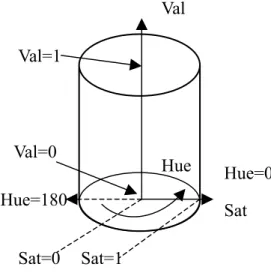
(6) computed in the simple Hamming metric. Preliminary experimental results indicate that good retrieval performance can be achieved with the proposed scheme.. Proposed Method A histogram-based image retrieval system consists of the following key components: an appropriate color space, a quantization scheme (and an optional index generation scheme) for the color space, and a similarity metric [9]. We adopt the HSV (hue-saturation-value) color system as is depicted in Fig. 2. The HSV color space approximates the way humans perceive and interpret color. Furthermore, the hue (color) is invariant to the illumination and camera direction and thus suitable for object recognition. In the cylindrical representation shown in Fig. 2, saturation (the degree of colorfulness) is denoted by the radius, value (the lightness of the color) is denoted by the height, and hue is denoted by the angle from 0 to 360 degrees. Val Val=1. Val=0. Hue. Hue=180 Sat=0. Hue=0 Sat. Sat=1. Fig. 2. HSV color space.. 6.
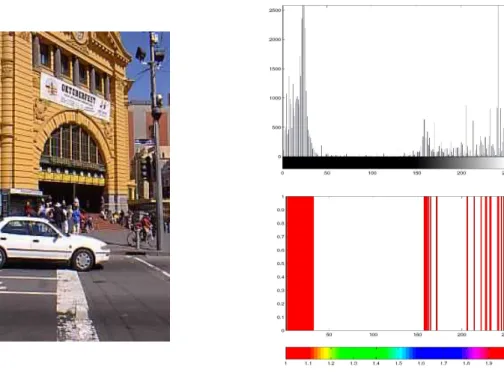
(7) The color histogram is obtained by uniformly dividing the hue distribution into p bins, where p = 256 in the experiments. Two scenarios are considered, using unquantized and quantized coefficients respectively. For the former (unquantized) case, the bin values are represented with full precision and the distance between two histograms is evaluated by the intersection [10] p. d U (h, k ) =. ∑ [k i =1. i. − min(hi , k i )] (2). p. ∑k i =1. i. where hi and ki denote the ith bin values of the two histograms h and k. For the latter (quantized) case, the ith bin value hi is quantized into a bit bhi with respect to a pre-defined threshold ui, that is:. 0, hi < u i bhi = 1, hi ≥ u i. (3). For an image of size m×n, we set u i = m × n / p = average of the bin values for each i for simplicity. The distance between two binary histograms is evaluated using the Hamming metric p. d Q (h,k) = ∑ [bhi ⊕ bki ]. (4). i =1. where ⊕ denotes the modulo-2 addition. An illustration for these two cases is shown in Fig. 3. In both cases, a smaller distance (close to 0) implies higher similarity.. 7.
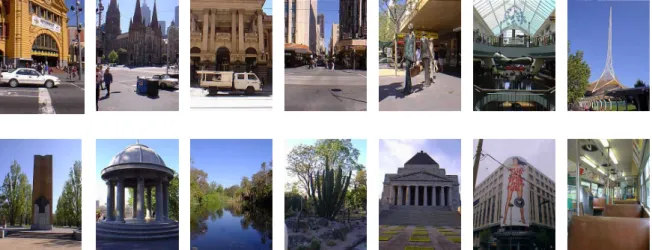
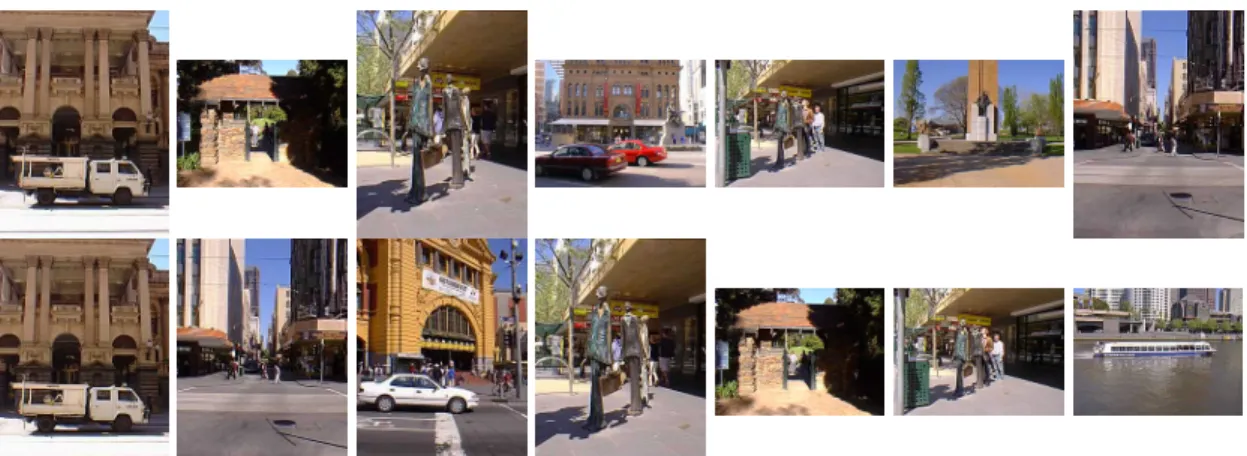
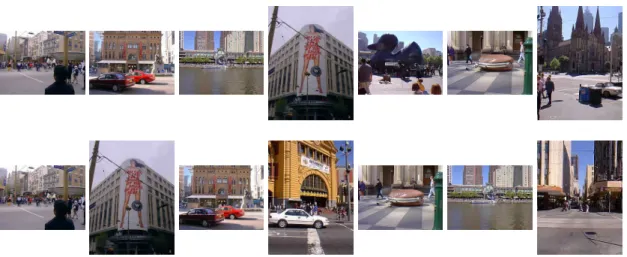
(8) Fig. 3. Unquantized and quantized histograms; left: test image, upper-right: unquantized histogram, lower-right: quantized (binary) histogram.. Experimental Results We use a test set that contains 47 natural color images with size either 320×240 or 240×320 as shown in Fig. 4. The first query result for both quantized and unquantized histograms is shown in Fig. 5, where six retrieved images that have smaller distances with the query image (#3), are singled out in the order of similarity. Fig. 6 gives the (normalized) similarity responses for these two approaches. It can be seen that the binary version provides fairly good retrieval results (4 out of 6 of the retrieved images are identical). The similarity response follows the same trend, although the unquantized histogram is more discriminating. Fig. 7 and Fig. 8 show the results when the image #38 is used as the query image and similar observations can be made.. 8.
(9) Conclusion and Future Work This work attempts to use a simplified binary color histogram as a means of image indexing. The storage and computational requirements of the proposed scheme are greatly reduced as compared with the conventional unquantized color histogram. The retrieval performance is acceptable for the examined experiments. Using the binarized histogram, however, will unavoidably lower the discriminating power for image retrieval. Furthermore, the hue histogram alone may not be sufficient for efficient image retrieval since many natural images contain achromatic regions dominated by value and saturation [8], [9], [11]. Currently, we are developing more efficient (adaptive) schemes based on binary histogram that address the above concerns.. 9.
(10) Fig. 4. Test set.. 10.
(11) Fig. 5. Query results using image #3 (leftmost) as the query image; top row: using unquantized histogram, bottom row: using quantized (binary) histogram. The retrieved images are ordered according to their similarity with the query image.. Fig. 6. Distance responses of the two schemes using image #3 as the query image.. 11.
(12) Fig 7. Query results using image #38 (leftmost) as the query image; top row: using unquantized histogram, bottom row: using quantized (binary) histogram. The retrieved images are ordered according to their similarity with the query image.. Fig. 8. Distance responses of the two schemes using image #38 as the query image.. 12.
(13) References 1. A. W. M. Smeulders, M. Worring, S. Santini, A. Gupta, and R. Jain, “Content-based image retrieval at the end of the early years,” IEEE Trans. Pattern Analysis and Machine Intelligence, vol. 22, no. 12, pp. 1349-1379, Dec. 2000. 2. ISO/IEC 15938:. Information Technology -- Multimedia Content Description. Interface. 3. M. K. Mandal, F. Idris, and S. Panchanathan, “A critical evaluation of image and video indexing techniques in the compressed domain,” Image and Vision Computing, vol. 17, pp. 513-529, 1999. 4. M. J. Swain and D. H. Ballard, “Color indexing,” International Journal of Computer Vision, vol. 7, no. 1, pp. 11-32, 1991. 5. L. Cinque, G. Ciocca, S. Levialdi, A. Pellicano, and R. Scherrini, “Color-based image retrieval using spatial-chromatic histograms,” Image and Vision Computing, vol. 19, pp. 979-986, 2001. 6. F. Idris and S. Panchanathan, “Image indexing using wavelet vector quantization,” SPIE - Digital Image Storage and Archiving Systems, vol. 2606, pp. 269-275, 1995. 7. J. Berens, G.. D. Finlayson, and G.. Qiu, “Image indexing using compressing colour histogram,” IEE Proc.-Vis. Image Signal Process, vol. 147, no. 4, August. 13.
(14) 2000. 8. M. Tico, T. Haverinen, and P. Kuosmanen, “A method of color histogram creation for image retrieval,” Proc. IEEE Nordic Signal Processing Symposium, 2000. 9. J. R. Smith and S.-F. Chang, “Single color extraction and image query,” Proc. Int’l Conf. Image Processing, vol. 3, pp. 528-531, 1995. 10. S. Gibson and R. Harvey, “Analyzing and simplifying histograms using scale-trees,” Proc. Int’l Conf. Image Analysis and Processing, pp. 84-89, 2001. 11. C.-M. Tsai and H.-J. Lee, “Binarization of color document images via luminance and saturation color features,” IEEE Trans. Image Processing, vol. 11, no. 4, pp. 434-451, Apr. 2002.. 14.
(15)
數據
+3
相關文件
image processing, visualization and interaction modules can be combined to complex image processing networks using a graphical
After students have had ample practice with developing characters, describing a setting and writing realistic dialogue, they will need to go back to the Short Story Writing Task
When using this image in external sources it can be cited as:Blausen.com staff. Wikiversity Journal
Retrieval performance of different texture features according to the number of relevant images retrieved at various scopes using Corel Photo galleries. # of top
Examples of thermal image (left) and processed binary images (middle and right) of
Presents a metric selection framew ork for online anomaly detection i n utility cloud.. ◦ Select most essential metrics by appl ying metric selection and
Lance Williams: Brute Force in image space (shadow maps in 1978, but other similar ideas like Z buffer, bump mapping using textures and so on).. Completely
Binary-coded decimal (BCD) integers use 4 binary bits to represent each decimal digit. A number using
