行政院國家科學委員會專題研究計畫 成果報告
多元淺水波理論數值模擬河相及土石流之研究(3/3)
計畫類別: 個別型計畫 計畫編號: NSC93-2211-E-002-004- 執行期間: 93 年 08 月 01 日至 94 年 07 月 31 日 執行單位: 國立臺灣大學土木工程學系暨研究所 計畫主持人: 卡艾瑋 報告類型: 完整報告 處理方式: 本計畫可公開查詢中 華 民 國 94 年 11 月 3 日
行政院國家科學委員會補助專題研究計畫
; 成 果 報 告
□期中進度報告
(多元淺水波理論數值模擬河相及土石流之研究(3/3))
計畫類別:
;
個別型計畫 □ 整合型計畫
計畫編號:NSC
93-2211-E-002-004--
執行期間:
2004.08.01 至 2005.07.31計畫主持人:卡艾瑋
共同主持人:
計畫參與人員:
成果報告類型(依經費核定清單規定繳交):□精簡報告
;
完整報告
本成果報告包括以下應繳交之附件:
□赴國外出差或研習心得報告一份
□赴大陸地區出差或研習心得報告一份
□出席國際學術會議心得報告及發表之論文各一份
□國際合作研究計畫國外研究報告書一份
附件一Computational modelling of geomorphic mountain flows
based on multi-component shallow water theory
Final report, October 2005 H. Capart
National Taiwan University Summary
The three-year research programme aimed to pursue the development of novel modelling tools for the description and prediction of geomorphic mountain flows. The approach is based on a multi-component, shallow layer description of horizontal two-dimensional flow. The overall programme sought to: 1) establish governing equations accounting for the coupled motion of water, liquefied soil, and transported sediment; 2) develop and implement suitable computational techniques; 3) test the equations and computations against theoretical, experimental and field information. The key findings of the research are documented in the present report. They are structured in three broad categories: 1) modeling of sharply stratified shallow flows; 2) treatment of interfacial transfer terms; 3) development of a reduced theory and applications to prograding deltas and geomorphic floods at the field scale. The aims attained and further work needed are described in a final section.
1. Sharply stratified shallow flows
A first series of results concerns two-layer flows over rigid boundaries. The governing equations can be written in the following way (see Capart, 2004 for a derivation and background): 0 ) ( 1 1 1 = ∂ ∂ + ∂ ∂ u h x t h , (1) 0 ) ( 2 2 2 = ∂ ∂ + ∂ ∂ u h x t h , (2) 1 ) 0 ( ) 1 ( 2 1 2 ) 0 ( 1 2 1 2 1 2 1 1 1 1 ) ( ) ( ρ τ τ ρ ρ = − + ∂ ∂ + + ∂ ∂ + ∂ ∂ h z x gh gh u h x u h t , (3) 2 ) 1 ( 1 0 2 2 2 2 1 2 2 2 2 2 ) ( ) ( ) ( ρ τ − = + ∂ ∂ + + ∂ ∂ + ∂ ∂ h z x gh gh u h x u h t , (4)
The equations describe mass and momentum balance of two superposed layers of different velocities and densities, without interfacial transfer of mass. Although the equations themselves are not new, the behaviour of their solutions is currently the focus of intense research. Theoretical and computational work conducted as part of the present project has dealt with three special cases: 1) density stratified flow with locked velocities (u1 =u2); 2) density-stratified frictionless flow ( u1 ≠u2 but τ(1) =τ(0) =0 ); 3) density- and rheologically-stratified flow (u1 ≠u2, 0τ(1) ≠τ(0) ≠ ). The three subsections below outline
some result highlights for these three cases. 1.1. Density stratified flow with locked velocities
For two-layer flows with locked velocities (u1 =u2), the main results include the derivation of a novel analytical solution extending the Stoker solution to density-stratifed flows (ρ1 ≠ρ2), and the corresponding development and validation of a numerical scheme. These results are illustrated on the figureabove and detailed in the MSc thesis of Ke (2005).
1.2. Density-stratified frictionless flow
When the two superposed layers are allowed to have different velocities (u1 ≠u2), the behaviour becomes much more complicated. A very special feature that has only recently been recognized is that local loss of hyperbolicity can occur. We have explored the implications of this feature through a series of computational tests and comparisons with experiments. This work was conducted jointly with B. Spinewine and Y. Zech of the Univ. catholique de Louvain, Belgium (Spinewine, Capart and Zech, in preparation).
1.3. Density- and rheologically stratified flow
The influence of the shear stress functions τ(0) and τ(1) on the flow behaviour is another
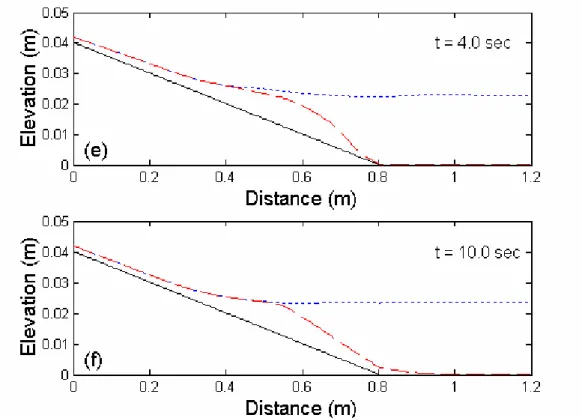
interesting issue which was examined in cooperation with S.-C. Chen and S.-H. Peng of the National Chung-Hsing University (Chen, Peng and Capart, submitted). In particular, we examined rheologically-stratified flows in which the top layer behaves like a usual water layer, but the lower layer is a visco-plastic Bingham mud. Sample simulations from this effort are shown on the figure below.
Figure 3. Two-layer simulation of mudflow intrusion into a shallow reservoir. On each snapshot of the sequence, the water surface is shown as a dotted line, the mud surface as a dashed line, and the underlying rigid bottom as a solid line.
1.4. Extension of the computational scheme to two dimensions
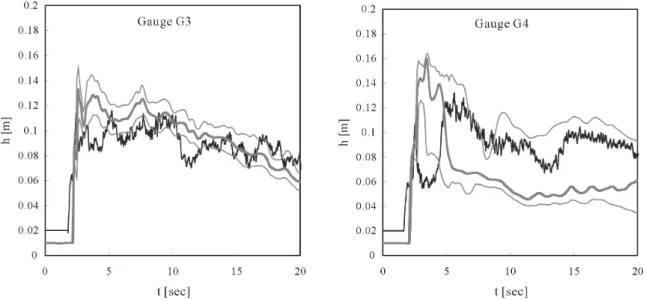
In addition, the computational scheme used to solve the equations was extended to two spatial dimensions and validated against laboratory experiments. This is illustrated on the figures below.
Figure 4. Dam-break flow past an isolated obstruction. Water depth contours at various times.
Figure 5. Comparison of measured depths (black) with simulated results at various gauges (Experimental data from the UCLouvain, Belgium).
2. Interfacial transfer: erosion and entrainment 2.1. Interfacial transfer theory
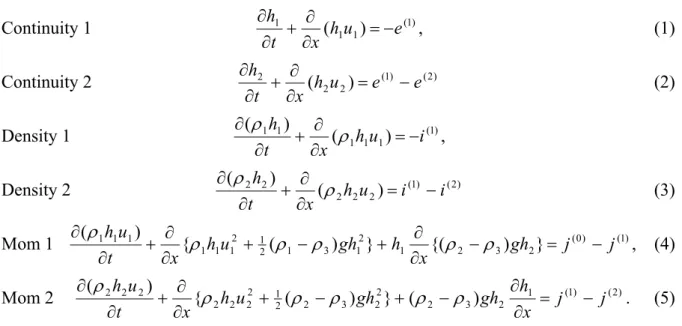
When transfer of mass occurs across interfaces separating the different layers, the governing equations must be extended to:
Continuity 1 (1) 1 1 1 (hu ) e x t h − = ∂ ∂ + ∂ ∂ , (1) Continuity 2 (1) (2) 2 2 2 (h u ) e e x t h − = ∂ ∂ + ∂ ∂ (2) Density 1 (1) 1 1 1 1 1 ) ( ) ( i u h x t h − = ∂ ∂ + ∂ ∂ ρ ρ , Density 2 (1) (2) 2 2 2 2 2 ) ( ) ( i i u h x t h − = ∂ ∂ + ∂ ∂ ρ ρ (3) Mom 1 (0) (1) 2 3 2 1 2 1 3 1 2 1 2 1 1 1 1 1 1 ) { ( ) } {( ) } ( j j gh x h gh u h x t u h − = − ∂ ∂ + − + ∂ ∂ + ∂ ∂ ρ ρ ρ ρ ρ ρ , (4) Mom 2 1 (1) (2) 2 3 2 2 2 3 2 2 1 2 2 2 2 2 2 2 ) { ( ) } ( ) ( j j x h gh gh u h x t u h − = ∂ ∂ − + − + ∂ ∂ + ∂ ∂ ρ ρ ρ ρ ρ ρ . (5) (Here we have assumed a horizontal bottom). The symbols are defined on the figure below:
Figure 1. Density-stratified two-layer flow with interfacial transfer
A key result of the present research was to work out the interfacial transfer terms at the open boundary between the two layers. Conservation laws first imply that
) 1 ( 2 ) 1 ( 2 ) 1 ( 1 ) 1 ( 1 ) 1 ( =ρe +ι =ρ e +ι i , (6) ) 1 ( 2 ) 1 ( 2 ) 1 ( 1 ) 1 ( 1 ) 1 ( =ui −τ =u i −τ j , (7)
The dissipative terms included in these flux relations have been worked out for both erosion and entrainment, which we have successfully integrated into a common framework.
2.2. Application to antidune flows
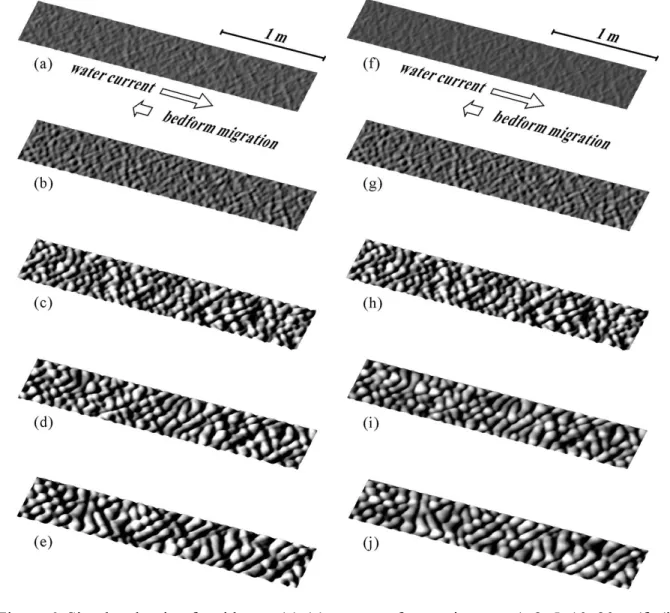
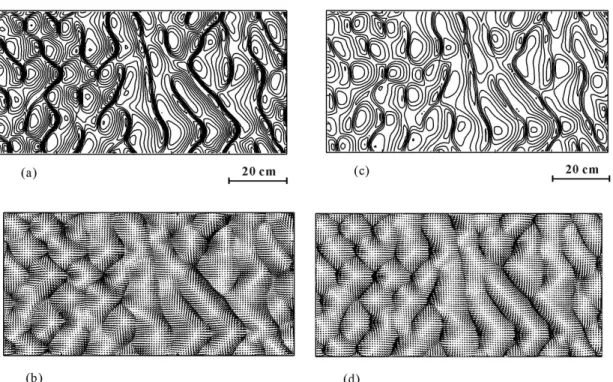
The approach above has been applied to various geomorphic flows. In two spatial dimensions, it has been applied to fast water currents over evolving antidunes. This is a challenging application which had not been attempted before. Results are illustrated below.
Figure 6. Simulated train of antidunes: (a)-(e) water surface at times t = 1, 2, 5, 10, 20 s; (f)-(j) sand bed surface at the same instants. The gray scale codes surface elevation with respect to
Figure 7. Antidunes detail at time t = 20 s: (a) water surface; (b) water velocity field; (c) sediment interface; (d) sediment layer velocity field. Contours at 1 mm intervals and mean
velocity subtracted from vector fields. 2.3. Application to two-dimensional deltas
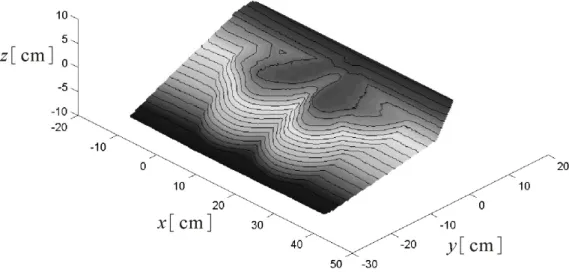
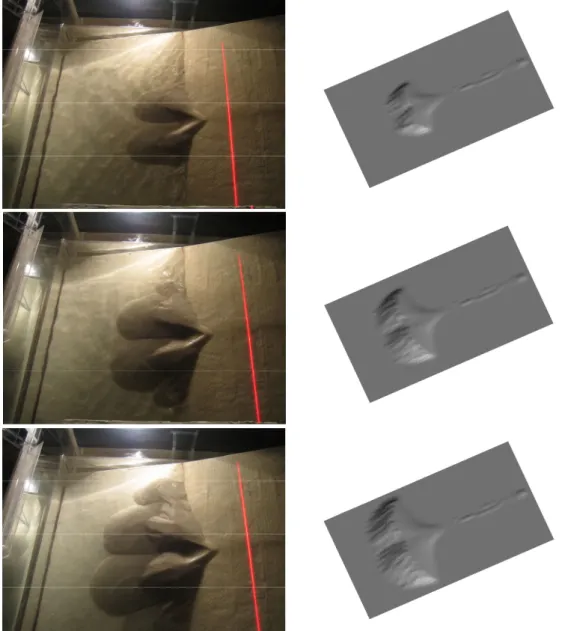
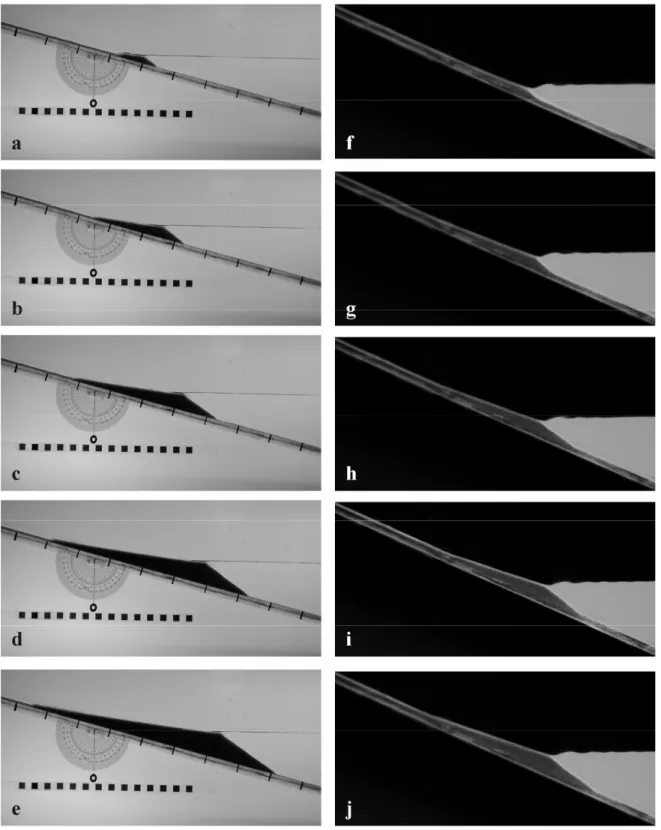
Another application concerns two-dimensional fluvial deltas, for which we conducted experiments and comparisons with simulations. Sample results from this effort are illustrated below (see also Ke, 2005).
Fig. 8. Two-dimensional fluvial deltas over rigid basements. Top: experimental photo; bottom: laser-scanned topography of the delta deposit.
Fig. 9. Comparison of experimental (overhead photos shown on the left) and numerical results (shaded surfaces shown on the right) for the delta development.
2.4. Application to turbulent entraining flows
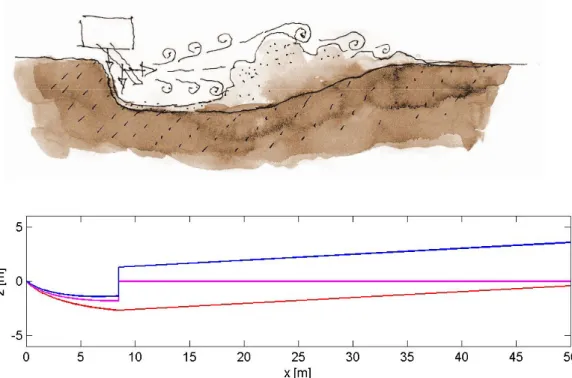
An unexpected feature of the developments above is that they turned out to apply as well to subaqueous flows with both erosion and turbulent entrainment. These flows are under study as part of another research project of our laboratory. The interfacial transfer approach originally developed for subaerial flows in the context of the present project was successfully transferred to this distinct domain. More recently, we have begun to test the approach for bubbly flows as well.
Figure 10. Jet-induced erosion of submerged sediment bed. Top: conceptual view. Bottom: shallow flow calculations including the effects of erosion and entrainment.
3. Reduced theories for large scale problems
Although the above approach can deal successfully with a number of fast, medium scale problems, computations are too expensive for the slowly evolving, large scale problems typically encountered in field applications. For this reason, the third component of our research has sought to identify reduced theories approximating the above equations. We have developed and successfully tested a reduced formulation that involves a combination of diffusion and complementarity equations (Capart, Lai and Young, in preparation). In one dimension, the reduced formulation is written
) ( ) ( ) ( s s s i x q t z = ∂ ∂ + ∂ ∂ , (5) ) ( ) ( w w i x q = ∂ ∂ . (6) 0 ) ( ) ( ≥ ∂ ∂ − x z j w w , z(w)−z(s) ≥0, ( ( ) ()) ( ) ( ) =0 ∂ ∂ − − x z j z z w s w w . (7)
and this can be extended to two dimensions as well. 3.1. Application to prograding deltas
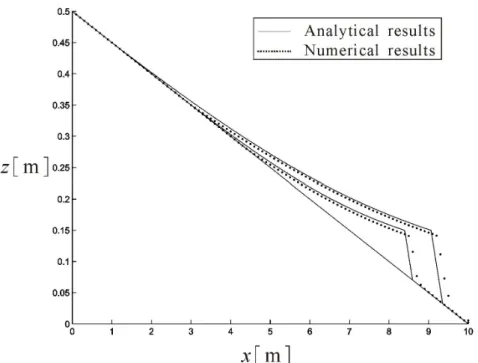
We have applied the approach to a number of problems, including the progradation of fluvial deltas into reservoirs. An example is shown on the figure below.
Figure 13. Comparison of analytical solutions of the reduced theory (lines) with numerical solutions of the full equations (dots) for a delta prograding over a rigid basement. For this problem, we have developed analytical and computational solutions, and checked that they provide reasonable approximations to the full shallow flow equations outlined earlier in the previous sections (see figure above). Comparisons with laboratory experiments were also conducted and are illustrated on the figure below.
An exciting recent finding (Lai et al. 2005) is that this reduction approach applies not only to sediment transport by subaerial streams, but also to sediment transport by subaqueous density currents. This is illustrated on the figure below.
3.2. Geomorphic flood of 1996 in the Ha! Ha! river, Saguenay region, Canada
To test the reduced theory, comparisons were conducted with a well-documented geomorphic event: the 1996 geomorphic flood which affected the Ha! Ha! river, in the Saguenay region of Canada. The field data collection and testing needed for this part of the work also received partial support from the Council of Agriculture. The event and the simulation results are presented in the following figures.
Figure 16. Vicinity of the failed dyke which triggered the geomorphic flood of July 1996. Left: helicopter view of the situation immediately after the flood (photo courtesy of Dr. G.R. Brooks, GSC). Right: ground view of the situation in September 2000 (photo by H. Capart).
Figure18. Comparison of observed and simulated long profile evolution for the full Ha! Ha! valley. Thin line: measured pre-flood profile; thick line: measured post-flood profile; dots:
post-flood profile calculated using reduced theory. 3.3. Incision of Tsaolin landslide dam, Taiwan, by the 2001 Toraji Typhoon
The reduced theory and computations were tested also on a well-documented Taiwan event: the 2001 incision of Tsaolin landslide dam by Toraji typhoon. The field data collection and testing needed for this work also received partial support from the Council of Agriculture. Results are illustrated below.
Figure 20. Accumulated geomorphic change of the Tsaolin Landslide dam induced by Toraji Typhoon. Top: erosion/deposition predicted by the anisotropic diffusion scheme; bottom:
4. Aims attained and further efforts needed
Overall, the three-year research project sought to make the following scientific and engineering contributions:
1) Propose to the international scientific community a novel approach to the modelling of severe geomorphic flows in mountain areas, fleshed out in detailed simulations and confronted with laboratory and field measurements.
2) Make available to government officials and engineering professionals in Taiwan a novel assessment tool applicable to hazard-prone mountain areas. In this respect, it should be emphasized that the goal is not to replace existing methods of hazard assessment and the engineering experience that they embody. Rather, the aim is to supplement existing expertise with an additional tool that is currently unavailable: a physically based simulation model of geomorphic mountain flows.
For the most part, these goals have been attained:
1) A workable modeling approach was derived theoretically and implemented numerically, in both one and two spatial dimensions, for flows involving one and two sublayers, including the effects of erosion and entrainment. Reduced theories were derived for application to slowly evolving, large scale tests.
2) The 1D and 2D simulations were compared with laboratory data for a number of flow configurations, including dam-break waves and prograding deltas.
3) Successful simulations of field events have been conducted, using reduced versions of multi-component shallow flow theory. Fluvial action was successfully reproduced for two field cases: the 1996 Ha! Ha! geomorphic flood in Saguenay, Canada, and the 2001 incision of Tsaolin landslide dam, Taiwan.
In addition, some further results that we did not anticipate have been attained. It turns out that the multi-component shallow flow approach developed originally for subaerial flows alone can readily be extended to subaqueous flows. Problems that we have treated that fall outside the scope of the original proposal include jet-induced sediment motion and slowly prograding deltas in deep water ambients.
5. Provisional list of publications related to the project
Capart, H. (2003) Dam-break flow past an oblique building on a square grid: rigid and erodible building simulations. 3rd IMPACT Workshop (EU-funded research project on Investigation of Extreme Flood Processes and Uncertainty), UCL Louvain-la-Neuve, Belgium, 5-7 November 2003. CD-ROM and online proceedings.
Capart, H. (2004) Shallow flow. Lecture notes, National Taiwan University.
Capart, H., Eldho, T.I, Huang, S.Y., Young, D.L., and Zech, Y. (2003) Treatment of natural topography in finite volume river flow computations. ASCE J. Hydr. Engrg 129(5): 385-393.
Capart, H., Lai, C.-H., and Young, D.-L. (in preparation) Streamwise diffusion theory of fluvial action applied to the incision of Tsaolin landslide dam, Taiwan. To be submitted to the Journal of Geophysical Research-Earth Surface.
Capart, H., Spinewine, B., Young, D.L., Zech, Y., Brooks, G.R., Leclerc, M., and Secretan,Y. (2003) The 1996 Lake Ha! Ha! breakout flood, Québec: Proposed test case for geomorphic flood models. 3rd IMPACT Workshop (EU-funded research project on Investigation of Extreme Flood Processes and Uncertainty), UCL Louvain-la-Neuve, Belgium, 5-7 November 2003. CD-ROM and online proceedings.
Capart, H., and Young, D.L. (2002) Two-layer shallow water computations of torrential geomorphic flows. Proceedings of the 1st International Conference. on Fluvial Hydraulics (D. Bousmar, Y. Zech, Eds.), Louvain-la-Neuve, Belgium (September 2002), pp. 1003-1012.
Capart, H., and Young, D.L. (2002) Development and preliminary validation of a geomorphic flood routing framework. Proceedings of the 1st International Conference on Debris-Flow Disaster Mitigation Strategy (Chen S.C., Ed.), Taipei, Taiwan (December 2002), pp. 151-172.
Capart H, and Young, D.L. (2004) Geomorphic routing of the 1996 Lake Ha!Ha! breakout flood, Quebec, by streamwise diffusion-advection. Fourth IMPACT Workshop (EU-funded research project on Investigation of Extreme Flood Processes and Uncertainty), University of Zaragoza, Spain, (November 2004). CD-ROM and online proceedings.
Chen S.C., Peng S.H., Capart H. (2004) Morphology of alluvial fans formed by hyperconcentrated tributaries. Proceedings of the 2nd International Conference. on Fluvial Hydraulics (M. Greco, A. Carravetta, and R. Della Morte, Eds.), Napoli, Italy (September 2002), pp. 1095-1102.
Chen, S.C., Peng, S.H. and Capart, H. (submitted) Two-layer shallow water computation of mud flow intrusions into quiescent water. Submitted to the Journal of Hydraulic Research. Douxchamps, D., Devriendt, D., Capart, H., Craeye, C., Macq, B. and Zech, Y. (2005)
Ke (2005) Formation of symmetrically palmated deltas: shallow flow computations and experimental study. MSc thesis, National Taiwan University (thesis advisor: H. Capart). Lai, Y.-J., Hsu, P.-C., Hou, C.-.Y, Wang, W., and Capart, H. (2005) Self-similar build-up of
subaerial and subaqueous deltas over bedrock basements. Geodynamics and Environment in East Asia International Conference & 5th Taiwan-France Earth Science Symposium, Taitung, Taiwan, November 2005.
Spinewine, B., Capart, H., and Zech, Y. (in preparation) Two-layer flow behaviour of dam-break waves over granular beds. To be submitted to Physics of Fluids.