
Study on the Physical Properties of Three-dimensional Spacer Fabrics
5
0
0
全文
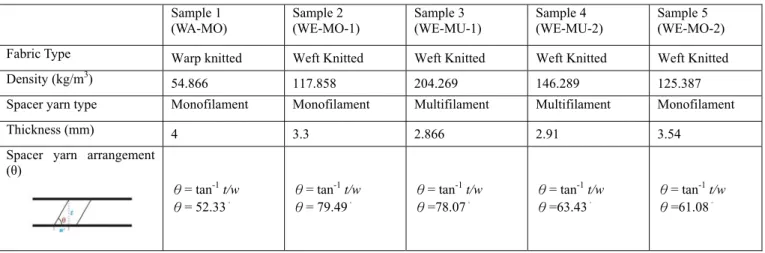
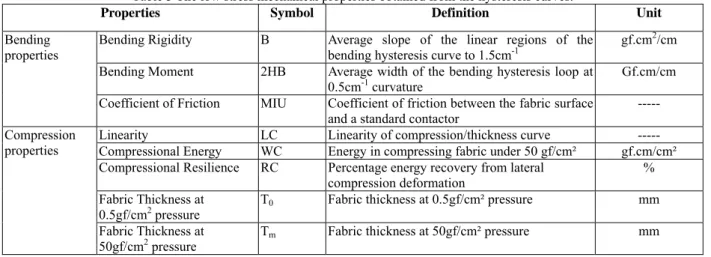
(2) Table 2 Fabric structure and microscopic view of different spacer fabrics. 2.2 Air permeability The air permeability of the samples was studied by KES-F8-AP1 air permeability tester. The air resistance (R) was recorded in terms of kpa.s/m. The results were averages from the values of ten readings.. test plate heater. The thermal conductivity value (W/mK) of different spacer fabrics can be calculated: Thermal conductivity (k) = Heat flow rate × distance / (area × temperature difference). 2.3 Thermal property The thermal property was studied by KES-F Thermo Labo II. 2.4 Low stress mechanical properties This test is used to measure the power loss from BT-Box (Watt) to The KES-F (Kawabata Evaluation System) was used for the Water Box through the spacer samples. The sample was put measuring the low stress mechanical properties of the spacer o on the Water Box which is in the room temperature (20 C). The samples including bending and compression properties. The temperature of BT-Box and Guard were set to the temperature parameters obtained from these hystersis curves are defined and o 30 C. The amount of heat passing through the sample in watts per shown in table 3. square meter was measured from the power consumption of the Table 3 The low stress mechanical properties obtained from the hysteresis curves. Properties Symbol Definition Unit Bending properties. Compression properties. Bending Rigidity. B. Bending Moment. 2HB. Coefficient of Friction. MIU. Linearity Compressional Energy Compressional Resilience. LC WC RC. Fabric Thickness at 0.5gf/cm2 pressure Fabric Thickness at 50gf/cm2 pressure. T0. Average slope of the linear regions of the bending hysteresis curve to 1.5cm-1 Average width of the bending hysteresis loop at 0.5cm-1 curvature Coefficient of friction between the fabric surface and a standard contactor Linearity of compression/thickness curve Energy in compressing fabric under 50 gf/cm² Percentage energy recovery from lateral compression deformation Fabric thickness at 0.5gf/cm² pressure. Tm. Fabric thickness at 50gf/cm² pressure. gf.cm2/cm Gf.cm/cm --------gf.cm/cm² % mm mm.
(3) The stretch and recovery properties of spacer samples were studied by INSTRON 4411 according to the British standard 4294. By using this method, the specimen of standard dimensions is stretched under a specified load. The INSTRON 4411 machine consists of two clamps which is 7.5cm width. The length of the specimen should be sufficient to allow a distance of 7.5cm (L1) between the inner edges of the clamps to hold the specimen. The load was gradually increased on the specimen to 6kg ± 5kg within 7.5s ± 2.5s. The load was maintained for 10s ±2s and then reduced the load gradually until the clamps were returned to their original position. The load was reapplied immediately to the specimen and the length of the specimen (L2) after 1 minute was measured. The specimen was removed form the clamps to a flat and smooth surface. The distance between the marks after 1 minute (L3) was measured. After 30 minutes the distance between the marks (L4) was measured. The same procedures were done on both warp and weft directions. The values of elongation (E), recovery after 1 minute (R1) and 30 minutes (R30) of different spacer fabrics were calculated as below:. Thermal conductivity (W/mK). 2.5 Stretch and Recovery. 1.1097. 1.2 1 0.8. 0.87912. 0.9486. 0.9534. 4. 5. 0.7648. 0.6 0.4 0.2 0 1. 2. 3 Sample. Fig. 2. Thermal conductivity values of different spacer fabrics Figure 1 indicates that sample 1 (WA-MO) has the lowest air resistance while sample 3 (WE-MU-1) has the highest air resistance. Figure 2 indicates that sample 1 (WA-MO) have a lower thermal conductivity while sample 3 (WE-MU-1) has a higher thermal conductivity.. E = 100(L2-L1)/L1 R1 = 100(L3-L1)/L1 R30 = 100(L4-L1)/L1 3. Results and discussion 3.1. Air permeability and Thermal Properties In this study, the air resistance (R) of different spacer fabrics in terms of kPa.s/m was recorded. A higher number of kPa.s/m indicates a higher air resistance of the fabric [6]. Figure 1 shows the air resistance of different spacer fabrics. The thermal conductivity of different spacer fabrics in terms of W/mK was also recorded. A higher value of thermal conductivity indicates more rapid movement of heat from the skin to the fabric surface, which will provide a cooler feeling [6]. Figure 2 shows the thermal conductivity of different spacer fabrics.. The air permeability of a fabric is closely related to the construction characteristics of the yarns and fabrics in which large volumes are occupied by air. There are some factors that affect the air permeability of the fabric, e.g. fabric structure, thickness, surface characteristics, etc [7, 8]. In this study, it is suggested that density shows the most significant effect on the air permeability and thermal property of the spacer fabric. A higher fabric density will hinder the air flows through the fabric, thus resulted in poor air permeability of the fabrics. However, a higher fabric density will have a better thermal conductivity as less space to trap the air inside. Therefore, it has better thermal ventilation.. Air resistance (kPa.s/m). 3.2. Compression properties 1.69. 1.8 1.6 1.4 1.2 1 0.8 0.6 0.4 0.2 0. 0.58. 0.49. 0.37. 0.035 1. 2. 3. 4. Sample. Fig. 1.. Air resistance of different spacer fabrics. 5. The compression resistance of different spacer fabrics in terms of the percentage change of thickness compressed under 50 gf/cm² loading was recorded (shown in figure 3). A higher percentage of thickness compressed indicates a lower compression resistance. It is interesting to find that sample 3(WE-MU-1) & 4 (WE-MU-2) have lower compression resistance than sample 1(WA-MO), 2(WE-MO-1) and 5(WE-MO-2). It is suggested that fabric using monofilament as spacer yarn generally has better compression resistant than using multifilament yarn. When the results of spacer fabrics using same type of spacer yarn were compared, it is found that the compression resistance of the sample is closely related to the spacer yarn arrangement. The resistance force of the spacer yarn is F sin θ. Therefore, the sample which has a greater degree will have a higher compression resistance [9, 10]..
(4) 450. Compressed thickess (%). 30.0 25.0. 23.7. 24.4. 23.4. 21.5. 20.0 15.0 10.0. Bending ridgidity (uN.m). 400 27.7. 5.0. 350 Warpwise Weftwise. 300 250 200 150 100 50. 0.0. 0 1. 2. 3. 4. 5. 1. 2. Sample. 3. 4. 5. Sample. Fig. 3. Compressed thickness of spacer samples. Fig. 4. Bending rigidity of spacer samples. Table 4 shows the compressional resilience of different spacer fabrics which is the percentage energy recovery from lateral compression deformation. A higher percentage indicates a better recovery property. The result indicates that sample 1, 2 and 5 have better recovery property than sample 3 and 4. It is observed that the recovery properties after compression is greatly depended on the spacer yarn type. Spacer samples using monofilament as their spacer yarns have a better recovery properties than that of using multifilament spacer yarns.. 3.4 Stretch and recovery The stretch and recovery properties of different spacer fabrics in terms of percentage (%) were recorded. A higher percentage indicates a better stretch and recovery properties. The results from table 5 and 6 indicate that sample 1 (WA-MO) has the best stretchabilty in weft-wise while has the poorest stretchabilty in warp-wise. Sample 3 (WE-MU-1) has the best recovery property in both the warp-wise and weft-wise fabric while sample 1 (WA-MO) has the poorest recovery property in both directions.. Table 4 Compressional resilience of different kind of spacer fabrics Sample 1 2 3 4 5 RC(%). 75.417. 52.247. 37.02. 35.15. 51.317. 3.3 Bending Properties In this study, the bending rigidity of different spacer fabrics in terms of uN.m was recorded. A higher number of uN.m indicates a higher bending rigidity of the fabric. Figure 4 indicates the bending rigidity of both warp-wise and weft-wise of spacer fabrics. From figure 4, the bending rigidity of spacer fabric is greatly related to the fabric type. Bending rigidity of weft knitted spacer fabric has a higher bending rigidity in weft-wise direction while warp knitted spacer fabric has a higher bending rigidity in warp-wise direction. It is mainly due to the direction of yarn incorporated [11-13]. When the samples are in the same fabric type (weft knitted spacer fabric), the bending rigidity is closely related to the fabric density, spacer structure and spacer type [14, 15]. Weft knitted spacer fabric using interlock structure, monofilament spacer yarn and a higher fabric density will have a higher bending rigidity.. Table 5 Elongation and recovery of the warp-wise spacer fabrics Recovery after 1min, Recovery after Sample Elongation, E R1 30min, R30 1. 49.17%. 86.90%. 96.83%. 2. 67.96%. 95.74%. 98.69%. 3. 93.28%. 97.38%. 99.53%. 4. 47.32%. 94.36%. 98.59%. 5. 114.03%. 91.61%. 96.88%. Table 6 Elongation and recovery of the weft-wise spacer fabrics Recovery after 1min, Recovery after Sample Elongation, E R1 30min, R30 1. 159.68%. 78.01%. 94.30%. 2. 101.77%. 90.83%. 96.73%. 3. 129.80%. 94.86%. 97.09%. 4. 119.51%. 85.31%. 94.79%. 5. 86.73%. 89.31%. 96.16%. It is suggested that stretchability of the spacer fabrics is closely related to their fabric type. The results shown in figure 5 reveled that the stretchability of warp knitted spacer fabric only has a high stretchability in weft-wise direction while the stretchability of warp-wise direction is very low (below 50%). On the other hand, weft knitted spacer fabrics have similar and high percentage of stretchability in both weft-wise and warp-wise directions. As the spacer fabric is composed of two separate surface fabrics and linked together by a spacer yarn, therefore, it can be concluded.
(5) that spacer fabrics carry the same fabric stretchability as their fabric types (i.e. warp knitted or weft knitted).. Elongation (%). When the results of the weft knitted spacer samples are compared, the stretchability of weft-wise direction of sample 3 and 4 are higher than that of sample 2 and 5. It is due to sample 3 and 4 are using multifilament spacer yarns which has higher stretchability than those samples using monofilament spacer yarns [16].. 180.00% 160.00% 140.00% 120.00% 100.00% 80.00% 60.00% 40.00% 20.00% 0.00%. warp-wise elongation weft-wise elongation. 1. 2. 3. 4. 5. Sample. Fig. 5. Elongation of different spacer samples. 4. Conclusion The air permeability, thermal property and low-stress mechanical properties of spacer fabric have been studied quantitatively. It is found that both air permeability and thermal properties are closely related to the fabric density. The compression properties depend very much on the spacer yarn type and the spacer yarn arrangement. Bending properties are closely related to the fabric type, structure, spacer yarn type and density while stretch and recovery properties depend very much on fabric type and spacer yarn type. It is believed that the fabric characteristics of spacer fabric show a very significant effect on the air permeability, thermal property and low-stress mechanical properties of spacer fabric. Therefore, a careful selection of spacer fabric for its application is of primary importance.. 5. Reference [1] Anonymous, New Patterning Possiblities. Kettenwirk-praxis, (2): pp. 31-68 (2001). [2] Wilkens, C., Raschel Knitted Spacer Fabric. Kettenwirk-praxis, (3): pp. 59-80 (1993). [3] Lehmann, W., Elastic, moulded spacer fabric. Kettenwirk-praxis, (3): pp. 33-50 (1994). [4] Adrian M. Shepherd, L.G., Weft Knitted Spacer Fabric, in USPTO Patent Full Text and Image Database. 2004. [5] Abbott, J.K.a.M.D., Brassiere Having a Spacer fabric and a Method of Making same, in USPTO Patent Full Text and Image Database. 2004, Sara Lee Corporation. [6] Joanne Yip, K.Chan, et al, Low temperature plasma-treatd nylon fabric. Material Processing Technology, 2000. [7] Comandar, C., M. Andriuta, and L. Manea, Researches on the influence of structure parameters if the interlock knits upon air permeability. Texsci-2000, pp. 91-95 (2001). [8] Zhang, P., et al, Effects of clothing material on thermoregulatory responses. Textile Research Journal, 72(1): pp. 83-89 (2002). [9] http://en.wikipedia.org/wiki/Stiffness [10] http://en.wikipedia.org/wiki/Spring_%28device%29. [11] Machova, K., Klug, Peter, Waldmann, Martin, Hoftmann, Gerald, Cherif, Chokri, Determining of the bending stregth of knitted spacer fabric. Melliand Textilberichte International Textile Report, 87(6): pp. E93 (2006). [12] Reisfeld, A., Warp knit engineering. 1966. 1-16, 337-352. [13] Raz, D.S., Flat knitting Technology. pp.60-67(1993). [14] Hes, P.L., Fundaments of Design of fabrics and garments with demanded thermophysiological. [15] Hes, L., Recent Development in the field of user friendly testing of mechanical and comfort properties of textile fabrics and garment. World Congress of the Textiles Institute, 2002. [16] King, R.R., Textile identification conservation and preservation energy prinsciple. pp.10-16 (1938)..
(6)
數據


+2

相關文件
Then, a visualization is proposed to explain how the convergent behaviors are influenced by two descent directions in merit function approach.. Based on the geometric properties
From these results, we study fixed point problems for nonlinear mappings, contractive type mappings, Caritsti type mappings, graph contractive type mappings with the Bregman distance
Then, we tested the influence of θ for the rate of convergence of Algorithm 4.1, by using this algorithm with α = 15 and four different θ to solve a test ex- ample generated as
Particularly, combining the numerical results of the two papers, we may obtain such a conclusion that the merit function method based on ϕ p has a better a global convergence and
Then, it is easy to see that there are 9 problems for which the iterative numbers of the algorithm using ψ α,θ,p in the case of θ = 1 and p = 3 are less than the one of the
Define instead the imaginary.. potential, magnetic field, lattice…) Dirac-BdG Hamiltonian:. with small, and matrix
S15 Expectation value of the total spin-squared operator h ˆ S 2 i for the ground state of cationic n-PP as a function of the chain length, calculated using KS-DFT with various
Most experimental reference values are collected from the NIST database, 1 while other publications 2-13 are adopted for the molecules marked..
