國立交通大學
物理研究所
博士論文
單層石墨層在調制場之下的電子特性和光
學性質
Electronic and Optical Properties of a
Single-layer Graphene in Spatially
Modulated Fields
研 究 生: 邱裕煌 (Yu-Huang Chiu)
指 導 教 授: 褚德三 (Der-San Chuu)
共同指導教授: 林明發 (Ming-Fa Lin)
誌謝
本篇論文的完成要感謝許多人的支持與幫助。首先要感謝褚德三
老師在這麼多年以來對我的指導,尤其是他給予我許多包容與耐心,
即使在我表現很差的時候,他仍然支持我,依舊相信我有能力完成我
的博士論文。其次要感謝成大物理系教授林明發,他給予我論文上面
的指導與幫助讓我受益良多,也因為他的鞭策才讓我得以在論文上面
有所成就。另外,台南科技大學張振鵬老師以及我的博士班同學林高
進博士時常給予我意見和討論,這些寶貴建議也讓我從中獲益許多。
交大的夥伴們,岳男、英彥、英瓚、瑞雯、奎霖和光胤,因為你們的
陪伴讓我不孤單。彥宏、思超、啟玄、子軒、兆穎、奕豪、琪朗、烱
煦、志偉、峻儀以及元正大哥,有你們在成大給予的幫助才能讓我的
論文得以順利完成。
最後要感謝我的家人以及身邊的好友們,你們一路的支持與陪伴
給予了我莫大的動力。尤其是我的母親,她從小到大對於我所做的一
切都盡力支持,也因為她的教導,讓我不至於誤入歧途,讓我能夠有
機會完成我的博士學位。在我想放棄的時候,大家給我安慰和鼓勵;
在我失意的時候,你們陪我一起度過低潮。博士班的這條路上,沒有
你們,我無法順利完成。未來的人生道路上,我仍然需要你們的陪伴。
在此,僅以這篇論文獻上我對你們的敬意。
摘要
這篇論文之中,我們以緊束模型及梯度近似法研究單層石墨系統在外加調制 磁場和調制電場之下的電子和光譜特性。對於調制磁場而言,電子性質受到它的 強烈影響而改變,這些改變包括能帶維度、能量色散關係、新的能量邊界態、能 帶非對稱性、能帶簡併度以及能帶的非等方性特質。在能帶結構中,費米能為零 的地方將會有局部平坦的能帶出現,而在其他能量對應的則是一維的拋物線能 帶。這兩種能帶在態密度中分別造成零維對稱和一維非對稱的發散峰。對於每一 條拋物線能帶而言,它具有一個原始邊界態和四個額外邊界態。這些邊界態所對 應的能量和調制週期以及調制磁場強度之間的關係都有詳細的討論與分析。另 外,在光學吸收譜中的吸收峰主要來自於原始邊界態和額外邊界態所產生。這兩 種邊界態對應的吸收峰分別遵守不同的光學選擇律,其主要原因是由於它們的波 函數擁有不同的特徵所造成。特別值得注意的是,光學吸收譜可以反應出調制磁 場方向以及外加光的極化方向所造成的非等方性特質。對於調制電場而言,電子 特性以及光學特性也會受到強烈的影響。在能帶結構中,靠近原始邊界態的能帶 具有數個額外邊界態,並且展現出震盪行為和色散關係。另外,原本在沒有外加 場之下的雙重簡併拋物線能帶變成沒有簡併的震盪能帶。態密度中所產生的一維 非對稱峰主要是來自於額外邊界態。值得一提的是,態密度中對應費米能為零的 有限值代表著自由電子的存在。換句話說,藉由調制電場的影響可以將單層石墨 系統從半導體性變成金屬性的系統。對於光學性質而言,同樣的也展現了許多來 自於額外邊界態所產生的吸收峰。然而,這些吸收峰並沒有展現出一個明確的光 學選擇律。Abstract
The π-electronic structures and optical absorption spectra of a single-layer graphene in spatially modulated magnetic and electric fields are studied by the tight-binding model and gradient approximation. For modulated magnetic fields, they could strongly affect the low-energy electronic properties, i.e., the dimensionality, energy dispersions, extra band-edge states, asymmetry, state degeneracy, and anisotropy of energy bands. There are partial flat bands at EF=0 and one-dimensional parabolic
bands at others. The two kinds of bands make density of states (DOS) exhibit a delta-function-like structure and asymmetric prominent peaks, respectively. Each parabolic band owns one original ( pp
y
k ) and four extra (kspy 's) band-edge states, and
their energy dependences on the period and strength are investigated in detail. In the optical absorption spectra, the absorption peaks originating in pp
y
k and kspy 's obey
different selection rules because their wave functions present different features. It is noted that the anisotropic absorption spectra are induced by different modulated directions and electric polarization directions. For modulated electric fields, they could drastically change the low-frequency electronic and optical properties. Each energy band displays oscillatory energy dispersions and several band-edge states near
pp y
k . The doubly degenerate parabolic bands become nondegenerate. DOS shows
many prominent asymmetric peaks mainly owing to the band-edge states. The finite DOS at EF =0 means that there are free carriers, i.e., a modulated electric field could
change a semiconducting graphene into a semimetallic one. The optical absorption spectra demonstrate rich peaks resulting from band-edge states, and reveal the anisotropy in the modulated direction. Such absorption peaks could not be ascribed to an obvious selection rule.
TABLE OF CONTENTS
誌謝 ...I 中文摘要 ...II Abstract ...III Table of contents ...IV Chapter 1.
Introduction ... 1
References ...6
Chapter 2. Electronic structure of a two-dimensional graphene monolayer in a spatially modulated magnetic field: Peierls tight-binding model 2.1 Introduction ... 12
2.2 Peierls Hamiltonian band matrix ... 14
2.3 Magnetoelectronic properties ... 18
2.4 Concluding remarks ... 27
References ... 29
Chapter 3. Low-frequency magneto-optical excitations in a graphene monolayer 3.1 Introduction ... 32
3.2 π-electronic wave functions ... 34
3.3 Magneto-optical absorption spectra ... 42
3.4 Summary and conclusions ... 55
References ... 60
Chapter 4. Electronic properties and optical absorption spectra of a graphene monolayer in the modulated electric field 4.1 Introduction ... 64
4.2 Hamiltonian matrix ... 65
4.3 Electronic properties ... 69
4.4 Optical absorption spectra ... 74
4.5 Conclusions ... 80
References ... 83
Chapter 5. Summary and future research ... 88
Chapter 1
Introduction
The bulk graphite is extensively studied in both theoretical calculations [1-4] and ex-perimental measurements [5-9]. Recently, few-layer graphenes with two-dimensional (2D) hexagonal symmetry and nanoscaled thickness have been produced by the mechanical fric-tion [10,11] and thermal decomposifric-tion [12,13]. Such systems are very appropriate in studying 2D physical properties. They have aroused a lot of investigations on band struc-tures [14-31], electronic excitations [32-35], phonon [36], transport properties [37-44], and optical spectra [14,45-51].
The geometric symmetry configurations have a profound influence on the electronic properties of few-layer graphenes. The honeycomb structure causes a single-layer graphene
to exhibit two linear bands intersecting at the Fermi level EF = 0. The low-energy bands
could be described by the fermion Dirac equation [16]. Energy bands are isotropic at low energy (≤ 0.5 eV) [1], and so are the low-frequency physical properties (e.g. Coulomb excitations) [32,34]. The vanishing density of states (DOS) at the Fermi level means that a graphene monolayer is an exotic zero-gap semiconductor. The massless Dirac electrons have been examined by using a combination of optical microscopy, scanning electron microscopy and atomic-force microscopy [11], and by the angle-resolved photoelectron spectroscopy [52].
The external electric [10,11] and magnetic fields [10,11,13,14,29,31,45,47,51] strongly affect the electronic properties of a graphene monolayer. A uniform perpendicular magnetic field makes the low-frequency energy bands become the dispersionless Landau levels (LLs),
and thus induces the novel half-integer quantum Hall effect [11,37]. The low-energy LLs
can be represented by a simple square-root form En ∝
p
|n| B0 (n the integer quantum and
B0 the field strength) [16,53]. The dependence on B0 has been identified by the
magneto-optical experiments of cyclotron resonance [47]. Meanwhile, an inhomogeneous magnetic field might also strongly influence the essential physical properties. Haldane, for example, concluded that a 2D graphene could exhibit magnetoconductance in the presence of a vanishing net magnetic field [54].
There are several studies on the optical absorption spectra of a graphene monolayer. The low-energy absorption spectra do not exhibit any absorption peaks by the theoretical prediction [14], which is dominated by the density of states. On the other hand, a uni-form perpendicular magnetic field could lead to many delta-function-like absorption peaks originating in LLs at low energy. These peaks result from the vertical excitations between the nth ((n + 1)th) occupied LLs and the (n + 1)th (nth) unoccupied LLs. Such peaks obey the specific selection rule |4n| = 1 because the wave functions (Ψn’s) own the spatial
symmetry configuration [16]. Ψn is characterized by the product of the nth order Hermite
polynomial and Gaussian function, as seen in a two-dimensional electron gas (2DEG). The optical selection has been confirmed by the far infrared transmission experiments [45].
The physical properties of a 2DEG in the presence of a spatially modulated magnetic field have been attracted numerous experimental [55-58] and theoretical [59-67] investiga-tions. These works primarily focus on the transport properties [55-57,59,60], energy bands [61-63], electronic excitations [64-67], and optical spectra [58]. The transport measurements reveal the oscillatory magnetoresistance [55,56]. Energy bands of a 2DEG in the absence of external fields have parabolic energy dispersions. A periodic magnetic field results in
drastic changes in the state degeneracy, band-edge states, and curvatures. In contrast, only few examine the physical properties of a single-layer graphene under a modulated magnetic field. Given the gap, we are motivated to investigate the magnetoelectronic and magneto-optical properties of a graphene monolayer in a modulated magnetic field.
The purpose of this dissertation is to investigate how modulated fields affect the physical properties of a single-layer graphene. At first, for modulated magnetic fields, the magne-toelectronic properties are calculated by the Peierls tight-binding model. The influence of such fields, including the energy dispersions, reduction of dimensionality, creation of extra band-edge states, change of state degeneracy, anisotropy at low energy, and asymmetry of energy bands, are studied (Chapter 2). Next, after obtaining the magnetoelectronic properties, the magneto-optical absorption spectra are figured out by the gradient approxi-mation [14,68-70]. The characteristics of wave functions, and the dependence of absorption peaks on the period, field strength, modulation direction, and electric polarization direction are discussed in detail (Chapter 3). In addition to modulated magnetic fields, the effects of modulated electric fields on the electronic and optical properties are further studied (Chapter 4). Finally, chapter 5 presents the summary and future research directions. The abstracts of chapters 2-4 are as follows.
The subject of chapter 2 is “Electronic structure of a two-dimensional graphene monolayer in a spatially modulated magnetic field: Peierls tight-binding model”. The magnetoelectronic properties of a 2D monolayer graphene are investigated by the Peierls tight-binding model. They are dominated by the period, strength, and direction of a spatially modulated magnetic field. Such a field could induce the reduction in di-mensionality, change of energy dispersions, anisotropy at low energy, composite behavior
in state degeneracy, extra band-edge states, and asymmetry of energy bands. There are partial flat bands at the Fermi level and 1D parabolic bands at others, which make density of states exhibit delta-function-like structure and asymmetric prominent peaks. Energies of the extra band-edge states strongly depend on the period, while those of the original band-edge states exhibit little dependence. Both of them grow as the strength increases. The modulated and uniform magnetic fields differ from each other in energy dispersion, state degeneracy, and dimensionality. Important differences between a monolayer graphene and a 2D electron gas are also found.
The subject of chapter 3 is “Low-frequency magneto-optical excitations in a graphene monolayer”. The low-frequency optical excitations of a monolayer graphene in a periodic magnetic field are calculated by the gradient approximation. The original and extra band-edge states make the optical absorption spectra exhibit a lot of asymmetric prominent peaks, which, respectively, lead to the principal peaks and subpeaks. The two kinds of peaks obey two different selection rules because their wave functions present differ-ent features. The intensity, frequency, and number of the absorption peaks are related to the period, strength, direction of a modulated magnetic field, and the electric polarization direction. The anisotropic absorption spectra are induced by the different modulated di-rections and electric polarization didi-rections. The above mentioned results could be verified by the optical measurements.
The subject of chapter 4 is “Electronic properties and optical absorption spectra of a graphene monolayer in the modulated electric field”. The electronic structure and optical absorption spectra of a monolayer graphene in the presence of a modulated electric field are investigated by the tight-binding model and gradient approximation. The
low-energy electronic properties and optical absorption spectra are strongly affected by the period, field strength, and modulated direction. Such a field strongly influences the energy dispersions, state degeneracy, dimensionality, band-edge states, and asymmetry of energy
bands. It should be noticed that there are many extra Fermi-momentum states at EF = 0.
The density of states (DOS) exhibits many prominent asymmetric peaks mainly owing to the band-edge states. The finite DOS at the Fermi level means that there are free carriers, i.e., a modulated electric field could change a semiconducting graphene into a semimetallic one. The dependence of the energies related to the band-edge states on the period and field strength is investigated in detail. The optical absorption spectra display rich peaks and they vanish at ω = 0. Such absorption peaks could not be ascribed to an obvious selection rule. In addition, the high-frequency energy bands are hardly affected by the modulated electric potential, and neither are the DOS and optical absorption spectra. It is worth noting that the electronic properties and optical absorption spectra could show anisotropic features in the different modulated directions. The predicted results could be verified by the experimental measurements.
References
[1] P. R. Wallace, Phys. Rev. 71, 622 (1947).
[2] F. L. Shyu, and M. F. Lin, J. Phys. Soc. Jpn. 69, 607 (2000).
[3] E. J. Duplock, M. Scheffler, P. J. D. Lindan, Phys. Rev. Lett. 92, 225502 (2004). [4] F. Ortmann, W. G. Schmidt, F. Bechstedt, Phys. Rev. Lett. 95, 186101 (2005). [5] J. M. D. Coey, M. Venkatesan, C. B. Fitzgerald, A. P. Douvalis, and I. S. Sanders,
Nature 420, 156 (2002).
[6] A. Hashimoto, K. Suenaga, A. Gloter, K. Urita, S. Iijima, Nature 430, 870 (2004). [7] E. T. Jesen, R. E. Palmer, W. Allison, and J. F. Annett, Phys. Rev. Lett. 66, 492
(1991).
[8] H. Kempa, P. Esquinazi, and Y. Kopelevich, Phys. Rev. B 65, 241101 (2002). [9] Y. Zhang, J. P. Small, M. E. S. Amori, and P. Kim, Phys. Rev. Lett. 94, 176803
(2005).
[10] K. S. Novoselov, A. K. Geim, S. V. Morozov, D. Jiang, Y. Zhang, S. V. Dubonos, I. V. Grigorieva, A. A. Firsov, Science 306, 666 (2004).
[11] K. S. Novoselov, A. K. Geim, S. V. Morozov, D. Jiang, M. I. Katsnelson, I. V. Grigorieva, S. V. Dubonos, and A. A. Firsov, Nature 438, 197 (2005).
[12] C. Berger, Z. M. Song, T. B. Li, X. B. Li, A. Y. Ogbazghi, R. Feng, Z. T. Dai, A. N. Marchenkov, E. H. Conrad, P. N. First, and W. A. de Heer, J. Phys. Chem. B 108, 19912 (2004).
[13] C. Berger, Z. Song, X. Li, X. Wu, N. Brown, C. Naud, D. Mayou, T. Li, J. Hass, A. N. Marchenkov, E. H. Conrad, P. N. First, and W. A. de Heer, Science 312, 1191 (2006).
[14] C. P. Chang, C. L. Lu, F. L. Shyu, R. B. Chen, Y. K. Fang and M. F. Lin, Carbon 42, 2975 (2004).
[15] S. Latil and L. Henrard, Phys. Rev. Lett. 97, 036803 (2006). [16] Y. Zheng and T. Ando, Phys. Rev. B 65, 245420 (2002). [17] E. McCann, Phys. Rev. B 74, 161403 (2006).
[18] C. L. Lu, C. P. Chang, Y. C. Huang, J. M. Lu, C. C. Hwang, and M. F. Lin, Journal of Physics: Condensed Matter 18, 5849 (2006).
[19] F. Guinea, A. H. C. Neto, and N. M. R. Peres, Phys. Rev. B 73, 245426 (2006). [20] E. McCann, K. Kechedzhi, V. I. Falko, H. Suzuura, T. Ando, and B. L. Altshuler,
Phys. Rev. Lett. 97, 146805 (2006).
[21] B. Partoens and F. M. Peeters, Phys. Rev. B 74, 075404 (2006). [22] M. Koshino and T. Ando, Phys. Rev. B 76, 085425 (2007)
[23] C. L. Lu, C. P. Chang, J. H. Ho, C. C. Tsai, and M. F. Lin, Physica E 32, 585 (2006). [24] J. H. Ho, Y. H. Lai, S. J. Tsai, J. S. Hwang, C. P. Chang, and M. F. Lin, J. Phys.
Soc. Jpn. 75, 114703 (2006).
[26] J. M. Pereira, F. M. Peeters, and P. Vasilopoulos, Phys. Rev. B 76, 115419 (2007). [27] N. Nemec and G. Cuniberti, Phys. Rev. B 75, 201404 (2007).
[28] J. H. Ho, Y. H. Lai, Y. H. Chiu, and M. F. Lin, Nanotechnology 19, 035712 (2008). [29] Y. H. Chiu, Y. H. Lai, J. H. Ho, D. S. Chuu, and M. F. Lin, Phys. Rev. B 77, 045407
(2008).
[30] E. V. Castro, K. S. Novoselov, S. V. Morozov, N. M. R. Peres, J. M. B. Lopes dos Santos, J. Nilsson, F. Guinea, A. K. Geim, and A. H. Castro Neto, Phys. Rev. Lett. 99, 216802 (2007).
[31] Y. H. Lai, J. H. Ho, C. P. Chang, and M. F. Lin, Phys. Rev. B 77, 085426 (2008). [32] F. L. Shyu and M. F. Lin, J. Phys. Soc. Jpn. 69, 607 (2000).
[33] J. H. Ho, C. P. Chang and M. F. Lin, Phys. Lett. A 352, 446 (2006).
[34] J. H. Ho, C. L. Lu, C. C. Hwang, C. P. Chang and M. F. Lin, Phys. Rev. B 74, 085406 (2006).
[35] X. F. Wang and T. Chakraborty, Phys. Rev. B 75, 041404 (2007). [36] A. H. Castro Neto and F. Guinea, Phys. Rev. B 75, 045404 (2007).
[37] Y. Zhang, Y. W. Tan, H. L. Stormer, and P. Kim, Nature 438, 201 (2005).
[38] K. S. Novoselov, Z. Jiang, Y. Zhang, S. V. Morozov, H. L. Stormer, U. Zeitler, J. C. Maan, G. S. Boebinger, P. Kim, and A. K. Geim, Science 315, 1379 (2007).
[39] K. S. Novoselov, E. McCann, S. V. Morozov, V. I. Fal’ko, M. I. Katsnelson, U. Zeitler, D. Jiang, F. Schedin, and A. K. Geim, Nat. Phys. 2, 177 (2006).
[40] V. P. Gusynin and S. G. Sharapov, Phys. Rev. B 73, 245411 (2006).
[41] V. P. Gusynin, V. A. Miransky, S. G. Sharapov, and I. A. Shovkovy, Phys. Rev. B 74, 195429 (2006).
[42] M. Koshino and T. Ando, Phys. Rev. B 73, 245403 (2006).
[43] J. Nilsson, A. H. Castro Neto, F. Guinea, and N. M. R. Peres, Phys. Rev. Lett. 97, 266801 (2006).
[44] N. M. R. Peres, F. Guinea, and A. H. Castro Neto, Phys. Rev. B 73, 125411 (2006). [45] M. L. Sadowski, G. Martinex, and M. Potemski, C. Berger, and W. A. de Heer, Phys.
Rev. Lett. 97, 266405 (2006).
[46] D. S. L. Abergel and Vladimir I. Fal’ko, Phys. Rev. B 75, 155430 (2007).
[47] R. S. Deacon, K.-C. Chuang, R. J. Nicholas, K. S. Novoselov, and A. K. Geim, Phys. Rev. B 76, 081406 (2007).
[48] D. S. L. Abergel, A. Russell, and Vladimir I. Fal’ko, Appl. Phys. Lett. 91, 063125 (2007).
[49] C. L. Lu, C. P. Chang, Y. C. Huang, R. B. Chen, and M. F. Lin, Phys. Rev. B 73, 144427 (2006).
[50] C. L. Lu, H. L. Lin, C. C. Hwang, J. Wang, C. P. Chang, and M. F. Lin, Appl. Phys. Lett. 89, 221910 (2006).
[51] Z. Jiang, E. A. Henriksen, L. C. Tung, Y.-J. Wang, M. E. Schwartz, M. Y. Han, P. Kim, and H. L. Stormer, Phys. Rev. Lett. 98, 197403 (2007).
[52] S. Y. Zhou, G.-H. Gweon, J. Graf, A. V. Fedorov, C. D. Spataru, R. D. Diehl, Y. Kopelevich, D.-H. Lee, Steven G. Louie, and A. Lanzara, Nature. Physics 2, 595 (2006).
[53] J. W. McClure, Phys. Rev. 104, 666 (1956). [54] F. D. Haldane, Phys. Rev. Lett. 61, 2015 (1988).
[55] S. P. Beaumont and M. G. Blamire, Phys. Rev. Lett. 74, 3009 (1995).
[56] P. D. Ye, D. Weiss, R. R. Gerhardts, M. Seeger, K. von Klitzing, K. Eberl and H. Nickel, Phys. Rev. Lett. 74, 3013 (1995).
[57] Mayumi Kato, Akira Endo, Makoto Sakairi, Shingo Katsumoto and Yasuhiro Iye, Journal of the physical society of Japan 68, 1492 (1999).
[58] S. Cina, D. M. Whittaker, D. D. Arnone, T. Burke, H. P. Hughes, M. Leadbeater, M. Pepper and D. A. Ritchie, Phys. Rev. Lett. 83, 4425 (1999).
[59] P. Vasilopoulos and F. M. Peeters, Superlattices and Microstructures 7, 393 (1990). [60] F. M. Peeters and P. Vasilopoulos, Phys. Rev. B 47, 1466 (1993).
[61] I. S. Ibrahim and F. Peeters, Phys. Rev. B 52, 17321 (1995). [62] Andrey Krakovsky, Phys. Rev. B 53, 8469 (1996).
[64] J. M. Luttinger, Phys. Rev. 84, 814 (1951).
[65] S. M. Stewart and C. Zhang, Semicond. Sci. Technol. 10, 1541 (1995). [66] S. M. Stewart and C. Zhang, Phys. Rev. B 52, R17036 (1995).
[67] S. M. Stewart and C. Zhang, Condens. Matter 8, 6019 (1996).
[68] M. F. Lin and Kenneth W.-K. Shung, Phys. Rev. B 50, 17744 (1994).
[69] Y. C. Huang, M. F. Lin, and C. P. Chang, J. App. Phy. 103, 073709 (2008).
[70] J. Blinowski, N. H. Hau, C. Rigaux, J. P. Vieren, R. L. Toullee, G. Furdin, A. Herold, and J. Melin, J. Phys. (Paris) 41, 47 (1980).
Chapter 2
Electronic structure of a two-dimensional graphene monolayer in
a spatially modulated magnetic field: Peierls tight-binding model
2.1 Introduction
Condensed-matter systems, such as diamond, layered graphenes, carbon nanotubes,
car-bon tori, C60-related fullerenes, and carbon onions, are purely made up of carbon atoms.
Such systems have very special symmetric configurations, and their dimensionalities vary from 3D to 0D. They could exhibit rich electronic properties, e.g., a wide-gap diamond, a semimetallic bulk graphite, a zero-gap monolayer graphene, a metallic armchair carbon nanotube, and a small-gap nonarmchair carbon nanotube. Recently, few-layer graphenes with 2D hexagonal symmetry and nanoscaled thickness could be produced by controlling film thickness with single-atom accuracy [1]. A lot of researches have been strongly mo-tivated, such as growth [2], phonon [3], band structure [4-7], electronic excitations [8-11], optical spectra [12,13], and transport properties [14-20]. These experimental [14-18] and theoretical [19,20] studies show that they display the novel quantum Hall effect.
A 2D monolayer graphene owns linear bands intersecting at the Fermi level EF = 0.
Energy bands are isotropic at low energy (.0.5 eV) [21], and so are the low-frequency physical properties (e.g., Coulomb excitations) [8,10]. They produce a vanishing density of
states at EF = 0, which makes a monolayer graphene an exotic zero-gap semiconductor.
The two important characteristics, isotropy and semiconductor, originate from the hexag-onal symmetric configuration. Electronic properties are completely changed by applying
a uniform perpendicular magnetic field. Most of energy bands become the dispersionless Landau levels. The effective-mass model predicts that energies of the low Landau levels are proportional to the square root of field strength and quantum number [22]. These theoret-ical predictions have been verified by experimental measurements on transport properties [16] and optical spectra [12]. An inhomogeneous magnetic field might also strongly affect the essential physical properties. Haldane first investigated whether a 2D graphene could exhibit the special magnetoconductance in the presence of a vanishing net magnetic field [23]. In this work, we mainly focus on the effects of a periodic magnetic field on electronic properties.
There are numerous experimental [24-27] and theoretical [28-36] researches for a 2D electron gas (2DEG) under a spatially modulated magnetic field. These works primarily analyze the transport properties [24-26,28,29], energy bands [30-32], electronic excitations [33-36], and optical spectra [27]. The transport measurements [24,25] manifest the oscil-latory magnetoresistance. Energy bands of a 2DEG have parabolic energy dispersions. A periodic magnetic field leads to the drastic changes in electronic properties, e.g., the changes in state degeneracy, band-edge states, and curvatures.
The Peierls tight-binding model is used to calculate the electronic structure of a 2D graphene in a spatially modulated magnetic field. The Hamiltonian is a huge Hermitian matrix for a large modulation period (&1000 ˚A). The numerical techniques are developed to attain a band-like Hamiltonian matrix. The dependence of electronic properties on the direction, period, and strength of the modulated magnetic field would be investigated in detail, e.g., energy dispersions, state degeneracy, band-edge states, symmetry of energy bands, and density of states. A comparison with those of a uniform magnetic field is made.
The important differences between a monolayer graphene and a 2DEG are also discussed. This paper is organized as follows. The band-like Hamiltonian matrix in a periodic magnetic field is derived in Sec. II. The main characteristics of the π-electronic structures are discussed in Sec. III. Finally, Sec. IV contains concluding remarks.
2.2 Peierls Hamiltonian band matrix
The tight-binding model with nearest-neighbor interactions is used to calculate the
π-electronic structure of 2pz orbitals. In the honeycomb structure of a 2D single-layer
graphene in the absence of an external field, there are two kinds of carbon atoms, a and
b, in a primitive unit cell. The wave function consisting of the two linear tight-binding
functions from periodic 2pz orbitals is expressed as |Ψki = Cak|aki + Cbk|bki, where
|aki =
P
ieik·Ri|aiki and |bki =
P
jeik·Rj|bjki. The Hamiltonian built from |aki and |bki is a
2 × 2 Hermitian matrix . The site energies are vanishing (h aik|H0|aiki = h bik|H0|biki = 0),
and the nearest-neighbor hopping integral is given by
h bjk|H0|aiki = γ0exp[ ik · (Ri− Rj) ], (2.1)
where γ0(=2.56 eV) [21] is the atom-atom interaction between two neighboring atoms at
Ri and Rj.
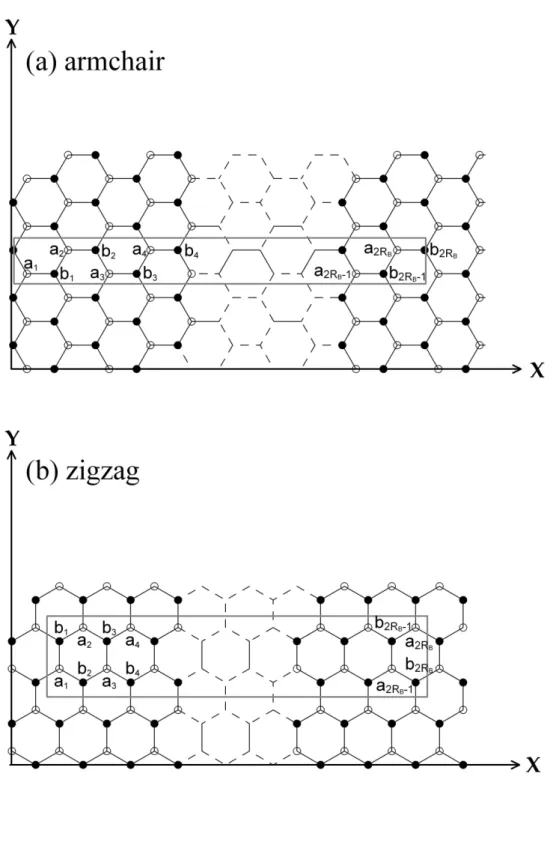
A monolayer graphene is assumed to exist in a spatially modulated magnetic field B =
B sin(Kx)ˆz along the armchair direction (the x-axis in Fig. 2.1(a)), and the periodic length
is lB = 2π /K = 3b0RB, where parameter RB is useful in describing the dimensionality
of the Hamiltonian matrix. The magnetic flux, product of the field strength and the
hexagonal area in the unit of flux quantum (Φ0 = hc/e = 4.1356 × 10⁻¹⁵[T /m2]), is Φ =
(3√3Bb02/2)/Φ
leads to the Peierls phase is characterized by the vector potential A = −[B cos(Kx)]/K ˆy.
The nearest-neighbor hopping integral becomes
hbjk|HB|aiki = γ0exp{i[ k · (Ri− Rj) + 2π Φ0 Z Rj Ri A · dr ]}. (2.2)
For three nearest-neighbor atoms, their hopping integrals are, respectively, t1k(n) = γ0exp[
(ikxb0/2 + iky √ 3b0/2) + G n], t2k(n) = γ0exp[ (ikxb0/2 − iky √ 3b0/2) − G n], and t3k(n) =
γ0exp(−ikxb0), where Gn = −i[6(RB)2Φ/π] cos[π(n − 5/6)/RB] sin(π/6RB) ]. The
mod-ulation period causes the periodic boundary conditions along the x-axis so that the
cor-responding Peierls phase is periodic in a period 2RB. An enlarged rectangular unit cell
includes 4RB carbon atoms. The wave function and the Hamiltonian matrix element are,
respectively, given by |Ψki = 2RB X n=1 Cakn |anki + Cbkn|bnki; (2.3a) hbmk|HB|anki = [t1k(n) + t2k(n)]δm,n+ t3k(n)δm,n−1. (2.3b) Cn
ak = Cakn+2RB and Cbkn = Cbkn+2RB are derived because of the periodical boundary condition.
To solve the complicated calculations of the huge Hamiltonian matrix, the base functions are chosen as the following sequence {|a1ki, |b2RBki, |b1ki, |a2RBki, |a2ki, |b2RB−1ki, |b2ki,
The Hamiltonian matrix could be expressed as a 4RB× 4RB band-like Hermitian matrix 0 q∗ p∗ 1 0 . . . . . . 0 0 q 0 0 p2RB 0 . . . . . . 0 p1 0 0 0 q 0 . . . 0 0 p∗ 2RB 0 0 0 q ∗ 0 0 ... ... q∗ 0 0 . .. . .. 0 ... ... ... q . .. . .. 0 pRB+1 0 ... ... . .. ... 0 . .. q 0 0 0 0 0 p∗ RB+1 q ∗ 0 , (2.4)
where pn ≡ t1k(n) + t2k(n) and q ≡ t3k. Because the range of kx is much smaller than that
of ky for a large RB, it is sufficient just to consider 1D energy dispersions along ky. That
is to say, a modulated magnetic field could effectively reduce the dimensionality by one. The π-electronic structure strongly depends on the direction of the modulated magnetic field, mainly owing to the anisotropic structure of a 2D monolayer graphene. For the zigzag direction (Fig. 2.1(b)), the similar calculations could also be done. By the detailed derivations, the three hopping integrals are t0
1k(n) = γ0exp[ (ikx √ 3b0/2 + ik yb0/2) + G0n], t0 2k(n) = γ0exp[ (−ikx √ 3b0/2 + ik
yb0/2) − G0n−1], and t03k(n) = γ0exp[ (−ikyb0) + G00n], where
G0
n = − i[2(RB)2Φ/3π] cos[π(n − 1/2)/RB] sin(π/2RB) and G00n = −i[(2RBΦ/3) cos[(n −
1)π/RB] ]. The Hamiltonian matrix element is further given by
hbmk|HB|anki = t01k(n)δm,n+1+ t02k(n)δm,n−1+ t03k(n)δm,n. (2.5)
With the base functions {|a1ki, |b2RBki, |b1ki, |a2RBki, |b2ki, |a2RB−1ki, |a2ki, |b2RB−1ki, . . .
Figure 2.1. The primitive unit cell of a monolayer graphene in the spatially modulated
band-like Hamiltonian matrix for the zigzag direction is 0 u∗ 2RB v ∗ 1 0 s∗1 0 . . . 0 0 0 u2RB 0 0 v2RB 0 s2RB−1 0 0 0 0 v1 0 0 s2RB . .. . .. . .. . .. 0 0 0 v∗ 2RB s ∗ 2RB 0 . .. . .. 0 ... s1 0 . .. . .. . .. . .. s∗RB−1 0 0 s∗ 2RB−1 . .. . .. . .. . .. 0 sRB+1 ... 0 . .. . .. 0 s∗ RB v ∗ RB 0 0 0 . .. . .. . .. . .. sRB 0 0 vRB+1 0 0 0 0 sRB−1 0 vRB 0 0 uRB 0 0 0 . . . 0 s∗ RB+1 0 v ∗ RB+1 u ∗ RB 0 , (2.6)
where sn ≡ t01k(n), un ≡ t02k(n) and vn ≡ t03k(n). The Hamiltonian matrices in Eqs. (2.4)
and (2.6), respectively, have two and three independent matrix elements.
2.3 Magnetoelectronic properties
The unoccupied conduction bands (Ec’s) are symmetric to the occupied valence bands
(Eν’s) about the Fermi level E
F = 0. Only the former are discussed in this work. We
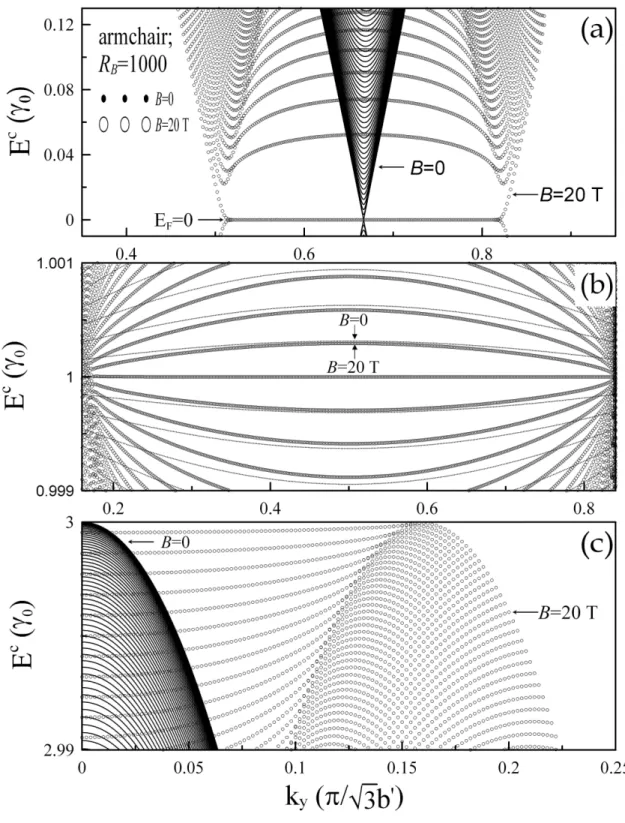
first look at the low energy bands resulting from the modulated magnetic field with period
RB = 1000 along the armchair direction. At B = 0, most of energy bands are parabolic
dispersions with the double degeneracy except two nondegenerate linear bands intersecting
at EF = 0 (the solid circles in Fig. 2.2(a)). There is only one band-edge state in each
energy band; furthermore, all the band-edge states are located at kpp
y = 2π/3
√
3b0 (the
band-edge states and energy dispersions, as shown in Fig. 2.2(a) by the open circles at B = 20
T. The range of ky, where electronic states could exist, becomes large. The linear bands
are changed into partial flat bands at EF = 0. Also noted that this result is similar
to that of carbon nanotubes in magnetic fields perpendicular to the symmetry axis [37]. The doubly degenerate parabolic bands have weak energy dispersions or low curvatures at
kpp
y , and their number is largely reduced. Such effects suggest that a magnetic field could
make electronic states flock together. The modulation effects of B on parabolic energy bands result in four extra band-edge states at ksp
y ’s, the strong energy dispersions close to
ksp
y ’s, and the destruction of the double degeneracy. The two extra band-edge states at
the left- and right-hand sites of kpp
y might have different energies; that is, one side of the
parabolic bands might be asymmetric to the other about the original band-edge states. Each parabolic band exhibits the composite behavior in state degeneracy, the single and double degeneracies near ksp
y and kypp respectively.
The number of subbands grows quickly as state energy Ec increases from zero. There
are many middle energy bands near Ec ' γ
0, as shown in Fig. 2.2(b). At B = 0, they
include complete flat bands at Ec= γ
0 and parabolic bands at the others. Both are doubly
degenerate. The parabolic bands have a low curvature at kpp
y = π/2
√
3b0 and the high
curvature at ksp
y = 0 (not shown). Moreover, in the small or large ky, the modulated
magnetic field could destroy double degeneracy and create extra band-edge states. It
modifies the band curvatures at kpp
y , and makes the complete flat bands change into the
partial flat bands.
The subband number decreases gradually with the further increase of state energy. The high energy bands, as shown in Fig. 2.2(c) for B = 0, are parabolic dispersions with the
Figure 2.2. Energy bands near (a) Ec= 0, (b) Ec= γ
0, and (c) Ec= 3γ0for the armchair
modulation direction at (RB = 1000 and B = 20 T). Those without B are also shown for
double degeneracy and one band-edge state at kpp
y = 0. All the kyppstates remain unchanged
in the presence of B, as seen in low and middle energy bands. However, the modulated
magnetic field could reduce the number of subbands or widen the range of ky, produce the
extra band-edge states at ksp
y 6= 0, and induce the composite behavior of the single and
double degeneracies.
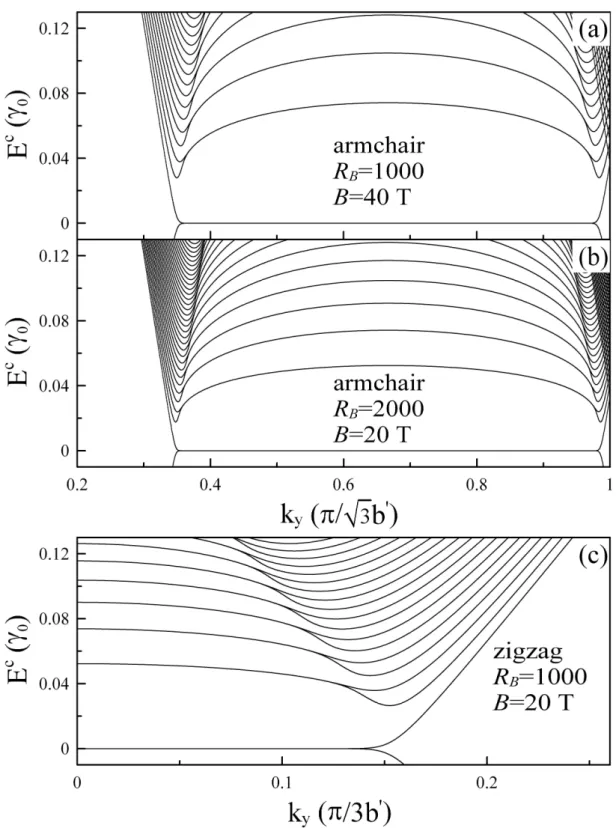
The strength, period, and direction of the modulated magnetic field strongly affect the electronic structure, as shown in Figs. 2.3(a)-2.3(b) for the low energy bands. The range of partial flat bands increases with the increasing B, while their number and curvatures exhibit the opposite behavior (Figs. 2.3(a) and 2.2(a)). These results further demonstrate that the ability to flock electronic states is enhanced by the increasing field strength. The longer the period is, the larger the effective range of ky is (Figs. 2.3(b) and 2.2(a)). The period
could alter state energies and curvatures of extra band-edge states at ksp
y ’s. It is also worth
noting that kpp
y = 2π/3
√
3b0 of the doubly degenerate parabolic bands is independent of
period and strength. When the spatially modulated direction is along the zigzag structure,
there are two partial flat bands at EF = 0 and many parabolic bands at the others (Fig.
2.3(c)). The former are doubly degenerate; the later are fourfold degenerate near kpp
y = 0
and doubly degenerate near ksp
y . That state degeneracy, subband number, ky’s of band-edge
states, and range of partial flat bands depend on the modulation direction directly reflects the anisotropic characteristic of a graphene geometry. In addition, the similar effects could also be found in moderate and high energy bands.
Figure 2.3. The low energy bands along the armchair direction at (a) (RB = 1000, B = 40
T) & (b) (RB = 2000, B = 20 T), and those along (c) the zigzag direction at (RB = 1000,
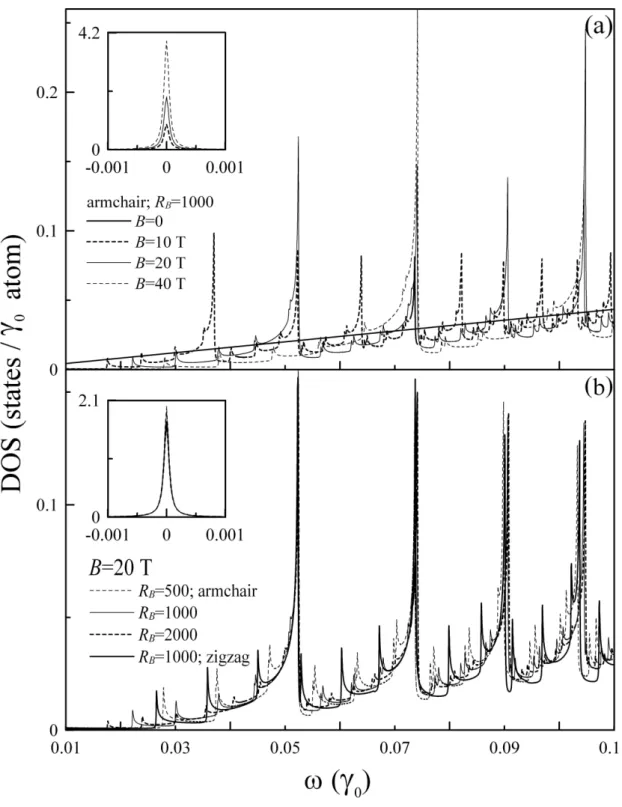
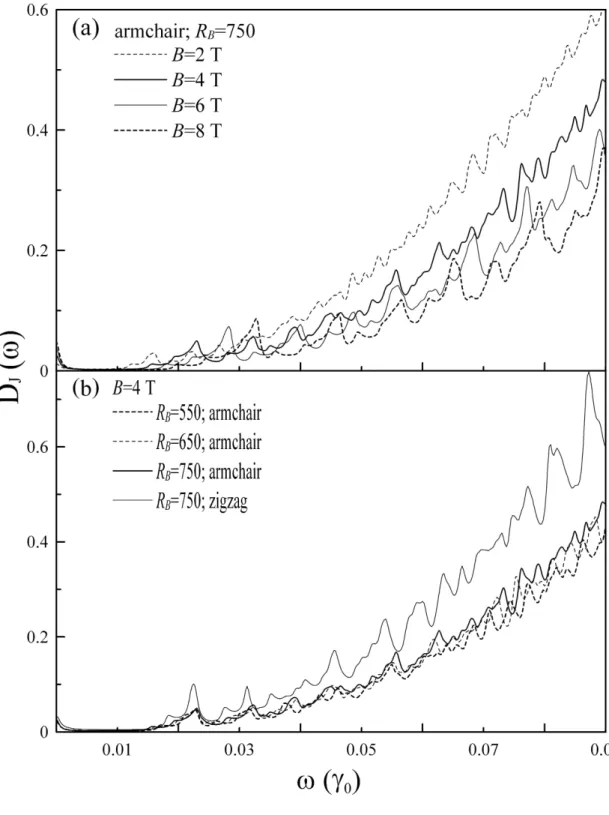
structure, is defined as D(ω) = X σ,h=c,ν Z 1stBZ dkxdky (2π)2 Γ π 1 [Eh(k x, ky) − ω]2+ Γ2 . (2.7) Γ(= 10−4 γ
0) is a phenomenological broadening parameter. The integration on kx could
be roughly neglected because of the very small range of kx. The low-frequency DOS at
B = 0 is proportional to ω, as shown in Fig. 2.4(a). It vanishes at ω = 0 and has no
special structures. However, the modulated magnetic field leads to a symmetric delta-function-like peak at ω = 0 (inset in Fig. 2.4(a)) and considerable asymmetric square-root
divergent peaks. The former comes from the two partial flat bands at EF = 0, and its
height grows with the increasing field strength. The latter are dominated by the band-edge
states of the 1D parabolic dispersions along bky (Fig. 2.2(a)). The asymmetric pronounced
peaks could be further divided into weak subpeaks and strong principal peaks. They are, respectively, due to the band-edge states at ksp
y ’s and kypp. There are many pairs of
subpeaks, and each pair of subpeaks is associated with the asymmetry of the 1D parabolic
bands about the kpp
y states (discussed earlier in Fig. 2.2(a)). The number, frequencies, and
heights of the asymmetric prominent peaks are sensitive to the changes in the strength, period, and modulation direction. The peak number decreases with the increase of the strength, while the peak frequencies exhibit a different behavior (Fig. 2.4(a)). The number of subpeaks increases as the period grows (Fig. 2.4(b)), while it is the other way around as the frequencies of subpeaks increase. The main features of principal peaks have the weak dependence on the period. When the modulation direction is orientated relatively close to the zigzag structure, more principal peaks with lower frequencies are observed (comparison between the heavy and light solid curves in Fig. 2.4(b)). Density of states could display the high anisotropy even at very low frequency (ω → 0 in the inset of Fig.
2.4(b)). However, the low-frequency physical properties without B are anisotropic only for
ω & 0.25 γ0, e.g., electronic excitations and absorption spectra [9]. This result indicates
that the anisotropy of the low-frequency electronic properties could be induced by means of a spatially modulated magnetic field.
The frequencies of prominent peaks in DOS deserve a closer investigation. Fig. 2.5(a) shows the relation between the frequencies (ωsp’s) of the first six subpeaks and the period
at B = 20 T. These peaks correspond to the extra band-edge states at the left-hand neigh-borhood of kpp
y (Fig. 2.2(a)). ωsp’s decline quickly as RB increases. As to the frequencies
of principal peaks (ωpp’s), their dependence on the period is minor for a sufficient large RB
(& 1000), as shown in Fig. 2.5(b). Both ωsp’s and ωpp’s are largely enhanced by the
in-creasing field strength (Figs. 2.5(c) and 2.5(d)). There exists a special square-root relation between ωpp and B, i.e., ωpp ∝
√
B. In addition, the low-energy flat Landau levels due to a
uniform magnetic field (B0) also exhibit the square-root dependence on the field strength
[22]. The band-edge state energies are closely related to the magneto-optical absorption frequencies. The predicted results could be verified by the optical spectroscopy.
A uniform magnetic field differs from a spatially modulated magnetic field in the low-energy magnetoelectronic structures. In terms of the ability in flocking electronic states, the former is much stronger than the latter. A uniform magnetic field could make linear or parabolic bands convert into the dispersionless Landau levels. Such levels are fourfold
degenerate for each ky state. All the Landau states could be regarded as the band-edge
states. They would exhibit zero-dimensional features, but not one-dimensional features. For example, the magneto-optical absorption spectra display the symmetric and asymmetric
Figure 2.4. The low-frequency density of states (a) along the armchair direction at RB =
1000 and different B’s; (b) at B = 20 T and different RB’s or directions. The insets show
Figure 2.5. Energies (ωsp’s) of extra band-edge states at the left-hand neighborhood of
kpp
y and those (ωpp’s) of the original band-edge states. (a) and (b) are their dependence on
The electronic structure of a 2DEG could be strongly affected by a spatially modulated magnetic field [20-32]. It also displays the similar behaviors to a monolayer graphene, such as the composite behavior in state degeneracy, creation of extra band-edge states, and change of curvatures. However, there are three significant differences between a 2DEG and a monolayer graphene. A 2DEG does not exhibit partial flat bands at zero energy. Its magnetoelectronic structure is independent of the modulation direction. Moreover, the
wave vectors of extra band-edge states are approximately close to ky = 0 and hardly depend
on the state energy. The above-mentioned differences mainly come from the hexagonal structure of a monolayer graphene.
2.4 Concluding remarks
In summary, the magnetoelectronic structure of a 2D monolayer graphene is studied by the Peierls tight-binding model. The specific base functions are chosen to solve a huge Hamiltonian matrix. The strength, period, and direction of a spatially modulated magnetic field dominate the main features of electronic properties. Such a field could reduce dimen-sionality by one, alter energy dispersions, cause anisotropy at low energy, induce composite behavior in state degeneracy (the composite behavior of single and double degeneracies for the armchair direction), produce extra band-edge states, and destroy the symmetry of energy bands about the original band-edge states. Energies of the extra band-edge states strongly rely on the period, while the opposite is true for those of the original band-edge states. Both of them grow with the increase of the strength. Density of states owns many asymmetric prominent peaks, mainly owing to the band-edge states in 1D parabolic bands. The partial flat bands also make DOS display delta-function-like structures at the Fermi
level. A spatially modulated magnetic field contrasts sharply with a uniform magnetic field in energy dispersion, state degeneracy, and dimensionality. The important differences between a monolayer graphene and a 2DEG arise from the hexagonal symmetry. They are the existence of the partial flat bands at zero energy, dependence on the modulation di-rection, and wave vectors of the band-edge states. The experimental measurements on the magneto-optical absorption spectra could be utilized to examine the predicted electronic properties.
References
[1] K. S. Novoselov, A. K. Geim, S. V. Morozov, D. Jiang, Y. Zhang, S. V. Dubonos, I. V. Grigorieva and A. A. Firsov, Science 306, 666 (2004).
[2] C. Berger, Z. Song, T. Li, X. Li, A. Y. Ogbazghi, R. Feng, Z. Dai, A. N. Marchenkov, E. H. Conrad, P. N. First and W. A. de Heer, J. Phys. Chem. B 108, 19912 (2004). [3] A. H. Castro Neto and F. Guinea, Phys. Rev. B 75, 045404 (2007).
[4] C. P. Chang, C. L. Lu, F. L. Shyu, R. B. Chen, Y. K. Fang and M. F. Lin, Carbon 42, 2975 (2004).
[5] F. Guinea, A. H. Castro Neto and N. M. R. Peres, Phys. Rev. B 73, 245426 (2006). [6] S. Latil and L. henrard, Phys. Rev. Lett. 97, 036803 (2006).
[7] E. McCann, Phys. Rev. B 74, 161403 (2006).
[8] F. L. Shyu and M. F. Lin, J. Phys. Soc. Jpn. 69, 607 (2000).
[9] J. H. Ho, C. P. Chang and M. F. Lin, Phys. Lett. A 352, 446 (2006).
[10] J. H. Ho, C. L. Lu, C. C. Hwang, C. P. Chang and M. F. Lin, Phys. Rev. B 74, 085406 (2006).
[11] X. F. Wang and T. Chakraborty, Phys. Rev. B 75, 041404 (2007).
[12] M. L. Sadowski, G. Martinez, M. Potemski, C. Berger and W. A. de Heer, Phys. Rev. Lett. 97, 266405 (2006).
[13] A. C. Ferrari, J. C. Meyer, V. Scardaci, C. Casiraghi, M. Lazzeri, F. Mauri, S. Piscanec, D. Jiang, K. S. Novoselov, S. Roth and A. K. Geim, Phys. Rev. Lett. 97, 187404 (2006).
[14] J. S. Bunch, Y. Yaish, M. Brink, K. Bolotin and P. L. McEuen, Nano Lett. 5, 287 (2005).
[15] K. S. Novoselov, E. McCann, S. V. Morozov, V. I. Fal’ko, M. I. Katsnelson, U. Zeitler, D. Jiang, F. Schedin and A. K. Geim, Nature Physics 2, 177 (2006).
[16] K. S. Novoselov, A. K. Geim, S. V. Morozov, D. Jiang, M. I. Katsnelson, I. V. Grigorieva, S. V. Dubonos and A. A. Firsov, Nature 438, 197 (2005).
[17] Y. Zhang, Y. W. Tan, H. L. Stormer and P. Kim, Nature 438, 201 (2005).
[18] K. S. Novoselov, Z. Jiang, Y. Zhang, S. V. Morozov, H. L. Stormer, U. Zeitler, J. C. Maan, G. S. Boebinger, P. Kim and A. K. Geim, Science 315, 1379 (2007).
[19] V. P. Gusynin and S. G. Sharapov, Phys. Rev. Lett. 95, 146801 (2005). [20] E. McCann and V. I. Fal’ko, Phys. Rev. Lett. 96, 086805 (2006).
[21] P. R. Wallace, Phys. Rev. 71, 622 (1947). [22] J. W. McClure, Phys. Rev. 104, 666 (1956). [23] F. D. Haldane, Phys. Rev. Lett. 61, 2015 (1988).
[25] P. D. Ye, D. Weiss, R. R. Gerhardts, M. Seeger, K. von Klitzing, K. Eberl and H. Nickel, Phys. Rev. Lett. 74, 3013 (1995).
[26] Mayumi Kato, Akira Endo, Makoto Sakairi, Shingo Katsumoto and Yasuhiro Iye, Journal of the physical society of Japan 68, 1492 (1999).
[27] S. Cina, D. M. Whittaker, D. D. Arnone, T. Burke, H. P. Hughes, M. Leadbeater, M. Pepper and D. A. Ritchie, Phys. Rev. Lett. 83, 4425 (1999).
[28] P. Vasilopoulos and F. M. Peeters, Superlattices and Microstructures 7, 393 (1990). [29] F. M. Peeters and P. Vasilopoulos, Phys. Rev. B 47, 1466 (1993).
[30] I. S. Ibrahim and F. Peeters, Phys. Rev. B 52, 17321 (1995). [31] Andrey Krakovsky, Phys. Rev. B 53, 8469 (1996).
[32] A. Y. Rom, Phys. Rev. B 55, 11025 (1997). [33] J. M. Luttinger, Phys. Rev. 84, 814 (1951).
[34] S. M. Stewart and C. Zhang, Semicond. Sci. Technol. 10, 1541 (1995). [35] S. M. Stewart and C. Zhang, Phys. Rev. B 52, R17036 (1995).
[36] S. M. Stewart and C. Zhang, Condens. Matter 8, 6019 (1996). [37] H. Ajiki and T. Ando, J. Phys. Soc. Jpn. 64, 260 (1995).
Chapter 3
Low-frequency magneto-optical excitations
in a graphene monolayer
3.1 Introduction
Recently, the few-layer graphenes have been produced by the mechanical friction [1, 2] and thermal decomposition [3, 4]. They have attracted a lot of theoretical and experimen-tal investigations on band structures [5-22], optical spectra [5, 23-29], electronic excitations [30-33], phonon spectra [34], and transport properties [35-42]. It is very appropriate to use these systems to study two-dimensional (2D) physical phenomena. A monolayer graphene is an exotic zero-gap semiconductor with a vanishing density of states (DOS) at the Fermi
level EF = 0, mainly owing to the hexagonal symmetry configuration. The massless Dirac
electrons have been inspected by using a combination of optical microscopy, scanning elec-tron microscopy and atomic-force microscopy [2], and by the angle-resolved photoelecelec-tron spectroscopy [43]. The electronic properties of a monolayer graphene could be effectively tuned by external electric [1, 2] and magnetic fields [1, 2, 4, 5, 20, 22, 23, 25, 29]. A
uni-form perpendicular magnetic field (B0) creates many Landau levels (LLs) and thus induces
the novel half-integer quantum Hall effect [2, 35]. In this work, we mainly study the low-frequency optical excitations of a monolayer graphene in a spatially modulated magnetic field (B). The dependence on B (period, strength; direction) and the polarization of an electromagnetic field is investigated. The comparison with the absorption spectra resulting
A 2D monolayer graphene owns many doubly degenerate parabolic bands except two
nondegenerate linear bands intersecting at EF = 0. Energy bands are isotropic at low
energy (. 0.5 eV) [44], and so are the other physical properties [5]. Moreover, there is only one band-edge state in each energy dispersion. Electronic properties are strongly affected
by the uniform and periodic magnetic fields. The low-energy LLs due to B0 display the
novel dependence on the quantum number (n) and field strength (B0); that is, their energies
obey the square root form En∝
p
|n| B0. The dependence on B0 has been identified by the
magneto-optical experiments of cyclotron resonance [25]. Compared to a uniform magnetic field, the ability of a periodic magnetic field in flocking electronic states together is weaker. However, the latter could induce the rich magnetoelectronic structures [20]. The linear
bands are changed into the partial flat bands at EF = 0. The energy dispersions of the
low-energy parabolic bands around the original band-edge state would become weaker. Each parabolic band shows four extra band-edge states and the composite behavior in state degeneracy (the double and single degeneracies at different wave vectors). The low-energy bands depend on the modulated direction of B; furthermore, they belong to the one-dimensional energy dispersions. The main features of magnetoelectronic properties are expected to be directly reflected in optical excitations.
There are several studies on optical absorption spectra of a monolayer graphene. From the theoretical prediction, the linear valence and conduction bands do not exhibit any absorption peaks at low frequency [5]. This result is dominated by the DOS. On the other hand, the low-energy LLs in a uniform magnetic field could lead to a number of prominent symmetric absorption peaks [5]. Each peak comes from the vertical transition between the occupied LL of n (n + 1) and the unoccupied LL of n + 1 (n). The magneto-optical
excitations need to obey the specific selection rule |∆n| = 1, since the magnetoelectronic
wave functions (Ψn’s) own the spatial symmetry configuration. Ψn is characterized by the
Hermite polynomial, as seen in a 2D electron gas (2DEG). The optical selection rule has been verified by the far infrared transmission measurements [23]. Whether |∆n| = 1 is destroyed by a spatially modulated magnetic field will be examined in this work.
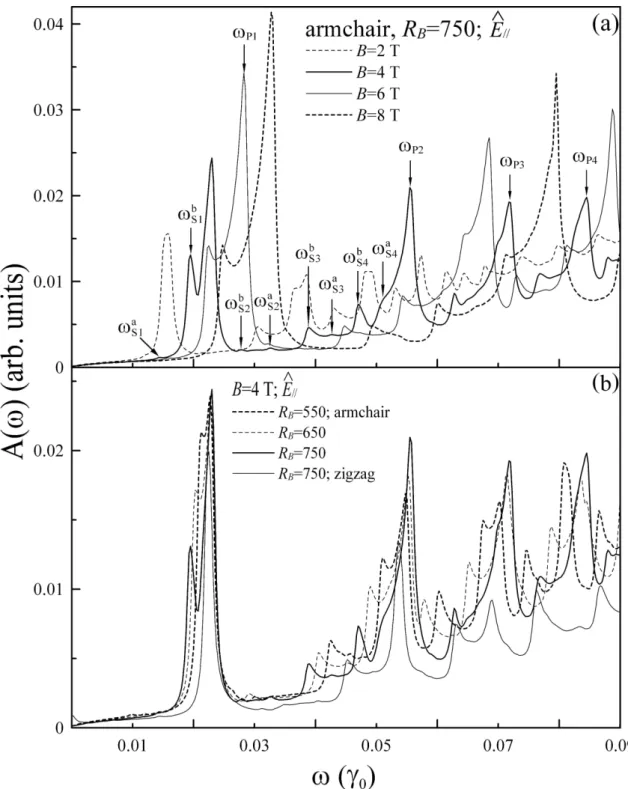
The Peierls tight-binding model, with the nearest-neighbor atomic interactions, is used to calculate the π-electronic structure of a monolayer graphene in a periodic magnetic field [20]. To explain the selection rules of optical excitations, the characteristics of magnetoelec-tronic wave functions are analyzed in detail. The optical transition elements are evaluated by the gradient approximation [5, 45-47]. This work shows that the magneto-optical ab-sorption spectra present a lot of asymmetric pronounced peaks. Such peaks result from the original and extra band-edge states of parabolic bands. Their characters are closely related to the polarization direction and the strength, period and direction of B. There
exist some important differences for the absorption spectra in the presence of B and B0.
The predicted results could be examined by the optical absorption spectroscopy.
In the next section, the π-electronic wave functions in the presence of a spatially mod-ulated magnetic field are studied by the Peierls tight-binding model. In Sec. 3.3, the magneto-absorption spectra are calculated at different polarization directions. Meanwhile, the effects due to the field strength, period and direction are also discussed. Finally, con-cluding remarks are presented in Sec. 3.4.
3.2 π-electronic wave functions
along the armchair direction (the x-axis in Fig. 3.1(a)). The periodic length in a unit of the lattice constant at B = 0 (3b0) is l
B = 2π /K = 3b0RB, where b0 = 1.42 ˚A is the C-C
bond length. There are 4RB carbon atoms in a primitive unit cell (2RB a atoms and 2RB
b atoms). The magnetoelectronic structure formed by the 2pz orbitals is described by the
4RB tight-binding functions. |amki and |bmki for m = 1, 2...2RB are, respectively, those
associated with the periodical a and b atoms. The π-electronic wave function is expressed as |Ψc,vk i = 2RXB−1 m=1 (Ac,vo |amki + Boc,v|bmki) + 2RB X m=2 (Ac,ve |amki + Bec,v|bmki) , (3.1)
where o (e) represents an odd (even) integer. The superscripts c and v indicate the
unoccu-pied conduction band and occuunoccu-pied valence band, respectively. Ac,v
o (Boc,v) is the amplitude
of the tight-binding function due to the a (b) atoms with odd indices. The Hamiltonian
matrix in the subspace spanned by the tight-binding functions is a 4RB × 4RB band-like
Hermitian matrix. Only the nearest-neighbor atomic hopping integrals γ0 (=2.56 eV) [44]
is taken into account. The magnetic field would induce an extra Peierls phase between
two nearest-neighbor atoms at Rm0 and Rm. Such a phase is defined as 2π
Φ0 RRm
Rm0 A · dr ,
where A = −B cos(Kx)/K ˆy is the vector potential, and Φ0 = h/e is the flux quantum.
To get the band-like Hamiltonian matrix, the 4RB tight-binding functions are arranged
as the following sequence {|a1ki, |b2RBki, |b1ki, |a2RBki, |a2ki, |b2RB−1ki, |b2ki, |a2RB−1ki, . . .
|aRB−1ki, |bRB+2ki, |bRB−1ki, |aRB+2ki, |aRBki, |bRB+1ki, |bRBki; |aRB+1ki}. By the detailed
calculations, the nonvanishing Hamiltonian matrix elements are
The three hopping integrals are, respectively, t1k(m) = γ0exp[ (ikxb0/2 + iky √ 3b0/2) + Gm], t2k(m) = γ0exp[ (ikxb0/2 − iky √ 3b0/2) − G m], and t3k = γ0exp(−ikxb0) (Gm =
−i[6(RB)2Φ/π] cos[π(m − 5/6)/RB] sin(π/6RB)). The similar equations could be obtained
for the periodic magnetic field along the zigzag direction.
The energy dispersions Ec,v(k, en)’s are obtained by diagonalizing the Hamiltonian,
where en represents the subband index measured from the Fermi level. The low-energy
bands are drastically changed by the modulated magnetic field, as shown in Fig. 3.1(b) at
RB = 750 and B = 4 T along the armchair direction. The unoccupied conduction bands
are symmetric to the occupied valence bands about EF = 0. The dependence of energy
bands on kx is negligible compared with that on ky. A periodic magnetic field, with a
suf-ficient large period, could effectively reduce the dimensionality by one. The ky-dependent
energy bands exhibit partial flat bands at EF = 0 and parabolic bands at others. Each
parabolic band owns one original band-edge state (kpp
y ) and four extra band-edge states
(ksp
y ’s). The former is situated at the fixed wave vector kppy = 2π/3
√
3b0, which is the same
with that in the B = 0 case [20]. However, the latter depend on the period and strength
of B. The parabolic bands close to kpp
y and kysp’s are, respectively, doubly degenerate and
nondegenerate. The very weak energy dispersions near kpp
y mean that the ability of the
periodic and uniform magnetic fields in flocking electronic states together is similar. Such energy bands could be regarded as the quasi-Landau levels (QLLs), as indicated from the characteristics of wave functions.
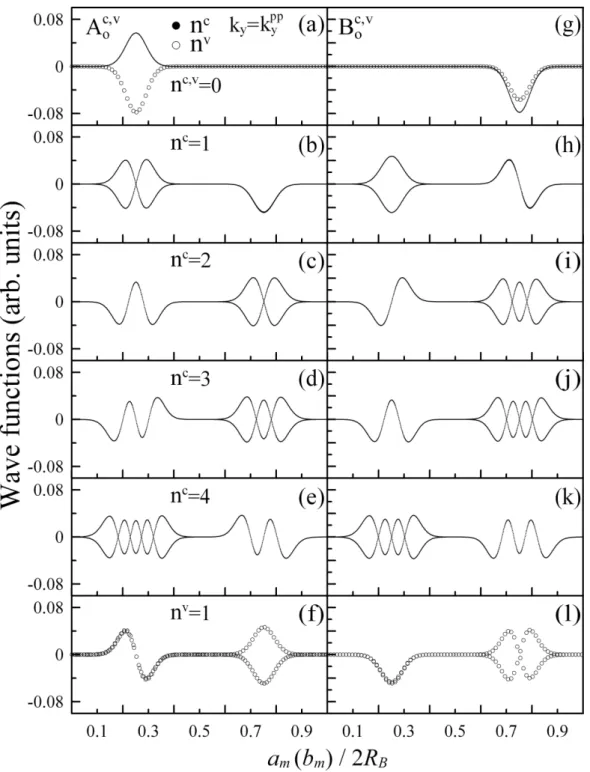
The main features of wave functions could be utilized to define the quantum number of QLLs. Carbon atoms, with odd and even indices, make equal contributions to wave functions. The tight-binding functions associated with these atoms in Eq. (3.1) have
Figure 3.1. (a) The primitive unit cell of a monolayer graphene in a periodic magnetic
field with a period RB = 750 along the armchair direction. (b) The energy bands for the
the opposite amplitudes; that is, Ac,v
o = −Ac,ve and Boc,v = −Bec,v. Only discussing the
amplitudes Ac,v
o and Boc,v is appropriate in understanding the wave functions. We first
see the wave function of the lowest unoccupied QLL (en = 1 or nc = 0) at kpp
y . The
position-dependent Ac
o and Boc, as shown in Figs. 3.2(a) and 3.2(g) by the solid circles,
mainly come from the 2pz orbitals centered at one-fourth (x1 = am/2RB = 1/4) and
three-fourths (x2 = bm/2RB = 3/4) of a primitive unit cell, respectively. The positions
x1 and x2 correspond to the maximum field strength. The wave function of the lowest
unoccupied QLL is similar to that of the highest occupied QLL (nv = 0 by the open circles
in Figs. 3.2(a) and 3.2(g)). Their main difference lies in the interchange of the localization positions of Ac,v
o and Bc,vo . Such interchange might include the sign change of the values.
The distribution width of the localization function (lB), that is, the full width at
half-maximum, is comparable to the magnetic length (p~/eB), e.g., lB ≈ 200 ˚A at B = 4 T.
Also note that the two LLs at EF = 0 due to a uniform magnetic field could display the
similar characteristics [22].
There are two important differences between the second and first (lowest) unoccupied
QLLs at kpp
y . The former, as shown in Figs. 3.2(b) and 3.2(h), is doubly degenerate.
Moreover, it is composed of two tight-binding functions centered at x1 and x2. Aco (Boc)
has two subenvelope functions Ac
o(x1) (Boc(x1)) and Aoc(x2) (Boc(x2)) located at x1 = 1/4
and x2 = 3/4, respectively. The oscillatory Aco(x1) (Boc(x2)) owns one zero point, while the
monotonic Ac
o(x2) (Boc(x1)) has none zero point. Their contributions to wave functions are
nearly comparable. The number of zero point (n), which stands for the spatial symmetry of the carrier density, could be chosen to characterize the wave functions. The effective
Figure 3.2. The wave functions contributed by the (a)∼(f) Ac,v
o and (g)∼(l) Boc,v atoms
is chosen for the second unoccupied QLL. Such a choice does not influence the specific selection rules of the optical absorption spectra. In addition, the twofold degenerate QLLs have the similar wave functions, their difference is only the sign change of the subenvelope
functions. By the definition of nc, the first unoccupied QLL without zero point is thus
defined as the nc= 0 state. The number of zero point will become larger with the increase
of state energy, i.e., nc also increases gradually as the unoccupied QLLs are away from
EF = 0 (Figs. 3.2(a)∼3.2(e), and 3.2(g)∼3.2(k)). The enth unoccupied QLL owns two
modes of subenvelope functions with n = en − 1 and n = en − 2, respectively. That nc
is just equal to en − 1 is very convenient in defining the unoccupied QLLs (Fig. 3.1(b)).
Furthermore, the second occupied QLL could also reveal the similar features to those in the second unoccupied QLL, as shown in Figs. 3.2(f) and 3.2(l). They have the same
effective quantum number (nv = nc= 1) and localization positions. Their main difference
is the same as that of nc = 0 case. The other enth occupied and unoccupied QLLs also
demonstrate the similar behavior. Accordingly, it is reasonable only to discuss the enth
unoccupied QLLs.
The monolayer graphene owns many low-energy dispersionless LLs in the presence of a uniform perpendicular magnetic field. The wave functions of LLs could be represented by the linear combination of those from the harmonic oscillator [7, 46]. After the well fitting, the enth QLLs and LLs show the similar characteristics, e.g., the same oscillatory behavior,
effective quantum number, and distribution width. Such similarities imply that the wave functions of the former could be approximately expressed as those of the latter. Therefore,
Ac,v
o and Boc,v of the enth QLL in Eq. (3.1) are written as
Ac,v
o ∝ e±ikyyϕ0(x1) ; Boc,v ∝ e±ikyyϕ0(x2) for en = 1. (3.3a)
Ac,v
o ∝ e±ikyy[ϕnc,v(x1) ± ϕnc,v−1(x2)] ; Boc,v ∝ e±ikyy[ϕnc,v−1(x1) ± ϕnc,v(x2)] for en > 1.
(3.3b)
The subenvelope function ϕn(x) is the product of the nth-order Hermite polynomial and
Gaussian function [7, 46].
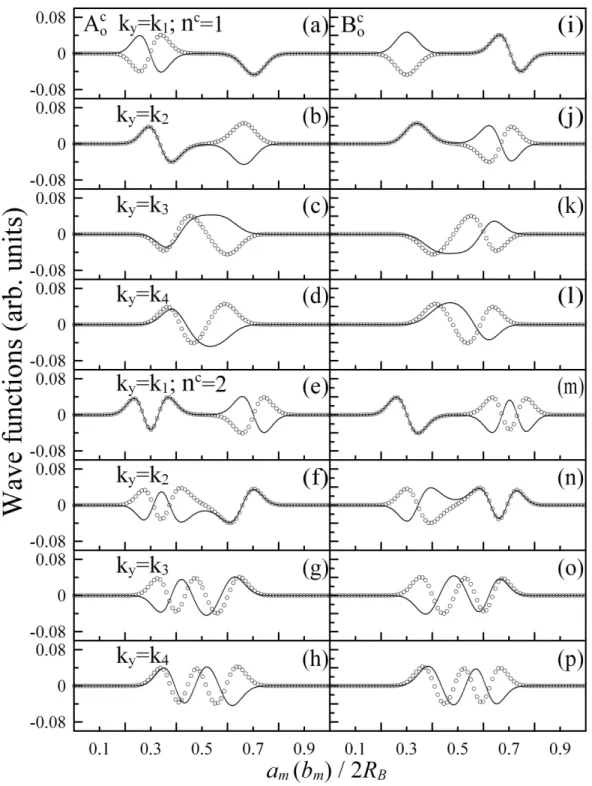
The wave functions would be strongly modified as the wave vectors gradually move away from the original band-edge state. The wave functions at the left- and right-side
wave vectors around kpp
y have the similar characteristics, and thus only the former are
discussed in the following part. For example, Ac
o(x1) (Boc(x1)) and Aco(x2) (Bco(x2)) of
the second unoccupied QLL at k1 (indicated in Fig. 3.1(b)) are centered at, respectively,
x1 = 3/10 and x2 = 7/10, as shown in Figs. 3.3(a) and 3.3(i). They still maintain the
same characteristics with those at kpp
y , while the distance between them (|x1− x2| = 2/5)
is shorter than that (|x1− x2| = 1/2) at kppy . At ky = k2, the doubly degenerate QLL is
going to separate into two subbands. x1 ≈ 7/20 and x2 ≈ 13/20 are so close that Aco(x1)
(Bc
o(x1)) and Aco(x2) (Boc(x2)) nearly overlap, as shown in Figs. 3.3(b) and 3.3(j). Besides,
one of the tight-binding functions has the opposite sign to that at k1, i.e., Aco (Boc) might
change its sign at some appropriate wave vectors. k3and k4 are, respectively, the band-edge
states (ksp
y ’s) of the higher and lower subbands. Their wave functions display the similar
behavior (Figs. 3.3(c) and 3.3(k); 3.3(d) and 3.3(l)). The second unoccupied QLL at k3 is
divided into two nondegenerate subbands, i.e., the 1α and 1β subbands. The subenvelope functions of the 1α state, as shown in Figs. 3.3(c) and 3.3(k) by the solid circles, exhibit more overlap behavior. It implies that there would be strong overlap in the subenvelope
functions at ksp
y ’s. Such a behavior would dominate the optical excitation strength. The
centered positions x1 and x2 are close to half of a primitive unit cell, i.e., they correspond
to the nearly zero magnetic field strength. In other words, the carriers will move from the position of the maximum magnetic field strength to that of the minimum magnetic field strength. The 1β (the open circles in Figs. 3.3(c) and 3.3(k)) and 1α subbands have
the similar overlap behavior. However, Ac
o(x1) (Boc(x1)) and Aco(x2) (Boc(x2)) of the former
display the stronger overlap than those of the latter. It results from the fact that k3 is the
extra band-edge state of the 1β subband, but not that of the 1α subband. Furthermore, the two states reveal the different linear combinations of Ac
o(x1) (Boc(x1)) and Aco(x2) (Boc(x2)).
Ac
o (Boc) of the 1α and 1β states could be roughly regarded as, respectively, the combination
of ϕ1(x1) − ϕ0(x2) (ϕ0(x1) + ϕ1(x2)) and of ϕ1(x1) + ϕ0(x2) (ϕ0(x1) − ϕ1(x2)); that is,
they might show the different spatial symmetries. The wave functions of the extra band-edge states have the dissimilar characteristics to those of the original band-band-edge state. Since the former exhibit the overlap behavior, the localized feature of QLLs is thoroughly destroyed at ksp
y ’s. Such properties would be reflected on the optical absorption spectra.
The wave functions of the 2α (2β) subband (Figs. 3.3(g), 3.3(h), 3.3(o), and 3.3(p)) also display the similar features as those of the 1α (1β) subband, i.e., the similar localization positions, linear combination, and the overlap behavior of the subenvelope functions. The
other enth α and β subbands also present the similar characteristics. The above-mentioned
characteristics of wave functions could be utilized to investigate the selection rules of the optical absorption spectra.
Figure 3.3. Same plots as Fig. 2, but shown for the second and third conduction bands at different ky’s.
The main features of electronic properties can be directly manifested by the optical excitations. When a monolayer graphene is excited from the occupied valence to unoccupied conduction bands (the inter-π-band excitation) by an electromagnetic field, there are only
inter-π-band excitations at zero temperature. The optical selection rules ∆kx= 0 and
∆ky= 0 due to the vertical transitions are mainly determined by the zero momentum of
photon. Based on the Fermi’s golden rule, the optical absorption function is given by
A(ω) ∝ X c,v,en,en0 Z 1stBZ dk (2π)2 ¯ ¯ ¯ ¯ ¯ * Ψc(k, en) ¯ ¯ ¯ ¯ ¯ b E · P me ¯ ¯ ¯ ¯ ¯Ψ v(k, en0) +¯¯ ¯ ¯ ¯ 2 × Im · f (Ec(k, en)) − f (Ev(k, en0)) Ec(k, en) − Ev(k, en0) − ω − iΓ ¸ , (3.4)
where f (E (k, en)) is the Fermi-Dirac distribution function. bE is the unit vector of an electric polarization. The parallel and perpendicular polarization directions, bE k bx and bE ⊥ bx, are
taken into account. The velocity matrix element Mcv = DΨc(k, en)¯¯¯bE · P/m e
¯ ¯
¯ Ψv(k, en0)E
is calculated from the gradient approximation. It is approximated by taking the gradient
of the Hamiltonian matrix element versus the wave vector kx or ky. Similar
approxima-tions have been successful in studying the optical properties of the carbon nanotubes [45], nanographite ribbons [46], graphite [5], and graphite intercalation compounds [47].
More-over, by substituting Eq. (3.1) into the velocity matrix element, Mcv is expressed as
2RB
X
m,m0=1
[(Aco+ Ace)∗× (Bov0+ Bev0) + (Boc+ Bec)∗× (Avo0 + Ave0)] ∇khamk|HB| bm0ki .
(3.5) The indices o (e) and o0 (e0) are, respectively, the odd (even) integers of m and m0. For
convenience, the value of (Ac