2010 IEEE 21 st Intemational Symposium on Personal Indoor and Mobile Radio Communications
QRD-based Precoder Selection for
Maximum-likelihood MIMO Detection
Chun-Tao Lin, and Wen-Rong Wu Department of Electrical Engineering,
National Chiao Thng University, Hsinchu, Taiwan, 300, R.O.c. E-mail: [email protected]@faculty.nctu.edu.tw
Abstract-Precoding is an effective method to improve the transmission quality in multiple-input multiple-output (MIMO) systems. In a real-world system, the precoder is selected from a codebook, and its index is fed back to the transmitter. For a maximum-likelihood (ML) receiver, the criterion for precoder selection is equivalent to maximizing the minimum distance of the received signal constellation. The derivation of the optimum solution, however, may be of high computational complexity due to the requirement of the exhaustive search. To reduce the computational complexity, a suboptimum solution based on singular value decomposition (SVD) has been proposed in literature. In this paper, we propose using a QR decomposition (QRD) based method for precoder selection. To further improve the system performance, we also propose an enhanced QRD based selection method. With Givens rotations, the computational complexity of the enhanced QRD-based method can be effectively reduced. Finally, we combine precoding with receive antenna selection, and use the proposed QRD-based methods to solve this joint optimization problem. Simulation results show that the proposed approaches can significantly improve the system performance.
I. INTRODUCTION
Spatial multiplexing is a promising method to achieve high spectra efficiencies in multiple-input multiple-output (MIMO) systems [1]. The drawback of the spatial multiplexing scheme is that the error rate performance is greatly affected by channel fading [2]. One way to alleviate the performance loss is to adopt the precoding technique at the transmitter, where the transmit symbol vector is multiplied by a precoding matrix before signal transmission. The main problem for precoding is that the precoding matrix must be fed back to the transmitter, and it is not possible to use infinite precision for the matrix. In practice, a finite-set codebook, which is pre-developed and available at both the transmitter and the receiver, is used for conducting precoding. For one MIMO channel, a precoder is selected from the codebook at the receiver, and then the index of the selected precoder is fed back to the transmitter. This is a simple yet effective approach in real-world precoding [3]. Thus, how to choose the precoder from a codebook becomes an important issue.
It is well-known that in precoding, different receiver struc tures may require different selection criteria. For linear re ceivers, several precoder selection methods have been pro posed in [3], including post signal-to-noise ratio (SNR) max imization and mean-square-error (MSE) minimization. In this paper, we focus on the maximum-likelihood (ML) receiver.
Note that, under high SNR, the error rate performance of an ML receiver strongly depends on the minimum distance of the received signal constellation, referred to as free distance. Therefore, we can choose the precoder that reshapes the MIMO channel to have the largest free distance. However, it is difficult to evaluate the free distance of a MIMO channel. This is because an exhaustive search is usually required, and the computational complexity can be very high. Thus, a suboptimum solution based on singular value decomposition (SVD) was then proposed in [3]. Instead of maximizing the free distance itself, the SVD-based method maximizes the lower bound of the free distance. Recently, another lower bound for the free distance via QR decomposition (QRD) was developed in [4]. It has been theoretically proved [5] that the QRD-based lower bound is tighter than the SVD-based one. In this paper, we propose using the QRD-based lower bound as a precoder selection criterion. To further improve the system performance, we also propose a method, referred to as enhanced QRD-based method, to tighten the lower bound. With Givens rotations, the computational complexity of the enhanced QRD-based method can be effectively reduced.
Except for precoding, antenna selection is also a common approach to improving the transmission quality in MIMO systems [6], [7]. It is simple to conduct antenna selection, and the computational complexity is very low. Antenna selection can be combined with precoding. With this scheme, the performance can be improved while the additional complexity is limited. For ML receivers, the objective in either precoding or antenna selection is to maximize the free distance. Thus, we can perform these two schemes jointly and optimize the joint selection with our proposed QRD-based methods. Note that antenna selection can be conducted at either the transmitter or the receiver. In this paper, we only consider receive antenna selection [8] since the overhead of required feedback bits will not be increased, or the system can achieve the target performance with less feedback bits. Simulation results show that the proposed methods outperform the conventional SVD based method and the joint precoder/antenna selection scheme improve the system performance even further.
The remainder of this paper is organized as follows. Section II outlines the system and signal model we use. Section III gives the SVD-based and proposed QRD-based selection criteria, and Section IV describes the joint optimization for precoder and antenna selection. Section V provides simulation
results evaluating the performance of the proposed algorithms. Finally, we draw conclusions in Section VI.
II. SYSTEM AND SIGNAL MODELS
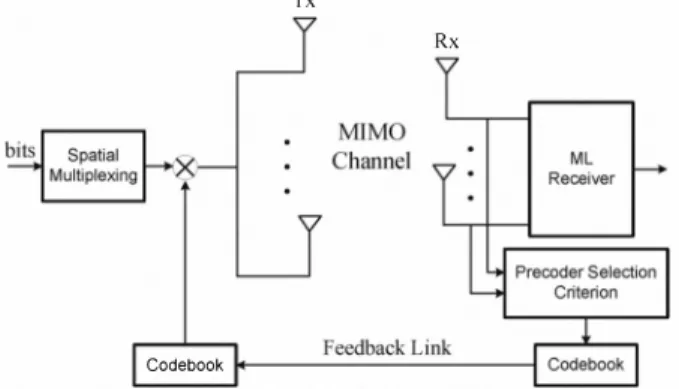
Consider a wireless MIMO system with
Nt
transmit anten nas andNr
receive antennas, as described in Fig. l. LetH
denote an
Nr
xNt (Nt � Nr)
channel matrix. We assume thatH
is available to the receiver, but not to the transmitter. For precoder selection, the receiver first chooses a precoderF p
from the codebook F. Note that the codebook consists of a finite set of precoding matrices, i.e., F =
{F
1,F
2,... ,F B},
where
B
is the size of the codebook, and P E{I,··· ,B}.
Assume this codebook is known at both the transmitter and the receiver. Via a feedback channel, the receiver sends this index p to the transmitter. Finally, the transmitter uses the corresponding precoder
F p
for precoding. We assume each precoding matrix in F has unit-norm columns so that the total transmit power is constrained. For spatial multiplexing, the input symbols are multiplexed into anM
x1
symbol vectors,
and then multiplied by anNt
xM (Nt � Nr � M)
precoderF p
before transmission. Thus, the received signal vector can be expressed asy
=
HFps+n
(1)where
n
is theNr
x1
Gaussian noise vector with the covariance a2IN�. The ML estimate of the transmit vectorS
can be expressed ass
=
minIly
-
HF p
Si
11
2 (2)"iES
where S is the set of all possible transmitted symbol vectors. Note that when a colored noise is considered in the system model, we have to conduct the whitening process at the receiver so that the minimum distance criterion in (2) can be used for signal detection.
Tx
Rx
Code book 1+---1
Fig. 1. System model for a limited-feedback precoding MIMO system.
III. PRECODER SELECTION CRITERIA
The free distance, which dominates the error rate perfor mance of ML detection for high SNR regimes, is defined as
dJ2
min -
- min (3)Let
(Si - Sj)
denote the difference vector, where i:I j.
Thus, for a given channel realization
H,
the optimum precoder selection criterion is to chooseF p
E F such that the free distance is maximized. From (3), we observe that the optimum solution is found by the exhaustive search over all possible difference vectors. Such numerical search, however, may be prohibitive when a large number of transmit bit-streams and a high-order QAM are adopted. In practice, we consider a suboptimum solution in which a lower bound of the free distance is maximized.A.
SVD-based selection criterion
Assume that
HF p
is anNr
xM
full column rank matrix, and its SVD is given asHF p
=
U A V*, where * representthe operation of Hermitian transpose, U is an
Nr
xNr
unitary matrix, V is an
M
xM
unitary matrix, and A=
[diag
(
Al, A2, . . . , AM)
OMX(N�-M)r is anNr
xM
matrix. The non-zero entries of A are the singular values ofHF p.
Based on the Rayleigh-Rits theorem, a lower bound for the free distance using SVD was derived in [6]. It is shown that
(4) where AM is the minimum singular value of the matrix
HF p,
and
cP.nin
is the minimum distance between any two distinct transmit symbol vectors. Note thatcJ2min
is a deterministic value for a fixed QAM modulation size. Therefore, the lower bound only depends on the minimum singular value ofHF p.
In [3], Heath
et al.
proposed the use of (4) to solve the precoder selection problem. The SVD-based precoder selection method can then be described as follows. With a given channel matrixH,
conduct SVD for eachHF p.
Choose the precoderF p
EF whose
HF p
provides the largest AM.With this criterion, only computing the minimum singular value AM of each
HF p
is required, and the computational complexity can be reduced dramatically. However, the problem for the SVD-based method is that the lower bound (4) may not be tight enough for evaluating the free distance.B.
QRD-based selection criterion
With QRD, we can factorize the matrix
HF p
in the form ofHF p
= QR
, whereQ
is anNr
xM
column-wise orthonormal matrix andR
is anM
xM
upper triangular matrix with positive real-valued diagonal entries as(
R�
,lR=
.
o o
)
Via this decomposition, we can have another lower bound for the free distance as
(5) where
[R]min
is the minimum diagonal value ofR.
Thus, we can have the QRD-based selection criterion described as follows. With a given channel matrixH,
conduct QRD foreach
HF p.
Choose the precoderF p
E :F whoseHF p
provides the largest[R]min.
With the Cholesky factorization, it has been shown [5] that the lower bound achieved with QRD is tighter than that with SVD; that is
[R]min 2:: AM.
(6)In other words, (5) will be more accurate when evaluating the free distance. We hereby provide another proof for (6). The main idea is treating the QRD as a special case of the generalized triangular decomposition (GID) [9] and use the corresponding properties.
Definition
1: Letg =
(a1, a2, . . . , am)
and Q=
(b1, b2,
• • •, bm)
be two positive, real-valued sequences satisfying
and
b1 2:: b2 2:: . . . 2:: bm·
We say that
g
majorizes Q in the product sense [10], [11] ifI I
II
ak 2::
II bk
k=l
k=l
for all l
= 1,2,
... , m, and with equality when l=
m.Proposition
1: The inequality in (6) holds for anyM
xM
full rank matrix
HF p.
Proof.
With QRDHF p
=
QR,
we can expressR
asR
=
Q*HFp.
(7)Since the singular values �
=
( A1, A2, . . . , AM)
ofHF p
are invariant under the unitary transformation, it follows thatHF p
and
R
provide the same singular values. Note thatR
is an upper triangular matrix, which means its diagonal elementsr. =
(r1, r2, . . . , r M
) are exactly the eigenvalues ofR.
Arrange both sequences � andr.
in a decreasing order. By a theorem in [12], we can have that � majorizesr.,
which is equivalent to the following inequalityI I
II
Ak 2::
II
rk
k=l
k=l
(8) for alll
= 1,2, . . . , M,
and with equality when l= M.
Thus, we can conclude that[R]min 2:: AM,
which completes the proof.C.
Enhanced QRD-based selection criterion
The tightness of the QRD-based lower bound in (5) may degrade for large
M
even though (6) still holds. In this subsection, we propose a simple method to enlarge[R]min
for each
HF p
so that the bound provided by QRD is even tighter. Assume that the same QAM modulation is adoptedfor each transmit bit-stream. Under this assumption, the ML detection criterion in (2) can be written as
s
=
minIly
-HF pPP*Si 112
8iES
=
minIly
-H/S� 112
(9)8�ES
where
P
is a permutation matrix,H'
=
HF pP,
andsi =
P*Si.
The key observation that leads to the enhanced QRD based method is that the solution of the ML detection in (9) remains the same sincesi
is a vector obtained with an element ordering ofSi.
Note thatH'
is a matrix obtained with a column ordering ofHF p,
and the QRD ofH'
will give a different[R]min.
This fact motivates us to adopt the permutation method to further tighten the QRD-based lower bound. Also note that the permutation method proposed here cannot be adopted in the SVD-based scheme since the singular values ofHF p
are independent of columns permutation. The details for the enhanced-QRD method can be summarized as follows. For a givenHF p,
we can obtainM!
matrices with column permutations denoted asH1
=
HFpP1,H2
=
HF pP 2, . . . , HM!
=
HF pP M!,
whereP n
is a permutation matrix corresponding to a specific permutation patternn.
Let their QRDs be expressed as(10) where
n = 1, . . . , M!.
From the above permutation method,M!
different minimum diagonal entries for a givenHF p
can be obtained, and we can choose the maximum one, denoted by
[R]min,maz,
as the minimum diagonal entry ofHF p.
Therefore, the enhanced QRD-based method is given as follows. With a given channel matrixH,
use the permutation method to compute the[R]min,maz
for eachHF p.
Then, choose the precoderF p
E :F whoseHF p
provides the largest[R]min,maz.
The permutation method we propose can tighten the lower bound in (5), but the computational complexity will be increased due to the extra
(M
-1)
QRD operations. Toreduce the complexity, we can use Givens rotations [10], [13] for computing the QRD of each
Hn.
First, we assume thatH1
=
Q1R1
is available via a complete QRD, andH2
is another matrix different fromH1
by exchanging two neighbor columns. We then seek to obtainR2
ofH2
without another complete QRD. Denote P as a permutation matrix that exchanges two specific neighbor columns ofH1.
We then have (11) whereR1
is a near upper triangular matrix. Now, all we have to do is to transferR1
into an upper triangular matrix. Since P only exchanges two neighbor columns of Rl. we can upper trianglizeR1
by applying a simple Givens rotation matrixG1,
that is,
G1R1
=
T,
whereT
is an upper triangular matrix. Thus we can rewrite (11) aswhere
Q2
=QI Gi
is a unitary matrix. Since the QRDof a full column rank matrix is unique [10], we know that
Q2T
in (12) is the QRD ofH2,
andT
is equal toR2.
In other words, we obtain
R2
by simply left-multiplying a Givens rotation matrix onRI
rather than by performing a complete QRD onH2.
Therefore, we can dramatically reduce the computational complexity of the enhanced QRD-based scheme. Fig. 2 illustrates (forM
=3)
how eachRn
canbe derived with Givens rotations.
82 =[h2 hi h31 83 =[hl h3 h21
1
1
84 =[h2 h3 hl1 85 = [h3 hi h21
1
86 =[h3 h2 hl1
Fig. 2. The ordering of computing each Rn of HF p. M = 3
D. Capacity-based selection criterion
The criterion of capacity maximization is also widely con sidered in the precoding problem [31. With a given equivalent channel matrix
HF p,
the capacity can be expressed asC =
log2 det(IM
+
�
F;H*HF p)
(13)where p is the average SNR per receive antenna,
detO
denotes the determinant, and1M
is anM
xM
identity matrix. Therefore, the capacity-based method can be given as follows. Compute channel capacity using (13) for eachHF p.
Choose the precoderF p
E :F whoseHF p
provides the largest C.The capacity-based selection criterion is derived from a general capacity formula, which is independent of the receiver structure. Thus, it may not provide the guaranteed performance improvement for some channel realizations. Also, the permu tation method in our enhanced QRD-based scheme cannot be adopted in the capacity-based method since the channel capacity C is invariant under the column permutation of the matrix
HFp.
E. Complexity comparisons
One way to quantify the complexity of the matrix compu tation is to count the number of floating operations (FLOPS). Several efficient algorithms for conducting QRD and SVD are given in [131. In general, SVD requires more FLOPS than QRD does. As a result, the QRD-based selection scheme not only has better performance, but also requires lower compu tational complexity. For the enhanced QRD-based scheme, the computational complexity of performing QRD on all
Hn
(for a givenHF p)
is0(M!M3).
As mentioned, we can reduce the complexity via Givens rotations, in which only one complete QRD and(M!
-1)
upper-triangulizationoperations are required. Each upper-triangulization operation only needs
0(3
x42)
FLOPS. Thus, the overall computational complexity is reduced from0(M!M3)
to0(M3 + 48(M!
-1))
�0(M3 + M!).
As for the capacity-based method,the computational complexity is
0(M3),
which mainly arises from computing the determinant and the matrix multiplicationF;H*HF p
in (13). Note that there is an additional overhead for the capacity-based method since the variance of the chan nel noise is required.IV. JOINT PRECODER AND ANTENNA SELECTION
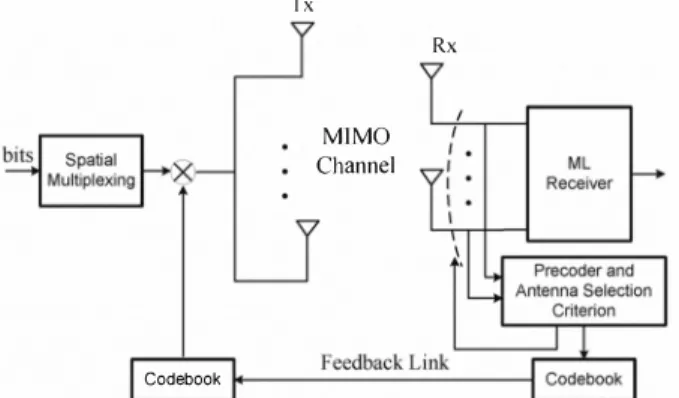
Antenna selection is a simple yet effective method to enhance the diversity gain in a wireless MIMO system. It has been shown that with ML detection, the optimum antenna subset is the one giving the largest free distance. We hereby propose a scheme that combines transmit precoding with an tenna selection. Note that antenna selection can be conducted at either the transmitter or the receiver side. In this paper, we only consider the receive antenna selection. The advantage of receive antenna selection is that the feedback overhead will not be increased. The system model for joint precoder and receive antenna selection is shown in Fig. 3.
Tx
MIMO Channel
Rx
Codebook 1+---1
Fig. 3. System model for joint precoder and receive antenna selection in a MIMO system.
Assume that
Nt � Nr
>M.
It means we have(�)
receive antenna subsets to choose. According to some criterion, the receiver jointly determines the optimum precoderF p
E :F , and the receive antenna subset indicated by the index q. Note that, via the feedback channel, only the index p will be sent back to the transmitter since the antenna selection is performed at the receiver side. The received signal in (1) can be rewritten as(14) where
Hq
is the channel matrix corresponding to the selected receive antenna subset. The ML detection can then be rewritten asmin (15)
Thus, among
B
(�)
possible combinations, we choose a pair ofHqF p
that can give the largest free distance. The jointprecoder and receive antenna selection problem can be viewed as a two-dimensional optimization problem as shown in Fig. 4. As mentioned, the optimum solution needs an exhaustive search over all possible difference vectors in (IS), which requires high computational complexity. Thus, we can use the suboptimum solution described in Section III for this joint optimization problem. The inequalities (4) and (5) can be rewritten as
(16) and
(17) respectively. Since
[R]min � AM,
we expect that (17) will be a better criterion for the optimization problem. Furthermore, the enhanced QRD-based method can also be used for further performance improvement. Similarly, the computational complexity of the enhanced QRD-based method can be reduced by applying Givens rotations.F 2 F I Free Distance #2 Free Distance # I s bs u et#1 Free Distance #(8+2) Free Distance #(8+ I) subset #2 · . . · . . · . . � ______________ �y� ______________ J Antenna Selection ,
Fig. 4. Two-dimensional search for the optimum Hq F p in joint optimization
problems.
V. SIMULATION RESULTS
In this section, we report simulation results demonstrating the effectiveness of the proposed algorithms. In simulations, we consider a flat-fading MIMO channel, of which the entries are assumed to be Li.d complex Gaussian random variables with zero mean and unit variance. The QPSK modulation is assumed at the transmitter while the ML detection is conducted at the receiver. The codebooks we use in the simulations are obtained from [14].
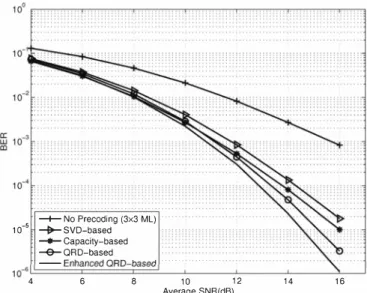
Fig. 5 shows the bit error rate (BER) performance of precoding. Here,
Nt
=6, Nr
=M
= 3, andB
=64.
Aswe can see, the scheme without precoding (3 x 3) suffers from the performance loss in channel fading. For precoding, the QRD-based method indeed outperforms the SVD-based method, and the enhanced QRD-based method achieves the best performance, about
2
dB better than the SVD-based method. Besides, the performance of capacity-based method is slightly better the SVD-based method but worse than the proposed methods. Note that the computational complexity of the capacity-based method is higher since the receiver needs to estimate the variance of channel noise.-+-No Precoding (3x3 ML) . 10-' -+-SVD-based __ Capacity-based --e-ORO-based -Enhanced ORO-based ... ... .. 10-6�==::;:::::==:::I::="---'-______ L-____ --'-____ �� 4 6 8 10 12 Average SNR(d8) 14 16 Fig. 5. BER performance comparison for precoder selection with Nt =
6, Nr = 3, M = 3, and B = 64. -+-No Preceding (2x2 ML) . -+-SVD-based __ Capacity-based --e-ORO-based - Enhanced ORO-based .. 1O-6�==C==C:::==C"--__ ,--__ -,-__ ---,,--__ -,-__ �L..J 2 4 6 8 10 12 Average SNR(d8) 14 16 18
Fig. 6. BER performance comparison for precoder selection with Nt =
4, Nr = 2, M = 2, and B = 64.
Fig. 6 compares the BER performance of precoding for the case with
Nt
=4, Nr
=M
=2,
andB
=64.
Similarly, theproposed selection methods outperform the SVD-based and capacity-based methods in high SNR regimes. In this set of simulations, the gap between the QRD-based and the enhanced QRD-based method is not obvious since we only have two permutation patterns for
M
=2.
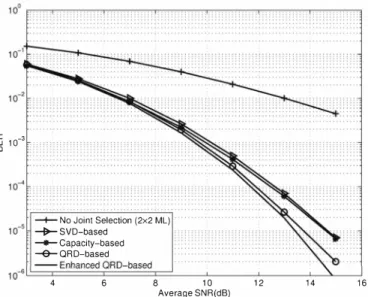
Fig. 7 shows the performance improvement for joint pre coding and receive antenna selection. In this case, we let
Nt
=4, Nr
= 3,M
=2,
andB
=16,
which means wehave 3 receive antenna subsets to choose. As we can see, the method is very effective for performance improvement. The proposed joint selection methods outperform other selection methods. Compared to the result in Fig. 6, the capacity-based method exhibits some performance loss for high SNR. This
ffi 10-' .••. . '" . --+-No Joint Selection (2x2 ML) . -+-SVO-based __ Capacity-based -e-ORO-based
--Enhanced ORO-based
1O-6L::::====:I::::====:::::!.. __ '--__ --'-__ ----L��___.J
4 6 8 10
Average SNR(dB) 12 14 16
Fig. 7. BER perfonnance comparison for joint precoder and receive antenna selection with Nt = 4, Nr = 3, M = 2, and B = 16.
0: LU '" --+-Precoder Selection, 8=4 -+-Precoder Selection, 8=8 __ Precoder Selection, 8=16 -e-Precoder Selection, 8=64
--Joint Selection, 8=4
1O-6l':===:::i::::==S===�_'____ __ ___'__ ___ '__ __ ___'___�
4 6 8 10 12
Average SNR(dB) 14 16 Fig. 8. BER perfonnance comparison between joint selection (Nt = 4, Nr = 3, and M = 2) and precoder selection (Nt = 4, Nr = 2, and
M= 2).
can be explained by the fact that it maximizes the channel capacity, not the free distance. Thus, its performance may degrade for some channel conditions, Besides, we observe that the gap between the QRD-based and SVO-based method is reduced somewhat since we only have
(�)
24 =48
candidatematrices in this case. Fig. 8 shows the reduction of the required feedback bits when the joint selection scheme is considered, Here, all results are obtained with the enhanced QRD-based method, We observe that at least log
�
4 - log�
=4
bits can besaved when an extra antenna is used at the receiver. Note that increasing the receive antenna may not be always possible for some applications due to the size constraint at the receiver. Thus, the joint selection method can be viewed as a tradeoff between the feedback bits and the number of receive antennas.
VI. CONCLUSIONS
In this paper, we propose a QRD-based precoder selection method for ML receivers. Theoretical and simulation results indicate that the QRD-based method is not only better than the conventional SVO-based method, but also has lower computa tional complexity. To further improve the performance, we also propose the enhanced QRD-based method that can provide a more accurate estimate of the free distance. Using Givens rotations, the computational complexity of the enhanced QRD based method can be reduced effectively. Besides, we combine the precoding with receive antenna selection, and solve the selection problem using the proposed methods. Simulations show that the proposed approaches can provide the significant performance improvement. Moreover, the proposed QRD based approaches will exhibit a significant advantage when sphere-decoding (SO) [15], an efficient algorithm for the ML detection, is used at the receiver. Note that the QRD is also required in the SO algorithm, which implies that the same QRD unit can be shared by proposed selection methods and the SO algorithm. Based on the above reasons, we conclude that the QRD-based selection algorithms will be much more efficient in real-world applications.
REFERENCES
[I] G. D. Golden, G. 1. Foschini, P. W Wolnianski and R. A. Valenzuela "VBLAST: A high capacity space-time architecture for the rich scat tering wireless channel," in Proc. Int. Symp. Advanced Radio Technol., Boulder, CO, Sep. 9-11, 1998.
[2] L. Zheng and D. Tse, "Diversity and multiplexing: A fundamental tradeoff in multiple antenna channels," IEEE Trans. Inform. Theory, vol. 49, no. 5, pp. 1073-1096, May 2003.
[3] D. 1. Love and R. W Heath Jr., "Limited feedback unitary precoding for spatial multiplexing systems," IEEE Trans. Inform Theory, vol. 51, no. 8, pp. 2967-2976, Aug. 2005.
[4] 1.-K. Zhang, A. Kavcic, and K. M. Wong, "Equal-diagonal QR decompo sition and its application to precoder design for successive-cancellation detection," IEEE Trans. Inform. Theory, vol. 51, no. I, pp. 154-172, Jan. 2005.
[5] C.-T. Lin and W-R. Wu, "QRD-based antenna selection for maximum likelihood MlMO detection," in IEEE Int. Symposium on personal, Indoor, and Mobile Radio Communications (PIMRC), Sep. 2009. [6] R. W Heath Jr" A. Paulraj, "Antenna selection for spatial multiplexing
systems based on minimum error rate," IEEE Int. Con! Communications (ICC), vol. 7, pp. 2276-2280, Jun. 2001.
[7] R. W Heath Jr., S. Sandhu, and A. Paulraj, "Antenna selection for spatial multiplexing systems with linear receivers," IEEE Commun. Lett., vol. 5, no. 4, pp. 142-144, Apr. 2001.
[8] A. Gorokhov, D. A. Gore, and A. J. Paulraj, "Receive antenna selection for MlMO spatial multiplexing: theory and algorithms," IEEE Trans. Signal Process., vol. 51, no. 11, pp. 2796-2807, Nov. 2003.
[9] Y. Jiang, W W Hager, and J. Li, "The generalized triangular decompo sition," Math. Comput., vol. 77, no. 262, pp. 1037-1056, Apr. 2008. [10] R. A. Hom and C. R. Johnson, Matrix Analysis. Cambridge, U.K.: Cam
brige Univ. Press, 1985.
[11] A. W Marshall and I. Olkin, Inequalities: Theory of Majorization and Its Applications. San Diego, CA: Academic Press, 1979.
[12] H. Weyl, "Inequalities between two kinds of eigenvalues of a linear transfonnation," Proc. Nat. Acad. Sci., vol. 35, pp. 408-411, Jul. 1949. [13] G. Golub and C. F. Van Loan, Matrix Computations. 3rd ed. Baltimore,
MD: Johns Hopkins Univ. Press, 1996.
[14] D.1. Love. (2004) Tables of Complex Grassmannian Packings. [Online]. Available: http://cobweb.ecn.purdue,edwdjlove/grass
[15] B. Hassibi and H. Vikalo, "On the sphere-decoding algorithm I. expected complexity," IEEE Trans. Signal Process., vol. 53, no. 8, pp. 2806-2818, Aug. 2005.