Low-complexity Prediction
Techniques of K-best
Sphere
Decoding for MIMO Systems
Hsiu-Chi Chang, Yen-Chin Liao,
and Hsie-ChiaChang
Department
of Electronics
Engineering
National Chiao
Tung University,
1001
Ta-Hsueh
Road,
Hsinchu,
Taiwan,
R.O.C.
Tel: +886-3-5712121 ext.54246 email:
jasper.ee94ggnctu.edu.tw
Abstract- In multiple-input multiple output (MIMO) systems, search
approach.
Thus the value ofK should belarge
enough,
maximum likelihood (ML) detection can provide good perfor- and the value K dominates the performance and computation
mance, however, exhaustively searching for the ML solution complexity.
becomes infeasible as the number ofantenna and constellation
points increases. ThusML detection is often realized byK-best In thispaper, two modified K-best SD algorithms are
pro-spheredecoding algorithm. posed for
reducing
thecomputation
complexity
whileremain-In this paper, two techniques to reduce the complexity of ing the performance similar to
ML
detection. The K-bestalgo-K-best algorithm while remaining an error probability similar rithm with
predicted
candidates,oneofourproposed
methods,to that of the ML detection is proposed. By the proposed r . .
K-best with predicted candidates approach, the computation r t
complexity can be reduced. Moreover, the proposed adaptive paths before selecting the K best candidates. Moreover, an
K-best algorithm provides a means to determine the value K adaptiveK-best algorithm is proposed,providingan adaptive
according the received signals. The simulation result shows that selection of K by observing the ratio of the second minimum the reduction inthecomplexity of 64-best algorithm rangesfrom and minimum of all paths at the first decoding layer. According
48% to 85%, whereas the corresponding SNR degradation is
maintained within 0.13dB and 1.1dB for a 64-QAM4x4MIMO to oursimulation results, theproposed techniquescan achieve
system. at most 85%
complexity
reduction whencomparing
tocon-ventional 64-best SD
algorithm.
I. INTRODUCTION
The rest of this paper is organized as the
following.
TheRecently,
multiple-input
multiple-out
(MIMO)systems
aresystem
model, SDalgorithm,
and K-best SDalgorithm
areapplied in
many
wirelessapplications
for bettertransmission
briefly described in SectionII.In SectionIII,the two proposed efficiency and signal quality due to the inherentdiversity
gain detection schemes are presented. The bit error probabilities ofprovided by
the multi-path environment.
Maximum-likelihood the proposed schemes are simulated in a 4 x 4 MIMO system(ME)
sequencedetection
is one of thedetection schemes
for of uncorrelated flat-fading channels, and the simulation resultsdetecting
thereceivedsignals
in MIMOsystems By searching and comparisons are given in Section IV. Finally, Section VIfor the constellation point nearest to the received signal, concludes this
work.
ML detection is optimized for
minimizing
thesymbol
errorprobabilities, but exhaustive search becomes infeasible since
the computation
complexity
grows as the number ofantenna 1. SPHERE DECODINGFORMIMO SYSTEM or theconstellation
points
increases.Sphere
decoding
(SD)
algorithmcanreduce the
computation
complexity by
confining
the number of constellation
points
to besearched,
Fincke- For a MIMOsystem
with NT transmit antennas andNR
Pohst [1] and Schnorr-Euchner [2] aretwo of the most com- receive
antennas,
the transmitted and receivedsignals
can bemon
computationally
efficient searchstrategies
forrealizing represented by
the ML detection.Nevertheless,
the difficulties in hardwareimplementation arise because of thenon-constant
computation
=Hs
+ii,
(1)complexity and
decoding
throughput.
Alternatively,
K-bestSD algorithm [3], [4]
simplifies
the hardwareimplementation
whereyi
is theNR
x 1 receivedcomplex
signals,
H is anof SD algorithm
by
keeping
at most K bestpaths
in eachNR
xNT
matrix ofindependent
and identical distributed layer, leadingtofixed-throughput
andpredictable
complexity.
(i.i.d.)
circular Gaussian random variables(flat
fading
isas-Note that the term layer refers to the signal constellations sumed),sis an NTx1 complexvectorrepresentingthe signals of an transmit antenna. However, K-best SD algorithm can transmitted by each transmit antenna, and
ni
is the NR X 1 not guaranteeME
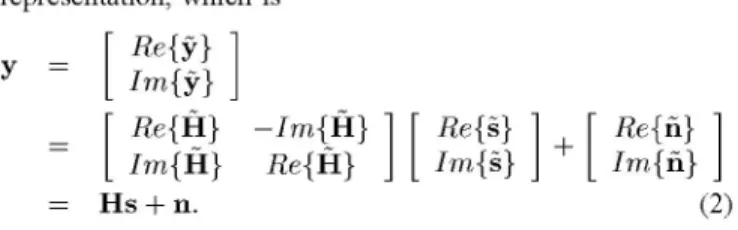
performance since the ML path might i.i.d. complex Gaussian noise vector. Moreover, the complex be eliminated due to the breadth-first nature of K-best SD model in (1) is often described by the equivalent real-valuedrepresentation, which is PED and the accumulated Euclidean distance corresponding
F
Re{i}
1 tos(i+±),
denotedby
T(s'+1)),
that is[ Im{ } J
T(s('))
=T(s(+))
+e(S)(7)
= F
Re{}
I
{}lHj
Re{}
l +FRe{fi}
The detection process starts fromi=NT, resulting
to atree-[
Im{H}
Re{H}
I [Im{s}
J [Imfn}
i structure, or called depth-first, search strategy. However,ex-- Hs+ n. (2) haustively searching for the ML solution becomes infeasible
This is also referred to as the real value decomposition. For [5] since the computation complexity grows exponentially QAM signals, real value decomposition transforms the com- with Nt or the number of constellation points. Thus, sphere plex constellation into two real-valued PAM
constellations,
decoding (SD) algorithm has been proposed and recognizedwhich can result to fewer computation. as a powerful means to solve the
ML
detection problems [6] For detecting the received signals, maximum likelihood [4]. SD algorithm reduces the computation by restricting the(ML)sequencedetectionis one of the MIMO system detection search range. Instead of searching all candidates in Q, SD
technique that optimizesthe symbol error probability. Accord- algorithm constrains a much smaller search range
QSD
=ing to the system model described in, Fig.1 ML detection
{s
s RRs
< r2}; only the candidates in QSD Will be is equivalent to searching for the vector s that minimizes compared. By the aforementioned procedure, the candidateIY-
Hsl12.
Thatis,
of the smallestT(s(1))
is always theML
solution as longas r is properly defined. However, not only the value r, s =argmin
IY- Hsll2,
(3) but the computation varies withSNR,
leading to anon-SGE2 constant decoding throughput. Hardware implementation of
where Q is the setconsisting ofall possible
2Nt-dimensional
SD algorithm becomes complicated.signal constellation points. Fig.1 shows the simplified block K-best SDalgorithm is an alternative method that improves
diagram ofa MIMO receiver. The channel estimator provides the decoding throughput. It simplified the original SD
algo-the required channel state informationH. By QR decomposi- rithm and maintains a constant throughput by keeping only
tion, the channel matrix H is decomposedby H = QR, and the K smallest accumulated PED at each layer. However,
(3)can be rewritten as K-best SD algorithm can not guarantee the performance of
IlY- Hsl2
=(s
-sZf)HHHH(s
-szf)
ML detection since theML
solution may be eliminated when+ y-ff
(I
-H(HHH)-'HT)Y
it is not of the K best accumulated PEDs. Thus, larger Kis required and the value K becomes a tradeoff between
and complexity and error performance.
-
argmin(s-szf)HHTH(s
- szf) Transmit Channeiarg min
sHRHRS.
(4) Symbols (H)Notethat the matrixR derivedfrom QRdecompositionis an Estimation Decomposition st
uppertriangular matrix with non-negative diagonal elements,
and
HHH=RHR.
Moreover, Szf is the zero-forcing (ZF)solution that can be derived by Szf =
H+y
for H+ is the Detect MaxmumLikdelihoodpseudo-inverse
of H. It isperceived
that s - szf is the Symbols Aithmdistance from the candidates ofsignal tothe ZF solution.
Due to the triangular form ofR, we can rewrite (4) as Fig. 1. Block diagram of MIMo detection
2
NR NT
argmin E -
1
Rijs>
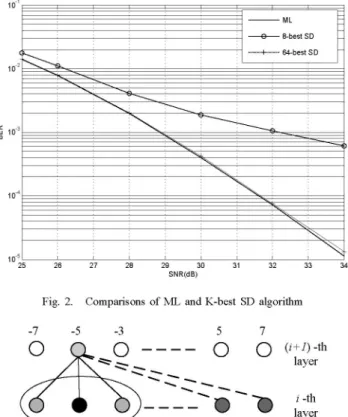
(5) Fig.2illustrates the bit error rate of a4 x 4 MIMOdetectori=1 j=i ofdifferent values ofK, and there isperformance degradation where
Ri
andsj
denote the i-th row,j-th column ofRand when K is chosen too small.the j-th element ofs. Moreover, we can define
e(s(')),
the III. PROPOSED K-BEST SD ALGORITHMWITH
PREDICTEDpartial square Euclideandistance(PED) of the i-th layer, by CANDIDATES
NT 2 AlthoughK-best SDalgorithmremainsconstant
throughput
e(s()
=Yi-E
Rij
,(6)
and computation, itscomputationcomplexityis notnecessarily lower than the conventionalSD algorithm since all the PEDs of each layer still need to be calculated. However, only the wheres(i)
- [sis).*s.)]
andsKi) isthe j-th element of K PEDs resulting to the K best accumulated PEDs can affect s() Then the accumulated Euclidean distance corresponding the PED calculation in the next decoding layer. That is, part to the candidates(i)
can be derived recursively from the of computations of the PEDs are unnecessary. A method toI---64-best SD
complexity
and errorprobability.
Due tofading,
thesignals
0-2 ~~~~~~~~~~sufferfrom low SNR when they are in deep fades, and K
...:.when the
signal strength
ishigh. Dynamic
Kimplies
ansignal
...q lity...in tor...is...re ire d.nd to ir
10-3____~~~~~~
...adaptive.... ...K -best...algorithm,...provides.. ...a...m eans...to...observe...the..
i
~
~~~~~~~~~antennas,
this indicatorcan beacquired by
the ratio... ... ... .. ... .. .. .... ... ... ... .. ... .. .. ... .. .. .. .... ... .... .... ... ...
Fi.2. Cmprsoso M ndKbetS
aloihmowhee MLndM
pathtbein selim
natd
duingmu
theK-bestm
SD-7
-5
3 5 7processing
increases.o Q - 0
(1± 1)
-thFig.4
is an illustrativeexample
ofa4x464-QAM system,
4:::-: _zz-
~~layer
which shows the relation between T and thesymbol
errorprobability
conditioned onthe value T. The curve stands fori -t the
probability
Pr(R
<T),
and thehistogram
shows the----
~~~~~~~~~ayr
the conditionalsymbol
errorprobability.
It isperceived
thatsymbol
errorprobability
is small as T increases.Thus,
theFig. 3. K-best with predicted candidates value K can be determined
by
firstcomputing
ft in(9),
thenK
K,
ifR<T; IK2
otherwise. (0predict
the morelikely
PEDs ispresented
in thefollowing.
Only
a fraction of the PEDs arecomputed,
andthus,
thecomputation
can begreatly
reduced.07At
decoding layer
i,
thepoint k'j resulting
in the smallestPr(symbolerror
occursIR
=T)
PED fora
given s('±l)
can be derivedby
0.6-~(±)-Yi NTP+1
Rijs05'
k
j=i~~f
(8)
.-and
only
the L- 1points
nearest tos~i±l)will
becomputed
for
e(s(')).
Thatis,
thes$')
of the vectors(')
will beki(i±1)
and its L- 1 nearest constellation
points. Only
L PEDs from0.3-e(s(i±1))
should be calculated instead.Accordingly,
we canalways
have the PEDvaluescomputed
in anascending
order,
0.2-and the first L smallest PEDs will contribute to more
likely
candidates.
Fig.3
is a64-QAM
example
with L =3. The 0.1constellation
corresponds
to the i-thlayer
is denotedasSi,
asthe
figure
shows,
thepoints
with ofcross mark is the 0(±1 andonly
the three constellationpoints (linked by
solidlines)T
willbe
cmputd.
Tus,
heompuatio
comlexiy
ca be Fig. 4. The probability of R < T and the conditional symbol errorreduced,
especially
whenNT
islarge.
probability.IV. PROPOSEDADAPTIVE K-BEST SPHERE DECODING The value R can be
regarded
as asignal quality
indicatorlayers
can be reduced if K=1K2
is chosen.However,
if reducecomputation
effort, however,
theperformance
will also R is determinedearlier,
there are chances that ft cannnotdegrade
since somecomputation
isignored.
provide
sufficient informationtoreport
thesignal quality
andthe
performance
willdegrade.
120.00%V. SIMULATIONRESULTS 0.%
80.00%-Inthis
section,
a 4x4 MIMOsystem
is simulated forcom-paring
theproposed
schemes and the conventionalSDandK- 60.00%best
algorithms (K =64),
whereas theMEI detectionprovides
40.00%
a
performance
baseline. Thesignal
is modulatedby
64-QAM
and the MIMOchannel is assumedto fade
uncorrelatedly
and 20.00%independently. Totally
106
bits are simulated when theSNR.
.0is below
30dB,
and i7bits are simulated for SNR > 30dB. SNR(dB)/Adaptiv Kbest 30 32 34The
proposed adaptive
K-bestalgorithm
can beapplied
w-K2=28,L2=8 35.54% 41.18% 51.37%with the above mentioned candidate
prediction technique,
*Kl=64,L1=8 64.46% 58.82% 48.63%whereas the
K,
andK.2
can have distinctL,
andL2
values,
respectively. Fig.5
presents
the errorprobabilities
versus SNR Fig. 6. Reduce computation effort inSNR 30, 32,and 34dB for T 30.for different detection methods. It is
perceived
that for SNRloweror
equal
to 30dB,
all theproposed
schemescanprovide
_______________________performance
very close to that of theMEI
detection. When 120.00%SNR is
greater
than30d,
aslight degradation
isshown,
and 100.00%the value L dominates the
degradation.
As shown inFig.
5,
for K1
K2
=64,
the one withL,
2 8outperforms
80.00%-the one with
L,
=-2
3.60.00%-...F... ...F. .0 -- K1=64,K2=32,L1=8,L2=3.20.00% -I--Kl=K2=64,2(Ll=L2=8. ~~~~~~~~~~~~~~~~~~~~0.00% 102 - -..--.K.K2..4.L..2=3.SNR(dB)/Adaptiv K-best 30 32 34 .e--K1=64,K2=28.L1=L2=8__- K23L23 517580%35% .* Kl=64,L1=8 47.83% 41.98% 26.48%
LU ...Fi.7. Reue.o puato efotinSN 0,32 4d frT 5
co
...7 7percentage....of....2..being...selected...also...increases,..
25... 26..27..28...31..32...33...overall com putation...com plexity...Thus,...the...num ber...of. sorting...
.---operations----
are recorded----and
aeshownteinrSTABLE0 I2for3comparingSN.---i--- ---i -i
_thceanume
r,
ofe
srcetinge
operat
bio
nga
allmethodaso inorm
alied,
error probability.
Since- --smaller --.2may
leat3prfrmnc showstatteredpucation
intcomplexity
bof64-este.algoih
odrops whentT>t1.oAccordingly,oercomparewthewoocasesuQAM
4he4
MIMO system64,26.27 28, 30 wit L1 8,33
whereascmpu
3VI.o
CONCity
TusION
ume f otnthe prameers hose wil resut tosimiar cmputtion twont rehiqesordeducing thew compALExIt fof K-bestiSD
copeitie. Asig5E
coprshows,o
thfernlattertiresultmstoslghlalortmplfortisiga
dhetetonmaineMoriMO
systmspaext
prefesented
smalervlerro
probailites.a
thus,of ietwcanbhe obseredithatdth oB thet poposhedKovninl6-bestalgorithm.wthprdite
S cadiatlesvaluerLpaffectlerrorSprobability.
Th maximumt valerfofmaLc reduces thatteneumberof sringthcompleration.
Morbeoveragrthemro
istegrdaimension
ofithePNaM consterTwllationSmlequrLwloed.O
ragsfo
adativ K-bestS algoriasthmporoviespaomeans
toRTABLE I
COMPARISONOFMLANDK-BEST SPHERE DECODINGANDRATIO SPHERE DECODING DESIGN
Method ML K1=K2=64 K1=64,K2=28 K =64,K2 =32 K1 K2 =64 Number of LL = L2=8 L =L2 =8 |L =8,L2 3 L1 L2 =3 Number of 1.19 x 10¹⁹ 6.59 x 10¹⁰ 3.43 X 10¹⁰ 1.9 x 101O 9.39 x 10⁹ Sorting Operations Normalized Sorting 1.8X 10⁸ 100% 52.04% 28.83% 14.2% Complexity 2 SNR(dB)for 32.64 32.72 32.85 33.24 33.82 BER- 5 x10⁻⁴k 326
determine the value K by observing the received signals. These two schemes can be applied at the same time when
considering
the errorprobability
and complexity, providingflexibility
and tradeoff between system performance and im-plementation cost. According to our simulation results, the reduction in the complexity of 64-best algorithm ranges from 48% to 85%, whereas the corresponding SNR degradation is maintained within 0.13dB andl.1dB
for a 64-QAM 4 x 4 MIMO system.REFERENCES
[1] U. Fincle andM. Phost, "Improved methods for calculating vectors for
shortlength in alattice,includeing complexity analysis," Math. Comput.,
vol. 44, pp.463-471,April. 1985.
[2] C.Schnorr andM.Euchnerr,"Lattice basis reduction: improved practical
algorihtms and solving subset sumproblems," Mathematical
Program-ming,vol. 66,pp. 181-191, 1994.
[3] K. W. Wong, C. Y Tsui, R. S. K. Cheng, and W. H. Mow, "A vlsi
architecture ofak-best lattice decoding algorithm for mimo channels,"
PIMRC,vol. 02, 2002.
[4] E. Viterbo andJ. Boutros, "Auniversal lattice code decoder for fading
channels,"IEEETrans. onInform. Theory, vol. 45,pp. 1639-1642, July.
1999.
[5] D.Micciancio, "The hardness of the closestvectorproblem wtih
prepro-cessing,"IEEETrans. onInform. Theory, vol. 47,pp. 1212-1215, March.
2001.
[6] E. Angrell, T.Eriksson, A.Vardy, and K.Zeger, "Close point search in
lattices,"IEEETrans. onInform. Theory, vol.48, no. 8, pp. 2201-2214, 2002.