行政院國家科學委員會專題研究計畫 成果報告
半導體奈米結構的磁性與光學性質之研究(3/3)
計畫類別: 個別型計畫
計畫編號: NSC93-2215-E-009-006-
執行期間: 93 年 08 月 01 日至 94 年 09 月 30 日
執行單位: 國立交通大學電子工程學系及電子研究所
計畫主持人: 李建平
報告類型: 完整報告
報告附件: 國外研究心得報告
出席國際會議研究心得報告及發表論文
處理方式: 本計畫可公開查詢
中 華 民 國 95 年 1 月 18 日
NSC Project (Theoretical part)
Abstract
This report summarizes the major results obtained from the third year of the project. In this work we compare magneto-optical properties of layers of nano-scale semiconductor rings and dots. It was found that collective magneto-optical response (reflectance, transmittance, and absorbance) of layers of nano-sized rings and dots can demonstrate drastically different properties. The optical Aharonov-Bohm effect is showing up for nano-rings with the overall increasing of the response magnitude in contrast to the quantum dot structures. In addition we demonstrate an interesting opportunity to decrease drastically the group velocity of light in two-dimensional photonic crystals constructed form materials with large dielectric constant without dispersion. Several publications were performed based on this year’s results.
Key words: magnetic and optical properties of nano-rings and dots, Aharonov-Bohm effect, III-V semiconductor nano-systems.
1. Magneto-optical properties of layers nano-rings and quantum dots
It is known already for a long time that micro-structured materials can manipulate electromagnetic radiation. Most of the research in that field focuse at present on photonic crystals, a concept introduced a long time ago. Recent advances in lithography, colloidal chemistry, and epitaxial growth have made it possible to manufacture artificial meta-materials from semiconductor nano-objects. Further application of these materials in technology demands particularly extension of the usable frequency range. These demands will put research efforts in this field to the limit. Scale reduction is the classical answer to meet these increased frequency demands and that holds particularly for the new nano-structured meta-materials. When these meta-materials can be made to manipulate electromagnetic fields in the optical range, this will be particularly beneficial for potential applications and devices, as well as for new basic science. The short list of possible implementations being at close range, consists of realization of optical quantum computing, meta-materials with negative refractive index in the optical region, artificial magnetism in basically non-magnetic materials and further.
Semiconductor quantum dots and nano-rings are nanosized objects resembling artificial atoms. From these nano-objects, the nano-rings are the newest and they are topologically different from quantum dots since their geometry is non-simply connected. This different and unique topology gives them unusual magnetic and magneto-optical properties. The key characteristic of this topology, the center hole, enables trapping of magnetic flux quanta. This property of the rings leads to quantum oscillating behavior of the magnetic response of the nano-ring for varying magnetic field B, the Aharonov-Bohm (AB) effect. For a simultaneously applied optical beam this gives rise to the optical AB effects, which can occur only in nano-rings. Modification of material properties by means of a magnetic field is an inherent aspect of AB effects, including optical. This option is a prerequisite to make artificial materials, not resembling anything in nature, like negative refractive index meta-materials. Until now, most of the investigations done in the field of magneto-optical effects in nano-rings has been about far-infrared (FIR) spectroscopy or magneto-photoluminescence (MP). In these methods an additional stimulus has been used, apart from the electromagnetic beam, to determine the response of the rings. These stimuli can be the creation of an extrinsic carrier population (FIR) or an electromagnetic beam of higher frequency (MP). In this sense those methods use pre-excitation. The data obtained by these methods are very important, but actually only return averaged single nano-ring information. For a quantitative characterization of the optical
properties of nano-ring based meta-materials a highly developed optical spectroscopy, like ellipsometry, and an advanced theoretical description are indispensable. Proper understanding and modeling of the collective electromagnetic response of nano-ring layers requires a correct approach, taking into account their composite and discrete character. In addition, comparison of the collective magneto-optical response of meta-materials made from semiconductor quantum dots and nano-rings can provide important information about the basic physical distinctions between these two types of systems.
The systems investigated in this project are two-dimensional square lattices of InAs/GaAs quantum dots and nano-rings, with lattice parameter aL as shown in Fig. 1. The basic elements
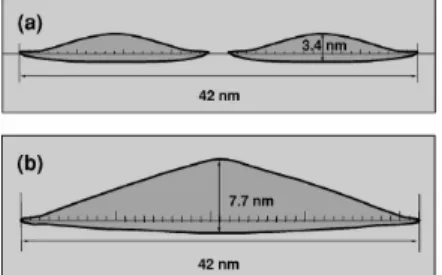
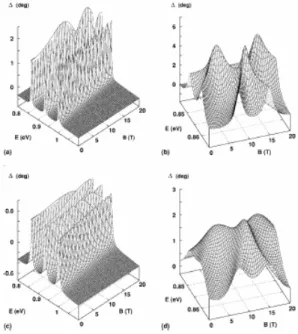
of those lattices are dots and "eye" shaped rings as obtained in our recent experiments (Fig.2). In this work we have performed a comparative study of the optical response functions (those like reflectance and absorbance and the ellipsometric angles Ψ, Δ) for quantum dots and nano-rings, when they are arranged in a square lattice (see Fig. 3-Fig. 5). We have developed accurate and workable expressions for the response terms of separate quantum dots and nano-rings as given by the polarizability. The polarizability is determined by both quantum mechanical and electromagnetic interactions. For nano-objects an outspoken consequence of these two aspects of the polarizability is that far below the energy gap the strength of the polarizability is volume and shape dependent, whereas for separately observable resonant transitions at the absorption edge the strength is volume and shape independent. For the optical response of the square lattices made up from these nano-objects only the electromagnetic interaction needs to be taken into account. The remote response, as represented by reflection and transmission coefficients has been obtained by remote propagators as usual in discrete optics and these coeficients build a key instrument for the quantitative analysis of the magneto-optical response of lattices made from nano-sized objects. The calculations clearly show that rings are more effective to exploit the dependence from magnetic fields than dots. Despite a lower volume fraction rings have stronger variation in any of the ellipsometric angles than the dots. The crossing of the transition energies, being characteristic for rings and known as optical Aharonov-Bohm effect, results in a pronounced variation of the ellipsometric angles for varying magnetic field. The reflectances for both types of lattice are weak, as can be expected from such thin layer-like systems. Remarkable is the strongly increasing dichroism for increasing angles of incidence. Since the origin of this dichroism is in the dynamic part of the anisotropy of the polarizability of the nano-objects, this dichroism can be of use to investigate the size and shape dependent behavior of the polarizability. The theoretical findings obtained here, yield also the essential starting point for future work to incorporate the influence of the embedding (capped quantum dot/nano-ring systems). This comparative study shows that use of nano-rings or quantum dots in both the investigation and use of magneto-optical response is in favor of the first.
2. Slow Light in Photonic Crystals
Recently photonic crystals built from polar materials have raised a great interest. One of the interesting phenomena is the flattening of photonic bands (a drastic decreasing of the light group velocity ug) below phononic resonance frequency. This effect lies in the opportunity to
obtain a large and negative dielectric function in this frequency region.
In this work we demonstrate an interesting opportunity to design flat bands and anti-crossing photonic bands in two-dimensional semiconductor photonic crystals using large dielectric constants, where the dynamical phononic polarization are not considered. This can decrease drastically the group velocity of the light in two-dimensional photonic crystals. We stress that the effect was not expected for the photonic crystals constructed from materials with dielectric functions without dispersion. Therefore we propose a general model for the flat and anti-crossing bands in photonic crystals with large dielectric constants.
We considered the light propagation in two-dimensional periodic structures of the square symmetry, when a dielectric rod with a large dielectric constant (εd) is inserted in the center of
frequency independent dielectric functions and the plane-wave expansion method is well suited for the problem.
Our calculation results suggest a drastic difference between photonic modes with TE and TM polarizations in two-dimensional photonic crystals with large dielectric constant (fig 6). While TM modes demonstrate well know properties, TE modes correspond to flat bands and the anti-crossing effect in the band structure the photonic crystals (fig.7). The group velocity of light in the crystal can be lowered up to 10-5-10-4 c (c is the speed of light in vacuum) in a
wide range of the Brillouin zone. We propose a general model for photonic crystal with large dielectric constants. The model explains the anti-crossing bands those are caused by the dielectric rod’s resonance coupled to the electromagnetic field.
The model and the effect can be verified by experiment since one can use for example zirconium-tin-titanate (εd=90 up to 1 THz ). For a photonic crystal with lattice constant a =
300 μm our theory predict the effects mentioned above in the region below 1 THz. In addition there is a prediction that the effective permeability in the lowest bends appears to be negative. Clearly, new meta-materials built from dielectrics with large dielectric constants remain of a grate interest.
Publications:
1. O. Voskoboynikov, C.M.J. Wijers, J.L. Liu, and C. P. Lee, Interband Magneto-Optical Transitions in a Layer of Semiconductor Nano-Rings, Europhys. Lett., 70 (5), pp. 656–662 (2005).
2. O. Voskoboynikov, C.M.J. Wijers, J.L. Liu, and C. P. Lee, Magneto-optical response of layers of semiconductor quantum dots and nanorings, Physical Review B 71, 245332-1-12 (2005).
3. O. Voskoboynikov, C.M.J. Wijers, J.L. Liu, and C. P. Lee, Magneto-optics of layers of semiconductor quantum dots and nano-rings, accepted for publication in Brazilian Journal of Physics.
4. Jiun Haw Chu, O. Voskoboynikov, and C.P. Lee, Slow light in photonic crystals, Microelectronics Journal 36 282–284 (2005).
Figures:
Figure 1. Schematic diagram of magneto-optical phenomena in a layer of nanorings. aL lattice constant
square lattice. Modeling of dots/rings by means of ellipsoids and center hole ellipsoids. a, c long and short axis, d radius cylindrical center hole. i, r, t incoming, reflected, and transmitted beam, respectively. θi angle of incidence.
Figure 2. Typical shape of nanoring and quantum dot structures. (a) Schematic InAs/GaAs ”eye” shaped nano-ring (after TEM picture), (b) Schematic InAs/GaAs “eye” shaped quantum dot.
Figure 3. Ellipsometric an nano-rings. (a),(b) for θi=60° and γ =2 eV (dam V. Left panels (a),(c): dots, right panels,(b),(d): rings.
Figure 4. Ellipsometric an no-rings. (a),(b) for θi=60° and γ =2 eV (dam V. Left panels (a),(c): dots, right panels,(b),(d): rings.
r a monolayer of InAs quantum dots and nanorings. Magnetic field B=7 T. Dots: Ћω=0.867 eV, rings: Ћω=0.854 eV. Both: γ =5 meV.
gle Ψ for a monolayer of InAs quantum dots and ping paramiter). (c),(d) for θi =60° and γ =5 me
gle Δ for a monolayer of InAs quantum dots and na ping parameter). (c),(d) for θi =60° and γ =5 me
(a)
igure 7. Relative group velocity of light in the third TE band within the first Brillouin zone for a two-imensional photonic crystal (
(b)
Figure 6. Band structure of the photonic crystal investigated (εd =100): (a) TE bands; (b) TM bands. In
insert: the unit cell of the crystal.
F d εd =100). Γ M X k 0.1 0.2 0.3 F requ e nc y (TH z ) (a) ε =1 a 2r=0.6a εd Γ M X k 0.1 0.2 0.3 F requ e nc y (TH z ) (a) ε =1 a 2r=0.6a εd Γ M X k 0.1 0.2 0.3 Fr e q u e ncy (THz) (b) Γ M X k 0.1 0.2 0.3 Fr e q u e ncy (THz) (b) M Γ X 1.5 3 4.5 6 ug /c (x1 0 -5) M Γ X ug /c (x1 0 -5) 1.5 3 4.5 6 k k