i
國 立 交 通 大 學
電機資訊國際學位學程
碩 士 論 文
應用於 WiMAX 系統中配置二層需求之演算法
A Data Mapping Algorithm for Two-Level
Requests in WiMAX Systems
研 究 生:高亞蕾
指導教授:李程輝 博士
ii
應用於 WiMAX 系統中配置二層需求之演算法
A Data Mapping Algorithm for Two-Level Requests in
WiMAX Systems
研 究 生:高亞蕾
Student: Arleth Soleiy Garth Campbell
指導教授:李程輝 博士
Advisor: Dr. Lee Tsern-Huei
國 立 交 通 大 學
電機資訊國際學位學程
碩 士 論 文
A Thesis
Submitted to EECS International Graduate Program
National Chiao Tung University
in Partial Fulfillment of the Requirements
for the Degree of
Master
June 2011
Hsinchu, Taiwan, Republic of China
i
應用於 WiMAX 系統中配置二層需求之演算法
研究生:高亞蕾 指導教授:李程輝 博士
電機資訊國際學位學程
國 立 交 通 大 學
摘 要
由於移動式無線網路高服務品質的要求快速成長,寬頻無線存取成
為一個有趣且受歡迎的網路架構。正交分頻多工存取 (OFDMA) 是 IEEE
802.16e 的物理層中最常被討論的傳輸技術。在 OFDMA 的架構下,媒介擷
取控制(MAC)訊框被展開成為兩個維度來看,一個是時間的維度,單位為
一個 OFDMA 符號區間;另一個是頻率的維度,單位為一個邏輯上的次通
道。OFDMA 系統架構下,資源分配是很重要的一部分。一般來說 資源分配
的模組包含兩部分: 排程和資料對映。排程部分,負責產生需求;資料
對映部分,負責將需求放置在二維的 MAC 訊框內。由於所有的需求必需要
以一個矩形的形狀被放置在訊框內,要找到一個下鏈路資料對映的最佳解
為 NP 完全(NP-complete)問題。因此許多研究提出了多樣的啟發式演算法
來達到低複雜且高效率的目的。
ii
在本篇論文裡,我們提出了雙級需求資料對應(2L_DMA)演算法,主
要目標有二:(1)提供雙級需求:必要(MUST)部分為高優先權的資料;期
望(WISH)部分為低優先權的資料。(2) 退回最少的必要部分給排程器,同
時維持資料對映機制的效率。我們將此想法實踐在當前擁有高效能的
eOCSA 演算法上,我們將會驗證所提出來的 2L_DMA 演算法能夠提高資料對
映的效能。模擬結果顯示我們所提出的演算法可藉由最大化系統吞吐量來
達到比 eOCSA 更好的效能。
iii
A Data Mapping Algorithm for Two-Level Requests in
WiMAX Systems
Student: Arleth Soleiy Garth Campbell Advisor: Dr. Lee Tsern-Huei
EECS International Graduate Program
National Chiao Tung University
ABSTRACT
Broadband wireless access has become a very interesting and popular
networking infrastructure, because of the rapidly growing demands of high
quality services over mobile wireless systems. Orthogonal Frequency Division
Multiple Access (OFDMA) the physical transmission mode adopted by IEEE
802.16e WiMAX is one of the most intensively researched technologies. In
OFDMA, the Medium Access Control (MAC) frame is extended over two
dimensions; time in units of OFDMA symbol, and frequency in units of logical
sub-channel. A very important component of OFDMA systems is resource
allocation. In general, the resource allocation module consists of a scheduler and
a data mapper. The scheduler generates requests while the data mapper maps
those requests into the two-dimensional MAC frame. A constraint of downlink
transmission is that every request has to be mapped as a rectangle. It was shown
that due to this constraint finding an optimum solution for downlink data
mapping is an NP-complete problem. Consequently, various heuristic algorithms
were proposed to achieve high efficiency with acceptable complexity.
iv
In this thesis, we propose a data mapping algorithm for two-level requests,
which we called 2L-DMA algorithm and it consists of two main targets: (1)
apply a Two-Level request: a MUST part, for high priority data (urgent data);
and a WISH part, for low priority data (non-urgent data); and (2) return as less
possible MUST part to the scheduler, while keeping the mapping scheme
efficient. We have implemented our idea on an existing algorithm called eOCSA,
a high-performance packing algorithm recently presented. The goal of our
proposed data mapping algorithm is to achieve high efficiency. Furthermore, the
performance of our proposed algorithm is compared with that of eOCSA, a
low-complexity algorithm with satisfactory performance. Experimental results show
that our proposed algorithm yields much better performance than eOCSA.
v
Acknowledgements
I am heartily thankful to my advisor
Lee Tsern-Huei, for his support,
supervision, guidance, patience, caring and encouragement during my Master
study in NCTU. He provided me with an excellent atmosphere for doing
research and valuable advices about my work. I would like to thank Shih Ju-Lin,
who as a good friend was always willing to help and to give me his best
suggestions. I also want to thank Yu Hui-Mei for her support, guidance, patience
and assistance in my academic and personal needs. Many thanks to my entire lab
mates for helping me through my academic year; they all played an important
role during my studies her in Taiwan.
Last, but not the least; special thanks to my Mother and family for their
support and encouragement with their best wishes; they have always trusted in
me and be there for me, cheering me up through the good times and bad times.
vi
Table of Contents
Chinese Abstract……….………i
English Abstract………...………iii
Acknowledgments……….v
Table of Contents……….vi
List of Tables………...vii
List of Figures………viii
Acronyms……….…ix
Chapter 1. Introduction………..1
1.1
WiMAX System: An Overview………..………..1
1.2
OFDMA Resources Allocation………3
1.3
Motivation and Objective………7
1.4
Organization of the Thesis………..10
Chapter 2. Related Work……….11
2.1
eOCSA System Description ………..12
2.2
An eOCSA Example……….………14
Chapter 3. Our Proposed 2L-DMA Algorithm………18
3.1
2L-DMA System Description……….19
Chapter 4. Performance Comparisons………26
Chapter 5. Conclusion………35
References………...37
vii
List of Tables
Table I: Ten Random Resource Allocations: Example ………...14
Table II: eOCSA Example Results……….……….16
viii
List of Figures
Figure 1: OFDMA DL sub-frame structure………...5
Figure 2: An example of mapping downlink burst using eOCSA………13
Figure 3: Resources allocation by eOCSA algorithm………17
Figure 4: Resources allocation after “eOCSA mapping”………20
Figure 5: Resources allocation after “eOCSA mapping”………22
Figure 6: Unused Slots Overhead for 10 Mobile Stations (MSs)………27
Figure 7: Over Allocated Slots Overhead for 10 Mobile Stations (MSs)……...28
Figure 8: System Efficiency for 10 Mobile Stations (MSs)………29
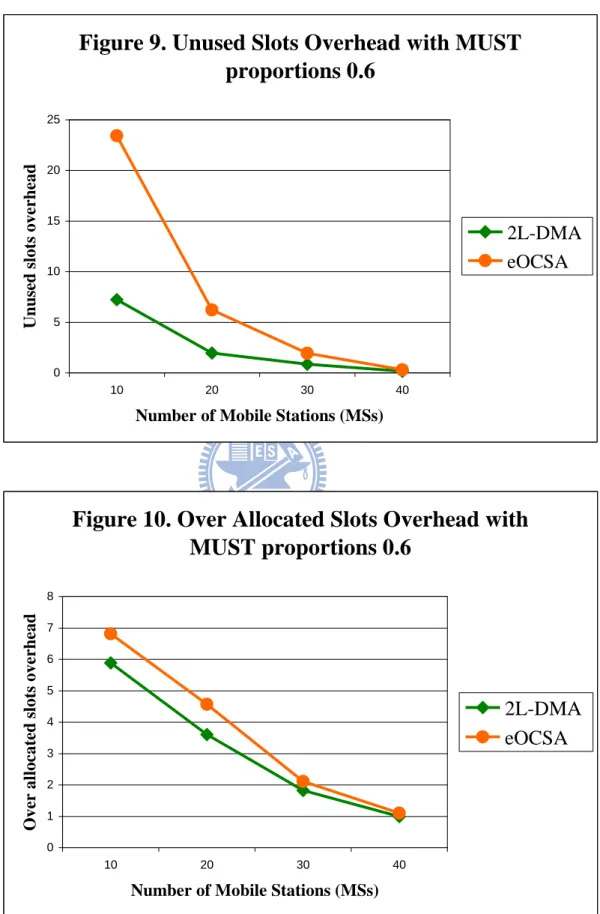
Figure 9: Unused Slots Overhead with MUST proportions 0.6………..31
Figure 10: Over Allocated Slots Overhead with MUST proportions 0.6………31
Figure 11: System Efficiency with MUST proportions 0.6……….32
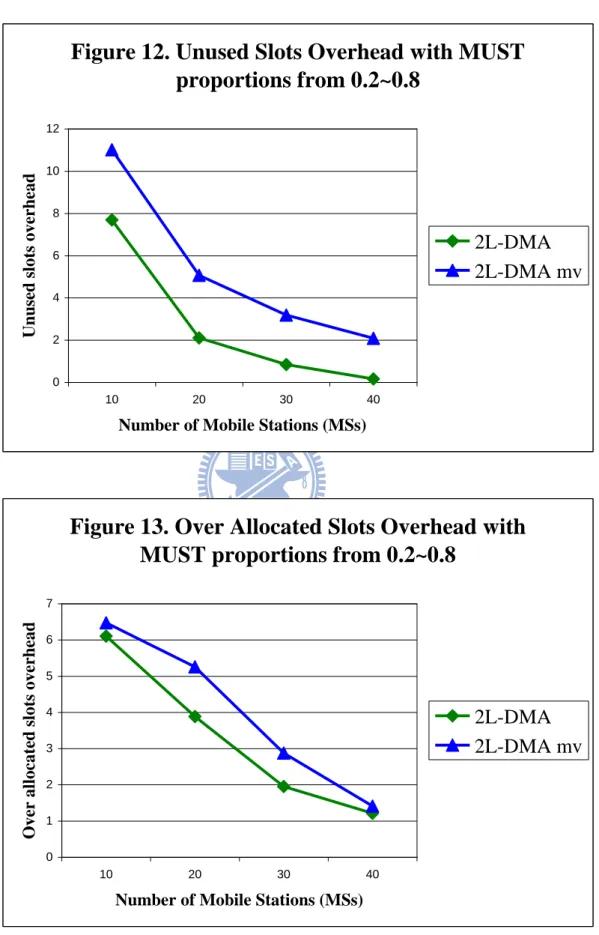
Figure 12: Unused Slots Overhead with MUST proportions from 0.2~0.8……33
Figure 13: Over Allocated S. Overhead with MUST proportions from 0.2~0.8.33
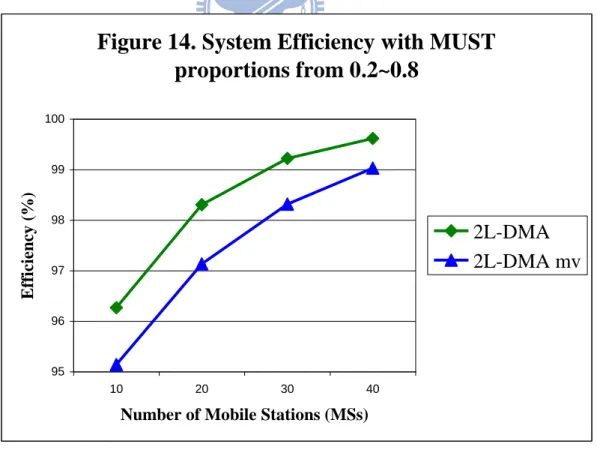
Figure 14: System Efficiency with MUST proportions from 0.2~0.8………….34
ix
Acronyms
2L-DMA
2 Level-Data Mapping Algorithm
2L-DMA mv
2 Level-Data Mapping Algorithm modified version
AMC
Adaptive Modulation and Coding
BWA
Broadband Wireless Access
BS
Base Station
BE
Best Effort
CDMA
Code Division Multiplexing
CAC
Call Admission Control
CID
Connection Identifier
DL-MAP
Downlink MAP
eOCSA
enhanced One Column Striping with non-increasing Area
first mapping
ertPS
extended real-time Polling Service
FDMA
Frequency Division Multiplexing
FUSC
Full Usage of Sub Channel
FDD
Frequency Division Duplexing
FCH
Frame Control Header
FER
Forward Error Control
IEEE
Institute of Electrical and Electronics Engineers
IE
Information Element
MAC
Medium Access Control
MS
Mobile Station
MSs
Mobile Stations
MCS
Modulation and Coding Scheme
x
OFDMA
Orthogonal Frequency Division Multiple Access
OCSA
One Column Striping with non-increasing Area first mapping
PUSC
Partial Usage of Sub Channel
QoS
Quality of Service
rtPS
real-time Polling Service
TDMA
Time Division Multiplexing
TDD
Time Division Duplexing
UGS
Unsolicited Grant Service
UL-MAP Uplink MAP
1
Chapter 1
Introduction
1.1
WiMAX System: An Overview
IEEE 802.16e, known as WiMAX (Worldwide Interoperability for Microwave
Access) [1], provide fixed and mobile Internet access and has been deployed in some
areas as a broadband wireless access (BWA) technology. According to the WiMAX
Forum, a non-profit association formed to ensure the compatibility and interoperability
of IEEE 802.16 devices; OFDMA is specified as the air interface because of its
capability to reduce multi-path fading and achieve multi-user diversity, when
compared with other alternative technologies such as Frequency Division Multiplexing
Access (FDMA), Time Division Multiplexing Access (TDMA), and Code Division
Multiplexing Access (CDMA).
In this thesis, we consider downlink transmission in a WiMAX system. The
mobile WiMAX system consists of a base station (BS) and several mobile stations
(MSs). The BS is responsible for performing most of the system decisions. To support
quality of services (QoS), those decisions include Call Admission Control (CAC),
Scheduling and Resources Allocation [2]. The CAC module, determines if a new
connection is to be accepted or rejected based on the available system capacity. For
accepted connections, the network traffic must be properly prioritized according to a
certain scheduling policy. The scheduler decides the services order of the user’s data
2
generated by the scheduler to be serviced. The IEEE 802.16e standard has defined five
scheduling services classes with different QoS requirements, including bandwidth,
packet loss, delay and delay jitter: Unsolicited Grant Service (UGS), real-time Polling
Service (rtPS), extended real-time Polling Service (ertPS), non-real-time Polling
Service (nrtPS), and Best Effort (BE) [3] [4].
After the scheduler has generated the requests, the next step is to perform
resources allocation (or requests allocation), also known as data mapping. In a
WiMAX system, the minimum data transmission unit is a slot, which is constituted of
one or more sub-channels by one or more OFDMA symbols. A constraint for
downlink transmission is that every request must be logically mapped into a
two-dimensional rectangle, called burst. With such a constraint, it is highly likely to have
unused and over allocated slots after the data mapping process. An unused slot defines
a slot which is not allocated to any user or left unused in a certain frame; and a slot is
over allocated if it is assigned to some user but not being utilized for transmitting data.
The efficiency is defined as the ratio of slots used to transmit data to the total number
of slots. It was shown that, to find the optimal solution that achieves maximum
efficiency, the complexity of the data mapping process in NP-complete [5]. As a result,
various heuristic data mapping algorithms were proposed to achieve high efficiency
with acceptable complexity.
According to the standard, it is allowed to assign multiple bursts to a user.
However, the DL-MAP overhead increases for such an allocation because each burst
has its own Information Element (IE). It is also possible to combine multiple requests
3
identical. A user can use Connection Identifier (CID) to retrieve its data if its request is
combined with other user’s requests in the same burst. Note that a request which is not mapped and transmitted in the current downlink sub-frame is returned to the scheduler
for its transmission in a later frame.
1.2
OFDMA Resources Allocation
In the OFDMA mode, the available spectrum bandwidth in a frame is divided
into several orthogonal subcarriers and these subcarriers are grouped into logical
sub-channels. The association between physical subcarriers and logical sub-channels is
called permutation mode. According to the standard the permutation modes is defined
into two sets: distributed permutation modes (PUSC, FUSC) and adjacent permutation
modes (like band-AMC).
In distributed permutation mode logical sub-channels are built from physically
distributed subcarriers along the available frequency spectrum; and in adjacent
permutation mode sub-channels are built from physically adjacent subcarriers.
Consequently, a certain resource allocation mechanism designed for distributed
permutation mode will not perform well for an adjacent permutation mode, or vice
versa. The distributed permutation mode are the one that have attracted more attention
so far in the literature, while some research paper [6] [7] indicate that adjacent
permutation mode can be an interesting alternative, though more challenging.
As mentioned before, the minimum transmission unit in WiMAX system is a
slot, which consists of one or more sub-channels by one or more OFDMA symbols.
4
only consider PUSC. PUSC is the type of carrier distribution in which the
channels are available in the downlink and uplink frame. In the downlink
sub-frame one slot is consisting of two OFDMA symbols by one sub-channel; and in the
uplink sub-frame one slot is three OFDMA symbols by one sub-channel.
Transmission in OFDMA is done in a time frame basis. Each frame is of 5 ms
duration [8]. In order to achieve bi-directional communication, WiMAX system can
employ frequency division duplexing (FDD) in which downlink and uplink use
different frequency bands; and time division duplexing (TDD) in which the downlink
traffic follows the uplink traffic in the time domain.
In this thesis, we make use of TDD technology, where the same frequency can
be use for downlink and uplink transmission. In other words, the TDD provides a
flexible partitioning of the frame for data traffic. Dividing the frame into downlink and
uplink sub-frames. Although we use the TDD system, the FDD technology can also be
used.
The Mobile WiMAX downlink sub-frame starts with a downlink “preamble”,
which is used for synchronization; a Frame Control Header (FCH), which describes
the length of the DL-MAP message; followed by the DL MAP and UL MAP, these
maps contain variable number of Information Element (IEs), which specifies each
burst. As shown in fig. 1. The IE contains information of the burst start time and end
time, a modulation type and a forward error control (FEC) if used. One IE occupies a
slot and once occupied by an IE, such slot can’t be used to transmit traffic data. The
5
The IEEE 802.16 standard defines the mapping algorithm for the uplink traffic,
which is the traffic from MSs to BS. But the downlink traffic mapping policy is not
specified, allowing differentiation among designer. In order to design an efficient
downlink mapping algorithm, some restriction are imposed:
All data been sent in a burst must be transmitted using the same Modulation and Coding Scheme (MCS). A burst is an allocation for transmitting data aimed to
one or more MSs. The MCS used by a burst is declared in its corresponding IE
6
The shape of a burst region is mandatory rectangular. This shape is specified in the burst IE as: starting symbol and sub-channel number, and width and height
of the burst in symbols and sub-channel. Thus, a burst can’t overlap each other.
The dimensions of any allocated burst must be multiple of the minimal allocation unit, called a slot. The size of a slot depends on the permutation mode
used.
Also, in order to design an efficient downlink mapping algorithm, some factor
has to be taken into account: which are MAP overhead, unused slots, over allocated
slots, and QoS preservation. When the data mapper inserts a new burst into the frame,
also the respective IE must be added to the DL-MAP. The DL-MAP uses slots which
could be used to transmit data. Meaning that, there is a certain MAP overhead directly
proportional to the number of bursts in a frame. Reducing the number of burst may
leave more slots for sending data. A way of reducing the number of burst is by
grouping data from several MSs which use the same MCS in a certain frame, so it can
be sent in the same burst.
Due to the specific mapping policy, it is possible that some slots of the frame
didn’t get finally assigned to any burst. These unused slots are considered as a waste of bandwidth, so the mapper should minimize its number. Also due to both the
rectangular shaping and the slot restrictions, some space may be internally wasted in a
burst; called as over allocated slots. For example, assume that the BS has to transmit
seven slots of data to an MS using PUSC mode, the slot size is two symbols per one
7
1 slot will be wasted. These over allocated slots can severely impair the resource
utilization and should also be minimized.
1.3
Motivation and Objective
In IEEE 802.16e the BS is responsible for mapping or allocating the requests
into the MAC frame, for both downlink and uplink sub-frame. The MAC frame is
extended over two dimensions: time in units of OFDMA symbol and frequency in
units of logical sub-channel. The IEEE 802.16e Mobile WiMAX standard requires that
all requests must be rectangular in shape when mapped into the downlink sub-frame.
In WiMAX system this mapping process is a mapping problem; also called a bin
packing problem; and it is known to be NP-complete [5], since the constraint require
that all user’s request has to be mapped as a rectangle into the downlink sub-frame.
When fulfilling this constraint and after the mapping process is done, the MAC frame
will result with over allocated slots and unused slots; which lower the system
throughput. For this reason, the rectangular criterion requires an efficient
two-dimensional mapping algorithm.
Furthermore, also due to this constraint, there are often requests that can’t be
mapped into the current frame, and will have to be returned to the scheduler for a later
transmission in the next frame. An issue is that those unmapped request can contain
urgent data that will need to be mapped into the current frame and can’t wait for a later
transmission in the next frame. To the best of our knowledge, there are no algorithm
that consider requests with urgent and non-urgent data (two kind of data); the majority
8
This motivated us to propose an algorithm that handles multi-level requests. In
this thesis, we propose a data mapping algorithm for two-level requests, which we
called 2L-DMA algorithm; and it consist of two main targets: (1) apply a Two-Level
request: MUST part for high priority data, and WISH part for low priority data. In
other words, all requests can consist of two parts: MUST part, for urgent data and
WISH part, for non-urgent data. The main objective of implementing Two-Level
request is that we can use it as a priority mechanism. (2) return as less possible MUST
part to the scheduler, while keeping the mapping scheme efficient. Our algorithm
focuses on minimizing the unused slots in order to maximize the efficiency, while
accomplishing (2).
Our main targets have been implemented on an existing algorithm called
eOCSA, a high-performance packing algorithm recently presented. Which is an
enhanced version of the algorithm called OCSA or One Column Striping with
non-increasing Area first mapping [11]. Similar to OCSA, the enhanced algorithm is also
simple and fast o implement; however, eOCSA considers the allocation of an
additional resource to ensure the QoS. Without this additional column’s consideration;
eOCSA can also roll the additional columns needed for the current frame to the next
frame before beginning the next frame mapping. However, this may cause an extra
delay. Moreover, without the extra columns a priority mechanism needs to be applied.
For example, the resource allocation with the highest priority is moved to the
beginning of the mapping queue thus being mapped regardless of the largest size
9
main targets are implemented on eOCSA algorithm; however, in our proposed
2L-DMA algorithm we do not take into consideration the additional columns.
Our proposed 2L-DMA algorithm is divided into two phases: First Phase and
Second Phase. The first phase consists of mapping all requests according to eOCSA
algorithm (eOCSA mapping). Therefore, taking into account that all requests can
consist of two parts (two-level): MUST part and WISH part; and when mapping into a
rectangle, all MUST part is allocated before the WISH part. The first phase is
completed when there are no spaces left in the downlink sub-frame or there are no
requests that can be fitted into the available spaces; we will call these requests
“unmapped requests”.
Note that these unmapped requests can contain MUST part and WISH part. In
the second phase of our algorithm will give higher priority to unmapped MUST part
over unmapped WISH part. The second phase consists of mapping all the MUST part
as possible for those unmapped requests (Unmapped MUST part mapping).
Consequently, to achieve this, some mapped WISH part in “eOCSA mapping”
will have to be sacrificed (partially removed) in order to map as possible unmapped
MUST part. The second phase is completed when there are not enough available
spaces and no mapped WISH part that can be removed in order to map unmapped
MUST part or there are no more unmapped MUST part that need to be map.
We proposed the data mapping algorithm for two-level requests to evaluate the
system efficiency of a WiMAX system. The simulation result show that our proposed
10
proposed in [12]. Furthermore, we also use an example of our 2L-DMA algorithm to
demonstrate how it works. Above all, our 2L-DMA algorithm is proposed to improve
in the data mapping process.
1.4
Organization of the Thesis
The rest of this thesis is organized as follow. In chapter 2, the system
description of eOCSA algorithm is introduced and described in detail, since our
proposed 2L-DMA algorithm is implemented on eOCSA “a low-complexity algorithm
with satisfactory performance”. In chapter 3, our Data Mapping Algorithm for Two-Level Requests in WiMAX systems, called 2L-DMA Algorithm is briefly introduced
and described. In chapter 4, the information of the performance comparisons of our
2L-DMA algorithm when compared with that of eOCSA is provided. Finally, the
11
Chapter 2
Related Work
As mentioned earlier, in this thesis we propose a data mapping algorithm for
two-level requests. Our proposed algorithm main targets are implemented on an
existing heuristic algorithm called eOCSA. Since our 2L-DMA algorithm is
implemented on eOCSA “a low-complexity algorithm with satisfactory performance”.
In this chapter we will briefly introduce and describe in detail the eOCSA
algorithm system description. eOCSA is the enhanced version of One Column Striping
with non-increasing Area first mapping, for two-dimensional downlink burst mapping
in IEEE 802.16e Mobile WiMAX networks.
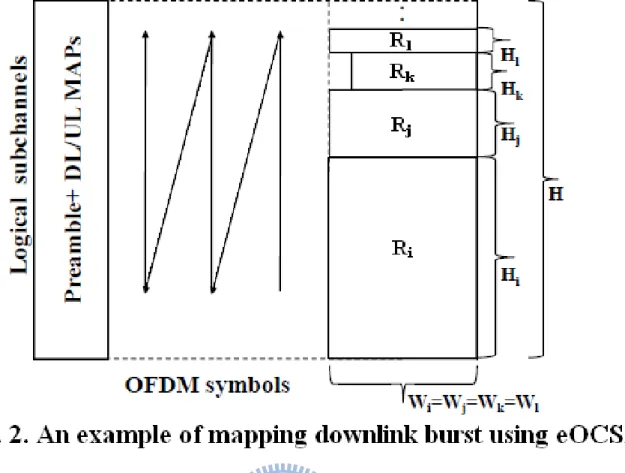
In order to maximize the efficiency, eOCSA consider the mapping in the
descending order of the resources allocation size (largest first). Then, the allocations
are mapped from bottom to top and from right to left into the downlink sub-frame; this
allow the space for the variable portions of the DL-MAP and UP-MAP to be adjusted
accordingly in the left part of the downlink sub-frame.
eOCSA algorithm does not consider all possible mapping pairs, it consider only
one best mapping pair either the least width (vertical mapping) or height (horizontal
mapping). The eOCSA algorithm consists of four steps, which we will briefly describe
12
2.1
eOCSA System Description
First step, when given a set of requests (resources allocation)
Ri, i1, 2, 3...N
, sort the set of resources allocation in the descending order and select the largest element to map first. Second step “vertical mapping”, consists ofmapping this resource allocation into the downlink sub-frame. Given an Ri , the
algorithm maps the width-height pair
W Hi, i
for the burst:/ i i W R H
(1) / i i i H R W
(2) Where, denotes the ceiling function, and H is the maximum available
height in the downlink sub-frame. With 10 MHz Mobile WiMAX, H is 30
sub-channels. Note that this ensures that the mapped region is bigger than the required
resource allocation
W Hi× i Ri
and that the rectangle has the maximum possible width (minimizing MS active time and energy).After a resource allocation is mapped into the downlink sub-frame, some space
may remain unallocated above the just mapped burst. In the third step “horizontal
mapping”, the algorithm tries to assign this space (which they call strip) to the next
largest element that can be fitted in; for example, th
j allocation. In this step the region
width is fixed, and it is used to determine the required height for the next largest
13
Find largestRj, such thatRj W Hi× 0,
/ j j i H R W
(3) / j j j W R H
(4) Here, H0 HHi is the maximum available height in the strip. This step is repeated until either no space is left vertically, or there is no allocation that can be
fitted in the available space.
If no allocation can be found to fit, the algorithm moves leftward to fill the
remaining empty column in the downlink sub-frame by moving back to step 2, and
selecting the next largest element to map.
Fig. 2 shows the process of moving vertically and horizontally from right to left
14
consider this possibility of having extra resources to assure the QoS. From there
simulations, they conclude that in order for the system to support all resources
allocation, on average only one more slot column is needed. However, in our
algorithm first phase we don’t adopt the eOCSA fourth step (adding an additional
column); we only consider step 1, step 2 and step 3.
2.2
An eOCSA Example
In this section, we provide an example that helps explain eOCSA algorithm. In
this example the scheduler makes an allocation decision for 10 mobile stations (MSs)
in a Mobile WiMAX sub-frame.
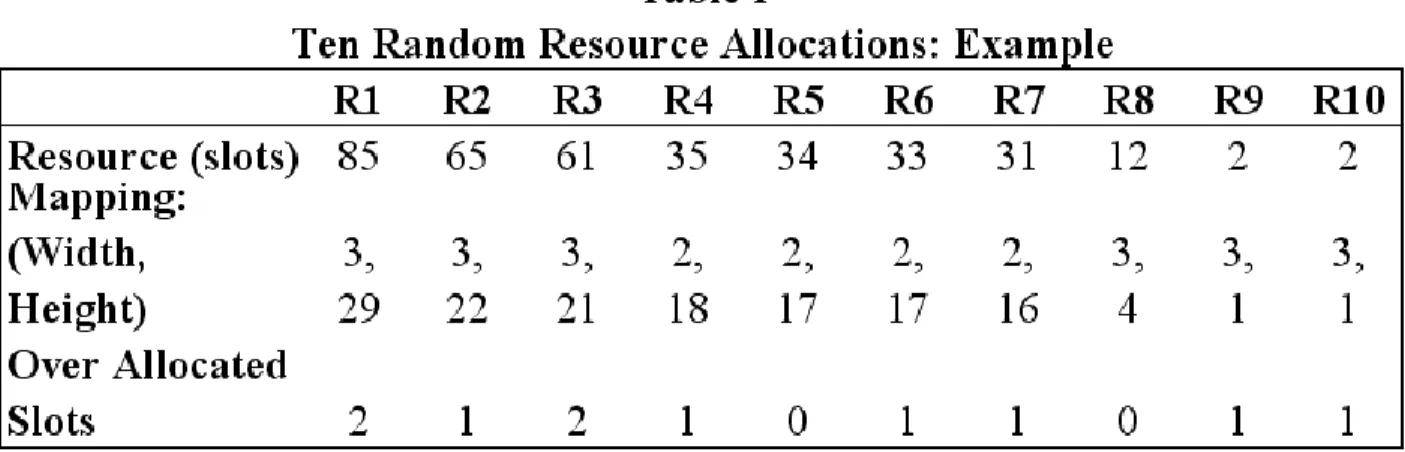
Table I show the 10 MSs that were chosen and have been allocated R1
throughR10 by the scheduler. The sum of all resources allocation is 360 or 12×30.
First, the algorithm sorts all resources allocation in the descending order of the
request size and select the largest resource to map first (step 1). Note that in table I, we
have already sorted the resources in the descending order. The largest resource
15
Applying step 2, we get a width of 85 / 30 3 columns and a height of
85 / 3 29rows. The rectangle 3×29 results in an over allocated of 2 slots. The
downlink sub-frame mapping is done from right to left and from bottom to top. The
mapping ofR1 into the sub-frame leaves a strip of 3×1.
In step 3, the algorithm chooses the next largest resource allocation that can fit
into the remaining strip, which is R10 2. And it is mapped as 3 2 / 3 or 3×1,
resulting in 1 over allocated slot. Since there is no left-over space within this strip, we
repeat step 2 by moving horizontally to the left.
The next largest resource allocation isR2 65, mapped into the downlink sub-frame in a rectangle of width 65 / 30 3and height 65 / 3 22. The rectangular mapping of 3×22 results in an over allocated of 1 slot and a left-over strip of 3×8 on
the top. We then move to step 3 to fill the 3×8 strip.
The next largest resource that can fit into this space isR8 12 ; which is mapped to a rectangle of 3 12 / 3 or 3×4 resulting in no over allocation and a left-over space of a 3×4 strip. We then repeat step 3 to find the next largest rectangle that can fit into
this remaining strip.
At this time, R9 2being mapped to a rectangle of 3 2 / 3 or 3×1; resulting in 1 over allocated slot and a left-over space of 3×3 on the top. Since there is no more
resource that can be fitted into the remaining space, the algorithm repeat step 2 by
16
The next largest resource allocationR3 61 is mapped to a rectangle of 3×21,
with 2 over allocated slots and a 3×9 left-over space. We then move again to step 3, to
look for the largest resource that can fit into the remaining space, but this time there
are no resource that can fit into the remaining space, so me move back to step 2, and
select the next largest resource to mapR4 35; mapped to a rectangle of 2×18, results
in 1 over allocated slot and a 2×12 left-over space.
Unfortunately, there are no resources that can fit into this left-over space.
Furthermore, the algorithm has not yet reaches the maximum frame width; there is still
a 1×30 available space.
But at this time, there are no resources that can fit into this available
space.R5 34,R6 33 andR7 31 are the only three unmapped resources, and finally
the algorithm terminates.
In this particular example, the total of over allocated slots is 2+1+1+1+2+1= 8,
and the total of unused slots is 3×3 + 3×9 + 2×12 + 1×30 = 90; the efficiency of the
algorithm (percentage of space used) is 72.78%, with over allocated slots and unused
slot being counted as waste space. The final results of this example are shown in Table
17
The downlink burst mapping results of this example are shown in Fig. 3. Where
the dark shaded (black) represent the over allocated slots and the light shaded (gray)
represent the unused slots; areas in white are all the mapped resources. This example is
18
Chapter 3
Our Proposed 2L-DMA Algorithm
In this chapter, we describe our proposed data mapping algorithm for two-level
requests which we called 2L-DMA algorithm. The proposed 2L-DMA algorithm uses
a modified version of eOCSA algorithm. In order to maximize bandwidth utilization,
eOCSA sorts the requests (or resources allocation) in the descending order (largest
first) and starts by mapping the largest one. The requests are mapped from bottom to
top and from right to left to allow the space for the variable portions of the DL-MAP.
Our proposed 2L-DMA algorithm is divided into two phases. The first phase,
called “eOCSA mapping” consists of mapping all requests according to a modified
eOCSA algorithm, which takes into account that all request can consist of two parts
(or two levels): MUST part and WISH part. The MUST part is urgent data which will
be dropped if it is not mapped and the WISH part represents non-urgent data that can
be transmitted in later frames.
Usually there are some remaining requests that were not mapped in the first
phase. We call these requests “unmapped requests”. Since these unmapped requests
can contain MUST part and WISH part, the second phase consists of mapping as
much MUST part as possible for those unmapped requests. Therefore, we call the
second phase “Unmapped MUST part mapping”.
There are 5 steps in the “Unmapped MUST part mapping” phase. Some mapped WISH parts in “eOCSA mapping” will have to be sacrificed (partially
19
removed) in order to map as much unmapped MUST parts as possible in the second
phase.
To evaluate our proposed 2L-DMA algorithm, in this thesis, we consider
various MUST proportions for the requests. We assume that either all requests have
the same MUST proportions or different requests have different MUST proportions
randomly selected from a range. Our proposed 2L-DMA algorithm is described in
more detail as follow:
We assume in this section that the data mapper receivers a set of requests
Ri, i1, 2,...,N
from the scheduler such that1 N i i R C
, the capacity of a downlink sub-frame. Let m w i i i R R R ; where m i R and w iR are respectively, the sizes of the MUST
part and the WISH part of the th
i request.
3.1
2L-DMA System Description
First Phase (eOCSA mapping)In the first phase, we basically perform the eOCSA algorithm, but with
two-level requests. However, for two-two-level requests, we require that when mapping the
requests into rectangles, the MUST part is allocated first, followed by the WISH part,
(see Fig. 4). In this figure the blue color represent the MUST part and the white color
represent the WISH part. Note that the blue color is allocated first then followed by the
white color if any. In case there are no MUST part we just allocate the WISH part and
vice versa. The black color in this figure represent the over allocated slots and the gray
20
As mentioned before, there are usually unmapped requests after the first phase
is completed. It is likely for these unmapped requests to contain MUST parts and Wish
parts. So, in the second phase we try to map as much MUST parts as possible of them
21
After the first phase is completed “eOCSA mapping”, we know exactly which
requests is covering the bin base (frame width), these is known as vertical mapping in
the original eOCSA algorithm.
We also know which others requests are mapped on the top of each vertical
mapping; these are known as horizontal mapping in the original eOCSA algorithm.
Based on the width of each vertical mapping (or request) that cover the bin base
and the complete height of the frame, we defined Vertical Blocks ( Vi). The total
possible amount of Vi are 12, since the downlink sub-frame is 12×30.
In other words, for each vertical block we consider the width of each request
that is mapped on the bin base after the first phase and the total height of the frame (30
sub-channels); in case they are empty columns, we defineVi base on the width of the
empty column and the frame total height.
Second Phase (Unmapped MUST part mapping)
Before we actually start describing the steps of our proposed 2L-DMA
algorithm second phase, we will illustrate a figure of resources allocation by eOCSA
algorithm which contain some notations that is needed for our second phase.
The Fig. 5, show the results of our proposed algorithm first phase and some
notations that are required for our second phase. These notations are explain and
23
Notations & Description
i
R : The size of the i request. th
m i
R : The MUST part of the i request. th
w i
R : The WISH part of the i request. th
i
V : The i vertical block after “eOCSA mapping”. th
u i
V : The i vertical block unused slots after “eOCSA mapping”. th
w i
V : The i vertical block width. th
' w i
R : The WISH part above all MUST part after “eOCSA mapping”.
i
OS : Over allocated slots of each mapped requests.
a i
O : Over allocated slots that can be used; only if '
( )
w w i i i
R V OS
MW : Over allocated slots of eachR . im MW
Rim/Viw
Viw
RimOur proposed 2L-DMA algorithm second phase consist of the following 5
steps:
Step 1: For unmapped requestsRiwithRim 0; sort them in the descending order
and select the largest m i
R to map first.
Step 2: Get
u, a, w'
i i i
V O R for eachVi; and then sort the set of Vi by the
1 n u a i i i V O
in the descending order.
Oia, i1, 2,...,n
Step 3: In this step the Vi width is fixed or known, and it is used to determinate the
required height for the m i
24
Since , denotes the ceiling function, this ensures that the mapped region is
bigger or equal to the required resource allocation w× m i k i
V H R .
Select the Vi ; having the largest
1 n u a i i i V O
; which satisfies ' ( ) > i u w a m i k k i k V V R O R
.If Viw×Hk Rim then fill MW partially with slots from w i
R if any.
Step 4: Map m i
R intoVi, first filling
u i
V ; second filling a i
O in the descending order,
and then fill with w'
i
R if needed.
In case there are still u i
V in the Vi after mapping m i
R into theVi; then fill u i
V with
w i
R if any; and when finish recalculate a, , ' k
u w
i k i
O V R for kV .
Step 5: Update the Vi by accommodating m i
R according to w×
i k
V H .
Repeat step 3, step 4 and step 5 until all m i
R are mapped or there are no available
spaces inVi.
Additionally, we present a modified version of our proposed 2L-DMA
algorithm, called 2L-DMA mv. The objective of this idea is to basically obtain it
results and analyzes it performance when compared to our proposed 2L-DMA
algorithm. 2L-DMA mv is similar to 2L-DMA algorithm, the only difference is given
in the first step of the “eOCSA mapping”; the remaining of the steps are the same, no
25
In our 2L-DMA “eOCSA mapping”, the first step consist of sorting all the
requests (or resources allocation) in the descending order of the request size and
selecting the largest request to map first.
Therefore, taking into account that all request can consist of two parts (or two
levels): MUST part and WISH part. We require that when mapping the requests into
rectangles, the MUST part is allocated first, followed by the WISH part.
Furthermore, in 2L-DMA mv “eOCSA mapping”, the first step consist of
sorting all the requests in the descending order of the MUST part size and selecting the
request with the largest MUST part to map first. We also require that when mapping
the requests into rectangles, the MUST part is allocated first, followed by the WISH
part.
In order to evaluate the performance of the modified version of our proposed
2L-DMA algorithm “2L-DMA mv”, we assume that all requests have random MUST
proportions from in a range.
If we set all the requests to have the same MUST proportions then it will be
performing same as our 2L-DMA algorithm, for this reason we set all requests have
random MUST proportions from in a range. The performance of this algorithm will be
26
Chapter 4
Performance Comparisons
In this thesis, we present the simulation results to show the performance
comparisons of our proposed 2L-DMA algorithm with that of eOCSA algorithm.
Furthermore, we will also present the performance comparisons of our proposed
2L-DMA algorithm with a modified version of our proposed 2L-2L-DMA algorithm,
(2L-DMA mv). In our simulations, we assume that either all requests have the same MUST
proportions or all requests have random MUST proportions from in a range. We also
assume that the request for each MS is randomly generated; with the constraint that the
sum of all requests is 12×30 slots. We consider one burst for each MS.
As mention before, for those unmapped requests after our 2L-DMA algorithm
first phase, which can contain MUST part and WISH part; in our 2L-DMA algorithm
second phase we consider that there burst can consist of only the MUST part or the
MUST part with some WISH slots only; the burst does not consist of the complete
request size, due to the objective of the second phase, which is to map as much
possible MUST part, for this reason we do not consider the burst having the total
amount of the request size.
The number of MSs is randomly chosen from 1 to 40. The over allocated slots,
unused slots and efficiency are average over 1000 trials. For our simulation, the
physical bandwidth is 10 MHz and the frame duration is 5 ms. The duplexing
27
used mode. Also as mentioned before, the selected algorithm to compare our 2L-DMA
algorithm with is that of eOCSA. We couldn’t compare 2L-DMA with other published algorithms for various reasons.
Our proposed 2L-DMA algorithm first phase consist of a modified eOCSA
algorithm, which make eOCSA the main comparison algorithm. After the first phase,
when mapping the remaining unmapped MUST part we consider vertical blocks; with
others algorithm we can’t obtain what we denotes vertical blocks.
To compare our proposed 2L-DMA algorithm with that of eOCSA algorithm,
we assume that all requests have the same MUST proportions. We start by evaluating
the impact of the unused slots overhead, which is define as the fraction of the
downlink sub-frame taken by the slots that are left unused in a certain frame.
Figure 6. Unused Slots Overhead for 10 Mobile
Stations (MSs)
5 8 11 14 17 20 23 0.2 0.3 0.4 0.5 0.6 0.7 0.8 MUST proportions U n u se d s lots ove rh ead 2L-DMA eOCSA28
Figure 6, illustrate that under the low traffic load (10 MSs) the eOCSA
algorithm generate much more unused slots than our 2L-DMA algorithm. Our
algorithm reduces the unused slots, since it start mapping the unmapped MUST part
into the vertical block by filling the unused slots. However, after mapping into the
vertical block, this can still contain unused slots, so our algorithms fill this space with
unmapped WISH part partially in order to minimize the unused slots generated by
eOCSA. Furthermore, in figure 6 it is shown that when the MUST proportions is 0.7
our proposed algorithm increase the unused slots, due that there are not much
unmapped WISH part to fill into the unused slots; and when the MUST proportions is
0.8 our proposed algorithm increase the unused slots, due that the unmapped MUST
part is too large and sometime can’t be mapped. On average, the unused slots of eOCSA are 23.931 and 7.257 with our 2L-DMA algorithm.
Figure 7. Over Allocated Slots Overhead for 10
Mobile Stations (MSs)
4 5 6 7 8 0.2 0.3 0.4 0.5 0.6 0.7 0.8 MUST proportions O ve r al loc ate d s lots ove rh ead 2L-DMA eOCSA29
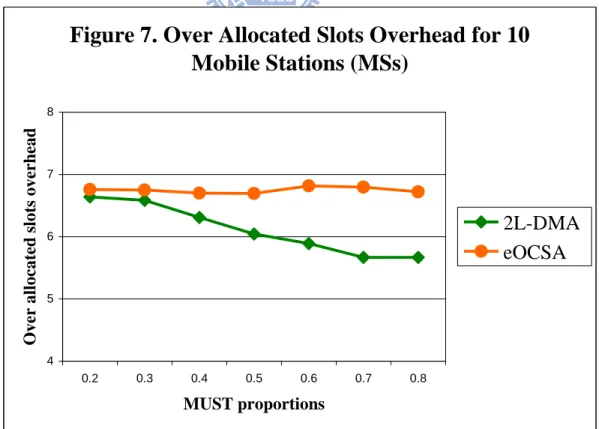
In figure 7, we compare the over allocated slots of eOCSA algorithm with our
proposed algorithm. The over allocated slots overhead is define as the fraction of the
downlink sub-frame taken by the portions of the burst that are not actually being
utilized for sending data. Fig. 7 shows that our proposed 2L-DMA algorithm is
generating less over allocated slots when the MUST proportions are increasing, this is
because after filling the unused slots our algorithm will fill some over allocated slots
while also removing some mapped WISH part in this row so it can also be filled.
Figure 8. System Efficiency for 10 Mobile
Stations (MSs)
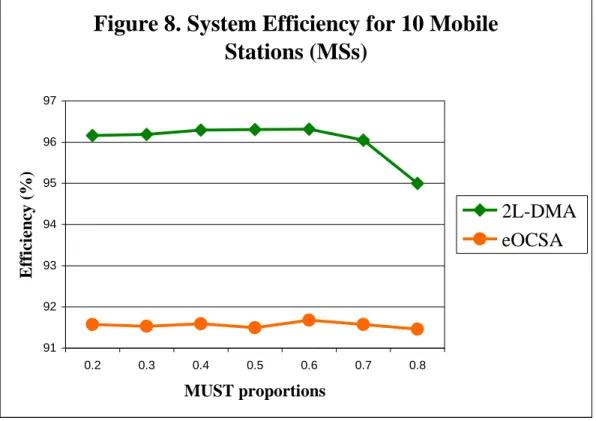
91 92 93 94 95 96 97 0.2 0.3 0.4 0.5 0.6 0.7 0.8 MUST proportions Effi ci en cy (%) 2L-DMA eOCSAIn figure 8, the efficiency of our proposed 2L-DMA algorithm compare to
eOCSA is shown. As shown, eOCSA is not properly performing mainly because of its
problem with the unused slots; and due to the amount of unused slots generated by
eOCSA, it leads to a low performance. Fig. 8 illustrates how our proposed 2L-DMA
30
Our proposed algorithm has the best performance because it actually reduces
the problem with the unused slots generated by eCOSA. However, we can also
observe from the result given in fig. 8 that our proposed algorithm is very steady when
the MUST proportions is from 0.2 to 0.6, and starting from 0.7 the efficiency began to
decrease, due to the size of the MUST proportions. When the MUST proportions is too large, the unmapped MUST part can’t be mapped, since there are not enough space in order to map these.
For example, the sum of the unused slots and the mapped WISH part that can
be partially removed is not enough in order to map the unmapped MUST part. Our
proposed 2L-DMA algorithm perform better when the MUST proportions is 0.6; at
this proportion the efficiency of our proposed algorithm is 96.313% with over
allocated slots and unused slots counted as waste.
So far, we have seen in Fig. 6, 7 and 8 the results of the over allocated slots, the
unused slots and the efficiency under 10 MSs (or 10 requests). Furthermore, since our
proposed algorithm performs better when the MUST proportions is 0.6, we will
illustrate it’s results of the over allocated slots, the unused slots and the efficiency when increasing the amount of MSs.
Fig. 9, 10 and 11; show the results of eOCSA algorithm again compared to our
proposed algorithm when we increase the network traffic and with MUST proportions
0.6; note that as we increase the network traffic our algorithm perform differently.
Under heavy traffic load (40 MSs) our proposed algorithm perform almost similar to
eOCSA, this is because eOCSA is at its best performance, so there are not much
31
Figure 9. Unused Slots Overhead with MUST
proportions 0.6
0 5 10 15 20 25 10 20 30 40Number of Mobile Stations (MSs)
U n u se d s lots ove rh ead 2L-DMA eOCSA
Figure 10. Over Allocated Slots Overhead with
MUST proportions 0.6
0 1 2 3 4 5 6 7 8 10 20 30 40Number of Mobile Stations (MSs)
O ve r al loc ate d s lots ove rh ead 2L-DMA eOCSA
32
Figure 11. System Efficiency with MUST
proportions 0.6
91 92 93 94 95 96 97 98 99 100 10 20 30 40Number of Mobile Stations (MSs)
Effi
ci
en
cy (%) 2L-DMA
eOCSA
Finally, in order the compare our proposed 2L-DMA algorithm with the
modified version of our proposed 2L-DMA algorithm, (2L-DMA mv). We assume that
all requests have random MUST proportions from in a range. As mentioned before, in
the modified version of our proposed 2L-DMA algorithm all requests are mapped
according to the size of the MUST parts in the descending order (largest MUST part
first) in “eOCSA mapping”. Fig. 12 shows the results of the unused slots overhead between the two comparative algorithms when the MUST proportions are from 0.2 to
0.8. The fig. 12 illustrates that the modified version of our proposed 2L-DMA
algorithm is generating more unused slots overhead when compare to our proposed
2L-DMA algorithm, due that 2L-DMA mv map all request according to the size of the
33
Figure 12. Unused Slots Overhead with MUST
proportions from 0.2~0.8
0 2 4 6 8 10 12 10 20 30 40Number of Mobile Stations (MSs)
U n u se d s lots ove rh ead 2L-DMA 2L-DMA mv
Figure 13. Over Allocated Slots Overhead with
MUST proportions from 0.2~0.8
0 1 2 3 4 5 6 7 10 20 30 40
Number of Mobile Stations (MSs)
O ve r al loc ate d s lots ove rh ead 2L-DMA 2L-DMA mv
34
In figure 13, we can observe the over allocated slots overhead generated with
MUST proportions from 0.2 to 0.8. This fig. illustrate that 2L-DMA mv generate more
over allocated slots overhead compare to our 2L-DMA algorithm, due to the fact that
when mapping all the request in the descending order of the MUST part size, the
mapping is more disorderly, resulting in more over allocated slots.
Fig. 14 describes the efficiency of the two comparative algorithms. Note that
our proposed 2L-DMA algorithm performs better when compare to the modified
version of our proposed algorithm, this is because 2L-DMA mv generate much more
over allocated slots and unused slots by mapping the requests in the descending order
of the MUST part size. On average, the efficiency of 2L-DMA mv are 95.142% and
96.267% with our 2L-DMA algorithm for 10 MSs.
Figure 14. System Efficiency with MUST
proportions from 0.2~0.8
95 96 97 98 99 100 10 20 30 40Number of Mobile Stations (MSs)
Effi
ci
en
cy (%) 2L-DMA
35
Chapter 5
Conclusion
In this thesis, the resource allocation problem which is also known as the bin
packing problem in WiMAX system is concerned. First, the resource allocation
problem in WiMAX system is briefly introduced. Then we introduce our proposed
data mapping algorithm for two-level request called 2L-DMA algorithm. The basic
idea of our proposed algorithm is to apply a two-level request; MUST part, for urgent
data and WISH part for non-urgent data; and to return as less possible MUST part to
the scheduler.
In chapter 3, our proposed 2L-DMA is described. Our proposed 2L-DMA
algorithm is divided into two phases. The first phase, called “eOCSA mapping”,
consists of mapping all requests according to a modified eOCSA algorithm which
takes into account that all request can consist of two parts (or two levels): MUST part
and WISH part. The second phase, called “Unmapped MUST part mapping”, consists
of mapping as much unmapped MUST part as possible for those unmapped requests.
The objective is to improve the resources allocation by utilizing our 2L-DMA
algorithm. The simulation results are presented in chapter 4. From the simulation
results we conclude that our proposed 2L-DMA algorithm can improve the
performance compared to that of eOCSA, due to the fact that it minimizes the unused slots generated in “eOCSA mapping” by first filling this waste space with unmapped
36
MUST part and then with unmapped WISH partially. On average, the efficiency of
eOCSA is 91.443% and 96.267% with our 2L-DMA algorithm for 10 MSs.
In addition, we present a modified version of our proposed 2L-DMA algorithm
(2L-DMA mv) which consist of mapping all the requests in the descending order of
the MUST part size (largest MUST part first) and starts by mapping the largest one
regardless the size of the request in the “eOCSA mapping ”.
In conclusion when compared to our 2L-DMA algorithm the simulations results
show that our 2L-DMA algorithm outperform 2L-DMA mv, due to the fact that when
mapping all requests according to the size of the MUST part in the “eOCSA
mapping ” it maximize the unused slots. On average, the efficiency of 2L-DMA mv are 95.142% with different MUST proportions and 96.267% for our 2L-DMA
37
References
[1] IEEE 802.16e-2005, “IEEE Standard for Local and Metropolitan Area
Networks – Part 16: Air interface for Fixed Broadband Wireless Access
systems – Amendment 2: Physical and Medium Access Control layers for
combined fixed and mobile operation in licensed bands and Corrigendum 1,” February 2006.
[2] Juan I. del-Castillo, Francisco M. Delicado, Jesús Delicado and Jose M.
Villalón “OFDMA Resource Allocation in IEEE 802.16 Networks: A Performance Comparative” in Wireless and Mobile Networking Conference (WMNC), 2010 Third Joint IFIP.
[3] Yanqun Le, Yi Wu, Dongmei Zhang “An Improved Scheduling Algorithm for rtPS Services in IEEE 802.16” 2009 IEEE.
[4] C. So-In, R. Jain, and A. Al-Tamimi, “Scheduling in IEEE 802.16e Mobile
WiMAX Networks: Key Issues and a Survey,” in IEEE Journal on Selected Areas in Comm., vol. 27, no. 2, pp. 156-171, Feb. 2009
[5] M-R. Garey and D-S Johnson, “Computers and Intractability: A Guide to the
Theory of NP-Completeness,” W.H. Freeman, 340 pp., Jan. 1979.
[6] I. Gutiérrez; F. Bader; R. Aquilué; J. Pijoan, “Contiguous Frequency-Time
Resource Allocation and Scheduling for Wireless OFDMA Systems with QoS
Support”, EURASIP Journal on Wireless Communications and Networking. Volume 2009, Article ID 134579, pages 12.
38
[7] T. Ali-Yahiya; A. Beylot; G. Pujole; “Downlink Resource Allocation Strategies
for OFDMA based Mobile WiMAX”. Telecommunication System;Vol 44, no.1-2, June 2010. pp. 29-37.
[8] WiMAX Forum, “WiMAX System Evaluation Methodology V2.1,” Jul. 2008, 230 pp. URL=http://www.wimaxforum.org/technology/documents
[9] A. Bacioccola; C. Cicconetti; L. Lenzini; E. Mingozzi, A. Erta, “A Downlink Data Region Allocation Algorithm for IEEE 802.16e OFDMA”, 6th International Conference on Information, Communication and Signal
Processing, pp. 1-5, December 2007.
[10] T. Ohseki, M. Morita, and T.Inoue, “Burst Construction and Packet Mapping
Scheme for OFDMA Downlinks in IEEE 802.16 System,” Proceeding of IEEE Global Communications Conference (IEEE GLOBECOM), 2007.
[11] C. So-In, R. Jain, and A. Al-Tamimi, “OCSA: An algorithm for Burst Mapping
in IEEE 802.16e Mobile WiMAX Networks,” To appear in the 15th Asia-Pacific Conference on Comm. (APCC 2009), Oct. 2009.
[12] Chakchai So-In, Raj Jain and Abdel-Karim Al Tamimi “eOCSA: An Algorithm
for Burst Mapping with Strict QoS Requirements in IEEE 802.16e Mobile
39