IEEE TRANSACTIONS ON SYSTEMS, MAN, AND CYBERNETICS-PART A: SYSTEMS AND HUMANS, VOL. 26, NO. 4, JULY 1996 493
[I31 D. M. Chickering, D. Geiger, and D. Heckerman, “Learning Bayesian networks: Search methods and experimental results,” in Preliminary Papers 5th Int. Workshop on Artificial Intelligence a n d Statistics, 1995, pp. 112-128.
[I41 D. Heckerman, D. Geiger, and D. M. Chickering, “Learning Bayesian networks: The combination of knowledge and statistical data,” in Microsoft, Technical Report MSR-TR-94-09, 1994.
1151 R. R. Bouckaert, “Properties of Bayesian belief networks learning algo- rithms,” in Proc. 10th Annual Con5 Uncertainty in Artificial Intelligence, Washington, 1994, pp. 102-109.
[ 161 P. LarraAaga, R. H. Murga, M. Poza, and C. M. H. Kuijpers, “Structure learning of Bayesian networks by hybrid genetic algorithms,” in Prelim- inary Papers 5th Int. Workshop on Artijicial Intelligence and Statistics,
1995, pp. 310-316.
1171 R. R. Bouckaert “Optimizing causal orderings for generating DAG’S from data,” in Proc. 8th Con$ Uncertainty in Artificial Intelligence, 1992, pp. 9-16.
1181 M. Singh and M. Valtorta, “An algorithm for the construction of Bayesian network structures from data,” in Proc. 9th Con$ Uncertainty in Artificial Intelligence, Washington, DC, 1993, pp. 259-265. [I91 W. Lam and F. Bacchus, “Learning Bayesian belief networks. An
approach based on the MDL principle,” Computational Intelligence, vol. 10, no. 4, 1994.
[20] ~, “Using causal information and local measures to learn Bayesian networks,” in Proc. 9th Con$ Uncertainty in Artificial Intelligence, Washington, DC, 1993, pp. 243-250.
[21] P. Larrafiaga, M. Poza, Y. Yurramendi, R. H. Murga, and C. M. H. Kuijpers, “Structure learning of Bayesian networks by genetic algorithms: A performance analysis of control parameters,” IEEE Trans. Pattern Anal. Much. Intell., in press.
[22] G. M. Provan and M. Singh, “Learning Bayesian networks using feature selection,” in Preliminary Papers 5th Int. Workshop on Artificial Intelligence and Statistics, FL, 1995, pp. 450-456.
[23] L. R. Andersen, J. H. Krebs, and J. D. Andersen, “STENO: An expert system for medical diagnosis based on graphical models and model search,” J . Appl. Stat., vol. 18, no. 1, pp. 139-153, 1991.
1241 S. Kreiner, “On tests of conditional independence,” Statistical Research Unit, University of Copenhagen, Res. Rep. 89/14, 1989.
[25] R. M. Fung and S. L. Crawford, “Constructor: A system for the induction of probabilistic models,” in Proc. M I , Boston, MA, 1990, [26] S. L. Lauritzen, B. Thiesson, and D. J . Spiegelhalter, “Diagnostic sys- tems created by model selection methods-A case study,” in Preliminary Pupers 4th Int. Workshop on Arti$cial Intelligence and Slatistics, 1993, pp. 93-105.
[27] H. Akaike, “New look at the statistical model identification,” IEEE
Trans. Automat. Contr, vol. 19, pp. 716-722, 1974.
1281 D. Madigan, A. E. Raffery, J. C. York, J. M. Bradshaw, and R. G. Almond, “Strategies for graphical model selection,” in Preliminary Papers 4th Int. Workshop on Arti$cial Intelligence and Sluiistics, 1993, pp. 331-336.
[29] R. Mechling and M. Valtorta, “PaCCIN: A parallel constructor of Markov networks,” in Preliminary Papers 4th lnt. Workshop on Artijicial Intelligence and Statistics, 1993, pp. 405410.
1301 G. M. Provan, “Model selection for diagnosis and treatment using temporal influence diagrams,” in Preliminary Paper.7 5th Int. Workshop on ArtiJicid Intelligence and Statistics, 1995, pp. 469-480.
[31] J. H. Holland, Adaptation in Natural and ArtiJicial Systems. Ann Arbor, MI: The Univ. of Michigan Press, 1975.
[32] U. K. Chakraborty and D. G. Dastidar, “Using reliability analysis to es- timate the number of generations to convergence in genetic algorithms,” lrform. Proc. Lett., vol. 46, no. 4, pp. 199-209, 1993.
[33] A. E. Eiben, E. H. L. Aarts, and K. M. van Hee, “Global convergence of genetic algorithms: An infinite Markov chain analysis,” Computing Science Notes, Eindhoven Univ. of Tech., 1990.
[34] G. Rudolph, “Convergence analysis of canonical genetic algoritms,” pp. 762-769.
rithms for the travelling salesman problem: A review of representations and operators,” submitted to Art$; Intell. Rev.
1381 D. E. Goldberg and J. R. Lingle, “Alleles, loci and the traveling salesman problem,” in Proc. Int. Con$ Genetic Algorithms and Their Applications, Pittsburgh, PA, 1985, pp. 154-159.
[39] I. M. Oliver, D. J. Smith, and J. R. C. Holland, “A study of permutation crossover operators on the TSP,” in Proc. 2 n d Int. Conj on Genetic Algorithms and Their Applications, Cambridge, MA, 1987, pp. 224-230. [40] L. Davis, “Applying adaptive algorithms to epistatic domains,” in Proc.
Inc. Joint Con$ on Artijicial Intelligence, Los Angeles, CA, 1985, pp, 162-164.
[41] G. Syswerda, “Schedule optimization using genetic algorithms,” in [36], pp. 332-349.
[42] H. Muhlenbein, “Parallel genetic algorithms, population genetics and combinatorial optimization,” in Proc. 3rd lnt, Con$ o n Genetic Algo- rithms, Arlington, VA, 1989, pp. 416421.
[43] P. LarraAaga, C. M. H. Kuijpers, M. Poza, and R. H. Murga, “Optimal decomposition of Bayesian networks by genetic algorithms,” Dept. of Com. Science and Art. Intel., Univ. of the Basque Country, Int. Rep. EHU-KZAA-IKT-3-94, 1994.
1441 Z. Michalewicz, Genetic Algorithms
+
Data Structures = Evolution Programs. Berlin: Springer-Verlag, 1992.1451 W. Banzhaf, “The “molecular” traveling salesman,” Bid. Cybern., vol. 64, pp. 7-14, 1990.
1461 D. B. Fogel, “A parallel processing approach to a multiple travel- ing salesman problem using evolutionary programming,” in Proc. 4th Annual Parallel Processing Symp., Fullerton, CA, 1990, pp. 3 18-326. 1471 D. Whitley, “The GENITOR algorithm and selection pressure: Why
rank-based allocation of reproductive trials is best,” in Proc. 3rd Int. Con$ on Generic Algorithms, Arlington, VA, 1989, pp. 116-121. [48] K. A. de Jong, “An analysis of the behavior of a class of genetic adaptive
systems,” Ph.D. Dissertation, Univ. of Michigan, 1975.
[491 E. H. Herskovits, “Computer based probabilistic-network construction,” Doctoral Dissertation, Dept. Medical Information Sciences, Stanford University, Stanford, CA, 1991.
A New Method for Evaluating Weapon
Systems Using Fuzzy Set Theory
Shyi-Ming Chen
Abstract-This paper presents a new method for evaluating weapon systems using fuzzy set theory. The proposed method is more flexible than the one presented in 1111 due to the fact that it allows each item of criteria to have a different weight represented by a triangular fuzzy number. Furthermore, because the proposed method does not need to perform complicated entropy weight calculations as described in 1111, its execution is much faster than the one shown in [U].
1.
INTRODUCTION
In
[111, Mon
etal.
have presented a method for evaluatingweapon
systems using fuzzy Analytic Hierarchy Process (AHP) based on
entropy weights [lo], where an example is used to illustrate the method. T h e example is reviewed as follows. Assume that there
are
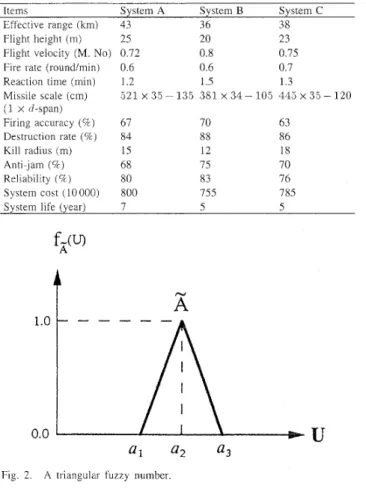
three tactical missile systems A, B, and C to b e evaluated, where the tactical specification data of the three missile systems and the expert’s opinions are listed in Tables I and I1 (data source [12]) for 1351
submitted to IEEE Trans. Neural Networks.
D. E. Goldberg, Genelic Algorithms in Search, Optimization and Ma-
chine Learning. Addison-Wesley, 1989. under Grant NSC 84-2213-E-009- 100. 1361 L. Davis, Ed., Handbook of Genetic Algorithms. New York: Van
Nostrand Reinhold, 1991.
[37] P. LarraAaga, C. M. H. Kuijpers, and R. H. Murga, “Evolutionary algo-
Manuscript received November 5, 1994; revised May 28, 1995. This work was supported in part by the National Science Council, Republic of China, The author is with the Department of Computer and Information Science, Publisher Item Identifier S 1083-4427(96)03847-7.
National Chiao Tung University, Hsinchu 30050, Taiwan, R.O.C.
494 IEEE TRANSACTIONS ON SYSTEMS, MAN A h D CYBERUETICS-PART A SYSTEMS AND HUMANS, VOL 26, NO 4, JULY 1996
Fig. 1. Structure model for evaluating three tactical missile systems. TABLE I
CHARACTERISTICS AND EXPERTS’ OPIUIONS
Item\ System A Syctem B System C
Operation condition Higher General General
requirement Safety Defilade Simplicity Assembility Combat capability Material limitation Mobility Modulation Standardidon Good General General General Good Higher Poor General General General General Good General General General General Poor General General General Higher Good General Good General General Good
the decision making process. The structure model presented in [ 1 I] for evaluating the three tactical missile systems is shown in Fig. I.
In Fig. 1, the tactic criteria includes the following items: 1) Effective range. 2) Flight height. 3) Flight velocity. 4) Reliability.
5)
Firing accuracy. 6) Destruction rate. 7) Kill radius. 1) Missile scale. 2) Reaction time. 3) Fire rate. 4) Anti-jam. 5 ) Combat capability.I ) Operation condition requirement
2)
Safety. 3) Defilade.4)
Simplicity.5 )
Assembility. 1) System cost. 2) System life. 3) Material limitation.The technology criteria includes the following items:
The maintenance item includes the following items:
The economy criteria includes the following items:
The advancement criteria includes the following items:
1) Modulization.
2) Mobility.
3) System standardization.
However, some drawbacks exist in the method presented by Mon
et al. [ I l l .
TABLE I1
T - i c ~ 1 c . i ~ SPECIFICATION DATA OF THE THREE TACTICAL MISSILE SYSTEMS
Items System A System B System C
Flight height (m) 25 20 23
Flight velocity (M. No) 0.72 0.8 0.75
Fire rate (round/min) 0.6 0.6 0.7
Reaction time (min) 1.2 1.5 1.3
Missile scale (cm) (1 x d-span) Firing accuracy (%) 67 70 63 Destruction rate (%) 84 88 86 Kill radius (m) 15 12 18 Anti-jam (%) 68 75 70 Reliability
(a)
80 83 76 System cost (10000) 800 755 785System life (year) 7 5 5
Effective range (km) 43 36 38
,521 x 35 - 135 381 x 34 - 105 445 x 35 - 120
a1 a2 a3
Fig. 2. A triangular fuzzy number TABLE I11
CORRESPONDING MEMBERSHIP FUNCTIONS TRIANGULAR F U Z Z Y NUMBERS AND THEIR Triangular fuzzy Membership
numbers functions
1 (1, 1, 2 )
Their method assumed that each item in each criteria has the same weight. For example, under tactic criteria, the items “reli- ability” and “flight height” have the same weight, respectively. However, in a real-world application, if we can allow each item of criteria to have a different weight, then there is room for more flexibility.
Their method is not efficient enough due to the fact that it must perform complicated entropy weight calculations
In this paper, we present a new method to overcome the drawbacks of the one presented in [ I 11, where we allow the items shown in Tables I and I1 to have different weights represented by triangular fuzzy numbers. The proposed method is more flexible than the one presented in [ 111 due to the fact that it allows each item of criteria to have a different weight. Furthermore, because the proposed method
IEEE TRANSACTIONS ON SYSTEMS, MAN, AND CYBERNETICS-PART A SYSTEMS AND HUMANS, VOL. 26, NO. 4, JULY 1996
~
495
TABLE IV
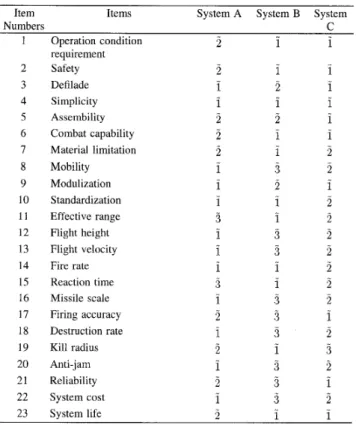
FUZZY SCORES OF THE THREE TACTICAL MISSILE SYSTEMS
Item Items System A System B System
Numbers C I Operation condition 2 1 1 2 Safety 2 1 1 3 Defilade 1 2 1 4 Simplicity
1
1 1 5 Assembility 2 2 1 6 Combat capability 2 1 1 7 Material limitation 2 1 2 8 Mobility 1 3 2 9 Modulization 1 2 1 10 Standardization 1 1 2 11 Effective range3
1 2 12 Flight height 13
2
13 Flight velocity 1 3 2 14 Fire rate 1 1 2 15 Reaction time 3 1 2 16 Missile scale 1 3 2 17 Firing accuracy 2 3 1 18 Destruction rate 1 3 2 19 Kill radius2
1 3 20 Anti-jam 1 3 2 21 Reliabilityi
3 1 22 System cost 1 3 2 23 System life 2 1 1 requirementdoes not need to perform the complicated entropy weight calculations
as described in
[Ill,
its execution is much faster than the one presented in[Ill.
11. BASIC CONCEPTS OF FUZZY S E T THEORY
In the following, we briefly review basic concepts of fuzzy set theory from
[1]-[9], [13],
and[14].
LetU
be the universe of discourse,U
= ( u 1 , u z , . . .,
U,}. A fuzzy setA
ofU
is a set of ordered pairs {(ul,f;l(U1)),(U2,fn(un)),....
( u , , f ; l ( u , ) ) > , where f;l is the membership function ofA ,
f;i:U
--t [0,1], andf;l(u,,) indicates the grade of membership of u L in
A. A
fuzzy seta
is convex if and only if 'd u1, u2 inU
f ; l ( A u l
+
(1
-A ) w )
L
m i n ( f / i ( u l ) , f / i ( w ) )(1)
where XE
[U, 11.A
fuzzy setA
is normal if and only if 3 u , EU.
f j i ( u t ) = 1.A
fuzzy number is a fuzzy subset inU
which is both convex and normal. The a - c u t of the fuzzy numberA
is denoted byA,,
whereA,
= { U t l f ; l ( U z )2
a } (2)and a E [O, 11.
A triangular fuzzy number
A
can be parameterized by a triplet( a l . a2, a3) shown in Fig.-2, where the membership function of the triangular fuzzy number
A
is defined byU
<
a110; - U
>
a3The set of triangular fuzzy numbers we used in this paper and their corresponding membership functions are show in Table 111. From
TABLE V
THE WEIGHTS OF ITEMS AND THE FUZZY SCORES OF TACTICAL MISSILE SYSTEMS WITH RESPECT TO THE ITEMS SHOWN IN TABLE IV
Item Weights System A System B System C
Numbers
1 W I Pl A
Pl
BPI
c2 w 2 F 2 A F2B F2c
23 m 2 3 F 2 3 A F 2 3 B F 2 3 c
TABLE VI
THE WEIGHTS OF THE ITEMS AND THE Fuzzy SCORES OF THE SYSTEMS
Item Weights System A System B Systems C
Numbers 1 5 2 1 1 2 6 2 1 1 3 2 1 2 1 4 3 1 1 1 5
3
2 2 1 69
2
1 1 7 5 2 1 2 8 7 1 3 2 9 5 1 2 1 10 3 1 1 2 11 7 3 1 2 12 1 1 3 2 13 9 1 3 2 149
1
1
2
15 3 1 2 16 4 1 3 2 17 9 2 3 1 18i
1 3 2 19 6 2 1 3 20 8 1 3 2 21 9 2 3 1 22 8 1 3 2 23 8 2 1 1Table 111, we can see that
1
is the smallest fuzzy number and9
is the largest fuzzy number.Let
A
andl?
be two triangular fuzzy numbers, where-4
=(a1,a2,as),8
= ( b i , b , b 3 ) .According to [8] and
[9],
the fuzzy number arithmetic operations can be summarized as follows:,4 CE
B
= ( a 1 , u2, u 3 )65
( b l,
b 2 , b 3 )A 8
B
= (U,, a2, u 3 )e
( b l . b 2 , b 3 )A
@l?
= ( a l , u2, a s ) @ ( b r . b 2 , b 3 )AaB
= ( a l , az, a3)0(h1, b z , b 3 )(4)
- - ( a 1 +bl.az + b ~ , a 3 + b 3 ) = (a1 - b3, a2 - b i ? a 3 - b l ) ( 5 ) =(a1x
b 1 . a ~x
b 2 , a zx
b 3 )(6)
= ( a l / b 3 , a 2 / b ~ , a 3 / h ) . ( 7 )111. A NEW METHODOLOGY TO EVALUATE WEAPON SYSTEMS In the following, we present a new method to deal with weapon system selection problems. Assume that the decision-maker can
496
0 3 3
IEEE TRANSACTIONS ON SYSTEMS, MAN, AND CYBERNETICS-PART A: SYSTEMS AND HUMANS, VOL. 26, NO. 4, JULY 1996
r N i ( 4 0 3 7
t
N&3) 0 3 6I
,
~ e --
- ---- - -
0 34 N:(C' 0 3 5I
0.32 0 3 1 1 11
.a
,i : : e A . : L--+Au A A A +System B 0 3 0 29 o 0 1 n 2 0 3 0 4 O S 0 6 n i o x 0 9 I a Fig. 5. decision-maker).Values of -\-;(A); X ; ( l 3 ) , and AVi(C) for X = 1 (pessimistic
of optimism. Let
and let
The values of
S
:
(-4). N: ( B ) . and N :(C)
indicate the degree of suitability of the selection with respect to the systems A, B, and C for fixed n and A. respectively, where o!t
[0, 11; Xt
[O,11.
Ar2(A)
E
[O.
11.
.\-:(B )
E[O.
11.
and?\-;(C)
E [0, 11. The larger the value, the more the suitability of the selection of the system.IV.
A NUMERICAL
EXAMPLE
Assume that three tactical missile systems A,
B,
and C are to be evaluated, where the tactical specification data of the three missile systems and the expert's opinions are listed in Tables I and 11, respectively. Assume that the decision-maker can assign different weights to the items shown in Tables I and 11, respectively, and assume that the decision-maker can assign fuzzy scores to the systems with respect to the items shown in Tables I andIT,
respectively, where the weights and the fuzzy scores are represented by triangular fuzzy numbers shown in Table 111. Furthermore, assume that the weightsof the items and the fuzzy scores of the systems with respect to the items assigned by the decision-maker are shown in Table VI.
IEEE TRANSACTIONS ON SYSTEMS, MAN, AND CYBERNETICS-PART A: SYSTEMS AND HUMANS, VOL. 26, NO. 4, JULY 1996 491 cti (8.9,9)
8
( 1 , 1 , 2 )(1’
( 8 . 9 , 9 )X
(1,1,2) (8,9,9)x
(2.3.4) G(3,4,5)
8
(1,1,2)tD(8,9,9) Q ( 1 . 2 , 3 ) ‘ 1 ( 6 , 7 , 8 ) ~ ( 1 , 1 , 2 )
~3(5.6,7)
X
(1,2.3) &(7.8.9)
(1.1,2)8
(8,9,9) @(1.2.3)
r? (7.8.9)8
(1,1,2) &(7.8.9)
8
(1,2,3) =(134,234,418).
T ( B )= S 1 3 G
6J1
a9.2LX
2
69
w
1
G9
B2
e
ti
N1
T5
8
1
tb
7%
3
6
5 2
e
3
8
i
e
i
cs
1 6
1h x I s ~ 9 , ~
2 ~ 9 x 1
~ 9 ~ 1 ~ ~ 4 8 3 ~ t i ~ ~ 9
~
i
~
S
~
G
~
i
~
8
~
9
~
9
~
3
~
8
~
3
~
8
~
i
C E(1,2,3)
CS
(1,2,3)
% ( 2 , 3 , 4 ) 3 ( 1 , 1 , 2 ) =(4,5,6)
8
(1.1,a)
a7(5,6,7)
d
(1.1,2)0
(2.3,4) $9 ( 1 , 2 , 3 )9
(8.9.9)8
( 1 . 1 . 2 ) -H(4.5,6)
@( I , 1 . 2 ) 6
(6.7,8)g
(2.3.4) I)(6,7,8)
9
( 1 . 1 , 2 )8
(1,1,2) ( 2 , 3 , 4 )L
(8,9,9)0:
(1,l.Z)
(8,9,9) % (2,3,4) cf, (8.9,9)8
( 2 , 3 , 4 )CE
(6,7,8)8
(2.3.4)
L(5.6.7)
@ (1,1.2) CF(7,8,9)
’c (2,3,4)+
(8,9.9) (2,3.4)6
(7,8,9)
% (2,3.4) v(i,8.9)
( 1 , 1 , 2 )
= (174,276,467).‘f
(4.5,6) ic (1,2,3)6
( 2 , 3 , 4 ) @( 1 , 1 , 2 )
tIi(8,9,9)23(2 3 , 4 ) + ( 8 , 9 9 ) @ ( 1 , 1 , 2 )T ( C )
= 5 c i ,i + 6 $
i A 2 R
i + 5 $
i + , , 3 8 T p 9 s i
~ j ~ i ~ i ~ a ~ S ~ i e 3 ~ i ~ i x i ~ i
C Y 3 23
9 K . 2 i l 9oC2995325
7 3 2 6
6 C $ 3 D 8 x ! 2 Q 9 @ 1B , s @ % @ g 8 1
=(4,5.6)
G:
(1,l.2 )
Cf>
(5.6.7) 8
(1,1,2) (1 2 , 3 ) Q.( L 1 . 2 ) 6
(2.3,4)
z
( 1 , 1 , 2 )
(2,3,4) N3 (1.1,2)8
(8,9,9)!x
(1,1.2)B
(4.5.6) %( L 1 . 2 )
@(6.7,s) 8
( 1 , 2 , 3 )+
(4.5.6) o(. (1,1,2) Si (2,3.4) @ (1,2.3) ? (6.7.8)8
(1,2,3)3
(1,1.2) t% (1.2.3) @ (8,9.9) .D (1,2,3) LE (8,9.9) 8 ( 1 . 2 . 3 ) i. ( 8 . 9 , 9 j . D ( l , 2 . 3 ) ~ ( 3 . 4 , 5 ) 8 ; 1 ( 1 , 2 , 3 ) 3 (8.9,9)Y
(1. L 2 ) (6.7,8) 3 (1,2,3) I(5.6,7)
8
(2,3.4) Cb ( 7 . 8 , 9 ) >(1.2,3)
3
( 8 , 9 , 9 ) ~3 (1,1.2) (c (7,8,9) I< (1.2.3) 1(7
8,9) 9(1.1,2)
= (125,226 412)The membership functions of
T ( A ) . T ( B ) ,
andT ( C )
are shown in Fig 3 , respectivelyBased on formulas (1 1)-( 16), we have used Turbo C++ version 3.0
to wntc a computer program on a PC/AT tor calculating the values of
VA ( A ) , N ; ( B ) ,
andh
,”
(C) with reTpect to different values ofa(a = 0 , O 05.0 1,
,
1) and X(X = 0 5 . 1 , O ) as shown in Figs4-6, respectively From Figs 4-6, we can see that system B is the best selection for all the degrees of optimism A. where X E [0, 11.
038 I --C System B 031
0
I
3
2
1
0 3 ” ’ ” ” ” ” ” ’ ” ” ” ” 0 0 1 0 2 0 3 0 4 O S 0 6 0 7 0 8 0 9 1 a Fig. 6. decision-maker).Values of IV?(A). IV?(B), and I V ~ ( C ) for X = 0 (optimistic
[
111.
Because the proposed method allows the items of criteria to have different weights represented by triangular fuzzy numbers, it ismore flexible than the one presented in [ 111. Furthermore, because the proposed method does not need to perform the complicated entropy weight calculations as described in [l
I],
its execution is much faster than the one presented in[ I l l .
ACKNOWLEDGMENT
The author would like to thank Dr. D. L. Mon and Dr. C.
H.
Cheng for their encouragement in this work. The author also would like to thank Mr. Y . J. Horng and Mr. W. T. Jong for their assistance in the computer simulations.RkFEKENCES
[ 11 S. M. Chen, “A new approach to handling fuzzy decisionmaking prob- lems,” ZEEE Trans. Syst., Man, Cybern., vol. 18, no. 6. pp. 1012-1016, Nov./Dec. 1988.
[2] -, “A new approach to inexact reasoning for rule-based systems,” Cybern. Syst.: Int. J., vol. 23, no. 6, pp. 561-582, Nov./I)ec. 1992. [3] -, “A weighted fuzzy reasoning algorithm for medical diagnosis,”
Decision Support Syst., vol. 11, no. 1, pp. 3 7 4 3 , Jan. 1994. [4] ~, “Fuzzy system reliability analysis using fuzzy number arithmetic
operations,” Fuzzy Sets Syst., vol. 64, no. 1, pp. 31-38, May 1994.
151 -, “A new method for handling multicriteria fuzzy decision-making problems,’’ Cybern. Syst.: Znt. J., vol. 25, no. 3, pp. 409420, May/June
1994.
[6] C. H. Cheng and D. L. Mon, “Fuzzy system reliability analysis by interval of confidence,” Fuzzy Sets Syst., vol. 56, no. 1, pp. 29-35, May 1993.
[7] A. Kandel, Fuzzy Mathematical Techniques with Applications. Read- ing, MA: Addison-Wesley, 1986.
[8] A. Kaufmann and M. M. Gupta, Introduction to Fuzzy Arithmetic Theory and Applications.
[9] -, Fuzzy Mathematical Models in Engineering and Management Science. Amsterdam: North-Holland, 1988.
[lo] T. Ke, “Target decision by entropy weight and fuzzy,” Syst. Eng. Theory and Practice, vol. 5 , 1992 (in Chinese).
[11] D. L. Mon, C. H. Cheng, and J. C. Lin, “Evaluating weapon system using fuzzy analytic hierarchy process based on entropy weight,” Fuzzy Sets Syst., vol. 62, no. 2, pp. 127-134, Mar. 1994.
1121 J. H. Wen, Guided Missile System Analysis and Design. Beijing: Beijing Natural Science & Engineering Univ., 1989 (in Chinese). [13] L. A. Zadeh, “Fuzzy sets,” Inform. Contr., vol. 8 , pp. 338-353, 1965. [ 141 H. J. Zimmermann, Fuzzy Set Theory and Its Applications.
New York: Van Nostrand Reinhold, 1991.
Norwell, MA: Kluwer, 1991
V. CONCLUSIONS
In this paper, we have presented a new method for evaluating weapon systems to overcome the drawbacks of the one presented in