期末報告
藉由臉部知覺探討連續性的分類決定(第2年)
計 畫 類 別 : 個別型計畫 計 畫 編 號 : MOST 102-2410-H-004-045-MY2 執 行 期 間 : 103年08月01日至104年12月31日 執 行 單 位 : 國立政治大學心智、大腦與學習研究中心 計 畫 主 持 人 : 徐慎謀 計畫參與人員: 學士級-專任助理人員:張仲銘 報 告 附 件 : 出席國際會議研究心得報告及發表論文 處 理 方 式 : 1.公開資訊:本計畫可公開查詢 2.「本研究」是否已有嚴重損及公共利益之發現:否 3.「本報告」是否建議提供政府單位施政參考:否中 華 民 國 105 年 03 月 28 日
斷過程獨立運作似乎不受當下所處的情境影響。此研究主要探討先 前的資訊所形塑的情境是否左右當下人臉身份的辨認。實驗證據顯 示當受試者對一連串臉部刺激物作連續判斷時,之前刺激物所塑造 的情境確實影響當下的決定,而其影響的程度取決於之前與當下刺 激物的關係。此外,女性受試者傾向重複之前的判斷而男性受試者 則傾向與之前的判斷相左。本計畫結果因而具重要性,其揭櫫人臉 身份的辨認是一種比較行為。 中 文 關 鍵 詞 : 臉部身分,分類,決策
英 文 摘 要 : Existing models of facial identity perception often assume that information conveyed by facial stimuli provides the sole basis for identity judgments, largely ignoring the involvement of contextual effects. Capitalizing on
sequential effects, the present study investigates whether facial identity is judged relative to a context shaped by stimuli presented in previous trials. When categorizing a sequence of facial identities, our results demonstrated that participants’ categorization of current faces varied according to the local sequential context provided by the immediately preceding faces and, to some extent, by the preceding stimuli presented two trials prior to the current trial. Moreover, this variation depended on the relative distance between the preceding and current faces. Notably, the nature of these identity-based sequential effects was qualitatively different between male and female
participants. Female participants tended to respond the current faces with the same category label as on the
preceding faces. However, male participants responded with the same label only when the relative distance was small, but responded with a different label when the relative distance was increasingly large. The present study thus demonstrates that relative information between the preceding and current faces may be used as evidence to inform a judgment. However, this process is multifaceted rather than unitary and depends in part on participant gender.
The ability to identify an individual’s face has been thought to have a privileged status in the human cognitive system. Given that all faces have the same basic configural appearance, representations of facial identity must be sufficiently robust to distinguish subtle variations in the facial characteristics of individuals. Existing models of facial identity perception frequently assume that there is direct mapping between stimulus features and corresponding perceptual judgments (Bruce & Young, 1986; Valentine, 1991). Thus, the information conveyed by facial stimuli may serve as the sole basis for judging facial identity. For example, according to the influential face space metaphor (Valentine, 1991), individual faces are conceptualized as distinct locations in a multi-dimensional space, and the dimensions of this space correspond to various aspects of the facial characteristics used for individuation. The location information in this space represents the absolute features used for the perceptual judgments of facial identity. However, relative judgment is also widely used in psychophysical (Helson, 1964; Laming, 1997; Lockhead, 2004) and social (Mussweiler, 2003) judgments. It has been posited that when a stimulus is presented, a perceptual judgment is rendered via comparison to an implicit standard, and one important source of the standard is a context shaped by previous material. For example, in the magnitude estimation of tones of varying loudness (Ward & Lockhead, 1970), a neutral tone is judged as louder than it actually is if preceded by a loud tone, but the same tone is judged as quieter than it actually is if preceded by a quiet tone.
Aim 2 of the project set to investigate whether the information provided by current facial stimuli determines the judgments of facial identity or if current facial identity is judged relative to preceding contextual information in the context of sequential effects. Recently, there has been a resurgence of interest in sequential effects, particularly during binary categorization processing (Hampton, Estes, & Simmons, 2005; Stewart, Brown, & Chater, 2002; Zotov, Jones, & Mewhort, 2011). In these studies, when a sequence of stimuli is presented, the categorization responses to the stimuli in current trials have been found to vary according to the local sequential context shaped by the immediately preceding stimuli presented one trial back. Although the presence of such sequential effects indicates that a current judgment is made relative to preceding contexts, interpretations regarding the nature of these phenomena still remain inconclusive. One interpretation suggests that sequential effects involve the computation of similarity/dissimilarity between preceding and current stimuli to guide perceptual judgments (Stewart & Brown, 2005; Stewart, et al., 2002). An alternative interpretation argues that sequential effects reflect the consequences regarding how the local sequential context shifts participants’ internal criteria to the current category representation (Hampton, et al., 2005; Zotov, et al., 2011).
Despite this disagreement, two types of sequential bias have frequently been observed in sequential effects during categorization, depending on the relative distance (i.e., similarity) between the preceding and current stimuli. One bias is contrast effects: When the relative distance between the current and preceding stimuli is large, the current stimuli are categorized as further from the category of the preceding stimuli than they actually are. For example, when participants learn to categorize a continuum of 10 equally spaced tones, with the 5 lowest frequency tones in Category A (tones 1 to 5) and the 5 highest frequency tones in Category B (tones 6 to 10), the participants are more likely to categorize tone 5 as “Category A” when it follows distant tone 10 from Category B than when it follows distant tone 1 from Category A (Stewart, et al., 2002). This bias occurs because participants contrast their judgments away from the category of a distant preceding stimulus, which leads to more correct responses if preceded by a stimulus from the opposite category but to more errors if preceded by a stimulus from the same category.
Conversely, assimilation effects indicate that current stimuli are categorized as closer to the category of the preceding stimuli than they actually are when the inter-stimulus distance is
small. For example, when a sequence of facial expressions is categorized in such a manner
that the physical features of the stimuli are morphed continuously between two categories of emotion (e.g., fear and disgust), participants are more likely to categorize a morphed fearful expression as “fearful” when it is preceded by a nearby fearful morph as opposed to a nearby disgusted morph (Hsu & Yang, 2013). This bias occurs because participants assimilate their judgments toward the category of a nearby preceding stimulus, which leads to more correct responses if preceded by a stimulus from the same category but to more errors if preceded by a stimulus from the opposite category.
In Aim 2, participants performed a similar binary categorization task on a sequence of facial identities that comprised a continuum of the morphed faces of two celebrities. If judgments of facial identity are dependent on local sequential contexts, we expect that the responses to the same facial stimuli will differ according to different local sequential contexts provided by immediately preceding facial stimuli. Nevertheless, perceptual judgments of facial identity are further complicated by the genders of the faces. Prior studies have shown that the processes of facial gender and facial identity may mutually interact. For example, using a Garner interference task (Ganel & Goshen-Gottstein, 2002), reaction time performance in gender classification was found to be impeded by irrelevant variations in facial identities. Reciprocally, irrelevant variations in facial gender could also interfere with identity classification.Capitalizing on facial identity aftereffects, evidence (Rhodes, et al., 2011) has suggested that facial gender determines how facial identities are represented, with male and female faces encoded along dissociable dimensions within the facial identity space. In
addition to facial gender, participants’ gender differences in the perceptual judgments of facial identity have also been reported (Herlitz & Loven, 2013; Lewin & Herlitz, 2002; Wright & Sladden, 2003). Females are better at recognizing female faces; however, the tendency for males to be better at recognizing male faces is less clear. Altogether, the goal of the present study is twofold: 1) we examine the involvement of relative judgment in facial identity perception in the context of sequential effects between the current and immediately preceding faces and 2) we further explore whether potential identity-based sequential effects are exhibited in the same manner across participants and faces of different genders and whether these effects involve contrast or assimilation effects.
Methods
ParticipantsFourteen right-handed males (mean age = 22.23 years, range = 20–26) and fourteen right-handed females (mean age = 22.21 years, range = 19–29) participated in the experiment. All participants had normal or corrected-to-normal vision and provided written informed consent prior to the study.
Stimuli
The original stimuli comprised 16 portraits of celebrities (8 males and 8 females) collected from the Internet. To optimize performance, the participants first provided familiarity ratings for all celebrities without viewing the corresponding stimuli. The participants indicated how well they knew that celebrity on a scale of 1 to 3: 1) “I have not heard of this celebrity at all,” 2) “I have heard of this celebrity but am not familiar with the face,” or 3) “I have heard of this celebrity and am familiar with the face.” Six male and six female celebrities were then selected for each participant according to the participants’ rating scores (all selected faces had a score of 3). As a result of this screening process, the content of the selected facial stimuli differed among the individuals.
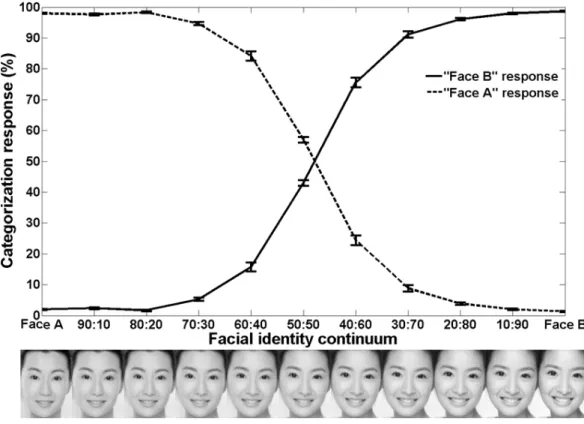
The appropriate faces were divided into 6 gender-matched pairs (3 male pairs and 3 female pairs) based on whether the paired faces had a similar composition and facial expression. The faces were subsequently subjected to a morphing procedure to create 6 continua of morphed facial identities using FantaMorph (Abrosoft). In each face identity continuum, celebrity A’s face was morphed 10%, 20%, 30%, 40%, 50%, 60%, 70%, 80% and 90% of the physical distance to paired celebrity B’s face (Figure 1, bottom panel). Moreover, the stimuli in each continuum were adjusted and matched on low-level physical attributes (luminance, contrast and spatial frequency) using the SHINE toolbox (Willenbockel, et al., 2010). The face images subtended a horizontal visual angle of 6.8° and a vertical angle of 8.6° around the center of the screen, with a viewing distance of approximately 60 cm.
Procedure
Because there were 6 identity continua (3 males and 3 females), the participants had to complete 6 randomized blocks of trials, with one block for each continuum. There were breaks between blocks. Each block comprised two runs. Within each run, all facial stimuli along a facial-identity continuum were repeated 9 times, which resulted in 99 randomly presented trials (9 repetitions x 11 faces per continuum).
A trial was initiated with a fixation cross at the screen center for 600 ms. A facial stimulus was randomly selected from a given facial continuum and presented for 400 ms. A response window was subsequently displayed with two choices that indicated the two identities used to create the continuum. The response choices were placed on either side of the fixation cross, and the positions of these choices were randomized across trials. The participants were given up to 3 s to classify the face they had just viewed by pressing a corresponding key. Performance feedback was not provided. The key press initiated a new trial after a 500 ms inter-trial interval.
Results
Categorization data of identity continua
For each continuum, the categorization data of each morphed face were calculated as the proportion of choices that corresponded to the two identity categories used to create the continuum. The responses to stimuli at identical morph steps were first averaged, regardless of their sequential contexts. Figure 1A and Figure 1B, respectively, show the data from one representative continuum from a single participant or collapsed across participants. A highly consistent picture emerged for each continuum. Every continuum roughly contained two regions that were separated by a category boundary with a categorization rate of approximately 50% (mean categorization rate ± SEM = 50.86 ± 0.90%, collapsed across identity categories, continua and participants). In addition, each region belonged to the identity category that corresponded to the prototype at that end of the continuum. Notably, depending on the continua and the individuals, the exact location of the category boundaries varied between 70:30 and 30:70 morphs.
Figure 1. Categorization data for the facial-identity continuum. The data were obtained from one representative continuum from a single participant (A) or after being collapsed across the participants (B). The continuum ranges from the prototype of celebrity A to the prototype of celebrity B in 10 morphing steps. It should be noted that depending on the continua and participants, the exact location of a category boundary is between 70:30 and 30:70 morphs. The gray bars indicate the expression stimuli selected to analyze sequential effects. The notations P and M represent the preceding P-faces and M-faces, respectively. Error bars represent ± SEM.
Stimulus selection
To control for the variability in category boundaries to properly examine the effects of sequential contexts, our analyses first focused on the two highly recognizable target morphs that were closest to the category boundaries for each continuum (one morph in each identity category) because this is the region in which the strongest sequential effects were previously observed (Hampton, et al., 2005; Hsu & Yang, 2013; Stewart, et al., 2002). Moreover, for every continuum, we analyzed how categorization responses to the targets varied when the targets were preceded by the following preceding stimulus types in each identity category: the prototypes at the ends of the continuum (P-faces), the targets themselves and the morphs (M-faces) at the mid-points of the P-faces and targets (if the exact mid-points did not exist, we selected the morphs around the potential mid-points but closer to the targets as the M-faces). The gray bars in Figure 1A illustrate an example of how these faces were selected for one representative participant. All these selected faces were highly recognizable and
judged as belonging to a distinct identity category with categorization rates at or greater than 77.78% for any one continuum and participant. After being collapsed across identity categories, continua and participants, the average categorization rates for these selected faces were as follows: P-face, mean categorization rate ± SEM = 97.94 ± 0.48%; M-face, 96.93 ± 0.62%; target, 88.30 ± 0.46%.
General sequential effects
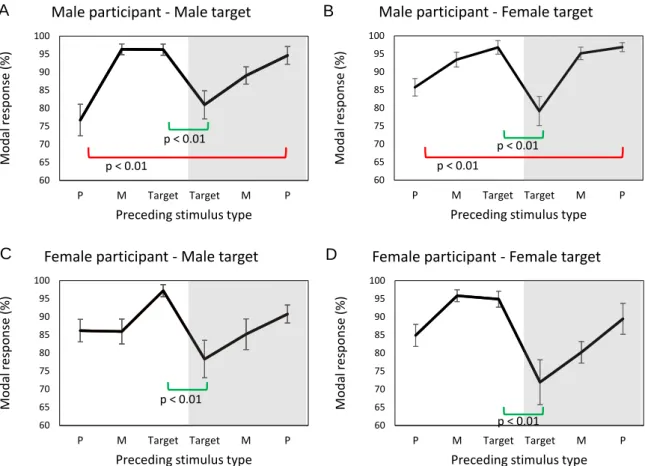
To investigate the respective roles of facial and participant gender, modal (“accurate”) categorization responses were calculated separately for male and female targets and for male and female participants. Here, modal responses were defined as the dominant or the majority category choices that participants assigned to the face stimuli. In each condition (Figure 2A-2D), responses to the two targets within the same continuum were first analyzed as a function of the preceding stimuli and then pooled together. Next, the obtained results were collapsed across continua. The preceding stimuli were the previously selected P-faces, M-faces and targets, depending on whether these were of the same category as the current targets (white zone) or of different identity categories from the current targets (gray zone). Notably, preceding stimuli and targets had the same facial gender because the continua were gender-matched. In addition, we did not analyze trials in which the targets were preceded by the stimuli whose responses were non-modal (“inaccurate”) to ensure that differential categorization rates among the preceding P-, M- and target faces would not contaminate the results.
The overall data collapsed across facial and participant genders were first analyzed. The results demonstrated the presence of sequential effects in facial identity perception, as categorization of current facial identities varied as a function of preceding stimulus types (2 x 2 x 6 mixed ANOVA, main effect of preceding stimulus type, F(5, 130) = 20.93, p < 0.001). Although the modal responses to the male and female targets were comparable (main effect of facial gender, F(1, 26) = 0.17, p = 0.681), responses did significantly differ between male and female participants (main effect of participant gender, F(1, 26) = 10.66, p = 0.003). Further analyses did not reveal any significant three-way interaction effect (F(5, 130) = 1.99,
p = 0.099), nor were there significant two-way interaction effects between preceding stimulus
type and facial gender (F(5, 130) = 0.88, p = 0.496) or between facial and participant gender (F(1, 130) = 1.85, p = 0.237). A significant interaction was found between preceding stimulus type and participant gender (F(5, 130) = 2.38, p = 0.042), indicating that the patterns of sequential effects exhibited differently between male and female participants.
Next, we separately examined the presence of identity-based sequential effects according to facial and participant gender. For male participants, the results showed that the categorization
of both current male and current female targets differed significantly according to the preceding stimulus types (male targets: one-way repeated-measures ANOVA, F(5, 65) = 8.57,
p < 0.001, Figure 2A; female targets: F(5, 65) = 9.12, p < 0.001, Figure 2B). Similarly, for
female participants, the modal responses differed for male targets (F(3, 39) = 6.57, p < 0.001, Figure 2C) as well as for female targets (F(5, 65) = 3.40, p = 0.009, Figure 2D). In general, these findings provide supporting evidence that the categorical judgments of current facial identities were affected by the local sequential context provided by the immediately preceding stimuli.
The effect of relative distance during same- and different-category transitions
To further understand the nature of the obtained sequential effects, we assessed how the effects depended on the relative distance between the preceding and current stimuli and whether this dependence differed when the preceding and current stimuli had the same or different identity category memberships. To this end, trends analyses were conducted to qualitatively estimate whether the relative distance between two successive faces influenced sequential effects in a linear fashion under each condition.
For male participants, when the preceding and current faces originated from the same identity category (same-category transitions), the modal categorization judgments of current male targets were increased, with decreasing relative distance between the preceding and current faces (F(1,13) = 17.28, p = 0.001, the white zone in Figure 2A). This linear trend was also observed for the judgments of current female faces (F(1, 13) = 7.17, p = 0.003, the white zone in Figure 2B). Conversely, when the preceding and current stimuli originated from different identity categories (different-category transitions), the modal responses to current male (F(1, 13) = 13.28, p = 0.003, the gray zone in Figure 2A) and female targets (F(1, 13) = 20.93, p = 0.001, the gray zone in Figure 2B) were increased, with increasing relative distance between the preceding and current faces.
Figure 2. Modal responses to the current facial targets as a function of the preceding stimulus types when male participants categorized male (A) and female (B) targets and female participants categorized male (C) and female (D) targets. The gray zones indicate that the preceding and current facial stimuli have different category memberships. Error bars represent ± SEM. After being collapsed across facial and participant genders, the average number of trials used to compute the data for each preceding stimulus type are as follows. P, 9.71 ± 0.74; M, 9.61 ± 0.87; Target, 8.16 ± 0.78; Target (gray zone), 7.73 ± 0.86; M (gray zone), 9.43 ± 0.85; P (gray zone), 9.64 ± 0.89.
For female participants, a similar pattern of results was obtained. During the same-category transitions, they performed better with decreasing relative distance between the preceding and current male faces (F(1,13) = 10.73, p = 0.006, the white zone in Figure 2C) and between the preceding and current female faces (F(1, 13) = 13.28, p = 0.003, the white zone in Figure 2D). Conversely, during the different-category transitions, categorization responses were increased for current male (F(1, 13) = 4.76, p = 0.048, the gray zone in Figure 2C) and female faces (F(1, 13) = 8.08, p = 0.014, the gray zone in Figure 2D), with increasing relative distance between the two successive stimuli.
In summary, the relative distance between the preceding and current faces plays a crucial role in determining the sequential effects. Moreover, the same pattern of relative-distance effects
60 65 70 75 80 85 90 95 100 P M Target Target M P Mo da l r es po ns e ( % )
Preceding stimulus type
Male participant - Female target
60 65 70 75 80 85 90 95 100 P M Target Target M P Mo da l r es po ns e ( % )
Preceding stimulus type
Female participant - Male target
60 65 70 75 80 85 90 95 100 P M Target Target M P Mo da l r es po ns e ( % )
Preceding stimulus type
Female participant - Female target
60 65 70 75 80 85 90 95 100 P M Target Target M P Mo da l r es po ns e ( % )
Preceding stimulus type
Male participant - Male target
p < 0.01 p < 0.01 p < 0.01 p < 0.01 p < 0.01 p < 0.01 A B C D
was observed in both male and female participants. On the one hand, during the same-category transitions, an increased inter-stimulus distance was accompanied by reduced modal responses for the current targets. On the other hand, during the different-category transitions, an increased inter-stimulus distance was associated with enhanced modal responses for the current targets. This pattern of findings can be explained by contrast effects. From this perspective, the participants may be biased in categorizing the current faces as away from the category of the preceding faces when the inter-stimulus distance is increasingly large. This bias yielded decreased modal responses for the current targets following more distant faces from the same category or increased modal responses following more distant faces from the opposite category. However, a complementary indication is that the identical findings reflect assimilation effects in which the targets are judged as close to the category of the preceding faces when the inter-stimulus distance is increasingly small. Consequently, the modal responses to the current targets were increased after viewing more nearby preceding faces from the same category or fewer modal responses were induced after viewing more nearby preceding faces from the opposite category.
Contrast and assimilation effects
We proceeded to examine whether our findings could best be construed as reflecting contrast, assimilation effects or both. As reported in previous research (Stewart, et al., 2002), contrast effects may be operationally defined by examining the responses to the current targets after viewing a distant stimulus from the opposite category relative to a distant stimulus from the
same category. This definition is based on that if participants classify current stimuli as
further from the category of a distant preceding stimulus, they would produce more modal (“correct”) responses when the current stimulus is preceded by a stimulus from the opposite category but produce fewer modal responses (“more errors”) when the current stimulus is preceded by a stimulus from the same category. Such a switch in categorization responses may thus optimize the phenomena of contrast effects.
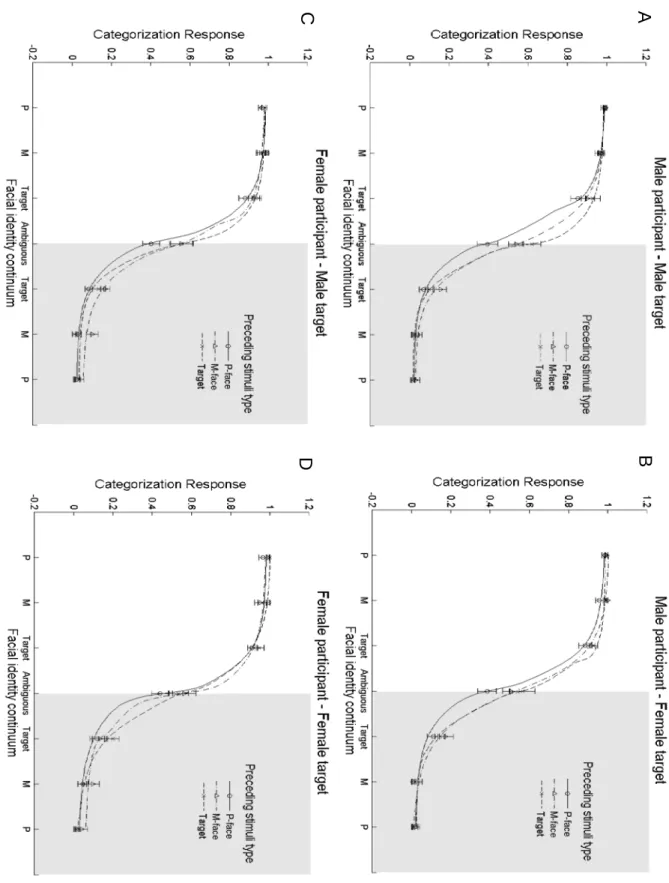
For male participants, we did find increased modal responses in both male and female targets when the preceding stimuli were the distant P-faces from the opposite category relative to the distant P-faces from the same category (male targets: paired t-test, t(13) = 3.41, p = 0.005, red-solid bracket in Figure 2A; female targets: t(13) = 3.84, p = 0.002, red-solid bracket in Figure 2B), which indicates the involvement of contrast effects. However, no contrast effect was found for female participants when they categorized either male targets (t(13) = 1.13, p = 0.278, Figure 2C) or female targets (t(13) = 0.82, p = 0.429, Figure 2D). When categorizing male facial targets, a separate analysis confirmed that the observed contrast effect was specific in male participants because the size of the effect was stronger in males than in females (two-sample t-test, t(13) = 2.01, p = 0.05). However, for female targets, the size was
not significantly different according to participant gender (t(13) = 1.04, p = 0.31).
Conversely, assimilation effects may be operationally defined by examining the responses to the current targets after viewing a nearby stimulus from the same category relative to after viewing a nearby stimulus from the opposite category. Because participants now classify current stimuli as close to the category of a nearby preceding stimulus when the relative distance between successive stimuli is small, this bias may lead to increased modal responses (higher “accuracy”) if preceded by a stimulus from the same category but decreased modal responses (reduced “accuracy”) if preceded by a stimulus from the opposite category.
Evidence of assimilation effects was found for the female participants when they categorized the current male and female targets because there was an increased modal responses in categorizing the targets after viewing the same target faces from the same category than after viewing the nearby target faces from the opposite category (male targets: t(13) = 3.50, p = 0.004, green-solid bracket Figure 2C; female targets: t(13) = 3.44, p = 0.004, green-solid bracket in Figure 2D). Assimilation effects were also observed when male participants categorized current targets of both genders (male targets: t(13) = 3.50, p = 0.004, green-solid bracket in Figure 2A; female targets: t(13) = 3.86, p = 0.002, green-solid bracket in Figure 2B). A separate two-sample t-test showed that, for both male and female targets, the sizes of the assimilation effects were comparable between male and female participants (male target:
t(13) = 0.52, p = 0.607; female target: t(13) = 0.66, p = 0.518), indicating that the assimilation
effect was not specific to participant gender.
Additional analysis revealed that assimilation and contrast effects could still be obtained in the overall data (assimilation effect: t(13) = 7.01, p < 0.001; contrast effect: t(13) = 4.44, p < 0.001). The above results indicate that these two effects are differentially involved in the performance of male and female participants. These results also closely agree with our previous ANOVA analysis which shows an interaction effect between preceding contexts and participant gender.
Long-term sequential effects
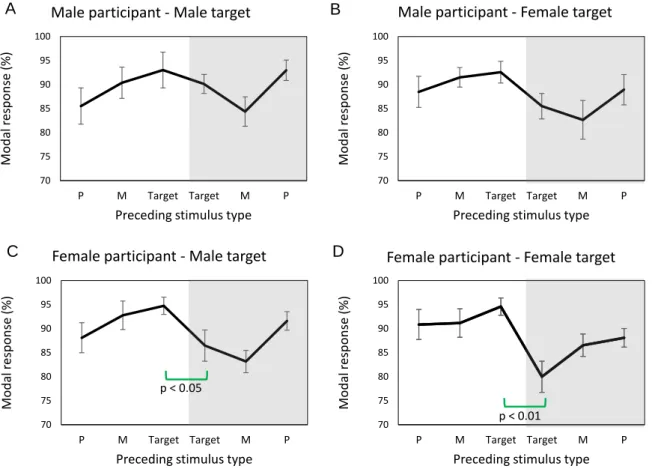
Were identity-based sequential effects limited to the influences from the immediately preceding stimuli or whether the stimuli presented earlier in the trial sequence, such as two trials back, still had an impact on the categorization responses to current facial identities? As shown in Figure 3, the sequential effects derived from the preceding faces presented two trials back were still present, as the categorization of current facial identities varied according to the preceding stimulus types (2 x 2 x 6 mixed ANOVA, main effect of preceding stimulus type, F(5, 130) = 6.75, p < 0.001). There were no main effects of facial gender, participant
gender and interaction effects (all ps > 0.319). Further analysis revealed that this long-term sequential effect was driven by the female participants (male targets: one-way repeated-measures ANOVA, F(5, 65) = 2.80, p = 0.024, Figure 3C; female targets: F(5, 65) = 3.08, p = 0.015, Figure 3D) and not by the male participants (male targets: F(5, 65) = 1.42, p = 0.229, Figure 3A; female targets: F(5, 65) = 1.60, p = 0.174, Figure 3B). In female participants, the effects varied in a significant linear manner with increasing relative distance between the female preceding and current faces during the different-category transitions (trend analysis, F(1, 13) = 3.36, p = 0.013, the gray zone in Figure 3D), but the influence of relative distance was not found in all the other conditions (all ps > 0.106). Moreover, female participants still exhibited a tendency to assimilate their current responses to the category of the preceding stimuli presented two trials back (i.e., assimilation effect) when they judged both male (t(13) = 2.60, p = 0.022, Figure 3C) and female current faces (t(13) = 3.42, p = 0.005, Figure 3D). Taken together, long-term sequential effects were observed only in female participants under certain conditions, indicating that these effects are reduced when there is a two-trial gap between the preceding and current facial identities. It should be noted that the data points in some participants were based on as few as 5 trials.
Figure 3. Modal responses of the current facial targets as a function of the preceding stimuli presented two trials back when male participants categorized male (A) and female (B) targets and female participants categorized male (C) and female (D) targets. The gray zones indicate that the
70 75 80 85 90 95 100 P M Target Target M P Mo da l r es po ns e ( % )
Preceding stimulus type
Female participant - Male target
70 75 80 85 90 95 100 P M Target Target M P Mo da l r es po ns e ( % )
Preceding stimulus type
Female participant - Female target
70 75 80 85 90 95 100 P M Target Target M P Mo da l r es po ns e ( % )
Preceding stimulus type
Male participant - Male target
70 75 80 85 90 95 100 P M Target Target M P Mo da l r es po ns e ( % )
Preceding stimulus type
Male participant - Female target
p < 0.05
p < 0.01
A B
preceding and current facial stimuli have different category memberships. Error bars represent ± SEM. After being collapsed across facial and participant genders, the average number of trials used to compute the data for each preceding stimulus type was as follows. P, 9.82 ± 0.91; M, 8.86 ± 0.82; Target, 7.77 ± 0.67; Target (gray zone), 8.71 ± 0.90; M (gray zone), 8.95 ± 0.86; P (gray zone), 9.09 ± 0.79.
Control analysis
Given that the exact stimulus content varied among participants (see “Stimuli” section), could this variance explain the participants’ gender effect? To address this issue, we first ensured that the patterns of categorization perception data, i.e., categorization performance along each continuum, were comparable across continua and participants of different genders (Pearson correlation: r > 0.997, all p values < 0.001). Second, we examined whether the nature of the selected stimuli was consistent regardless of the gender of the faces and participants. To this end, the mean categorization rates of the P-faces, B-faces and targets in male or female facial continua were separately calculated for male and female participants. As shown in Figure 4, we did not observe any significant difference in categorization between male and female P-faces (two-way mixed ANOVA, main effect on facial gender, F(1, 26) = 3.91, p = 0.06), male and female M-faces (F(1, 26) = 0.36, p = 0.55), or male and female targets (F(1, 26) = 2.15, p = 0.16). In addition, female and male participants performed comparably on all three types of faces (P-face: main effect on participant gender, F(1, 26) = 0.25, p = 0.62; M-face:
F(1, 26) = 2.97, p = 0.10; target: F(1, 26) = 0.88, p = 0.36). Finally, there was no significant
face-gender x gender-group interaction effect (P-face: F(1, 26) = 0.68, p = 0.42; M-face: F(1, 26) = 0.86, p = 0.36; target: F(1, 26) = 0.29, p = 0.59).
85 90 95 100 Male Female Ca te go riz ati on re spo ns e ( % ) Facial gender
P-face
Male participant Female participant 85 90 95 100 Male Female Ca te go riz ati on re spo ns e ( % ) Facial genderM-face
Male participant Female participant 85 90 95 100 Male Female Ca te go riz ati on re spo ns e ( % ) Facial genderTarget face
Male participant Female participantFigure 4. Categorization data of selected P-faces (A), M-faces (B) and targets (C) as a function of facial and participant gender. Error bars represent ± SEM.
Psychometric analysis of sequential effects
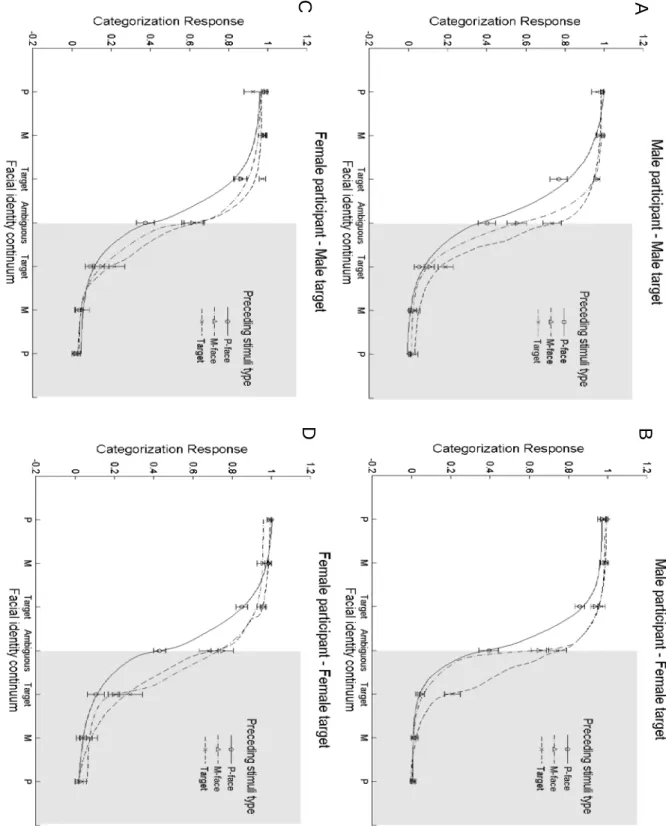
Rather than examining the sequential effects only with the highly recognizable targets, we included more stimuli along the continua to perform additional psychometric analysis. For this analysis, we calculated the proportions of current responses that agreed with the immediately preceding responses (i.e., the proportions of the same category choices) for all highly recognizable current faces (P-, M-faces and targets) as well as for ambiguous current faces located at the category boundary according to each preceding stimulus type. In other words, we analyzed the modal responses to current faces when preceding and current faces originated from the same category and the non-modal responses when the two faces originated from different categories. Next, we fit the data along the continua using a sigmoidal function based on facial and participant genders (Thielscher & Pessoa, 2007). The 50% points and the slopes of the fitted curves served as the indices for comparison across preceding stimulus conditions.
As shown in Figure 5, the psychometric curves, particularly for the current faces in the middle region around the category boundaries, were shifted from right to left with increasing relative distance between the preceding and current stimuli. Trend analyses confirmed this visual inspection. While the slopes remained comparable across preceding stimulus conditions (all ps > 0.172), the 50% points of the psychometric functions significantly varied in a linear manner when male participants categorized both male (F(1, 13) = 29.84, p < 0.001, Figure 5A) and female faces (F(1, 13) = 29.87, p < 0.001, Figure 5B) and when female participants categorized both male (F(1, 13) = 16.23, p = 0.001, Figure 5C) and female faces (F(1, 13) = 13.45, p = 0.003, Figure 5D). This direction of the shifts is closely in line with our previous results, which show that during the same-category/different-category transitions, an increased inter-stimulus distance is accompanied by reduced/enhanced modal responses for the current targets. This is because those relative-distance effects equivalently indicate that the proportion of current responses that agree with preceding responses is decreased with increasing inter-stimulus distance.
Figure 5. Psychometric data of the facial-identity continuum as a function of the preceding stimuli when male participants categorized male (A) and female (B) continua and female participants categorized male (C) and female (D) continua. The y-axis represents the proportions of current responses that agreed with the immediately preceding responses. The x-axis represents the current faces along the continuum, including the selected faces depicted in Figure 1A and the ambiguous
A
B
C
faces located at the category boundary. The curves denote the fitted psychometric functions, whereas the dots denote the original data. The gray zones indicate that the preceding and current facial stimuli have different category memberships. Error bars represent ± SEM. After being collapsed across the preceding stimulus types and facial and participant genders, the average number of trials used to compute the data for each preceding stimulus type are as follows. P, 8.62 ± 0.80; M, 8.58 ± 0.79; Target, 9.15 ± 0.82; Ambiguous face, 9.39 ± 0.75; Target (gray zone), 8.96 ± 0.00; M (gray zone), 8.65 ± 0.72; P (gray zone), 8.83 ± 0.86.
When there was a two-trial gap between the preceding and current stimuli (Figure 6), the 50% points of the curves also linearly shifted from right to left with increasing relative distance between the preceding and current stimuli. This pattern of results was observed for both male and female participants when they categorized either male or female faces (all ps =< 0.05). The slopes of the curves did not significantly differ (all ps > 0.75). However, these findings are inconsistent with the results in which the targets were analyzed along (see the “Long-term sequential effects” section). We reason that this discrepancy could be attributed to the fact that in the psychometric analyses, sequential effects were accumulated across all data points and ambiguous current faces were also included. Indeed, for the ambiguous current faces, modal responses varied linearly with increasing inter-stimulus distance, regardless of whether the faces were preceded by the immediately preceding face (Figure 7, all ps < 0.004) or the preceding face presented two trials back (Figure 8, all ps =< 0.05, except when female participants judged female faces: F(1, 13) = 2.24, p = 0.15). Notably, because the ambiguous faces do not belong to any identity category and have a categorization rate approximately 50%, we calculated the proportion of choices assigned to a distinct identity category instead of modal responses. For the same reason, we did not examine the presence of assimilation or contrast effects for the ambiguous faces.
Figure 6. Psychometric data of the facial-identity continuum as a function of the preceding stimuli presented two trial back when male participants categorized male (A) and female (B) continua and female participants categorized male (C) and female (D) continua. The y-axis represents the
A
B
C
proportions of current responses that agreed with the immediately preceding responses. The x-axis represents the selected current faces depicted in Figure 1A and the ambiguous faces located at the category boundary. The curves denote the fitted psychometric functions, whereas the dots denote the original data. The gray zones indicate that the preceding and current facial stimuli have different category memberships. Error bars represent ± SEM. After being collapsed across preceding stimulus types and facial and participant genders, the average number of trials used to compute the data for each preceding stimulus type are as follows. P, 8.99 ± 0.80; M, 8.72 ± 0.75; Target, 8.82 ± 0.83; Ambiguous face, 9.02 ± 0.74; Target (gray zone), 8.92 ± 0.85; M (gray zone), 8.98 ± 0.87; P (gray zone), 8.63 ± 0.78.
Discussion
The role of relative information in identity-based sequential effects
When categorizing the identities of a sequence of randomly presented faces, categorization performance on current targets was influenced by the local sequential context provided by the immediately preceding faces. This influence was also observed to some extent when there was a two-trial gap between the preceding and current faces. Furthermore, consistent with previous research (Hampton, et al., 2005; Stewart & Brown, 2005), these identity-based sequential effects also depend on the relative distance between the preceding and current stimuli, which suggests that the local sequential context is used to inform the judgments of facial identity. Accordingly, the present study reveals that in addition to the information conveyed by the faces, facial identity is also judged according to preceding contextual information.
However, alternative explanations need to be ruled out. First, could the observed results reflect a consequence of well-established facial identity aftereffects (Leopold, O'Toole, Vetter, & Blanz, 2001) because the identity aftereffects also involve a biased recognition of current facial identity after a period of stimulation from preceding faces? However, unlike the experimental procedure adopted in this study, a prolonged adaptation to preceding faces of more than 1 second is typically required to generate robust aftereffects (Strobach & Carbon, 2013). In addition to the identity aftereffects, response bias, in which participants are biased against/toward making two identical responses in a row, is also incompatible with the present results. In our analysis, we excluded the trials in which the targets were preceded by “inaccurate” preceding stimuli. In other words, the preceding responses were all identical (i.e., they were all “accurate") regardless of preceding stimulus types during either the same-category or different-category transitions. Therefore, if there exists response bias, categorization performance should be comparable across preceding contexts during either category transition. However, this prediction clearly contradicts the relative-distance effects reported on pp. 11-12. Is it possible that our results (particularly the relative-distance effects
observed during the same-category transitions) may be related to facial-identity priming effects (Schweinberger, Pickering, Jentzsch, Burton, & Kaufmann, 2002), in which performance is improved when stimuli are preceded by highly similar faces (e.g., repetition priming)? However, there are some important differences between our results and facial-identity priming effects. First, priming effects generally affect reaction time (RT), whereas our findings are indexed by categorization rates. Second, during the different-category transitions, performance was actually decreased following more similar preceding faces. To further address this issue, we conducted additional analyses to investigate whether RTs were gradually shorter with decreasing relative distance between the preceding and current stimuli during the same-category transitions, such that RTs were the shortest when the targets were preceded by themselves. Our analyses did not support this prediction, as RTs were comparable across preceding stimulus conditions in most conditions (trend analysis, all ps > 0.07 except when female participants judged female faces, F(1,13) = 12.92, p = 0.003). Furthermore, could the assimilation effects reflect categorical priming (Wiese & Schweinberger, 2008), in which performance of current faces is improved following the faces from the same category relative to the faces from the opposite category? For the assimilation effects observed in both male and female participants, we did observed reduced RTs when the current targets were preceded by the targets themselves compared with when preceded by the targets from the opposite category (paired t-test, all ps < 0.05). However, reduced RTs were also observed in the contrast effects, as the RTs for the current targets were shorter following the P-faces from the same category compared with the P-faces from the opposite category (all
ps < 0.05 except when male participants judged male faces). Thus, we suggest that priming
effects cannot fully explain the assimilation effects. Further investigation is necessary to better determine the relationship between priming and sequential effects.
Distinct nature of sequential effects between male and female participants
Although identity-based sequential effects were observed in both male and female participants, the nature of these effects appeared to be qualitatively different. For male participants, sequential effects involved contrast bias when the inter-stimulus distance was large and assimilation bias when the inter-stimulus distance was small. In contrast, for female participants, sequential effects involved only assimilation bias when the distance was small and these effects could still be observed when a two-trial gap was included between the preceding and current stimuli.
To account for assimilation/contrast effects during categorization, the similarity-dissimilarity generalized context model (Stewart & Brown, 2005; Stewart, et al., 2002) suggests that the effects reflect the result of a particular decision strategy in which relative difference information between successive items is used by participants to inform their categorization
decisions. In this view, when the relative distance between two successive faces is increasingly large, participants might believe that the two faces are dissimilar. As a result, participants would tend to judge the preceding and current faces as belonging to different categories (contrast effect). Conversely, when the relative distance between the two successive faces is increasingly small, participants might believe that the two faces are similar. As a result, participants would tend to judge the current face as belonging to the same category as the preceding face (assimilation effects).
Echoing this view, a model of social judgment (Mussweiler, 2003) contends that the consequence of relative judgment (i.e., contrast or assimilation) depends on whether participants focus on the similarity or dissimilarity between the preceding and current stimuli. One study (Damisch, Mussweiler, & Plessner, 2006) showed that when facing a sequence of performances in the gymnastics competition in the 2004 Olympic Games, participants tended to assimilate their evaluations of the current performance toward the judgments of the preceding performance if participants were induced to focus on the similarities between the successive performances. Conversely, a focus on dissimilarities led participants to contrast their judgments away from the preceding performance. Based on a foundation of previous research, the present study suggests that, when making perceptual judgments on a sequence of facial identities, female participants may focus on the similarities between the preceding and current faces and thereby produce assimilation effects; however, male participants may focus on both inter-stimulus similarities and dissimilarities, which results in corresponding assimilation and contrast effects.
Conclusion
Although sequential effects in perceptual judgment have long been established, the issue has been largely ignored in the facial identity perception literature. One possible reason is that whether relative information between preceding and current stimuli is used in facial identity perception is extraneous to the theory pursued. Therefore, sequential effects are often treated as noise in the majority of previous studies and can be ignored by averaging the responses to randomly presented facial stimuli over trials. The present study demonstrates that the application of sequential effects can provide important insights into the nature of facial identity perception. We suggest that facial identity perception is not unitary; instead, it is a multifaceted process. First, in addition to the information values conveyed by faces, the relative information regarding current faces and preceding contexts also plays a contributing role in perceptual judgments. Second, when relative information is used as evidence to inform judgment, females tend to assimilate their judgments toward the category of the preceding faces whereas males tend to either assimilate or contrast their judgments toward or away from the category of the preceding faces, depending on the relationship between
preceding and current faces. Recent studies have also reported sequential effects in the perceptual judgments of other facial domains, such as face perception (Liberman, Fischer, & Whitney, 2014), facial expression (Hsu & Yang, 2013) and facial attractiveness (Kondo, Takahashi, & Watanabe, 2012, 2013; Kramer, Jones, & Sharma, 2013). With the present study, these findings suggest the inherent nature of relative judgment in face perception in general.
References
Bruce, V., & Young, A. (1986). Understanding face recognition. British Journal Psychology,
77, 305-327.
Damisch, L., Mussweiler, T., & Plessner, H. (2006). Olympic medals as fruits of comparison? Assimilation and contrast in sequential performance judgements. Journal of
Experimental Psychology: Applied, 12, 166-178.
Ganel, T., & Goshen-Gottstein, Y. (2002). Perceptual integrality of sex and identity of faces: Further evidence for the single-route hypothesis. Journal of Experimental Psychology:
Human Perception and Performance, 28, 854-867.
Hampton, J. A., Estes, Z., & Simmons, C. L. (2005). Comparison and contrast in perceptual categorization. Journal of Experimental Psychology: Learning, Memory, and
Cognition, 31, 1459-1476.
Helson, H. (1964). Current Trends and Issues in Adaptation-Level Theory. American
Psychologist, 19, 26-38.
Herlitz, A., & Loven, J. (2013). Sex differences and the own-gender bias in face recognition: A meta-analysis review. Visual Cognition, 21, 1306-1336.
Hsu, S. M., & Yang, L. X. (2013). Sequential Effects in Facial Expression Categorization.
Emotion, 13, 573-586.
Jesteadt, W., Luce, R. D., & Green, D. M. (1977). Sequential Effects in Judgments of
Loudness. Journal of Experimental Psychology: Human Perception and Performance,
3, 92-104.
Kondo, A., Takahashi, K., & Watanabe, K. (2012). Sequential effects in face-attractiveness judgment. Perception, 41, 43-49.
Kondo, A., Takahashi, K., & Watanabe, K. (2013). Influence of gender membership on sequential decisions of face attractiveness. Attention Perception & Psychophysics, 75, 1347-1352.
Kramer, R. S. S., Jones, A. L., & Sharma, D. (2013). Sequential effects in judgements of attractiveness: the influences of face race and sex. Plos One, 8, doi: ARTN e82226 Laming, D. R. J. (1997). The measurement of sensation. Oxford: Oxford University Press. Leopold, D. A., O'Toole, A. J., Vetter, T., & Blanz, V. (2001). Prototype-referenced shape
encoding revealed by high-level aftereffects. Nature Neuroscience, 4, 89-94. Lewin, C., & Herlitz, A. (2002). Sex differences in face recognition - Women's faces make
the difference. Brain and Cognition, 50, 121-128.
Liberman, A., Fischer, J., & Whitney, D. (2014). Serial dependence in the perception of faces.
Current Biology, 24, 2569-2574.
Lockhead, G. R. (2004). Absolute judgments are relative: A reinterpretation of some psychophysical ideas. Review of General Psychology, 8, 265-272.
Mussweiler, T. (2003). Comparison processes in social judgment: Mechanisms and consequences. Psychological Review, 110, 472-489.
Rhodes, G., Jaquet, E., Jeffery, L., Evangelista, E., Keane, J., & Calder, A. J. (2011). Sex-specific norms code face identity. Journal of Vision, 11, doi: 10.1167/11.1.1. Schweinberger, S. R., Pickering, E. C., Jentzsch, I., Burton, A. M., & Kaufmann, J. M. (2002).
Event-related brain potential evidence for a response of inferior temporal cortex to familiar face repetitions. Cognitive Brain Research, 14, 398-409.
Stewart, N., & Brown, G. D. A. (2005). Similarity and dissimilarity as evidence in perceptual categorization. Journal of Mathematical Psychology, 49, 403-409.
Stewart, N., Brown, G. D. A., & Chater, N. (2002). Sequential effects in categorization of simple perceptual stimuli. Journal of Experimental Psychology: Learning, Memory,
and Cognition, 28, 3-11.
Strobach, T., & Carbon, C. C. (2013). Face adaptation effects: reviewing the impact of adapting information, time, and transfer. Frontiers in Psychology, 4, doi: 10.3389/fpsyg.2013.00318.
Thielscher, A., & Pessoa, L. (2007). Neural correlates of perceptual choice and decision making during fear-disgust discrimination. Journal Neuroscience, 27, 2908-2917. Valentine, T. (1991). A Unified Account of the Effects of Distinctiveness, Inversion, and Race
in Face Recognition. The Quarterly Journal of Experimental Psychology A: Human
Experimental Psychology, 43, 161-204.
Ward, L. M., & Lockhead, G. R. (1970). Sequential effects and memory in category judgments. Journal of Experimental Psychology, 84, 27-34.
Wiese, H., & Schweinberger, S. R. (2008). Event-related potentials indicate different processes to mediate categorical and associative priming in person recognition. Journal of
Experimental Psychology-Learning Memory and Cognition, 34, 1246-1263.
Willenbockel, V., Sadr, J., Fiset, D., Horne, G. O., Gosselin, F., & Tanaka, J. W. (2010). Controlling low-level image properties: The SHINE toolbox. Behavior Research
Methods, 42, 671-684.
Wolff, N., Kemter, K., Schweinberger, S. R., & Wiese, H. (2014). What drives social in-group biases in face recognition memory? ERP evidence from the own-gender bias. Social
Cognitive and Affective Neuroscience, 9, 580-590.
Wright, D. B., & Sladden, B. (2003). An own gender bias and the importance of hair in face recognition. Acta Psychologica, 114, 101-114.
Zotov, V., Jones, M. N., & Mewhort, D. J. K. (2011). Contrast and assimilation in
categorization and exemplar production. Attention Perception & Psychophysics, 73, 621-639.
科技部補助專題研究計畫出席國際學術會議心得報告
日期:105 年 3 月 28 日
一、參加會議經過
This conference lasted for 5 days and my poster was presented on the fourth day. The venue was a little bit away from the city center and with some sort of iron-curtain feel. In addition to the major events, I also participated in a pre-conference workshop to refresh some basic psychophysical skills.
二、與會心得
I chose this conference to attend because this conference has received researchers who are working on face perception. Not to my disappointment, I got some attention and feedbacks from other researchers during the poster session. In addition, there was a symposium regarding how to measure visual awareness. I found that this one is particularly beneficial because I am inspired by some of the discussion and the material will be used to conceive my next project. As usual, there was an ‘Illusion Night’, which offers an opportunity to be exposed to a novel or a variant of an old illusion in an informal and interactive setting. Although most of the results are not relevant to my current research, I might incorporate some of the illusions to probe the underlying neural mechanism in the brain in the future.
計畫編號 MOST 102-2410-H-004-045-MY2
計畫名稱
藉由臉部知覺探討連續性的分類決定
出國人員
姓名
徐慎謀
服務機構
及職稱
政治大學心智大腦與學習中心
助理研究員
會議時間
103 年 8 月 24 日
至 103 年 8 月 28
日
會議地點
塞爾維亞貝爾格勒
會議名稱
(中文)2014 歐洲視覺會議
(英文)2014The European Conference on Visual Perception
發表題目
(中文)連續性效應發現辨認男性與女性人臉依賴不同的運作機制
(英文) Distinct mechanisms for male and female identity categorization as
revealed by sequential effects
As below
四、建議
N/A五、攜回資料名稱及內容
The PDF version of the program and abstract book
六、其他
N/AWednesday
asymptote ( 100 ms) at 7-8 months postnatal (Lee et al, 2012), indicating continuing development of later cortical processing. Most of the PBI group, tested 3-4 times during 24 post-term months, reached adult P1 latency values by 5 months. However calculated latency remained around 200 msec beyond 1 year for this group. These results show that calculated latency, reflecting cortical processing beyond initial V1 activation, is more sensitive to cerebral impairment than the conventional transient VEP, and may predict later neurological deficits in childhood.
[Supported by the Leverhulme Trust, Castang Foundation, Oxford Biomedical Research Centre, and a Thouron Fellowship from the University of Pennsylvania.]
POSTERS: FACE PERCEPTION III
◆
1
The face inversion effect alters quantitatively and qualitatively information sampling X Ouyang, S Miellet, J Lao, R Caldara (Department of Psychology, University of Fribourg, Switzerland; e-mail: [email protected])
Humans are equipped with a sophisticated machinery that allows the rapid and effective recognition of a wide range of faces exemplars. The visual system actively and flexibly adapts eye movement information sampling to achieve this biological feat. However, recognition performance for inverted faces disproportionally decreases compared to (inverted) objects: the Face Inversion Effect (FIE). Yet, whether the FIE relies on qualitative and/or quantitative changes in information sampling is still debated. To clarify this issue, we implemented the gaze-contingent Expanding Spotlight technique (Miellet et al., 2013), while observers performed a delayed face-matching task with upright and inverted faces. A 2° Gaussian aperture was centered on the observers’ fixations and expanded dynamically by 1 degree every 12ms - the longer the fixation duration, the larger the aperture size. We then used Bayesian classifiers to categorize the observers according to their information sampling strategies (i.e., global versus local). As expected, recognition performance decreased and fixation durations were shorter in the inverted compared to the upright condition for all observers. Crucially, while some observers shifted their fixation pattern between upright and inverted faces, others did not. Our data suggest that the FIE relies on quantitative and idiosyncratic qualitative changes in eye movement information-gathering strategies.
◆
2
Different mechanisms for male and female facial identity categorization as revealed by sequential effects
S Hsu (Research Center for Mind, Brain and Learning, National Chengchi University, Taiwan (R.O.C.); e-mail: [email protected])
Facial identity provides crucial information that guides social interactions. To investigate how the human brain represents facial identities in different sex, this study examined the fine temporal structure of facial identity recognition on a trial-to-trial basis as participants categorized a sequence of male or female facial identities. Different patterns of sequential effects were observed, depending on whether participants recognized the faces of their own or opposite sex. When viewing the faces of their opposite sex, participants tended to categorize the preceding and current faces as belonging to the same identity (assimilation effect) if the two successive faces were from the same identity category, but the current faces were categorized as away from the identity category of the preceding faces (contrast effect) if the two faces were from the different categories. However, when viewing the faces of their own sex, only contrast effects were found regardless whether the preceding and current faces had the same or different identity categories. The present study suggests that the recognition of male and female facial identities involves distinct computational mechanisms and these two types of identities might be differentially represented in the face space in the human brain.
[NSC 102-2410-H-004-045-MY2]
◆
3
A preliminary investigation on the role of facial symmetry and facial expressions in attractiveness judgements and pupil dilation
P Hepsomali1, D Gokcay2(1Psychology, University of Southampton, United Kingdom;2Medical Informatics, Middle East Technical University, Turkey; e-mail: [email protected])
We investigated the relationship between attractiveness judgements and pupillary responses for three facial expressions (neutral, surprised, angry) chosen from the KDEF database. These expressions form a minimal set with one control condition and two high arousal expressions with either positive or negative valence. Another factor which is of interest is symmetry, because it is widely accepted that symmetric faces are considered as more attractive. To study this effect, symmetric versions of each picture is generated through a warping scheme. Subjects (18 M, 12 F) evaluated the attractiveness
科技部補助專題研究計畫出席國際學術會議心得報告
日期:105 年 3 月 28 日
一、參加會議經過
The presented results were obtained based on the spare budget from this project. Attending this
conference serves two purposes: (1) to have further discussion on potential collaboration with Catherine Tallon-Baudry, who is one of the organizers of this conference and my director when I was a researcher in CNRS and (2) to get inspired for the next project. Before the conference, there were charged tutorials with some interesting topics. However, due to limited budget, I only attended the lecture, keynote, some symposiums and poster sessions.
二、與會心得
Because the theme of this conference is more focused, I undoubtedly benefit a lot, particularly the discussion from the symposiums “Levels of Consciousness” and “The No-report Paradigm”. Moreover, some familiar faces in the studies of consciousness also attended this conference. It is exciting to hear
計畫編號 MOST 102-2410-H-004-045-MY2
計畫名稱
藉由臉部知覺探討連續性的分類決定
出國人員
姓名
徐慎謀
服務機構
及職稱
政治大學心智大腦與學習中心
助理研究員
會議時間
104 年 7 月 7 日至
104 年 7 月 10 日
會議地點
法國巴黎
會議名稱
(中文)意識研究協會第十九屆會議
(英文)19
thAnnual Meeting of the Association for the Scientific Study of
Consciousness
發表題目
(中文)不同但彼此互動的神經機制負責處理人臉辨認和人臉偵測的知
覺意識
(英文)Distinct but interacting neural mechanisms underlying conscious
face identification and conscious face detection
for a lunch and had a time to chat about the ongoing project and future collaboration. Meanwhile, I also met some other acquaintances not only to talk about the old days but also to discuss potential
collaboration in the future. In short, this is a fruitful trip.
It is worth noting that students seem to play a major role in organizing this conference, including
receiving the attendee. I felt that this is a good idea, as students who are interested in staying in Academia may have a chance to build connection with internal scholars worldwide. In addition, it is a good idea that the conference also provides a session in which students and young researchers may have chance to chat with the senior in order to benefit experience from them.
三、發表論文全文或摘要
As below四、建議
N/A五、攜回資料名稱及內容
The PDF version of the program and abstract book
六、其他
N/Athat there could not be such a set). Experiential seemings are perhaps a genus of seeming, under which some other kinds of seemings (e.g., perceptual and intellectual) fall. We use the experiential sense of ‘seem’ to describe our experiences, and O’s seeming F to us is compatible with our knowing that O is not F. Finally, justificatory seemings are mental states that give us (defeasible) reasons for accepting that the world is as it seems—e.g., if it seems that there is a dagger before me that is a (defeasible) reason for my believing that there is a dagger before me. It is because there are these (apparently) different kinds of seemings that it is an open possibility that the seemings discussed in, say, the philosophy of perception are not the same as those discussed in epistemology. My taxonomy will make clear what connections there are between the different kinds of seemings in play, and will help with the question of how we should characterise these different seemings: whether in terms of phenomenal character, or content, or whether the seeming is a propositional attitudes, for example.
P053 - Distinct but interacting neural mechanisms underlying conscious face
identification and conscious face detection
Shen-Mou Hsu [1], Catherine Tallon-Baudry [2], Yu-Fang YANG [1]
[1] Research Center for Mind, Brain and Learning, National Chengchi University, Taipei, Taiwan (R.O.C.), [2] Cognitive Neuroscience Laboratory, Institut National de la Santé et de la Recherche Médicale (INSERM) – École Normale Supérieure (ENS), Paris, France.
How an external piece of information gains access to conscious processing has been one of the central issues in the literature. Much of previous progress has focused on distinguishing different states of conscious access, with the emphasis on how brain activity differentially responds to perceptual aware and unaware stimuli. However, according to the hierarchical view of stimulus representations, a face, for instance, has at least two levels of representations, ranging from a low-level representation of facial features to a high-level representation of facial identities. By capitalizing on the hierarchical contents of face stimuli, in this study, participants were instructed to view a briefly presented masked face from trial to trial while MEG activity was recorded. Behaviorally, the participants were able to recognize the identity of the faces (conscious face identification) in some trials, but were only able to detect the presence of the faces (conscious face detection without identification) in other trials. The MEG results showed that these two levels of conscious access depended on distinct spatio-temporal-frequency patterns of phase clustering. However, further analysis revealed that the phase adjustment tuned for conscious identification interacted with the phase adjustment tuned for conscious detection. Altogether, these findings suggest that different levels of conscious perception are not accessed in a fully independent manner, but conscious face identification is built upon the success of conscious face detection.
P054 - The puzzle about particularity of perceptual content and a deeper
question
Ting-An Lin [1]
[1] Department of Philosophy, Texas Tech University Consciousness Research Group, Taiwan.
The “indistinguishability phenomenon” and the “veridicality requirement” of perception seem to pull us into opposite directions when concerned with the nature of perceptual content. While there are some proposals to the puzzle about particularity, I shall argue that the proposals reveal to us deeper questions about the relationship between the experiential part and the representational part of perceptual content and we should answer this deeper question in order to treat the puzzle about particularity properly. Two proposals to the puzzle about particularity discussed in this paper are the multiple-contents thesis and Soteriou’s theory. Both proposals suggest a distinction between the experiential part and the representational part of perception and try to explain the indistinguishability phenomenon by the experiential part and to meet the veridicality requirement by the representational part. They also agree that (1) the representational part is object-involved while experiential part is not and (2) two perceptual experiences with different representational parts can have the same experiential part. However, what is the relationship between the two parts? I suggest that a version of vehicle-based representationalism can help us with this question. I shall argue that the representational part is determined by what is
日期:2016/03/28
科技部補助計畫
計畫名稱: 藉由臉部知覺探討連續性的分類決定 計畫主持人: 徐慎謀 計畫編號: 102-2410-H-004-045-MY2 學門領域: 實驗及認知心理學無研發成果推廣資料
計畫主持人:徐慎謀 計畫編號:102-2410-H-004-045-MY2 計畫名稱:藉由臉部知覺探討連續性的分類決定 成果項目 量化 單位 備註(質化說明 :如數個計畫共 同成果、成果列 為該期刊之封面 故事...等) 實際已達成 數(被接受 或已發表) 預期總達成 數(含實際 已達成數) 本計畫實 際貢獻百 分比 國內 論文著作 期刊論文 0 0 100% 篇 研究報告/技術報告 0 0 100% 研討會論文 0 0 100% 專書 0 0 100% 章/本 專利 申請中件數 0 0 100% 件 已獲得件數 0 0 100% 技術移轉 件數 0 0 100% 件 權利金 0 0 100% 千元 參與計畫人力 (本國籍) 碩士生 0 0 100% 人次 博士生 0 0 100% 博士後研究員 0 0 100% 專任助理 0 0 100% 國外 論文著作 期刊論文 1 1 100% 篇 Published in a high quality journal in the field of experimental psychology 研究報告/技術報告 0 0 100% 研討會論文 2 2 100% 專書 0 0 100% 章/本 專利 申請中件數 0 0 100% 件 已獲得件數 0 0 100% 技術移轉 件數 0 0 100% 件 權利金 0 0 100% 千元 參與計畫人力 (外國籍) 碩士生 0 0 100% 人次 博士生 0 0 100% 博士後研究員 0 0 100% 專任助理 0 0 100% 其他成果 (無法以量化表達之 成果如辦理學術活動
Invited talks on the workshop of “Information and Neural decision Sciences” on the conference of “Innovation: Perspectives from Both the Sciences and Humanities” at “2014 International Conference on
產業技術發展之具體 效益事項等,請以文 字敘述填列。) 成果項目 量化 名稱或內容性質簡述 科 教 處 計 畫 加 填 項 目 測驗工具(含質性與量性) 0 課程/模組 0 電腦及網路系統或工具 0 教材 0 舉辦之活動/競賽 0 研討會/工作坊 0 電子報、網站 0 計畫成果推廣之參與(閱聽)人數 0