Experimental investigation of a fiber Bragg
grating integrated optical limiting amplifier
with high dynamic range
Shien-Kuei Liaw Sien Chi
National Chiao-Tung University Institute of Electro-Optical Engineering Hsin-Chu 300
Taiwan
E-mail: [email protected]
Abstract. By inserting a bidirectional erbium-doped fiber amplifier
(EDFA) in between an optical circulator and a fiber Bragg grating (FBG), we realize an FBG-integrated optical limiting amplifier (OLA) with high dynamic range. The dual-pass OLA has a wide dynamic range of over 40 dB and a saturation signal output power of about 13.0 dBm. The perfor-mance of dual-pass OLA has no obvious degradation due to back reflec-tion of the amplified signal. A negligible power penalty of about 0.3 dB is observed when compared with other conventional configurations. The FBG-integrated OLA configuration has potential application in wave-length division multiplexing (WDM) systems where high saturated power is needed for multichannel transmission. © 1998 Society of Photo-Optical In-strumentation Engineers. [S0091-3286(98)02207-7]
Subject terms: erbium-doped fiber amplifier; wavelength division multiplexing; fi-ber Bragg grating; optical circulator; optical limiting amplifier; dynamic range. Paper 26107 received Oct. 18, 1997; revised manuscript received Feb. 17, 1998; accepted for publication Feb. 18, 1998.
1 Introduction
Long distance transmission over conventional single mode fiber~SMF! is of great interest. The availability of erbium-doped fiber amplifiers ~EDFAs! has resulted in rapid progress in 1.55-mm optical fiber transmission since they can be used to overcome the link loss caused by branching and/or tapping as well as the fiber transmission loss.1,2 However, the power level of each wavelength division mul-tiplexing~WDM! signal is restricted by the EDFA saturated output power. For instance, each amplified signal level of a four-channel WDM system is about 6 dB lower than that of the one-channel case. Also, since the signal power launched to the next stage EDFA should be increased to maintain a good transmission performance, the fiber span is shorter when larger volumes of information are transmitted along the fiber link. In high speed/long haul transmission, chirped fiber gratings~CFGs! are frequently used3,4 to compensate the large chromatic dispersion (;17 ps/nm km) character-istic of SMFs. The EDFAs are inserted repeatedly to am-plify the signals. However, the fiber span is limited by the loss of CFGs, SMF and optical circulators ~OCs!. Fortu-nately, the optical limiting amplifier5 ~OLA!, which pro-vides a constant output power for a wide input signal dy-namic range and has a high saturated output power, can be used to solve these problems.
In this paper, by inserting a bidirectional EDFA between the OC and fiber Bragg grating ~FBG!, we realize a dual-pass EDFA acting as an OLA to amplify the modulated signal. We evaluate the output power performance of the proposed OLA configuration and investigate the impact of power penalty results from back reflection of the dual-pass amplified signal. The dynamic range characteristic of the OLA, the bit error rate ~BER! performance and the eye
diagram of the modulated signal are measured and dis-cussed.
2 Experimental Setup
As shown in Fig. 1, one distributed feedback~DFB! laser with a central wavelength of 1549.8 nm was externally modulated with a 2.488 Gbit/s 22321 nonreturn-to-zero
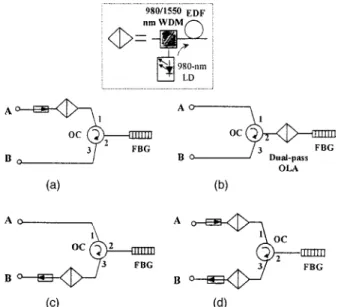
~NRZ! signal by a LiNbO3 external intensity modulator. The transmitted signal was amplified by a boost amplifier, which was followed by a 50-km SMF with chromatic dis-persion of 17 ps/nm km and attenuation of 0.3 dB/km. A variable optical attenuator~VA! was used to adjust the in-put power level from245 to 25 dBm in the measurement. Another 50-km SMF was arranged after the optical ampli-fier module. Four possible optical amplified modules made possible by integrating the FBG with the bidirectional ED-FAs were investigated, as shown in Figs. 2~a! to 2~d! by locating the EDFAs in front of port 1@Fig. 2~a!#, after port 2@Fig. 2~b!#, and after port 3 @Fig. 2~c!# or by locating one EDFA in front of port 1 and the other one after port 3 of the OC, respectively @Fig. 2~d!#. The FBG was operated as a reflective mirror at wavelength of 1549.8 nm. The circulator-grating combination exhibited total insertion losses of;3.5 dB, which are attributed to the OC insertion loss, FBG reflection loss and the possibility of power loss due to slight laser wavelength and FBG misalignment. Note that misalignment of 60.1 nm will induce an ;1.2 dB power attenuation by the FBG used in this experiment. In these modules, the modulated signal was amplified then filtered @Fig. 2~a!#; amplified, filtered and then amplified again@Fig. 2~b!#; filtered then amplified @Fig. 2~c!#, or am-plified, filtered and then amplified as in Fig. 2~b! but using two EDFAs, respectively@Fig. 2~d!#. By using either con-2101 Opt. Eng. 37(7) 2101–2103 (July 1998) 0091-3286/98/$10.00 © 1998 Society of Photo-Optical Instrumentation Engineers Downloaded From: http://opticalengineering.spiedigitallibrary.org/ on 04/28/2014 Terms of Use: http://spiedl.org/terms
figuration A or B, the amplified spontaneous emission
~ASE! was greatly reduced due to the narrow-band filtering
effect of the FBG. Meanwhile, the effective available gain for signal amplification increased. One regular FBG was located after port 2 of the OC for feasible study. The iso-lation of the OC from port 2/3 to port 1/2 is 50 dB. The insertion loss of the OC is about 1.3 dB from port 1/2 to port 2/3. The saturation signal output power and noise fig-ure~NF! of each EDFA used here are about 13.0 dBm and 5 dB, respectively. An FBG with 90% reflectivity and 3-dB bandwidth of 0.2 nm at 1549.8 nm was used in this experi-ment. Note that configuration B ~dual-pass OLA! was ex-actly operated as an OLA, the signal was amplified before and after~i.e., twice! reflection by the FBG.
3 Results and Discussion
Figure 3 shows the measured signal output power as a func-tion of the input signal power at 1549.8 nm. Both configu-rations B and D have the highest dynamic range of over 40 dB. Here, the dynamic range is defined as the input power range that maintains a power level that is within 3 dB be-low from the peak value. Configuration C has the be-lowest
signal output power since the signal power was attenuated at about 3.5 dB before amplification by EDFA due to the insertion loss of the OC and reflection loss of the FBG. Though configuration D also has a higher dynamic range, it is much more expensive than configuration B since an extra EDFA was used. Figure 4 shows the signal to ASE ratio against different input power level of these four configura-tions at 1549.8 nm. Configuration C has the lowest value among these four configurations since the ASE noise was not filtered out by the FBG. To the contrary, the dual-pass OLA configuration has the most flattened curve and the highest value in the high inversion region when the input power level ranges from 225 to 245 dBm. The relative ASE power is much larger at a lower input power level than that at a higher input power level because the gain of OLA was suppressed in the latter case and the ASE power decreased accordingly. Nevertheless, much of the ASE power was filtered out by the grating reflector in this case when compared with the conventional configuration C. Also, as shown in Fig. 3, the link budget of configuration B is improved from 6.5 to 30 dB when the input power level is decreased from 210 to 240 dBm. The measured BER Fig. 1 Experimental setup: NBPF, narrow bandpass filter; VA,
vari-able optical attenuator; SMF, single mode fiber; and BERTS, BER test set.
Fig. 2 Four possible FBG integrated bidirectional EDFA configura-tions: (a) preamplification, (b) dual-pass OLA amplification, (c) postamplification, and (d) two-EDFA amplification.
Fig. 3 Measured signal output power against input signal power at 1549.8 nm of the four possible amplifier configurations.
Fig. 4 Measured signal output power to ASE ratio versus input sig-nal power at 1549.8 nm of the four possible amplifier configurations. Liaw and Chi: Experimental investigation of a fiber Bragg grating . . .
2102 Optical Engineering, Vol. 37 No. 7, July 1998
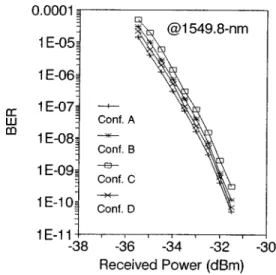
performance of the 2.488 Gbit/s modulated signal is shown in Fig. 5. The performance of dual-pass OLA has no obvi-ous degradation due to back reflection of the amplified sig-nal. A negligible power penalty of only 0.3 dB was ob-served when compared with the best performance curve in configuration A case. Consequently, configuration B is the best scheme from the performance and cost-effectiveness points of view.
4 Summary
By inserting a bidirectional EDFA in between an OC and an FBG, we realized a FBG-integrated OLA with a high dynamic range. The dual-pass OLA has a wide dynamic range of over 40 dB and a saturation signal output power of about 13.0 dBm. The performance characteristics of the dual-pass OLA were compared with three other configura-tions. The advantages of the dual-pass OLA over configu-rations A and C are the nearly doubled gain efficiency, a higher dynamic range of over 40 dB, and larger link budget and signal output power. Furthermore, the dual-pass OLA is much more compact and cost effective than the two-EDFA type OLA in configuration D. A negligible power penalty due to back reflection of the dual-pass amplified signal was observed. This dual-pass amplified configuration should have useful applications in WDM transmission as well as in high speed transmission when CFGs are used for both signal reflection and dispersion compensation.
Acknowledgments
The authors would like to thank Dr. B.-S. Cheng and J.-W. Liaw of Chung-Hwa Telecommunication Laboratories in Taiwan for their support. The authors are also indebted to Y.-K. Chen, K.-P. Ho and C.-C. Lee for fruitful discussion.
The work was partially supported by Grant No. NSC-87-2215-E-009-012 from the National Science Council, Tai-wan.
References
1. N. S. Bergano and C. R. Davidson, ‘‘Wavelength division multiplex-ing in long-haul transmission systems,’’ J. Lightwave Technol. 14~6!, 1299–1308~1996!.
2. R. E. Wagner, R. C. Alferness, A. A. M. Saleh and M. S. Goodman, ‘‘MONET: Multiwavelength optical networking,’’ J. Lightwave Tech-nol. 14~6!, 1349–1355 ~1996!.
3. R. I. Laming, N. Robinson, P. L. Scrivener, M. N. Zervas, S. Barce-los, L. Reekie and J. A. Tucknott, ‘‘A dispersion tunable grating in a 10-Gb/s 100-220-km-step index fiber link,’’ IEEE Photon. Technol. Lett. 8, 428–430~1996!.
4. W. H. Loh, R. I. Laming, A. D. Ellis and D. Atkinson, ‘‘10 Gb/s transmission over 700 km of standard single-mode fiber with 10-cm chirped fiber grating compensator and duobinary transmitter,’’ IEEE Photon. Technol. Lett. 8, 1258–1260~1996!.
5. Y.-K. Chen, S.-K. Liaw, W.-Y. Guo and S. Chi, ‘‘Multiwavelength erbium-doped power limiting amplifier in all-optical self-healing ring network,’’ IEEE. Photon. Technol. Lett. 8, 842–844~1996!.
Shien-Kuei Liaw received his BSEE de-gree from the National Taiwan University and his MSEE degree from the National Tsing-Hua University, Taiwan, in 1988 and 1993, respectively. From 1993 to 1997 he was a member of the technical staff at the Applied Research of Chung-Hwa Tele-communication Laboratories in Yang-Mei, Taiwan. In 1996 he was a resident visitor at Bellcore, Red Bank, New Jersey, for a period of 6 months. He is currently a PhD student at the National Chiao-Tung University, Taiwan. His research interests include optical fiber communications, erbium-doped fiber amplifiers, fiber Bragg gratings and their related applications.
Sien Chi received his BSEE degree from the National Taiwan University and his MSEE degree from the National Chiao-Tung University, Taiwan, in 1959 and 1961, respectively. He received his PhD in electrophysics from the Polytechnic Insti-tute of Brooklyn, New York, in 1971 and he joined the faculty of the National Chiao-Tung University, where he is currently a professor of electro-optical engineering. From 1972 to 1973 he chaired the Depart-ment of Electrophysics; from 1973 to 1977 he directed the Institute of Electronics; from 1977 to 1978 he was a resident visitor at Bell Laboratories, Holmdel, New Jersey; from 1985 to 1988 he was the principal advisor with the Hua-Eng Wires and Cables Company, the first manufacturer of fibers and fiber cables in Taiwan, developing fiber making and cabling technology; and from 1988 to 1990 di-rected the Institute of Electro-Optical Engineering. He was the sym-posium chair of the International Symsym-posium of Optoelectronics in Computers, Communications and Control in 1992, which was coor-ganized by the National Chiao-Tung University and SPIE. In 1993 he received the Distinguished Research Award sponsored by the National Science Council, Taiwan. His research interests are optical fiber communications, optical solitons and optical fiber amplifiers. Chi is a member of the Chinese Optical Engineering Society and fellow of the Optical Society of America and the Photonics Society of Chinese-Americans.
Fig. 5 BER measurement of a 100-km SMF transmission.
Liaw and Chi: Experimental investigation of a fiber Bragg grating . . .
2103 Optical Engineering, Vol. 37 No. 7, July 1998 Downloaded From: http://opticalengineering.spiedigitallibrary.org/ on 04/28/2014 Terms of Use: http://spiedl.org/terms