國 立 交 通 大 學
電信工程研究所
碩 士 論 文
下鏈 LTE-A 蜂巢式系統中協調式多點傳輸方法
之研究
A Study on Coordinated Multi-Point Transmission
(CoMP) Scheme for the Downlink LTE-A Cellular
System
研 究 生: 楊為守
指導教授: 黃家齊 博士
下鏈 LTE-A 蜂巢式系統中協調式多點傳輸方法之研究
A Study on Coordinated Multi-Point Transmission (CoMP)
Scheme for the Downlink LTE-A Cellular System
研 究 生:楊為守
Student: Wei-Shou Yang
指導教授:黃家齊 博士
Advisor: Dr. Chia-Chi Huang
國 立 交 通 大 學
電信工程研究所
碩 士 論 文
A Thesis
Submitted to Institute of Communication Engineering
College of Electrical and Computer Engineering
National Chiao Tung University
in Partial Fulfillment of the Requirements
for the Degree of
Master of Science
in
Communication Engineering
July 2012
Hsinchu, Taiwan, Republic of China
下鏈 LTE-A 蜂巢式系統中協調式多點傳輸方法之研究
研究生:楊為守
指導教授:黃家齊 博士
國立交通大學電信工程研究所 碩士班
摘
要
協調式多點傳輸 (Coordinated Multi-Point Transmission,CoMP) 是一種有效降低基 地台間干擾的方法。其主要概念是挑選數個基地台彼此合作以消除干擾,這衍生出一個 問題:哪些基地台該合作並形成一個協調式多點傳輸叢集 (CoMP Cluster)?針對下鏈傳 輸,我們提出一個動態建立叢集的方法。為了降低複雜度,我們使用一種基於區塊對 角化 (Block Diagonalization) 的線性前置編碼器。模擬結果顯示出此動態方法優於另一 靜態方法。接下來,我們提出一最佳的功率分配方式,使得總傳輸功率最低並同時滿 足誤碼率 (Bit Error Rate)、資料傳輸率與天線傳輸功率限制。我們使用 Lagrange 對偶分 解 (Dual Decomposition) 來解決此非凸 (Non-Convex) 的最佳化問題。和一固定的功率分 配方式比較後,模擬結果顯示此最佳化方法能提供較佳的效能,此外,各天線上的傳 輸功率也較少超出其限制。最後,我們提出了一個降低峰均值功率比 (Peak-to-Average Power Ratio,PAPR) 的方法,其使用疊代的方式來改變星座點以降低 PAPR。模擬結果
A Study on Coordinated Multi-Point Transmission (CoMP)
Scheme for the Downlink LTE-A Cellular System
Student: Wei-Shou Yang
Advisor: Dr. Chia-Chi Huang
Institute of Communication Engineering
National Chiao Tung University
ABSTRACT
Coordinated multi-point transmission (CoMP) is a promising way to suppress inter-base
station (BS) interference. The main idea of CoMP is to select several BSs which could
coop-erate together to mitigate interference, which raises an intrinsic problem of which BSs should
form a CoMP cluster. We propose a dynamic clustering method for downlink transmission,
which forms CoMP clusters adaptively. To reduce the complexity, a linear precoder based on
block diagonalization (BD) is used throughout this thesis. Simulation results show that our
dynamic scheme outperforms another static method. Next, we design an optimal power
allo-cation method that minimizes the total transmit power while satisfying bit error rate (BER),
user rate requirement and per-antenna power constraints. Lagrange dual decomposition is used
to solve this non-convex optimization problem. The numerical results reveal the great
perfor-mance gain against fixed power allocation, and the transmit power on each antenna seldom
exceeds the power limit. Finally, we propose a peak-to-average power ratio (PAPR) reduction
method, which reduces signal peak by altering signal constellations. The simulation results
誌 謝
首先感謝黃家齊教授這兩年來,對於我的研究、課業與生活上的指導與勉勵,以及 對於論文內容的建議,使我得以完成碩士學位。同時感謝口試委員高銘盛教授、陳紹基 教授與古孟霖教授給予寶貴的意見與指教,使得本論文更加完整。 特別感謝馬峻楹學長、蕭煒翰學長與溫紹閔學長在我研究過程中給予的指導,讓我 的觀念更加清楚、紮實。感謝實驗室的同學俊諺、伯謙、永勝、明佳、凱偉以及學弟妹 健瑋、冠銘、日翔、雅涵與駿逸的砥礪與照顧,並帶給實驗室許多歡樂。也感謝梓瑄這 段時間的支持,在我遇到挫折時鼓勵我、陪伴我。 感謝我的家人給予我的關心,你們是我最強大的支柱,讓我能無後顧之憂的完成學 業。最後,再次感謝所有人,讓我有個非常精彩的碩士生涯。TABLE OF CONTENTS
中文摘要 i
ABSTRACT ii
誌謝 iii
LIST OF FIGURES vii
LIST OF TABLES viii
CHAPTER 1 INTRODUCTION 1
1.1 CoMP Concept . . . 2
1.2 Resource Allocation . . . 4
1.3 PAPR Reduction . . . 5
1.4 Organization of this thesis . . . 6
CHAPTER 2 CLUSTERING TECHNIQUES FOR COMP 8 2.1 System Model and Transmission Schemes . . . 8
2.1.1 Single Cell Processing . . . 9
2.1.2 Base Station Cooperation . . . 12
2.2 Clustering Algorithms . . . 14
2.2.1 Static Clustering . . . 14
2.2.2 Dynamic Clustering . . . 16
2.3 Simulation Results . . . 19
CHAPTER 3 ADAPTIVE RESOURCE ALLOCATION 27 3.1 System Model and Transmission Schemes . . . 27
3.2 Problem Formulation . . . 28
3.3 Low Complexity Solution for Power Minimization . . . 30
3.3.1 Optimization Based on Dual Decomposition . . . 30
3.3.2 Convergence Behavior Control . . . 35
CHAPTER 4 PAPR REDUCTION FOR MU-MIMO SYSTEMS 44
4.1 System Model and Transmission Schemes . . . 44
4.2 Suboptimal Power Minimization Algorithm . . . 45
4.3 Multiuser Active Constellation Extension Method . . . 46
4.3.1 PAPR Definition and ACE Concept . . . 46
4.3.2 Problem Formulation . . . 48
4.3.3 An Efficient Algorithm for ACE . . . 50
4.3.4 Modifications of ACE . . . 54
4.4 Simulation Results . . . 55
CHAPTER 5 CONCLUSION 61 APPENDIX A DERIVATIONS FOR CHAPTER 3 63 A.1 Derivation of Competitive Water Filling Solution . . . 63
A.2 Derivation of Supergradient . . . 65
LIST OF FIGURES
Figure Page
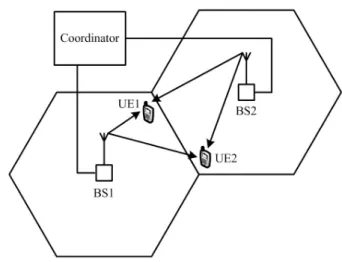
1.1 Illustration for CoMP-JT mode. The solid arrows stand for the signal links. . . 2
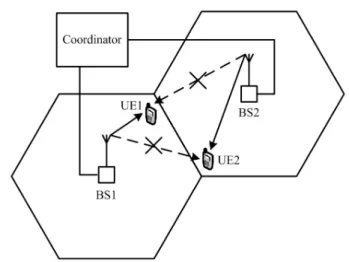
1.2 Illustration for CoMP-CB mode. The solid arrows stand for the signal links and the dashed ones are the interfering links. . . 3
2.1 A clustering example with B = 2 and Nb = 4. . . 9
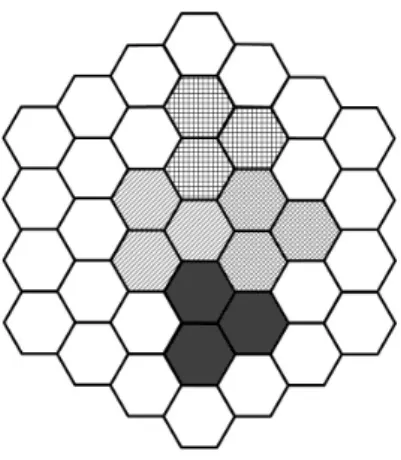
2.2 Proposed static clustering table when cluster size B = 3. . . . 16
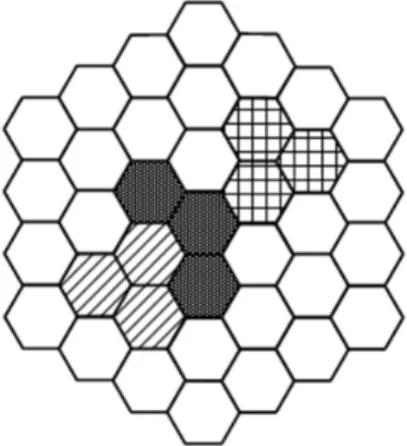
2.3 A snapshot of the dynamic clustering. . . 18
2.4 Average rate versus the edge-SNR. . . 20
2.5 The average rate versus different pilot SINR threshold. . . 22
2.6 The CDF of the CoMP requesting users. . . 24
2.7 The CDF of the CoMP included users. . . 24
2.8 The CDF of the last five percent users. . . 25
2.9 The average rate versus different CoMP cluster size. . . 26
2.10 The CDF of the CoMP requesting users using weighted sum utility versus different CoMP cluster size. . . 26
3.1 Block diagram for downlink multi-user MIMO-OFDM. . . 27
3.2 Flowchart of our resource allocation algorithm. . . 37
3.3 Illustration for three-sectorized CoMP. . . 38
3.4 Edge-SNR versus different target rate. . . 40
3.5 Edge-SNR versus different number of antennas. . . 40
3.6 User rate convergence behavior. . . 42
3.7 Sum-power convergence behavior. . . 42
3.8 Normalized transmit power on antenna 1 over 100 channel realizations when pcona ∼= 8.019 W. . . . 43
3.9 Normalized transmit power on antenna 1 over 100 channel realizations when pcon a ∼= 1.271 W. . . . 43
4.2 Illustration for ACE with 16-QAM modulation. . . 48
4.3 Illustration of block-IDFT. . . 49
4.4 The SNR versus different rate requirements. . . 56
4.5 A snapshot of the data symbols with QPSK modulation after ACE. . . 56
4.6 A snapshot of the data symbols with 16-QAM modulation after ACE. . . 57
4.7 The CCDF of the PAPR after ACE. . . 58
4.8 The CCDF of the PAPR after ACE with different oversampling factors. . . 58
4.9 The CCDF of the PAPR after ACE with different PAPR targets. . . 59
LIST OF TABLES
Table Page
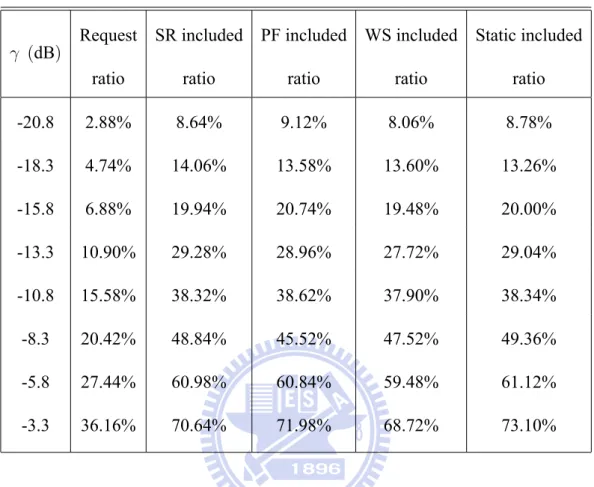
2.1 The CoMP request ratio and the actual CoMP included ratio against different pilot SINR threshold. . . 21
CHAPTER 1
INTRODUCTION
With the demand of high data rate in the future wireless communication systems,
multiple-input multiple-output (MIMO) techniques have been proposed to improve the system
through-put. Besides, in a cellular network, the frequency band can be reused in a one cell fashion to
maximize the spectral efficiency. However, one cell frequency reuse limits the performance of
MIMO systems due to severe other-cell interference (OCI) [1]. Although the receiver can
elim-inate the interference by applying techniques like successive interference cancellation (SIC),
but in the downlink, this burdens the user equipment (UE) with high computational
complex-ity. Recently, a promising way called CoMP has been proposed by the long-term evolution
advanced (LTE-A) to suppress OCI. The idea of CoMP is to gather a group of BSs which share
channel state information (CSI) and/or user data via high speed backhaul. In this way, the BSs
can cooperate to lower the interference. On the other hand, since the channel varies with the
user location, we can allocate power in different domains like frequency and space according to
their channel quality. LTE-A prescribes orthogonal frequency division multiplexing (OFDM)
for downlink transmission, such a multi-tone system suffers from high PAPR, which reduces
the transmit power efficiency. In this thesis, we discuss the CoMP, power allocation and PAPR
reduction issues, and some algorithms suitable for BS coordination scenario are proposed. It
Figure 1.1: Illustration for CoMP-JT mode. The solid arrows stand for the signal links.
1.1
CoMP Concept
In LTE-A downlink, there are two classes of CoMP schemes named joint transmission (JT)
and coordinated beamforming (CB). One can distinguish these two modes by the type of
infor-mation sharing. The former requires both CSI and data exchange and the latter needs only CSI
exchange.
The concept of CoMP-JT can be illustrated using Figure 1.1. Conceptually, the cellular
network which deploys CoMP-JT is equivalent to multi-user MIMO (MU-MIMO) with some
distinctions that the transmit antennas now belong to distributed BSs and the channels to
differ-ent users experience independdiffer-ent pathloss and shadowing. Joint transmission means the signal
intended for any user is jointly pre-processed and transmitted from all the BSs. Therefore, the
interfering links (a link is the channel from a BS to a user) are transformed into useful links.
The drawback of this mode is that the data for every user and the CSI of all the links need to be
shared among the BSs, which increases the backhaul overhead.
In the case of CoMP-CB (see Figure 1.2), as conventional single cell scheme, each BS
Figure 1.2: Illustration for CoMP-CB mode. The solid arrows stand for the signal links and the
dashed ones are the interfering links.
the other cell by acquiring the CSI of the interfering links. In this mode, there is no data
shar-ing, which reduces the backhaul traffic. However, the design target is to eliminate the generated
interference but not to make use of it, which leads limited performance gain compared to
CoMP-JT. In both cases, the users need to feedback the CSI from all the links including the interfering
ones. In time division duplex (TDD) mode, the job of channel estimation can be placed in either
BS or user side, while in frequency division duplex (FDD) mode, user has to estimate the CSI
and feedback through uplink channels.
Plentiful research works on CoMP-JT can be found in the recent years [2]-[6]. [2] gives
an overview including the currently known techniques for JT (also a part of
CoMP-CB), practical issues related to system complexity and main challenges for future CoMP design.
A straightforward way to implement CoMP-JT is to build a central coordinator (CC) which
collects all the CSI and then computes the precoding weights for all the users. The performance
analysis to this way, using nonlinear (dirty paper coding, DPC) and linear (zero-forcing, ZF and
minimum min square error, MMSE) precoding, was studied in [3] and [4], respectively. Such a
to overcome this problem is dividing the BSs into several clusters [5], [6].
As for CoMP-CB, [7] proposed a beamforming algorithm which aims to find the interfering
users with similar channels. Another way to suppress interference using distributed resource
allocation is discussed in [8]. In this thesis, we mainly focus on CoMP-JT.
In order to reduce the overhead, there are only a limited number of BSs can be included in
a CoMP cluster. This leads to the question which BSs should form the clusters to maximize the
system performance at manageable complexity. Static [9] and dynamic [10] clustering are two
types of forming CoMP clusters. Static clustering can be performed in advance based on field
measurements or geographical relations. Whereas dynamic clustering exploits CSI and changes
the cluster groups over time. Algorithms for these two types can be found in Chapter 2.
1.2
Resource Allocation
After the BSs in the cellular network are grouped into several CoMP clusters, there are more
jobs we can do in each cluster to improve the system performance. OFDM is chosen to be
the modulation scheme for the downlink LTE-A, one advantage of the multicarrier system is
that the power and rate can be allocated over different tones according to their variety if the
transmitter has the CSI. In general, there are two objectives of resource allocation: the sum-rate
maximization and power minimization [11], [12]. We pay our attention on the latter in this thesis
for power saving.
Traditionally, resource allocation problems are formulated under sum-power constraint on
the transmit antennas. However, per-antenna power constraint would be more realistic since
each antenna has independent power amplifier. Besides, for avoiding inter-user interference,
many systems apply orthogonal frequency division multiple access (OFDMA) technique which
im-proved by separating the users in the spatial domain when the transmitter equips multiple
an-tennas [13], in this way, multiple users can share the same subcarrier. As for the user terminals,
different users may have individual quality of service (QoS) requirements such as minimal data
rate and acceptable bit error rate (BER).
In Chapter 3, the power minimization problem under user rate and BER constraints as in
[12] is considered. To make this problem more general, we add additional per-antenna power
constraint and extend the system to a multi-cell scenario. The problem is non-convex since it
aims to find the optimal set among different subcarrier and user combinations, and the
com-plexity increases exponentially with the number of subcarriers and users. Therefore, efficient
solutions must be found to make the complexity feasible. Although the original problem is not
convex, it can be transformed to another problem based on Lagrange dual decomposition [12].
The transformed problem is always concave regardless of the convexity of the original problem.
In this way, conventional convex optimization techniques can be applied to solve this problem
efficiently.
1.3
PAPR Reduction
Although the average transmit power can be minimized via the techniques introduced in
Chapter 3, however, the power consumption of the power amplifier (PA) is dominated by the
peak power rather than the average power. One of the main drawbacks of OFDM is the large
PAPR, which makes the efficiency of the PA very poor (the definition of PAPR is left in section
4.3.1. In order to transmit a signal with wide power rang, an expensive PA is needed. For
im-proving the power efficiency, several classes of PAPR reduction techniques have been proposed
[14]-[16].
re-serves some unused subcarriers and inserts signals to reduce the PAPR. This method causes
no distortion to the data-carrying subcarriers due to the orthogonality of subcarriers. However,
there exists a tradeoff between the PAPR reduction performance and the number of the reserved
subcarriers. Reserving more subcarriers yields better performance, but sacrifices the available
bandwidth for transmitting information data.
Another class called active constellation extension (ACE) tries to reduce PAPR by altering
the constellation of the data [15], [16]. Without reserving any subcarrier, this scheme maps the
original constellation to a constrained space which produces lower PAPR.
In Chapter 4, we first propose a suboptimal power allocation algorithm to reduce the
av-erage transmit power. As stated above, the power consumption depends mainly on the peak
power. Hence we introduce a PAPR reduction scheme which combines tone reservation and
constellation extension. This scheme is based on the idea of [15]. Additionally, we made some
modifications so that it is suitable for CoMP-JT systems. As a note, this approach is designed
for the signal which employs quadrature amplitude modulation (QAM).
1.4
Organization of this thesis
The rest of this thesis is organized as follows. In Chapter 2, we start with the CoMP clustering
concept. How does a cellular network implement CoMP and which BSs should form a CoMP
cluster will be illustrated. In Chapter 3, assuming all the CoMP clusters have been planned, we
design an optimal power allocation method for each cluster. For power saving, the objective is
to minimize the total transmit power. Chapter 4 deals with the problem of PAPR. A practical
PAPR reduction algorithm suitable for the CoMP system is proposed. Finally, Chapter 5 gives
the conclusion of this thesis. It should be noted that Chapter 2 - 4 have their own system models
Throughout this thesis, we adopt some notations: Matrix and vectors are denoted by
up-percase and lower case boldface letters; IN is the N × N identity matrix; A [i, j] indicates the
element in the row i and column j of the matrix A;∥ · ∥2
F and∥ · ∥2∞are the Frobenius norm
and infinity norm; (·)∗, (·)T and (·)H represent the conjugate, transpose and conjugate transpose operators.
CHAPTER 2
CLUSTERING TECHNIQUES FOR COMP
2.1
System Model and Transmission Schemes
Consider a downlink cellular network consists of Nb BSs with Nt antennas each and Kb
active users in the bth cell with N
r antennas each. All the BSs operate on the same carrier
frequency so they will cause interference to each other. Assume that the BSs in the network
are divided into several clusters, each contains B BSs, where B ≤ Nb (see Figure 2.1). The
clusters are all non-overlapping groups. In other words, if one BS has been involved in a cluster,
it cannot join the others. LetG be one of the set of the selected BSs in a cluster. The received signal of the kth user in the bthcell of the setG can be written as
yGk,b = Hbk,bxk,b+ ∑ i̸=k,i↔b Hbk,bxi,b+ ∑ b∈G,b̸=b ∑ j↔b Hbk,bxj,b+∑ eb/∈G ∑ l↔eb Hebk,bxl,eb+ nk,b, (2.1)
where Hbk,bis the Nr× NtMIMO channel from the BS b to the user k served by the BS b, xk,bis
the Nt×1 transmitted signal and nk,bis the corresponding Nr×1 received noise vector, in which
each element is a zero-mean complex Gaussian random variable with variance N0. The first term
of (2.1) is the desired signal, the second is the inter-user interference (IUI) in the bthcell where
i↔ b means the user i is served by the BS b, the third is the intra-cluster interference (ICI) from the BSs in the clusterG except the BS b, and the last term is the outer-cluster interference (OCI) from the BSs outside the clusterG.
Figure 2.1: A clustering example with B = 2 and Nb = 4.
2.1.1
Single Cell Processing
In this scenario, each BS serves its users without coordinating with the other BSs, i.e., B = 1.
Assume the bthBS is considered. The transmit precoding matrices for the user k in the BS b are
designed in the following two cases respectively.
Case 1) Eigenmode Precoding for Kb = 1
When there is only one user per BS, the received signal of the user k in the cell b can
be written as yk,b = Hbk,bxk,b+ ∑ b̸=b ∑ i↔b Hbk,bxi,b+ nk,b. (2.2)
Note that the index for cluster is ignored here since there is no clustering concept when
B = 1. When each BS has only the CSI of its served user, the precoding matrix can be designed by performing singular value decomposition (SVD) on Hbk,b:
Hbk,b = Ubk,bSk,bb (Vbk,b)H, (2.3) where Sbk,b ∈ CNr×Nt is the matrix which contains the singular values, Ub
k,b ∈ CNr×Nr
and Vbk,b∈ CNt×Nt collects the left and right singular vectors, respectively. Let Pb k,bbe
the power allocation matrix for the user k in the BS b. Here we assume a simple equal
power allocation, that is
Pbk,b=(√pcon/N
r
)
where pconis the sum power constraint per BS. The precoding matrix can be chosen as
Fbk,b= Vbk,b (2.5) and the receive equalization matrix is
Qbk,b=(Ubk,b)H. (2.6) Having the precoding matrix, the pre-processing can be done as
xbk,b = Fbk,bPbk,bdbk,b, (2.7) where dbk,b ∈ CNr×1 represents the information data. After receive equalization, the
signal becomes rk,b = Qbk,byk,b = Qbk,b Hb k,bxk,b+ ∑ b̸=b ∑ i↔b Hbk,bxi,b+ nk,b =(Ubk,b)HUbk,bSbk,b(Vk,bb )HVbk,bPbk,bdbk,b+ Qbk,b∑ b̸=b ∑ i↔b Hbk,bxi,b+ Qbk,bnk,b = Sbk,bPbk,bdbk,b+∑ b̸=b ibk,b+enk,b, (2.8) where ibk,b = ∑ i↔b
Qbk,bHbk,bxi,b is the equivalent interference from BS b. Therefore the spatial streams can be extracted as
rk,b,l = sbk,b,l √ pb k,b,ld b k,b,l+ i b k,b,l+enk,b,l, 1≤ l ≤ Nr, (2.9)
where dbk,b,lis the lthelement of dbk,b, sbk,b,land pbk,b,lare the corresponding singular value and the power loading weight, respectively, ib
k,b,l is the interference on the lth stream
andenk,b,l is the complex Gaussian noise with variance N0. As a result, the Nr × Nt
MIMO channel Hbk,b is decoupled into Nr parallel single-input single-output (SISO)
signal-to-interference plus noise ratio (SINR) of the lthstream for the user k in the BS b is SIN Reigenk,b,l = ( sb k,b,l )2 pb k,b,l E [ ∑ b̸=b ib k,b,l ( ib k,b,l )∗] + N0 (2.10)
and the capacity is
Ck,beigen =
Nr
∑
l=1
log2(1 + SIN Reigenk,b,l ). (2.11) Case 2) Block Diagonalization (BD) [13] for Kb > 1
In this case, the interference seen by the user k in the BS b can come from the other
users in the same BS and those in the other BSs. The received signal can be written as
yk,b = Hbk,bxk,b+ ∑ i̸=k,i↔b Hbk,bxi,b+ ∑ b̸=b ∑ j↔b Hbk,bxj,b+ nk,b. (2.12)
Having only the CSI of the users in its scope, each BS can apply BD to eliminate the
IUI, i.e., the second term of (2.12). There is a restriction on BD, which is Nt≥ KbNr,
that is, the number of the transmit antennas must be larger than or equal to the sum of
the number of the receive antennas. We introduce the procedure of designing the BD
precoder below.
For simplicity, the index for BS is ignored here. The composite channel of all the users
in the cluster can be written as H =[HT1, . . . , HTK]T ∈ CKNr×Nt. Then we collect the
interfering channels to the user k and apply SVD as
[ HT1, . . . , HTk−1, Hk+1T , . . . , HTK]T = UkSk [ VkVk ]H , (2.13)
where Vk ∈ CNt×(Nt−(K−1)Nr)is the matrix which contains the right singular vectors
that correspond to the zero singular values and therefore is the null space. The
equiva-lent channel to the user k after orthogonalization is given by
e
Apply SVD again on eHkand get
e
Hk= eUkeSkeVk. (2.15)
Similarly, we can use eigenmode precoder to decompose the equivalent MIMO channel
e
Hk. The transmit precoding matrix can be designed as
Fk = VkeVk (2.16)
and the receive equalization matrix is
Qk= eUHk. (2.17) Hence, the users in the BD deployed BS will not observe interference from each other
because their channels are mutually orthogonal, although the interference from the other
BSs still remains. Since there are K users now, the power allocated to each user should
be divided by K. Thus, the power allocation matrix should be
Pk = (√ pcon/KN r ) INr. (2.18)
Since the inter-user interference is eliminated, the capacity for the user k can be
repre-sented in the same form as 2.11, the difference is that each BS now applies BD but not
eigenmode precoding.
2.1.2
Base Station Cooperation
In this section, we show where the BD algorithm should be modified when it is applied to a
multi-cell scenario. Assume a CoMP clustering algorithm is applied and some CoMP clusters
are formed. In JT mode, all the users' information data and channels are shared among the BSs in
the same cluster. Therefore, the grouped BSs can be seen as a huge BS with additional antennas.
scope. The multi-cell BD can be done in a way similar to the Case 2 of single cell processing with
some little differences that the transmit antenna Ntbecomes BNtand the sum power constraint
pcon changes to Bpcon. Like single cell BD, the channels of all the users in the same cluster will
become orthogonal to each other after multi-cell BD. Therefore, the interference only comes
from the BSs outside the cluster, and the received signal of the user k in the BS b of the cluster
G can be written as yGk,b = HGk,bxGk,b+∑ b /∈G ∑ i↔b Hbk,bxi,b+ nGk,b, (2.19) where HGk,bis the Nr×BNtmulti-cell MIMO channel and xGk,bis the BNt×1 transmitted signal.
The joint BD precoding matrix is
FGk,b = VGk,beVGk,b, (2.20) where VGk,bis the null space of the other users inG except the user k and eVGk,bis the matrix which collects the first Nrright singular vectors of the projected channel eHGk,b = HGk,bV
G
k,b. The jointly
pre-processed signal can be represented as
xGk,b= FGk,bPGk,bdGk,b, (2.21) where the power allocation matrix is
PGk,b= √Bpcon/∑ b∈G KbNr INr, (2.22)
(assume every BS has the same transmit power constraint pcon) and dG
k,bis the information data.
If the user k chooses the equalization matrix to be
QGk,b= ( eUG k,b )H , (2.23)
where eUGk,bcontains the left singular vectors of the projected channel eHGk,b. The equalized signal at the receiver side can be derived following the similar steps of (2.8) and given by
rGk,b = QGk,b HG k,bxGk,b+ ∑ b /∈G ∑ i↔b Hbk,bxi,b+ nGk,b = QGk,bHGk,bVGk,beVGk,bPGk,bdGk,b+∑ b /∈G ∑ i↔b QGk,bHbk,bxi,b+ QGk,bnGk,b = ( eUG k,b )H eUG k,beSGk,b ( eVG k,b )H eVG k,bPGk,bdGk,b+ ∑ b /∈G ibk,b+enGk,b = eSGk,bPGk,bdGk,b+∑ b /∈G ibk,b+enGk,b. (2.24) Being similar to (2.9), the multi-cell MIMO channel is decoupled and the lthspatial stream is
rk,b,lG = sGk,b,l √
pGk,b,ldGk,b,l+ ibk,b,l+enGk,b,l, 1≤ l ≤ Nr. (2.25)
The SINR of the lthstream for the user k in the BS b of the clusterG is
SIN RCoMPk,b,l = ( sGk,b,l)2pGk,b,l E [ ∑ b /∈G ib k,b,l ( ib k,b,l )∗] + N0 (2.26)
and the capacity is
Ck,bCoMP =
Nr
∑
l=1
log2(1 + SIN RCoM Pk,b,l ). (2.27) In BS cooperation scenario, the signal from different BSs will experience different delay.
There-fore, synchronization is an important topic. Nevertheless, to simplify our system, we assume
the synchronization is always perfect.
2.2
Clustering Algorithms
2.2.1
Static Clustering
Static clustering is a feasible way to form the clusters in the cellular network. It can be
determined, it will not change over time. The advantage of this clustering type is that routing
CSI and user data to a central coordinator (CC) is unnecessary. Instead, it requires a distributed
coordinator (DC) per cluster which controls the BSs. The cooperation only takes place in each
cluster and different clusters do not communicate with each other, which reduces the overheads.
Here we propose a static clustering algorithm as follow. In each cell, we assume there is only
one scheduled user, so the index for user can be ignored and the new notation Hbbstands for the channel from the BS b to its user.
Algorithm Static Clustering Algorithm.
1: Specify the CoMP cluster size B;
2: Each user measures channel gains and calculates his pilot SINR by
SIN Rpilotb = Hbb 2/ ∑ b̸=b,b∈Ib Hb b 2 + N0 , ∀b, (2.28) whereIbis set of the six first tier interfering BSs around BS b, i.e., only the pilots from the
neighboring BSs are regarded as the valid interference. If SIN Rpilotb < γ, where γ is the threshold, the user requests CoMP service to the BS b through uplink. Then BS b sends the
request to its DC;
3: DC finds the remaining B− 1 BSs which should cooperate with the BS b based on the pre-defined clustering table (see Figure 2.2 for the case of B = 3), and makes them to form a
cluster;
4: Go back to step3 until all the CoMP needed users are satisfied;
The clusters are formed by neighboring BSs here. Since in average, they cause stronger
in-terference compared with those farther BSs. Although static clustering reduces the inter-cluster
communication overhead, it inherits the fairness problem from single cell scenario that the users
Figure 2.2: Proposed static clustering table when cluster size B = 3.
2.2.2
Dynamic Clustering
Static clustering has very limited performance gain since the variation of the channel
con-dition is not fully exploited. As mentioned in the previous section, we select the neighboring
BSs to form static clusters. Since on average, they are the ones which cause strong
interfer-ence. Nevertheless, due to the effect of shadowing, a user might experience a better channel to
a farther BS, in other words, interference does not always come from near BSs. Therefore, it
is not flexible to form fixed clusters by grouping BSs which are close to each other. Besides,
users at the edge of the static cluster experience much more interference from the neighboring
clusters than the ones located around the center of the cluster, which causes fairness problem. In
order to overcome the aforementioned problems, the idea of dynamic clustering has been
intro-duced. Geographical relation is not the main concern anymore. Instead, we try to group the BSs
which cause the strictest interference before any cooperation. The proposed greedy algorithm
Algorithm Dynamic Clustering Algorithm.
1: Specify the CoMP cluster size B;
2: Each user calculates his SIN Rpilotb as defined in (2.28). If SIN Rpilotb < γ, the user sends CoMP request to the serving BS b;
3: The CC collects all the requests and chooses a CoMP needed user who has not been chosen
so far uniformly;
4: Find the remaining B− 1 BSs which maximize the utility function J(C1CoMP, . . . , CBCoMP) with the user chosen in step 3, where CCoMP
b is the capacity given by (2.27). We let only the
first tier BSs around the selected user to be the candidates, i.e., b∈ Ib. If the available BSs
is less than B− 1, the user cannot acquire CoMP service at this time slot, then CC drops this user and picks another one uniformly;
5: Go back to step 3 until all the CoMP needed users find their partners;
We provide three choices of the utility function in this dynamic algorithm:
• Sum-rate (SR) utility: J1 = 1 B B ∑ b=1 CbCoMP (2.29)
• Proportional fair (PF) utility:
J2 = ( B ∏ b=1 CbCoMP )1/B (2.30)
• Weighted sum (WS) utility:
J3 =
B
∑
b=1
wbCbCoMP (2.31)
The purpose of the weight is to find the users who really need CoMP, i.e., the users with low
SINR. So the weight is set to the reciprocal of the SINR, which is
where qb = log2 ( 1 + SIN Rpilotb ) (2.33)
is the transformed SINR which approximates capacity and
c = 1 B ∑ b=1 q−1b (2.34)
is a normalization factor such that
B
∑
b=1
wb = 1. Note that SIN Rpilotb is the SINR experienced by
the users before CoMP. The user with larger SIN Rpilotb will get lower weight, since the perfor-mance gain is little when apply CoMP to the users with high SINR.
Figure 2.3 shows a snapshot of the dynamic clustering result. No matter which utility
func-tion is chosen, the CoMP clusters can be formed adaptively according to the change of channel
conditions. Hence there are no constant cluster edges and therefore no users will suffer from
more interference. However, there must exits a CC to run the dynamic clustering algorithm.
Besides, the overhead of routing the CSI and user data is higher than the static scheme.
Since the available BSs for selection are reducing through the dynamic algorithm, it benefits
the user that is chosen earlier in Step 3. To circumvent this fairness issue, we have to choose the
user uniformly. Therefore, on average, everyone obtains close performance gain.
2.3
Simulation Results
We consider a downlink network consists of thirty-seven cells overall (Nb = 37), i.e., the
first three tiers of cells, each cell has one BS at its center. Every BS has two omnidirectional
antennas (Nt = 2) and each user has two antennas (Nr= 2). The cell radius is set to 1 Km. The
MIMO channel from the BS b to the user k served by the BS b is
Hbk,b = Rbk,b/ √ β ( db k,b )α sb k,b, (2.35)
where Rbk,bis the Nr× NtRayleigh fading channel, in which the elements are all i.i.d. complex
Gaussian random variables, sb
k,b is log-normal distributed with 8 dB standard deviation which
models the shadowing effect and dbk,bis the corresponding distance in Km. For the pathloss, the 3GPP LTE pathloss model [10] is used, where β = 1014.81 and α = 3.76. The noise power
spectral density is -174 dBm/Hz. Suppose that all of the BSs transmit on the same subcarrier
with 15 KHz subcarrier spacing, so the noise power is N0 ∼= −162.2391 dBW. One user is
generated uniformly in each cell (Kb = 1, ∀b) to simulate the round-robin scheduling, and we
assume the user has not been handed off to another cell, i.e., the user generated in the cell b is
served by the BS b, although the strongest signal may come from another BS. The cluster size
B is fixed to three unless otherwise stated. We only observe the performance of the user in the central cell in the network, whereas all of the users in the central cell and its first tier BSs (total
seven users) are allowed to request CoMP service. For our observed user in the central cell, only
the signals from the six first tier BSs are treated as interference. The six BSs could be CoMP or
non-CoMP BSs, which depends on the result of our clustering algorithm. If it is a CoMP BS,
it deploys multi-cell BD (see section 2.1.2) with its partners. Otherwise, it applies single cell
0 5 10 15 20 25 30 35 3.4 3.6 3.8 4 4.2 4.4 4.6 4.8 5 Edge−SNR (d B) Average Rate (bps/Hz) Sum−Rate Weighted Sum PF Static NonCoMP
Figure 2.4: Average rate versus the edge-SNR.
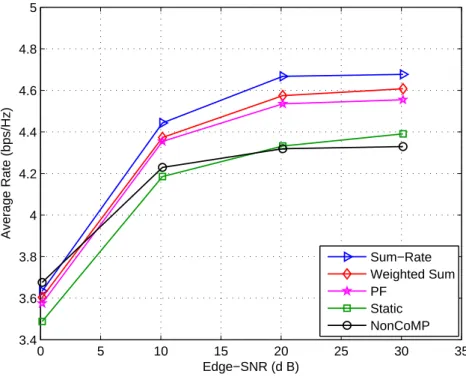
Figure 2.4 shows the average rate as a function of the edge-SNR when the pilot SINR
thresh-old γ =−8.3 dB. The edge-SNR is defined as the SNR measured by the user located at cell-edge without shadowing and interference, which is given by
SN Redge(dB) = pcon(dBW)− 10log10(β)− 10αlog10(rcell)− N0(dBW) , (2.36)
where rcellis the cell radius. In (2.36), we count the transmit power from only one BS, but each
user receives multiple signal from all the BSs in the same CoMP cluster in our simulation. We
can see that all the clustering schemes outperform the non-CoMP one when SN Redge > 20 dB
since the interference is reduced. The three dynamic approaches provide better average rate gain
against the static clustering because they exploit the instantaneous CSI. Due to the target of the
utility function, using sum-rate utility gets the best average rate and weighted sum is better than
Table 2.1: The CoMP request ratio and the actual CoMP included ratio against different pilot SINR threshold. γ (dB) Request ratio SR included ratio PF included ratio WS included ratio Static included ratio -20.8 2.88% 8.64% 9.12% 8.06% 8.78% -18.3 4.74% 14.06% 13.58% 13.60% 13.26% -15.8 6.88% 19.94% 20.74% 19.48% 20.00% -13.3 10.90% 29.28% 28.96% 27.72% 29.04% -10.8 15.58% 38.32% 38.62% 37.90% 38.34% -8.3 20.42% 48.84% 45.52% 47.52% 49.36% -5.8 27.44% 60.98% 60.84% 59.48% 61.12% -3.3 36.16% 70.64% 71.98% 68.72% 73.10%
Table 2.1 gives the probability of the CoMP requesting users and the actual CoMP included
users with different pilot SINR threshold when SN Redge ∼= 30 dB. In both of the static and
dynamic algorithms, there are two types of users named the CoMP requesting users and the
CoMP included users. The CoMP requesting user is the one whose pilot SINR is lower than the
threshold, in other words, is the user who sends CoMP request. The CoMP included users are
the CoMP requesting user plus the B− 1 users who are forced to get CoMP service (see the clustering algorithm in either section 2.2.1 or 2.2.2. For instance, if B = 3 and the user in the
BS 1 sends a CoMP request. The coordinator makes the users in the BS 2 and 3 to be the CoMP
partners of the user in the BS 1. Then the user served by the BS 1 is called the CoMP requesting
user and all of them are called CoMP included users. This table tells us the percentage of these
static CoMP included users is higher than the three dynamic ones when the threshold is high.
Because when the threshold is getting larger, more and more users request CoMP. As a result,
some CoMP requesting users in the dynamic clustering algorithm cannot find sufficient BSs to
form a cluster.
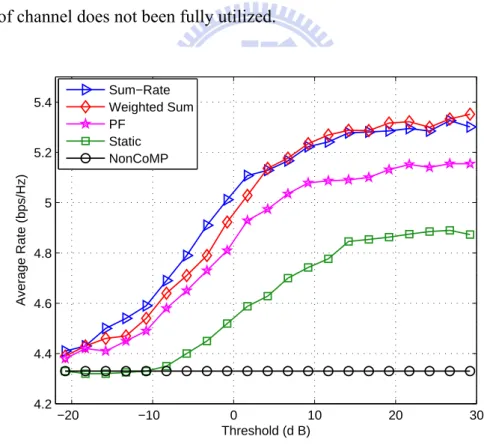
Figure 2.5 plots the average rate versus different pilot SINR threshold when SN Redge ∼=
30 dB, which corresponds to pcon = 16 dBW. As stated in Table 2.1, with the increasing of the
threshold, more users can request CoMP and therefore the average rate is getting better with the
price of higher network overhead. The average rates saturate when the threshold is high enough
(about 15 dB above), since almost 100 % users are included in CoMP areas now. The static
scheme obtains relatively low performance gain compared to the three dynamic ones because
the variety of channel does not been fully utilized.
−20 −10 0 10 20 30 4.2 4.4 4.6 4.8 5 5.2 5.4 Threshold (d B) Average Rate (bps/Hz) Sum−Rate Weighted Sum PF Static NonCoMP
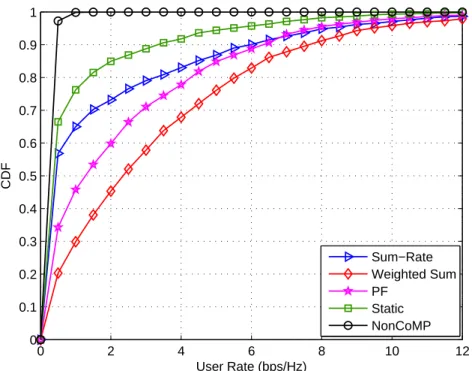
In Figure 2.6, the cumulative distribution function (CDF) of the capacity for the CoMP
re-questing users is plotted. The setup here is pcon = 16 dBW and γ = −8.3dB. The weighted
sum dynamic scheme outperforms the others since it makes the users with low SINR to form
the CoMP cluster and hence reduces the most interference. The black line with circle marker is
the users whose SIN Rpilot < γ but there is no CoMP service available in the network, which is
very poor compared with the other CoMP approaches.
Figure 2.7 is the CDF of the CoMP included users when the setup is the same as the one
in Figure 2.6. Seemingly, the sum-rate and the proportional fair schemes are better than the
weighted one. However, the reason is that they find the high SINR users to be the partners of
the CoMP requesting users. Note that if the SINR is already high, the effect of CoMP is limited
since the purpose of BS cooperation is to suppress interference. Therefore it is inefficient to
include users with high SINR in the CoMP cluster, even though it seems that the average rate of
the CoMP included users is increased.
Figure 2.8 plots the CDF of the last five percent users using the same setup as the one in
Figure 2.6. As mentioned above, we only observe the performance of the user in the central
cell. However, we can generate different samples of the user locations. For each sample, the
user capacity after running our BS clustering algorithms is calculated, and we sort the capacity
for all the samples and observe the ones with the lowest 5 % capacity. In general, the users with
such low capacity are located near cell-edge. So this figure shows the approximate performance
of the cell-edge users. It can be seen that the dynamic clustering scheme improves significant
fairness. The sum-rate approach provides less performance gain since it puts resource to the
0 2 4 6 8 10 12 0 0.1 0.2 0.3 0.4 0.5 0.6 0.7 0.8 0.9 1 User Rate (bps/Hz) CDF Sum−Rate Weighted Sum PF Static NonCoMP
Figure 2.6: The CDF of the CoMP requesting users.
0 2 4 6 8 10 12 0 0.1 0.2 0.3 0.4 0.5 0.6 0.7 0.8 0.9 1 User Rate (bps/Hz) CDF Sum−Rate Weighted Sum PF Static
0 0.05 0.1 0.15 0.2 0 0.1 0.2 0.3 0.4 0.5 0.6 0.7 0.8 0.9 1 User Rate (bps/Hz) CDF Sum−Rate Weighted Sum PF Static NonCoMP
Figure 2.8: The CDF of the last five percent users.
Figure 2.9 illustrates the effect of increasing the CoMP cluster size when the setup is the
same as the one in Figure 2.6. As expected, the average rate increases with the cluster size since
more interference is eliminated. The drawback is the raise of network overhead.
In Figure 2.10, the CDF of the weighted sum scheme versus different CoMP cluster size is
plotted when the setup is the same as the one in Figure 2.6. Only the performance of the CoMP
requesting users is observed. In addition to sum rate benefit, increasing the cluster size provides
3 3.5 4 4.5 5 5.5 6 6.5 7 4.6 4.8 5 5.2 5.4 5.6 5.8 6 6.2 6.4
CoMP Cluster Size
Average Rate (bps/Hz)
Sum−Rate Weighted Sum PF
Figure 2.9: The average rate versus different CoMP cluster size.
0 5 10 15 20 25 30 0 0.1 0.2 0.3 0.4 0.5 0.6 0.7 0.8 0.9 1 User Rate (bps/Hz) CDF
Weighted Sum, size = 3 Weighted Sum, size = 5 Weighted Sum, size = 7
Figure 2.10: The CDF of the CoMP requesting users using weighted sum utility versus different
CHAPTER 3
ADAPTIVE RESOURCE ALLOCATION
3.1
System Model and Transmission Schemes
In Chapter 2, we focus on a specific subcarrier and tackle the problem of BS clustering.
In this chapter, we extend the scenario to a more general multi-carrier system. Suppose some
CoMP clusters are formed in the cellular network based on a clustering algorithm. For the sake
of illustration, only one cluster is taken into consideration. Assume there are B BSs and K users
overall in this CoMP cluster, each BS equips Nt antennas and each user has Nr antennas. In
CoMP-JT mode, user data and CSI are shared across all the BSs in the same cluster, therefore,
a cluster is equivalent to a super BS with NT = BNt antennas which serves K users
simul-taneously. Let there are M available subcarriers, the downlink transmission can be illustrated
by Figure 3.1. In general, users are allocated to different subcarriers in order to avoid inter-user
interference. However, we can apply BD to decouple the channels of different users on the same
subcarrier. In this way, the spectral efficiency will be improved since multiple users can share
the same bandwidth.
Assume we place Km users on subcarrier m. After removing the cyclic prefix (CP) at the
user side, the signal can be processed in a per-subcarrier MIMO fashion. That is, the input-output
relation on every subcarrier can be represented in a MIMO structure. Ignoring the outer-cluster
interference, the received signal of the user k on the subcarrier m can be represented as
yk,m = Hk,mxk,m+ Km
∑
n=1,n̸=k
Hn,mxk,m+ nk,m, (3.1)
where Hk,mis the Nr×NT MIMO channel, xk,mis the NT×1 transmitted signal for the user k and
nk,mis the zero-mean complex Gaussian noise vector with covariance matrix E
[
nk,m(nk,m) H]
=
N0INr. After BD (refer to section 2.1.1) pre-filtering, the transmitted signal can be represented
as
xk,m= Fk,mPk,mdk,m (3.2)
where Pk,m is the Nr × Nr power allocation matrix and dk,mis the Nr × 1 data vector before
pre-filtering. The BD matrix is Fk,m= Vk,meVk,m, where Vk,mmakes the channel of the user k
to be orthogonal to the channels of the others, and eVk,m decouples the orthogonalized MIMO
channel of the user k into Nrparallel SISO channels. Following the derivation similar to (2.24)
and (2.25), the lthspatial stream for the user k is
rk,m,l = sk,m,l√pk,m,ldk,m,l+enk,m,l, 1≤ l ≤ Nr, (3.3)
where sk,m,l is the lthsingular value of the orthogonalized channel matrix of the user k on
sub-carrier m, pk,m,lis the power allocated on this stream, dk,m,lis the lthelement in dk,mandenk,m,l
is a zero-mean complex Gaussian noise with variance N0.
3.2
Problem Formulation
The mathematical problem of power minimization is formulated in this section. In order to
the transmit power while satisfies some constraints. In practice, users may have different QoS
requirements such as target data rate and tolerable BER. On the other hand, each antenna has its
own power amplifier and therefore has a unique transmit power constraint. Considering all the
issues above, the power minimization problem can be formulated as
minimize pk,m,l K ∑ k=1 M ∑ m=1 Nr ∑ l=1 pk,m,l subject to M ∑ m=1 Nr ∑ l=1 rk,m,l ≥ Mrtark , 1≤ k ≤ K K ∑ k=1 M ∑ m=1 Nr ∑ l=1 |Fk,m[a, l]| 2 pk,m,l ≤ pcona , 1≤ a ≤ NT pk,m,l ≥ 0, ∀k, m, l, (3.4)
where pk,m,l and rk,m,l is the transmit power and rate allocated on the lth stream of the user k
on the subcarrier m, rktar is the target data rate in bps/Hz, Fk,m[a, l] is the element in the ath
row and lthcolumn of the BD matrix F
k,m, and pcona is the power constraint on transmit antenna
a. Note that if the bandwidth of each subcarrier is β, the total rate requirement per user of one OFDM symbol is M βrtark (bps), therefore, M rtark bits are required during the period of one OFDM symbol. The rate rk,m,lcan be written as
rk,m,l = log2 ( 1 + pk,m,ls 2 k,m,l τ N0 ) , (3.5)
where τ is the SNR gap given by
τ =−ln (5BER
tar)
1.5 , (3.6)
where BERtaris the target BER specified by the users. Although the capacity is hard to achieve
in practice, it provides an upper bound that tells us how well we can do. The problem (3.4)
implies a user selection problem on each subcarrier. If pk,m= Nr
∑
l=1
pk,m,l = 0, the user k is absent
modified version of the one in [12], which considers no power constraint. However, as the user's
target rate increases, the minimized power may exceed the transmit power limit. Therefore, we
want to see how the results will be when the per-antenna power constraints are added to the
power minimization problem.
3.3
Low Complexity Solution for Power Minimization
3.3.1
Optimization Based on Dual Decomposition
In this section, we propose a low complexity solution to (3.4) based on the Lagrange dual
transformation. For the sake of interpretation, we rewrite (3.4) in a new form:
minimize r f (r) subject to M ∑ m=1 rm ≽ Mrtar g (r)≼ pcon, (3.7) where r =[rT1, . . . , rT m, . . . , rTM ]T , with rm = [r1,m, . . . , rk,m, . . . rK,m]T, with rk,m = Nr ∑ l=1 rk,m,l
are the allocated rates, rtar= [rtar1 , . . . , rtarK]T are the target rates, pcon =[pcon1 , . . . , pconN
T
]T
are the
per-antenna power constraints, f (·) and g (·) are the RM K → R and RM K → RNT mapping
functions, respectively, and a ≽ b means ai ≥ bi, ∀i. The constraints pk,m,l ≥ 0, ∀k, m, l in
(3.4) are removed temporarily and will be considered afterwards (in Appendix A.1). Although
the original objective function f (·) is not convex, it can be transformed into a dual function, which is always concave regardless of the convexity of f (·). Hence traditional convex opti-mization techniques can be used to solve the transformed problem. We start from the Lagrangian
of (3.7), which is L (r, µ, κ) = f (r) + µT ( M rtar− M ∑ m=1 rm ) + κT (g (r)− pcon) , (3.8)
where µ = [µ1, . . . , µK] T
and κ = [κ1, . . . , κNT] T
are the vectors of Lagrange multipliers
correspond to the rate and power constraints in (3.7). The dual function is defined as
d (µ, κ) =L (r∗, µ, κ) , (3.9) where r∗ = min
r L (r, µ, κ). The dual problem can be formulated as
maximize
µ,κ d (µ, κ)
subject to µ≽ 0
κ≽ 0. (3.10)
In another word, we let the Lagrange multipliers to be constants temporarily and find the r∗ which minimizes the LagrangianL (r, µ, κ), this is the definition of the dual function d (µ, κ). Next, we formulate the dual problem which aims to find the optimal Lagrange multipliers that
maximize the dual function. In contrast with the dual problem, the original problem (3.7) is
called the primal problem. The dual problem is equivalent to the primal problem if the original
objective function f (·) is convex, otherwise, there exists a duality gap between these two prob-lems [18]. In our case, f (·) is not convex since it is a pointwise minimum of several convex functions. Nevertheless, [19] shows that this gap can be reduced by increasing the subcarrier
size M . In order to find the r∗ in (3.9), we first express (3.8) in another form: e L = K ∑ k=1 M ∑ m=1 Nr ∑ l=1 pk,m,l+ K ∑ k=1 µk ( M rtark − M ∑ m=1 Nr ∑ l=1 rk,m,l ) + NT ∑ a=1 κa ( K ∑ k=1 M ∑ m=1 Nr ∑ l=1 |Fk,m[a, l]| 2 pk,m,l− pcona ) . (3.11)
Since data rate is a function of power, therefore, finding the r∗which minimizesL is equivalent to finding p∗k,m,l, ∀k, m, l which minimize eL, so we set the latter to be our new goal. After making some arrangements to (3.11), it becomes
e L = M ∑ m=1 K ∑ k=1 Nr ∑ l=1 ( L (m, k, l))+ K ∑ k=1 µkM rtark − NT ∑ a=1 κapcona , (3.12)
where L (m, k, l) = pk,m,l− µkrk,m,l+ NT ∑ a=1 κa|Fk,m[a, l]|2pk,m,l. (3.13)
In the dual function, µk and κa are treated as constants temporarily, so the last two terms in
(3.12) are unrelated terms. Therefore, minimizing eL is equivalent to minimizing L. On each subcarrier, when the user selection has been determined, we can obtain the BD precoding
ma-trices Fk.m, ∀k, m, the minimal power and rate allocated on each spatial stream can be given
by pk,m,l = max µk ln (2) 1 1 + NT ∑ a=1 κa|Fk,m[a, l]|2 − τ N0 s2 k,m,l , 0 (3.14) and rk,m,l= log2 max µks2k,m,l ln (2) τ N0 ( 1 + NT ∑ a=1 κa|Fk,m[a, l]|2 ), 1 . (3.15)
For brevity, the derivations of (3.14) and (3.15) are left in Appendix A.1. We call this solution
the competitive water-filling solution. The reason for the name will be explained later.
Since BD can mitigate the inter-user interference on the same subcarrier, multiple users can
share the same bandwidth. The optimal user selection on each subcarrier would be to search
over 2Kuser combinations and find the one that minimizes
b L (m) = K ∑ k=1 Nr ∑ l=1 L (m, k, l). (3.16)
For the overall M subcarriers, there would be M 2K choices. As mentioned above, the duality gap approaches zero when M goes to infinity. However, this will make user selection problem
to be computational infeasible. The complexity could be reduced by a suboptimal greedy user
selection introduced in [12]: For each subcarrier, allocate the user that minimizes bL (m) on subcarrier m. Next, add another one from the remaining K − 1 users if bL (m) can be further reduced, and so on. Note that if bL (m) ≥ 0, there is no user allocated on this subcarrier, since
positive bL (m) will not minimize eL. As the number of users on this subcarrier increases, the BD precoder will project each user's channel to a more restricted space (see section 2.1.1), which
makes the channels weak. Hence, it is not always the best to put all the users on each subcarrier,
even though they do not interfere to each other after BD. The suitable number of users that
allocated on each subcarrier can be found by the greedy user selection algorithm above. In this
way, the maximum combination of users over the total M subcarriers becomes M
K∑−1 j=0 (K−j 1 ) = M K(K+1)
2 , which is small compared to M 2
K when K is large. As for the globally optimal
solution, even if the per-antenna power constraints are ignored and the minimal power which
satisfies the user rate constraint is obtained by the water-filling solutions (which are (3.14) and
(3.15) after setting κa= 0, ∀a), it still needs a search over 2KM possibilities to find the optimal
solution, which is computationally prohibitive.
So far, we have found the p∗k,m,l, ∀k, m, l that minimize eL and therefore the dual function d (µ, κ) is obtained. Next, we need to find the optimal µ and κ that maximize d (µ, κ). Since d (µ, κ) is concave, we can update µ and κ along some directions to find the optimal point. We adopt a special searching direction named supergradient [20]. In general, the supergradient at a
point α∈ Rn×1 is defined as a vector χ∈ Rn×1which satisfies
d (α)e ≤ d (α) + χT (αe − α) , ∀eα̸= α. (3.17) In our optimization problem (3.7), α comprises the Lagrange multiplier vectors µ and κ, and
χ can be decomposed into two directions χ1and χ2, which are given by
χ1 = M rtar− M ∑ m=1 r∗m (3.18) and χ2 = g (r∗)− pcon, (3.19) where g (·) is the function defined in (3.7). The proofs are shown in Appendix A.2. Without
changing the direction, we divide the first supergradient by M , that is, χ1 = χ1/M =[χ1,1, . . . , χ1,k, . . . , χ1,K]T, (3.20) where χ1,k = rktar− 1 M M ∑ m=1 Nr ∑ l=1 rk,m,l. (3.21)
The second supergradient remains the same, which is
χ2 = [χ2,1, . . . , χ2,a, . . . χ2,NT] T (3.22) where χ2,a = K ∑ k=1 M ∑ m=1 Nr ∑ l=1 |Fk,m[a, l]| 2 pk,m,l− pcona . (3.23)
We update the two Lagrange multiplier vectors in an iteration manner:
µi+1k = max{µik+ δ1iχ1,k, 0} (3.24) and
κi+1a = max{κia+ δi2χ2,a, 0
}
, (3.25)
where i is the iteration index, δi
1 and δ2i are the two positive step sizes for µ and κ, respectively.
As we can see in (3.21), if the allocated rate to the user k exceeds the its target, the direction
becomes negative and µkwill be reduced in the next iteration. On the contrary, µkwill increase
if it falls below the target rate. The similar actions can be observed in (3.23). Since the rate
(3.15) is directly proportional to µkbut inversely proportional to ϕa, consider a case that a user
requests so much rate that the allocated power goes beyond the per-antenna power constraints,
then χ2becomes positive and hence increases κ, as a consequence, the power will be dropped.
However, it will be raised again since the target rates are not satisfied due to insufficient power.
This causes a struggle situation in our iterative algorithm and that is why the allocation scheme is
much or the power constraints are set to very high, the allocated rate to each user will gradually
converge to their targets from an initial point without struggling.
3.3.2
Convergence Behavior Control
In this section, we design the initial point and step size for a faster convergence. Although
the concavity of the dual function promises that the power and rate will converge along the
supergradient, we can boost the speed of convergence by finding the proper initial values. The
choice of the step size also has great impacts. A small step size lengthens the convergence time,
while a large step size leads to coarse convergence result. The main design principle in this
section is based on [12]. In order to give the initial values of µ and κ, we let each subcarrier
is occupied by all the K users and BD is deployed to separate the users. Even though this is
not the optimal way, it gives a good starting point to our algorithm. Since the user selection has
been fixed now, we can apply the competitive water-filling solution (3.14) and (3.15), where the
initial values of κ0
a, ∀a are generated uniformly on an open interval (0, 1), and the initial values
of µ0
k, ∀k are chosen to the levels such that M ∑ m=1 Nr ∑ l=1 rk,m,l = M rktar, ∀k. (3.26)
The initial step sizes for updating µ and κ can be designed as
δ10 = η1 K ∑ k=1 µ0 k K ∑ k=1 rtar k (3.27) and δ20 = η1 NT ∑ a=1 κ0 a NT ∑ a=1 pcon a , (3.28)
where η1 > 0 is a constant. There are two behavior when the algorithm is running, the first is
that µ and κ are changing in one direction, which can be expressed as
sign(χi1,k) == sign(χi1,k−1), ∀k (3.29) and
sign(χi2,a)== sign(χi2,a−1), ∀a, (3.30) where “==" is the equality judgment. Since the initial values may be far from the optimal
results, this situation tells us the µ and κ are approaching the optimal values. Therefore, we can
increase the step sizes to boost the convergence by adjusting
δ1i+1= η2δi1 (3.31)
and
δ2i+1= η2δ2i, (3.32)
where η2 > 1 is a constant. On the other hand, if µ and κ are oscillating, which means that they
are already close to the optimal values. The oscillation behavior can be represented as
∃k such that [sign(χi1,k) ̸= sign(χi1,k−1)]∩[sign(χi1,k−1)̸= sign(χi1,k−2)], (3.33) and the second direction is
∃a such that [sign(χi2,a)̸= sign(χi−12,a)]∩[sign(χi−12,a)̸= sign(χi−22,a)]. (3.34) In this case, we can stabilize them by changing
δ1i+1= δ1i/η3 (3.35)
and
where η3 > 1 is a constant. If the condition does not belong to anyone of these two, then δi1and
δi
2 remain the same. Besides, in order to prevent the step size from going unboundedly. We set
the upper and lower bounds for the step size, which are
δ1(max) = η(max)δ01, δ(max)2 = η(max)δ20 (3.37)
and
δ1(min) = η(min)δ10, δ2(min) = η(min)δ20. (3.38)
where η(max) > 1 and 0 < η(min) < 1 are constants.
It should be noted that although the behavior of µ and κ have some relation, but they are not
fully identical. In other words, if µ is moving in one direction, it is possible that κ is oscillating.
In short, our resource allocation algorithm can be illustrated by Figure 3.2.
Fixed user selection, get initial and
Clear all the users on each subcarrier Adaptive user selection and resource allocation Max iteration? Compute supergradient Update and End No Yes