Electrokinetic Properties of Colloidal Zirconia Powders in
Aqueous Suspension
Wen-Cheng J. Wei,
*,†Sheng-Chang Wang, and Fang-Yuan Ho
Institute of Materials Science and Engineering, National Taiwan University, Taipei, Taiwan 106, Republic of China Pure zirconia, yttria, and three yttria-doped zirconiapow-ders of submicrometer size have been dispersed in various aqueous solutions. The zeta potential () of the zirconia powders is determined primarily via streaming-current (SC) detection and is confirmed using electrophoretic spec-troscopy techniques. The results reveal that the isoelectric point (IEP) of these zirconia powders is in the pH range of 5.6–7.2 and is controlled primarily by the yttrium content of the zirconia powders and the type of electrolyte. In ad-dition, the yttria content strongly affects the potential and SC in zirconia suspensions only at high solids contents (>1 vol%). The electrokinetic data reveal that the surface of the yttria-doped tetragonal zirconia powder (TZP) can be modified via the adsorption of ionic molecules or polymeric species in the suspension. The adsorption of an anionic poly-mer can stabilize zirconia particles in a solution that is almost neutral or weakly basic (in the IEP range of pure ZrO2). The interaction of the zirconia and yttria particles
with the electrolytes in an aqueous suspension will be dis-cussed to reveal the roles of hydrated oxide formation and zirconia surface interaction with polymeric dispersants.
I. Introduction
D
ISPERSIONof submicrometer- or nanometer-sized ceramic powders in aqueous solution is one of the key factors in understanding the behavior of fine ceramic particles; this char-acteristic is the primary property in the application of chemical mechanical polishing (CMP).1,2The property is especially im-portant for concentrated colloidal systems that are used to make structural parts. The slurry requires a consistent flow behavior, to prevent the sedimentation of heavy particles such as zirconia (ZrO2) during filtration. For filtration through a colloidal route, the viscosity of the suspension system, which is prepared under different dispersion conditions, may change by several orders of magnitude. In addition, the density may vary throughout the thickness of the sediment. In fact, the surface characteristics of the particles and the chemistry of the solution control the dis-persion conditions and the properties of the green and fired ceramics.Electrostatic repulsion forces that are generated by common surface charges on the particles provide the sources of stabili-zation of the suspensions. Two other effects—steric hindrance and a combination of electrosteric repulsions—also can be re-sponsible for the stabilization. The zeta potential () is the most prominent parameter used to describe the surface-force inter-action and the stabilization behavior of the particles in the
suspensions. This potential is influenced by many factors, such as the powder source,3–5 the electrolyte concentration (ionic strength),3 the particle concentration and size, the solution pH,6,7and the state of hydration.8
Wernet and Feke4 reported that powder loading possibly drives the acidity of suspension toward the point of zero charge (PZC) and may result in diminished electrostatic stabilization. Thus, a highly loaded powder suspension ultimately forms an agglomeration. Two basic problems result from this condition. One problem is the hydration reaction of the powder surface with the solution, which is especially conspicuous in a suspen-sion of fine powders and high levels of solids content. The other problem is that the stability of the suspension decreases at a high level of solids content.
Because of recent advances in high-strength, high-fracture-toughness, and other versatile applications, zirconia has be-come an important ceramic material.9,10To produce a zirconia material with final sintered properties of high tetragonal-phase (t-phase) content and uniform microstructure, it is preferable to start with a fine powder with an appropriate phase stabilizer. However, fine zirconia powder, especially doped with dissimi-lar oxides and over a high surface area, has a high probability of flocculation, because of unavoidable hydration reactions in aqueous solutions.4 To achieve a stable zirconia suspension, polymeric additives such as poly(acrylic acid) have been added to the solution11to create a repulsive force between the par-ticles. In addition, suspension stability also can be obtained via pH adjustment. Repulsive forces result from the value in the particles, which protect fine particles from agglomeration and leads to a higher packing density in the sediment. The uniform and denser green parts generally possess good sintering behav-ior and mechanical properties.
Measurement of the surface potential of ceramic powders can be achieved using several techniques, such as laser light scattering, mass transport, and electrokinetic sonic methods (see Table I); each of these techniques measures the electro-phoretic mobility of the ceramic particles in solution. However, the use of any visual spectroscopic techniques is limited by the transparency of the suspension, which requires a very low con-centration of solid particles. Obviously, the potential result is applicable only for the prediction of the dispersive behavior in a suspension with a low solids concentration.
In addition to these techniques, the “streaming current” (SC) method was developed recently for characterization of the co-agulation of dosage in water systems. The fundamental theory of the SC method has been reported in previous literature,12 which conducted the testing in a capillary device. Recently, Dentel and co-workers12,13changed the capillary device to a so-called “SC detector device,” which could be used to mea-sure suspensions with various solids contents. Those research-ers reported a relationship that was different from the theoret-ical prediction:12 I= −
冉
16sR 2 c2冊
EM= −冋
4s冉
R2 c2冊册
(1) where s, c, and R are the piston stroke distance, width of the annulus, and the radius of geometrical properties of the SC C. F. Zukoski—contributing editorManuscript No. 190066. Received June 29, 1998; approved May 25, 1999. Supported by the National Science Council of Taiwan (under Contract No. NSC86-2622-E-002-026R).
*Member, American Ceramic Society.
†Author to whom correspondence should be addressed.
Journal
detector (SCD) cell, respectively. EM is the electrophoretic mobility. The driving speed of the motor is represented by, and the viscosity is represented by (refer to Fig. A1(a) in the Appendix for an explanation of the variables). However, mea-surement of a buffered kaolinite suspension obviously revealed an offset from the origin (an intercept with the SC axis at a negative unit) and a nonlinear relationship of greater negative mobility, as well as a deviation from the linear current– potential (I–) relationships that are predicted by Eq. (1). Den-tel et al.12suggested that this phenomenon is due to the nega-tive charge of the sensor surfaces (which are composed of a plastic material), which may not be completely covered by charged particles.
The surface potential of a submicrometer-sized zirconia powder is related to the surface reactions of the zirconium and hydroxyl species (Zr−OH). The protonization ( j1)‡ or depro-tonization ( j2)§of a hydrated Zr−OH unit proceeds toward the equilibrium condition of the PZC. This condition reveals that
PZC⳱12(pKj1+ pKj2) (2)
where Kj1and Kj2are defined as the equilibrium constants of the surface ionization reactions j1 and j2, respectively. PZC values of 6.5 ± 0.1 have been reported.4Furthermore, the sur-face potential of various ZrO2and yttria (Y2O3) powders have been measured and reported using one characteristic parameter of these powders: the isoelectric point (IEP). The IEP values that have been reported in the literature and summarized in Table I are in the range of 5.0–8.0; these values are clearly different from the theoretical value.
The coagulation of particles in a concentrated ZrO2 suspen-sion is a very pronounced phenomenon that greatly influences the stability of the suspension. Therefore, the surface potential must be determined, to reveal the differences in the ceramic particle behavior at various concentrations. In this study, and the SC readings of ZrO2, Y2O3, and yttria-doped tetragonal
zirconia polycrystal (Y-TZP) suspensions at different pH val-ues were measured. The yttria, which is in a hydrated form (Y(OH)3), exhibits an IEP value of 8.8;8this IEP value is not equal to that of that ZrO2. The influence of yttria in the form of a solid solution in Y-TZP powder is significant. In addition, suspensions that have been treated with various polymeric dis-persants and electrolyte concentrations have been prepared, to investigate the behavior of these TZP powders and their inter-action with dissimilar molecules in aqueous solution.
II. Experimental Procedure
In this study, four commercial-grade zirconia powders— pure ZrO2and ZrO2that has been doped with 3, 4, and 6 mol% Y2O3 (3Y-TZP, 4Y-TZP, and 6Y-TZP, respectively) (Tosoh Manufacturing Co., Ltd., Tokyo, Japan)—were used. The par-ticle sizes of all the powders were ∼0.3 m; however, the specific surface areas of the pure ZrO2and 3Y-TZP, 4Y-TZP, and 6Y-TZP powders were 15.5, 15.7, 17.9, and 19.0 m2/g, respectively. In addition, a high-purity Y2O3powder (99.99% pure, −325 mesh; Cerac, Milwaukee, WI) was used, for com-parison between the TZP powders.
Two techniques were used to measure the value of the suspensions. A photon correlation spectrometer (Model Zeta-sizer IIC, Malvern Instruments, Southborough, MA) and an electrokinetics charger analyzer (Model ECA2000 Chemtrac Systems, USA) were used to measure the and SC values, respectively. Deionized water with a resistivity of >15 M⍀䡠cm was used to prepare the suspensions.
The solution acidity (pHi) was pH ⳱ 3–11; the solutions were titrated with reagent-grade hydrochloric acid (HCl) and sodium hydroxide (NaOH). The temperature of all the suspen-sions was maintained constant at 26°–27°C. Unless specified in the text, 0.01M sodium chloride (NaCl) was added in all the suspensions to maintain the same ionic strength prior to adding the powders. The suspensions always were dispersed in an ultrasonic bath (Model RK103, Bandelin Sonorex, Berlin, Ger-many) for 10 min and/or aged for 24 h before testing. The suspension pH0and pHfvalues were measured; these represent the pH values after 10 min of ultrasonication and 24 h of aging, respectively. Normally, suspensions with a solids content of either 200 or 300 ppm were prepared to measure the electro-phoretic mobility. ‡ MOH2+(surf) Kj1 ←→MOH(surf)+ H+ § MOH(surf) Kj2 ←→MO(surf)+ H− +
Table I. Isoelectric Point (IEP) of Zirconia and Yttria Powders, as Reported in the Literature
Material Dispersion conditions Measurement method IEP Reference
m-ZrO2 30 wt% solids Zeta potential 6 Moreno et al.
3
3Y-TZP 8 m2
/g,†
0.3m‡
30 wt% solids Zeta potential 5 Moreno et al.3
13.1 m2
/g,†
0.27‡
15 wt% solids Electrokinetic sonic
amplitude (ESA) 7.7 Huisman et al.10 2.8Y-TZP (40.4 m2 /g,† 20 nm‡ )
Zeta potential 6.5 Shan and Zhang14
m-ZrO2 50 wt% solids + 0.001M
NaCl
Yield stress 6.7 Leong and co-workers6,7
m-ZrO2 50 wt% solids + 0.00033M
Na2SO4
Yield stress 5.0 Leong and co-workers6,7
Y-ZrO2 65 wt% solids Yield stress 7.5–8 Leong and co-workers
6,7
m-ZrO2 57 wt% solids + 0.3 wt%
Dispex A40
Yield stress 4 Leong and co-workers6,7
ZrO2(15.1 m 2
/g†
) 18 vol% solids Yield stess 7.0 Leong and co-workers6,7
Y2O3 Electrophoretic mobility 8.8
§
Kagawa et al.8
ZrO2 Electrophoretic mobility 6.5 Kagawa et al.
8
3Y-TZP Electrophoretic mobility 7.7 Kagawa et al.8
m-ZrO2 0.02 vol% Electrophoretic mobility 5.6 Present work
Y2O3 0.02 vol% Electrophoretic mobility 8.2 Present work
3Y-TZP 0.03 vol% Electrophoretic mobility 6.6–7.2 Present work
4Y-TZP 0.03 vol% Electrophoretic mobility 6.6–7.2 Present work
6Y-TZP 0.03 vol% Electrophoretic mobility 6.6–7.2 Present work
3Y-TZP 0.03 vol% Streaming current 6.6 Present work
3Y-TZP 1 vol% + 1 wt% D−134 Streaming current 3.9 Present work
§Specific surface area.‡Particle size.§In the form of Y(OH) 3.
For SC measurement, suspensions with solids contents of 0.03, 0.1, and 1 vol% were dispersed via turbomixing for 18 h and then aged for 24 h.
To investigate the stability of the 3Y-TZP suspensions, two organic surfactants were used: Ceramo D-134 (Dai-ichi Kogyo Seriyaku Co., Ltd., Japan), which is an ammonium salt of homopolymer of 2-propenoic acid, and B515.1 (Chartwell In-ternational, USA), which is an acidic metal-organic polymer of the amino group. The SC of TZP suspensions with 0–10 mol% (based on the mass of solids content) of dispersant D-134 or B515.1 was measured. However, only the concentration of ad-sorbed D-134 polymer was determined, via measurement of the residual carbon content in the solution using the total organic content (TOC) technique (Model TOC 5000C, Shimadzu Co., Kyoto, Japan). The amount of dispersant D-134 that was ad-sorbed on the TZP powder could be determined indirectly.
III. Results
(1) Electrokinetic Properties of Zirconia and
Yttria Powders
The relationship between the pH values (either pH0or pHf) and the SC readings of pure ZrO2and Y2O3is illustrated in Fig. 1. The SC reading of pure ZrO2 apparently does not change during aging for 24 h; however, it does change for pure Y2O3. The SC curves show that the behavior of pure ZrO2powder in a higher solids concentration (1 vol%) is almost identical to that of the diluted suspension. The zero SC reading of pure ZrO2 is located at pH 6.0, which is less than the IEP values (6–6.7) that have been reported in the literature (Table I).
The SC curves of the yttria suspension (Fig. 1(b)) are greatly different at various solids contents, especially under acidic con-ditions. The literature has reported that yttria is in a hydrated form (Y(OH)3) under aqueous conditions and exhibits an IEP value of 8.8.8We have observed that ultrasonication for 10 min in a water bath is sufficient for Y2O3to transform to a hydrated surface. The pH of the suspensions with high solid Y2O3 con-tents changed from being weakly acidic to neutral (for instance, pHi⳱ 4 changed to pH0 ⳱ 8). The zero SC reading of the Y2O3 powder is located at pH 7.8 in a diluted suspension; however, at pH 9.3, the Y2O3 content in the suspension in-creased from 0.03 vol% to 1.0 vol%.
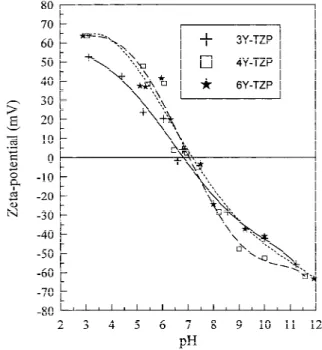
The value of the 3Y-TZP, 4Y-TZP, and 6Y-TZP powders that are dispersed in water at various pH values was measured using electrophoretic spectroscopy (Zetasizer IIC), as shown in Fig. 2. Based on the present results, the values of the three TZP suspensions are very similar to each other. The IEP value of these TZP suspensions is in the pH range of 6.6 –7.2 and does not seem to increase with changes in the Y2O3content.
The streaming current (I ) of the three TZP suspensions in Fig. 2 was tested and compared to the value in Fig. 2. Each I– data pair is plotted in Fig. 3. Note that the data points for the basic conditions (pH >9) are not included in Fig. 3, because of the possible deviation of the SC reading at greater negative values.11Figure 3 clearly shows a linear, but offset, relation-ship with the origin of the I– diagram. The zero potential ( ⳱ 0) is located at I⳱ −0.22 mA. Then, the IEP of the monoclinic zirconia (m-ZrO2) suspensions in Fig. 1 can be determined
Fig. 1. Streaming-current (SC) readings of (a) pure ZrO2 and (b) Y2O3 plotted against the suspension pH under various specified conditions.
Fig. 2. Zeta potential () of three yttria-doped zirconia (Y-TZP) powders, versus the pH of aged solutions with a solids content of 0.03 vol% and a NaCl concentration of 0.01M.
using the I– calibration curve in Fig. 3. The IEP of the pure ZrO2powder is located in the pH range of 7.0–7.4. Meanwhile, it is proposed in the Appendix that the linear offset results from the negative charge of the cell surface of the plastic (polytet-rafluoroethylene, PTFE) driver (the ECA2000 electrokinetic charge analyzer) and also is related to the concentration of charged particles in the testing suspension. The fundamentals of the offset are discussed in the Appendix.
(2) Reactions of TZP in Various Solids Concentrations
The reactions of 3Y-TZP powder were investigated by mea-suring the pH change of the solution. Three series of suspen-sions, with 3Y-TZP concentrations of 0.03, 0.1, and 1 vol%, were dispersed in water at different pH values (pHi).2¶ The suspension initially was turbomixed for 2 h and then aged for 30 min, and the final pH values (pHf) of the suspension were measured; the results are shown in Table II. The suspensions, with pHi⳱ 6.76, experienced minor changes in their pHf val-ues after aging for 30 min. However, the weakly acidic (pHi⳱ 3.2) or basic (pHi⳱ 10.1) suspensions approached a neutral condition. The change in the pH value (⌬pH ⳱ pHf − pHi) becomes apparent if the concentration of TZP powder is larger (1 vol%). A greater change in the content of Y2O3 powder,
especially under acidic conditions (pHi⳱ 3.2), is noted in Fig. 1(b), where the acidity of the Y2O3 suspension changes by more than three orders of magnitude (⌬pH ⳱ 3.13). In other words, the hydration reaction of the Y2O3and 3Y-TZP pow-ders is much stronger than that for pure ZrO2. This phenom-enon is especially pronounced when the solids content of TZP powder in suspension is >0.1 vol%.
Figure 4 shows the SC reading versus the pHf values for 3Y-TZP suspensions with a solids content of 0.03, 0.1, and 1 vol%. The dotted line at −0.22 mA is the point of zero potential ( ⳱ 0) for the suspension with a solids content of 0.03 vol%. The IEP of the 3Y-TZP should be intrinsically equal in the suspensions with solids content of 0.03, 0.1, or 1 vol%. How-ever, the SC reading changes according to the concentration of TZP powder (Cs), as shown in Eq. (A-3) in the Appendix. The apparent SC increases as the surface charge of TZP is relatively greater than the surface charge of the PTFE driver under vari-ous pH conditions. The results in Fig. 4 show that the SC measurement of the 3Y-TZP suspension apparently is affected by the powder content in suspension.
(3) Influence of Electrolytes
In this research, two types of electrolytes were dissolved in the zirconia solutions: NaCl salt, and ammonium molybdate ((NH4)2MoO4) that was prepared from the dissolution of mo-lybdenum(VI) oxide (MoO3) powder in a 5% ammonium (NH4+) solution. Figure 5(a) plots the SC reading of the 3Y-TZP suspension against the pHfvalue of the aqueous solutions; this figure indicates that NaCl can increase the ionic strength of the suspensions. The decrease in the surface potential of a highly electrolytic suspension (0.1M) has been reported as being due to compression of the double layer of ceramic particles.13
In addition, the value and acidity of the pure ZrO2 suspen-sion are plotted as a function of the amount of MoO3in Fig. 5(b). The molybdate ion (MoO42−) can be formed when MoO3 is dissolved in an NH4+ solution. This figure shows that the ZrO2surface seems to be negatively charged and the absolute values of decrease as the MoO42− concentration increase. In fact, the OH−and MoO2−
4 ions compete with each other to ad-¶Note that pH
iis different from pH0, because the powder surface reacts with the water.
Fig. 4. Effect of pH and solids loading on the streaming-current (SC) reading of 3Y-TZP suspensions with 0.01M NaCl.
Fig. 3. Streaming-current (SC) reading versus the zeta potential () of the Y-TZP powders. Note that ⳱ 0 corresponds to an SC reading of −0.221 mA for the suspensions with a solids content of 0.03 vol%.
Table II. Effect of Solids Loading on the pH of Various 3Y-TZP Solutions with Specified Acidity
3Y-TZP amount (vol%) pHi pHf ⌬pH
0.03 3.23 3.26 0.03 0.1 3.23 3.47 0.24 1 3.23 4.80 1.57 0.03 6.76 6.84 0.08 0.1 6.76 7.22 0.42 1 6.76 7.11 0.35 0.03 10.13 9.83 −0.30 0.1 10.13 8.88 −1.25 1 10.13 8.08 −2.05
sorb onto the ZrO2 surface. The formation of a neutral site (−MoO2) on the particles decreases the surface potential of the ZrO2. Thus, the surface charge of the ZrO2particle can become less negative.
Figure 6 shows the effect of the polymeric dispersants D-134 and B-515.1 on the SC and pH values of a 3Y-TZP suspension with a solids content of 1 vol%. The SC readings become negative when >0.25 mol% (based on solids content) of dis-persant D-134 is used. Dissolution of disdis-persant D-134 in water seems to cause the charged backbone (−[C−COO]n−−) to be adsorbed on the particle surface, thus resulting in a reversal of surface potential. However, as the concentration of dispersant D-134 exceeds 1.0 mol%, the absolute value of the SC reading decreases slightly. This increase of the concentration of dis-solved electrolyte results in compression of the double-layer thickness of ZrO2particles; thus, the absolute values of the SC reading decrease accordingly. In contrast, dispersant B-515.1 has a weak electrostatic effect on the 3Y-TZP powders (Fig. 6(b)), although the SC reading of the suspension exhibits al-most no change. However, the pH changes slightly, from 5.2 to 4.4. This observation implies that more dispersant B-515.1 is
dissolving in the suspension as the concentration of dispersant B-515.1 increases, and few of the molecules are adsorbed on the TZP powder surface. The optimal dispersion effect of the 3Y-TZP suspension could be produced by adding 1 mol% of dispersant D-134 under weakly basic conditions (pH⳱ 8–10). The effect of pH on the SC of 3Y-TZP suspensions with a solids content of 1 vol% and 0 or 1 mol% of dispersant D-134 are shown in Fig. 7. The dotted line in this figure represents an offset value of 0.44 mA for the suspension with 1.0 vol% of TZP (which has been used for SC measurement), as shown in Fig. 4. The IEP shifts from pH 6.6 to pH 3.9 as the additions of dispersant D-134 increase. In addition, SC readings of 3Y-TZP suspensions with high solids contents—2, 15, or 28 vol% (denoted as suspensions Z02D2, Z15D2 and Z2SD2, respec-tively)—also are shown in Fig. 7. The pH values of the latter three suspensions are in the range of 7.5–8.6; the higher the solids content, the lower the absolute value of the SC reading. The trend is similar to that observed in Fig. 3.
In contrast, the adsorption behavior of the polymeric chains on the surface of TZP is quite different from that of the MoO42− ions. Dispersant D-134 is an anionic polymer with a 2-prope-noic acid backbone; Fig. 8 shows that the adsorption isotherm of dispersant D-134 onto a ZrO2 surface under various pH conditions is almost independent of the suspension pH, over the pH range of 5–9. The adsorption results reveal that the Fig. 5. (a) Streaming-current (SC) reading and zeta potential (),
relative to the pH of 1 vol% 3Y-TZP suspensions with various NaCl concentrations; (b) and pH of a pure ZrO2suspension, relative to the amount of dissolved MoO3in an ammonium suspension.
Fig. 6. Effects of dispersants ((a) D-134 and (b) B-515.1) on the streaming-current (SC) reading and pH of a 3Y-TZP suspension.
adsorbed amount of dispersant D-134 will increase as the amount of dispersant D-134 present in the 28 vol% 3Y-TZP (Z2SD2) suspension increases. However, 1 mol% of added dispersant D-134 has been adsorbed onto the powder surface, which yields a higher degree of absorption (∼90%) and a lower sensitivity to pH. The degree of adsorption for the other two cases (2 and 3 mol% of dispersant D-134 in the suspension) is only 85% and 70%, respectively, and those cases are more sensitive to the suspension pH. The dissolution coefficient of
the polymeric dispersant D-134 should be lower under acidic conditions; thus, less dissolved molecules would be available to adsorb onto the TZP surface. The attached polymeric chains on the powder surface can lead the TZP particle to exert elec-trostatic stabilization.
IV. Discussion
The surface of most oxide ceramics can react with water molecules at different rates, finally being converted to a hy-drated layer when the particles are exposed to a humid atmo-sphere or an aqueous environment.1,4,5The existence of a hy-drated layer of tetragonal ZrO2(t-ZrO2) has been proven using Fourier transform infrared (FTIR) spectroscopy techniques.5 The formation of a hydrated surface layer compensates for the unsaturated coordinative ions, because of breakage of the Zr−O or Y−O bonds.4 In an acidic solution, the H+
cations in sus-pension are adsorbed onto the surface of Y2O3 or ZrO2 and produces a positively charged surface; however, the Y2O3 action proceeds fairly rapidly, with the complete reaction re-quiring <10 min. The SC data for Y2O3in the 1.0 vol% sus-pension in Fig. 1(b) clearly indicates that the acidity of the suspension is balanced by this hydration reaction on the Y2O3 surface. Because of the adsorption of H+cations from the sus-pension, that H+ concentration has been reduced by several orders of magnitude and consequently increases the pH of the Y2O3suspension. A similar observation is presented in Table II, which shows the reaction of TZP powder with water; this effect is especially clear for highly concentrated suspensions. The value of a 3Y-TZP suspension should be affected by the dissolved Y2O3content. However, the shifting of the IEP toward a basic condition is not great enough to be detected via currently used techniques. The dissolution of Y2O3or the hy-dration of oxide surfaces in the water has been reported in the literature.15,16 Y
2O3 has a tendency to produce a hydrated Y(OH)3surface and dissolves in aqueous solution in the form of Y3+, Y(OH)2+, or Y
2(OH)24+species. The reported equilib-rium concentration of these hydrated yttria molecules is depen-dent on the pH conditions of the solution.15Of these species, the Y3+ cation is the most concentrated species among these hydrates in solutions with pH <7.5. The reported equilibrium concentration of Y3+ cations is ∼5 × 10⁻⁴ mol/dm3, which corresponds to a Y2O3concentration of∼0.11 g/dm3. The Y3+ concentration is less than that in any TZP suspension with a solid TZP concentration of >2.2 g/dm3(or 0.035 vol%). As a result, the TZP suspension with a solids content of 0.03 vol% that is used to measure may continue to dissolve Y3+cations until an equilibrium concentration is achieved.
The zero SC reading of pure ZrO2is located at pH 6.0, which is less than the IEP values that have been reported in the lit-erature (pH ⳱ 6–6.7).3,4,6,8 There are two possible reasons for our lower measured values of ZrO2. The lower IEP value (pH⳱ 4.0 or 5.0) that was reported for the zirconia suspen-sions was perhaps due to the adsorption of a minor additive. The other possibility is the deviation (offset) of the SC reading from the values.12This observation would indicate that the ⳱ 0 condition may result in an offset value of the SC reading (−0.22 mA), under various powder content levels in suspen-sion, as proven in the Appendix.
Zirconia suspensions with a very minor amount (3.3 × 10⁻⁴M) of Dispex A40 dispersant or sodium sulfate (Na
2SO4) salt have lower IEP values. Leong and Boger6determined that the SO42− ion is, in fact, adsorbed onto the surface of the m-phase powder; they also determined that the IEP value of the ZrO2decrease as the powder concentration decreases. Figure 5(b) reveals the effects of molybdate ions. Either MoO42− or Mo7O246−can be the ionic forms when MoO3is dissolved in an NH+
4 solution. The MoO42−ions are stable in a basic (pH >7) solution.17A previous study18showed that the MoO
4
2−ion can be adsorbed onto the surface of alumina (Al2O3) and the ad-sorption of the MoO42−ion can shift the value of the Al2O3 particle. Figure 5(b) shows that the ZrO2 surface seems to be Fig. 7. Effect of pH on the streaming-current (SC) reading of
3Y-TZP suspensions with various contents of solids and dispersant D-134. The format “ZxxDy” indicates the solids loading (xx vol%) and the amount of added dispersant (y mol%), based on the solid phase.
Fig. 8. Isothermic adsorption curves of various amounts of disper-sant D-134 in a 3Y-TZP suspension with a solids content of 28 vol%. Note that the amount of added dispersant D-134 in the suspension varied from 1 mol% to 3 mol%, based on powder mass.
negatively charged, and the absolute values of the value decrease as the MoO42−concentration increases. However, the OH−and MoO
4
2−ions compete with each other to adsorb onto the ZrO2. The adsorption of MoO42− could release OH
− ions concurrently, via the reaction
Zr−OH +MoO4 2−→ ←Zr−O MoO2+2OH − Zr−OH Zr−O
The formation of a neutral site (−MoO2) on the particles is attributed to the decrease of the surface potential of the ZrO2.
If only a small amount of MoO42−species is added, the surface
potential of ZrO2decreases and the surface of the ZrO2particle
shifts to a less-negative condition. However, the surface double
layer is compressed if the MoO42− concentration is >0.01M,
which ultimately may lead to particle agglomeration.
The interaction of polymeric dispersants with TZP powder in aqueous solution is clear. The SC curve (suspension Z01D1) is shifted from the position of the suspension Z01D0 curve to a negative value (Fig. 7) because of the adsorption of the ionized backbone of dispersant D-134. At the same time, the IEP of the colloidal system changes from 6.6 to 3.9. In addition, as the powder concentration increases (refer to the data points in Fig.
7), the absolute value of the corresponding decreases slightly.
The interparticle distance decreases as the solids content in the solution increases. Steric hindrance that results from the repul-sion of adsorbed polymer on the TZP particle becomes appar-ent as the interparticle distance gets smaller. Therefore, the polymeric dispersant has an important role in the stabilization of zirconia suspensions (especially concentrated suspensions).
V. Conclusions
(1) Pure zirconia (ZrO2) powder has an isoelectric point
(IEP) in the pH range of 7.0–7.4. The zeta potential () and IEP
of yttria-doped zirconia (Y-TZP) powders in a diluted suspen-sion is hardly affected by the addition of yttria (Y2O3). The IEP
of Y-TZP powders with an Y2O3content of 3–6 mol% is in the
pH range of 6.6–7.2.
(2) The streaming current (SC) and pH values of Y-TZP
suspensions are strongly controlled by the powder content of the suspensions. This observation is related, in part, to the
dissolution or hydration of Y2O3on the surface of TZP under
different pH conditions. The IEP shifts toward the IEP of Y2O3 as the TZP powder content in the suspension increases.
(3) The surface potential of ZrO2is reduced because of the
increased ionic strength of the suspension and/or the adsorption
of molybdate (MoO42−) ions onto the surface. A decrease of the
absolute value of for ZrO2may result in the destabilization of
ZrO2particles in suspension when the concentration of
elec-trolytes is >0.1M.
(4) The polymeric dispersant D-134 is an effective
disper-sant for Y-TZP suspensions. The negatively charged polypro-penoic acid backbone is adsorbed onto the particle surface in the pH range of 5–9. The degree of adsorption on TZP powder decreases from 90% to 70% as the addition of the dispersant increases from 1 mol% to 3 mol%. The adsorption changes the
IEP of the TZP powder to an acidic range (pH⳱ 3.9) and can
offer electrosteric stabilization of zirconia powder in a weakly basic solution.
(5) Colloidal stability can be measured using either or SC
measurements. The relationship between these two parameters is linear in the pH range of 3–9. However, an offset from the
origin of the current–potential (I–) relationship is noted at the
SC axis intercept at values that are dependent upon the powder concentration in suspension.
APPENDIX
Relationship of the Streaming Current to the Zeta Potential of ZrO2Powder
The deviation of the streaming current (SC) reading from the
zeta potential () that is shown in Fig. 3 implies that the surface
charge of the SC detector (SCD) may contribute, in part, to the
SC readings of charged ZrO2particles in suspension. The
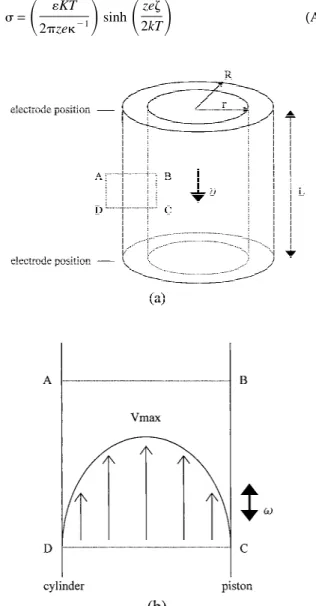
sus-pension is flowing upward through the annulus when the piston is driving downward, as shown in Fig. A1(a). Thus, the net charge q moving upward is given as
dq⳱ sQCsAs−pAp (A-1)
wheresandpare the charge densities of the ZrO2powder
and the driving piston, respectively. Q is the average flow volume of the suspension in the annulus of the SCD (in units
of dm3), and Cs is the concentration of ZrO2 powder in
sus-pension (in units of g/dm3). Asand Apare the specific surface
areas of the powder and the piston. Ap⳱ 2r dL, where L is
the piston length. Thus, Q then can be expressed as
Q= −r2dL (A-2)
Combining Eqs. (A-1) and (A-2) and dividing by the change in time dt gives the instant current I:
I⳱dq dt= −sCsAsr 2dL dt −p共2r兲 dL dt (A-3)
The charge densities s andp can be obtained because the
surfaces of the powder and the piston hold an electric double
layer. According to the Gouy– Chapman model,19the average
charge density is
=
冉
KT2zeⳮ1
冊
sinh冉
ze
2kT
冊
(A-4)Fig. A1. Schematic diagrams of (a) a streaming-current detector (SCD) with downward piston motion and (b) the flow pattern of the suspension in the annulus.
where is the permittivity of water (7.08 × 10⁻¹⁰), k the Boltz-mann constant, the electrokinetic potential of the ZrO2 par-ticle, z the valence number of predominant ions in solution (here, z⳱ 1), e the electron charge, T the absolute temperature, and−1the thickness of the double layer. Then, Eq. (A-4) can be simplified to Eq. (A-5) at low values of and :
=
4ⳮ1 (A-5)
Equation (A-3) can be simplified to Eq. (A-6) when the geometric dimensions (here, r⳱ 0.63 cm, R ⳱ 0.645 cm, and L⳱ 2.45 cm) of the instrument, the operation conditions (in this case, ⳱ 4 cycles per second), and the properties of the 3Y-TZP powder (here, As⳱ 15.7 m2/g and Cs⳱ 10 mol/m3) all are known:
I=9.52×10ⳮ3s−3.21×10ⳮ5p (A-6) and
p= −1.29×10ⳮ2p=3.22×10ⳮ3
冋
共R−r兲2s
册
Ip (A-7) By measuring the value of Ip for the polytetrafluorethylene (PTFE) material that comprises the plastic piston, thepvalue that is calculated from Eq. (A-7) can be substituted into Eq. (A-6), givingI(mA)⳱ 9.52 × 10⁻³
s− 0.128 (A-8)
The second term of the right-hand side of Eq. (A-8) is −0.128 mA, which is larger than, but on the same order as, the devia-tion value of the (I–) diagram shown in Fig. 3 (−0.221 mA). Acknowledgment: The authors express their appreciation for the kind discussion with Prof. Dahtong Ray (National Cheng-Kung University) on the measurement technique of organic concentrations in a solution.
References
1M. Obitsu, T. Kaga, and Y. Fujii, “Zirconia Sol and Method for Making the
Same,” U.S. Pat. No. 5 223 176, Jan. 29, 1993.
2W.-C. J. Wei, S. J. Lu, and C. L. Hsieh, “Colloidal Processing and Fracture
Strength of Alumina Prepared from Partially Agglomerated Theta-Phase Pow-der,” J. Ceram. Soc. Jpn., 104 [4] 277–83 (1996).
3R. Moreno, J. Requena, and J. S. Moya, “Slip Casting of Yttria-Stabilized
Tetragonal Zirconia Polycrystals,” J. Am. Ceram. Soc., 71 [12] 1036–40 (1988).
4J. Wernet and D. L. Feke, “Effects of Solids Loading and Dispersion
Sched-ule on the State of Aqueous Alumina / Zirconia Dispersions,” J. Am. Ceram.
Soc., 77 [10] 2693–98 (1994).
5C. Morterra, G. Cerrato, and L. Ferroni, “Surface Characterization of
Yttria-Stabilized Tetragonal ZrO2, Part 1. Structural, Morphological, and Surface
Hy-dration Features,” Mater. Chem. Phys., 37, 243–57 (1994).
6Y. K. Leong and D. V. Boger, “Surface Chemistry and Rheological
Prop-erties of Zirconia Suspensions,” J. Rheol. (NY ), 35 [1] 149–65 (1991).
7Y. K. Leong, P. J. Scales, T. W. Healy, and D. V. Boger, “Effect of Particle
Size on Colloidal Zirconia Rheology at the Isoelectric Point,” J. Am. Ceram.
Soc., 78 [8] 2209–12 (1995).
8M. Kagawa, M. Omori, and Y. Syono, “Surface Characterization of Zirconia
after Reaction with Water,” J. Am. Ceram. Soc., 70 [9] C-212–C-213 (1987).
9A. H. Heuer, “Transformation Toughening in ZrO
2-Containing Ceramics,”
J. Am. Ceram. Soc., 70 [10] 689–98 (1987).
10W. Huisman, T. Graule, and L. J. Gauckler, “Centrifugal Slip Casting of
Zirconia (TZP),” J. Eur. Ceram. Soc., 13, 33–39 (1994).
11P. C. Hiemenz, Principles of Colloidal and Surface Chemistry. Marcel
Dekker, New York, 1977.
12S. K. Dentel and K. M. Kingery, “Theoretical Principles of Streaming
Cur-rent Detection,” Water. Sci. Technol., 21, 443–53 (1989).
13S. K. Dentel, A. V. Thomas, and K. M. Kingery, “Evaluation of the
Stream-ing Current Detector, I. Use in Jar Test,” Water. Sci. Technol., 21, 413–21 (1989).
14H. Shan and Z. Zhang, “Slip Casting of Nanometer Sized Tetragonal
Zir-conia Powder,” Br. Ceram. Trans., 95 [1] 35–38 (1996).
15M. Yasrebi, M. Z. Moroz, W. Kemp, and D. H. Sturgis, “Role of Particle
Dissolution in The Stability of Binary Yttria–Silica Colloidal Suspensions,” J.
Am. Ceram. Soc., 79 [5] 1223–27 (1996).
16M. Yasrebi, M. E. Springgate, D. G. Nikolas, W. Kemp, and D. H. Sturgis,
“Colloidal Stability of Zirconia-Doped Yttria–Silica Binary Aqueous Suspen-sions,” J. Am. Ceram. Soc., 80 [6] 1615–18 (1997).
17N. P. Lutra and W. C. Cheng, “Molybdenum-95 NMR Study of the
Ad-sorption of Molybdate on Alumina,” J. Catal., 107, 154–60 (1987).
18M. H. Lo, F. H. Cheng, and W. J. Wei, “Preparation of Al
2O3/Mo
Nanocomposite Powder via Chemical Route and Spray Drying,” J. Mater. Res.,
11 [8] 2020–28 (1996).
19R. J. Hunter, Foundations of Colloidal Science, Vol. 1. Clarendon Press,