ELSEVIER
Journal of Orthopaedic Research 23 (2005) 788-794Journal
of
Orthopaedic
Resea
r c h
www.elsevier.com/loca te/orthres
Increase of pullout strength
of spinal pedicle screws with conical
core: biomechanical tests and finite element analyses
Ching-Chi Hsu a,
Ching-Kong Chao a,
Jaw-Lin Wang
’,
Sheng-Mou Hou b,
Ying-Tsung Tsai a,
Jinn Lin
b9*a Department of Mechanical Engineering, National Taiwan University of Science and Technology, Taipei 106, Taiwan
Department of Orthopedic Surgery, National Taiwan University Hospital, No. 7 Chung Shan S. Rd. Taipei 100, Taiwan
Abstract
Screw loosening can threaten pedicle screw fixation of the spine. Conical screws can improve the bending strength, but studies of
their pullout strength as compared with that of cylindrical screws have shown wide variation. In the present study, polyurethane
foam with two different densities
(0.32 and 0.16gm/cm3) was used to compare the pullout strength and stripping torque among three
kinds of pedicle screws with different degrees
of core tapering. Three-dimensional finite element models were also developed
tocom-
pare the structural performance of these screws and to predict their pullout strength. In the mechanical tests, pullout strength was
consistently higher in the higher density foam and was closely related to screw insertion torque
( r= 0.87 and 0.81 for the high and
low
density foam, respectively) and stripping torque ( r = 0.92 and 0.78, respectively). Conical core screws with effective foam com-
paction had significantly higher pullout strength and insertion torque than cylindrical core screws
(p < 0.05). The results of finiteelement analyses were closely related to those of the mechanical tests in both situations with or without foam compaction. This
study led to three conclusions: polyurethane foam bone yielded consistent experimental results; screws with a conical core could
significantly increase pullout strength and insertion torque over cylindrical; and,finite element models
could reliubly reflect the results
of
mechunicul tests.
0
2004Orthopaedic Research Society. Published by Elsevier Ltd. All rights reserved.
Keywords: Pedicle screw; Pullout strength: Pullout test; Finite element analysis
Introduction
Pedicle screw fixation, widely
used
for different thora-
columbar spinal disorders, has the advantage of rigid
fixation with minimal fused segments [20]. Fixation fail-
ures still occur, however,
and
may jeopardize the
spinal
alignment and fixation stability
and
lead
to severe com-
plications.
As
reported in the literature, the incidence
of
screw loosening ranges from
0.6%
to
1 1% [17]
and
might
be
even higher in osteoporotic spines [14]. The pullout
strength
of
pedicle
screws is
mainly
determined
by
screw
Corresponding author. Tel.: +886 2 23123456x5278; fax: +886 2
E-mail address: [email protected] (J. Lin). 232241 12.
design [13,16], which
includes
outer
and
core diameters,
pitches, and thread profiles. Modification of the screw
design
can
substantially affect the
pullout
strength. Re-
cently, conical screws with tapering
of
the core diameter
have been introduced to increase the bending strength
of
the screws [1,14]. However, their pullout strengths
as
compared
with that of cylindrical
screws have
varied
widely [1,8,14,15,18]. High variation
of
the cadaver bone
quality and pedicle structures, insufficient sample size,
and incomparable screw structures are responsible for
the discrepancy
and
may
lead
to biased study results
and invalid conclusions in spite of careful study design
[
1 2,131.
In
the present study, screw pullout and stripping
tests
were conducted according to an American Society
for
0736-0266/$-
see front matter 0 2004 Orthopaedic Research Society. Published by Elsevier Ltd. All rights reserved.C.-C.
Hsu
ef al. I Journal of Orrhopaedic Research 23 (2005) 788-794 789Testing and Materials (ASTM) standard [3] on three
kinds
of
commercially available spinal pedicle screws
with different degrees of core tapering. Polyurethane
foam was used to simulate cancellous bone but yet pro-
vide more uniform material properties. Concurrently,
three-dimensional finite element models of these pedicle
screws were created to simulate the mechanical tests. We
hypothesized that conical screws could produce foam
compaction during screw insertion and yield higher
insertion torques and pullout strengths. Furthermore,
we hoped to demonstrate that finite element analyses
could effectively predict the results
of
mechanical
experiments.
Materials and methods
Pedicle screws
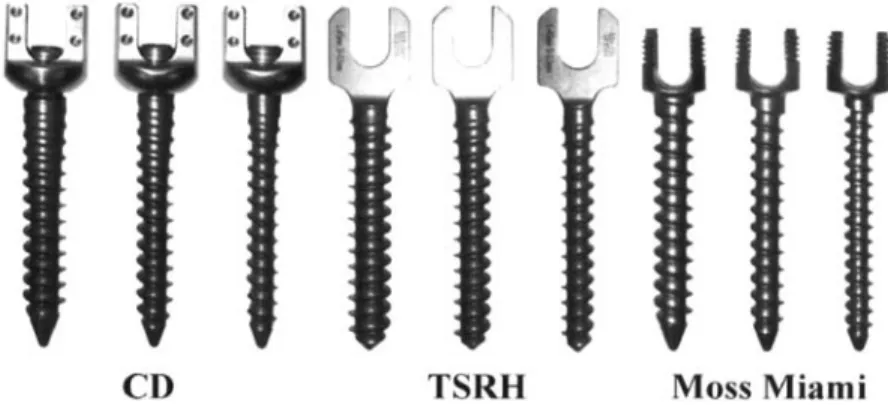
Three kinds of commercially available pedicle screws were studied: Cotrel-Dubousset (CD) (Medtronic Sofamor-Danek, Memphis, TN), Texas Scottish Rite Hospital (TSRH) (Danek, Memphis, TN), and Moss Miami (DePuy Spine, Raynham, MA). For application to differ- ent levels of vertebrae, each kind of pedicle screw had three different sizes (Fig. I), which were designated as type I, 11, and I11 (from large to small outer diameter). Consequently, nine distinct types of pedicle screws were tested. The pertinent dimensions of these screws included
outer diameter, core diameter, pitch, proximal half angle, distal half angle, proximal root radius, distal root radius, thread width, conical angle, and the beginning point of the conical angle (Table 1) and were measured by means of an optical comparator (Starrett HF-600, Unlim- ited Services, New Haven, MI). All screws were made of a titanium alloy and were 45mm long. CD screws had a cylindrical outer diameter and conical core diameter with a conical angle of 4". TSRH screws also had a cylindrical outer diameter and conical core diameter, but the conical part was shorter than that of CD screws. The beginning point of the conical angle differed between these two screws. Moss Miami screws had cylindrical outer and core diameters.
Mechanical tests
We used cellular polyurethane foam (Pacific Research Lab., Vas- hon, WA) conforming to ASTM standard F1839-97 [2] to prevent the wide individual variation of the mechanical properties of cadaver bones encountered in biomechanical tests. Two densities of the foam, 0.32 and 0.16gm/cm3 with a compressive modulus of 137.5 and 23MPa, a compressive strength of 5.4 and 2.3MPa, and a porosity of 71% and 86%, respectively, were used. Each brick of foam bone (13cm x 18cmx4cm) was equally divided into nine blocks for study of the nine screws. To decrease the bias caused by size discrepancy be- tween core diameter and pilot hole, the foam blocks were pre-drilled using straight drill bits with a diameter of 0.2mm less than the core diameter of the screws. Then the pedicle screws were inserted without pre-tapping. Under this condition, the conical core of screws could compact the foam during screw insertion. For a fair comparison, the length of the threaded part that purchased on the foam was kept con- stant: 35mm for all screws. Because of the different lengths of the un- threaded tip among the different screws, the total length of the screw inserted in the foam block varied from 38mm to 44mm.
Fig. 1. Three different pedicle screws tested in this study. Each had three type-I, 11, and IIILcorresponding to different outer diameters.
Table 1
Dimensions of the pedicle screws
Outer Core Pitch Proximal root Distal root Proximal Distal half Thread Conical Beginning diameter diameter (mm) radius (mm) radius (mm) half angle (") width angle (") point of
conical angle (mm) (mm) (mm) angle (") (m) CD I 7.50 4.92 2.8 0.81 1.27 20.33 5.5 0.20 4 26.60 CD I1 6.50 4.10 2.8 0.88 1.20 23.50 9.67 0.20 4 28 CD I11 5.50 3.84 2.71 0.81 1.23 21.50 10.33 0.10 4 31.17 TSRH I 7.50 4.98 2.8 0.83 1.16 21.33 5.33 0.18 4 35 TSRH I1 6.50 4.32 2.8 0.84 1.18 22 5 0.26 4 32.20 TSRH 111 5.50 3.78 2.75 0.83 1.23 21.33 7.33 0.18 4 33 Moss Miami I 6.90 4.5 2.98 3.31 3.31 29.83 28.50 0.18 - ~ Moss Miami I1 5.85 4.19 2.94 3.31 3.31 30 27.83 0.19 - - Moss Miami 111 4.87 3.03 2.48 2.54 2.54 33.17 27.67 0.19 - -
790 C.-C. Hsu et al. I Journal of’ Orthopaedic Research 23 (2005) 788-794
Pull
Fixture
frame
Fig. 2. Setup for pullout tests.
The foam block was placed in a fixture frame whose top surface had a spherical hole for the screw head. The foam block was com- pletely seated in the fixture frame when an axial load was applied via
‘i custom-machined rod tightly fastened to the screw head (Fig. 2). Fol-
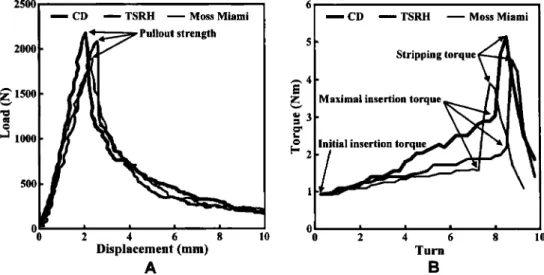
lowing ASTM standard F1691-96 [3], the testing setup had a universal loint linked to the base plate of the MTS servohydraulic testing ma- chine (Bionix 858, MTS Corp., Minneapolis, MN) to ensure the ap- plied load was aligned with the screw’s longitudinal axis. The screws &ere extracted at a loading rate of 5mm/min., and the loadtiisplace- inent curves were recorded (Fig. 3A) with a data acquisition system (instruNet, GW Instruments, Somerville, MA). The peak load to pull out the screws was defined as the pullout strength. The pullout tests \rere then repeated using tapered drill bits with a structure similar to
1 he core of the conical screws to investigate the condition without foam
compaction.
Next, screw-stripping tests were performed with pedicle screws in- w t e d into new foam blocks pre-drilled with straight drill bits. The insertion torque was continuously monitored by a torsional load cell on the MTS system. To avoid exerting axial force on the screws, screws were driven by applying a horizontal force manually to the rod fas- tened to the screw head at a speed of two rpm. The torque-turn curves \$ere recorded (Fig. 3B). To ensure a constant length of the threaded part inserted in the foam block, metal shims with different thicknesses were placed between the foam block and screw head.
2500
-CD -TSRH -MossMiami
Displacement
(mm)
A
Initially, as the screws were inserted, the insertion torque increased gradually. When the length of the inserted threaded part reached 35mm, the screw head collided with the shims and the insertion torque
rose quickly. As the screws were further advanced, the insertion torque reached a maximum and then dropped abruptly when the foam was stripped. The highest torque before the screw head collided with the shims was defined as the maximal insertion torque. The highest torque to strip the foam was defined as the stripping torque. Increase of the insertion torque was defined as the difference between the maximal insertion torque and initial insertion torque. The pullout tests and screw stripping tests were performed on six of each screw type.
Finite element analysis
The finite element analyses of the pedicle screws were conducted using commercial software ANSYS 5.7 (Canonsburg, PA). The screw models were built to the measured geometry and dimensions. Surface models were first generated by helical sweep of a pre-determined thread with Ansys Parametric Design Language. Then the surface models were transformed to three-dimensional models by subtraction from a solid cylinder with the use of a Boolean operation. The screws were assumed inserted in the center of a cylinder of cancellous bone with a diameter of 30mm (Fig. 4). The material properties of the screws and bone were assumed to be linear isotropic. The elastic mod- ulus was 1 I4GPa for pedicle screws and 137.5 or 23 MPa for bone like
Fig. 4. Finite element model. The gray zone was fully constrained.
6 -CD -TSRH
-
MossMiami tial insertion t tial insertion t 0 2 4 6 8 TurnB
DC.-C. Hsu et al. I Journal of Orthopuedic Research 23 (2005) 788-794 79 1 the foams used in the biomechanical tests; Poisson’s ratio was 0.3 for
both screws and bone. The screws and bones were map-meshed, with the exception of the irregular contact areas, which were free-meshed. The elements used were high order 20-node brick elements of SO- LID 95. Contact elements were applied to the interface between the pedicle screw and bone. The surface of the pedicle screw was meshed with the elements of CONTA 174, and the surface of bone was meshed with elements of TARGE 170. The frictional coefficient was set to zero. The loading condition was an axial displacement of 0.01 mm applied to the end surface of the pedicle screw, and the screw could be displaced only in the axial direction. The boundary condition was full constraint at the surface of the bone end to simulate the experimental condition (Fig. 4).
The total number of elements in the models ranged from 110,000 to 220,000; the total number of nodes ranged from 210,000 to 410,000. The computer solution time ranged from 12 to 28h. The solution was achieved by the Precondition Conjugate Gradient solver with small deformation. Numerical instability was checked by decreasing the element size, the solutions were considered converged when the variation of the sequential analytic results was less than 3%. For screws with a conical core, the foam compaction effects were simulated by adjusting the elastic modulus of the bone surrounding the conical core according to the density change of the bone around that core. The elas- tic modulus of bone was assumed to be a function of the density squared. Density change was calculated on the basis of the volume reduction caused by the conical core. In postprocessing analysis, the bone-screw interface stiffness was assessed by analyzing the total reac- tion force on screws and the total strain energy of bones. The total reaction force was defined as the summation of the resultant axial force
on the nodes over the end surface of the screw with pre-applied dis- placement. The total strain energy was defined as the summation of the strain energy of all the bone elements. The results of mechanical tests and finite element analyses were compared by analysis of variance and linear regression test. Significance was defined as p < 0.05.
Results
In pullout tests, screw displacement at the point of
peak load was less than 2mm in all the screws. In strip-
ping tests, foam bone was stripped within one turn after
the screw head collided with the shim. In both tests, the
failure was cylindrical shear of the polyurethane foam
surrounding the screws, and the screw structure was
completely preserved. The pullout strength, insertion
torque, and stripping torque were consistently higher
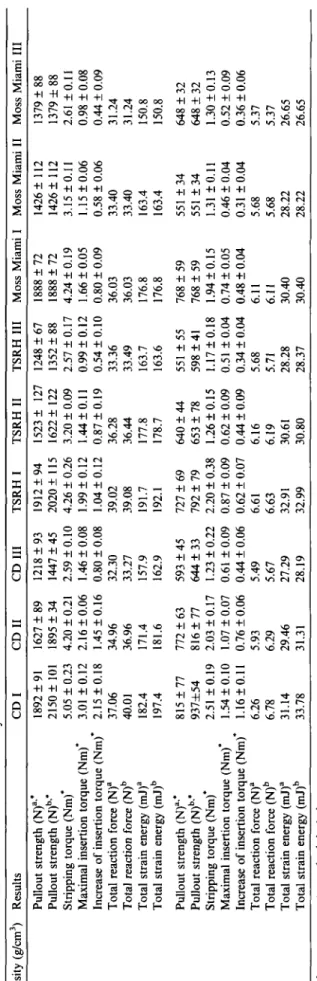
in the foam bones with the higher density (Table 2).
Among the nine screw types, pullout strength was signif-
icantly related to stripping torque, r = 0.92 and
0.78
for
the 0.32 and 0.16gm/cm3 foams, respectively. The max-
imal insertion torque was also significantly related to the
pullout strength ( r
=
0.87 and 0.81 for the higher and
lower density foams, respectively) and the stripping tor-
que (r = 0.89 and 0.87 for the higher and lower density
foams, respectively). For conical screws, the pullout
strength was significantly higher in situations with foam
compaction than in situations without foam compaction
(p
< 0.05 for both higher and lower density foams). The
average increase of pullout strength for CD and TSRH
screws was 16.3% and
6.8%
in foams with a density of
0.32gm/cm3 and was 9.8% and 6.4% in foams with a
density of 0.16 gm/cm3. With foam compaction, conical
screws also had a significantly higher pullout strength,
maximal insertion torque, and increase of insertion tor-
que than did cylindrical screws by an analysis of vari-
ance test
(p
c
0.05
for both foams).
In the finite element analysis, a strong relationship
between the total reaction force and total strain energy
was found ( r =
0.99
for both foam bones). Screw defor-
mation was minimal
(<O.
1?,40),
compatible with the find-
ings in the mechanical tests. The bone-screw interface
stiffness was closely related to the strength measured in
the pullout tests for CD (r
=
0.95 and 0.91 for the higher
and lower density foams, respectively, in situations with-
out foam compaction; r = 0 . 9 8 and 0.92 in situations
with foam compaction), TSRH
( r
= 0.95 and 0.86 in sit-
uations without foam compaction; r = 0.93 and 0.77 in
situations with foam compaction), and Moss-Miami
( r
=
0.88 and
0.58).
The screws with a larger outer dia-
meter had higher bone-screw interface stiffnesses and
pullout strengths. When the nine screws were considered
together, the relationship was still close ( r = 0.85 vs. 0.59
in situations without foam compaction; r = 0.90 vs. 0.77
in situations with foam compaction). The bone-screw
interface stiffness was also higher in situations with foam
compaction, especially in CD screws with a long conical
core.
Discussion
Pullout strength of pedicle screws has been exten-
sively studied using cadaver bone [5,7,18,21], animal
bone [ 1,9,11,15], and artificial materials [5,8,9,11] by
either axial pullout or cephalocaudad toggling tests.
Straight axial pullout of the pedicle screws, although
not the only mechanism responsible for clinical failure,
is a popular experimental testing mode and has gener-
ally been accepted for evaluation of screw-bone inter-
face strength of pedicle screws in different conditions
[
1,14,18]. This method provides a standard test to check
the uniformity of the screws and to compare the pullout
strength of different screw designs [3]. The pullout
strength of pedicle screws might be affected by design,
bone quality, pedicle structures, inserted length, and
the size of pilot holes. For a fair comparison among dif-
ferent screws, adequate control of these variables is
crucial.
A conical screw design was originally intended to in-
crease the strength of the pedicle screw by decreasing the
stress concentration effects caused by the sharp geomet-
rical change at the thread-shaft junction. Theoretically,
the conical core could compact its neighboring cancel-
lous bone in the pedicle and increase the screw insertion
torque and pullout strength [1,14]. However, reports of
the pullout strength of conical screws as compared with
that of the conventional cylindrical screw vary mark-
edly. For example, Kwok et al. [14] reported that conical
screws yielded higher insertion torque than cylindrical
screws, but their pullout strength did not significantly
Table 2 Results of biomechanical tests and finite element analyses in foam with different densities Density (n/cm3) Results CD I CD I1 CD I11 TSRH I TSRH I1 TSRH I11 Moss Miami I Moss Miami I1 Moss Miami 111 0.32 Pullout strength (N)',' Pullout strength (N)b.' Stripping torque (Nm)' Maximal insertion torque
(Nm)'
Increase of insertion torque (Nm)' Total reaction force (N)a Total reaction force (N)b Total strain energy (mJ)a Total strain energy (mJ)b 1892 f 91 2150 f 101 5.05 f 0.23 3.01 f 0.12 2.15f0.18 37.06 40.01 182.4 197.4 1627 f 89 l895f 34 4.20 f 0.21 2.16f
0.06 1.45 f0.16 34.96 36.96 171.4 181.6 1218 f 93 1447 f 45 2.59 f 0.10 1.46 f 0.08 0.80 f 0.08 32.30 33.27 157.9 162.9 1912 ?r 94 2020 f 1 I5 4.26 f 0.26 1.99 f 0.12 1.04f 0.12 39.02 39.08 191.7 192.1 1523f 127 1622 f 122 3.20 f 0.09 1.44 f 0.1 1 0.87 f 0.19 36.28 36.44 177.8 178.7 1248 f 67 1352 f 88 2.57 f 0.17 0.99 f 0.12 0.54 f 0.10 33.36 33.49 163.7 163.6 1888 f 72 1888 f 72 4.24f 0.19 1.66 f 0.05 0.80 f 0.09 36.03 36.03 176.8 176.8 1426 f 112 1426 f 112 3.15fO.ll 1.15 f0.06 0.58 f 0.06 33.40 33.40 163.4 163.4 1379 f 88 1379 f 88 2.61 f 0.1 I 0.98 f 0.08 0.44 f 0.09 3 1.24 3 I .24 150.8 150.8 0.16 Pullout strength (N)".' 815f77 772f63 593f45 727f69 640f44 551 255 768559 551 f 34 648 f 32 Pullout strength (N)b,' 9372~54 816f77 644f 33 792f 79 653 f 78 598 f41 768f 59 551 f 34 648 f 32 Stripping torque (Nm)' 2.51f0.19 2.03f0.17 1.23f0.22 2.20k0.38 1.26f0.15 1.17f0.18 1.94f0.15 1.31 fO.11 1.30 f 0.13 Maximal insertion torque (Nm)' 1.54 f 0.10 1.07 f 0.07 0.61 f 0.09 0.87 f 0.09 0.62 f 0.09 0.51 f 0.04 0.74 f 0.05 0.46 f 0.04 0.52 f 0.09 Increase of insertion torque (Nm)' 1.16 f 0.1 I 0.76 f 0.06 0.44 f 0.06 0.62 f 0.07 0.44 ?I 0.09 0.34 f 0.04 0.48f
0.04 0.31 f 0.04 0.36 f 0.06 Total reaction force (N)' 6.26 5.93 5.49 6.61 6.16 5.68 6.11 5.68 5.37 Total reaction force (N)b 6.78 6.29 5.67 6.63 6.19 5.71 6.11 5.68 5.37 Total strain energy (~LI)~ 31.14 29.46 27.29 32.91 30.61 28.28 30.40 28.22 26.65 Total strain energy (mJ)b 33.78 31.31 28.19 32.99 30.80 28.37 30.40 28.22 26.65 Values are means ? standard deviation. a Without foam compaction. With foam compaction..
6
3
P 7 h, 0E
LC.-C. Hsu rt ul. I Journul of Orthopaedic Rrsearclr 23 (2005) 788-794 193
differ. Abshire et al. [l] and Ono et al. [18] found conical
screws had higher pullout strength than cylindrical
screws with similar thread design and pitch. Choi et al.
[8] reported that conical screws were consistently more
effective against pullout than cylindrical screws, espe-
cially when the outer diameter of the screws was kept
straight. By contrast, Lill et al. [15] found the pullout
strength of the conical screws, especially after cyclic
loading, was less than that of cylindrical screws. These
contradictory results might be attributed to variations
in bone quality, screw-cortical purchase, and screw
dimensions responsible for bone purchase.
We used foam with more consistent properties in an
attempt to prevent the bias caused by variation of bone
quality, pedicle structures or different screw-cortical
purchase. The foam was also readily availability, easy
to handle, and did not degrade during testing. Incompa-
rability of screw dimensions may lead to biased results
from comparisons of pullout strength of conical and
cylindrical screws and should be examined before
experiments are started
[I,
1 81.
In the mechanical tests, pullout strength was closely
related to the stripping torque because of the similar
shear failure mechanism [16]. Both tests reliably assess
the risk of screw loosening. The pullout strength and
insertion torque in the foam with the higher density
was consistently higher than that in the foam with the
lower density. This result supports findings that pullout
strength or insertion torque was higher in bone with
higher bone mineral density [9,15,18]. The pullout
strength of conical screws was significantly higher in sit-
uations with foam compaction. The conical core could
effectively compact the foam during screw insertion
and yield higher pullout strength. Conical screws also
had a significantly higher maximal insertion torque
and greater increase of insertion torque during screw
insertion than did cylindrical screws. The conical core
advancing through the bone acted like the screw head
that was colliding with the bone and led to higher inser-
tion torques and greater increases in insertion torque.
Another controversial question is the relationship be-
tween screw insertion torque and pullout strength. The
factors that affect screw insertion torque include screw
design, the shear strength
of the surrounding bone, fric-
tion between the screw and the bone, and the size of the
pilot hole. Most studies have demonstrated a close rela-
tionship between pullout strength and maximal insertion
torque [9,15,18,21]. However, in the study of Kwok
et al. [14], the insertion torque was not consistently
related to pullout strength. In the study of Okuyama
[17], the insertion torque did not significantly differ be-
tween patients with and without loosening of the pedicle
screws. In the present study, the maximal insertion tor-
que was consistently and closely related to the density of
the foam and the pullout strength of the screws. As
shown in the torque-turn curves (Fig. 3B), the screw
insertion torque increased sharply when the screw head
collided with the shim. We postulate that variation of
choosing the points with maximal insertion torque
might be one of the factors causing inconsistent results.
The finite element method can save the expense, time,
and effort of repeated mechanical tests. The models can
incorporate all the screw design factors that potentially
affect the pullout strength. Sensitivity analysis can fur-
ther investigate the effects of an individual design factor
independently. The linear relationship between total
strain energy and total reaction force was compatible
with the linear part of the load4isplacement curve in
the pullout tests. The results of finite element analyses
were closely related to those of mechanical tests in situ-
ations both with and without foam compaction. The
finite element model can be used to assess the structural
comparability and the effects of foam compaction
among different screw designs without the necessity of
mechanical tests.
The present study has potential limitations. First, the
applicability of experimental results based on the poly-
urethane foam to real clinical conditions is a concern.
Use of polyurethane foam to simulate clinical conditions
is supported by two facts: 81% of the vertebral bone in
men and 71% in women is cancellous [lo], and pedicle
screws principally anchor on cancellous bone. More-
over, the material properties of the polyurethane foam
are on the same order of human vertebral cancellous
bone, which has a density ranging from 0.09 to 0.34
g/cm3, a compressive modulus ranging from 127 to
725MPa, and a compressive strength ranging from
0.60 to 6.17MPa [4]. The pullout strength in the foam
with
a density of 0.16gm/cm3 was close to that of the
study of Kwok et al. using osteoporotic vertebrae [14].
The polyurethane foam can avoid the material and
structural bias and be a standard test material for com-
parative studies among different screw designs [2]. In this
study, because the size and distribution of foam cells
were more heterogeneous in the foam with the lower
density, testing results had wider standard deviations
and poorer relationship to finite element results than
those of the higher density foam. However, these stan-
dard deviations were still much smaller than the 30%
40% reported for human cadaver bones [ 191.
A second limitation of the study is that the abso-
lute values of the results were subject to changes of
material properties, interface conditions, boundary con-
ditions, and loading conditions. Nevertheless, these val-
ues mainly reflected the relative scales or the trend in
different screw designs and were useful especially for
comparative studies [6,16]. Another limitation is that
modification of the foam modulus around the conical
core of the screws seems subjective, but this simple ac-
tion allowed us to correctly simulate the conditions
of
mechanical tests in the finite element analyses. Further
verification of this method is necessary.
194 C.-C. Hsu et al. I Journul of Orthopaedic Research 23 (2005) 788-794
In conclusion, pullout tests and stripping tests
of
ped-
icle screws using polyurethane foam yielded consistent
experimental results.
A
higher foam density consistently
yielded a higher pullout strength and screw insertion tor-
que. Conical core screws demonstrated higher pullout
strength and screw insertion torque than cylindrical core
screws with comparable geometries. The maximal inser-
tion torque was closely related to pullout strength, if cor-
rectly measured. Finite element analyses used in this
study could reliably reflect the results
of
mechanical tests.
References
[l] Abshire BB, McLain RF, Valdevit A, Kambic HE. Characteristics of pullout failure in conical and cylindrical pedicle screws after full insertion and back-out. Spine J 2001;1:408-14.
[2] Allen RF, Baldini NC, Donofrio PE, Gutman EL, Keefe E, Kramer JG. Standard specification for rigid polyurethane foam for use as a standard material for testing orthopedic devices and instruments (F1839-97). Annual book of ASTM standards, medical devices and services. West Conshohocken, The American Society for Testing and Materials, 1998.
[3] Allen RF, Baldini NC, Donofrio PE, Gutman EL, Keefe E, Kramer JG. Standard test method for determining axial pull-out strength of medical bone screws (F1691-96). Annual book of ASTM standards, medical devices and services. West Conshohoc- ken, The American Society for Testing and Materials, 1998. [4] Banse
X,
Sims TJ, Bailey AJ. Mechanical properties of adultvertebral cancellous bone: correlation with collagen intermolecu- lar cross-links. J Bone Miner Res 2002;17:1621-8.
[5] Barber
JW,
Boden SD, Ganey T, Hutton WC. Biomechanical study of lumbar pedicle screws: Does convergence affect axial pullout strength?. J Spinal Disord 1998;11:215-20.[6] Brown GA, McCarthy T, Bourgeault CA, Callahan DJ. Mechan- ical performance of standard and cannulated 4.0-nun cancellous bone screws. J Orthop Res 2000;18:307-12.
[7] Buhler
DW,
Berlemann U, Oxland TR, Nolte LP. Moments and forces during pedicle screw insertion: in vitro and in vivo measurements. Spine 1998;23: 1220-8.[8] Choi W, Lee S, Kim JW, Kim JK, Goel V. Assessment of pullout strength of various pedicle screw designs in relation to the changes
in bone mineral density. In: 48th Annual Meeting of the Orthopaedic Research Society, 2002.
[9] Daftari TK, Horton WC, Hutton WC. Correlations between screw hole preparation, torque of insertion, and pullout strength for spinal screws. J Spinal Disord 1994;7:139-45.
[lo] Eastell R, Mosekilde L, Hodgson SF, Riggs BL. Proportion of human vertebral body bone that is cancellous. J Bone Miner Res
1990;5: 123741.
[Ill Gausepohl T, Mohring R, Penning D, Koebke J. Fine thread versus coarse thread: a comparison of the maximum holding power. Injury 2001;32:SD1-7.
[12] George DC, Krag MH, Johnson CC, Vanhal ME, Haugh LD, Grobler LJ. Hole preparation techniques for transpedicle screws: effect on pull-out strength from human cadaveric vertebrae. Spine
1991;16:1814.
[13] Krag MH, Beynnon BD, Pope MH, Frymoyer
JW,
Haugh LD, Weaver DL. An internal fixation for posterior application to short segments of the thoracic, lumbar, or lumbosacral spine: design and testing. Clin Orthop 1986;203:75-98.[14] Kwok AWL, Finkelstein JA, Woodside T, Hearn TC, Hu RW. Insertional torque and pull-out strengths of conical and cylindrical pedicle screws in cadaveric bone. Spine l996;2 1 :
[I51 Lill CA, Schlegel U, Wahl
D,
Schneider E. Comparison of the in vitro holding strengths of conical and cylindrical pedicle screws in a fully inserted setting and backed out 180 degrees. J Spinal Disord 2000; 13:259-66.[I61 Lin J, Lin SJ, Chiang H, Hou SM. Bending strength and holding power of tibia1 locking screws. Clin Orthop 2001;385: 199-206.
[I71 Okuyama K, Abe E, Suzuki T, Tamura Y, Chiba M, Sat0 K. Can insertion torque predict screw loosening and related failures? An in vivo study of pedicle screw fixation augmenting posterior lumbar interbody fusion. Spine 200025:85844.
[18] Ono A, Brown MD, Latta LL, Milne EL, Holmes DC. Triangu- lated pedicle screw construct technique and pull-out strength of conical and cylindrical screws. J Spinal Disord 2001;14:323-9. [I91 Shepard MF, Wang JC, Oshtory R, Yo0 J, Kabo JM. Enhance-
ment of pedicle screw fixation through washers. Clin Orthop 2002; 39 5: 249-54.
[20] Zdeblick TA. A prospective, randomized study of lumbar fusion: preliminary results. Spine 1993;18:983-91.
[21] Zdeblick TA, Kunz DN, Cooke ME, McCabe R. Pedicle screw pullout strength: correlation with insertional torque. Spine 1993; 18: 1673-6.