行政院國家科學委員會專題研究計畫 成果報告
Internet 擴散類型及擴散模式之分類研究
計畫類別: 個別型計畫 計畫編號: NSC91-2416-H-110-013- 執行期間: 91 年 08 月 01 日至 92 年 07 月 31 日 執行單位: 國立中山大學資訊管理學系(所) 計畫主持人: 林信惠 計畫參與人員: 呂以文,吳金山 報告類型: 精簡報告 處理方式: 本計畫可公開查詢中 華 民 國 92 年 12 月 23 日
An Analysis of Website User Growth under Membership
Relationship
Hsin-Hui Lin
a, Yi-Wun Lu
b, Rong-Fu Dai
cDepartment of Information Management, National Sun Yat-sen University No.70, Lien-hai Rd., Kaohsiung, Taiwan 804, R.O.C.
a [email protected] b [email protected] c [email protected] Abstract
Focused less on the technical capacity the website possesses and more on the services it provides, the purpose of this study is to explore the extent to which the growth of the website users under membership relationship. Bass Model is applied to examine the growth pattern of member, non-member, and the total users. The research results demonstrate that the word of mouth effect of members is stronger than those of non-members. It suggests that the users, who are attracted by the website are enrolled as members, are more willing to influence the others.
Keywords
Website Users, Membership, Diffusion Model
1. Introduction
It has been widely called the era of Internet now. Internet, originating from the U.S. ARPA networking research, is just a system of networks that allow computers to communicate transparently across multiple linked networks, and have emerged as an “Information Superhighway” for global world. The introduction of World Wide Web technology has generated much interest of Internet in both business and non-business world. According to a report of Electronic Commerce Research Center in Taiwan, there were about 440,000 users of Internet in Taiwan in June 1996. The number of users was doubled almost every one and a half years. A latest report indicates that there were about 9 millions users of Internet in June 2003.
Despite of the up-and-down of the Dot Com booming, new business models are invented. A variety of websites are created and registered, not only for the new companies but also for the traditional ones, which would like to re-invent themselves. There are many researches articulating the phenomenon. While people surfing on the net via these websites, it is not their interest of the hardware or software of the World Wide Web technology. Instead, it is the services or the information provided by the websites that attract and keep the users to visit continuously. If these services or information are the end product for the users, then the websites are the means to reach the end product. As “electronic information does not sell
In order to manage the business on the net in the long run, most of the websites have their transactions under a membership relation, which allows for the gathering of valuable information about the user-base for product customization and refinement purposes, and the continuous nature of transactions makes the pricing structure more straightforward, such as a base fee with incremental charges for specific transactions (Hawes, 1987). Under the membership relation, some websites extend the functionalities of service and forms up a virtual community of special interest groups. Thus, the information on the website is on two levels – as an end information in itself and as a means to the creation of knowledge, new information successfully integrated with old via the reciprocal information exchange with others.
The generation and distribution of website information and services are the driving forces behind the study. It provides opportunities of research, and this paper addresses one, which is to analyse the growth pattern of members and non-members of the website users through the lens of innovation diffusion theory. Mathematical model is applied to examine the data collected from the sample website – SCTNet. The remainder of this paper is organized as follows. Literature review on information on the website and innovation diffusion theory are conveyed in section 2. Research method is illustrated in sections 3, followed by parameter estimation result and discussion in section 4. Finally, conclusions are provided in section 5.
2. Literature Review
Marketing of Information and Service
Website provides information and services. They are different from material goods. In a marketing context, “services” are simply intangibles for which customers make expenditures, and expenditures are from any of the four possible budgets – money, time, barter-able goods or services, and energy. The characteristics of services mandate different marketing approaches from those used for physical products (Kotler, 1982, Lovelock 1984). Information is interpreted data. When data have been evaluated for use in a specific context and situation, they have become information. Marketing of information is addresses in the study of Hawes (Hawes, 1987), and it conveys that services shares the same characteristics of intangibleness as information. Mostly, services on the website are represented in the form of information, although some services on the website involve succeeding logistics of physical goods. There is no service on the website without information regarded.
Information on the website is on two levels – as an end information in itself and as a means to the creation of knowledge, new information successfully integrated with old via the reciprocal information exchange with others. The reciprocal process can be implicit, which is undergoing in the mind of the recipient, or explicit, which is via the functions of website, such as chat room or bulletin board. Therefore, the generation and distribution of information on the website is sophisticated that can only be observed of its explicit process.
The behaviors of firm-level marketing on the Internet have been articulated in the framework of virtual value chain (Schlueter and Shaw, 1997). The behaviors of online consumers are also explored in many studies (Chen et al. 2002; Koufaris et al. 2002; Huang; 2000). However, little has been addressed in the aspect of diffusion theory.
Diffusion Theory
Diffusion is defined as the process by which an innovation is communicated through certain channels over a period of time among the numbers of a social system (Rogers 1995). Four critical elements that affect the diffusion pattern in the process are innovation, communication channels, time and social system. An innovation can be defined in a variety of ways. The most commonly accepted definition is that an innovation is any idea or product perceived by the potential adopters to be new (Engel et al. 1995). Since the diffusion of innovation is a growth process, it is often described by mathematical formulae, called diffusion models. Diffusion models are used to depict the successive increase in the number of adopters or adopting units over time (Mahajan and Peterson 1985). Therefore, they can be used to portray the diffusion pattern, predict future distribution of an innovative technology, and illustrate possible effects of a policy or marketing of a new product.
The basic diffusion model can be expressed as equation (1), where N(t) stands for the cumulated number of adopters, m is the ultimate ceiling of potential adopters. Equation (1) conveys that the diffusion rate is a function of the potential adopters who have not adopted the technology yet. The function of time, g(t), is the probability that potential adopters will adopt the innovation at time t.
)]. ( )[ ( ) ( t N m t g dt t dN − = ...(1)
Mahajan and Peterson (1985) proposed three general diffusion models: the external-influence model, internal-influence model and the mixed-influence model. External-influence model implies the diffusion rate is affected by factors outside the system, such as the mass media. In this model, the coefficient of diffusion g(t) is a constant p. The internal-influence model assumes that the interpersonal communication within the system has a great influence on the diffusion rate. Earlier adopters influenced the later adopters. The coefficient of diffusion g(t) is qN(t). The mix-influence model combines the effects of external and internal influence.
The coefficient of diffusion g(t) is p+qN(t). The external-influence model and the
internal-influence model can be regarded as a special case of the mixed-internal-influence model. This research uses the mixed-influence model as the basis for analysis. Therefore two parameters, p and q, are to be estimated.
3. The Research Method
Sample
SCTNet (URL is http://sctnet.edu.tw), which stands for ‘Smart Creative Teachers Net’, is a non-profit website serving for the teachers at the elementary school and junior high school in Taiwan. Under the sponsor of the Bureau of Education of Kaohsiung City, it was established in mid 2000, and has evolved to have more than fifteen thousands members now. In addition to the basic function of World Wide Web server, SCTNet provides various interactive services to its members, such as educational news subscription, online-email, bulletin board, files sharing, chat room, etc. The web server is hosting in the Computer Center at National Sun Yat-sen University, all the online activity data are logged daily for the purpose of future
login id with password, and any user who is using a guest id with no password is identified as non-member.
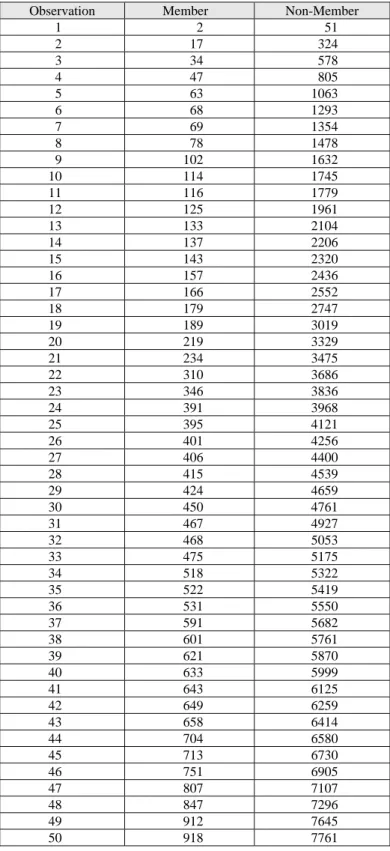
Although the SCTNet does not have any restriction on its applicants for member registration, the teachers located in Kaohsiung, due to the promotion activities done by the change agent – Bureau of Education in Kaohsiung, dominate the registered members. Weekly data of accumulated number of members and non-members are compiled to have fifty observations available and listed in Table 2.
Bass model and
Parameter
estimation
The research model used is Bass model (1969) for its strong theoretical background and wide validation by various studies. The emerging phenomenon of website user diffusion has justified the use of Bass model. The mathematical form is in equation (2), given that an adoption will occur at time t for non-adopters.
)] ( )][ ( [ ) ( ) ( N t m N t m q p dt t dN t n = = + − ...(2)
When m is defined as the potential number of ultimate adopters, then n(t) and N(t) can be defined as: n(t) is the number of adopters at time t, and N(t) is the cumulated number of adopters at time t.
With the assumption that the potential adopter m is a constant, equation (2) is a first-order differential equation, and can be integrated to yield the cumulated adopters distribution N(t) in equation (3). This model is referred as the Bass model. Three parameters (p, q, m) need to be estimated in the model. The solution of the Bass model is listed below in equation (3).
t q p t q p e N m q p N m m q e N m q p N m p m t N ) ( 0 0 ) ( 0 0 ) ( 1 ) ( ) ( + − + − + − + + − − = ...(3) where, N(t = 0) = N0
The potential size m is given, based on the statistic data published by Taiwan’s ministry of education. There are two parameters, p and q, to be estimated.
Among a variety of estimation methods used in a review of diffusion literatures, Mahajan et al. (1990) classified them into two groups: invariant estimation procedures and time-varying estimation procedures. “Time-time-varying estimation procedures are designed to update parameter estimates as new data become available.”(p.9) Apparently, these procedures are not fitting to this study because the study data is kept constant throughout the study. The time-invariant estimation procedures include ordinary least square (OLS), maximum likelihood estimation (MLE), and nonlinear least squares (NLS). Compared with each other, NLS are superior to the other two in parameter estimate of diffusion model (Mahajan et al., 1986; see Mahajan et al. review, p.9). Therefore, NLS is used, and nonlinear regression analysis is applied to estimate parameters.
4. Result
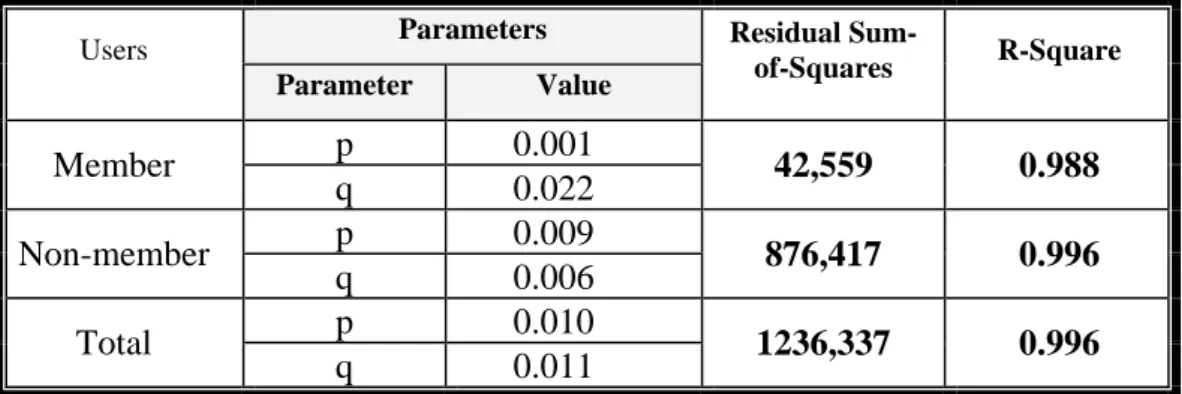
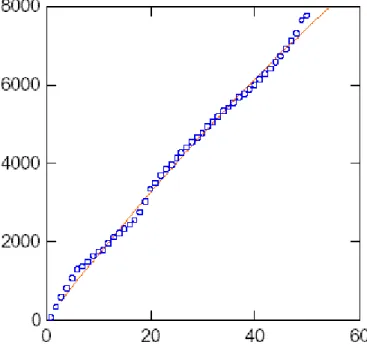
The resulting model parameters are summarized in Table 1. The Bass model gives a satisfactory result for that all the R-square values in three cases are high (Member 0.988, Non-member 0.996, and Total 0.996). The graphs of model fit for each are plotted in Figure-1, Figure-2, and Figure-3 respectively.
Parameters Users Parameter Value Residual Sum-of-Squares R-Square p 0.001 Member q 0.022 42,559 0.988 p 0.009 Non-member q 0.006 876,417 0.996 p 0.010 Total q 0.011 1236,337 0.996
Table 1. Parameters of Bass Model for Members, Non-member, and Total Users
Figure 1. Bass Model Fit for Members
All the parameters p and q shown in Table 1 are non-zero, and it means that the diffusion of three cases have the internal and external effect. The parameter p is the external effect, which is referring to the effect of advertising. SCTNet has very limited resource and does not have any budget to do advertising in any traditional mass communication media including TV and newspapers. However, its URL has been put in some portal websites as well as non-profit educational websites, and these can be regarded as the source of its external effect. The
yet. In the case of member users, the result demonstrates that the internal effect of parameter
q (=0.022) is stronger than the external effect of parameter p (=0.001). In other words, the
member users are willing to influence the others.
Figure 2. Bass Model Fit for Non-members
Figure 3. Bass Model Fit for Total Users
5. Conclusion
The research has several contributions. For academic researchers, it conveys that the growth pattern of website users can be modelled in mathematical form, and has satisfactory result
with Bass model. For practitioners, it shows both advertising and inter-personal relationship have the effect to promote the website. The result shows that the member users are willing to influence the others, For those websites wish to make profit under the membership relation, and the management of websites should address the need of members for the purpose of keeping the existing members as well as recruiting new members.
References
Abrahamson, E & Rosenkopf, L (1997), ‘Social Network Effects on the Extent of Innovation Diffusion: A Computer Simulation’, Organization Science, vol. 8, no. 3, pp. 289-309. Bass, FM (1969), ‘A New Product Growth Model for Consumer Durables’, Management
Science, vol. 15, pp. 215-227.
Chen, L, Gillenson, ML, and Sherrell, DL (2002), ‘Enticing Online Consumers: an Extended Technology Acceptance Perspective,’ Information and Management, Vol. 39, Issue 8, September 2002, pp. 705-719.
Field, AR & Harris, CL (1986), ‘The Information Business’, Business Week, 25 August, pp. 82-90.
Goodman, SE, Press, LI, Ruth, SR & Rutkowski, AM (1994), ‘The Global Diffusion of the Internet: Pattern and Problems’, Communication of the ACM, vol. 37, no. 8, pp. 27-31. Gurbaxani, V (1990), ‘Diffusion in Computing Networks: the Case of BITNET’,
Communication of the ACM, vol. 33, no. 12, pp.65-75.
Hawes, DK (1987), ‘The Role of Marketing in Facilitating the Diffusion of Microcomputers and the Information Society’, Journal of the Academy of Marketing Science, Special Issue, Vol. 15, No. 2, pp. 83-90
Huang, M (2000), ‘Information Load: Its Relationship to Online Exploratory and Shopping Behavior,’ International Journal of Information Management 20, 2000, pp. 337-347. Kotler, P (1982), Marketing for Non-profit Organizations, 2nd ed. Englewood Cliffs, NJ:
Prentice-Hall, Inc.
Koufar, M, Kambil, A, and LaBarbera, PA (2002), ‘Consumer Behavior in Web-Based Commerce: An Empirical Study,’ International Journal Electronic Commerce, Vol. 6, No. 2, Winter 2001-2002, pp. 115-138.
Lovelock, CH (1984), Service Marketing, Englewood Cliffs, NJ: Prentice-Hall, Inc.
Mahajan, V & Peterson RA (1985), Models For Innovation Diffusion, Beverly Hill, CA: Sage Publication Inc.
Peterson, RA & Mahajan, V (1978), ‘Multi-Product Growth Models’, in Research in
Marketing, J. Shedth, ed., Greenwitch: JAI Press, pp. 201-231.
Rai, A, Ravichandran, T & Samaddar, S (1998), ‘How to Anticipate the Internet’s Global Diffusion’, Communications of the ACM, vol. 41, no. 10, pp. 97-106.
Rogers, EM (1995), Diffusion of Innovation, 3nd ed., New York: The Free Press.
Schlueter, C. and Shaw, M. (1997), ‘A Strategic Framework for Developing Electronic Commerce,’ IEEE Internet Computing, 1, 6 (Nov. 1997), pp. 20-28.
Table 2. Weekly Data of Cumulated Member-Adopters and Non-member Adopters
Observation Member Non-Member
1 2 51 2 17 324 3 34 578 4 47 805 5 63 1063 6 68 1293 7 69 1354 8 78 1478 9 102 1632 10 114 1745 11 116 1779 12 125 1961 13 133 2104 14 137 2206 15 143 2320 16 157 2436 17 166 2552 18 179 2747 19 189 3019 20 219 3329 21 234 3475 22 310 3686 23 346 3836 24 391 3968 25 395 4121 26 401 4256 27 406 4400 28 415 4539 29 424 4659 30 450 4761 31 467 4927 32 468 5053 33 475 5175 34 518 5322 35 522 5419 36 531 5550 37 591 5682 38 601 5761 39 621 5870 40 633 5999 41 643 6125 42 649 6259 43 658 6414 44 704 6580 45 713 6730 46 751 6905 47 807 7107 48 847 7296 49 912 7645 50 918 7761