Enhancement of 1.5
μm emission in erbium-doped
spin-on glass by furnace annealing
Yuen Yung Hui
⁎
, Ping-Hung Shih, Kuo-Jui Sun, Ching-Fuh Lin
Graduate Institute of Electro-optical Engineering and Department of Electrical Engineering, National Taiwan University, No.1, Sec. 4, Roosevelt Road, Taipei, Taiwan, ROC
Received 24 March 2006; received in revised form 8 December 2006; accepted 6 February 2007 Available online 13 February 2007
Abstract
Characteristics of light emission from mixture of spin-on glass and erbium oxide nanoparticles were investigated. Such erbium-doped silica thin films after furnace annealing have exhibited a strong room temperature photoluminescence (PL) at∼ 1.53 μm. The PL intensity of the erbium-doped thin film after annealing at 1000 °C was 30 times higher than those after low-temperature annealing. The chemical environment of the erbium ion in the thin film after annealing has been studied by Time-of-Flight Secondary Ion Mass Spectrometry (SIMS). The SIMS result confirmed that Er–O–Si complex was favored and OH group was eliminated in the erbium-doped silica film sample after annealing. Hence we accounted for the PL enhancement of erbium-doped silica by furnace annealing.
© 2007 Elsevier B.V. All rights reserved.
Keywords: Annealing; Erbium; Photoluminescence; Secondary Ion Mass Spectrometry
1. Introduction
Erbium-doped silica materials have received much research interest, since they emit light at 1.5 μm, which is crucial for telecommunication applications [1,2]. The trivalent erbium ions, Er3+, which is characterized by the4I13/2→4I15/2intra-4f
transition, play the key role in the optical emission. But, the emission of erbium ion is forbidden, if the symmetry of the local crystal field around the erbium ion in the host material is not distorted. The erbium ions must be incorporated in a non-centrosymmetric host material for strong optical emission.
Many methods have been developed to incorporate the erbium ion into the silica host materials and to fabricate erbium-doped silica materials. They are usually prepared by plasma enhanced chemical vapor deposition [3], ion implantation [4]
and sol–gel processing[5]. In addition, thermal annealing[6,7]
on the erbium-doped materials after growth can enhance the photoluminescence (PL). Slooff et al.[7] found that hydroxyl (OH) groups were eliminated in the annealed erbium-doped
sample using infrared analysis. Meanwhile, the fluorescence lifetime of the PL increased as the removal of OH groups[8]. The PL enhancement was explained as due to the elimination of OH groups. Chen et al. [9] further studied the chemical environment of erbium ion in sol–gel silica by extended X-ray absorption fine structure and found that the local chemical environment of erbium ions in the silica film was similar to that of erbium oxide (Er2O3). The first neighborhood of an erbium
ion was determined as an oxygen atom for efficient PL emission. Zheng et al.[6]attributed the PL enhancement to the formation of Er–O–Si complex in high-temperature annealed sample. However, a full understanding of the temperature dependence in erbium-doped silica material has not been achieved yet.
In this work, we report the use of the spin-on glass (SOG) solution to fabricate erbium-doped silica thin film. Our fabrication method does not demand any costly vacuum apparatus. The erbium-doped thin film is deposited just simply by spin-coating and the spin-coating solution is P2O5-doped
SOG which comprises Er2O3nanoparticles. The PL of the film
samples after annealing will be studied. We further investigate the chemical environment of the erbium ion in the silica thin
Thin Solid Films 515 (2007) 6754–6757
www.elsevier.com/locate/tsf
⁎ Corresponding author. Tel.: +886 2 3366 3540; fax: +886 2 2364 2603. E-mail address:[email protected](Y.Y. Hui).
0040-6090/$ - see front matter © 2007 Elsevier B.V. All rights reserved. doi:10.1016/j.tsf.2007.02.013
film and explain the PL enhancement after annealing by Secondary Ion Mass Spectrometry (SIMS). The SIMS spectra of the high-temperature and low-temperature annealed film samples are compared. Hence we deduce that the Er–O–Si complex is favored and OH group is eliminated during high temperature annealing. Our SIMS study shows a complemen-tary picture of chemical environment in the erbium-doped silica thin film after thermal annealing.
2. Experimental details
Erbium-doped silica thin films were prepared by spin-coating. In our experiment, the ingredient of the spin-coating solution was briefly described as follows. A pre-determined weight ratio of Er2O3 nanoparticles and P2O5 particles were
added to the commercially available SOG solution. The SOG solution, which was manufactured by Filmtronics Inc., contained silanol groups. The weight ratio of the nanoparticles and the SOG solution was 1:5. It was noted that the average diameter of the Er2O3nanoparticles and the P2O5particles were
43 nm and 74 μm respectively. The P2O5 particles were
completely dissolved into the SOG solution. Then the prepared solution was spun on a cleaned Si substrate at 3000 rpm for 40 s. Afterwards, the samples were heated up with a ramp of 5 °C/ min until 300 °C in ambient. The temperature of the furnace was held at 300 °C for 30 min, so heavily P2O5-doped SOG became
phosphate glass. The samples were further heated up with a ramp of 5 °C/min to a higher temperature, according to our annealing condition. The samples were then annealed at that high temperature for 90 min, and finally cooled down to the room temperature.
The PL of the erbium-doped thin film samples was then collected at room temperature with a pumping laser at the wavelength of 980 nm, because Er3+ions have high absorption cross section at 980 nm. The PL signal was spectrally analyzed with a monochrometer and detected with an InGaAs detector. The film samples exhibited strong luminescence at 1530 nm. The luminescence intensity of the film sample significantly varied with the annealing condition. Finally, the chemical environment of the erbium ion was probed by the Time-of-Flight SIMS. The primary ion source was a pulsed69Ga+source
(30 ns, 10 kHz) operated at 25 keV. The analysis area was a square of 150 μm×150 μm. The SIMS spectra were recorded after the samples were sputtered cleaned. Electron flooding was applied for charge compensation during our experiment. 3. Results
Firstly, we compared the PL spectra annealed at different temperatures. The PL spectra of the film samples annealed at
Fig. 1. PL comparison for erbium-doped silica thin film samples annealed at different temperatures.
Fig. 2. Positive SIMS spectrum of erbium-doped silica thin film sample annealed at 1000 °C. (The mass-to-charge ratio of the secondary ion is specified in the blanket.)
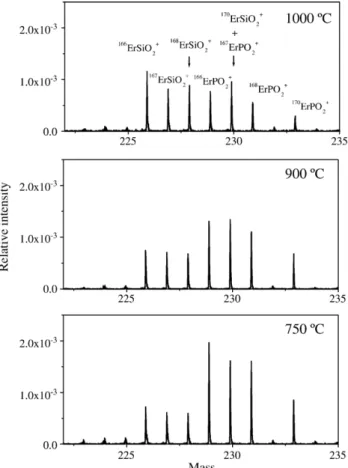
Fig. 3. Positive SIMS spectra of erbium-doped silica thin film samples annealed at different temperatures.
6755 Y.Y. Hui et al. / Thin Solid Films 515 (2007) 6754–6757
750, 900 and 1000 °C in ambient were illustrated respectively in
Fig. 1. All samples displayed broad peak at 1530 nm, which was characteristic for the intra-4f transition of Er3+. Fig. 1
demonstrated that the PL intensity increased with the annealing temperature during preparation, which was also reported in other erbium-doped silica system[6,7,10]. The PL intensity of the erbium-doped silica after furnace annealing at 1000 °C was 30 times higher than that after low temperature annealing at 750 °C. The annealing temperature at 1000 °C was approxi-mately the best operation temperature.
Then we investigated the chemical environment of erbium ion in the film samples by TOF-SIMS. The positive ion spectra annealed at different temperatures between 750 °C and 1000 °C were recorded. InFig. 2, the majority of the ion fragments in the low-mass side (below 70) were due to Si-, SiO-, and PO-related structure respectively. The peak at m/z = 43 was assigned to
28
SiOH+ ion, which was the active component in the SOG solution[11]. On the high-mass side (above 150) the majority of the ion fragments was due to Er-related structure. For instance, peaks corresponding to erbium ion (m/z = 166, 167, 168, and 170) were detected. The ion intensities of erbium ion agreed with the natural isotopic abundance ratio.
It was worth pointing out the presence of ErSiO2+(m/z = 226,
227, 228 and 230) and ErSiO3+(m/z = 242, 243, 244, and 245)
ions, which was a hint to the presence of the Er–O–Si direct linkage. To confirm the formation of the Er–O–Si complex, we took the ratio of all intensities relative to the matrix and analyzed the samples after different annealing conditions in a semi-quantitative manner. The intensity of 28Si+ peak was selected as the reference peak. Fig. 3 displayed the relative secondary ions from the sample annealed at 750 °C, 900 °C, and 1000 °C respectively. The abundance of relative intensity for ErSiO2
+
ion (m/z = 226, 227, and 228) increased, as the annealing temperature rose from 750 °C to 1000 °C. Hence, our SIMS result not only demonstrated the formation of the Er–O–Si complex in the erbium-doped silica, but also the enhancement of the Er–O–Si complex after annealing up to 1000 °C.
The peak corresponding to ErPO2+ion (m/z = 229, 230, 231,
233) were observed in Fig. 3, which were due to the fragmentation of the erbium phosphor oxide (ErPxOy). X-ray
photoelectron spectroscopy experiment confirmed that ErPxOy
with high OH content, which was enriched in the film surface, was found in the low-temperature annealed sample (below 750 °C). Hence, erbium ions dissolved into the silica thin film during high-temperature annealing. The low-temperature annealed film samples also produced poor PL emission.
It was known that OH group was one of PL quenching centers in Er-doped silica [12,13]. When an erbium ion was coupled to an OH group; PL excitation would be lost by non-radiative relaxation of OH vibration. So, we checked the secondary ion spectra of the samples and searched for the molecular ion coupled with OH groups. Both the ErOH+ (m/ z = 183, 184, 185, and 187) and ErO2H2+(m/z = 200, 201, 202,
and 204) ions were detected in the SIMS spectrum, shown in
Fig. 2.
For a better understanding of the SIMS result, we considered the relative secondary ion evolution with the annealing
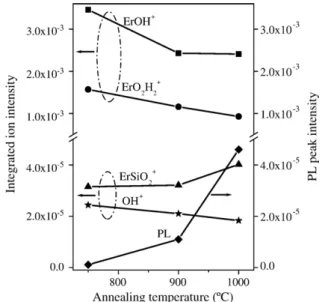
temperature and compared the secondary ion intensities from the samples inFig. 4. We selected the isotope of OH+(m/z = 17),
170
ErOH+ (m/z = 187), 166ErO2H2+ (m/z = 200) and 166ErSiO2+
(m/z = 226) for our comparison. Fig. 4 revealed when the annealing temperature rose from 750 °C to 1000 °C, the abundance of OH+,170ErOH+and166ErO2H2+ions diminished
for not less than 30%. And the abundance of 166ErSiO2+ ions
gained by 25%. We also found that the relative intensity for other isotopes of ErOH+and ErO2H2+ions behaved similarly as
the annealing temperature rose. Though the relative ion intensity in our SIMS result was not linearly proportional to the number of the molecular complex in the film sample, it reflected the abundance of the corresponding molecular complex and also the neighborhood atoms of erbium ion. Thus, the high-temperature annealed film sample contained more Er–O–Si complexes and fewer OH groups, compared with the low-temperature annealed one.
4. Discussion
The PL emission of erbium-doped silica is strongly influenced by the chemical environment of erbium ion because an excited erbium ion can de-excite by either photon emission at 1530 nm, or non-radiative relaxation through coupling to a quenching site. In other words, the following conditions must be fulfilled for strong PL emission of erbium-doped material. (1) The local symmetry of the crystal field around the erbium ion a host material should be distorted. (2) Also, the erbium ion should be linked with a molecular chain free of quenching site, for instance OH group. Otherwise, the excitation would be lost. Both conditions contribute to the chemical environment of erbium ion and also the final PL emission.
Considering these conditions, we explain our PL observation qualitatively by the SIMS result. The SIMS result suggests that the high-temperature annealed film sample contains more Er– O–Si complexes and fewer OH groups, compared with the
low-Fig. 4. Comparison of relative secondary ion intensities for erbium-doped silica thin film samples annealed at different temperatures. (The PL peak intensities of the corresponding samples are included).
temperature annealed one. Hence, high temperature annealing promotes the formation of Er–O–Si complexes, and eliminates the OH groups in the erbium-doped silica sample. We further assume that the Er–O–Si complex contributes to the excitation center for PL, while the OH group contributes to the quenching centers and deteriorates the final PL intensity. Therefore our SIMS data predicts as the annealing temperature of the erbium-doped silica film sample rises till 1000 °C, the PL peak intensity also increases, which is consistent with our PL result inFig. 4. Zheng et al.[14] observed the PL enhancement in erbium implanted silicon dioxide thin film after furnace annealing, and explained the enhancement by the formation of Er–O–Si complex in high-temperature annealed film sample. d'Acapito et al. [15] confirmed the formation of Er–O–Si complex in
erbium-doped silica by the extended X-ray absorption fine structure. They inferred that the erbium ion was linked to 5 or 6 oxygen atoms, and there was a well defined Er–O–Si bond angle of 135°. (So, the local symmetry around the erbium ion is broken.) The formation of Er–O–Si complex concedes with our SIMS result.
Finally, it is wondered what is the optimum chemical environment around erbium ion for efficient PL based on our observation. The first probable nearest neighborhood atom of erbium ion is oxygen atom, because co-doping of oxygen is an efficient way to enhance the solubility of erbium ion in silicon
[9]. Then the second neighborhood atom must not be hydrogen atom, because Er(OH)n complex is the PL quenching center.
Also, the second neighborhood atom should not be an erbium ion, as the excitation energy would easily lose between two nearby erbium ions by co-operative upconversion [13]. Therefore, in order to achieve the optimal chemical environ-ment around erbium ion and improve the PL efficiency in the erbium-doped silica system, we should enhance the excitation center for PL and eliminate the formation of quenching centers, for instance Er(OH)ngroup. It is suggested that the addition of
aluminum oxide can improve the solubility of erbium ion in silica material, and hence the abundance of erbium excitation center be enhanced.
5. Conclusion
In conclusion, we employed the SOG solution to produce erbium-doped silica thin film and studied the PL and SIMS of
the doped thin films. The PL intensity of the erbium-doped thin films was greatly enhanced by high-temperature annealing (1000 °C). The SIMS result demonstrated that high temperature annealing favored the formation of Er–O–Si complex and eliminated the OH group in the erbium-doped silica film. Our result explained the PL enhancement of erbium-doped silica thin film after high-temperature annealing. Acknowledgements
This work is supported by the National Science Council, Taiwan, Republic of China, with Grant No: NSC94-2120-M-002-010 and NSC-2112-M-002-009. We are also grateful for the SIMS experiment in the Department of Chemistry, National Tsing Hua University, Taiwan.
References
[1] L. Yang, D.K. Armanic, K.J. Vahala, Appl. Phys. Lett. 83 (2003) 825. [2] S. Gallis, M. Huang, H. Efstathiadis, E. Eisenbraun, A.E. Kaloyeros, E.E.
Nyein, U. Hommerich, Appl. Phys. Lett. 87 (2005) 091901. [3] J.H. Shin, M.J. Kim, J. Vac. Sci. Technol., A 17 (1999) 3230.
[4] F. Xu, Z. Xiao, G. Cheng, Z. Yi, T. Zhang, L. Gu, X. Wang, Thin Solid Films 410 (2002) 94.
[5] M. Fukushima, N. Managaki, M. Fujii, H. Yanagi, S. Hayashi, J. Appl. Phys. 98 (2005) 024316.
[6] C.S. Zhang, H.B. Xiao, Y.J. Wang, Z.J. Cheng, X.L. Cheng, F. Zhang, Physica. B 362 (2005) 208.
[7] L.H. Slooff, M.J.A. de Dood, A. van Blaaderen, A. Polman, J. Non-Cryst. Solids 296 (2001) 158.
[8] Y.G. Li, L.Y. Liu, Z.A. He, H.S. Tang, S.M. Xiao, L. Xu, W.C. Wong, J. Sol–Gel Sci. Technol. 30 (2004) 29.
[9] S.Y. Chen, C.C. Ting, C.H. Li, J. Mater. Chem. 12 (2002) 1118. [10] G. Kocher-Oberlehnera, W. Jantscha, L. Palmetshofera, A. Ulyashinb,
Physica, E 16 (2003) 347.
[11] G. Cerveau, R.J.P. Corriu, J. Dabosi, J.L. Aubagnac, R. Combarieu, Y. de Puydt, J. Mater. Chem. 8 (1998) 1761.
[12] Y. Yan, A.J. Faber, H. de Waal, J. Non-Cryst. Solids 181 (1995) 283. [13] E. Snoeks, P.G. Kik, A. Polman, Opt. Mater. 5 (1996) 159. [14] C.S. Zhang, J.Z. Sun, F. Zhang, Microelectron. Eng. 81 (2005) 378. [15] F. d'Acapito, S. Mobilio, S. Scalese, Phys. Rev., B 69 (2004) 153310.
6757 Y.Y. Hui et al. / Thin Solid Films 515 (2007) 6754–6757