UNSUPERVISED OBJECT-BASED SPRITE CODING SYSTEM FOR TENNIS SPORT
Ching-Yeh Chen, Shao-Yi Chien, Yi-Hau Chen, Yu-Wen Huang, and Liang-Gee Chen
DSP/IC Design Lab
Graduate Institute
of
Electronics Engineering
and
Department of Electrical Engineering
National Taiwan University
1, Sec.
4,
Roosevelt
Rd.,
Taipei, Taiwan
ABSTRACT
Sprite coding is a new objected-based coding technology proposed by MPEG-4 video standard. In this paper. we propose an unsu- pervised sprite coding System for sport videos, for example. ten- nis sequences. Our system can provide several important func- tions. First, the sprite of the background can he generated without any pre-processing masks in our system. Second, it can automati- cally segment the foreground and background in a video sequence. Third. it can provide themasks of the foreground objects and the tennis ball. The experimental results show that our system has a very good performance and the coding gain of our system com- pared with MPEG-4 Advanced Simple Profile is 2.5dB at the low bit rate (270Kbps) and is 2dB at the ultra low bit rate (7OKbps). It can he used in the spon video coding at low bit rate and provides a object-based sport video sequence.
1. INTRODUCTION
The concept of the sprite is proposed by MPEG-4 video standard [I]. A sprite(mosaic) is an image that collects all related informa- tion belonging to a video object in a video sequence. For a still object, like background, a sprite can give a panoramic view of the scene and can well represent the associated video object planes (VOPs). According to this property, sprite coding is proposed and it has several advantages. First, sprite coding is an efficient video coding with parametric motion models at very low bit rate. Sec- ond, sprite coding is also a kind of object-based coding. It is to
say that sprite coding can provide various functions and options to users.
There are also many applications of sprite. For example, we can use the sprite of the background to segment the foreground objects in a video sequence. The sprite of the background can support the MPEG-7 descriptors about the background in a video sequence. The camera motion provided by sprite coding is also an imponant descriptor in MPEG-7. Moreover, there are much mure intelligent information provided by sprite coding. There are sev- eral sprite coding systems in previous researches[Zl 131. However, their performances are not good and cannot provide a object-based sport video sequence. At the same time, there are some difficul- ties when we implement a sprite coding system. For example. if we want to collect the information of the background, we have to
recognize the information of the foreground first. However, if we want to recognize the information of the foreground, the related information of the background is needed. That is. it is an egg- and-chcken problem. Another task is the algorithm to generate the sprite of the background, where global motion estimation and
compensation are involved. There is a lack of a appropriate algo- rithm of global motion estimation and compensation to he applied in a sprite coding system.
In this paper, we propose a complete sprite coding system for
spon videos, for example, tennis sequences. And we overcome the above-mentioned difficulties by means of a two pass method. A defective sprite is generated in the first pass. In the second pass,
the defect is compensated and then we use the compensated sprite to segment the foreground objects. Our proposed system can au- tomatically generate the sprite of the background without any pre- processing masks. The masks of the foreground objects and the tennis ball can he generated automatically in our system. Our sys- tem can provide high quality in PSNR of the foreground and in subjective view of the background at very low bit rate. The struc- ture of this paper is as follows. In Sec. 2, we would introduce the algorithm in our sprite coding system. In Sec. 3, we would show the experimental results and compare it with MPEG-4 Advanced Simple Profile.' And a conclusion is given in Sec. 4.
2. ALGORITHM
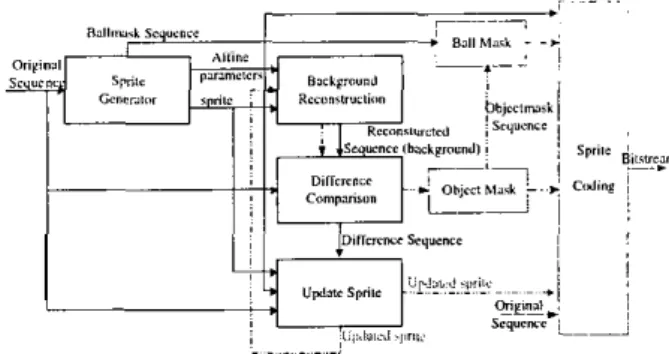
Our target is to set up a sprite coding system which can achieve following requirements. First of all, the sprite of the background can he generated automatically without any pre-processing masks in our system. Second. it can use the related information in a sprite coding system to generate the masks of the foreground objects au- tomatically. Third, since we focus on the application of sport video sequences, tennis sport. this system also has to get the informa- tion of the tennis hall. Therefore, the flowchart of the proposed sprite coding system is shown in Fig. 1. There are two passes in our system. The sprite of the background is generated in the first pass, whch is represented with the thick line. The dotted line shows the second pass to compensate the defect in the sprite of the background and segment the masks of the foreground objects. The processing steps are as following.
1. In Sprire Generator, the sprite of the background in a video sequence is generated.
2. Use the information of the sprite to reconstruct the back- ground in a frame in Background Reconstructio~~.
3. Calculate the difference between the original and recon- structed frame in Difference Comparison.
4. According to the information of the difference, the defect in the sprite of the background is recovered and a compensated sprite is gotten in Update Sprite.
5 . Repeat the step 2 but use the compensated sprite
Fig. 1. Block diagram of the proposed sprite coding system
6. Repeat the step 3.
1. The masks of the foreground objects are segmented in ac- cordance with the information of the difference in Objecr
Mask.
8. The mask of the tennis ball is calculated in Ball Mask. 9. All related information are compressed into a bitstream in
Sprire coding.
In the successive subsections. we would introduce the five ma- jor components, Sprire Generaror, Updare Sprire, Objecr Mask,
Ball Mask and Sprire coding in our proposed system.
2.1. Sprite Generator
The core operation of Sprire Generaror is a feature-point based global motion estimation[4]. There are three steps in tlus algo- rithm. First, we select some feature points which have larger Hes-
sian values,
to represent the frame. The second step is motion estimation, and affine model,
x' = aox
+
sly+ a2y' = a3x
+
aay+
as,(2) (3) is used to describe the global motion. We use the previous global motion parameters as prediction to calculate the motion vectors of these feature points in the sprite. Simultaneously, in order to avoid the selected feature points belonging to the foreground objects and get more accurate global motion parameters, the motion vector of the selected feature point is neglected if the absolute difference
of this feature point is larger than a threshold. Finally, we use these motion vectors to estimate the global motion parameters by the LMS algorithm. This process is repeated iteratively until it converges or the number of iterations is larger than ten. When this process stops, the final global motion parameters are gotten. According to these global motion parameters, we warp the current frame to a warped frame in the sprite domain and only record the new inlormation in the warped frame.
2.2. Update Sprite
Bccause we cannot recognize the information of the foreground objects before the sprite of the background is generated. there is a defect appeared in the sprite of the background. Therefore, wc ha\e to compensate tlus defect to get the true background. After
DiQerence Comparison, there are two major categories in the dif- ference frame. The foreground objects in the current frame belong to a category, and the region warped by the defect is the other. That is to say, if we warp the difference frame to the warped frame in the sprite domain, the former is warped to different positions and the latter is warped to the same place, the defect in the sprite. By this properly, we make a judgement, J ( x , y), to detect the region of the defect in the sprite of the background.
where (x, y) is the position of a pixel in the sprite domain, and P ( x , y) is the number of times, where the corresponding position in the difference frame of the pixel (x, y) is apixel of some object. After we find the region of the defect. we select the temporal me- dian value of each pixel in the region of the defect to make up for the defect in the sprite of the background. In order to reduce the memory size, a hierarchial method is used. A median is selected in every ten frames, and then we choose the median in the set of these medians. In this way, only ten percent memories are required compared with the original method.
2.3. Object Mask
After the process of Updare Sprire, there is only one category in the difference frame. This category includes the foreground objects in the current frame. However, there are still two objects in this cat- egory corresponding to lhe two players in the game. The job of
Objecr Mask is to separate the foreground objects into the two dif-
ferent objects. The first step is temporal continuity. In Difference
Comparison. some information is lost after eliminating noise. We can recover these information by temporal continuity. Next, a con- nected component algorithm is applied to separate the masks of the foreground objects into two mask frames, and then we use the temporal similarity to classify them. At last, the rectangular mask are used to replace the irregular shape mask to achieve a higher compression ratio.
2.4. Ball Mask
In Sprire Generaror, some pixels are selected as the candidates for the tennis ball. These pixels have very larger Hessian values and the chrominance of these pixels are in a certain range. The tennis ball does not stay at the same place in continuous several frames; therefore, we can delete these candidates which stay at the same position in successive frames. On the other hand, the information of the tennis ball does not appear i n the sprite of the background so
the corresponding position of the tennis ball in the sprite domain does not have a very large Hessian value, but the pixel of the tennis ball in the current frame does. According to this property, there are some candidates which can be deleted. Finally, there are two candidates for the tennis ball in each frame, in average.
Fig. 2. The sprite of Sampras.
Fig. 3. The defect in the sprite of Sampras.
2.5. Sprite coding
Sprite coding is a component to compress all related information in a video sequence into a bitstream. In Sprite coding, MPEG-4 object coding tools are applied to compress the information ofthe foreground objects and the sprite of the background. The infor- mation of the tennis hall is compressed by the DPCM technique. Funhermore, the sprite points in MPEG-4 video standard are used to replace the global motion parameters in order to preserve the precisions ofthe parameters in the coding system.
3. EXPERIMENTAL
RESULTSThis section would show the experimental results of our proposed sprite coding system. The test platform is a PC with a P4 1.8 GHz processor. The test sequence is a tennis sequence, Sampras, in CIF format with 162 frames. In the following subsections, we also show the experimental results of Sprite Generator, Update Sprite
and the comparison of rate distortion cuwes and the reconstructed frames between OUT system and MPEG-4 Advanced Simple Profile with searching range 16.
3.1. Sprite Generator and Update Sprite
The experimental result of Sprite Generator is shown in Fig. 2.
In the sprite of the background, there are apparent two foreground objects corresponding to the two players in the game. The reason is that we cannot recognize the information of the foreground ob- jects before the sprite of the background is generated. In Fig. 3, we
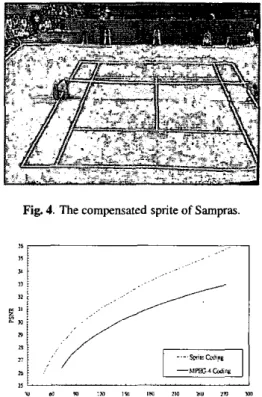
Fig. 4. The compensated sprite of Sampras.
Fig. 5. The comparison between the RD curve of the foreground objects in our system and that of the whole frame in MPEG-4 Ad- vanced Simple Profile.
show the position of the defect detected in Updnte Sprite and Fig. 4
is the compensated sprite after the process of Updnte Sprite. There
is no foreground objects in the compensated sprite of the back- ground. That is to say, we overcome the egg-and-chicken problem about the segmentation of the foreground and background, and successfully generate a sprite without any pre-processing masks. Besides, our sprite has a good quality in subjective view.
3.2. Rate Distortion
In Fig. 5, we show the comparison of rate distortion between our proposed sprite coding system and MPEG-4 Advanced Simple Profile with searching range 16. There are three major components of the hitstream in our system. They are the information of the foreground objects, the global motion parameters and the informa- tion of the tennis ball. The hit rate of the sprite of the background can be neglected, because in a real video sequence, there are thou- sands of frames in a scene. That is to say, the information of the sprite would be reused in very many frames. The bit rate of the sprite of the background is distributed to each frame averagely so
that the bit rate of the sprite of the background is small enough to neglect it. Similarly, the
PSNR
is calculated by only considering the part of the foreground objects excluding the information ofthe background.According to Fig. 5 at low bit rate (270Kbps, 3Ofps). the coding gain of our proposed system compared with MPEG-4 Ad- vanced Simple Profile is 2.5dB. At the ultra low bit rate (7OKbps.
Fig.
6.
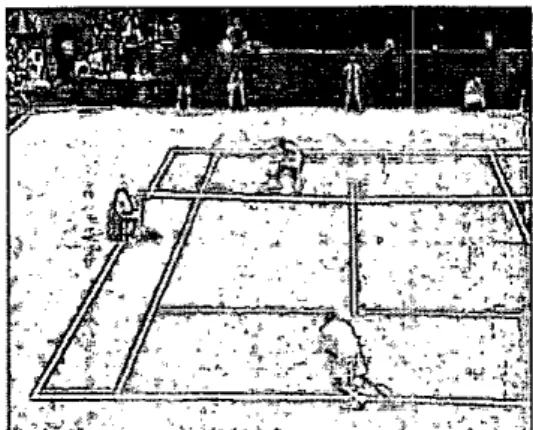
The reconstructed frame 5 1 in Sampras by our proposed system at I6OKhps and the PSNR is 32.61 dB.Fig. S. The reconstructed frame 71 in Sampras by our proposed system at 72Kbps a i d the PSNR is 28.28 dB.
Fig.
I.
The reconstructed frame51
in Sampras by MPEG-4 Ad- vanced Simple Profile at 160Kbps and the PSNR is 30.62 dB.3Ofps). the coding gain is 2dB. In Fig. 6 and Fig. 7, we show the reconstructed frame 5 1 in Sampras by our proposed system and MPEG-4 Advanced Simple Profile at 160Kbps. respectively. Tne PSNR of our system is 32.61dB and that of MPEG-4 Advanced Simple Profile is 30.62dB at I 6 0 Kbps. In Fig. 8 and Fig. 9, we show the reconstructed frame 71 in Sampras by our proposed sys- tem and MPEG-4 Advanced Simple Profile at 72Khps. The PSNR
of our system is 28.28dB and that of MPEG-4 Advanced Simple Profile is 26.33dB. To he brief. our performance is much better than MPEG-4 Advanced Simple
Profile
either in the PSNRor
in
the subjective view and the coding gain is at least 2dB.
4. CONCLUSION
In this paper. we establish a complete and unsupervised sprite cod- ing system for sport videos, for example, tennis sequences. Our proposed system can automatically generate the sprite of the back- ground without any pre-processing masks by a two pass method. The foreground and background in a video sequence can he seg-
mented automatically in our proposed system. The masks of the foreground objects and the tennis ball are also provided by this sys- tem. The performance of our proposed system is much better than MPEG-4 Advanced Simple Profile and the coding gain compared
Fig. 9. The reconstructed frame 71 in Sampras by MPEG-4 Ad- vanced Simple Profile at 72Kbps and the PSNR is 26.33 dB.
with MPEG-4 Advanced Simple Profile is at least 2dB a1 low bit rate.
5. REFERENCES
[ I ] MPEG Video Group, “The MPEG-4 video standard verifi- cation model version 18.0.” ISO/IEC JTC I/SC 2 9 N G l l N3908.2001.
[2] K. Jinzenji, S . Okada, H. Watanahe. and N . Kobayashi, “Au- tomatic two-layer video object plane generation scheme and its application to MPEG-4 video coding:’ in Proc. of /mer- narional Symposium on Circuirs and Systems, 2MM, pp. 606-
609.
[3] K. Jinzenji, S . Okada,
N.
Kobayashi. and H. Watanahe, “MPEG-4 very low bit-rate video compression by adaptively utilizing sprite to short sequences,” in Proc. of InternationalCon/erence on Multimedia and Expo, 2002, pp. 653456. 141 S:Y. Chien, C.-Y. Chen, W.-M. Chao, C.-W. Hsu, Y.-W.
Huang, and L:G. Chen, “ A fast and high subjective quality sprite generation algorithm with frame skipping and multiple sprites techniques,” in Proc. of lnrernarional Coiljerencr on Image Pmcessing, 2002, pp. 193-196.