DISCRETE FRACTIONAL FOURIER TRANSFORM
Soo- Chang Pei' Man-Hung Yeh'
'Department of Electrical Engineering, National Taiwan University, Taipei, Taiwan, R. 0. C. Email address: [email protected]
'Department of Electrical Engineering, National Taiwan University] Taipei, Taiwan, R. 0. C. Email address: [email protected]
ABSTRACT
The continuous fractional Fourier transform (FRFT) rep- resents a rotation of signal in time-frequency plane, and it becomes an important tool for signal analysis. A discrete version of fractional Fourier transform has been developed but its results do not match those of continuous case. In this paper, we propose a new version of discrete fractional Fourier transform (DFRFT). This new DFRFT will provide similar transforms as those of continuous fractional Fourier transform and also hold the rotation properties.
1. INTRODUCTION
Successive application of the Fourier transform
F
on the signal z ( t ) yields F'"[z(t)] = z ( - t ) , F 3 [ z ( t ) ] = X ( - w ) , F ' [ z ( t ) ] = z ( t ) . Based upon this notation, the Fourier transform can be interpreted as a $ rotation of sig- nal in the time-frequency plane. A generalization of Fourier trasform, FRFT, is treated as a rotation of signal in the time-frequency plane, so it satisfies the following rotation properties:1. Zero rotation: 80 =
I
2. Additivity of rotation:
Ra8p
=Xa+p
3. Consistency with Fourier transform: 8 % =
F
4. 27r rotation: iI?2T = I
where
R
indicates the rotation operation in the time- frequency plane. Parameters a andp
are the rotation an- gles. The transform kernel of continuous fractional Fourier transform (FRFT) is defined as[4]:Using the kernel of FRFT, the F R F T of the signal z ( t ) , with angular parameter CY, is computed as:
m
& ( U ) =
1
z ( t ) K a ( t , u ) d t (2)- 0 3
The signal z ( t ) can be recovered form a FRFT operation with angular parameter ( - a ) :
M
~ ( t ) =
JIM
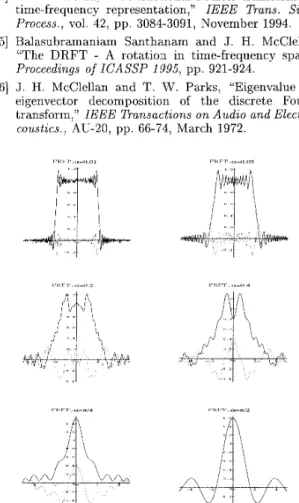
X , ( ~ ) K - ~ ( u , t ) d u (3) The main properties of FRFT is well discussed in [4]. Figure 1 shows the F R F T of the rectangle window function ( z ( t ) =1 for
It1
5
2; otherwisez ( t )
= 0) for various angles. The real parts of FRFT or DFRFT in this paper are plotted by solid lines, and the imaginary parts ofFRFT or DFRFT
are plotted by dashed lines.2. THE ROATAIONAL CONCEPT IN
The discrete fractional Fourier transform (DFRFT) must obey the rotation rules as those of FRFT. These rotation- al properties can be realized by the power laws of kernel matrix in discrete case. The power of DFRFT kernel and the rotation angles in DFRFT essentially mean the same thing. In order to avoid ambiguity] the Greek letters (for example: a ,
p )
are used to denote the rotation angles in the time-frequency planes and the English letters are used to denote the power values of the DFT kernel matrices in this paper. The relationships between the fractional power of DFT kernel matrix and the rotation angle of the D F T operation are listed below:DISCRETE CASE
Ra
= (4)Ft =
?R%
( 5 )The method to compute DFRFT proposed in [2] and [5] is direct computing the fractional power of Fourier transform kernel. The fractional power of Fourier transform kernel can be calculated by equation (6):
Ft = ao(t)F0
+
ai(t)F1+
a2(t)F2+
a3(t)T3 (6) where(7) f f i ( t ) =
1
2
e3 $ ( t - t Pk = l
4
Applying the above defined kernel t o signal, the DFRFT of the signal z ( t ) is compute as:
F t [ z ( n ) ] =ao(t)z(n)+a,(t)z(-n)+al(t)X(n)+cxs(t)X(-n)
(8) where X ( n ) is the D F T of signal z(n). Equation (8) indi- cates the DFRFT of the signal z ( t ) are the angular combi- nation of the four parts: the original signal z ( n ) , its DFT, a circular flipped version of the signal z ( n ) and a circu- lar flipped version of its DFT. Although this definition of DFRFT obey the rotation principle as F R F T and can be computed through the D F T fast algorithm. But this D- FRFT does not provide the same transforms as those of FRFT. The relationship between DFRFT and F R F T is un- known.
3. N E W D I S C R E T E F R A C T I O N A L F O U R I E R The development of our DFRFT is based upon the eigen- decomposition of the D F T kernel matrix. To begin with, we will review the properties of the eigenvalues and eigen- vectors of the D F T kernel matrix. It has been shown in [6] that the kernel matrix of D F T has only four distinct eigen- values: [l, - j , -1, j ] . The multiplicities of the eigenvalues of the DFT have also been derived in [6] and are shown a- gain in Table l. Because the eigenvectors of DFT kernel F
T R A N S F O R M N 4m 4 m + 1 1
-.i
-1 j m + l m m m - 1 m t l m m mT a b l e 1. Multiplicities of the eigenvalues of DFT k e r n e l matrix
are not uniquely determined, the eigenvectors correspond- ing to the same eigenvalues construct a vector space. Every vector spanned by the eigenvectors corresponding to the same eigenvalues is also an eigenvector of F. In [2], B. W.
Dickinson and K. Steiglits introduced a commuting matrix S to compute the eigenvectors of F with real values. The definition of matrix S is listed as follows:
1 0 0 . . .
r
;
2cosw 1 0 . . . N 4m 4 m + is =
I
0 1 2c0s2w .1. the eigenvalues e - j9 ,
k = 0 , 1 , 2 , .' .
,4m-
2,4m e - j v.
k
= 0.1 2. ..
. .4m - 1.4m 0 4m+
2 4m+
3 L 1 0 0 0 . . . 2cos(N - 1)w1
where w =
$.
Matrix S commutes with matrix F and it satisfies the following commutative property:SF = FS (9)
The eigenvectors of S are also the eigenvectors of F, but they correspond to different eigenvalues. Because matrix S is a symmetric matrix, the eigenvalues of matrix S are all real and the eigenvectors are orthonormal each other. The eigen-decomposition of matrix S is written as:
k = 0 , 1 , 2 , .
' .
,4m,4m 4- 2 k = 0 , 1 , 2 ,...
,4m+
1,4m+
2k=O
where Yk is the eigenvalue of the matrix
s,
and V k is theeigenvector of the matrix S corresponding t o the eigenvalue
yk. The eigen-decomposition of DFT kernel matrix
F is written as:F =
C v ~ v ~ + C
( - j ) v l e v i + C ( - l ) v k v ; + C ( j ) v k v ;k E E i k E E z k E E 3 k E E 4
(11) where E1 is the set of indices for eigenvectors belongs to XI, = 1. E2 for X k = - j and so on. The eigenvector ob-
tained from matrix S can be regarded as the discrete Her- mite function for the following reasons:
1. The eigenvectors obtained from matrix S are also the 2. The eigenvectors obtained from matrix S are all real
eigenvectors of discrete Fourier transform kernel. function.
3. The eigenvectors of matrix
S
construct an orthonormal Based upon the extensive numerical evidence, it can be found that the numbers of sign-changes in the DFT-shifted eigenvectors of matrix S are 0 , 1 , 2 , . . .,
N - 1.Eigenvalues A s s i g n m e n t Rule
The power of matrix can be calculated from its eigen- decomposition and directly make the powers for the eigen- values. But the ambiguity presented in the fraction powers of eigenvalues. The eigenvalues of F R F T are e-J""[3]
,
so the ambiguity existed in the fractional power of the eigen- values is solved by the order of Hermite function. Because the eigenvectors of matrix S is regarded as the discrete ver- sion of Hermite function, the eigenvalues of F can be de- termined based upon the corresponding order of discrete Hermite function. The n-th order Hermite function have n zeros, the number of sign-changes in the eigenvectors of ma- trix S can be used determined to the Hermite order which the eigenvectors of F correspond to. If the eigenvector hask sign-changes, it is regarded as the k-th order discrete Her-
mite function and it corresponds to the eigenvalue e-jka. But the numbers of sign-changes in an N-point eigenvector can have at most (N-1). If the eigenvalue of this eigenvec- tor is assigned to e--j(N-l)a
,
the multiplicities of eigenvalues of DFT will not match those shown in Table 1 for the two cases: N = 4m and N = 4m+
2. This eigenvalue of this eigenvector should be assigned t o the value e--jaN. Table 2 shows the eigenvalues assignment rule for various cases ofN .
basis.
T a b l e 2. The eigenvalues assignment rule of DFT
k e r n e l matrix
After the eigenvalues of DFT kernel is determined, the transform kernel of DFRFT can be easily defined by taking fractional powers of the eigenvalues.
N is odd
C e - j k a v k v E
+
e-3NavN-lvh-l N is evenI
k=Owhere v k is the eigenvector obtained from matrix S, and it
has k sign-changes in the DFT-shifted case.
The DFRFT of signal c(n) can be computed through equation (12):
& 2 -
X,(n) = R,z(n) = F n z ( n ) = VD"V*z(n) (12)
The signal z ( n ) can also be recovered from its DFRFT through a operation with parameter
( - a )
as the contin-
uous case.x(n) = R-,Xa(n) = VD-*V*X,(n) (13)
Example: Here, we deal with the rectangle window with period [-2,2]. The sampling interval is T, = 4/13, and the number of point is N = 73, The discrete data become: ( N = 73,
f(k)
= 1, -65
k5 6;
otherwisef(k)
= 0). Figure2 shows the results of D F R F T proposed in [5]. Figure 3 shows the results of new DFRFT. Comparing the results shown from Figure 1 t o Figure 3, we can find the transform results in Figure 3 are very similar t o those shown in Figure 1. But the curves of Figure 3 are much smoother than those of Figure 1, it is for the reason that only 73 points of data is used in our experiments. The resolution of DFRFT is not sufficient, so it cannot reveal the value-changes in the transform results as those of continuous case.
The development of this DFRFT is based upon the eigen- decomposition of D F T kernel matrix F. The main differ- ence of our method from t h a t developed in [5] is with dif- ferent eigenvalues assignment rule. The method proposed in [5] assigns the fractional powers of eigenvalues of F only to four values: e - J o r , e--jZa e--jSa, e - ~ * ~
,
and it ignores the implicit orders existed id the eigenvectors (regarded as discrete Hermite function) of matrix F.4. PROPERTIES O F DFRFT
Most of the properties of this DFRFT are inherited from D F T and FRFT. Properties of the new DFRFT are dis- cussed below: 1 2. 3. 4. 5. 6 . 7. The
Unitary: The DFRFT operator
Re
inherited the uni- tary of D F T kernel .R;
=RL1
= (14)l l ~ a [ ~ ( n ) l l l
=ll4n)ll
(15) In other word, this transform preserve the signal ener- gy.Angle additivity: The rotation with angular param- eter cy followed by another rotation with angular pa-
rameter
p
is equivalent to the rotation with parametercy
+
p.
RorRzp
=Re+@
(16)Rorz(-n) = X , ( - n ) (17)
Time Inversion:
Periodicity: The transform kernel and the result of transform are periodic with period 27r.
Ror+27r =
Ror
(18)Symmetric: The transform kernel is a symmetric ma- trix.
Ra
( a , b ) =Re
( b , a ) (19) Eigenfunction: This transform similar to the case of FR.FT has a Hermite-like function as its eigenvector. Parity: If signal z ( n ) is even, the transform X , ( n ) is also even. If signal z ( n ) is odd, the transform X a ( n ) is also odd.5. CONCLUSIONS
DFRFT proposed in this paper can provide the similar
transforms a s those of continuous case,. and it also holds
the rotation properties. This DFRFT provide a method for implementing D F R F T in digital electronic system.
REFERENCES
G. Sansone, Orthogonal Functions Interscience Puh- lisher Inc., 1959.
B. W. Dickinson and K. Steiglitz, “Eigenvectors and functions of the discrete Fourier transform,” IEEE Trans. Acoust., Speech, and Signal Process., vol.
ASSP-30, pp. 25-31, February 1982.
H. M. Ozaktas and B. Barshan, “Convolution, filter-
ing, and multiplexing in fractional Fourier domains and their relationship to chirp and wavelet transforms,” J .
Opt. Soc. A m e r . A , vol. 11, February 1994.
L. B. Almeida, “The fractional Fourier transform and time-frequency representation,” IEEE Trans. Signal Process., vol. 42, pp. 3084-3091, November 1994. Balasuhramaniam Santhanam and J. H. McClellan,
“The DRFT - A rotatioin in time-frequency space,” Proceedings of
ICASSP
1995, pp. 921-924.J . H. McClellan and T . W. Parks, “Eigenvalue and eigenvector decomposition of the discrete Fourier transform,” IEEE Ransuctions on Audio and Electroa-
coustics., AU-20, pp. 66-74, March 1972.
Figure 1. The FRFT of rectangle window
old DFRFT alpha.0 01
-20 0 20
- 0 2
Old DFRFI, alQha=O 2
i\JL/
0 2 0 - -- 0 2
-20 0 20
Old DFRFI, alQha.Pli4
1
-1 5
-20 0 20
Old DFRFI, alpha=005
:iFl
0 4 0 2- 0 2 -20 0 20
Old DFRFLalpha.0.4
Old DFRFI, slphs=Pi2
zm
45-
-20 0 20
Figure 2. The old DFRFT of the rectangle window function for various angles
DFRFT, alpha=O 01 1 2 --20 0 20 - 0 2 l ' ' ' DFRFI. alpha=0.2 1 5 -I -20 0 20 DFRFI,slpha=005
i'57
DFRFI, alQha=Pt2 -20 0 20Figure 3. T h e new DFRFT of the rectangle window
function for various angles