This article was downloaded by: [National Chiao Tung University 國立交通大學] On: 28 April 2014, At: 04:45
Publisher: Taylor & Francis
Informa Ltd Registered in England and Wales Registered Number: 1072954 Registered office: Mortimer House, 37-41 Mortimer Street, London W1T 3JH, UK
International Journal of Systems Science
Publication details, including instructions for authors and subscription information: http://www.tandfonline.com/loi/tsys20
A hybrid strategy for Gilbert' s channel characterization
using gradient and annealing techniques
TAN-HSU TAN a & WEN-WHEI CHANG a a
Department of Communication Engineering , National Chiao Tung University , Hsinchu, Taiwan Phone: Tel: 0021-886-3-5731826 Fax: Tel: 0021-886-3-5731826
Published online: 16 May 2007.
To cite this article: TAN-HSU TAN & WEN-WHEI CHANG (1998) A hybrid strategy for Gilbert' s channel characterization using gradient and annealing techniques, International Journal of Systems Science, 29:6, 579-585, DOI: 10.1080/00207729808929549 To link to this article: http://dx.doi.org/10.1080/00207729808929549
PLEASE SCROLL DOWN FOR ARTICLE
Taylor & Francis makes every effort to ensure the accuracy of all the information (the “Content”) contained in the publications on our platform. However, Taylor & Francis, our agents, and our licensors make no representations or warranties whatsoever as to the accuracy, completeness, or suitability for any purpose of the Content. Any opinions and views expressed in this publication are the opinions and views of the authors, and are not the views of or endorsed by Taylor & Francis. The accuracy of the Content should not be relied upon and should be independently verified with primary sources of information. Taylor and Francis shall not be liable for any losses, actions, claims, proceedings, demands, costs, expenses, damages, and other liabilities whatsoever or howsoever caused arising directly or indirectly in connection with, in relation to or arising out of the use of the Content. This article may be used for research, teaching, and private study purposes. Any substantial or systematic reproduction, redistribution, reselling, loan, sub-licensing, systematic supply, or distribution in any
form to anyone is expressly forbidden. Terms & Conditions of access and use can be found at http:// www.tandfonline.com/page/terms-and-conditions
International Journal of Systems Science, 1998, volume 29, number 6, pages 579-585
A hybrid strategy for Gilbert's channel characterization using
gradient and annealing techniques
TAN-Hsu TANt
and
WEN-WHEI CHANGttThis paper presents a hybrid algorithm for estimating Gilbert's channel model par-ameters from an experimental error-gap distribution. A stochastic simulated annealing algorithm is applied to determine automatically a set ofgood starting points, which are then used by the deterministic gradient algorithm for faster convergence to the global optimum. Simulation results indicate that, for channel characterization. this hybrid strategy provides an ideal compromise between modelling accuracy and convergence time.
I. Introduction
For many years there has been considerable interest in reliable transmission of bit-rate reduced signals over noisy channels. One general solution is to select a fixed coder configuration that meets the error-tolerance capa-city of the worst channel to be expected. The main draw-back to this approach is that the coders cannot adapt to channel variations. To complicate matters further, the
proposed coder candidates were usually ranked
according to their average bit-error-rate (BER) perform-ances. The basic problem with this ranking method is that the BER has difficulty distinguishing between
random and burst characteristics of sample error
sequences, perhaps the most efficient coding system should take the intrinsic natures of typical error occur-rences into consideration. Therein lies the motivation for channel modelling, which lends itself easily to para-metrization from experimental error sequences, and to further utilization in adaptive error-control design.
Transmission errors encountered in digital communi-cation channels tend to exhibit various degrees of statis-tical dependences between successive samples. Attempts to characterize such compound channels have included numerous parametrized probabilistic models proposed to assess some of the most relevant aspects of error statistics (Kana I and Sastry 1978). Most studies have
Received 7 July 1997. Revised 9 September 1997. Accepted 3 Oclober 1997.
t
Department of Communication Engineering, National ChiaoTung University, Hsinchu, Taiwan. Tel: 0021-886-3-5731826; Fax: 0021-886-3-5710116.
t
e-rnuil:[email protected].emphasized finite-state Markov chain models (Sa to et
al. 1991, Fritchman 1967). The principal difficulty
encountered in channel characterization is that model parameters are not directly observable; so methods of deducing them from easily measured error statistics must be considered. The use of exponential curve fitting allows channel modelling to be formulated as a combi-natorial optimization problem in which the squared error distortion between the measured error-gap distri-bution and its modelled fit is a cost function to be mini-mized. This task can be done by using an estimation
method based on the gradient-descent algorithm
(Chouinard et al. 1988). Although the gradient-descent method has a fast convergence rate, its simple downhill search transitions can easily become trapped in local minima and thus miss finding the globally optimal sol-ution. Thus, it is common to run gradient searches from a large number of starting points, and the best solution
is chosen from among those obtained. In addition,
quasi-Newton methods (Powell 1984) have also been successfully applied in solving the multidimensional optimization problems. Although the quasi-Newton approach is conceptually satisfying in its ability to con-verge rapidly, it is based on the assumption that the cost function can be locally approximated by the quadratic form with a convex condition. However, for channel modelling problems, the cost function tends to exhibit many different convex regions and has been found diffi-cult to optimize by means of the quasi-Newton method. An alternative approach to function optimization is based on the stochastic simulated annealing algorithm
(Kirkpatrick et al. 1983). It aims to benefit through
acceptance of permutations that move uphill in a
con-0020-7721/98 $12.00(1) 1998 Taylor&Francis Ltd.
580 T-H. Tan and W- W Chang
subject to the following constraints:
(I) 001 +002
=
I and(2) 0 :;;;; o, :;;;; I, 0 :;;;; ~i :;;;; I, for i = 1,2,
minE = min
{t
~
[y(m) - loglo(t
alfi ') ]
2}
o.{3 a,p 111=1"1 i=1
(2)
This is because the number of exponentials correspond to the number of distinct line segments embedded in the measured value, expressed logarithmically, of the
error-gap distribution. In the case of curve fitting,{a2'~2} are
chosen to match the correct behaviour of P(O'"
I
I) forlarge m, and {ai,~I} are chosen to improve the fit for
small m. Proceeding in this way, the original descriptive modelling issue can be formulated as a combinatorial
optimization problem in which the parameters
{o.,
~i}are the optimization variables to be identified. For this investigation, a suitable cost function is the sum of the squared errors between the measured error-gap distribu-tion values and the modelled fits. This minimizadistribu-tion leads to a constrained nonlinear optimization problem that can be stated as follows:
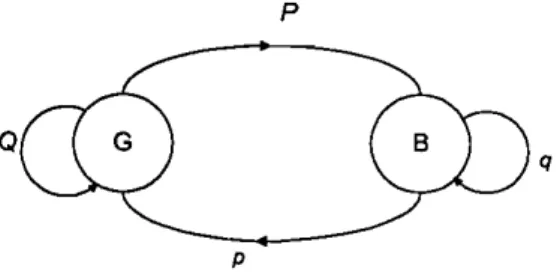
this, consider the example of burst ehannels. The state
transition probabilities P and p are so small that the
probabilities
Q
and q of remaining in G and B stateswill be high.
The principal difficulty encountered in parameter
esti-mation is that Gilbert's model parameters
{P, h,p}
arenot directly observable; so methods of deducing them from more easily measured error statistics must be derived. The measurement data considered here are
the error-gap distributions, denoted by P(O'"
I
I), thatgive the probability that at least m successive
error-free bits will be encountered next on the condition
that an error bit has just occurred. In many
applications (Chouinard et al. 1988), it suffices to
pos-tulate that the experimental error-gap distribution can be well approximated by the sum of two exponential functions:
(I)
P(O'"II )
=
aJJ{'
+
a2tJ2'·2. Error oecurrence model
Error control code design and performance analysis require that probabilistic models be used to describe the statistical distribution of errors due to channel
impairments. While the binary symmetric channel
model is simple, it has some limitations in simulating
the behaviour of error bursts over channels with
memory. To match error sources more closely, Gilbert (1960) introduced the application of finite-state Markov chain models to the representation of digital channels with memory. Gilbert's channel model consists of a Markov chain having a good state G, whieh is error
free, and a bad state B, in which the channel has an
error probability of I-h. The model state transition
diagram is shown in figure I. A wide range of channels ean be represented by appropriate definitions of the transition probabilities among all states. To illustrate
trolled fashion. The main drawback to simulated
annealing is that convergence can be very slow for com-plicated optimization problems. This suggests a hybrid strategy involving merging the most appealing features of these two methods, the first component of which helps to identify the smallest number of starting points through simulated annealing. The second component, the gradient-descent method, then uses these starting points to ensure that the actual optimum is found
efficiently.
This paper is organized as follows. An overall view of the investigation has been presented in this section. In section 2, we present the basic aspects of channel mod-elling and algorithms for statistical error characteriza-tion. Section 3 presents an estimation algorithm based on simulated annealing for optimal identification of Gilbert's channel model parameters. In section 4, we
explore the benefits of using a hybrid estimation
approach that combines the stochastic annealing
algorithm with the deterministic gradient-descent algo-rithm. Comparative performance results for estimating Gilbert's model parameters in conjunction with various optimization algorithms are also included. Section 5
presents a short summary and a list of conclusions.
p
q
p
Figure I. Gilbert's model.
where M is the longest interval between two consecutive
errors and y(m) is the measured value, expressed
loga-rithmically, of the error-gap distribution.
Traditional methods of model parameter estimation consist of exponential curve fitting (Gilbert 1960) and
the iterative gradient-descent techniques (Chouinard et
al. 1988). In the case of curve fitting, the parameters are
estimated by determining the number of straight-line segments required to approximate the measured error-gap distribution, and then determining approximate values for the slopes of these segments. The main
Hybrid strategy for Gilbert's channel characterization 581
Although the gradient-descent method converges
rapidly, its simple downhill transitions can easily trap its final solution into a local optimum when multiple optima are present. To highlight the problems encoun-tered by the gradient-descent method, we show in figure 2 the error-performance surface that results from using a
typical error burst for a range of values of ,81 and ,82.
This surface has been found difficult to optimize be-cause the global minimum is in close proximity to a
number of local minima, ridges and saddles. One
possible solution is to perform iterative improvement starting from a number of initial configurations and to
choose the best outcome from all those obtained.
However, the computational burden could be intoler-able and we would still have no guarantee of finding an optimal solution.
3. Simulated annealing for estimation
This section discusses the basic formulations of the sto-chastic simulated annealing algorithm for solving
com-binatorial optimization problems (Kirkpatrick et al.
1983).Ithas been shown that, from almost any starting
point, successive iterations of the annealing algorithm would converge asymptotically to the global optimum with probability one sense (Aats and Korst 1989). The study of simulated annealing coincides with the assump-tion that the equilibrium condiassump-tion leads to a Boltzmann state transition rule for state updates. This suggests that the relative probabilities of the two global states is deter-mined solely by their cost difference and temperatures, and the probability of being in a given state follows a Boltzmann distribution. Viewed in this respect. tempera-ture provides a new free parameter to help to steer the search direction and step size towards the global optimum solution. In the initial phase, a higher tempera-ture should be used to allow random searches so that it is easier for the states to escape from local optima. The search will move towards some feasibility regions likely to contain the global optimum as the temperature gra-dually decreases, but escape from local optima is still
possible since uphill state transitions are allowed.
When the tempera ture is too low to move uphill, the annealing algorithm becomes a simple downhill-search algorithm and the average state should be very close to the globally optimal solution.
The proposed estimation method based on simulated annealing consists of two nested loops; the inner loop proceeds until the equilibrium condition at each tem-perature is satisfied. while the outer loop is terminated at a very low temperature. We summarize the relevant aspects of the standard simulated annealing algorithm here; more comprehensive accounts can be found in the paper by Tan and Chang (1996).
(i) Start with a high temperature To= 10aoo' where
a oo is the standard deviation of the costs. Also.
choose an initial state 110 = (cy?,cy~,rJI,{fl) with
the associated cost function £(110).
(ii) Generate a new state following a random
perturba-tion mechanism. Let t:>£denote the cost difference
between the new and old states, and r a random
(6)
(5)
P.
Cost function of burst error for a BER of 1.3% witb
"I = 0.78 and"2 =0.22. _ (,8 -,8 )
+
(I -
,8,)(,82 - h) p - CY, I 2 I _ h . Coa 0.8 0.7 0.6 0.5 0.' 0.3 0.2 0.1 0,
Figure 2.back to curve fitting is that it must be augmented by human judgments and so may become subjective and unreliable. Alternatively, the iterative gradient-descent method tries to find optimum solutions by perfor-ming successive corrections on parameter estimates in
the direction opposite to the gradient of the cost
function. According to the steepest-descent method, the updated values of the model parameters at time
n
+
I are computed using the simple recursiverelation-ship
(CYI(n
+
1),CY2(n+
1),,8I(n+
1),,82(n+
I))= (cy,(n)'CY2(n),,8I(n),,82(n)) - 'x(n) \1£(n), (3)
where 'x(n) indicates the step size and \1£(n) the
gra-dient of the cost function. The detailed expressions for the step size and cost-function gradient are presented in the Appendix.
Given that the values of {CYI,CY2,,8I,,82} have been
determined, Gilbert's model parameters
{P,h,p}
canbe calculated as follows (Gilbert 1960):
h=
,81~,
(4),81 - CYI (,81 - ,82) (1-,8il(l-,82)
P= I-h '
582 T.-H. Tan and
w.-
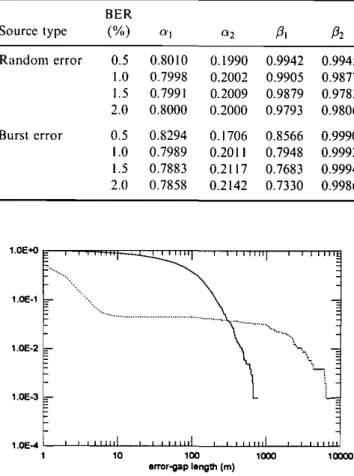
W. Chang 10000 100 1000 8rror~plength (m) 10 '... ... . ... 1.ee·' 1.0E-3 1.0E·2Table I. Estimated descriptive statistics for different error sources using the simulated annealing method
BER Source type (%) 0'1 0'2 (31 (32 Random error 0.5 0.8010 0.1990 0.9942 0.9945 1.0 0.7998 0.2002 0.9905 0.9877 1.5 0.7991 0.2009 0.9879 0.9783 2.0 0.8000 0.2000 0.9793 0.9806 Burst error 0.5 0.8294 0.1706 0.8566 0.9990 1.0 0.7989 0.2011 0.7948 0.9992 1.5 0.7883 0.2117 0.7683 0.9994 2.0 0.7858 0.2142 0.7330 0.9986 1.0E+OE-'-"""""FA""f=r::::r::rrTTT",-"-"""""'mr-,-rrrrn'!j
Figure 3. Experimental error-gap distributions of random error ( - - ) and burst error ( ) sources with a BER of 1%.
bursts. Table I presents the results of descriptive statis-tics from different error sources using the simulated annealing method. For our study, the annealing
par-ameters To and ( were empirically determined to be 5
and I respectively. In addition, the annealing algorithm was terminated when the temperature dropped below 0.05. Figure 3 illustrates the basic difference in the
error-gap distributions between random and burst
error sources, even with the same BER of 1.0%.
Compared with the burst errors, the error-gap distribu-tion of random errors tended to decay more slowly. This
translates directly into smaller values of
f31
when theerror process exhibits predominantly clustered trends.
Viewed in this context, the value of f31 provides an
ideal framework for choosing between the random-error-correcting and burst-random-error-correcting codes. For purposes of comparison, we also show in figure 4 the learning curves of Gilbert's model parameter estimation using the gradient-descent method and the annealing method. Our general conclusion is that the annealing method is preferable to the gradient-descent method, but only at the expense of extra convergence time.
t
exp{[1/
a - E(Ui)J1T}< (,
;=1 11
number uniformly distributed between 0 and I. The
new state is accepted if either !::l.E
<
0 or theBoltzmann state transition rule e-t>E/T
>
r issatis-fied; otherwise, the new state is rejected.
(iii) In the inner loop, for each temperature T, if the
equilibrium condition has been reached at the nth iteration,
then the inner loop stops and goes to step (iv); other-wise, steps (ii)-(iii) are repeated. The threshold ( is
empirically determined and17ais the average cost of
the accepted states.
(iv) Decrease the temperature according to a cooling schedule and return to step (ii) until a desired low temperature is reached.
Having a proper cooling schedule is critical for both the convergence rate and the final performance of the annealing techniques. For this reason, three different temperature schedules were considered here. In standard
annealing, the control temperature is decreased
according to T(k) = "(T(k - I), where k is the index
of the outer loop and the values 01'''( lie between 0.9
and 0.95. However, it has been proven (Aats and Korst 1989) that the necessary and sufficient condition for converging to a global optimum requires the cooling schedule to be inversely proportional to the logarithmic
function of time: T(k) = To/In(k
+
1). Unfortunately,this approach results in slow convergence because of constraints caused by the bounded variance of the
Boltzmann process. To compensate for this
short-coming, Szu and Hartley (1987) proposed a fast simu-lated annealing using a generation mechanism based on the Cauchy distribution. The Boltzmann distribution has the same general shape as the Cauchy distribution
but the latter has a fatter tail at high energies.
Proceeding in this way, the cooling schedule will
follow the relationshipT(k) = To/(k
+
I). In our earlierwork (Tan and Chang 1996), we presented preliminary experimental results that substantiate the superiority of fast simulated annealing used for Gilbert's parameter estimation.
To test the validity of the proposed estimation
scheme, extensive computer simulations were conducted on a Pentium-133 PC using sample error sequences with different characteristics. Two basic types of error-source model were considered: uniformly distributed random errors and error bursts. Each sample error sequence was 100000 bits long. For all test samples, we first
eval-uated the measured values ofP(O'"II) by computing the
ratio of consecutive series of error-free bits with lengths
equal to or greater than 111 to the total number of error
Hybrid strategy for Gilbert's channel characterization 583
Figure 4. Learning curve for the iterative gradient-descent method ( - - ) and the simulated annealing method ( ... ).
Table 2. Results of good points and costs obtained by the pro-posed hybrid algorithm using a burst error source of HER 0.5% Good points found by
first component Egradient 0.5006 0.5407 0.1940 0.2452 0.0334 0.0533 0.2439 0.1607 Final gradient cost 0.5330 0.5252 0.2887 0.2431 0.0570 0.0675 0.2484 0.1616 Corresponding cost ESA 0.6555, 0.9987 0.8350, 0.9986 0.6560, 0.9988 0.8460, 0.9988 0.8025, 0.9989 0.9050, 0.9989 0.8240, 0.9992 0.9190, 0.9992 0.6, 0.4 0.6, 0.4 0.7,0.3 0.7,0.3 0.8,0.2 0.8,0.2 0.9,0.1 0.9,0.1 16000 12000 8000 Iterative Number 4000 2.00 c 0 'llc 1.50
"
u....
0 1.00 0 0.50 0.00 04. Hybrid estimation algorithm
While stochastic simulated annealing is conceptually useful in converging to a global optimum, it has some limitations as far as its time-consuming optimization process is concerned. On the other hand, the selection of good starting points (Brooks and Morgan 1994) for the efficient gradient-descent algorithm can be difficult. To overcome these problems, we propose using a hybrid optimization algorithm that merges the most appealing features of these two algorithms. The first component, based on simulated annealing, automatically determines the smallest number of starting points, which are then used by the second component, a gradient-descent method, for rapid convergence to the global optimum.
The tuning of a hybrid algorithm demands both suit-able use of all the knowledge availsuit-able on the actual problem and a suitably designed set of experiments to find an appropriate set of parameters. In our hybrid algorithm, the first component consists of an annealing
algorithm that is stopped prematurely after No u l
tem-perature reductions. At each temtem-perature, the annealing algorithm searches for an equilibrium point until the
maximum number of iterations exceeds Nin . At each
new temperature, the iteration always starts with the final equilibrium state reached at the previous
tempera-ture. On the one hand, the values of
Ni«
and No u l shouldbe large enough to ensure the equilibrium condition is reached and convergence occurs. On the other hand, overly large values may lead to excessive exploration of the parameter space. In our study, we found suitable
values for Nin and No u l empirically and determined that
1000 and 6 respectively worked best.
The next step of the present investigation concerns selecting good starting points for use by the
gradient-descent algorithm. Thus, over a grid ofal values
con-taining (0.6,0.7,0.8,0.9), 20 different starting points for {fil'fiz} were examined using simulated annealing to
find the two best solutions for each value ofal' As an
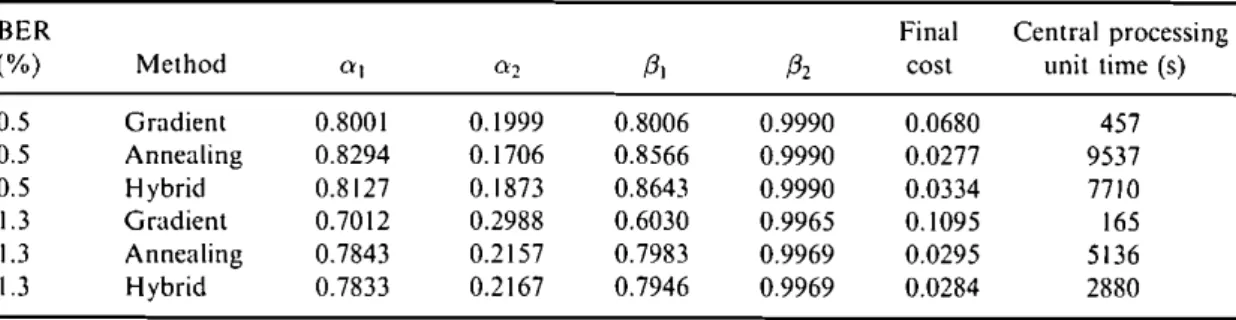
illustrative example, the resultant good points and their corresponding costs using burst errors of BER 0.5% are shown in table 2. With each of these starts, iterative gradient-descent routines were executed in order to choose the best solution from those obtained. The costs incurred using those starts are also given in table 2, where the best solution is shown to be 0.0334, a value near the global optimum. As presented in the discussion above, the test example has demonstrated the ability of the proposed algorithm to find global or near-global optimum solutions. Table 3 presents a comparison of
Table 3. Comparison of results from various estimation algorithms
BER
Final Central processing(%) Method 0', Q2 (3, (32 cost unit time (s)
0.5 Gradient 0.8001 0.1999 0.8006 0.9990 0.0680 457 0.5 Annealing 0.8294 0.1706 0.8566 0.9990 0.0277 9537 0.5 Hybrid 0.8127 0.1873 0.8643 0.9990 0.0334 7710 1.3 Gradient 0.7012 0.2988 0.6030 0.9965 0.1095 165 1.3 Annealing 0.7843 0.2157 0.7983 0.9969 0.0295 5136 1.3 Hybrid 0.7833 0.2167 0.7946 0.9969 0.0284 2880
584 T.-H. Tan and W- W Chang
(A I)
(
8E 8E 8E 8E)
V'E = 8al' 8a2 ' 8(31 ' 8(32 '
Appendix
In the iterative gradient-descent method the cost-func-tion gradient and the step size respectively are given as follows:
10000
100 1000
error-gap length(m)
10
Experimental error-gap distribution ( ) and
resulting Gilbert's model lit (--).
1.0E·2 1.0E-l 1.0E" L-...l-LLLlil.lL----L-Ll-Ll.J.llL----'---'-.L.UW1J_.!-w..Jw..wJ 1 1.0E-3 Figure 5. where (A4)
(A 5)
scores associated with various estimation algorithms. The first result shows that the gradient-descent method leads to an unsatisfactory local minimum. By contrast, the next set of results demonstrates how the annealing component of the hybrid algorithm can help to identify a far better starting point for use with the gradient-des-cent search. Using the parameter estimates, the resulting modelled fit for error-gap distribution is plotted in figure 5. Also shown in the figure is the experimentally
mea-sured error-gap distribution. The good agreement
between them provides justification for asserting the
proposed hybrid algorithm's ability to estimate
Gilbert's model parameters and demonstrates its useful-ness in channel characterization.
8E
M I- 8= -2(loglOe)
L
-0':1 m=1m
x [y(m) - 10gIO (al(3J' + a2(32)](f3i - (32) (A3)
a, (3;" + a2(3'2' '
8E
8E
8a2 8al'
8E
M I8(3i= - 2a i(lOglOe)
~
m[y(m) - 10gIO (al(3J' + a2(32)]m(37'-1
x
""-"-'---"'-'-''-::::c::--'----;:::::--'-'----'--al(3j + a2(3'2 '
5. Conclusions
This paper has explored the benefits of a hybrid strategy combining stochastic simulated annealing and determi-nistic gradient-descent algorithms for use in modelling Gilbert's channels. Our method coincides with the opti-mization process of fitting mixtures of exponential dis-tributions to experimental error-gap distribution. We
first emphasized the importance of selecting good
starting points that allow the iterative gradient-descent method to converge towards the global optimum. This task was accomplished by using simulated annealing to minimize the quadratic error bet wen the measured error-gap distribution and its modelled fit. As shown, this nonlinear optimization method helps to identify the feasibility region which is thought to contain the global optimum.
Acknowledgments
This work was supported by the National Science Council, Taiwan, under grant NSC85-2221-E009-029.
(A 6)
&E
8
2E (A 7) 8a, 8 a2 8al8al,
&E
8
2E (A 8) 8a28a2 8a18a,,
&E
M I 8a 8(3 = -2(loglOe)L;
1 I m=1[y(m) - 10gIO (a,(3J' + a2(32)](m(3J,-1 (32)
x-"---'----=.O--'--'-"---'-=-,;-''---'-'----''-'-(al(3j+a2(32)2 + 2(log
lOe)
t
..!..
(Iogloe)(malf3i-I)(~
- (32) , (A 9)m=lm (al(3j + a2(32)
Hybrid strategy for Gilbert's channel characterization 585
fiE M I
{) {)f3
=
-2(log tOe)L
-0:2 2 m=lf rl
References
AATS, E., and KORST,J., 1989, Simulated Annealing and Boltzmann Machines: A Stochastic Approach 10 Combinatorial Optimization and Neural Computing (New York: Wiley).
BROOKS, S. P., and MORGAN,B. J. T., 1994, Automatic starting point
selection for function optimization. Statistics and Computing, 4,
173-177.
CHOUtNARD, J.-Y., LECOURS, M., and DELISLE,G. Y., 1988,
Estima-tion of Gilbert's and Fritchman's models parameters using the gra-dient method for digital mobile radio channels.IEEETransactions on Vehicular Techology,37, 158-166.
FRITCHMAN, B. D., 1967, A binary channel characterization using partitioned Markov chains. IEEE Transactions on Information Theory, 13, 221-227.
GILBERT, E. N., 1960, Capacity of a burst-noise channel. The Bell
System Technical Journal. 39, 1253-1265.
KANAL,L.N., and SASTRY, A.R. K., 1978, Models for channels with
memory and their applications to error control. Proceedings ofthe
IEEE,66, 724-744.
KIRKPATRICK, S.. GELARTT,C.D., and VECCHI, M. P., 1983,
Optimi-zation by simulated annealing.Science, 220,671-680.
POWELL, M. J. D., 1984, Some properties of the variable metric
algo-rithms for unconstrained optimization. Proceedings of 'he Inter-nationalCongress of Mathematicians.
SATO, T., TOKUDA, K., KAWABE, M., and KATO, T., 1991, Simulaton
of burst error models andan adaptive error control scheme for high speed data transmission over analog cellular systems.IEEE Trans-actions on Vehicular Technology,40,443-452.
Szu, H., andHARTLEY, R., 1987, Fast simulated annealing. Physics Leiters A, 122, 157-162.
TAN, T. H., and CHANG,W.W., 1996, Estimation of Gilbert's model
parameters using the simulated annealing method. Proceedings of the Seventh IEEE International Symposium 011 Personal, Indoor.
and Mobile Radio Communications, pp.1226-1229.
(A 12) (A 11) (A 10) M 1 2(10g10e)