Some widely deployed
protocols work transparently
within NAT environments, but
others fail completely or require
special solutions to NAT-enable
them. As NATs proliferate, it is
important to recognize where
they can be used without
breaking the protocols used in
the networks.
Network Address Translators:
Effects on Security Protocols and Applications
in the TCP/IP Stack
SHIUH-PYNGSHIEH, FU-SHENHO, YU-LUNHUANG, ANDJIA-NINGLUO
National Chiao Tung University, Taiwan
O
ne proposed method for mitigating the address shortageprob-lem in IPv4 is to use network address translators (NATs) to allow address reuse. The basic idea is to transparently map a wide set of private network addresses and corresponding TCP/UDP ports to a small set of globally unique public network addresses and ports.
NAT devices provide a way to handle IP address depletion incremen-tally—without changing hosts and routers—until more long-term approaches like IPv6 can be implemented. Existing Internet security pro-tocols must be re-examined, however, to see how they function within this new network environment. We begin with a description of the four NAT environments and a discussion of their limitations. We then examine the relationships between NAT devices and popular Internet security proto-cols and applications at each layer of the TCP/IP stack to see if they can survive with NAT devices.
NAT ENVIRONMENTS
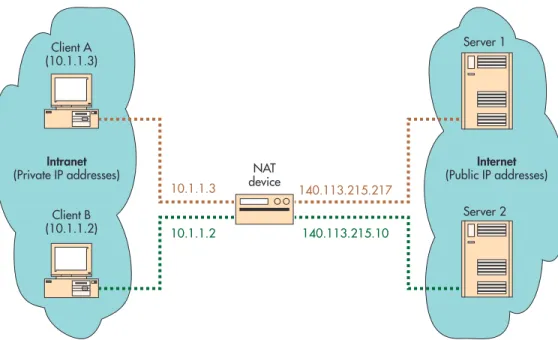
Figure 1 shows a NAT router with two interfaces. The device provides trans-parent routing between an intranet (using private IP addresses such as 10.1.1.1) and the Internet (using public IP addresses such as 140.113.215.1). Host addresses in the private network are unique only within the network, so the router converts unregistered internal addressing schemes to registered addresses before forwarding packets to public networks.
There are four common NAT environments defined in RFC 2663. With traditional NAT, hosts within private networks can unidirectionally access remote hosts in external networks. External network hosts, howev-er, cannot initiate session requests to hosts inside private networks.
A bidirectional NAT server (also called two-way NAT), allows both inbound and outbound sessions. Once a connection is established in either direction, the NAT server maps the private network address statically or dynamically to a globally unique address. Bidirectional NAT assumes that fully qualified domain names for hosts in private and public networks are end-to-end unique. A DNS application-level gateway (ALG) must
fore be used with bidirectional NAT to facilitate name-to-IP address and TCP/UDP port mappings. Twice NAT modifies both the source and desti-nation addresses for packets in a NAT session— unlike traditional and bidirectional NAT, which modify just one. Twice NAT is typically used when there are conflicts in the address space of both source and destination network addresses. In addi-tion to the translaaddi-tion of source addresses for out-bound packets, the twice-NAT server maps the external network host’s registered IP address to another unique private IP address.
Finally, network address and port translation (NAPT) extends NAT a step further by also translat-ing source and destination port numbers and check-sum values in TCP/UDP protocol headers in the transport layer. NAPT also lets NAT servers modify these transport identifiers in a way that is generally transparent to upper-layer protocols and does not affect their behaviors. Address translation becomes dif-ficult, however, when a payload containing IP address and port information is encrypted by security proto-cols because the server cannot decrypt the payload.
LIMITATIONS AND SECURITY
Despite the convenience that address translation brings, it also has limitations. Not all applications can pass through NAT servers transparently, and thosecarrying IP address and TCP/UDP port information inside their payloads require ALGs for both out-bound and inout-bound sessions. By breaking the end-to-end nature of Internet applications, NAT threat-ens Internet security. Some existing security protocols fail, for example, when address translation is applied to authentication packets. There are, however, a few methods for minimizing this drawback for many such protocols.
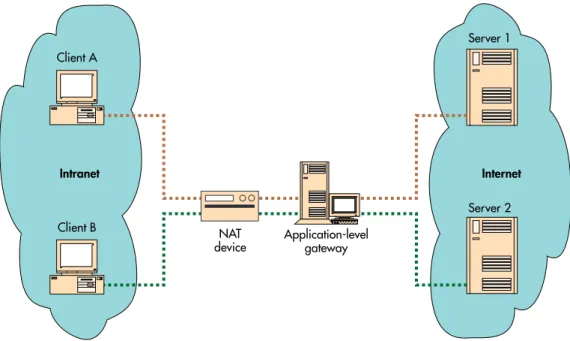
In Figure 2, for example, all payloads routed by the NAT server are forwarded to the ALG, which interprets them and performs the necessary address translations on the connection. If a session is initi-ated from the public network, however, the ALG must be integrated with the NAT server in order to allow inbound sessions to pass through the server. The server can also perform translation with port forwarding for some simple protocols that use only fixed ports.1This feature lets us forward all
packets from certain ports to their dedicated servers, while treating the NAT as a virtual server that distributes traffic among designated server farms. This solution still cannot provide end-to-end security, however, especially when the NAT server and the ALG are outside a trusted boundary. An ALG can also become a bottleneck that con-siderably degrades forwarding throughput for the border router and NAT server.
Client A (10.1.1.3) Client B (10.1.1.2) Server 1 Server 2 NAT device 10.1.1.3 10.1.1.2 140.113.215.217 140.113.215.10 Intranet
(Private IP addresses) (Public IP addresses)Internet
Figure 1. Example network using NAT. The NAT router maintains a mapping pool for address transla-tion and routing purposes. Hosts with private addresses (10.x.x.x) are assigned temporary public addresses (140.x.x.x) when they connect to the Internet.
Furthermore, NAT servers must maintain state information for modified addresses while commu-nicating with external hosts in order to ensure the datagrams in the session are routed to the correct destination at either end. A NAT router maintains mapping relations for all sessions established through it, and requests and responses for those ses-sions must be routed back through it as well. The NAT router should thus be combined with a bor-der router in a domain for better performance.
Regardless of the method used, NAT must be able to translate headers and packets according to the referred addressing scheme. Many security pro-tocols exchange IP addresses or TCP/UDP port-related information in their authentication pack-ets, which makes them vulnerable when passing through NAT servers. Any host applying encryp-tion to TCP/IP checksums must thus be assigned a globally unique IP address that is exempted from address translation.
NETWORK AND TRANSPORT
LAYER PROTOCOLS
Address translation is meaningful only at the net-work layer and above. NAT servers in the netnet-work layer translate all IP addresses from private to pub-lic, and the original checksum in the packet header becomes incorrect once the source or destination
address is modified. The NAT server’s basic func-tion, aside from IP translafunc-tion, is to recalculate the checksum after the modification. Using a NAT device can cause problems when encryption is applied to the IP address or port number-related protocol data at these two layers using a signed or modification-proof function. In the following, we discuss how NAT affects some important network and transport layer protocols.
Virtual Private Networks
Virtual private network technology has become a popular solution for enterprises looking to secure their intranets, and three major tunneling proto-cols have been proposed for building a VPN: the point-to-point tunneling protocol (PPTP, RFC 2637), layer-2 tunneling protocol (L2TP, RFC 2661), and the IP security protocols (IPSec, RFCs 2401, 2402, 2406).1
Tunneling protocols. As long as addresses are glob-ally unique, PPTP and L2TP can both transpar-ently provide users with end-to-end services when tunneling between border routers. Neither proto-col can provide end-to-end tunnels, however, when one of the endpoints is behind a NAT server. Enter-prises will encounter problems when combining VPN technology with NAT devices to establish
Client A Client B Server 1 Server 2 Intranet Internet Application-level gateway NAT device
Figure 2. Example network with NAT and ALG. An application-level gateway intercepts protocol pay-loads and performs necessary address translation between the private and public networks. ALGs are usually application-dependent.
tunnels between an endpoint in a private domain and another in a private or public domain. IPSec. IPSec defines two packet headers: the authen-tication header (AH) for handling authenauthen-tication, and the encapsulating security payload (ESP) for encryption. The AH helps ensure data integrity by preventing packet modification by a third party. Unfortunately, it also prohibits NAT servers from performing address translation. Not even an ALG can modify the authentication header because it does not know the source and destination hosts’ secret information to reproduce the authentication header after the modification. Moreover, TCP/UDP port numbers and checksums are embedded in the ESP, and may sometimes be encrypted. A NAT server can use a traditional translation method for packets with ESP headers, but a server using NAPT cannot mod-ify ESP-enabled packets without the secret key to decrypt and rebuild the ESP. In addition to these problems, IPSec’s third main component, key man-agement, is also incompatible with NAT.
There are two ways to handle key exchange and key management in IPSec: manual keying, which is suitable with a small number of hosts, and auto-mated keying. A scalable automatic key manage-ment protocol, such as the Internet key exchange (IKE), is required for on-demand creation of a security association (SA).
The SA is used to bundle IPSec with the cryp-tographic algorithms and key exchange method agreed on by the source and destination endpoints. An SA must be derived using key exchange before an IPSec connection can be established, and the packets transmitted during the process contain encrypted IP addresses and authentication values, which the NAT server cannot modify. Thus, IKE cannot pass through NAT devices.
As an alternative to IKE, some enterprises use another distribution scheme, simple key manage-ment for IP (SKIP, RFC 2409), for encryption key exchange in VPNs.2Rather than session-oriented
keys, SKIP uses packet-oriented keys, which are communicated in-line. The NAT server can trans-late the standard IP header with traditional meth-ods. When NAPT is used, however, the NAT serv-er cannot translate the payload because it is encrypted using the packet key and may contain TCP/UDP port numbers.
Socket Layer Protocols
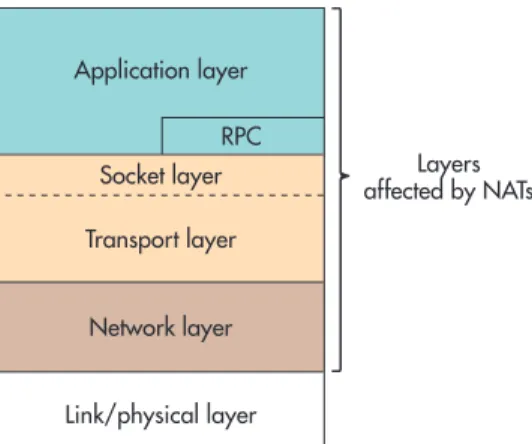
As shown in Figure 3, the socket layer is a logical layer between the transport and application layers
in the TCP/IP stack. It encapsulates the transport layer for programming and manages a logical con-nection between two endpoints to simplify access to underlying layers. Only a few Internet security protocols, such as secure socket layer (SSL)3and
transport layer security (TLS, RFC 2246), are cur-rently deployed in this layer.
The SSL protocol is designed to provide com-munication privacy over the Internet by prevent-ing message forgery and eavesdroppprevent-ing. SSL inter-cepts messages transmitted from the application layer and fragments them into blocks. The proto-col can then compress the data before applying the Message Authentication Code, encrypting the messages, and transmitting the result to the trans-port layer. Because SSL does not use IP or trans-port information to verify a user’s identity, it is net-work-independent and works equally well with both traditional NAT and NAPT.
As a successor of SSL, TLS is also designed to provide end-to-end security over the Internet. TLS also verifies user identification without depending on IP and port information, which lets it pass transparently through NAT and NAPT.
APPLICATION LAYER
PROTOCOLS
In this section, we examine how several primary groups of application layer protocols interact with NAT. Encryption, signed, or modification-proof func-tions applied to IP address or port-number-related data cause similar problems with NATs at the appli-cation layer to those at the network and transport lay-ers. Application-layer protocols also commonly use dynamic port number assignment in protocol ses-sions, which can cause problems for NATs. In the
fol-Application layer Socket layer Transport layer Network layer Link/physical layer RPC Layers affected by NATs
Figure 3. TCP/IP layer stack. NAT is meaningful only at and above the physical network layer.
lowing sections, we will discuss some popular appli-cation layer protocols and their issues with NATs.
Remote Procedure Calls
The remote procedure call (RPC, RFC 1831) is treated as middleware by application layer protocols between the transport and application layers with the aid of RPC protocol tools, such as rpcgen in Unix-like systems. Many applications, such as the network file system (NFS), rely on the RPC model for distributed interaction because it uses an appli-cation-oriented approach and relates client-server communication to conventional procedure calls.
RPC normally uses three different UDP ports to set up a session, and the packets exchanged between an RPC client and server during the setup process contain IP address and port information. As a result, protocols that utilize RPC as an under-lying layer fail when used with NAT. Not even an ALG can resolve the problem because some RPC packets contain encrypted information and cannot be modified by the NAT server.
Authentication Protocols
NAT devices are usually deployed in enterprise net-works, for which authentication plays an important role in Internet security. Because most Internet authentication protocols authenticate users or verify certificates by users’ privately held information only, these protocols can usually pass through NAT servers with the aid of DNS-ALG or port forwarding. Kerberos. The Kerberos authentication protocol, designed for TCP/IP networks by B.C. Neuman et al. at MIT, uses a combination of packet encryption, time-based credentials, and a trusted third party to provide secure authentication.4If a client in a private
realm initiates requests to a ticket-granting server, authentication server, or destination server located in a public network, address translation can be per-formed with no problem—unless any one of these servers is located in a different private network than the client’s realm. In this case, DNS-ALG or port-forwarding technology is required for the authenti-cation process to succeed because the client can’t directly reach servers hidden by the NAT server. Radius. The remote authentication dial-in user ser-vice protocol (Radius, RFC 2138) carries authen-tication, authorization, and configuration infor-mation between a network-access server (NAS) and a shared authentication server. The NAS operates as a Radius client and passes user information to
the server. The connection between the client and Radius server is authenticated by a shared secret rather than by IP address, so authentication is unaf-fected by the NAT server as long as the Radius serv-er is located on the public network. If the Radius server is seated on a private network and unreach-able by outside clients, DNS ALG or port for-warding will still allow authentication packets to successfully pass through the NAT server. S/Key. S/Key (RFC 2289) limits the use of any password to a single communication session.5
When a user logs in, the S/Key-enabled network server issues a challenge consisting of a number and a string of characters for the user to calculate the one-time password. S/Key packets contain no IP or port information, so as with Radius, authentication fails to traverse the NAT server if the S/Key server is located on a private network unless DNS ALG or port forwarding is used.
Voice over IP
International Telecommunication Union recom-mendation H.323 defines the components, proce-dures, and protocols for packet-based audiovisual communication, and it is fundamental to the growth of voice over IP.6H.323 uses multiple control sessions
to negotiate the IP addresses and port numbers for successive H.235 authentication and Real-time Trans-port Protocol (RFC 1889) audio or video sessions.
When passing through a NAT server, the suc-cessive sessions fail because the server has no knowl-edge about the encoded payloads, which include the addresses and port numbers. In this case, an application-specific ALG (called an H.323 proxy) is necessary between the calling and called parties to look into the H.323 messages and perform the address and port translation, so that the NAT serv-er can be prepared for the successive sessions.
The session initiation protocol (SIP, RFC 2543) and media gateway control protocol (MGCP, RFC 2705) are other key application-layer protocols for VoIP. Both use the session description protocol (SDP, RFC 2327) to derive the RTP address and port number for voice communication. Like H.323, both SIP and MGCP require an ALG between the parties in order to perform the translation.
Secure Electronic Commerce
Many protocols have been proposed for transactions and payments in Internet-based commerce, but the secure electronic transaction (SET) protocol is cur-rently the most popular solution.7With SET,
card-holders and merchants must obtain their own cer-tificates from a trusted certificate authority prior to transacting business. User identification, credit card information, and electronic purchase orders can be transmitted securely over the Internet using the public key cryptosystem and the certificates for the parties involved in the transaction. Because the SET payload contains no IP addresses or port informa-tion, it works under all NAT environments.
Other Popular Protocols
Address translation is directly affected by the charac-teristics of some of the most popular Internet proto-cols, including the file transfer protocol (FTP), mail-er protocols, and secure shell (SSH). No discussion of the relationship between NAT devices and proto-cols would be complete without examining these. FTP. FTP does not work under traditional NAT or NAPT, although its authentication commands work fine in NAT environments. The PORTand PASV com-mands both include IP address and port numbers to enable the destination host to set up another data connection, and the NAT server cannot read the encapsulated information on its own. An FTP ALG (also called an FTP proxy) must be used to analyze the payloads in order for FTP to work with tradi-tional NAT, NAPT, or bidirectradi-tional NAT servers.
FTP data is often fragmented into packets of various lengths, which must be reassembled before address translation can be performed. To modify the fragmented packets, the FTP ALG maintains TCP/UDP state information and regenerates the original packets. If the replaced packet is longer than the original, the ALG must split the replace-ment into fragreplace-ments again and modify all the pack-et sequence numbers.
Mail protocols. Most popular mail protocols, such as SMTP (RFC 876) and POP3 (RFC 1939), can pass through NAT servers as long as port forwarding is applied because they do not include IP addresses in the data payload. Version four of the Internet message access protocol (IMAP4, RFC 2060), how-ever, uses mechanisms such as Kerberos and S/Key to authenticate users accessing e-mail or bulletin board messages from mail servers. As noted, some of these mechanisms are not NAT-compatible, unless a DNS ALG or port forwarding is used when the IMAP4 server is located behind a NAT device. Secure shell. SSH was designed to replace well-known Internet communication applications like
telnet and rlogin for remote login and other secure network services over the Internet. To prevent trans-mitting clear data across the insecure network, SSH uses public-key-based cryptosystems for authenti-cating users and verifying certificates. Authentica-tion is based on user identity, rather than IP address and port information, so like other certificate-based protocols, SSH works well in NAT environments.
COMPARISONS
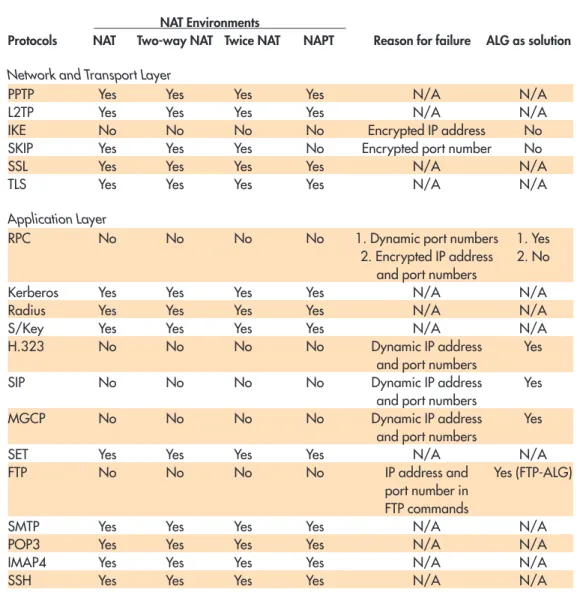
Table 1 (page 48) summarizes the NAT-compatibil-ity of the protocols described in this article. The com-parison assumes that clients are located on private networks and servers are on public networks, which is the most common topology used with NATs.
In many cases, placing ALGs outside the private network can NAT-enable protocols that use embedded IP addresses and port numbers. Proto-cols that encrypt packets with IP addresses and port numbers can be handled by exchanging decryption keys between authentication servers and NAT servers, but this solution is not generally practical because NAT servers are usually located at network boundaries, where they can become the target of attacks. Once the NAT server is compromised, an intruder can obtain all secret information passed through it. In addition, all traffic goes through the NAT server, and performing encryption functions there can heavily degrade throughput. To date, no good solution exists for this problem.
Another serious problem occurs when the pro-tocols listed in Table 1 are run on servers located on private networks: None of the clients can reach them. A general solution to this problem, which applies only to fixed-port protocols, is to add port-forwarding or ALG functions to the NAT servers. Some modern routers supporting NAT also include built-in ALGs and port-forwarding functions for working with popular protocols.
Because they use only a limited number of glob-al IP addresses, architectures in which client and server are both located in private realms are likely to increase in popularity as cable-modem or xDSL-based enterprise networks are deployed. With this type of architecture, we can try to use the solutions described above and derive hybrid solutions. For example, combining an ALG and port-forwarding functions can create a solution for a given proto-col. Without NAT standards, however, the solu-tions remain application-dependent.
FUTURE WORK
solu-tion like IPv6 gets widely deployed on the Internet, but NAT-based solutions appear to be here for the near future. Indeed, Internet service providers might provide only NAT solutions to small enterprise net-works due to the shortage of addresses in IPv4. Given this trend, existing Internet security proto-cols must be re-examined to see how they function within NAT network environments.
Some popular Internet security protocols can sur-vive when deployed in NAT environments, but others fail completely or require complicated solutions. When IPSec is used in a network with NAT, for exam-ple, there is no solution that does not break end-to-end security—not even an ALG—because the authentication headers and ESPs prohibit modifica-tions to the IP headers and payloads. Other protocols
require modifications and ad hoc work-arounds to be NAT-friendly. For instance, authentication protocols can work with NAT devices as long as IP addresses and port numbers are not sent in encrypted, signed, or hashed messages. Identifiers that are unrelated to such information should be used for routing instead. ALGs can also be used for address translation with some protocols, but they raise security and bottleneck issues that deserve further studies. Other solutions can sometimes be found for specific NAT imple-mentations, but the lack of common translation rules can keep these solutions from working in other NAT implementations. Efforts toward establishing com-mon, negotiable NAT rules for all implementations to follow could help ensure that higher-layer
proto-cols can survive under NAT environments. ■
Table 1. Compatibility of common Internet protocols with NAT environments. NAT Environments
Protocols NAT Two-way NAT Twice NAT NAPT Reason for failure ALG as solution
Network and Transport Layer
PPTP Yes Yes Yes Yes N/A N/A
L2TP Yes Yes Yes Yes N/A N/A
IKE No No No No Encrypted IP address No
SKIP Yes Yes Yes No Encrypted port number No
SSL Yes Yes Yes Yes N/A N/A
TLS Yes Yes Yes Yes N/A N/A
Application Layer
RPC No No No No 1. Dynamic port numbers 1. Yes
2. Encrypted IP address 2. No and port numbers
Kerberos Yes Yes Yes Yes N/A N/A
Radius Yes Yes Yes Yes N/A N/A
S/Key Yes Yes Yes Yes N/A N/A
H.323 No No No No Dynamic IP address Yes
and port numbers
SIP No No No No Dynamic IP address Yes
and port numbers
MGCP No No No No Dynamic IP address Yes
and port numbers
SET Yes Yes Yes Yes N/A N/A
FTP No No No No IP address and Yes (FTP-ALG)
port number in FTP commands
SMTP Yes Yes Yes Yes N/A N/A
POP3 Yes Yes Yes Yes N/A N/A
IMAP4 Yes Yes Yes Yes N/A N/A
ACKNOWLEDGMENTS
This work is supported in part by the Ministry of Education and National Science Council of Taiwan. The authors especial-ly thank and acknowledge the anonymous referees for their sug-gestions and comments on this article.
REFERENCES
1. D. Kosiur, Building and Managing Virtual Private Networks, John Wiley & Sons, New York, 1998.
2. A. Aziz, M. Patterson, and G. Baehr, “Simple Key-Man-agement for Internet Protocols (SKIP),” Proc. 1995 Int’l
Networking Conf., Internet Soc., Reston, VA; available at
http://www.isoc.org/HMP/PAPER/244/abst.html. 3. A. Frier, P. Karlton, and P. Kocher, “The SSL 3.0 Protocol,”
specification, Netscape Comm. Corp., Nov. 1996. 4. B.C. Neuman and T. Ts’o, “Kerberos: An Authentication
Service for Computer Networks,” IEEE Comm., vol. 32, no. 9, Sep. 1994, pp. 33-38; available at http://www.isi. edu/gost/publications/kerberos-neuman-tso.html. 5. N. Haller, “The S/KEY One-Time Password System,” Proc.
Internet Soc. Symp. Network and Distributed System Securi-ty, Internet Soc., Reston, VA, 1994, pp. 151-158.
6. “Series H: Audiovisual and Multimedia Systems, Infra-structure of Audiovisual Services—Systems and Terminal Equipment for Audiovisual Services,” ITU-T Recommen-dation H.323, Feb. 1998.
7. “Secure Electronic Transaction (SET) Specification—Book 3: Formal Protocol Description, version 1.0,” Visa and MasterCard, May 1997; available online at http://www-s2.visa.com/nt/ecomm/set/set_bk3.pdf.
Shiuh-Pyng Shieh is director of the Computer and Network Center and a professor with the Department of Comput-er Science and Information EngineComput-ering at National Chiao Tung University, Taiwan. He has an MS and a PhD in elec-trical engineering from the University of Maryland, Col-lege Park. His research interests include internetworking, distributed operating systems, and network security. Fu-Shen Ho received a BS and an MS in computer science and
information engineering from National Chiao Tung Uni-versity. He is currently a PhD candidate in the same depart-ment. His research interests include operating systems design, distributed systems, network security, and VoIP systems. Yu-Lun Huang received a BS in computer science and
infor-mation engineering from National Chiao Tung Universi-ty. She is currently a PhD candidate in the same depart-ment. Her research interests include electronic commerce, distributed systems, data hiding, network security, and VoIP systems. She is a member of the Phi Tau Phi Society. Jia-Ning Luo received a BS in electrical engineering and an MS
in computer science from Ta-Tung University. He is cur-rently a PhD candidate at National Chiao Tung University. His research interests include computer networks, Internet security, and e-commerce.
Readers can contact the authors at (ssp, fsho, ylhuang, jnluo)@csie.nctu.edu.tw.
IETF Requests For Comments
The RFCs referenced in this article are available online at the IETF RFC editor at http://www.ietf.org/rfc/rfcxxxx.txt.
RFC 876 • “Survey of SMTP Implementation,” D. Smallberg, Sept. 1983.
RFC 1831 • “RPC: Remote Procedure Call Protocol Specification, version 2,” R. Srinivasan, Aug. 1995.
RFC 1889 • “RTP: A Transport Protocol for Real-Time Applica-tions,” H. Schulzrinne et al., Jan. 1996.
RFC 1939 • “Post Office Protocol, version 3,” J. Myers and M. Rose, May 1996.
RFC 2060 • “Internet Message Access Protocol, version 4 revision 1,” M. Crispin, Dec. 1996.
RFC 2138 • “Remote Authentication Dial-In User Service (RADIUS),” C. Rigney et al., Apr. 1997.
RFC 2246 • “The TLS Protocol, version 1.0,” T. Dierks and C. Allen, Jan. 1999.
RFC 2289 • “A One-Time Password System,” N. Haller et al., Feb. 1998.
RFC 2327 • “SDP: Session Description Protocol,” M. Handley and V. Jacobson, Apr 1998.
RFC 2341 • “Cisco Layer-Two Forwarding (Protocol) (L2F),” A. Valencia, M. Littlewood, and T. Kolar, May 1998.
RFC 2401 • “Security Architecture for the Internet Protocol,” S. Kent and R. Atkinson, Nov. 1998.
RFC 2402 • “IP Authentication Header,” S. Kent and R. Atkinson, Nov. 1998.
RFC 2406 • “IP Encapsulating Security Payload (ESP),” S. Kent and R. Atkinson, Nov. 1998.
RFC 2409 • “The Internet Key Exchange (IKE),” D. Harkins and D. Carrel, Nov. 1998.
RFC 2543 • “SIP: Session Initiation Protocol,” M. Handley et al., Mar. 1999.
RFC 2637 • “Point-to-Point Tunneling Protocol (PPTP),” K. Hamzeh et al., July 1999.
RFC 2661 • “Layer-Two Tunneling Protocol (L2TP),” W. Townsley et al., Aug. 1999.
RFC 2663 • “IP Network Address Translator (NAT) Terminology and Considerations,” P. Srisuresh and M. Holdrege, Aug. 1999. RFC 2705 • “Media Gateway Control Protocol (MGCP) Version