
Rearrangeable Graphs and Rearrangeability Numbers
7
0
0
全文
(2) 1. Introduction. rangeability number in trees, rings, meshes and hypercubes.. The topology of a multiprocessor system can be, in. Let σ = (. general, modeled by a directed graph, where each. from σ. A permutation is called dearrangement if. where V = V (D) = {1, 2, . . . , n} and A ⊆ V × V.. πvi 6= vi , for i = 1, 2, . . . , n. A permutation σ’. vn ) be an nπvn. permutation of n symbols v1 , v2 , . . . , vn .. vi ), for i = 1, 2, . . . , n. A πv i. tion σ if σ’ is obtained by removing some entries. sors. Let D = (V, A) be a directed graph(digraph),. ... .... . . . vn ) be a permuta. . . πvn. permutation σ’ is a subpermutation of a permuta-. sents the communication link between two proces-. v2 πv 2. v2 πv 2. tion with n entries, (. vertex represents a processor and each arc repre-. v Let σ = ( 1 πv 1. v1 πv 1. is a dearrangement subpermutation of a permuta-. An n-. tion σ if it is obtained from σ by removing the. permutation σ is called realizable on D if n arc dis-. entries πvi = vi . There are two rows of symbols. joint paths can be established in D that connect vi. in a permutation. Such a symbol we call it as in-. to πvi , for i = 1, 2 . . . , n, respectively. Digraph D is. cident vertex. Let set incident(σ’) be the set of. rearrangeable if all n! n-permutations are realizable. incident vertices of the subpermutation σ’. For ex-. in D. Research on the rearrangeability are widely. ample, the permutation σ = (. studied on networks, such as hypercubes, Benes. 1 5. has π1 =5, π2 =6, π4 =4, etc.. Networks and Omega Networks [1, 5, 8, 7, 9]. In [3], Hu et al. showed that complete digraphs and stars are rearrangeable. A related problem is to make. 2 6. 4 4. 6 1 ), ( 1 5. 2 6. 3 2. 3 2. 4 4. 5 3. 6 ) 1. Permutations. 6 ) are subpermu1 1 2 3 5 6 tations of σ. Then, σ 0 = ( ) is 5 6 2 3 1 (. 1 5. 2 6. 5 3. the dearrangement subpermutation of σ, where. a digraph rearrangeable by duplicating arcs. The. incident(σ 0 ) = {1, 2, 3, 5, 6}. Clearly, a permutation. times of the duplicity is said to be the multiplicity.. is realizable if its dearrangement subpermutation is. Let Dm be the m-multiple digraph of D which is. realizable. For simplicity, we assume that the given. obtained by duplicating every arc with multiplicity. permutations in this paper are all dearrangement.. m; notice that D1 =D. The rearrangeability number In this paper, we shall show that complete nψ(D) is the minimum value of m such that Dm is partite digraphs are rearrangeable. For the purrearrangeable. Let ψ(D)=+∞ if D is not strongly pose of practical applications on interconnection connected. Hu et al.[3] gave the bounds of rear1.
(3) networks, torus network is studied which is an al-. from the vertex set V and the arc set A of a digraph. ternative of mesh. The upper and lower bounds of D where vi 6= vj for i 6= j. Vertex v1 is called the rearrangeability number of torus networks is given. source vertex of P , and vertex vk+1 is the destination vertex of P . Two paths are called disjoint if. The remaining part of this paper is organized as. there are no common arc in them.. follows. In the next section, the complete bipartite digraphs and complete n-partite digraphs are. Lemma 1 Complete bipartite digraphs Km,n are. shown to be rearrangeable. In Section 3, the up-. rearrangeable, for m, n ≥ 2. per and lower bounds of rearrangeability number of torus networks are established. Finally, this paProof.. Let V1 = {a1 , a2 , . . . , am } and V2 =. per concludes with some remarks in Section 4. {b1 , b2 , . . . , bn } be the partite sets of Km,n . Since. 2. |V (Km,n )| = m + n, we shall give an algorithm to. Complete n-partite digraphs are rearrangeable. construct the m + n disjoint paths that connect vi to πvi , vi ∈ V1. A complete n-partite digraph Km1 ,m2 ,...,mn is a di-. V2 , for each one of the (m + n)!. permutations.. graph whose vertex set can be partitioned into n. If there exists π(ai ) = bj or π(bj ) = ai , then. partite sets such that the arcs < u, v > and < v, u >. the path connects the pair of vertices ai and bj is. exist if and only if u and v are the vertices of two. simply the arc < ai , bj > if π(ai ) = bj or < bj , ai >. different partite sets. Indeed, if n=2, then we name. if π(bj ) = ai . Notice that both arcs < ai , bj > and. it complete bipartite digraph which is denoted by. < bj , ai > exist in a complete bipartite digraph.. Km,n . Since stars are rearrangeable[3], the com-. For π(ai ) = aj (respectively, π(bi ) = bj ), i 6= m,. plete bipartite digraph Km,n is rearrangeable when. the path ai → b1 → aj (respectively, bi → a1 →. m=1 or n=1. Let S ⊆ V (Km,n ), we define Π(S) =. S. bj ) is chosen. Finally, for π(am ) = ai (respectively, S. v∈S {πv }.. π(bm ) = bi ), if it exists, the path am → b2 → ai (respectively, bm → a2 → bi ) is chosen. Clearly,. A path P is a sequence. v1 e1 v2 e2 v3 . . . vk ek vk+1 , denoted by v1 → v2 → the above m + n paths are disjoint and the lemma v3 → . . . → vk → vk+1 , with elements alternately follows. 2.
(4) Q. E. D. For. example,. V1. =. {1, 2, 3, 4}. For each two distinct partites Vi , Vj of a complete n-partite digraph, the induced subgraph of. and. Vi. V2 = {5, 6, 7, 8, 9} are the two partite sets of K4,5 . (. 1 5. 3 4. 4 2. 5 3. 6 7. 7 1. 8 9. Vj is a complete bipartite digraph which is. called induced complete bipartite digraph Bi,j of. The 9 disjoint paths for permutaion 2 6. S. 9 ) are listed in the 8. Km1 ,m2 ,...,mn . Let Σ=m1 + m2 + . . . + mn .. following. Theorem 3 Complete. 1→5. n-partite. digraphs. Km1 ,m2 ,...,mn are rearrangeable.. 2→6 3→5→4. Let Vi = {vi,k |1 ≤ k ≤ mi }, for. Proof. 4→6→2. i = 1, 2, . . . , n. The vertex set V (Km1 ,m2 ,...,mn ) = 5→3 S. i=1,2,...,n. Vi where Vj. T. Vk = ∅, for j 6= k.. 6→1→7 Let Vi = Wi,1. S. Wi,2. S. .... S. Wi,n , i = 1, 2, . . . , n,. 7→1 where Wi,k = {v ∈ Vi |πv ∈ Vk }, for k = 1, 2, . . . , n. 8→1→9 If Π(Vi ). T. Vk = ∅, then Wi,k = ∅. For any per-. 9→2→8 mutation σ = (. 1 π1. 2 π2. ... Σ ), we split σ into . . . πΣ. subpermutations so that for each subpermutation Since complete bipartite digraphs Km,n are re-. σ’, incident(σ’)⊆ V (Bi,j ). By Lemma 1, we con-. arrrangeable, there are m + n disjoint paths that. struct the disjoint paths of each Bi,j . By Corol-. connect vi to πvi , i = 1, 2 . . . , m + n, for each per-. lary 2, the paths for each subpermutation can be. mutation σ. It is clear, for each subpermutation u σ0 = ( 1 πu 1. u2 πu 2. ... .... found in its corresponding induced complete biparuk ) of σ, there are k distite digraph. Thus, the complete n-partite digraphs πuk. joint paths that connect ui to πui , i = 1, 2, . . . , k.. Km1 ,m2 ,...,mn are rearrangeable.. Furthermore, σ’ is realizable.. Q. E. D.. Corollary 2 Every subpermutation with k entries. Take complete 3-partite digraph K3,3,3 as an S. S. contains k disjoint paths on a complete bipartite di-. example.. graph.. V1 = {1, 2, 3}, V2 = {4, 5, 6}, V3 = {7, 8, 9}. For 3. Let V (K3,3,3 ) = V1. V2. V3 , where.
(5) with smaller size consists of b n2 c × n vertices. Hu. a permutation. 9 ), we split it et al.[3] made a permutation such that b n2 c × n ver5 2 3 6 into three subpermutations α = ( ), β = tices in each half are mapped to the other half. So, 4 2 1 1 7 8 4 5 9 b n c×n×2 = b n2 c. Thus, ψ(M ) ≥ b n2 c. ( ) and γ = ( ). By Lemma 1 ψ(M ) ≥ 2 2n 9 8 3 7 6 5 σ = (. 1 9. 2 4. 3 2. 4 7. 5 6. 6 1. 7 8. 8 3. and Corollary 2, we construct 3 disjoint paths in. To show the upper bound of the rearrangeability. B1,2 for the subpermutation α. There are also three. number of a mesh, a realization is made. Let k =. disjoint paths been established in B1,3 and B2,3 for. (r, c) and πk = (r0 , c0 ) where r0 ≥ r and c0 ≥ c. For. the subpermutation α, β, respectively.. source vertex (r, c), let the path pass through (r, c0 ) to the destination vertex (r0 , c0 ). In this realization,. 3. Torus networks. the rightmost arc < (r, n − 1), (r, n) > in row r will be used at most n − 1 times. The same holds. Let M be an n × n mesh with n2 vertices and (r, c). for the arcs < (r, 1), (r, 2) >, < (1, c), (2, c) > and. be the vertex in row r and column c. A torus T. < (n − 1, c), (n, c) >. Thus, Hu et al.[3] gave the. is a mesh with wrap-around arcs in the rows and. upper bound n − 1.. columns. Figure 1 shows a mesh and a torus. Notice that two opposite directed arcs are assumed Theorem 4 b n c ≤ ψ(M ) ≤ n − 1 for an n × n 2 between two adjacent vertices. In an n × n mesh, mesh M [3]. there are 2n directed arcs between two adjacent rows(columns). The rows from 1 to b n2 c are the. In an n × n torus network T , the wrap-around. upper half of an n × n mesh and the rest is lower. arcs exist in the rows and columns. There are 4n. half of the mesh. If n is even, Hu et al.[3] con-. directed arcs between the two halves. Based on. structed a permutation π such that every vertex in the algorithms of Hu et al., ψ(T ) ≥ the upper(lower) half of the mesh is mapped to a n is even.. And ψ(T ) ≥. bn 2 c×n×2 4n. n2 4n. =. n 4,. if. = b n4 c, if n. unique vertex in the lower(upper) half of the mesh. is odd. Thus, ψ(T ) ≥ b n4 c. Then, we want to To be rearrangeable, the 2n directed arcs between show the upper bound of ψ(T ). Let k = (r, c) the two parts should be duplicated at least times. Hence, ψ(M ) ≥. n 2.. n2 2n. =. and πk = (r0 , c0 ). If c = 1 and c0 = n, then the. n 2. If n is odd, the half path oriented from (r, 1) pass through the wrap4.
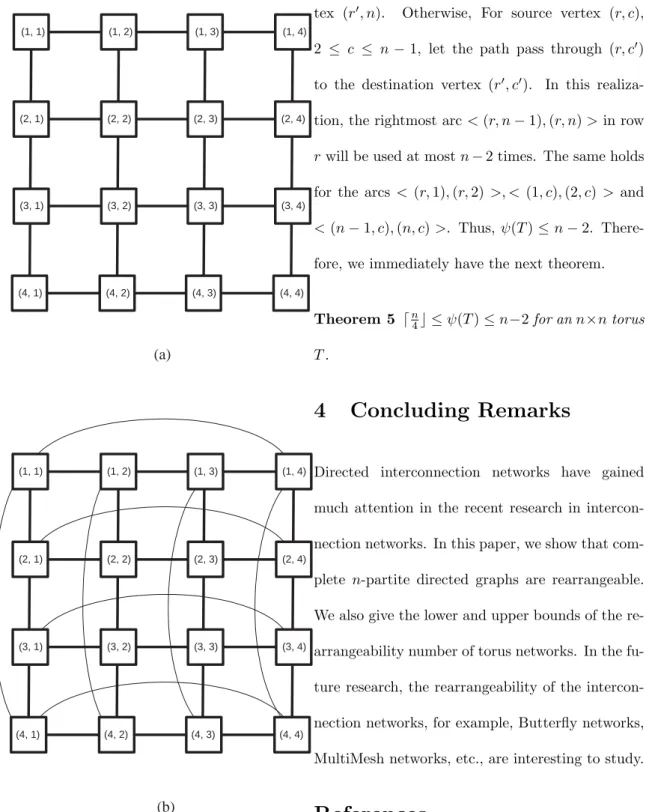
(6) around arc < (r, 1), (r, n) > to the destination vertex (r0 , n). (1, 1). (1, 2). (1, 3). Otherwise, For source vertex (r, c),. (1, 4). 2 ≤ c ≤ n − 1, let the path pass through (r, c0 ) to the destination vertex (r0 , c0 ). In this realiza(2, 1). (2, 2). (2, 3). (2, 4). tion, the rightmost arc < (r, n − 1), (r, n) > in row r will be used at most n − 2 times. The same holds for the arcs < (r, 1), (r, 2) >, < (1, c), (2, c) > and. (3, 1). (3, 2). (3, 3). (3, 4). < (n − 1, c), (n, c) >. Thus, ψ(T ) ≤ n − 2. Therefore, we immediately have the next theorem. (4, 1). (4, 2). (4, 3). (4, 4). Theorem 5 d n4 c ≤ ψ(T ) ≤ n−2 for an n×n torus. (a). T.. 4 (1, 1). (1, 2). (1, 3). (1, 4). Concluding Remarks. Directed interconnection networks have gained much attention in the recent research in interconnection networks. In this paper, we show that com-. (2, 1). (2, 2). (2, 3). (2, 4). plete n-partite directed graphs are rearrangeable. We also give the lower and upper bounds of the re(3, 1). (3, 2). (3, 3). (3, 4). arrangeability number of torus networks. In the future research, the rearrangeability of the interconnection networks, for example, Butterfly networks,. (4, 1). (4, 2). (4, 3). (4, 4). MultiMesh networks, etc., are interesting to study.. (b). References. Figure 1: (a)A 4 × 4 mesh;(b)a 4 × 4 torus. [1] V.E. Benes, The Mathematical Theory of Connecting Networks and Telephone Traffic, Aca5.
(7) demic Press, New York, 1965.. [9] T. Szymanski, On the permutation capability of a circuit-switched hypercube, in: Proceedings of. [2] M.R. Garey, D.S. Johnson, Computers and In-. International Conference on Parallel Processing,. tractability : A Guide to the Theory of NP-. (1989), I:103-110.. Completeness, W.H. Freeman, San Francisco, CA, 1979. [3] Q. Hu, Y. Ahang, X. Shen, Rearrangeable graphs, Information Processing Letters, 71 (1999), 23-27. [4] Q. Hu, Y. Zhang, X. Shen, Rearrangeable graphs, in: 3rd Annual International Conference, COCOON’97, Shanghai, China, August 20-22, Lecture Notes in Computer Science 1276, Springer, Berlin, 1997, 441-449. [5] K. Hwang, F.A. Briggs, Computer Architecture and Parallel Processing, McGraw-Hill, New York, 1984. [6] F.T. Leighton, Introduction to Parallel Algorithms and Architectures: Arrays, Trees, Hypercubes, Morgan Kaufmann, San Mateo, CA, 1992. [7] X. Shen, Q. Hu, Realizability of an arbitrary permutation on a circuit-switched hypercube, Information Processing Letters 51 (1994), 237-243. [8] H.J. Siegel, Interconnection Networks for LargeScale Parallel Processing, McGraw-Hill, New York, 1990. 6.
(8)
數據
相關文件
In particular, we present a linear-time algorithm for the k-tuple total domination problem for graphs in which each block is a clique, a cycle or a complete bipartite graph,
Breu and Kirk- patrick [35] (see [4]) improved this by giving O(nm 2 )-time algorithms for the domination and the total domination problems and an O(n 2.376 )-time algorithm for
2 Center for Theoretical Sciences and Center for Quantum Science and Engineering, National Taiwan University, Taipei 10617, Taiwan!. ⇤ Author to whom correspondence should
In this paper we establish, by using the obtained second-order calculations and the recent results of [23], complete characterizations of full and tilt stability for locally
The case where all the ρ s are equal to identity shows that this is not true in general (in this case the irreducible representations are lines, and we have an infinity of ways
We will give a quasi-spectral characterization of a connected bipartite weighted 2-punctually distance-regular graph whose halved graphs are distance-regular.. In the case the
Monopolies in synchronous distributed systems (Peleg 1998; Peleg
We give a quasi- spectral characterization of a connected bipartite weighted 2-punctually distance- regular graph whose halved graphs are distance-regular.. In the case the
