Coherent Aharonov-Bohm oscillations in type-II (Zn,Mn)Te/ZnSe quantum dots
I. R. Sellers,1,
*
V. R. Whiteside,1 A. O. Govorov,2W. C. Fan,3 W-C. Chou,3I. Khan,1A. Petrou,1 and B. D. McCombe1 1Department of Physics, Fronzcak Hall, University at Buffalo SUNY, Buffalo, New York 14260, USA2Department of Physics & Astronomy, Ohio University, Athens, Ohio 45701, USA
3Department of Electrophysics, National Chiao Tung University, Hsin Chu 30010, Taiwan, Republic of China
共Received 20 March 2008; published 3 June 2008兲
The magneto-photoluminescence of type-II共Zn,Mn兲Te quantum dots is presented. As a result of the type-II band alignment, Aharonov-Bohm共AB兲 oscillations in the photoluminescence intensity are evident. In addition, an interesting interplay between the AB effect and the spin polarization in these diluted magnetic semiconduc-tor quantum dots is observed. The intensity of the AB oscillations increases with both magnetic field and the degree of optical polarization, indicating that the suppression of spin fluctuations improves the coherence of the system.
DOI:10.1103/PhysRevB.77.241302 PACS number共s兲: 78.55.Et, 78.67.Hc, 85.35.Be, 71.35.Ji
The Aharonov-Bohm 共AB兲 effect describes a phase shift induced upon a charged particle as it moves in a closed tra-jectory in the presence of a magnetic field.1Despite the fact that the AB effect is a property of charged particles, it has been shown that for neutral excitons in semiconductor nano-rings, a nonzero electric dipole moment exists,2–5 which is adequate to create AB oscillations. Such behavior results from the differences in confinement potential and effective masses of the electron and hole, resulting in a different tra-jectory for each of the charge carriers and, thus, a measurable AB effect. Type-II quantum dots共QDs兲 have been predicted to be particularly amenable to exhibiting such AB effects because of the enhanced polarization of the exciton due to the spatial separation of the carriers in such systems.2,4,5
In this work, we present experimental evidence of AB oscillations in the magneto-photoluminescence 共MPL兲 of type-II 共Zn,Mn兲Te/ZnSe QDs. In this system, the hole is strongly confined within the共Zn,Mn兲Te QD, while the elec-tron resides in the ZnSe matrix, confined only through cou-lomb attraction to the hole. Although the AB effect has been observed optically for charged excitons in In共Ga兲As QDs,6 for neutral excitons in both Type-II GaAs/InP7and Zn共SeTe兲 QDs8,9 and also in capacitance10 and magnetization measurements11 in InAs quantum rings, we report such ef-fects in a diluted magnetic semiconductor共DMS兲 system. In DMS materials, the application of a magnetic field strongly aligns the Mn spins, thus, polarizing the optical emission through the carrier-Mn exchange interaction.12At saturation polarization, the carrier spins will also be preferentially aligned, and the spin disorder in the system is significantly reduced.12,13
The samples studied were grown by molecular beam ep-itaxy 共MBE兲 on 共001兲 GaAs substrates. The GaAs buffer layer was planarized at 580 ° C before the temperature was reduced to 300 ° C to deposit a ZnSe buffer. The共Zn,Mn兲Te QDs were formed through conventional self-assembled growth, resulting from the 7% lattice mismatch between the ZnSe and 共ZnMnTe兲 layers. In the sample described here, five 2.6 ML共Zn,Mn兲Te QD layers were grown, separated by narrow 共5 nm兲 ZnSe spacer layers. The Mn composition in the dot containing layers was estimated to be⬃5% by x ray diffraction techniques. The growth optimization and material
characterization of this sample are described fully elsewhere.13
Figure1shows the photoluminescence共PL兲 at 4.2 K. The QD emission peaks at ⬃1.92 eV, which is much lower in energy than the peak emission from bulk Zn0.95Mn0.05Te at low temperatures 共⬃2.4 eV兲.12,14 This large redshift of the energy gap observed for the共Zn,Mn兲Te/ZnSe QDs is a direct result of the type-II band alignment and confinement poten-tial of the dots.
The incorporation of Mn into the QDs forms the paramag-netic alloy共Zn,Mn兲Te, with large g-factors for both the elec-trons and holes due to the large exchange interaction that exists between the localized Mn spins and the charge carriers in this material.12 These properties result in a large optical polarization of the PL with applied magnetic field. This be-havior is illustrated in the inset共a兲 to Fig.1, which shows the integrated PL intensity of the + and−emission measured in the Faraday geometry. As the magnetic field increases, the electron 共ms=⫾1/2兲 and heavy hole states 共mj=⫾3/2兲 split, creating a situation where the carriers preferentially occupy their lowest energy states共ms= −1/2, mj= 3/2兲. The emitted polarization of the PL then directly represents the
FIG. 1. PL of the ZnSe/共Zn,Mn兲Te quantum dots at 4.2 K. The inset 共a兲 shows the intensity of the+ 共full circles兲 and− 共open
circles兲 photoluminescence component versus magnetic field. The inset 共b兲 shows the degree of optical polarization while inset 共c兲 shows a schematic of the structure.
PHYSICAL REVIEW B 77, 241302共R兲 共2008兲
RAPID COMMUNICATIONS
total carrier spin orientation due to the selection rules of the transition.14Here, since the dominant transition is associated with an exciton formed between 共spin down兲 electrons 共ms= −1/2兲 and 共spin up兲 holes 共mJ= + 3/2兲, with total angu-lar momentum projection equal to +1,15the emission of pho-tons is dominated by left-circularly polarized共+兲 light.
Figure 1共b兲 shows the optical polarization
P =共I+− I−兲/共I++ I兲, where I+共I−兲 represents the intensity of the +共−兲 luminescence, respectively. Despite the inhomo-geneity of the QDs, the optical polarization degree is greater than 95% at magnetic fields above 4 T.
As a result of the relatively narrow ZnSe spacer layers in these structures, the ZnMnTe QDs form columns due to strain interaction between adjacent dot-containing layers.16,17 This geometry, which was confirmed by cross-sectional transmission electron microscopy,13coupled with the type-II band alignment, has previously been shown to be particularly appropriate for observing the optical AB effect.8,9Not only is the electron bound to the confined hole through coulomb attraction, but because of the narrow ZnSe barrier layer, it is constrained to move in-plane, thus, defining a ringlike geom-etry.
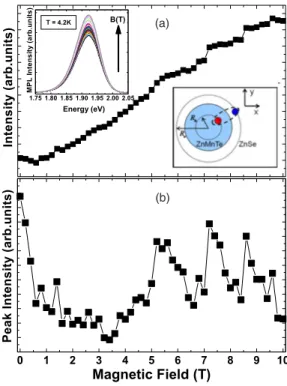
The main panel in Fig.2共a兲shows the magnetic field de-pendence of the PL intensity for an ensemble of共Zn,Mn兲Te/ ZnSe QD columns. The overall PL intensity increases with magnetic field consistent with the field, “squeezing” the elec-tron wave function at the QD interface, which increases the electron-hole wave function overlap and, thus, the oscillator strength. We also note here that an unusually large increase
in the PL intensity of II-VI DMS systems has been reported previously, although the origin of this behavior is still under discussion.18 In the main panel of Fig.2共a兲, periodic oscilla-tions are visible, superimposed upon the rising intensity background of the emission. These oscillations are clear evi-dence of a coherent AB effect between the constituent par-ticles of the exciton —the electron and hole— and are con-sistent with the behavior observed in similar Zn共SeTe兲 QDs.8,9,19
The specific origin of oscillatory behavior in the PL in-tensity is related to the cylindrical symmetry of the QD col-umn and the optical AB effect. The radial spatial separation in the type-II QD creates a rotating dipole with the two charged particles of the exciton orbiting over different areas. This behavior is described qualitatively by a simple model of a rotating dipole 关shown as inset of Fig. 2共a兲兴 with a mag-netic field normal to the plane,
Eexc= Eg+ ប2 2MR02
冉
L + ⌬⌽ ⌽0冊
2 , 共1兲where L is the angular momentum quantum number, Eg is the confined hole-to-electron ground state energy, ⌽0= hc/兩e兩 is the magnetic flux quantum, R0=共Re+ Rh兲/2, and M =共meRe 2+ m hRh 2兲/R 0 2; R
h and Reare the averaged radii of orbits of the hole and electron, respectively, and mh and
me are their masses. Here, since the hole is strongly local-ized, Rh⬇0. The quantity ⌬⌽ is the magnetic flux through the area between electron and hole trajectories.
With increasing magnetic field, the L value characterizing the ground state angular momentum projection changes from zero to successively larger 共in magnitude兲 nonzero values due to the cylindrical symmetry of the system. Such behavior should have significant impact upon the PL intensity since the selection rules for the optical transition are modified, and in the simplest case, with increasing magnetic field when
L⫽0, the intensity should be strongly suppressed.4 Interest-ingly, the oscillations in the PL intensity shown in Fig.2共a兲 are not consistent with this picture, with bright nonzero L states evident with increasing magnetic field. This unusual behavior is likely related to a relaxation of the selection rules due to symmetry breaking in the nonideal QDs studied here. In addition, impurity scattering and localization effects at the QD perimeter20 can enhance these effects, as was observed in the nonmagnetic ZnSeTe QDs formed through Te clustering.9 In those particular nonmagnetic dots, although oscillations in the PL intensity were evident for higher order
L⫽0 states, the overall intensity of the emission actually
decreased.9For the DMS dots described in this Rapid Com-munication, spin-orbit interaction may also play a role. How-ever, since spin-orbit coupling is relatively weak for elec-trons, particularly in wide gap ZnSe, these effects are probably weak.
The effective radius共Re=
冑
⌽0/⌬B兲 of the electron orbit can be estimated from the period of the AB oscillations and in this case, is determined to be⬃28 nm. This is larger than the 20 nm lateral extent of the QDs determined by structural analysis13and, as such, is consistent with the picture of the electron orbiting the QD perimeter bound to the hole.2,4,5(a)
(b)
FIG. 2. 共Color online兲 共a兲 Integrated PL intensity versus mag-netic field for the ZnSe/共Zn,Mn兲Te QDs at 4.2 K. The upper inset 共left兲 shows the magneto-photoluminescence spectra with increas-ing magnetic field. The lower inset 共right兲 represents a simple model created by the electron and hole in this type-II columnar geometry.共b兲 Peak PL intensity versus magnetic field for the QDs with the rising background observed in共a兲 removed.
SELLERS et al. PHYSICAL REVIEW B 77, 241302共R兲 共2008兲
RAPID COMMUNICATIONS
Importantly, the estimated AB oscillations in the energy of the lowest state of the exciton, determined from Eq. 共1兲, is
⬃0.04 meV due to the relatively large lateral radius 共Re兲 of the electron orbit 共28 nm兲. As a result, we do not expect to observe these weak energy oscillations experimentally in the peak PL energy due to the strong inhomogeneous broadening 共⬃80 meV兲 of the excitonic peak. This is indeed shown to be the case in Fig. 3共a兲, where the position of the PL peak does not exhibit any visible oscillations but rather a slight reduction in the transition energy with magnetic field. The origin of this behavior is related to the Zeeman contribution to the emission, which, interestingly, is much smaller 共⬃7 meV兲 than expected for bulk Zn0.95Mn0.05Te 共⬃50 meV兲. This unusual behavior is currently under inves-tigation, the details of which will be discussed elsewhere.
Turning back to the oscillations in the emission intensity, it can be seen from the data of Fig.1共a兲that the strength of the oscillations increases with magnetic field. This is more obvious in Fig.2共b兲, which shows the peak intensity of the oscillations with the PL normalized to the featureless back-ground luminescence. In this figure, three oscillations are clearly evident with peaks at ⬃5.4, 7.4, and 9 T. This en-hancement of the AB effect at higher magnetic fields appears to be strongly related to the spin polarization of the carriers in the DMS QDs共and, thus, to the magnetization of the dots兲 and can be correlated with the optical polarization关see inset 共b兲 of Fig.1兴. At low magnetic fields, the Mn spins are
ran-domly orientated and fluctuating14due to the finite tempera-ture of the system共⬃4 K兲 and low transition temperature of dilute ZnMnTe.12,14
Since the exciton and the Mn spins are coupled through an exchange interaction, fluctuations of Mn spins create a fluc-tuating exchange potential for the electron orbiting a QD column. In addition, the finite penetration of the electron wave function into the Mn-containing QD will further en-hance these effects.8 Such fluctuations may have a destruc-tive effect upon the AB phase, which may not survive. The behavior of the spectra in Fig.2共b兲at B⬍4 T is consistent with this idea. As the magnetic field aligns the Mn spins, magnetic fluctuations in the system are reduced and the AB oscillations increase in strength. This is also consistent with the increase in the optical polarization degree with the largest AB oscillations observed at magnetic fields above polariza-tion saturapolariza-tion 共⬎4 T兲.
The average magnetic moment of a single Mn impurity and the strength of spin fluctuations can be written as
M¯z=具Mz典 = S · gMn·B· B5/2共x兲 and
冑
⌬M2 =冑
具共Mz− M¯z兲2典 =冑
kBTM¯z
B , 共2兲
where具Mz典 is the thermal average over the states of Mn spin with S = 5/2, B5/2共x兲 is the Brillouin function
x = gMn· S ·B· B/kBT, and B is the magnetic field. We take
T = 4.2 K and gMn= 2. The results of these calculations are shown in Fig. 3共b兲 and clearly illustrate the suppression of spin fluctuations for B⬎4 T. Consequently, these predictions support the assumption that the increase in AB oscillations at higher B is related to the reduction of the fluctuations of the exchange potential. This behavior is also supported by temperature-dependent measurements, which are shown in the inset to Fig. 3共a兲. With increasing temperature the AB oscillations damp and, although weak, remain evident at 40 K. Above 50 K, which is the temperature at which thermal effects completely randomize the system, the coherence is lost.21In Mn-doped systems, some amount of Mn ions may form antiferromagnetic clusters with frozen spin configura-tions; these clusters also create a scattering potential for elec-trons and can affect the AB oscillations.
In summary, we have presented clear evidence of the Aharonov-Bohm effect in the PL intensity of type-II 共Zn,Mn兲Te/ZnSe QDs. Simultaneously, we have observed an interesting interplay between the AB oscillations and the magnetization. The strength of the AB effect appears to be correlated with the degree of optical polarization of the sys-tem. We believe that with increasing magnetic field and, therefore, increased spin polarization, the AB oscillations be-come enhanced due to the suppression of spin fluctuations and related decoherence. The appearance of such oscillations in the columnar QDs presented here appears to confirm pre-vious predictions of the suitability of this particular geometry8,9 for the creation and control of AB effects in semiconductor systems.
We acknowledge support from the Center for Spin Effects and Quantum Information in Nanostructures共UB兲.
FIG. 3. 共a兲 PL energy versus magnetic field for the ZnSe/ 共Zn,Mn兲Te QDs. The inset shows the intensity of the + 共full
circles兲 and –共open ciricles兲 PL at 40K. 共b兲 Calculated average
magnetic moment共closed squares兲 and fluctuations of a single Mn spin共open circles兲 in the units of the Bohr magneton.
COHERENT AHARONOV-BOHM OSCILLATIONS IN TYPE-… PHYSICAL REVIEW B 77, 241302共R兲 共2008兲
RAPID COMMUNICATIONS
1Y. Aharonov and D. Bohm, Phys. Rev. 115, 485共1959兲. 2A. B. Kalameitsev, V. M. Kovalev, and A. O. Govorov, JETP
Lett. 68, 669共1998兲.
3A. V. Chaplik, Pis’ma Zh. Eksp. Teor. Fiz. 62, 885 共1995兲;
关JETP Lett. 75, 292 共2002兲兴.
4A. O. Govorov and A. V. Kalameitsev, Phys. Rev. B 71, 035338
共2005兲.
5K. L. Janssens, B. Partoens, and F. M. Peeters, Phys. Rev. B 66,
075314共2002兲.
6M. Bayer, M. Korkusinski, P. Hawrylak, T. Gutbrod, M. Michel,
and A. Forchel, Phys. Rev. Lett. 90, 186801共2003兲.
7E. Ribeiro, A. O. Govorov, W. Carvalho, and G.
Medeiros-Ribeiro, Phys. Rev. Lett. 92, 126402共2004兲.
8I. L. Kuskovsky, W. MacDonald, A. O. Govorov, L. Muroukh,
X. Wei, M. C. Tamargo, M. Tadic, and F. M. Peeters, Phys. Rev. B 76, 035342共2007兲.
9I. R. Sellers, V. R. Whiteside, I. L. Kuskovsky, A. O. Govorov,
and B. D. McCombe, Phys. Rev. Lett. 100, 136405共2008兲.
10A. Lorke, R. J. Luyken, A. O. Govorov, J. P. Kotthaus, J. M.
Garcia, and P. M. Petroff, Phys. Rev. Lett. 84, 2223共2000兲.
11N. A. J. M. Kleemans, I. M. A. Bominaar-Silkens, V. M. Fomin,
V. N. Gladilin, D. Granados, A. G. Taboada, J. M. Garcia, P. Offermans, U. Zeitler, P. C. M. Christianen, J. C. Maan, J. T. Devreese, and P. M. Koenraad, Phys. Rev. Lett. 99, 146808
共2007兲.
12J. K. Furdyna, J. Appl. Phys. 64, R29共1988兲.
13M. C. Kuo, J. S. Hsu, J. L. Shen, K. C. Chui, W. C. Fan, Y. C.
Lin, C. H. Chia, W.-C. Chou, M. Yasar, R. Mallory, A. Petrou, and H. Luo, Appl. Phys. Lett. 89, 263111共2006兲.
14A. Twardowski, C. J. M. Denissen, W. J. M. Dejonge, A. T. A.
M. Dewaele, M. Demianiuk, and R. Triboulet, Solid State Com-mun. 59, 199共1986兲.
15M. Holub and P. Bhattacharya, J. Phys. D 40, R179共2007兲. 16H. Y. Liu, I. R. Sellers, R. J. Airey, M. J. Steer, P. A. Houston, D.
J. Mowbray, J. Cockburn, M. S. Skolnick, B. Xu, and Z. G. Wang, Appl. Phys. Lett. 80, 3769共2002兲.
17H. Y. Liu, I. R. Sellers, M. Gutiérrez, K. M. Groom, W. M.
Soong, M. Hopkinson, J. P. R. David, R. Beanland, T. J. Bad-cock, D. J. Mowbray, and M. S. Skolnick, J. Appl. Phys. 96, 1988共2004兲.
18H. Falk, J. Hubner, P. J. Klar, and W. Heimbrodt, Phys. Rev. B 68, 165203共2003兲.
19I. R. Sellers, V. R. Whiteside, I. L. Kuskovsky, A. O. Govorov,
and B. D. McCombe, Physica E共Amsterdam兲 40, 1819 共2008兲.
20L. G. G. V. Dias da Silva, S. E. Ulloa, and A. O. Govorov, Phys.
Rev. B 70, 155318共2004兲.
21V. R. Whiteside, I. R. Sellers, M. Eginligil, A. Petrou, and B. D.
McCombe, J. Phys.: Condens. Matter共to be published兲.
SELLERS et al. PHYSICAL REVIEW B 77, 241302共R兲 共2008兲
RAPID COMMUNICATIONS