1.3 lm quantum dot vertical-cavity
surface-emitting laser with
external light injection
P.C. Peng, Y.H. Chang, H.C. Kuo, W.K. Tsai, G. Lin,
C.T. Lin, H.C. Yu, H.P. Yang, R.S. Hsiao, K.F. Lin, J.Y. Chi,
S. Chi and S.C. Wang
A 1.3 mm quantum dot vertical-cavity surface-emitting laser (QD VCSEL) with external light injection is presented, having been experimentally demonstrated. The QD VCSEL is fabricated on GaAs substrate. The 3 dB frequency response of the QD VCSEL based on the TO-Can package is enhanced from the free-running 1.75 to 7.44 GHz with the light injection technique.
Introduction: Quantum dots are attractive quantum structures owing to their superior characteristics and broad applications. A semiconductor laser with a quantum dot active region has been proven to exhibit excellent characteristics, including high differential gain, high modulation bandwidth, low threshold currents, and temperature insensitive threshold current density [1]. Quantum dot vertical-cavity surface-emitting lasers (QD VCSELs) have been the focus of a great deal of research in recent years [2, 3]. The advantages of VCSELs, such as low power consumption, high beam quality, and low-cost production capability, have led to important application in optical communications. Therefore, enhancing the frequency response of QD VCSELs to increase the data rates is very important.
Recently, the light injection technique has been shown to be effective for enhancing the frequency response of semiconductor lasers [4]. However, QD VCSELs with external light injection have not yet been addressed. In this Letter we report the experimental characterisation of a 1.3 mm QD VCSEL with and without external light injection. Signifi-cant frequency response enhancement has been observed. The 3 dB frequency response has been increased by as much as 4.2 times using the light injection technique.
6 1 dBm -DFB VA PC 1 2 3 OC PD OSA Amp QD VCSEL network analyser bias T DC bias DC bias p-DBR n-DBR GaAs/Al0.9Ga0.1As 22 pairs Al0.98Ga0.02As layer InAs/InGaAs QDs x5 GaAs/Al0.9Ga0.1As 33 pairs GaAs substrate substrate a b
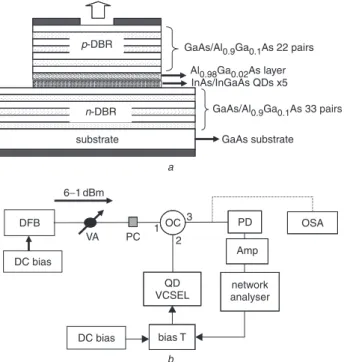
Fig. 1 Schematic diagram of QD VCSEL and experimental setup for injection locking of QD VCSEL
a Schematic diagram b Experimental setup
DFB: DFB laser; VA: variable optical attenuator; OC: optical circulator; OSA: optical spectrum analyser; PC: polarisation controller; PD: photodetector; Amp: electrical amplifier
Experiment and results: The schematic diagram of the QD VCSEL is shown inFig. 1a. The structure is grown on a GaAs (100) substrate using molecular beam epitaxy (MBE) by NL Nanosemiconductor GmbH (Germany). The wafer is then processed into a VCSEL structure. The fabrication method has been described in our previous
work[5]. The threshold current of the InAs=InGaAs QD VCSEL is about 2 mA at room temperature. The QD VCSEL is hermetically sealed by a standard TO-Can laser package (TO-46) with a built-in lens. The QD VCSEL TO-Can package and the singlemode fibre are assembled by the laser welding technique.
Fig. 1b shows the experimental setup for the injection locking of
the QD VCSEL. The QD VCSEL is used as the slave laser while a DFB laser is used as the master laser. The QD VCSEL is biased at 4 mA. The injection power is varied by a variable optical attenuator at the output of the DFB laser. The polarisation of the DFB laser is adjusted using a polarisation controller before injecting into the QD VCSEL. In the experiment, the polarisation and the centre wavelength of the DFB laser are adjusted such that the QD VCSEL has the most significant enhancement in the frequency response.
3 mA 3.5 mA 4 mA 3 mA 3.5 mA 4 mA 10 0 -10 -20 -30 -40 -50 -60 response , dB frequency, GHz 0 2.5 5.0 7.5 10.0 1276 1278 1280 1282 intensity , 10 dB/div . l, nm
Fig. 2 Small-signal frequency response of QD VCSEL at different bias currents
The small-signal response of QD VCSELs against bias current is measured at room temperature using a vector network analyser (Agilent 8720ES).Fig. 2shows the frequency response of the QD VCSEL. The 3 dB frequency response is 1.75 GHz at an operating bias of 4 mA. The inset of Fig. 2 shows the output spectra of the QD VCSEL, which indicate single transverse mode operation and the sidemode suppression ratio over 30 dB. The lasing wavelength of the QD VCSEL is around 1278 nm. Furthermore, the VCSEL is single polarisation in the full operating range. 10 0 -10 -20 -30 -40 -50 -60 response , dB frequency, GHz 0 2.5 5.0 7.5 10.0 1276 1278 1280 1282 intensity , 10 dB/div . l, nm 4 mA free running with 4 dBm injection 6 dBm 4 dBm 2 dBm
Fig. 3 Small-signal frequency response of QD VCSEL at different injection powers
Fig. 3shows the frequency response of the QD VCSEL at different
injection powers. This Figure clearly shows that external injection can achieve a significant enhancement in frequency response. Moreover, when the QD VCSEL is injection locked, as shown in the inset of
Fig. 3, its optical spectrum shifts a slightly longer wavelength. The
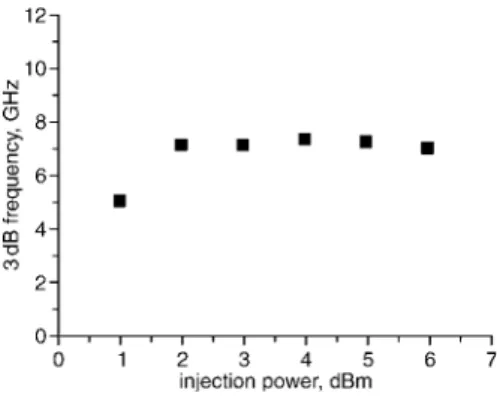
relationship between the 3 dB frequency response and injection power is shown inFig. 4. We observe that the 3 dB frequency is over 7.1 GHz when injection power is more than 2 dBm.
Fig. 4 3 dB frequency response against injection power
Conclusion: A 1.3 mm QD VCSEL with external light injection is presented for the first time. The QD VCSEL is grown on a GaAs substrate. It is shown that the 3 dB frequency response of the QD VCSEL increases significantly under strong light injection. The 3 dB frequency response enhancement as high as 4.2 times has been demonstrated.
Acknowledgment: This work was supported by the National Science Council of the R.O.C. under contract NSC 94-2752-E-009-007-PAE.
#IEE 2005 25 August 2005
Electronics Letters online no: 20053072 doi: 10.1049/el:20053072
P.C. Peng, Y.H. Chang, H.C. Kuo, W.K. Tsai, C.T. Lin, S. Chi and S.C. Wang (Department of Photonics, National Chiao-Tung Univer-sity, 1001 Ta Hsueh Road, Hsinchu, Taiwan 300, Republic of China) E-mail: [email protected]
G. Lin, H.C. Yu, H.P. Yang, R.S. Hsiao, K.F. Lin and J.Y. Chi (Opto-Electronics and System Laboratory, Industrial Technology Research Institute, Hsinchu, Taiwan 300, Republic of China)
References
1 Ledentsov, N.N.: ‘Long-wavelength quantum-dot lasers on GaAs substrates: from media to device concepts’, IEEE J. Sel. Top. Quantum Electron., 2002, 8, pp. 1015–1024
2 Yamamoto, N., Akahane, K., Gozu, S., and Ohtani, N.: ‘Over 1.3 mm CW laser emission from InGaSb quantum-dot vertical-cavity surface-emitting laser on GaAs substrate’, Electron. Lett., 2004, 40, (18), pp. 1120–1121 3 Lott, J.A., et al.: ‘InAs-InGaAs quantum dot VCSELs on GaAs substrates
emitting at 1.3 mm’, Electron. Lett., 2000, 36, (16), pp. 1384–1385 4 Chang, C.H., Chrostowski, L., and Chang-Hasnain, C.J.: ‘Injection
locking of VCSELs’, IEEE J. Sel. Top. Quantum Electron., 2003, 9, pp. 1386–1393
5 Yu, H.C., et al.: ‘A simple method for fabrication of high speed vertical cavity surface emitting lasers’, Mater. Sci. Eng. B, 2004, 106, pp. 101– 104