Angle measurement using total-internal-reflection
heterodyne interferometry
Ming-Horng Chiu Der-Chin Su
National Chiao Tung University Institute of Electro-Optical Engineering 1001, Ta-Hsueh Road
Hsin-Chu, Taiwan
E-mail: [email protected]
Abstract. A new optical method for angle measurement based on total-internal-reflection heterodyne interferometry is presented. In this method, heterodyne interferometry is applied to measure the phase dif-ference betweens and p polarization states at total internal reflection. This phase difference depends on the angle of incidence. Hence, small-angle measurement can be performed only by evaluating this phase difference. The validity of the method is demonstrated, and it has a mea-surement range of 10 deg. Its resolution depends on the angle of inci-dence; the best resolution is 831025 deg. © 1997 Society of Photo-Optical Instrumentation Engineers. [S0091-3286(97)02406-9]
Subject terms: angle measurement; total-internal-reflection effect; heterodyne in-terferometry.
Paper 11106 received Oct. 4, 1996; revised manuscript received Jan. 31, 1997; accepted for publication Jan. 31, 1997.
1 Introduction
Optical measurement of small angles is conventionally per-formed with interferometers1–5 and autocollimators.6–9 They have been widely used in alignment, machine-tool calibration, and many other applications. Although they are sensitive and accurate, their sizes are too large to be used in some space-limited areas. In order to solve these problems, Huang et al.10,11 proposed an optical method for small-angle measurement, namely, small-angle measurement based on the internal-reflection effect~AMIRE!. In Huang’s method, a beamsplitter is used to separate the incident beam into two beams with equal intensity, and two right-angle prisms are located on a rotary stage in an orthogonal alignment such that internal reflections occur in them. By measuring the reflectance difference between these two prisms, the small rotation angle can be estimated. This technique has some merits, such as a more compact size, simple setup, low cost, and high resolution, but there are still some dis-advantages that might be alleviated:
1. Due to the intensity measurements, it can be per-formed only in the darkroom with a high stable light source.
2. The reflectance of a beamsplitter and the unnecessary reflectances at the entrance and exit surfaces of the prisms depend on the incident angle, so the measur-ands should be carefully estimated to enhance their accuracies.
3. The measurement range is too small~about 1.6 deg!. In this paper, in contrast to Huang’s method, a new op-tical method for angle measurement based on total-internal-reflection heterodyne interferometry ~TIRHI! is presented. In this method, the phase difference between s and p po-larization states at total internal reflection is measured with heterodyne interferometry. Because the phase difference depends on the incident angle, small-angle measurement
can be performed by evaluating only the phase difference. This method has several advantages. First, the phase differ-ence is independent of the intensity and can be extracted accurately despite surrounding light and instability of the light source. Second, it has high stability against air turbu-lence, due to its common-path configuration. Third, the op-tical setup is simple, compact, and easy to align. Further-more, it has a high resolution and a larger measurement range.
2 The Principle of TIRHI
2.1 The Relation Between the Phase Difference and the Incident Angle at Total Internal Reflection
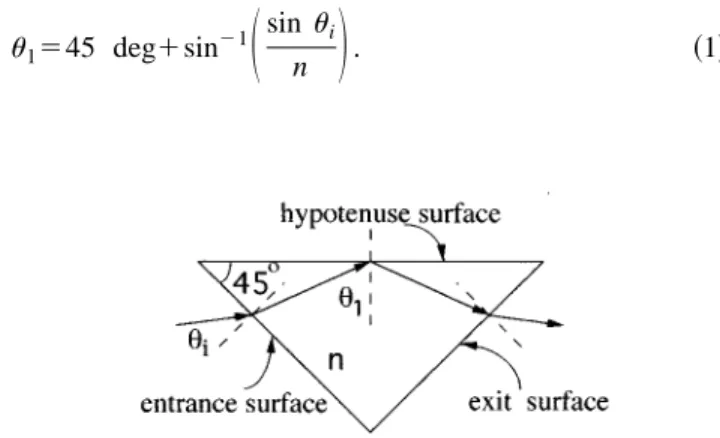
A ray of light in air is incident atui on one side surface of
a right-angle prism with refractive index n as shown in Fig. 1. The light ray is refracted into the prism and propagates toward the hypotenuse surface of the prism. At that surface there is a boundary between the prism and air. If the angle of incidence at the boundary isu1, then we have
u1545 deg1sin21
S
sinui
n
D
. ~1!Fig. 1 The total internal reflection in a right-angle prism.
1750 Opt. Eng. 36(6) 1750–1753 (June 1997) 0091-3286/97/$10.00 © 1997 Society of Photo-Optical Instrumentation Engineers
Here the signs ofu1anduiare defined to be positive if they are measured clockwise from a surface normal. Because
u1 is larger than the critical angle, the light is totally
re-flected at the boundary. According to Fresnel’s equation,12 the phase difference between s and p polarization states is given as f52 tan21
S
~sin 2 u 121/n2!1/2 tanu1 sinu1D
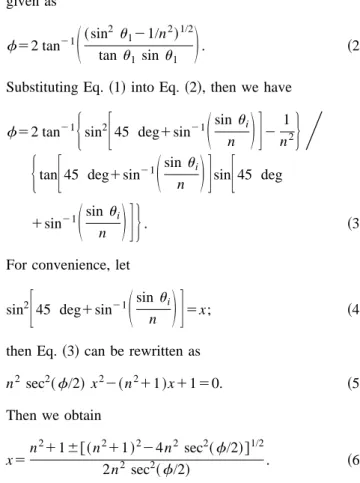
. ~2!Substituting Eq.~1! into Eq. ~2!, then we have
f52 tan21
H
sin2F
45 deg1sin21S
sinuin
DG
2 1 n2JY
H
tanF
45 deg1sin21S
sin uin
DG
sinF
45 deg 1sin21S
sinuin
DGJ
. ~3!For convenience, let
sin2
F
45 deg1sin21S
sin uin
DG
5x; ~4!then Eq.~3! can be rewritten as
n2 sec2~f/2! x22~n211!x1150. ~5!
Then we obtain
x5n
2116@~n211!224n2 sec2~f/2!#1/2
2n2 sec2~f/2! . ~6!
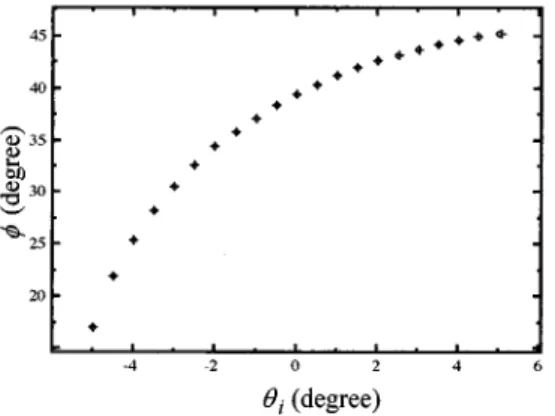
To understand what the signs6 in Eq. ~6! represent, the later experimental condition n51.51509 is substituted into Eq. ~3!, and a plot of the phase difference f against the incident angleuiis obtained and shown in Fig. 2. The plus
sign and minus sign in Eq.~6! then correspond to the re-gions whose slopes are negative and positive in Fig. 2, respectively. In the former region, the absolute value of the
slope is larger than in the latter, so the technique is more sensitive and has a higher resolution. Hence, we choose this region for our measurement range, that is, from the incident angle f50 ~i.e., u1 equals the critical angle! to f
5fmax. Therefore, Eq.~6! can be rewritten as x5n
2112@~n211!224n2 sec2~f/2!#1/2
2n2 sec2~f/2! . ~7!
Substituting Eq. ~7! into Eq. ~4!, the incident angle to be measured can be obtained as follows:
ui5sin21@n sin~sin21
A
x245 deg!#. ~8!2.2 Optical Setup for Measuring Phase Differences with Heterodyne Interferometry
The procedures for measuring the phase difference between s and p polarization states are the same as those for mea-suring the phase retardation of a wave plate. Chiu et al.13 proposed a heterodyne interferometric method for measur-ing the phase retardation of a wave plate, and good results were obtained. Here, Chiu’s optical setup is modified by introducing a right-angle prism mounted on a rotary stage instead of the test wave plate, as shown in Fig. 3. Linearly polarized light passing through an electro-optic modulator ~EO! is incident on a beamsplitter BS and is divided into reflected and transmitted light. The reflected light passes through an analyzer ANr, then enters a photodetector Dr.
The signal measured by Dr is the reference signal. The
transmitted light enters the prism and is totally reflected there; then it propagates out of the prism. Finally, it passes through an analyzer ANtand is detected by another
photo-detector Dt. The signal measured by Dt is the test signal.
These two signals are sent to a phase meter, and their phase difference ft can be obtained. Then, we remove the test
prism and let the transmitted light directly pass through ANt and enter Dt. The phase meter obtains 2fr, where fr is the initial phase of the reference signal. Hence, the
phase difference between s and p polarization due to total internal reflection is
f5ft1fr. ~9!
Fig. 2 The curve offversusui.
Fig. 3 Schematic diagram for this novel method for measuring
small angles based on TIRHI. EO: electro-optic modulator; BS: beamsplitter; D: photodetector; AN: analyzer.
Chiu and Su: Angle measurement . . .
1751 Optical Engineering, Vol. 36 No. 6, June 1997
Substituting the data onfinto Eqs.~7! and ~8!, the incident angle ~or rotation angle! ui can be calculated. Here, the
output of the phase meter is sent to a personal computer for calculation, so this method can be performed in real time and with high resolution.
3 Experiments and Results
A right-angle prism of BK7 glass with refractive index 1.51509 for 632.8-nm wavelength was used, and it is mounted on a high-precision rotary stage ~PS-u-90! with angular resolution 0.005 deg, manufactured by Japan Chuo Precision Industrial Co. Ltd. The incident anglesui of this
prism, that is, the rotation angles of the rotary stage, were evaluated. Based on the measurement sensitivity and the above descriptions, the measurement range 25.6<ui
<5 deg was chosen. A He-Ne laser with a 632.8-nm wave-length and an electro-optic modulator~PC200/2, manufac-tured by England Electro-Optics Developments Ltd., with half-wave voltage 170 V! were used in this test. The fre-quency of the sawtooth signal applied to EO was 2 kHz. A phase meter with resolution 0.01 deg, built in this labora-tory, was used. The experimental curve of fversusui for
angle measurement is shown in Fig. 4. In the figure, the1 spots represent the evaluated values of the rotation angles which are obtained by introducing the data offinto Eqs. ~7! and ~8!, and the circles represent the direct readouts of the division marks of the rotary stage. It is clear that they are in good correspondence.
4 Discussion
From Eq.~3!, we can get Dui' ~n2 tan2 u121!~n2 sin2 u 121!1/2 2n sinu1@22~n221!tan2 u1# 3~n 22sin2 u i!1/2 cosui Df, ~10!
where Dui and Df are the rotation angular error of the
measurement of the rotary stage and angular error of the phase difference. It is obvious that, the angular resolution of the measurement is dependent on the incident angle of the prism ~i.e., the rotation angle of the rotary stage! and the angular resolution of the phase meter. In our
experi-ment, the angular resolution of the phase meter is 0.01 deg. Consequently, the curve of Dui versusui can be obtained
by substituting n51.51509 and Df50.01 deg into Eq. ~10!, as shown in Fig. 5. Obviously, the rotation angular error becomes smaller asui decreases. The best resolution can be obtained as the incident angle is in the neighborhood near the critical angle ~i.e., ui'25.6 deg), and it is 8
31025deg. 5 Conclusion
A new optical method based on TIRHI for angle measure-ment is presented. The phase difference between s and p polarization states at the total internal reflection in a test prism is measured with the heterodyne interferometry. The rotation angle of the test prism can be evaluated after sub-stituting the phase difference into Fresnel’s equation. This method has some merits, such as a simple and compact optical setup, easy operation, high stability, high measure-ment accuracy, rapid measuremeasure-ment, and wider measuremeasure-ment range. Its feasibility is demonstrated.
Acknowledgment
This study was supported, in part, by the National Science Council, ROC, under contract No. NSC85-2215-E-009-005.
References
1. J. Rohlin, ‘‘An interferometer for precision angle measurements,’’
Appl. Opt. 2, 762–763~1963!.
2. D. Malacara and O. Harris, ‘‘Interferometric measurement of angles,’’
Appl. Opt. 9, 1630–1633~1970!.
3. G. D. Chapman, ‘‘Interferometric angular measurement,’’ Appl. Opt.
13, 1646–1651~1974!.
4. P. Shi and E. Stijns, ‘‘New optical methods for measuring small-angle rotations,’’ Appl. Opt. 27, 4342–4344~1988!.
5. P. Shi and E. Stijns, ‘‘Improving the linearity of the Michelson inter-ferometric angular measurement by a parameter-compensation method,’’ Appl. Opt. 32, 44–51~1993!.
6. P. R. Yoder, Jr., E. R. Schlesinger, and J. L. Chickvary, ‘‘Active annular-beam laser autocollimator system,’’ Appl. Opt. 14, 1890– 1895~1975!.
7. A. E. Ennos and M. S. Virdee, ‘‘High accuracy profile measurement of quasiconical mirror surface by laser autocollimation,’’ Precis. Eng.
5, 5–8~1982!.
8. F. J. Schuda, ‘‘High-precision, wide range, dual-axis, angle-monitoring system,’’ Rev. Sci. Instrum. 54, 1648–1652~1983!. 9. G. G. Luther and R. D. Deslattes, ‘‘Single-axis photoelectronic
auto-collimator,’’ Rev. Sci. Instrum. 55, 747–750~1984!.
10. P. S. Huang, S. Kiyono, and O. Kamada, ‘‘Angle measurement based
Fig. 4 The experimental curves offversusui. Fig. 5 The curve ofDuiversusui.
Chiu and Su: Angle measurement . . .
1752 Optical Engineering, Vol. 36 No. 6, June 1997
on the internal-reflection effect: a new method,’’ Appl. Opt. 31, 6047– 6055~1992!.
11. P. S. Huang and J. Ni, ‘‘Angle measurement based on the internal-reflection effect and the use of right-angle prisms,’’ Appl. Opt. 34, 4976–4981~1995!.
12. M. Born and E. Wolf, Principles of Optics, 6th ed., pp. 48–50, Per-gamon Press, Oxford~1980!.
13. M. H. Chiu, C. D. Chen, and D. C. Su, ‘‘Method for measuring the fast axis and phase retardation of a wave plate,’’ J. Opt. Soc. Am. A
13, 1924–1929~1996!.
Ming-Horng Chiu received the MS
de-gree from the Institute of Electro-Optical Engineering, National Chiao Tung Univer-sity, Taiwan, in 1994. He is now working toward a PhD degree in optical metrology at the Institute of Electro-Optical Engineer-ing of National Chiao Tung University. His research interests include optical metrol-ogy, optical information processing, and optical sensors.
Der-Chin Su received the BS degree in
physics from National Taiwan Normal Uni-versity in 1975, and the MS and PhD de-grees in information processing from To-kyo Institute of Technology in 1983 and 1986, respectively. He joined the faculty of National Chiao Tung University in 1986, where he currently holds the position of professor at the Institute of Electro-Optical Engineering. His current research inter-ests are in optical testing and holography. Chiu and Su: Angle measurement . . .
1753 Optical Engineering, Vol. 36 No. 6, June 1997