Adomian’s decomposition method for electromagnetically induced transparency
Yee-Mou Kao*Institute of Applied Mathematics, National Chiao Tung University, Hsinchu 300, Taiwan
T. F. Jiang
Institute of Physics, National Chiao Tung University, Hsinchu 300, Taiwan
Ite A. Yu
Department of Physics, National Tsing Hua University, Hsinchu 300, Taiwan
共Received 24 June 2005; published 6 December 2005兲
We developed the Adomian’s decomposition method to work for the electromagnetically induced transpar-ency 共EIT兲 problem. The method is general and capable to solve the coupled nonlinear partial differential equations for a light pulse passing through a three-level⌳-type coherent medium. This EIT system is described by the coupled Maxwell-Schrödinger equations and optical Bloch equations. In the weak probe field case, the results agree with perturbation solutions and experimental data. In the stronger probe field case while pertur-bation may fail, our results reproduce experimental data well. With the techniques of spatial and time parti-tions, we extend the decomposition method that will be versatile for the investigation of the light pulse propagating through a coherent atomic medium.
DOI:10.1103/PhysRevE.72.066703 PACS number共s兲: 02.70.Wz, 42.50.Gy, 03.65.Ge
I. INTRODUCTION
Recent progress for the control of light pulse propagations through a coherent medium inspires interesting discoveries. Namely, the electromagnetically induced transparency共EIT兲 关1兴 and the frozen of light 关2兴 are two of the amazing phe-nomena. The technique to manipulate properties of light pulses关3兴 can be used to create large populations of coher-ently driven atoms. Types of optoelectronic devices关4兴 may be invented by this kind of technology. The basic principles involved in the two problems are delicate quantum interfer-ences. To our knowledge, except for the perturbational solu-tions, the general way of solutions to the system is still de-manding. We aim in this paper to develop a general tractable method to solve the related partial differential equations for the system. So, some realistic experimental physical param-eters are used and the results of the experiment and numeri-cal numeri-calculations are compared.
The method we developed here is the Adomian’s decom-position method共ADM兲. ADM solves nonlinear differential equations with decompositions; neither linearization nor per-turbation is necessary for the nonlinear part. The method has been widely applied to various domains in science and engi-neering. Adomian himself treated many physical topics such as the Navier-Stokes equations, Burger’s equation, the advection-diffusion equation, Korteweg–de Vries equation, nonlinear Schrödinger equation, etc.关5兴. ADM is extremely powerful for nonlinear physical problems, but no general treatments for eigenvalue problems are found. We recently developed a general ADM method for either linear or non-linear eigenvalue problems关6兴. Some of the techniques
de-veloped in the previous paper are adopted here, also. The ADM treatment of the quantum optical propagation problem is valuable to computational physics. It provides nonperturbative, semianalytical solutions. So the solution may be used to analyze the behaviors when the physical parameters change. This advantage is by no means beyond the capacity of usual numerical grids methods. Thus, the ADM method will enhance the understanding of EIT and related problems.
Consider a coherent medium consisting of ⌳-type three-level atoms with two metastable lower states兩1典, 兩2典, and an excited state 兩3典. In a typical experiment 关7兴, the medium contains one billion of ultracold87Rb atoms produced by a magneto-optical trap. The three states are chosen as hyper-fine levels of兩5S1/2, F = 1典, 兩5S1/2, F = 2典, and 兩5P3/2, F
⬘
= 2典. A weak probe pulse Ep共x,t兲=pe−ipt+ c . c. couples state 兩1典and the excited state 兩3典, and a stronger control field
Ec共x,t兲=ce−ict+ c . c. couples state兩2典 and state 兩3典, where
the pulse envelopes are slowly varying. Due to the long wavelength condition, the spatial dependence e±ikxof electric fields is neglected, howeverpandcstill depend on x.
The Maxwell-Schrödinger equations共MSE兲 with the Rabi frequencies ⍀p⬅d13p/ q and ⍀c⬅d23c/ q for the probe
field and control field are 1 c ⍀p共x,t兲 t + ⍀p共x,t兲 x = iIm关31兴, 共1兲 1 c ⍀c共x,t兲 t + ⍀c共x,t兲 x = iIm关32兴, 共2兲
where dijis the dipole-matrix element between states i and j,
= 32⌫N/共8兲, and ⌫ is the spontaneous decay rate of the excited state兩3典. The decay rates from 兩3典 to 兩1典 and to 兩2典 are usually assumed equal关8兴. N is the number density of the *Present address: Physics Division, National Center for
Theoret-ical Sciences, Hsinchu 300, Taiwan.
medium, and is the wavelength of the probe laser. We consider that the coupling frequency and the carrier fre-quency of the probe pulse are tuned resonantly. The density matrix elementsijare obtained from the optical Bloch
equa-tions共OBE兲 under the rotating-wave approximation 关9,10兴:
11 t = ⌫ 233− i⍀p 2 共13−31兲, 22 t = ⌫ 233− i⍀c 2 共23−32兲, 共3兲 and 12 t = −␥12− i⍀c 2 13+ i⍀p 2 23, 23 t = − ⌫ 223− i⍀p 2 21− i⍀c 2 共22−33兲, 31 t = − ⌫ 231+ i⍀c 2 21+ i⍀p 2 共11−33兲, 共4兲 whereij are functions of x, and t and are complex in
gen-eral. In the OBE,␥ is the relaxation rate of the ground-state coherence. It can affect the amplitude of the output probe pulse significantly. The ␥ is a practical physical parameter but was usually neglected in other calculations. For example, in Ref. 关8兴 the authors calculate the problem nonperturba-tively. Merely, they did not consider the relaxation rate of ground-state coherence. In Ref. 关11兴, the authors treat the probe pulse as the perturbation, since they do not have the equations of populations. However, a constant population distribution is only valid for the perturbative calculation, i.e., the ground-state population of the probe field,11⬃1. Our goal is to solve the combined MSE and OBE by ADM with practical experimental parameters that may lie beyond the perturbative regime.
The paper is organized as follows. In Sec. II we introduce the scheme to decompose the spatial variable. In Sec. III we describe the decomposition of the time variable. In Sec. IV the time domain partition method is used to overcome the trouble of divergence in the series expansion of t. In Sec. V, for a stronger probe pulse case, we use the spatial domain partition method to resolve the convergent problem of x and present the results. Section VII is devoted to the concluding remarks.
II. DECOMPOSITION OF THE POSITION VARIABLE In the following, we denote the probability of the excited state as e=33, and the reduced probability of the ground state as g= 1 −11 for convenience. The conservation of probability requires 22=g−e. We find from Eq. 共4兲 that
12 is real and 23 and 31 are imaginary. We denote
12=␣, and23= i,31= i␥, where e,g,␣,,␥,⍀c,
and ⍀p all are real functions. Thus the coupled MSE and
OBE become g t = − ⌫ 2e+⍀p␥, e t = −⌫e+⍀p␥−⍀c, ␣ t = −␥␣− ⍀c 2 ␥− ⍀p 2 ,  t = − ⌫ 2− ⍀p 2 ␣− ⍀c 2 共g− 2e兲, ␥ t = − ⌫ 2␥+ ⍀c 2 ␣+ ⍀p 2 共1 −g−e兲, 共5兲 and 1 c ⍀p共x,t兲 t + ⍀p共x,t兲 x = −␥, 共6兲 1 c ⍀c共x,t兲 t + ⍀c共x,t兲 x =. 共7兲
The ansatz of ADM is to expand the unknown solutions ⍀p共x,t兲, ⍀c共x,t兲, andi共x,t兲 in infinite series:
⍀p共x,t兲 =
兺
n=0 ⬁ ⍀p n共t兲xn , ⍀c共x,t兲 =兺
n=0 ⬁ ⍀c n共t兲xn , i共x,t兲 =兺
n=0 ⬁ i n共t兲xn , 共8兲where the superscript n designates the order of decomposi-tion. The initial conditions in this problem are
⍀p 0共t兲 = lim t→0+ ⍀p共x = 0, t ⬎ 0兲, ⍀c 0共t兲 = ⍀ c共const兲, i0共t = 0兲 =i共x = 0, t = 0兲 = 0. 共9兲
Let Lx represent /x and Lt represent /t. By the
as-sumption of Eq.共8兲, we rewrite the OBE in the form
Ltg0= − ⌫ 2e 0+⍀ p 0 ␥ 0, Lte0= −⌫e0+⍀p0␥0−⍀c0, Lt␣0= −␥␣0− ⍀c 2 ␥ 0− ⍀p 0 2  0,
Lt0= − ⌫ 2 0−⍀p 0 2 ␣ 0+⍀c 2 共g 0− 2 e 0兲, Lt␥0= − ⌫ 2␥ 0 +⍀c 2 ␣ 0 +⍀p 0 2 共1 −g 0 −e 0兲. 共10兲 By solving Eq.共10兲 with conditions of Eq. 共9兲, we can get
i
0共t兲. If we write Eqs. 共6兲 and 共7兲 in the form
Lx⍀p= −␥− 1 cLt⍀p, 共11兲 Lx⍀c=− 1 cLt⍀c, 共12兲
and operate with the inverse operators Lx
−1 , we have ⍀p= −Lx −1 ␥−1 cLx −1 Lt⍀p, 共13兲 ⍀c=Lx −1 − 1 cLx −1 Lt⍀c. 共14兲
By the assumption of Eq.共8兲, we get the ordinary differential equation ⍀p n+1共t兲 = − 1 n + 1␥ n共t兲 − 1 共n + 1兲cLt⍀p n共t兲, 共15兲 ⍀cn+1共t兲 = 1 n + 1 n共t兲 − 1 共n + 1兲cLt⍀c n共t兲, 共16兲
where n艌0. Using ⍀p0共t兲, ⍀c0共t兲,i0共t兲 and Eqs. 共15兲 and 共16兲
we can get⍀p1共t兲 and ⍀c1共t兲.
For the higher orders ofi, by Eq.共8兲 and the OBE, we
have Ltg n = −⌫ 2e n + Nx n关⍀ p␥兴, Lte n = −⌫e n + Nx n关⍀ p␥兴 − Nx n关⍀ c兴, Lt␣ n = −␥␣n−12Nx n关⍀ c␥兴 − 1 2Nx n关⍀ p兴, Ltn= − ⌫ 2 n −1 2Nx n关⍀ p␣兴 − 1 2Nx n关⍀ cg兴 − Nx n关⍀ ce兴, Lt␥ n = −⌫ 2␥ n +1 2Nx n关⍀ c␣兴 + 1 2共⍀p n − Nx n关⍀ pg兴 − Nx n关⍀ pe兴兲, 共17兲 where the nonlinear function Nx
n关CD兴 is the nth order
decom-position of function C共x,t兲 times D共x,t兲 with variable x; de-fined as Nx n关CD兴 ⬅ 1 n!
冋
冉
x冊
n 关C共x,t兲 ⫻ D共x,t兲兴册
x=0 . 共18兲 For example, if C共x,t兲=兺Cn共t兲xm, and D共x,t兲=兺Dn共t兲xm,then Nx1关CD兴=C0共t兲D1共t兲+C1共t兲D0共t兲.
In summary, our iteration procedure is to first apply the initial condition ⍀i
0共t兲 to Eq. 共10兲 and obtain
i
0共t兲. Then from Eqs. 共15兲 and 共16兲 we obtain ⍀i1共t兲; the next
order i1共t兲 is given through Eq. 共17兲, and so on.
Schematically: ⍀i 0共t兲→ i 0共t兲→⍀ i 1共t兲→ i 1共t兲¯⍀ i k共t兲→ i k共t兲
→⍀ik+1共t兲→ik+1共t兲¯ . We finally construct the functions
⍀i共x,t兲 andi共x,t兲 by Eq. 共8兲.
In the next section we show the method of solving differ-ential equations with variable t by ADM.
III. DECOMPOSITION OF THE TIME VARIABLE Expand the decomposition orders ⍀p
n共t兲,⍀ c n共t兲, and i n共t兲 in series: ⍀p n共t兲 =
兺
m=0 ⬁ ⍀p n,m tm, ⍀c n共t兲 =兺
m=0 ⬁ ⍀c n,m tm, i n共t兲 =兺
m=0 ⬁ i n,m tm, 共19兲and with the initial conditions
⍀p 0共t兲 =
兺
m=0 ⬁ ⍀p 0,m tm, 共20兲 ⍀c 0共t兲 = ⍀ c 0,0 =⍀c 共21兲 i 0,m = 0. So the coefficients⍀i0,mare all known.Now, operate the inverse operators Lt−1 on both sides of
Eq.共10兲, we have g 0 =g 0,0 + Lt −1
再
−⌫ 2e 0 +⍀p 0 ␥ 0冎
, e 0 =e 0,0 + Lt −1兵− ⌫ e 0 +⍀p 0 ␥ 0 −⍀c0其, ␣0=␣0,0+ Lt −1再
−␥␣0−⍀c 2 ␥ 0 −⍀p 0 2  0冎
, 0=0,0+ Lt −1再
− ⌫ 2 0 −⍀p 0 2 ␣ 0 −⍀c 2 共g 0 − 2e 0兲冎
, ␥0=␥0,0+ Lt−1再
− ⌫ 2␥ 0+⍀c 2 ␣ 0+⍀p 0 2 共1 −g 0− e 0兲冎
. 共22兲 Substitute Eq.共19兲 into Eq. 共22兲, we obtaing0,m+1= 1 m + 1
再
− ⌫ 2e 0,m+ N t m关⍀ p 0 ␥ 0兴冎
, e 0,m+1 = 1 m + 1兵− ⌫e 0,m + Nt m关⍀ p 0 ␥ 0兴 − N t m关⍀ c 0  0兴其, ␣0,m+1= 1 m + 1兵
−␥␣ 0,m −12Nt m关⍀ c 0 ␥ 0兴 −1 2Nt m关⍀ p 0  0兴其
, 0,m+1= 1 m + 1再
− ⌫ 2 0,m−1 2Nt m关⍀ p 0 ␣ 0兴 +1 2Nt m关⍀ c 0 g 0兴 − Nt m关⍀ c 0 e 0兴冎
, ␥0,m+1= 1 m + 1再
− ⌫ 2␥ 0,m +1 2Nt m关⍀ c 0 ␣ 0兴 +⍀p0,m 2 − 1 2Nt m关⍀ p 0 g 0兴 −1 2Nt m关⍀ p 0 e 0兴冎
, 共23兲where the nonlinear function Nt
n关EF兴 is defined as the nth
order decomposition of function E共t兲 and by multiplying F共t兲 for variable t, Nt n关EF兴 ⬅ 1 n!
冋
冉
d dt冊
n 关E共t兲 ⫻ F共t兲兴册
t=0 . 共24兲For instance, if E共t兲=兺Emtmand F共t兲=兺Fmtm, then N t
2关EF兴 = E0F2+ E1F1+ E2F0. From the initial conditions and Eq. 共23兲, the functionsi
0共t兲 are obtained.
Substitute Eq.共19兲 into Eqs. 共15兲 and 共16兲, we get
兺
m=0 ⍀p n+1,m tm= − 1 n + 1m=0兺
共␥n,mtm兲 −兺
m=0冉
m 共n + 1兲c⍀p n,m−1 tm−1冊
, 共25兲兺
m=0 ⍀cn+1,mtm= 1 n + 1m=0兺
共 n,mtm兲 −兺
m=0冉
m 共n + 1兲c⍀cn,m−1tm−1冊
, 共26兲 or ⍀pn+1,m= − 1 n + 1␥ n,m− m + 1 共n + 1兲c⍀pn,m+1, 共27兲 ⍀cn+1,m= 1 n + 1 n,m− m + 1 共n + 1兲c⍀cn,m+1. 共28兲With the initial conditions ␥0,m,⍀p0,m and⍀c0,m, the next
order ⍀p
1,k
and ⍀c
1,k
for any k are derived from the above equation. Then⍀p1共t兲 and ⍀c1共t兲 can be derived. Similar
pro-cedures,⍀pn共t兲 and ⍀cn共t兲 for n艌2, can be found. To find higher ordersi
m共t兲, we operate the inverse
opera-tors Lt−1to both sides of Eq.共17兲, then
gn,m+1= 1 m + 1
再
− ⌫ 2e n,m+ Nn,m关⍀ p␥兴冎
, e n,m+1 = 1 m + 1兵− ⌫e n,m + Nn,m关⍀p␥兴 − Nn,m关⍀c兴其, ␣n,m+1= 1 m + 1兵
−␥␣ n,m −12Nn,m关⍀c␥兴 − 1 2N n,m关⍀ p兴其
, n,m+1= 1 m + 1再
− ⌫ 2 n,m−1 2N n,m关⍀ p␣兴 + 1 2N n,m关⍀ cgn,m兴 − Nn,m关⍀ce n,m兴冎
, ␥n,m+1= 1 m + 1再
− ⌫ 2␥ n,m+1 2N n,m关⍀ c␣兴 + ⍀p n,m 2 −1 2N n,m关⍀ pg兴 − 1 2N n,m关⍀ pe兴冎
, 共29兲where the nonlinear function Nn,m关CD兴 is defined as the nth
order in variable x and mth order in variable t of function
C共x,t兲; multiply D共x,t兲, Nn,m关CD兴 ⬅ Nt m关N x n关CD兴兴 = 1 n ! m!
冋
冉
x冊
n冉
t冊
m 关C共x,t兲D共x,t兲兴册
x=0,t=0 . 共30兲 For example, if C共x,t兲=兺Cn,mxntm, and D共x,t兲=兺Dn,mxntm,then N1,2关CD兴=共C0,0D1,2+ C0,1D1,1+ C0,2D1,0兲+共C1,0D0,2 + C1,1D0,1+ C1,2D0,0兲.
We now already have enough information to obtain all the functions. For a known⍀p
k共t兲 and ⍀ c
k共t兲, our procedure starts
from the initial condition ik,0, then proceeds schematically
i k,0→ i k,1→ ¯ → i k,m
, . . . , to construct the functions i k共t兲.
We use␥k,m and⍀pk,m+1 to obtain ⍀k+1,mp , and use k,m and
⍀c k,m+1
to obtain⍀c k+1,m
, to construct the higher decomposi-tion funcdecomposi-tion⍀pk+1共t兲 and ⍀ck+1共t兲.
Combine the decomposition x and t method, all the func-tions ⍀i共x,t兲 and i共x,t兲, and hence the solution to the
coupled equations are obtained.
IV. THE TIME DOMAIN PARTITION METHOD To justify the convergence of series expansion of t, we divide the time domain 关0,T兴 into a union of q partitions 关Tm−1, Tm兴, m=1,2,3, ... ,q. And the electric field function
⍀i
n共t兲 and density functions i
n共t兲 in the mth partition are
denoted as⍀i,mn 共t兲 andi,mn 共t兲 with t苸关Tm−1, Tm兴. The global
⍀i n共t兲 =
兺
m=1 q ⍀i,m n 共t兲 m共t兲, i n共t兲 =兺
m=1 q i,m n 共t兲 m共t兲, t苸 关0,T兴, 共31兲 where m共t兲 =再
1, t苸 关Tm−1,Tm兴, 0, t⫽ 关Tm−1,Tm兴, 共32兲 and 关0,T兴 = 艛 m=1 q 关Tm−1,Tm兴. 共33兲We reset the connection conditions at t = Tmas
⍀i,m n 共⌬ mT兲 = ⍀i,m+1 n 共0兲, i,m n 共⌬ mT兲 =i,m+1 n 共0兲, 共34兲
where⌬mT = Tm− Tm−1is the length of the interval关Tm−1, Tm兴.
With this partition method, we overcome the problem of con-vergence in time domain. The method was developed in our previous treatment of ADM eigenvalue problems关6兴.
In the following, we consider a Gaussian temporal pulse passing through the coherent medium. The initial condition of the field is ⍀0p共t ⬎ 0兲 = ⍀0exp
冋
−冉
t − t0冑
2冊
2册
, 共35兲 ⍀c 0共t兲 = ⍀ c. 共36兲Our first example is a weaker field case so that we can compare the results with perturbation theory. We take ⍀0 = 0.01⌫,t0= 3,= 240/⌫,␥= 0.001⌫, and = 9.06⌫/L, where L is the length of the medium. Here L = 780m, and ⌫=3.77⫻107/ sec; ⍀
c= 0.3⌫ is the Rabi frequency of the
coupling laser.
Notice that the reset initial condition for each interval is ⍀p,m 0 共t兲 = ⍀ p 0共T m−1+ t兲 =⍀0e−关共Tm−1+ t − t0兲/冑2兴2, t苸 关0,⌬ mT兴. 共37兲
We choose T = 6, and slice the time domain into
q = 24 000 parts. The choice of the number q is related to the
size of time slice⌬mT. Assume the machine accuracy of a
numerical computation is⑀, then after propagation of q steps, the accumulative error is estimated to be O共q⫻⑀兲. Thus, the smaller value of q provides higher accuracy than larger value of q. On the other hand, smaller q means larger value of ⌬mT. To reach the expected accuracy, the ADM expansion
must go to higher order. For nonlinear PDE, higher order terms are complicated. The compromise is to choose a larger value of q and keep modest order in expansion so that proper accuracy can be obtained. If the accuracy criterion is set to
O共10−10兲, and⑀= 10−16, we need q艋O共106兲.
In Fig. 1, we depict the results of⍀p共x,t兲 in Eq. 共8兲 and
its associated decompositions up to the sixth order at the end
point of medium x = L. Note that⍀0pis the input pulse at the beginning end x = 0. The peak ratio of ⍀p共x=0,t兲 to
⍀p共x=L,t兲 agrees with the spatial variation from the
pertur-bational theory and will be discussed later. We can also see that the magnitude decreases from order to order and the magnitude of the sixth order is negligibly small. Thus, the convergence in expansion orders is justified. Figure 2 shows the time evolutional results of states probabilities and the coherence at the end x = L. During the calculation, the spatial domain expansion order is 6 and the time domain expansion order is 4. The numerical error in time is less than 10−9, and is less than 10−3in spatial expansion.
A. The perturbation theory
In the previous calculation, the amplitude of control field ⍀chas the same order of magnitude of⌫ and is 30 times of
FIG. 1. 共Color online兲 The probe field in Eq. 共8兲. The curve Input denotes the probe pulse at the beginning end x = 0, and the curve Output is at the end of medium x = L. Also shown are decom-position orders. The labels⍀nare shorthand for⍀
p
nin Eq.共8兲. The
parameters are ⍀0= 0.01⌫, ⍀c= 0.3⌫, =240/⌫, ␥=0.001⌫, and
= 9.06⌫/L.
FIG. 2.共Color online兲 The density functionsi共t兲 as functions of
time at the end of medium x = L. Also shown arei0共t兲 at the begin-ning end x = 0. The parameters are the same as Fig. 1. The meabegin-nings of indices are described in the text.
the probe pulse⍀p. We have⍀pⰆ⍀c,⌫. Due to the optical
pumping effect by the strong control field, all population is nearly in the兩1典 state and, hence,g,eⰆ1. The optical
co-herence is qualitatively proportional to the Rabi frequency of the driving field multiplied by the ground-state population. The population in the兩1典 state is driven by the very weak ⍀p and the negligibleg is driven by the control field. It is
reasonable that,␥Ⰶ␣and the change rates ofand␥ are much smaller than⍀cand⌫. Under the above conditions,
we neglect the term of⍀p/ 2 in the third equation of Eq.
共5兲; 1−g−e⬇1 and the terms of ␥/t and ⌫␥/ 2 are
negligible in the fifth equation of Eq.共5兲. We then have
␣ t ⯝ −␥␣− ⍀c 2 ␥, 0⯝⍀c 2 ␣+ ⍀p 2 . 共38兲
By using the results of Eq.共38兲 and the condition that ⍀cis
a constant, we obtain ␥⯝ ⍀2 c 2 ⍀p t + 2␥ ⍀c2 ⍀p. 共39兲
Plug this expression ␥ into MSE of Eq. 共6兲, the traveling wave equation becomes
冉
1 c+ 2 ⍀c2冊
⍀p共x,t兲 t + ⍀p共x,t兲 x = − 2␥ ⍀c2 ⍀p, 共40兲so we find that the group velocityvg satisfies
1 vg =1 c+ 2 ⍀c2 . 共41兲
The amplitude as a function of the position is ⍀p共x,t兲 = ⍀p共t兲exp
冉
−2␥x
⍀c
2
冊
. 共42兲B. The comparison of ADM and perturbational results If 2/⍀c2Ⰷ1/c, with the physical parameters described
above, we then have
vg⯝
⍀c2
2= 145.9 m/s. 共43兲
The traveling time of the pulse through the medium is L /vg,
in the dimensionless unit
r⌬t = L vg
= 201.5. 共44兲
At x = L, the decay factor is
exp共−␥⌬t兲 = exp共− 0.202兲 = 0.817. 共45兲 From the ADM data presented in Fig. 1, the decay in the peak heights of the probe pulse at the input and output posi-tion 共curves labeled with Input and Output兲, agrees quite
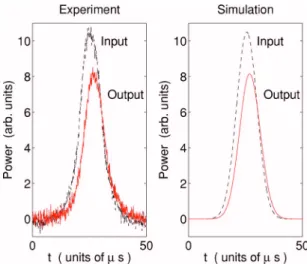
well with the perturbation formula of Eq. 共45兲. Our ADM results also reproduce the experimental data as shown in Fig. 3 with parameters described in the captions of that figure.
V. THE SPATIAL DOMAIN PARTITION METHOD In the next simulation, we increase the light pulse ampli-tude but reduce the width of the pulse, so that the perturba-tion theory may not work. The direct use of the same ADM as described previously is divergent in spatial series. To guar-antee the convergence of series expansion in x, we divide the domain 关0,X兴 into r partitions 关Xm−1, Xm兴, m=1,2,3, ... ,r,
just like the method we developed for the nonlinear eigen-value problem of the Gross-Pitaevskii equation 关6兴. So the field function⍀i共x,t兲 and density functionsi共x,t兲 in the mth
partition are denoted as ⍀i,m共x,t兲 and i,m共x,t兲 with
t苸关Tm−1, Tm兴. The global solutions are given by
⍀i共x,t兲 =
兺
m=1 q ⍀i,m共x,t兲m共x兲, i共x,t兲 =兺
m=1 q i,m共x,t兲m共x兲, x苸 关0,X兴, 共46兲 where m共x兲 =再
1, x苸 关Xm−1,Xm兴, 0, x⫽ 关Xm−1,Xm兴, 共47兲 and 关0,X兴 = 艛 m=1 r 关Xm−1,Xm兴. 共48兲The connection conditions at x = Xmare
FIG. 3.共Color online兲 The comparison of the experimental data and numerical simulation. ⍀c= 0.35± 0.03⌫, ⍀0= 0.07± 0.01⌫, = 3.6± 0.2⌫/L, ␥=共3±1兲⫻10−3⌫, and =240/⌫ are determined experimentally 关7兴. ⍀c= 0.35⌫, ⍀0= 0.07⌫, = 3.6⌫/L, ␥=2⫻10−3⌫, and=240/⌫ are used in the calculation.
⍀i,m共⌬mX,t兲 = ⍀i,m+1共0,t兲,
i,m共⌬mX,t兲 =i,m+1共0,t兲, 共49兲
where ⌬mX = Xm− Xm−1 is the length of the interval
关Xm−1, Xm兴. With the spatial partition method, the
conver-gence problem in the series expansion of the spatial domain is resolved. With the above condition for light pulse, we divide the space into ten partitions and solve the coupled OBE and MSE by ADM. We show in Fig. 4 the time evolu-tions of a Gaussian pulse passing through a medium of ⌳-type three-level atoms at various positions in the medium. In the simulation,⍀0 is 0.1⌫ which is ten times larger than the case in Fig. 1, and with much shorter width = 28/⌫. Interestingly, we find that the stronger and narrower light pulse is now more diffused by the medium than the case in the previous section. Experiments show that the EIT fre-quency transmission window is narrower compared to the previous parameter set of a weaker field case. The narrower
frequency band transmitted causes the pulse shape to be broader in the time domain. This phenomenon has not been explained by the perturbation calculation.
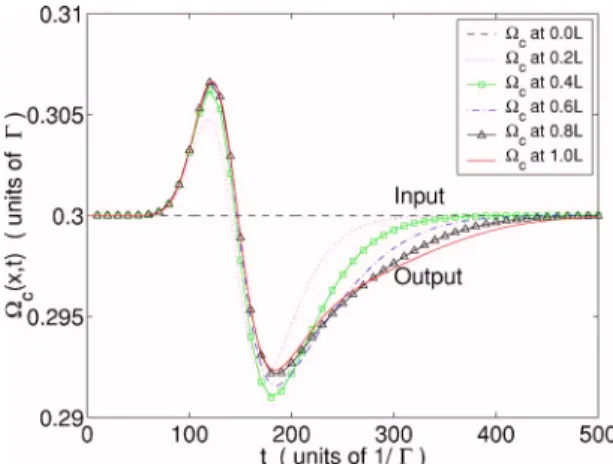
Figure 5 depicts the time evolutions of the control field at several places in the medium. At the beginning end共x=0兲, the field is fixed at the level of 0.3. The limiting case with
␥= 0 was shown in关8兴. Our results take␥into consideration;
␥ can affect the amplitude of output probe pulses signifi-cantly. The behavior of the output probe pulse in the medium is quite different from those calculated with␥= 0. To exhibit the effect of␥, we show in Fig. 6 the results of␥= 0, 0.001, and 0.002⌫ and the other parameters are set equal to those of Fig. 1. The output probe pulse amplitude of the case with nonvanishing ␥ is significantly lower than the case with
␥= 0.
Figure 7 shows the comparisons between calculation and experimental results in real time. Significantly different from the case shown in Fig. 3, the output probe pulse is broadened FIG. 4.共Color online兲 The pulse shape of fields passing through
a medium of⌳-type three-level atoms at various places in the me-dium. ⍀p are shorthand for ⍀p共x,t兲 at labeled positions. The parameters are ⍀0= 0.1⌫, ⍀c= 0.3⌫, =28/⌫, ␥=0.001⌫, and
= 9.06⌫/L.
FIG. 5.共Color online兲 The time evolutions of the control field at several places in the medium of⌳-type three-level system. ⍀care
shorthand for⍀c共x,t兲 at labeled positions. The parameters are the same as Fig. 3.
FIG. 6. 共Color online兲 The input ⍀c 共x=0,t兲 and output probe
pulses⍀c共x=L,t兲 at␥=0, 0.001, and 0.002⌫. The other parameters are equal to those of Fig. 1.
FIG. 7.共Color online兲 The comparison of the experimental data and numerical simulation. ⍀c= 0.30± 0.03⌫, ⍀0= 0.10± 0.01⌫, = 3.6± 0.2⌫/L, ␥=共3±1兲⫻10−3⌫, and =28/⌫ are determined experimentally 关7兴. The experimental data are taken through a 20-MHz low-pass filter. ⍀c= 0.33⌫, ⍀0= 0.10⌫, = 3.6⌫/L, ␥=2⫻10−3⌫, and=28/⌫ are used in the calculation.
and asymmetrical with a longer tail. The agreement between the experimental data and the theoretical prediction is satis-factory. The agreements in both weak and stronger field cases are excellent. This justifies that our ADM method works well for either perturbative or nonperturbative cases.
VI. CONCLUSION
We show the Adomian’s decomposition method can pro-vide semianalytical solutions for the problems of light pulse passing through a medium of⌳-type three-level atoms. Un-like other numerical grids methods, the ADM technique gives explicit forms of solution. The direct use of the power series expansion method 共or modified decomposition method兲 may not be able to solve the partial differential equation straightforwardly. In that case, the spatial partition method is a recipe to provide convergent results.
In summary, we have developed in this paper a new and efficient algorithm to solve the coupled partial differential equations of MSE and OBE for the three-level EIT problem. All the computations reported here are carried out on a per-sonal computer. The four levels are related to the problems; such as photon switching by quantum interference关12兴. It is far more complicated than the three-level system but is in-teresting. The method of the solution is currently under de-velopment and will be reported in the future.
ACKNOWLEDGMENTS
We thank the authors of Ref.关7兴 for providing the experi-mental data for direct comparison with our theoretical inves-tigations. TFJ acknowledges the support from the National Science Council of Taiwan under Contract No. NSC93-2112-M009-024.
关1兴 A. Kasapi, M. Jain, G. Y. Yin, and S. E. Harris, Phys. Rev. Lett. 74, 2447共1995兲.
关2兴 L. V. Hau, S. E. Harris, Z. Dutton, and C. H. Behroozi, Nature 共London兲 397, 594 共1999兲; C. Liu, Z. Dutton, C. H. Behroozi, and L. V. Hau, ibid. 409, 490共2001兲; M. Bajcsy, A. S. Zibrov, and M. D. Lukin, ibid. 426, 638共2003兲.
关3兴 M. D. Lukin and A. Imamoglu, Nature 共London兲 413, 273 共2001兲; M. Fleischhauer and M. D. Lukin, Phys. Rev. Lett. 84, 5094共2000兲.
关4兴 S. E. Harris, Phys. Today 50共7兲, 36 共1997兲.
关5兴 G. Adomian, Solving Frontier Problems of Physics: The
De-composition Method共Kluwer, Dordrecht, 1994兲.
关6兴 Y. M. Kao and T. F. Jiang, Phys. Rev. E 71, 036702 共2005兲. 关7兴 Y. F. Chen, Z. H. Tsai, Y. C. Liu, and Ite A. Yu, Opt. Lett. 共to
be published兲.
关8兴 T. N. Dey and G. S. Agarwal, Phys. Rev. A 67, 033813 共2003兲. 关9兴 M. O. Scully and M. S. Zubairy, Quantum Optics 共Cambridge
University Press, Cambridge, UK, 1997兲.
关10兴 S. Alam, Lasers without Inversion and Electromagnetically
In-duced Transparency共SPIE, Washington, 1999兲.
关11兴 A. K. Patnaik, F. L. Kien, and K. Hakuta, Phys. Rev. A 69, 035803共2004兲.
关12兴 S. E. Harris and Y. Yamamoto, Phys. Rev. Lett. 81, 3611 共1998兲.