E L S E V I E R PII: S0032-3861(97)00527-2
Printed in Great Britain. All rights reserved 0032-3861/98/$19.00+0.00
The role of partial miscibility on the properties
of ternary blends of liquid crystalline
copolyesters and polyetherimide
Kung-Hwa Wei* and Horng-Long Tyan
/nstitute of Materia/s Science and Engineering, Nationa/ Chiao Tung University, Hsinchu, Taiwan 30049, R.O.C.
(Received 3 March 1997; revJsed 25 June 1997; accepted 25 June 1997)
Binary blends of liquid crystalline co ?oly(oxybenzoate-p-ethylene terephthalate) at molar ratio 60/40, POB-PET, and polyetherimide (PEI) were investigated with differential scanning calorimetry and polarised optical microscopy. It was found that POB-PET and PEI were partially miscible when PEI was the major component. Adding a small amount (5 phr) of POB-PET to the originally immiscible blends of liquid crystalline copoly(oxybenzoate-naphthalate) (73/27), Vectra, and PEI resulted in better interracial adhesions between Vectra and PEI as evidenced by the morphological observations with scanning electron microscopy. The enhancement in the interfacial adhesions caused an increase in the ultimate tensile strength and the impact strength of these ternary blends of Vectra, POB-PET and PEI as compared to that of the corresponding binary blends of Vectra and PEI in an injection molding process. © 1998 Elsevier Science Ltd. All rights reserved.
(Keywords: polyetherimide; miscibility; tensile)
INTRODUCTION
In situ thermotropic liquid crystalline polymer composites have become a major research topic in recent years. Ideally, thermotropic liquid crystalline polymers (TLCP) were melt- blended with matrix polymers, and then the TLCP blends were processed in a conventional machir~e with relative ease. Due to its low viscosity, the TLCP can form fibrillar structure in the oriented direction to reinforce the matrix polymers during the processing j'2. There are several factors in determining the shape of the TLCP fibre in the composite such as the viscosity ratio between the two polymers, the type and the strength of deformations in the flow and the compatibility between the two polymers 3. The compatibility between the TLCP and the matrix polymer seemed the most critical one in deciding the mechanical properties of the composites because most failures appeared at the interfaces. Owing to the rigid-rod nature of the TLCP, TLCP are usually immiscible with flexible-coil pc lymers. In fact, phase separation occurred when the TLCP blends were subject to high stress and high temperature ~. A few research groups have paid attention to the miscibil:Lty issue between liquid crystalline copoly(ethylene terephthalate-p-oxy- benzoate) (PET-POB) and polycarbonate :;-7, In a previous paper s , we reported that the interface adhesion between
thermotropic copoly(oxybenzoate-naph:halate) (73/27)
(VectraA900) and polycarbonate (PC) held been enhanced by the presence of a liquid crystalline compatibiliser. This enhancement was evidenced by morphological observation and mechanical tests. The liquid crystalline compatibiliser is based on a controlled ester-ester excl~ange between PC and liquid crystalline copoly(ethylene, terephthalate-p- oxybenzoate) (PET-POB) 9, in which, transesterification
* To whom correspondence should be addressed
first happened between ethylene terephthalate and bis-A phenol and then between oxybenzoate and bis-A phenol. Consequently, the liquid crystalline character of this compatibiliser was able to be retained by using an inhibitor, triphenyl phosphate. After transesterification, the compati- biliser contained mixed chemical structures of bisphenol-A and oxybenzoate, these structures are miscible with polycarbonate and partially miscible with reinforcing TLCP Vectra A900. Therefore, the compatibility between the originally immiscible matrix polymer (PC) and Vectra A900 has been increased. However, the existence of a chemical interaction between the matrix polymer and a second TLCP is limited. DiBenetto's group l° had tried adding a second TLCP to polycarbonate or polyethylene terephthalate and Vectra, and obtained some improvements in mechanical properties in a cold drawing process. Our motivation is to extend the idea of adding a second liquid crystalline polymer that is partially miscible with both the reinforcing liquid crystalline polymer and the matrix polymer for better interracial adhesions and mechanical performances.
Polyetherimide (PEI) is a high performance engineering plastics due to its thermal stability. Baird's group 1|'|2 studied binary blends of PEI and Vectra A900, and found they are immiscible. The resultant mechanical improvement for PEI/Vectra was marginal. We can expect adding a semi- rigid TLCP, which is partially miscible with PEI, into amorphous polyetherimide (PEI) and reinforcing polymer Vectra can improve the physical interaction between them and therefore enhance the mechanical properties of this ternary blend in an injection molding process.
EXPERIMENTAL
Role of partial miscibility: K.-H. Wei and H.-L. Tyan
Company, and its trade name is Ultem 1000. Copoly (oxybenzoate-naphthalate) at molar ratio 73/27 with trade name VectraA950, was provided by Hoechst Celanese Company, USA. In this study, VectraA950 is shortened as Vectra. The second liquid crystalline polymer POB-PET at molar ratio 60/40 was termed POB-PET in this study, and was provided by Unitika Corporation, Japan. Ulteml000, Vectra and POB-PET at proper weight ratios were dried in a vacuum oven at 120°C for 24 h. For the miscibility study on POB-PET and PEI, the solution blend of POB-PET/PEI was prepared by dissolving 2 g of the polymers at the proper weight ratio in 100 cm 3 mixed soh'ent of 50/50 phenol/ tetrachloroethane by weight. The temperature of the solvent was maintained at 55°C. The solution was precipitated in a 10-fold volume of methanol after the solution became one phase for 1 h. The precipitated polymers were washed four times in hot methanol. The blend was dried in a vacuum oven at 100°C for 4 days before a thermal analysis. The thermal gravimetric analysis of the dried blends showed no appreciable weight loss up to 360°C, indicating a complete removal of the solvent. The thermal analysis of the blend at different times was carried out with a Dupont 2910 differential scanning calorimetry (d.s.c.). The samples were heated up from 30 to 300°C, at a heating rate of 20°C per min. At 300°C, the samples were annealed for 30 sec. Subsequently, the samples were quenched down to 25°C. The samples were heated agair~ from 25 to 300°C at the same heating rate. For birefringence observation, the blends in powder form were heated c n a hot plate to form melt, and then were squeezed onto a glass slide to form a film. The birefringence pictures of the films out of these blends were obtained with a Carl Zeiss Axiophot polarised microscope at room temperature. The melt blends were prepared at 300°C in 50 cm 3 mixer in a Brabender PL2100 instrument.
The ternary blends were made with a twinscrew extruder, with a length to diameter ratio of 25, attached to the
Brabender mixer PL2100 at 360°C. A blend of 20/80 Vectra/PEI was made for comparison. These blends were molded with a Toshiba IS55EPN injection molding machine. The melt temperature was 370°C, and the cycle time was 30 sec during the molding process. Tensile tests were performed according to ASTM D638 at 23°C using a Testometric Micro 500 machine. Data was obtained at a crosshead speed of 1.3 mm per rain. Unnotched I-Zod tests were performed according to ASTM D256 specification. For each data point, six specimens were tested, and the average value was taken. In scanning electron microscopy (SEM) study, the impact-fractured surface was coated with 10 nm-thick gold for observation in a Hitachi S-2500 SEM.
RESULTS AND DISCUSSION
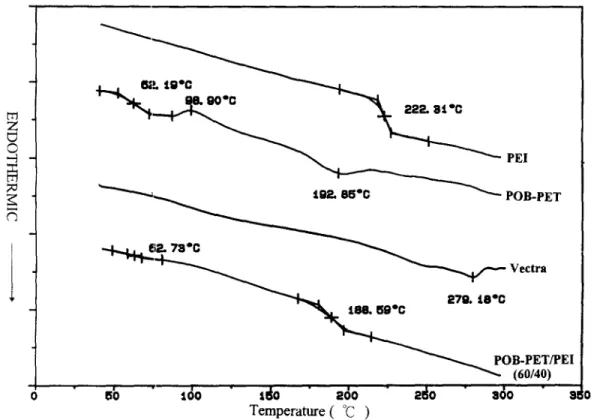
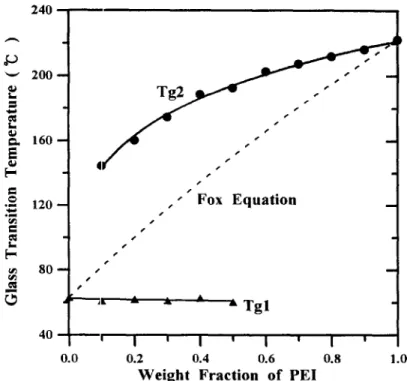
The differential scanning calorimetry curves of PE1, POB- PET, Vectra and 60/40 POB-PET/PEI solution blend are shown in Figure 1. From Figure 1, the glass transition temperatures of PEI and POB-PET were 222.3 and 62.2°C, respectively. The crystallisation temperature and the melt- ing temperature of POB-PET were 98.9 and 192.9°C, respectively. For Vectra, there is only a melting temperature appearing at 279.2°C. The miscibility in blends of POB-PET and PEI was studied through the difference in their glass transition temperature (Tg) in the blends. The Tgs of solution blends of POB-PET/PEI at different compositions are shown in Figure 2. In Figure 2, the low Ygl, was
exhibited by POB-PET, and the high Tg2, stood for PEI. There were two distinctive Tgs when the amount of PEI is less than or equal to 50% by weight in the blend. The Tgj was almost independent of the concentration of PEI in these compositions, and the Tg2 increased with the concentration of PEI in these blends. Specifically, the Yg 2 was 144.5°C for 10% PEI in the blend, and became 192.5°C for 50% PEI in the blend. There was only one Yg (Tg 2 by PEI) appearing for blends consisting of more than 50% PEI. This single Tg also
Figure l © K ~ " ~ ~ O POB-PET "° 279. iS"C ~ ° (B~0P/E0"iTEI
0 5~) ~oo r' ==to =6o ado soo "L ... =
Temperature ( ~C )
The d.s.c, curves of PEI, POB-PET, Vectra and 60/40
2 4 0 t_ [- ° ~ o ~ l - 200 160 120 80 4O 0.0 m 4 - Fox E q u a t i o n s ¢ "_ & • "~ T g l ¢ S L ~ L I ' I ' I ' I ' 0.2 0.4 0.6 0.8 1.0 W e i g h t Fraction o f PEI
Figure 2 The glass transition temperatures of POB-?ET/PEI solution blends at different compositions
increased with the PEI concentration. This indicated that POB-PET is partially miscible with PEI. It was reported that PET and PEI were miscible ~ 3,14. Apparently, the presence of the liquid crystalline POB segments in the', blend hindered the miscibility of PET segments with PEI to some extent. This argument is consistent with the fact that Vectra (containing 73 molar percentage POB) and PEI were immiscible. For a miscible random binar) polymer blend, a number of equations have been proposed to describe the
composition dependence of Tg of the blend 15'a6. One of
them is the following:
Fox equation : l/Tg = W l / T g I n t- WzFrg 2
where W~ and W2 are weight fractions of components one
and two. Because the Tgl was contributed by the PET seg-
ment in POB-PET, only PET fraction in POB-PET and PEI
were chosen for calculations by the Fox equation. In Figure
2, the measured Tg2 did not agree with the predicted Tg
value from the Fox equation, especially for the higher POB-PET concentration in the blend. In other words, the miscibility of POB-PET and PEI decreases with increasing POB segment concentration. Annealing 50/50 POB-PET/ PEI blends at 300°C for different times did not produce
any shift in the t w o TgS as shown in Figure 3. Consequently,
the miscibility of these blends was not affected by anneal- ing. This annealing result is contrary to that of the blend of PET and PEI. When the 40/60 PET/PEI solution blend was
annealed at 280°C for different times, the Tgl by PET and
the Tg2 by PEI moved toward each other as displayed in Figure 3. This indicated that the miscibility of the PET/ PEI blend was enhanced by the melt annealing at high tem- peratures 14. The stiff POB segments probably restricted the mobility of PET segments. Further evidence on the misci- bility of POB-PET/PEI blends can also be supported by the
birefringence study. In Figure 4a, the birefringence and
small spherical crystal shown for POB-PET, corresponded to the liquid cr~ystal and the crystal phases. They agreed with the appearance of the crystallisation poirt and the melting
point in the d.s.c, curve of POB-PET. Figure 4b-d are
birefringence pictures of POB-PET/PEI blends at composi- tions of 70/30, 30/70 and 10/90, respectively. As the POB- PET component decreased to 30%, there were only traces of liquid crystalline phase left without any crystal phase as
shown in Figure 4c. Additionally, 10/90 POB-PET/PEI
became an almost completely amorphous phase as dis-
played in Figure 4d. In Figure 4e and f, the birefringence
of freshly prepared and annealed 50/50 POB-PET/PEI solu- tion blend was displayed. They were almost the same other than a few isotropic spots which appeared in the annealed one. The Tgs of various POB-PET/PEI blends and Vectra/
PEI blend are listed in Table 1. They agreed to the Tgs of
solution blends. Hence, the morphological effect on their thermal property is minimum. Second, Vectra and PEI are immiscible since the Tg of PEI was not affected by the presence of Vectra. The dramatic difference in the morphol-
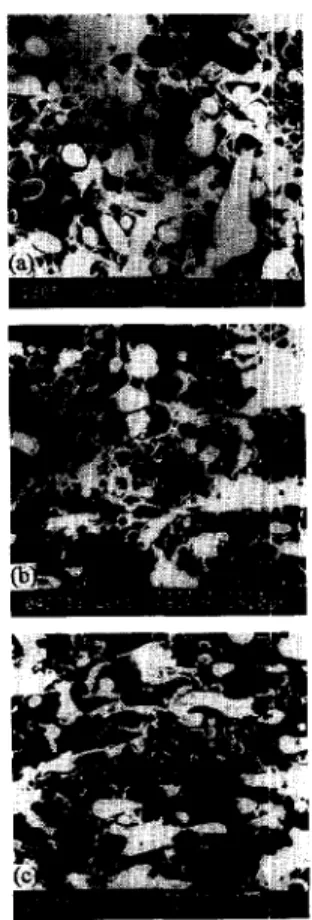
ogy of POB-PET/PEI blends is illustrated in Figure 5a-c.
There were two distinctive structures appearing for the 70/
30 POB-PET/PEI blend as shown in Figure 5a. The fibrils
were formed by POB-PET, and the spherical particles with an average size of about 15 micron were PEI phase. As the concentration of PEI increased to 50%, the interfaces between the fibrils and the spherical particles reduced as
displayed in Figure 5b. In Figure 5c, the morphology of
30/70 POB-PET/PEI blend appeared more homogeneous than that of 70/30 and 50/50 POB-PET/PEI blends. This
corresponded to the single Tg behaviour of the 30/70
POB-PET/PEI solution blend very well.
Following our previous study 8, ternary blends of Vectra, PEI and POB-PET were prepared and then injection molded
for mechanical tests. In Table 2, the tensile and the impact
properties of ternary and binary blends of Vectra and PEI as well as pure Vectra and PEI were presented. The tensile modulus of PEI and Vectra was 2431.8 and 7742.5 MPa, respectively. The tensile modulus of the binary and the ternary blends of PEI and Vectra is always higher than that of the pure PE1. This is owing to the reinforcement provided by high modulus Vectra. On the contrary, the ultimate tensile strength of these blends is lower than that of pure
Role of partial miscibility: K.-H. Wei and H.-L. Tyan r~
.=
t_ [- r ~ t ~ 240.0 t 200.0 160.0 120.0 8 0 . 0 - 40.0POB-PET/PEI (60/40)
P E T / P E I (40/60) v ) @"Q" - - - O_ A v . . . o T g 2Tg2
A e . . . . ~ T g l T g l ak .t .k ' ' ' ' ' I ' ' ' ' ' I ' ' ' ' ' I 0 . 0 40.0 80.0 120.0Annealing Time ( min )
Figure 3 The glass transition temperatures of"0/60 POB-PET/PEI solution blend annealed at 300°C (solid line) and 40/60 PET/PEI solution blend annealed at 280°C (dotted line) for different times
[] i
Figure 4 The birefringence prints of: (a) POB-PET; (b) 70/30 POB-PET/ PEL (c) 30/70 POB-PET/PEI; (d) 10/90 POB-PET/PEh (e) 50/50 POB- PET/PEI: and (f) 50/50 POB-PET/PE! after beng annealed at 300°C for 60 min
Figure 5 The SEM micrographs of melt blends of: (a) 70/30 POB-PET/ PEI: (b/50/50 POB-PET/PEI; and (c) 30/70 POB-PET/PEI
Table 1
Tgl Tg2 Tg I Tg2
(mixed 15 min) (mixed 60 min)
POB-PET/PEI (70/300) 62.0 171.8 62.5 172.5
POB-PET/PEI (50/50) * 191.2 * 191.8
POB-PET/PEI (30/70) * 202.0 * 203.7
Vectra/PEI (50/50) * 2 l 9.1 * 220.5
Table 2 The tensile and the impact properties of PEI, Vectra, binary and ternary blend of Vectra, PEI and POB-PET
Ultimate tens!le strength Tensile modulus Impact Elongation
(Mpa) (MPal (ft-lb/in) (%)
The glass transition temperatures of melt blends of 70/30, 50/50, 30/70 POB-PET/PEI and 50/50 Vectra/PEI
PEI 95.89 2431.76 30.68 6.97 PEl/Vectra (80/20) 77.91 2867.71 3.79 3.82 PeI/POB-PET/Vectra (80/3/20) 84.70 2905.92 4.41 4.28 PEI/POB -PET/Vectra (80/5/20) 91.19 3036.06 5.46 4.98 PEI/POB-PET/Vectra (80/7/20) 84.83 3052.23 4.68 4.24 PEI/POB-PET/Vectra (80/10/20) 81.12 3005.84 5.19 4.22 PEl/Vectra (70/30) 62.65 2751,37 2.59 2.86 PEI/POB-PET/Vectra (70/5/30) 83.21 2916.45 4.70 4.08 Vectra 203.98 7742.53 * 7.51
*Out of test range
•
Tensile Strength
<> Impact Strength
9 0 . 0 L . "N 8 0 . 0 1 0 0 . 0 -- - - 6 . 0 7 0 . 0 <> O <> ' I ' I ' I ' I 0 . 0 2 . 0 4 . 0 6 . 0 8 . 0 10.0POB-PET concentration (phr) in (20/80) Vectra/PEI
5 . 0 ~ I 4.o ~ L E , 2 . 0
Figure 6 The tensile strength and the impact strength of ternary blends of Vectra/POB-PET/PEI at different POB-PET concentration with the weight ratio of
Vectra to PEI fixed at 20 to 80
PEI. This can be interpreted as a failure in the interface adhesion between Vectra and PEI, which is manifested by the fact that Vectra and PEI are immiscible. In the case of adding POB-PET to binary blends of Vectra and PEI, both the ultimate tensile strength and the impact strength of Vectra/POB-PET/PEI ternary blends increased as compared to those of corresponding binary bleeds as shown in
Figure 6. The maximum increase took place for 20/5/80 Vectra/POB-PET/PEI ternary blend, with 17% and 44% increase in ultimate tensile strength and impact property, respectively, as compared to those of 20/80 Vectra/PEI binary blend. When the amount of POB-PET in the blend increased to 7 phr, a reduction of mechanical performance of the ternary blend resulted. This might be explained by the
Role of partial miscibility: K.-H. I/Vei and H.-L. Tyan
critical micelle concentration effect of POB-PET. The critical micelle concentration can be explained as follows. A blockcopolymer A-b-B was formed by monomers A and B. This A-b-B blockcopolymer tends to migrate to the interface of immiscible homopolymers A and B, and served as a surfactant as predicted by Leiber 17. As the concentration of the blockcopolymer increased to a p.3int, free copolymer chains tend to aggregate, rather than migrate to the interface. This concentration is defined as the critical micelle concentration. From the nuclear magnetic spectra of POB- PET, POB-PET is close to a randc,m copolymer. POB segments and PET segments in POB-PET polymers are miscible with Vectra and PEI, respectively. Although there was no theory so f a r - - t o our knowledge--to predict the effect of a random copolymer on two immiscible polymers, we speculated that there was some surfactant effect of POB- PET on the two immiscible Vectra and PEI. Therefore, POB-PET can be treated as a compatibiliser for Vectra and PEI. As far as the proof of the micelle formation in the interface of Vectra and PEI is concer:aed, it requires a full new investigation and is beyond the scope of this paper. At the concentration of 7 phr, POB-PET itself might be associated together in stead of serving as a compatibiliser for Vectra and PEI. A similar behaviour occurred in 30/5/70 Vectra/POB-PET/PEI ternary blend, with a 33% and 82% increase in ultimate tensile strength and impact strength as compared to those of 30/70 Vectra/PEI binary blend. The scanning electron microscopy micrographs of the near-skin section of the fractured surface of the injection-molded bars out of these blends are displayed in Figure 7a-c. The near skin regions of the fractured surfaces of binary and ternary
blends are also presented in Figure 7 a-c. For the 20/80 Vectra/PEI binary blend, Vectra particles or fibrils about 2 microns in diameter were dispersed in PEI matrix as shown in Figure 7a. When 3 phr POB-PET was added into 20/80 Vectra/PEI, the dispersion of Vectra particles is better with an average size of about 1 micron in diameter, and the Vectra fibrils were more than that in the binary blend case as displayed in Figure 7b. In the case of adding 5 phr POB- PET as illustrated in Figure 7c, the dispersion of Vectra particles did not improve further, rather the Vectra fibrils seemed longer than that in the 3 phr POB-PET case. In the centre regions of the fractured surfaces, the interfacial gap between Vectra particles and PEI matrix reduced when 3 phr POB-PET was added into 20/80 Vectra/PEI blend. This is demonstrated in Figure 8a and b. In the case of 5 phr POB-PET added into the 20/80 Vectra/PEI blend, there was no discernible improvement in the interface adhesion as compared to that in the 3 phr POB-PET case, as shown in
Figure 8c. These observations supported the results that interface adhesion was increased by the presence of POB- PET, and mechanical properties of ternary blends of Vectra/ PEI/POB-PET were improved.
Therefore, by adding a second semi-rigid liquid crystalline copolyester which being even partially miscible with the amorphous matrix polymer polyetherimide would enhance the interface adhesion between originally immiscible fully aromatic TLCP Vectra and PEI. As a result the overall mechanical properties of the ternary blends including tensile and impact strength were enhanced.
Figure 7 The SEM micrographs of the near-skin section of the fractured surfaces of injection bars out of blends: (a) Ve,ztra/PEl (20/80); (b) Vectra/ POB-PET/PEI (20/3/80); and (c) Vectra/POB-PET/PEI (20/5/80)
Figure 8 The SEM micrographs of the core section of the fractured surfaces of injection bars out of blends: (a) Vectra/PE1 (20/80); (b) Vectra/ POB-PET/PEI (20/3/80); and (c) Vectra/POB-PET/PEI (20/5/80)
CONCLUSIONS
Semi-rigid liquid crystalline copoly(oxybenzoate-p-ter- ephthalate) at molar ratio 60/40, POB-PET, is partially miscible with polyetherimide, PEI, when polyetherimide is the major component in binary blends of POB-PET and PEI. Adding a small amount (less than 5 phr) of POB-PET to blends of polyetherimide and reinforcing liquid crystalline copoly(oxybenzoate-naphthalate), Vectra, resulted in better interfacial adhesions between originally immiscible poly- etherimide and Vectra as elucidated from the morphological evidence. This enhancement in interfacial adhesion caused an increase in both the ultimate tensile ~trength and the impact strength of these ternary blends of Vectra, POB-PET and PEI as compared to the corresponding binary blends of Vectra and PEI in an injection molding process.
ACKNOWLEDGEMENTS
The authors appreciated the financial support provided by the National Science Council through Project NSC86-2216- E-009-006.
REFERENCES
1. Kiss, G., Polym. Eng. Sci., 1987, 27, 410.
2. Weiss, R. A., Huh, W. and Nicolais, L., Polym. Eng. Sci., 1987, 27, 684.
3. O'Donnell, H. J. and Baird, D. G., Polymer, 1995, 36, 311. 4. Tang, P., Reimer, J. A. and Denn, M. M., Macromolecules, 1993,
26, 4269.
5. Zhang, P., Kyu, T. and White, J. L., Polym. Eng. Sci., 1988, 28,
1093.
6. Su. K. F. and Wei, K. H., J. Appl. Polym. Sci., 1995, :56, 79. 7. Wei, K. H. and Su, K. F., J. Appl. Polym. Sci., 1996, 59, 789. 8. Wei, K. H., Hwang, J. L. and Tyan, H. L., Polymer, 1996, 37, 2087. 9. Wei, K. H. and Ho, J. C.. Macromolecules, 1997, 30, 1587. 10. Lee, W. and DiBenedetto, A. J., Polymer, 1993, 34, 684. 11. Bafna, S. S., Sun, T., De Souza, J. P. and Baird, D. G., Polymer,
1995, 36, 259.
12. De Souza, J. P. and Baird, D. G., Polymer Composites, 1996, 17, 578.
13. Martinez, J. M., Equiazabal, J. I. and Nazabal, J., J. Appl. Polym. Sci., 1993, 48, 935.
14. Chen, H. L., Macromolecules, 1995, 28, 2228. 15. Couchman, P. R., Macomolecules, 1978, 11, 1156. 16. Fox, T. G., Proc. Am. Phy. Soc., 1956, 1, 123.