Thermal fluctuations and vortex melting in the Nb
3Sn superconductor from high resolution
specific heat measurements
R. Lortz,1F. Lin,2N. Musolino,1Y. Wang,1A. Junod,1 B. Rosenstein,2and N. Toyota3
1Department of Condensed Matter Physics, University of Geneva, 24 Quai Ernest-Ansermet, CH-1211 Geneva 4, Switzerland 2National Center for Theoretical Sciences and Electrophysics Department, National Chiao Tung University, Hsinchu 30050, Taiwan
3Physics Department, Graduate School of Science, Tohoku University, 980-8571 Sendai, Japan
共Received 4 April 2006; published 5 September 2006兲
The range of critical thermal fluctuations in “classical” bulk superconductors is extremely small and espe-cially in low fields hardly experimentally accessible. With a new type of calorimeter we have been able to resolve a small lambda anomaly within a narrow temperature range around the Hc2 line. We show that the evolution of the anomaly as a function of magnetic field follows scaling laws expected in the presence of critical fluctuations. The lower onset of the fluctuation regime shows many characteristics of a continuous solid-to-liquid transition in the vortex matter. It can be driven into a first-order vortex melting transition by a small ac field which helps the vortex matter to reach equilibrium.
DOI:10.1103/PhysRevB.74.104502 PACS number共s兲: 74.25.Bt, 74.25.Op, 74.25.Qt, 74.40.⫹k
I. INTRODUCTION
The superconducting transition belongs to the family of second-order phase transitions for which the order parameter is continuous at the critical temperature. Fluctuations typi-cally dominate such transitions. This is certainly true for high-temperature superconductors共HTSCs兲 共Refs.1–9兲 and
layered organic superconductors10,11 in which fluctuations
broaden the superconducting transition in a magnetic field and melt the vortex lattice into a liquid far below the mean-field transition temperature. However, in the case of “classi-cal” bulk low-Tcsuperconductors the coherence volumes are large and the transition temperatures low. This strongly nar-rows the temperature window around Tc in zero magnetic fields in which the effect of fluctuations becomes important down to a size which is generally believed to be experimen-tally inaccessible. Experimental limits for their observation are sample inhomogeneity and the temperature resolution of standard thermodynamic measurements. Improving sample quality and experimental sensitivity to observe critical fluc-tuations thus poses a significant challenge to the experimen-talist. Nevertheless, some “universal” features in the field-temperature phase diagram of classical type-II super-conductors, e.g., a broadening of the upper-critical field line 关Hc2or Tc共H兲兴 or a peak effect13–18show analogies with the HTSCs. New high-resolution calorimetric methods which we developed during years of study on the HTSCs motivated us to investigate whether fluctuation effects and vortex melting might also be responsible in this case. We have chosen the compound Nb3Sn, as high purity single crystals are available19,20and it is still the most important superconductor
for applications.
In this paper, we report specific-heat measurements on a homogeneous single crystal of the superconductor Nb3Sn. We observe a small lambda anomaly superimposed on the specific-heat jump at Tc共H兲. The broadening of the anomaly and the jump as a function of magnetic field follows scaling laws typical in the presence of fluctuations. The lower onset of the fluctuation regime may be interpreted as an “ideal-ized” upward step related to a continuous vortex melting
transition. It can be driven into a first-order transition by a small ac field. Fluctuations are also observed in the sample magnetization which proves that the anomalies are of a ther-modynamic origin.
II. EXPERIMENTS
The sample under investigation is a Nb3Sn single crystal with a Tc width of ⬃20 mK.19 The specific heat was mea-sured with a new type of quasi-isothermal calorimeter. A sample platform with a deposited thin-film heater is sus-pended by a thermopile made of 24 thermocouples acting as a strong heat link to the surrounding thermal bath. The spe-cific heat can be obtained using an ac technique21 which
provides a high sensitivity and density of data points, or with a less sensitive dc heat-flow technique.22The latter is helpful
to calibrate absolute values and to rule out artifacts due to the ac method. These may arise in the presence of thermal hys-teresis effects, e.g., due to flux pinning or close to a first-order phase transition. The isothermal magnetization was measured with a commercial quantum design MPMS-5 SQUID magnetometer using a scan length of 2 cm in steps of 4 mT.
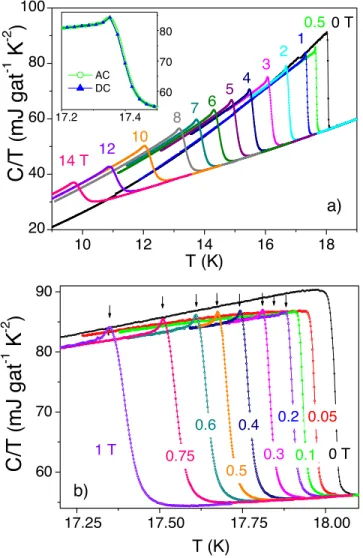
An overview of the specific heat measured with the ac technique in various fields is given in Fig.1共a兲. Figure1共b兲 shows details close to Tc共0兲. In zero fields the typical mean-field jump is found at Tc. No signature of fluctuations is visible when entering the superconducting phase from the normal state. In a small field ⬎0.05 T the jump ⌬C is re-duced by a factor of 1.11. For high- superconductors共 is the ratio of penetration depth to coherence length 兲 a reduction of⌬C by a factor of 1.16 is expected when enter-ing the Abrikosov phase instead of the Meissner phase,23
close to our value. For0H = 0.05 T the transition at the Hc1
line can be seen as a smooth increase of the specific heat towards the zero-field data upon lowering the temperature below Tc共H兲. It extends over a broad temperature interval between 17.4– 17.9 K as the transition line is almost reached tangentially in this temperature sweep experiment. In fields
⬎0.2 T a tiny lambda anomaly, superimposed on the jump, can be resolved. If the field is raised further the anomaly grows until it represents⬃10% of the total jump. The tem-perature range over which it is visible is enlarged simulta-neously with the jump upon increasing the field. To exclude artifacts originating from dissipative effects of the vortex matter in presence of flux pinning when using the ac tech-nique, we compared the data for a few fields with measure-ments performed in the dc mode. The shape of the anomalies does however not depend on the method used关inset of Fig.
1共a兲兴. Furthermore, the same anomaly is found in field-sweep
experiments.17This rules out irreversible effects as its origin.
Figure 2共a兲 shows isothermal magnetization measurements. A deviation from linear behavior just below the kink at Hc2 indicates the onset of fluctuations. The effect appears more clearly in the derivative dM / dH 关Fig.2共b兲兴 where a similar lambda anomaly to that seen in the specific heat appears superimposed on a jump. Together these measurements prove that the observed anomaly is a true thermodynamic feature.
III. DISCUSSION A. Thermal fluctuations
A measure of the width of the critical regime is the Gin-zburg number Gi= 0.5共kBTc兲2/关Hc
2共0兲
03兴2; Hc共0兲 is the ther-modynamic critical field at T = 0 and 0 the isotropic Ginzburg-Landau coherence length. While Gi is enhanced in the HTSCs to ⬃10−1− 10−3, small values are found in bulk classical superconductors, e.g., 10−10for Nb. The Ginzburg temperature G= GiTc determines the temperature range around Tcwhere fluctuations in the specific heat are of the same order of magnitude as the mean-field jump. Using Tc = 18 K, Hc共0兲=5200 Oe, and 0= 36 Å,12 we obtain G = 10−5− 10–4K. Contributions of a few percent of the jump
10 12 14 16 18 20 40 60 80 100 17.2 17.4 60 70 80
a)
T (K)
4 5 14 T 12 10 8 7 6 3 2 1 0.5 0 TC/T
(
mJ gat
-1K
-2)
AC DC 17.25 17.50 17.75 18.00 60 70 80 90b)
C/T
(
mJ gat
-1K
-2)
T (K)
1 T 0.75 0.6 0.5 0.4 0.3 0.2 0.1 0.05 0 TFIG. 1.共Color online兲 共a兲 Total specific heat of a single crystal of Nb3Sn in fields from 0 – 14 T measured by an AC technique.共b兲 Details of the specific heat in small fields close to Tcshowing the evolution of a small fluctuation ‘peak’ superimposed on the specific-heat jump. Inset of共a兲 Comparison of the specific heat in 1 T measured with an ac and a dc technique.
1.0
1.5
2.0
2.5
3.0
3.5
-4
-3
-2
-1
0
5 6 7 -50 0 50a)
b)
μ
0H (T)
17 K
16.75 K
16.5 K
16.25 K
M (mJ gat
-1T
-1)
T=14 K
1.0
1.5
2.0
2.5
3.0
3.5
0
2
4
6
8
10
12
μ
0H (T)
17 K
16.5 K
16.75 K
16.25 K
dM/dH (mJ ga
t
-1T
-2)
FIG. 2.共Color online兲 共a兲 Magnetization as a function of applied field at four different temperatures. The straight lines serve as a guide to the eye to show the deviation from linear behavior due to the onset of fluctuations close to Tc共H兲. The inset shows a sharp hysteresis loop共“magnetization peak effect”兲 due to enhanced flux pinning at the lower onset of the fluctuation regime which develops at lower temperatures共here 14 K兲 共Refs.17and18兲. 共b兲 Derivative
of the magnetization curves showing a small fluctuation peak su-perimposed on the broadened jump at Tc共H兲. Consistent units J gat−1T−1= Am2gat−1and J gat−1K−1are used for the
magnetiza-tion and the specific heat respectively. Here 1 gat共gram-atom兲 is 1 / 4 mole.
might therefore be observable in a range of 10−2K around Tc. We observe in the 0.25 T data that the anomaly repre-sents 3% of the specific-heat jump and it appears over a temperature range ⬃10−2K. For comparison, G for the HTSC YBa2Cu3O7 共YBCO兲 is of the order of 1 K, while fluctuation contributions have been observed up to 30 K above Tc.4,5 Furthermore, G increases in a field due to a reduction of the effective dimensionality arising from the confinement of the excitations to a few low Landau orbits.24 This lead to the observation of fluctuations in some classical superconductors, especially in Nb, in rather high fields close to Hc2共0兲 which have been interpreted in terms of “lowest Landau level”共LLL兲 fluctuations.25,26In the present work the
fluctuations can be traced down to very low fields where they express themselves in a rather sharp lambda anomaly.
Outside the temperature range defined byG, the fluctua-tions in the low-field limit have been described either within the Gaussian or the 3d-XY model including correction terms.1,27 The temperature range of the fluctuations is too small here to extract any critical exponents. Information can be obtained from the broadening and the increasing width of the fluctuation regime in magnetic fields. Both follow scaling laws as we will show below. In some HTSCs, the scaling of data taken in different fields has been successfully used to investigate fluctuations.2,3,5–7 The effect of a magnetic field
on fluctuations is to induce a length scale which reduces the effective dimensionality. This magnetic length l =共⌽0/ B兲1/2 is related to the vortex-vortex distance in type-II superconductors.5,28 In the critical regime, the correlation length diverges upon approaching Tc following a power law of the form ⬃0共1-t兲−v, t = T / Tc共0兲, = 0.67 共3d-XY兲. The presence of a magnetic length will cut off this diver-gence within a certain temperature window. A finite-size ef-fect is thus responsible for the broadening of Tc in fields. Scaling involves normalizing data taken in different fields by the ratio of to the magnetic length. If universality holds scaled data should merge on a common curve. 3d-XY scaling was observed, e.g., for YBCO up to fields of⬃10 T 共Ref.5兲
although the temperature range was clearly larger thanG. In higher fields the quasiparticles are confined to low Landau levels and the scaling model for 3d-LLL fluctuations should be applicable.6,8,26 We tested both models on Nb
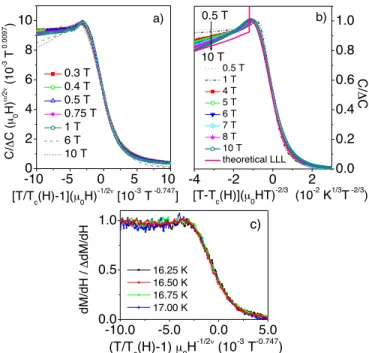
3Sn. The 14 T data above 10 K represents the specific heat of the nor-mal state and was used to subtract the phonon contribution. In Fig. 3共a兲 we started by 3d-XY scaling the data in low fields. As the fluctuations contribution is small, we had to normalize the specific-heat jump and consider a field-dependent Tc共H兲. The data can then be merged when plotted as C /⌬CH␣/2 versus 关T/T
c共H兲-1兴−1/2 which is the proper scaling for the 3d-XY model共␣⬵−0.001兲.1 The scaling
be-comes worse around 4 T and fails completely in higher fields. Fig. 3共c兲 shows a similar 3d-XY scaling plot for
dM共H兲/dH. The curves 共in the low-field 3d-XY limit兲 merge
perfectly and prove that the signature of fluctuations is a true thermodynamic effect. In Fig.3共b兲we plotted the same data as C /⌬C versus 关T-Tc共H兲兴共HT兲−2/3which is the proper nor-malization for the 3d-LLL model. The scaling holds in fields above 4 T in the region of the broadened specific-heat jump, while the curves measured in lower fields deviate
increas-ingly. To compare the data more quantitatively with the 3d-LLL model in which pinning is neglected we performed a clean 3d-LLL fit9 with help of the LLL scaling parameter:
aT= −共2/Gi兲1/3关t-Tc共H兲/Tc共0兲兴共ht兲−2/3,25 where h = H / Hc2共0兲. The second critical field line is accurately approximated by:
Hc2共T兲=c1关T-Tc共0兲兴−c2关T-Tc共0兲兴2, c1= −2.05, and c2= −0.036. Coefficients of the Ginzburg-Landau model such as the effective mass m* which weakly depend on temperature were extracted from the zero-field specific-heat data. The so obtained theoretical curve is included in Fig.3共b兲and repre-sents a scaling function. The data at high fields cannot only be merged, but also mapped onto the scaling function in the upper temperature range. In fields lower than 4 T the broad-ening of the curves is overestimated by the 3d-LLL model, indicating contributions from quasiparticles occupying higher Landau orbits and a crossover into the low-field 3d -XY region. According to the theoretical fit a solid vortex phase is the ground state for aT⬍−9.5 and a liquid phase for
aT⬎9.5. A vortex melting transition should thus occur at
aT= −9.5.9,29 It is manifested by a spike as included in Fig.
3共b兲, which was however not observed in the experimental data. The scaling of the experimental data is limited to the temperature range above this theoretical melting tempera-ture. Below a smooth upturn of the specific heat is found instead and will be discussed later. We note that the expo-nents in the scaling variables of the 3d-XY and the 3d-LLL model are very similar and it is hard to determine from scal-ing alone which model is more suitable for describscal-ing the fluctuations, as has also been observed in HTSCs.2,3
Never-theless neither model can be used alone to describe the scal-ing over the whole range of fields which we take as an indi-cation for a crossover from 3d-XY to 3d-LLL fluctuations in high fields. -100 -5 0 5 10 2 4 6 8 10 -4 -2 0 2 0.0 0.2 0.4 0.6 0.8 1.0 a) 0.3 T 0.4 T 0.5 T 0.75 T 1 T 6 T 10 T C/ Δ C ( μ0 H) α /2 ν (10 -3 T 0.0097 ) [T/Tc(H)-1](μ0H) -1/2ν [10-3 T -0.747] b) C/ Δ C 10 T 0.5 T 0.5 T 1 T 4 T 5 T 6 T 7 T 8 T 10 T theoretical LLL [T-Tc(H)](μ0HT) -2/3 (10-2 K1/3T -2/3) -10.0 -5.0 0.0 5.0 0.0 0.5 1.0 c) (T/Tc(H)-1) μ0H -1/2ν (10-3 T-0.747) 16.25 K 16.50 K 16.75 K 17.00 K dM/dH / Δ dM/dH
FIG. 3. 共Color online兲 共a兲 3d-XY and 共b兲 3d-LLL scaling of the specific-heat data after subtraction of the normal-state contribution. A theoretical fit共Ref.9兲 according to a 3d-LLL model is added to
共b兲 共see text for details兲. 共c兲 3d-XY scaling of the derivative of the magnetization.
The fluctuations disappear in low fields in the vicinity of the Meissner phase. For this classical superconductor with a large coherence volume vortex degrees of freedom are likely to be important to destabilize the phase of the superconduct-ing condensate. The fluctuation anomaly might thus be re-lated to a transition into a liquid vortex phase. Evidence for vortex melting has indeed been found in the experimental data, as discussed below.
B. Vortex melting
Below 15 K, irreversibility due to enhanced flux pinning close to the Hc2line gives rise to a sharp magnetization peak effect共Fig.3 inset兲.17,18 Such peak effects have been
inter-preted as being due to an underlying solid-to-liquid transition in the vortex matter.30The onset of the fluctuation anomaly
in the specific heat when approaching Tc共H兲 from below may be interpreted as an “idealized” upward step, similar to the second-order vortex melting observed in some YBCO samples.31 It has also been shown that a small ac field can
help the vortices to reach equilibrium in the presence of flux pinning.32,33 For this reason we installed a coil below the
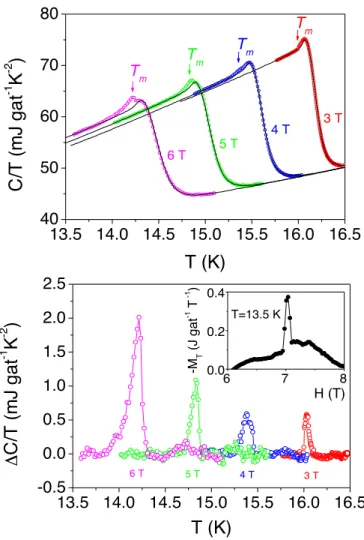
sample platform of our calorimeter and repeated measure-ments with a superimposed ac field of⬃10 G, 1 kHz applied parallel to the dc field. Starting from 3 T the shape of the fluctuation anomaly changes: The upward step is shifted somewhat to lower temperatures and becomes clearly sharper关Fig.4共a兲兴. In 5 T a small spike replaces the smooth upturn in the specific heat which grows further in 6 T which is the highest field in which we were able to perform this experiment. The ac coil which is thermally anchored to the thermal bath dissipates too much heat to stabilize tempera-tures lower than 13.5 K. In Fig4共b兲we plotted the difference in the curves with and without ac field to show the anomaly more clearly.
The spike in fields above 4 T most probably arises from the latent heat of a first-order vortex-melting transition. Self-heating effects due to screening currents induced by the ac field can be ruled out as an origin of the spike. The produced heat would flow out of the sample to the thermal bath 共nega-tive contribution to the specific heat兲, while heat is absorbed from the thermal bath by the latent heat of a first-order tran-sition which results in a positive contribution. ac specific-heat methods共as also some relaxation methods兲 may under-estimate latent heats of first-order transitions if the temperature hysteresis is larger than the amplitude of the temperature modulation of the experiment. This was e.g. demonstrated on the first-order vortex-melting transition in YBCO.34 The ac method with a small temperature
modula-tion 共⬃1 mK兲 was however necessary to have sufficiently temperature resolution to resolve the spikes at the melting temperature共Tm兲 without broadening it. To measure the true value of the latent heat which can be compared to that ob-served in YBCO, we measured the dc heat flow through the thermopile during a field sweep in presence of the small ac field at a fixed temperature共13.5 K兲. The related quantity is the isothermal magnetocaloric effect MT共H兲=共dQ/dB兲T=const 共see Ref.17for more details兲. Also in this quantity, which is
closely related to the specific heat, a spike is observed at
⬃7 T 关inset of Fig.4共b兲兴. From the area below the spike we
can calculate the latent heat absorbed at the transition from the solid to the liquid phase. We find a value of ⌬S=2 ⫻10−3± 5⫻10−4J gat−1K−1= 0.06± 0.015 k
B/vortex. In the layered compound YBCO values of⬃0.4 kB/vortex/layer are reported in comparable fields applied perpendicular to the superconducting layers.35 It is a delicate question how to
compare the latent heat of a vortex in an isotropic system as Nb3Sn with that of a layered compound. A relevant length scale is the average length of vortex segments which are “straight” along the field direction36 and it can be assumed
that this length is closely related to the coherence length. We thus normalize the ⌬S value by the coherence length 共 = 36 Å for Nb3Sn兲 which extends in Nb3Sn over a few lattice parameters共5.293 Å兲.12 We find 0.3± 0.1 k
B/ vortex/, com-parable to the value of YBCO and thus a reasonable value for a vortex-melting transition. A four times smaller value is
13.5 14.0 14.5 15.0 15.5 16.0 16.5
40
50
60
70
80
Tm Tm Tm Tm 6 T 5 T 4 T 3 TC/T (mJ ga
t
-1K
-2)
T (K)
13.5 14.0 14.5 15.0 15.5 16.0 16.5
-0.5
0.0
0.5
1.0
1.5
2.0
2.5
6 7 8 0.0 0.2 0.4 6 T 5 T 4 T 3 TΔ
C/T (mJ ga
t
-1K
-2)
T (K)
T=13.5 K -M T (J gat -1 T -1 ) H (T)FIG. 4.共Color online兲 共a兲 Specific-heat data in 3, 4, 5, and 6 T with a small ac field共⬃10 G, 1 kHz兲 superimposed parallel to the dc field共open circles兲 which helps the vortices to reach equilibrium in comparison with the data in absence of the ac field as shown in Fig.1. Arrows mark the vortex-melting temperatures共Tm兲. 共b兲 Dif-ference in the data with and without ac field showing the anomalies related to vortex melting more clearly. Inset: First-order vortex-melting transition in the magnetocaloric effect MT共H兲 =共dQ/dB兲T=const 共inverted for clarity兲 as measured by a dc tech-nique during a field sweep experiment共Ref.17兲.
derived from the AC specific-heat data in 6 T indicating an underestimation of the latent heat due to the presence of a temperature hysteresis and thus confirming the first-order na-ture of the transition.
In our interpretation the method of “vortex shaking” seems to help restore the Bragg glass phase in the magneti-zation peak effect region where the thermal fluctuations soften the vortices and tend to transform the Bragg glass into a pinned intermediate glassy phase. Without vortex shaking, this glassy phase separates the Bragg glass and the liquid phase with no latent heat due to a first-order transition
there-fore being observed. Instead, a small hysteresis loop due to enhanced flux pinning appears in the magnetization 关Fig.
2共a兲inset兴. The solid-to-liquid transition has become a con-tinuous crossover. Once the Bragg glass is restored by the ac field it melts directly into a liquid via a first-order melting transition.
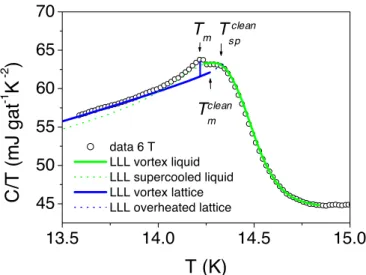
In Fig.5 we finally compare the 6 T data taken in pres-ence of an ac field with the 3d-LLL fits9 of the solid and
liquid vortex phases identical to the curves used as a scaling function in Fig3共b兲. At the experimental melting temperature the difference in the two exactly represents the additional degrees of freedom due to the transition into the liquid rep-resented by the idealized step in the original measurement. In the vortex shaking experiment the step is hidden by the latent heat of the first-order vortex melting transition. We also in-clude the metastable phases as dotted lines, with the super-cooled liquid and overheated solid terminating at the spin-odal point TSP
clean
at aT= −5.5 共Refs. 9 and 29兲 recently observed in the dynamics of several low-Tc compounds.37 The actual melting temperature 共Tm兲 is shifted downwards due to quenched disorder and appears as a smeared spike somewhat below the theoretical value Tm
clean .29
IV. CONCLUSION
The present data show that fluctuations and vortex melt-ing show up not only in HTSCs but are also present in
low-Tc superconductors. This is valuable information for the in-terpretation of universal features in the phase diagram of type-II superconductors, e.g., the broadening of the Hc2line in fields25,38and the peak effect.13–18
ACKNOWLEDGMENTS
We acknowledge stimulating discussions with A. Schill-ing, T. Giamarchi, M.G. Adesso, R. Flükiger, and H. Küpfer.
1T. Schneider and J. M. Singer, Phase Transition Approach to
High Temperature Superconductivity 共Imperial College Press, 2000兲; and references therein.
2M. Roulin and A. Junod, Physica C 260, 257共1996兲.
3M. Roulin, A. Junod, and J. Muller, Phys. Rev. Lett. 75, 1869
共1995兲.
4C. Meingast, V. Pasler, P. Nagel, A. Rykov, S. Tajima, and P.
Olsson, Phys. Rev. Lett. 86, 1606共2001兲.
5R. Lortz, C. Meingast, A. I. Rykov, and S. Tajima, Phys. Rev.
Lett. 91, 207001共2003兲.
6N. Overend, M. A. Howson, and I. D. Lawrie, Phys. Rev. Lett. 72, 3238共1994兲.
7S. W. Pierson, T. M. Katona, Z. Tesanovic, and O. T. Valls, Phys.
Rev. B 53, 8638 共1996兲; S. W. Pierson, O. T. Valls, Z. Te-sanovic, and M. A. Lindemann, ibid. 57, 8622共1998兲; S. W. Pierson, J. Buan, B. Zhou, C. C. Huang, and O. T. Valls, Phys. Rev. Lett. 74, 1887共1995兲.
8Z. Tešanovic, Phys. Rev. B 59, 6449共1999兲.
9D. Li and B. Rosenstein, Phys. Rev. Lett. 86, 3618共2001兲; Phys.
Rev. B 65, 024514共2002兲.
10M. Lang, F. Steglich, N. Toyota, and T. Sasaki, Phys. Rev. B 49,
15227共1994兲.
11S. Friemel, C. Pasquier, Y. Loirat, and D. Jérome, Physica C 259,
181共1996兲.
12V. Guritanu, W. Goldacker, F. Bouquet, Y. Wang, R. Lortz, G.
Goll, and A. Junod, Phys. Rev. B 70, 184526共2004兲.
13W. de Sorbo, Rev. Mod. Phys. 36, 90共1964兲.
14A. D. Huxley, C. Paulson, O. Laborde, J. L. Tholence, D.
Sanchez, A. Junod, and R. Calemczuk, J. Phys.: Condens. Mat-ter 5, 7709共1993兲.
15S. B. Roy and P. Chaddah, J. Phys.: Condens. Matter 9, L625
共1997兲; S. B. Roy, P. Chaddah, and S. Chaudhary, Phys. Rev. B
62, 9191共2000兲.
16S. S. Banerjee, N. G. Patil, S. Saha, S. Ramakrishnan, A. K.
Grover, G. Ravikumar, P. K. Mishra, T. V. Chandrasekhar Rao, V. C. Sahni, E. Yamamoto, Y. Haga, M. Hedo, Y. Inada, and Y. Onuki, Phys. Rev. B 58, 995共1998兲.
17R. Lortz et al., cond-mat/0604176共unpublished兲.
13.5
14.0
14.5
15.0
45
50
55
60
65
70
T
clean spT
mT
clean mdata 6 T LLL vortex liquid LLL supercooled liquid LLL vortex lattice LLL overheated lattice
C/T (mJ gat
-1K
-2)
T (K)
FIG. 5. 共Color online兲 Specific-heat data in 6 T with a small ac field共⬃10 G, 1 kHz兲 superimposed parallel to the dc field 共open circles兲 in comparison with theoretical fits 共lines兲 共Ref.9兲 using a
model for a solid vortex phase and a liquid共see text for details兲. Tm is the first-order vortex melting transition, Tmclean the theoretical melting temperature in the absence of quenched disorder and TSPclean the spinodal point.
18M. G. Adesso, D. Uglietti, R. Flükiger, M. Polichetti, and Sandro
Pace, Phys. Rev. B 73, 092513共2006兲.
19N. Toyota, T. Itoh, M. Kataoka, T. Fukase, F. Takei, and Y. Muto,
Physica B & C 135, 364共1985兲; N. Toyota, T. Kobayashi, M. Kataoka, H. F. J. Watanabe, T. Fukase, Y. Muto, and F. Takei, J. Phys. Soc. Jpn. 57, 3089共1988兲.
20R. Lortz et al.共unpublished兲.
21P. F. Sullivan and G. Seidel, Phys. Rev. 173, 679共1968兲. 22T. Plackowski, Y. Wang, and A. Junod, Rev. Sci. Instrum. 73,
2755共2002兲.
23K. Maki, Physics共Long Island City, N.Y.兲 1, 21 共1964兲. 24P. A. Lee and S. R. Shenoy, Phys. Rev. Lett. 28, 1025共1972兲. 25S. P. Farrant and C. E. Gough, Phys. Rev. Lett. 34, 943共1975兲. 26D. J. Thouless, Phys. Rev. Lett. 34, 946共1975兲.
27L. N. Bulaevskii, V. L. Ginzburg, and A. A. Sobyanin, Physica C 152, 378共1988兲.
28R. Haussmann, Phys. Rev. B 60, 12373共1999兲.
29D. Li and B. Rosenstein, Phys. Rev. Lett. 90, 167004 共2003兲;
Phys. Rev. B 70, 144521共2004兲.
30T. Giamarchi and P. Le Doussal, Phys. Rev. B 52, 1242共1995兲.
31M. Roulin, A. Junod, and E. Walker, Science 273, 1210共1996兲. 32N. Avraham, B. Khaykovich, Y. Myasoedov, M Rappaport, H.
Shtrikman, D. E. Feldman, T. Tamegai, P. H. Kes, M. Li, M. Konczykowski, K. van der Beek, and E. Zeldov, Nature 共Lon-don兲 411, 451 共2001兲.
33E. H. Brandt and G. P. Mikitik, Supercond. Sci. Technol. 17, 1
共2004兲.
34F. Bouquet, in ‘Etude Thermodynamique de l’Etat Mixte dans
YBa2Cu3O7−␦’. Ph.D thesis共in french language兲 prepared in the ‘Département de Recherche Fondamentale sur la Matière Con-densée, CEA-Grenoble, France共1998兲.
35A. Schilling, R. A. Fisher, N. E. Phillips, U. Welp, W. K. Kwok,
and G. W. Crabtree, Physica C 282, 327共1997兲.
36I. F. Herbut and Z. Tešanovic, Physica C 255, 324共1995兲. 37Z. L. Xiao, O. Dogru, E. Y. Andrei, P. Shuk, and M. Greenblatt,
Phys. Rev. Lett. 92, 227004共2004兲; A. D. Thakur, S. S. Baner-jee, M. J. Higgins, S. Ramakrishnan, and A. K. Grover, Phys. Rev. B 72, 134524共2005兲.