
Chapter Four Results and Discussion
In this chapter, the results of the study will be presented and discussed. First, error rates of the five different phonetic environments of English liquids will be presented, and special attention will be paid to their error types and degree of influence from their surrounding vowels. Second, effect of the scope of the task on the subjects’ performance of /r/ and /l/ will be examined and analyzed. Then, contrast of /r/ and /l/ in minimal pairs will be reported to better illuminate their relative degree of difficulty for Chinese learners. Finally, other possible factors which may affect the subjects’ accurate pronunciation will also be taken into consideration, including prominence of stress, assimilation of a neighboring nasal, and some idiosyncrasies of the subjects’ learning.
4.1 /r/ and /l/ in the five phonetic environments
In this section, the error rates of /r/ and /l/ will be reported in the five different phonetic environments in our data, namely syllable initial /r, l/, syllable final /r, l/, initial /r/ and /l/ clusters, final /r/ and /l/ clusters and clusters containing /rl/. The division is mainly due to different phonetic environments in which /r/ and /l/ occur as discussed in 2.3.1 and in Table 2.1. Furthermore, there exists certain relationship between the pronunciation of liquids and their surrounding vowels as discussed in Chapter Two. Specifically, it has been observed that a surrounding back vowel affects the accuracy of liquid pronunciation, while a non-back vowel promotes it (Hinton &
Pollock, 2000; Chen, 2001), and thus, the influence of the surrounding vowel of /r, l/
will be taken into consideration. Finally, different error types for /r, l/ in different phonetic environments due to L1 interference or developmental process or other
factors will be carefully examined as well.
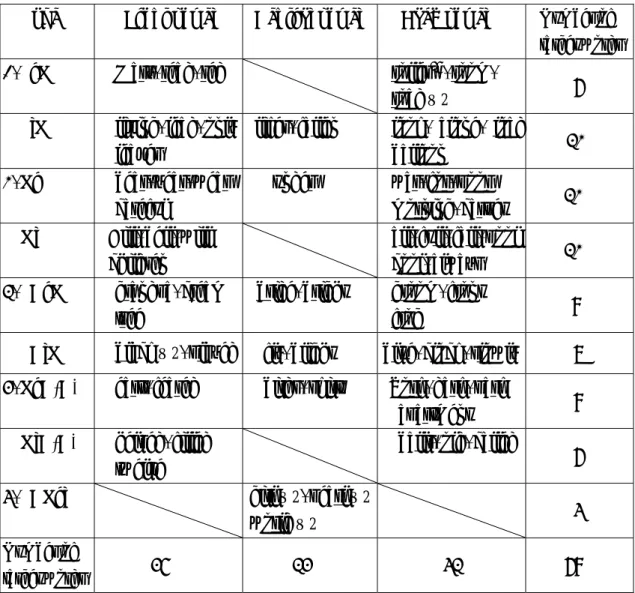
Table 4.1 shows all the target words in the five phonetic environments occurring with different kinds of surrounding vowels.
Table 4.1 All the target words in the five phonetic environments
Type Front vowel Central vowel Back vowel Number of target words 1. $rV Mary, read, red roller15, room,
road × 2 6
$lV living, lead, only leaves
likes, fallen look, alone, load
balloon 10
2. Vr$ bear, year, wear careful
under war, for, poor
morning, carpet 10 Vl$ Bill, bell, will
children
all, full, fall, pool
cool, always 10 3. $CrV grandpa, cream
tree
bride, bright groom, front
frog 8
$ClV black × 2, played fly, blight blue, clock, slowly 7 4. VrC(C)$ ears, feared birds, skirt York, dark, park
apartment 8 VlC(C)$ helped, filled
twelve
balls, old, called
6 5. $CVrl girl × 2, pearl × 2
world × 2 3
Number of
target words 25 12 31 68
As illustrated in Table 4.1, the target sounds /r/ and /l/ are distributed as evenly as possible in each of the five phonetic environments. There are 6 target words for syllable initial /r/ but 10 for initial /l/, 10 for syllable final /r/ and 10 for final /l/, 8 for initial /r/ cluster and 7 for initial /l/ clusters, 8 for final /r/ clusters and 6 for final /l/
15 Some of the target words contain more than one liquid, but our discussion focuses only on the underlined letter representing /r/ or /l/ because of the consideration of the five phonetic environments.
clusters, as well as 3 for clusters containing /rl/. Except for five words road, black, girl, pearl, and world occurring twice each, the rest of 63 target words only appear once in the reading text. Among them, 25 liquids with surrounding front vowels, 12 with central vowels, and the rest of 31 with back vowels. In order to make our data analysis significant, the error rates presented here are all divided in terms of two kinds of surrounding vowels, back vowels and non-back vowels. Central vowels and front vowels are classified as non-back vowels because their effect on liquid performance is seen to be similar in the present experiment.
What follows is a detailed account of erroneous productions of each type.
4.1.1 Type 1 -- syllable initial /r/ and /l/
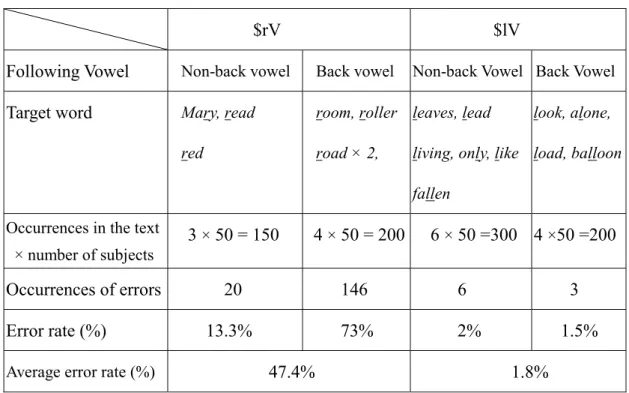
There are 16 target words in Type 1, with syllable initial /r/ and /l/. Among them, the word road occurs twice (once in the wordlist, and the other in the passage), and the other 15 words appear only once, amounting to 17 occurrences in Type 1. The following table shows the subjects’ total error numbers and their error rates.
Table 4.2 Error numbers and error rates of syllable initial /r/ and /l/ (%) $rV $lV
Following Vowel Non-back vowel Back vowel Non-back Vowel Back Vowel Target word Mary, read
red
room, roller road × 2,
leaves, lead living, only, like fallen
look, alone, load, balloon
Occurrences in the text × number of subjects
3 × 50 = 150 4 × 50 = 200 6 × 50 =300 4 ×50 =200
Occurrences of errors 20 146 6 3 Error rate (%) 13.3% 73% 2% 1.5%
Average error rate (%) 47.4% 1.8%
The figures in Table 4.2 show that syllable initial /l/ causes notably less trouble than initial /r/ because the average error rate of initial /l/ is only 1.8% while that of initial /r/ is up to 47.4%. In other words, clear /l/ is an easy sound for most of the subjects when preceding either non-back vowel or back vowel. In fact, no error is made for the 8 target words living, lead, leaves, likes, fallen, look, alone, and balloon, while the word only shows 12% (6/50) of error rate, and load, 6% (3/50). Six out of the 50 subjects pronounced only /΄onlɪ/ as /΄onnɪ/, in which the substitution of /n/ for clear /l/
in only is the sole error type. The process of nasalization for prevocalic /l/ in only may be attributed to the assimilation of the preceding nasal /n/, which will be discussed in details in Section 4.4.2. Besides, two out of the 50 subjects pronounced the word load /lod/ as /wod/ and one pronounced it as /ʐod/. On the whole, the substitutions of /w/
and /ʐ/ for clear /l/ are rare.
On the other hand, figures in Table 4.2 exhibit that the overall error rate of initial /r/ far exceeds that of initial /l/. The error rate for /r/ preceding back vowel is 73%, 5.5 times higher than that preceding non-back vowel 13.3%. Specifically, it is notable that initial /r/ in target words such as roller, road, and room are much more difficult for the subjects than that in Mary, read /rid/ and red. In other words, syllable initial /r/
preceding a back vowel is obviously more difficult to the subjects than that preceding a non-back vowel. In fact, no error is found for Mary and read /rid/ while red exhibits a 40% (20/50) error rate. The substitution of /ʐʊ/ for initial /r/ in red appears to be the major error type because 19 out of the 20 errors are produced as /ʐʊɛd/, sounding like 瑞 (ㄖㄨㄟ) 的 in Mandarin, and only one is pronounced as /luɛd/.
The higher error rate of /r/ in red /rɛd/ than that in Mary /΄mɛrɪ/ and read /rid / can be explained from the similarity of Mandarin ㄖ(/ʐ/) to English /-r/ and distribution of /ʐ/. According to Ing (1976) and Dong (1983), Mandarin /ʐ/ is similar to English syllable initial /r/ because they both share the common phonetic quality of
retroflection. Therefore, substitution of /ʐ/ is frequently observed among our subjects to replace /r-/. Moreover, as discussed in Chapter Two (cf. p18), /ʐ/ can be followed by different finals to form 13 possible syllables, and among them ㄖㄨㄟ (/ʐʊɛ/) is present while the combination of ㄖㄧ (/ʐi/) or ㄖㄨㄧ (/ʐʊi/) is absent. Hence, confusion of discriminating Mandarin /ʐʊɛ/ from English /rɛ/ may arise, and some of the subjects may even misperceive Mandarin /ʐʊɛ/ for English /rɛ/. English /r/
preceding a high front vowel /i/ or /ɪ/ as in read /rid/ and Mary /΄mɛrɪ/, on the other hand, does not show similarity with any existent Chinese syllable, and thus causes almost no confusion to the subjects.
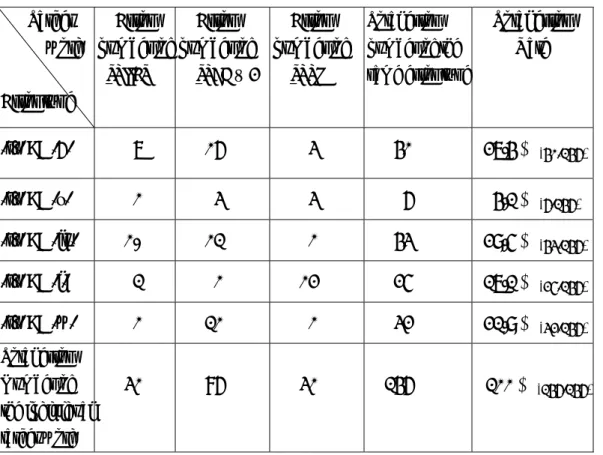
Furthermore, syllable initial /r/ preceding a back vowel has extreme difficulty for most of the subjects. Table 4.3 shows the error types of initial /r/ in the three target words, road, roller, and room, preceding the back vowels /o/ and /u/.
Table 4.3 Error types of syllable initial /r/ preceding a back vowel Target
word
Error type
Error number of roller
Error number of
road × 2
Error number of
room
Total error number of the same error type
Total error Rate
/r-/ => /ʐ/ 9 28 3 40 27.4 % (40/146)
/r-/ => /z/ 0 3 3 6 4.1 % (6/146) /r-/ => /lu/ 20 23 0 43 29.5 % (43/146) /r-/ => /l/ 1 0 24 25 17.1 % (25/146) /r-/ => /w/ 0 32 0 32 21.9 % (32/146) Total error
Number of the individual target word
30
86
30 146 100 % (146/146)
As shown in Table 4.3, the main error type of /r/ in roller /΄rolɚ/ is substitution of /ʐ/
and /lu/, which is very similar to that for /r/ in road /rod/ (except for the additional substitution of /w/ for /r/ in road). However, the main error type of /r/ in room shows a quite different substitution pattern from that in roller and road, with /lu/ substituting for /r/. The different substitution patterns observed above may result from their following vowels, because /r/ in room precedes a high back vowel /u/ while the other two precede a mid back vowel /o/. The reason for the main error type of room /rum/ to be the substitution of /l/ for /r-/ rather than /lu/ may very likely be that there already exists the round back vowel /u/ in room /rum/, and therefore, the subjects’ intentional forming of lip-rounding for an /u/ addition is not necessary.
Moreover, the substitution of /ʐ/ for initial /r/ in roller and road is probably due to interference from Mandarin, in which /ʐ/ is a retroflexed consonant similar to English /r-/ (Ing, 1987; Dong, 1983). Thus, road /rod/ is usually pronounced as /ʐod/, sounding like 肉的 in Mandarin. Second, substitution of /lʊ/ for initial /r/ may be due to interference from Taiwanese. Thus, speakers of Taiwan Mandarin is often seen to pronounce road as /lʊɔd/ sounding like 落的, because the retroflex consonant is not existent in Taiwanese.
The addition of a back round vowel /u/ in /lu/ for room and in /ʐʊ/ for red (cf.
p50) is probably due to the fact that many of the subjects tried to capture the lip-rounding, an essential quality of English prevocalic /r/ (Gimson, 1975: 209). This may also account for the substitute of /w/ for /r-/ in road. In fact, this echoes the developmental errors, in which gliding of liquid (/r/ => /w/), both sharing the quality of lip-rounding, is employed by L1 children in acquiring their native language (O’Grady & Dobrovolsky, 1996; Parker & Riley, 1994; Stoel-Gammon & Dunn, 1985 and Bernthal & Bankson, 1993 both cited in Chen, 1999).
4.1.2 Type 2 -- syllable final /r/ and /l/
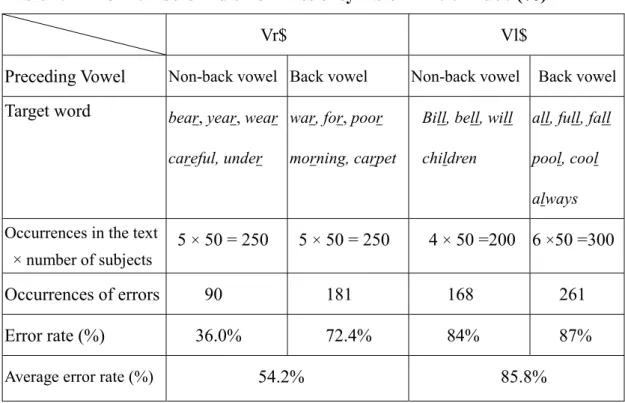
There are 20 target words in Type 2, with syllable final /r/ and /l/, occurring only once each and totally amounting to 20 occurrences. The following table shows the subjects’ total error numbers and their error rates.
Table 4.4 Error numbers and error rates of syllable final /r/ and /l/ (%) Vr$ Vl$
Preceding Vowel Non-back vowel Back vowel Non-back vowel Back vowel Target word bear, year, wear
careful, under
war, for, poor morning, carpet
Bill, bell, will children
all, full, fall pool, cool always Occurrences in the text
× number of subjects
5 × 50 = 250 5 × 50 = 250 4 × 50 =200 6 ×50 =300
Occurrences of errors 90 181 168 261 Error rate (%) 36.0% 72.4% 84% 87%
Average error rate (%) 54.2% 85.8%
The figures in Table 4.4 show that syllable final /l/ has a higher error rate than final /r/, and compared with those of syllable initial /r/ and /l/ in Table 4.2, initial /l/ has a much lower error rate (1.8 %), than that of final /l/ (85.8%), and that of initial /r/ (47.4%) is only slightly lower than that of final /r/ (54.2%). This means that both /r/ and /l/
appearing syllable-finally is more problematic to the subjects than appearing syllable-initially, with the mispronunciation of dark /ɫ/ far exceeding that of clear /l/, while postvocalic /r/ only causes a little bit more difficulty than prevocalic /r/.
Moreover, regardless of the preceding vowel quality, /ɫ/ has a markedly high error rate following either a back vowel (87%) or a non-back vowel (84%), and is indeed a troublesome sound for most of the subjects. On the other hand, backness of the preceding vowel has notable influence on the erroneous production of postvocalic
/r/, with 72.4% error rate for a following back vowel, twice as much as that with a preceding non-back vowel, 36%.
To illuminate the exact nature of the influence from the preceding vowel, the error types of final /l/ following a back vowel and a non-back vowel are further presented in Table 4.5 and Table 4.6.
Table 4.5 Error types of syllable final /l/ following a mid-back vowel and a high-back vowel
target word error type
Error number of all
Error number of fall
Error number of always
Error number of full
Error number of pool
Error number of cool
Error number of the same type
Total error rate
/ɫ/ =>
ø
46 45 44 1 0 7 143 54.8 % (143/261) /ɫ/ => /ɔ/ 0 0 0 42 45 29 116 44.4 %(116/261) /ɫ/ => /ə/ 0 0 0 2 0 0 2 0.8 %
(2/261) Total
Error No. 46 45 44 45 45 36 261 100 %
(261/261)
Table 4.6 Error types of syllable final /l/ following a non-back vowel target
Error word Type
Error number of Bill
Error number of bell
Error number of children
Error number of will
Error number of the same type
Total error rate
/ɫ/ => /ɔ
/
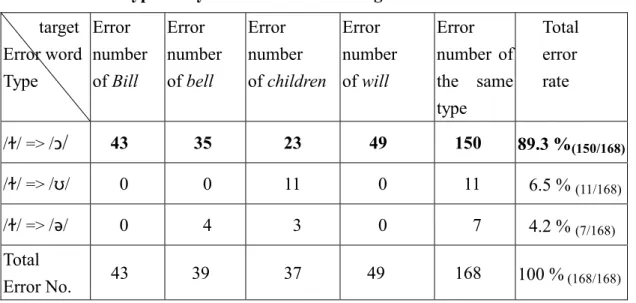
43 35 23 49 150 89.3 %(150/168) /ɫ/ => /ʊ/ 0 0 11 0 11 6.5 % (11/168) /ɫ/ => /ə/ 0 4 3 0 7 4.2 % (7/168) TotalError No. 43 39 37 49 168 100 % (168/168)
The figures in Table 4.5 and Table 4.6 clearly show that the major error type of dark
/ɫ/ following a back vowel is /ɫ/ deletion (54.8%), followed by /ɔ/ substitution (44.4%), while that following a non-back vowel is mainly /ɔ/ substitution (89.3%) and the deletion of /ɫ/ does not even occur.
Table 4.5 shows that dark /ɫ/ following a mid back vowel /ɔ/ as in all /ɔl/, fall /fɔl/, and always /΄ɔlwes / is usually deleted by our subjects. Thus, the target all /ɔl/ is frequently produced as /ɔ/, fall /fɔl/ as /fɔ/, and always /΄ɔlwes/ as /΄ɔwes/. The deletion of /ɫ/ is probably due to the phonetic similarity of /ɫ/ to the back vowel /ɔ/.
Jones (1967: 91) reported that dark /ɫ/ is sometimes very dark in London area, in which the resonance of /ɫ/ might turn into a mid back vowel as /ɔ/ or /o/ rather than a high back vowel as /ʊ/ or /u/. Although the phenomenon is observed in London area, the phonetic similarity between /ɔ/ and /ɫ/ may probably explain why a dark /ɫ/ following the mid back vowel /ɔ/ as in fall, all, or always, which already owns the quality of back vowel resonance on /ɔ/ is more likely to be deleted.
On the other hand, a dark /ɫ/ following a vowel other than /ɔ/ (such as /ʊ/, /u/, /ɪ/ or /ɛ/) is more likely to be substituted by /ɔ/. For example, the word full /fʊl/ is usually pronounced as /fʊɔ/ and pool /pul/ as /puɔ/, Bill /bɪl/ as /bɪɔ/, bell /bɛl/ as /bɛɔ/, and will /wɪl/ as /wɛɔ/. The substitution of /ɔ/ for /ɫ/ is also called “vocalization of liquid ” and is reported to occur often in L1 acquisition (Stoel-Gammon & Dunn, 1985 and Bernthal & Bankson, 1993 both cited in Chen, 1999), which is largely due to the phonetic quality of back vowel resonance on dark /ɫ/. Jones’ (1967:91) observation in London area may also account for the substitution of a mid back vowel /ɔ/ for /ɫ/ appearing more frequently than other back vowels in the present study.
Besides, among the 261 errors of dark /ɫ/ following a back vowel and the 168 of that following a non-back vowel, there appear a total of nine tokens of /ə/ substitution.
This may be attributed to the phonetic similarity between /ə/ and /r/. In fact, the substitution of ㄜ for ㄦ is commonly observed in Taiwan Mandarin. The nine /ə/
substitution tokens for /-r/ are found in subjects who show schwa character tension.
For example, they usually pronounce “一 二 (ㄜˋ) 三” to replace “一 二 (ㄦˋ) 三.” As the substitution of /ə/ (ㄜ) for /ər/ (ㄦ) in Taiwan Mandarin is commonly observed, many Taiwanese students may substitute an English dark /ɫ/ with a schwa /ə/ such as /bɪə/ for Bill /bɪl/. However, the substitution of /ə/ is relatively less frequent than that of /ɔ/, because the substitute /ə/ being a central vowel is phonetically less similar to /ɫ/, which exhibits more back vowel-like resonance.
Finally, as exhibited in Table 4.6, there are 11 tokens of /ʊ/ substitution for /ɫ/ in children (/΄ʧɪldrən/ => /΄ʧɪʊdən/). The substitution of a high back vowel /ʊ/ rather than a mid back vowel /ɔ/, is probably due to the height of the tongue position of the preceding high front vowel /ɪ/ and the preceding affricative /ʧ/.
In addition to the discussion of the error types of dark /ɫ/, the error types of postvocalic /r/ are displayed in Table 4.7.
Table 4.7 Error types of syllable final /r/
Surrounding
Vowel Non-back vowel Back vowel Target
word
Error type
Error number of bear, year, wear careful, under
Error number of war, poor, carpet morning, for
Total Error number of the same error type
Total error
rate
/-r/ =>
ø
19 129 148 54.6% (148/271) /-r/ => /ə/ 64 42 106 39.1% (106/271) /-r/ => /ɔ/ 3 10 13 4.8% (13/271) /-r/ => /lə/ 4 0 4 1.5% (4/271) Total errornumber 90 181 271 100% (402/402)
The figures in Table 4.7 show that the major error type of final /r/ following a back
vowel is /r/ deletion (i.e., morning /΄mɔrnɪH/ => /΄mɔnɪH/,), while that following a non-back vowel is mainly /ə/ substitution (i.e, bear /bɛr/ => /bɛə/). Moreover, when a postvocalic /r/ follows a mid back vowel /ɔ/, the deletion of /r/ is usually the only error type (i.e., York /jɔrk/ => /jɔk/), and when it follows a vowel other than /ɔ/, more than one error type occurs (i.e., poor /pʊr/ => /pʊɔ/ or /pʊə/, carpet /΄karpɪt/ =>
/΄kapɪt/ or /kaəpɪt/).
The tendency of /r/ deletion when it follows a mid back vowel /ɔ/ may result from /r/’s phonetic similarity with back vowel resonance. When articulating a postvocalic /r/ following a back vowel /ɔ/ as /ɔr/ in for /fɔr/, the root of tongue in the oral cavity is raised backward and then the tongue tip is simultaneously curled backward, producing back vowel resonance. The overlap of back vowel resonance produced both by the postvocalic /r/ and its preceding back vowel /ɔ/ probably confuse our subjects, for whom the word war /wɔr/ may sound like /wɔ/, with the quality of retroflection largely neglected. Thus, the strategy of /r/ deletion is often applied by Chinese students. For example, they may count the English numbers “one, two, three, four /fɔr/” as “one, two, three, /fɔ/”.
Furthermore, the process of the substitution of /ə/ for final /r/ is similar to that for final /ɫ/ as discussed earlier in this section, which may also be due to the similarity between English /ə/ and /r/ as well as interference from Taiwan Mandarin.
Interestingly, as shown in Table 4.7, /ə/ substitution shows more occurrences when the postvocalic /r/ follows a non-back vowel (64 errors) than a back vowel (42 errors).
The situation somewhat corresponds to that for final /ɫ/, in which /ɫ/ with a preceding non-back vowel has 7 occurrences of /ə/ substitution, but that with a preceding back vowel only has 2 occurrence (see Table 4.5 and 4.6).
4.1.3 Type 3 -- initial /r/ clusters and initial /l/ clusters
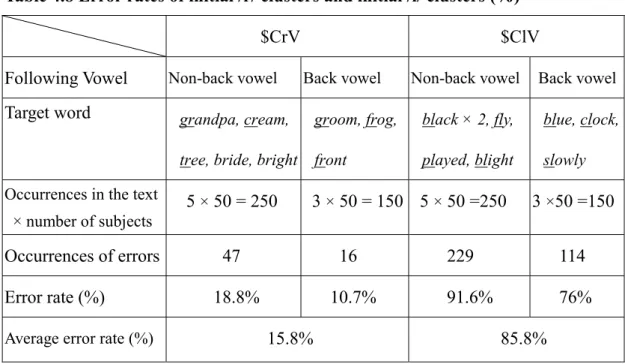
There are 15 target words for initial /r/ and initial /l/ clusters. Among them, the word black occurs twice (once in the sentence, the other in the passage) and the rest of 14 words occur only once each and totally amount to 16 occurrences. The following table shows the subjects’ total numbers and rates of /r/ and /l/ errors in initial clusters.
Table 4.8 Error rates of initial /r/ clusters and initial /l/ clusters (%) $CrV $ClV
Following Vowel Non-back vowel Back vowel Non-back vowel Back vowel Target word grandpa, cream,
tree, bride, bright
groom, frog, front
black × 2, fly, played, blight
blue, clock, slowly Occurrences in the text
× number of subjects
5 × 50 = 250 3 × 50 = 150 5 × 50 =250 3 ×50 =150
Occurrences of errors 47 16 229 114 Error rate (%) 18.8% 10.7% 91.6% 76%
Average error rate (%) 15.8% 85.8%
According to the figures in Table 4.8, the overall error rate of initial /r/ clusters is only 15.8% while that of initial /l/ clusters is up to 85.8%, obviously showing that initial /l/
clusters cause far more difficulty to the subjects than initial /r/ clusters. Furthermore, the difficulty prevails; i.e., regardless of vowel quality, an initial /l/ cluster preceding either a back vowel or a non-back vowel is indeed a troublesome sound.
The source of the difficulty in articulating an initial /l/ cluster may probably be due to the absence of consonantal clusters in Mandarin. As discussed in Chapter Two (2.3.3), English /r/ and /l/ are active in forming clusters (i.e., #CCV or #CCCV), and in the initial biphonematic cluster (#CCV), each of them usually appears as the second consonant as in crowd or cloud. On the other hand, syllable structure in
Mandarin is mainly #CV, #VC or #CVC16 (Dong, 1983; Ing, 1984), and a consonantal cluster like #CCV or #CCCV is, however, not existent. The subjects’
unfamiliarity with English cluster structures may thus cause a large amount of mispronunciation for initial /l/ clusters.
In spite of the absence of consonantal clusters in Mandarin, initial /r/ clusters are still observed to be much easier for the subjects than initial /l/ clusters, which may be attributed to the movement of the tongue and the lips. When pronouncing /l/ in initial clusters as in blight, the tongue tip is raised and touches the alveolar ridge, and the contact between the articulators must be made right after articulating the preceding consonant, which may be more difficult than /r/ cluster production as in bright, in which no contact between articulators is necessary. Hence, /r/ in bright is observed to be much easier than /l/ in blight. What is more, some target words containing initial /r/
clusters seem to cause no troubles to our subjects. For example, no errors are found for /r/ in cream and front.
In order to better illuminate the subjects’ erroneous production, the error types for initial /l/ clusters are presented in the following table.
16 In Mandarin, consonants in word final positions are limited to /n/ and /H/. The occurrence of final /r/ only appears in Pekinese Mandarin (cf. 2.5.4, p33).
Table 4.9 Error types of initial /l/ clusters Surrounding
vowel Non-back vowel Back vowel Target
word
Error type
Error number of play, blight, fly black × 2
Error number of blue, slowly
clock
Total Error number of the same error type
Total error
Rate
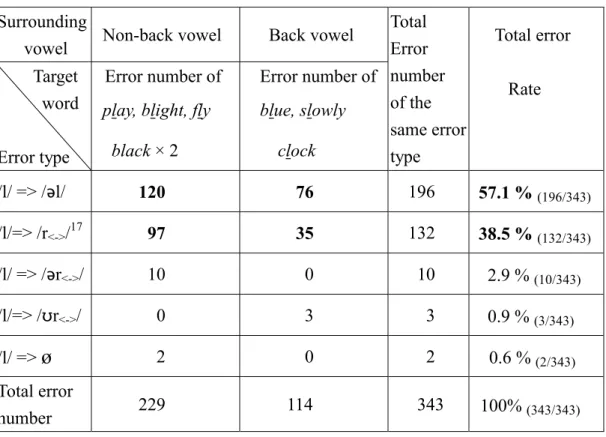
/l/ => /əl/ 120 76 196 57.1 % (196/343) /l/=> /r<->/17 97 35 132 38.5 % (132/343) /l/ => /ər<->/ 10 0 10 2.9 % (10/343) /l/=> /ʊr<->/ 0 3 3 0.9 % (3/343) /l/ =>
ø
2 0 2 0.6 % (2/343) Total errornumber 229 114 343 100% (343/343)
The figures in Table 4.9 show that addition of /ə/ is the major error type for initial /l/
clusters preceding either a non-back vowel or a back vowel, occupying 57.1% of all errors (i.e., black /blæk/ => /bə΄læk/, clock /klak/ =>/kə΄lak/). The epenthesis of schwa /ə/ in initial /l/ clusters may be attributed to developmental process factor, because it also occurs in L1 acquisition (Stoel-Gammon & Dunn, 1985 and Bernthal
& Bankson, 1993 both cited in Chen, 1999). Besides, the subjects’ intentional forming of a familiar syllable structure, #CV, (i.e., /bə/ and /læ/) to replace the unfamiliar
#CCV (i.e., /blæ/) in the process of /ə/ addition is also commonly observed.
Moreover, the substitution of /r<->/ for /l/ in initial clusters is the second main error type. The substitute is a sound between /r/ and /l/, which sounds like a tongue-tip flap at the area of alveolar ridge, but without the tongue curling for a normal /r/ nor the tongue contact required for a normal clear /l/. Interestingly, it occurs more
17 The symbol /r<->/ represents the sound between the prevocalic /r/ and /l/.
frequently when /l/ occurs with a following high vowel as /u/ in blue (i.e., blue /blu/
=> /br<->u/) or with a preceding voiceless consonant as /f, p/ in fly and play (i.e., play /ple/ => /pr<->e/, fly /flaɪ/ => /fr<->aɪ/). The presence of a following high back vowel /u/ in initial /l/ clusters is observed to promote the usage of / r<->/ substitution, which may be possibly due to the similar tongue height between the tongue tip flap /r<->/ and the high back vowel /u/, as well as the lip-rounding quality shared by both /r/ and /u/.
Moreover, our subjects are also observed to produce a shorter duration for an initial /l/
cluster with a preceding voiceless consonant (i.e., play, fly) than with a preceding a voiced one (i.e., blight). Thus, /r<->/ substitution without the tongue contact, assumed to be less time-consuming than /ə/ epenthesis usually with the tongue contact, is more likely to occur for /l/ in play and fly than that in blight in the present study. Also, strong friction or aspiration of the voiceless consonants may further encourage substitution of a flap-like consonant, which often costs less energy and time duration.
In addition to the error types for initial /l/ clusters, those for initial /r/ clusters are presented in the following table.
Table 4.10 Error types of initial /r/ clusters (except /tr/ in tree) Surrounding
vowel Non-back vowel Back vowel Target
word
Error type
Error number of bride, bright grandpa
Error number of groom, frog
Total Error number of the same error type
Total error
Rate
/r/ => /əl/ 7 7 14 48.3 % (14/29) /r/ => /ər/ 6 3 9 31.0 % (9/29) /r/ =>
ø
0 6 6 20.7 % (6/29) Total errornumber 13 16 29 100% (29/29)
Although not many errors are committed for initial /r/ clusters, their error types are
still observed to be compared with those for initial /l/ clusters. As illustrated in Table 4.10, /l/ substitution plus /ə/ addition (/r/ => /əl/) is the major error type occupying 48.3%, similar to that of initial /l/ clusters (/l/ => /əl/), followed by /ə/ addition (/r/ =>
/ər/) with 31% error rate, and /r/ deletion with 20.7% error rate. Some examples of the mispronounced initial /r/ clusters are: bride /braɪd/ => /bə΄raɪd/, frog /frag/ =>
/fə΄lag/, and groom /grum/ => /gum/. Interestingly, the three error types reveal that the subjects tend to break up an initial /r/ cluster with an epenthetic /ə/ to create a CV structure.
Finally, backness of the following vowel seems to be irrelevant to the erroneous production of /r, l/ in initial clusters. As shown in Table 4.8, the error rate of initial /l/
clusters preceding a back vowel is 76% lower than that preceding a non-back vowel 91.6%. That is probably due to the extreme difficulty of initial /l/ clusters. The difference between the two error rates does not show any significance of surrounding vowel quality. On the other hand, the error rate of initial /r/ clusters preceding a back vowel is 10.7% eight percent lower than that preceding a non-back vowel 18.8%.
Here, the higher error rate of /r/ clusters with a following non-back vowel is mainly due to the difficulty of the target cluster /tr/ in tree, whose error rate is up to 68%, markedly higher than other /r/ clusters in other target words with the same phonetic environment: cream 0%, grandpa 2%, and bright 10%, and bride 14%.
The unusually high error rate appears in tree is mainly due to the overlap of the coronal feature in both /t/ and /r/. 34 out of the 50 subjects pronounced the word tree /tri/ as /ʧʊi/. The substitution of /ʧʊ/ for /tr/ is the main error type of tree. Chen (2001: 63) reported that initial /r/ cluster following a coronal and preceding either a front or back vowel (i.e., tree, true) is one of the four most difficult phonetic environments of /r/ for Chinese students. According to O’Grady & Dobrovolsky (1996: 88), any sound that is articulated with the tongue tip or blade raised has
coronal feature, including /t, d, s, z, n ,L ,M, ʃ, ʒ, ʧ, ʤ, l, r/. Therefore, an initial /r/
cluster, which already owns coronal feature following another coronal, as in tree, may causes great difficulty in articulation. Moreover, the overlap of the two coronals /t/
and /r/ in the place of articulation may cause the initial cluster /tr/ sounding like an affricate, /ʧ/, for Chinese students. In the study, our subjects substituted /tr/ with /ʧʊ/ and the addition of a back vowel /ʊ/ is to capture the resonance of lip-rounding, quality of English /r/.
4.1.4 Type 4 -- final /r/ clusters and final /l/ clusters
There are 14 Type 4 target words containing final /r/ and /l/ clusters, with only one occurrence each. Table 4.12 displays the subjects’ total numbers and rates of /r/
and /l/ errors in final clusters.
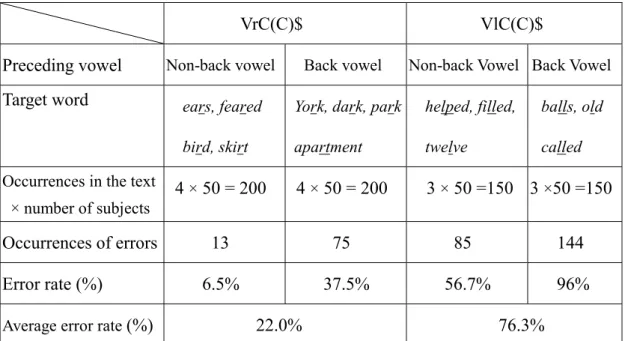
Table 4.11 Error rates of final /r/ clusters and final /l/ clusters (%) VrC(C)$ VlC(C)$
Preceding vowel Non-back vowel Back vowel Non-back Vowel Back Vowel Target word ears, feared
bird, skirt
York, dark, park apartment
helped, filled, twelve
balls, old called Occurrences in the text
× number of subjects
4 × 50 = 200 4 × 50 = 200 3 × 50 =150 3 ×50 =150
Occurrences of errors 13 75 85 144 Error rate (%) 6.5% 37.5% 56.7% 96%
Average error rate (%) 22.0% 76.3%
As shown in Table 4.11, the overall error rate for final /l/ clusters is 76.3%, three times as high as the 22% for final /r/ clusters. This shows that /l/ in final clusters is obviously much more difficult for the subjects than /r/ in the same phonetic environment. In fact, this higher error rate of dark /ɫ/ in the final clusters parallels that
of dark /ɫ/ in syllable final positions.
Moreover, the above data also reveals that backness of the preceding vowel has great effect on the erroneous production of final liquid clusters. Specifically, the error rate of final /l/ clusters following a back vowel is 96%, almost twice as high as that with a preceding non-back vowel 56.7%; while that of final /r/ clusters following a back vowel is 37.5%, more than five times higher than that with a preceding non-back vowel, 6.5%. Notably, backness of the preceding vowel is a deciding factor influencing liquid cluster performance.
The error types of final /r/ clusters are mainly deletion of /r/ as well as substitution of /ə/, and sometimes the substitute turns to /ɔ/. Table 4.10 displays the subjects’ different types of errors for /r/ in final clusters.
Table 4.12 Error types of final /r/ clusters Surrounding
vowel Non-back vowel Back vowel Target
word
Error type
Error number of ears, birds feared, skirt
Error number of York, dark, park
Apartment
Total Error number of the same error type
Total error
Rate
/-r/ =>
ø
0 62 62 70.5% (62/88) /-r/ => /ə/ 10 13 23 26.1% (23/88) /-r/ => /ɔ/ 3 0 3 3.4% (3/88) Total errornumber 13 75 88 100% (88/88)
Basically, the main error types in final /r/ clusters are the same as those of postvocalic /r/ in the syllable final position. The deletion of /r/ in a final cluster occurs more frequently when it follows a back vowel (i.e., York /jɔrk/ => /jɔk/, park /park/ =>
/pak/), and when it follows a non-back vowel, /ə/ substitution becomes the major error
type (i.e., ears /ɪrz/ => /ɪəz/, feared /fɪrd/ => /fɪəd/).
The error types of final /l/ clusters are mainly substitution of /ɔ/ for /ɫ/ as well as deletion of /ɫ/, and sometimes the substitution of /ə/ also occurs. The following table shows the error types of dark /ɫ/ in final clusters.
Table 4.13 Error types of final /l/ cluster Surrounding
vowel
Non-mid-back
vowel Mid-back vowel Target
word
Error type
Error number of helped, twelve filled
Error number of balls, old, called
Total Error number of the same error type
Total error
Rate
/ɫ/ =>
ø
8 143 151 65.9% (151/229) /ɫ/ => /ɔ/ 59 1 60 26.2% (60/229) /ɫ/ => /ə/ 18 0 18 7.9% (18/229) Total errornumber 85 144 229 100% (229/229)
The major error types of /ɫ/ in final clusters are almost identical to those of /ɫ/ in syllable final position. Here, the uniqueness of the preceding mid back vowels /ɔ/ and /o/ again reveals its influence on the error types for final clusters as those for syllable final /ɫ/. As illustrated in Table 4.13, deletion of /ɫ/ occurs when it follows a mid back vowel /ɔ/ or /o/, and when it follows a vowel other than /ɔ, o/, substitution of /ɔ/ appears more frequently than other error types. For example, the word old /old/ is usually pronounced as /od/ and called /kɔld/ as /kɔd/; however, helped /hɛlpt/ is often produced as /hɛɔpt/ and twelve /twɛlv/ as /twɛɔv/ by our subjects.
4.1.5 Type 5 -- clusters containing /rl/
There are only three target words in clusters containing /rl/, which occur twice each (world in wordlist and sentence, pearl in wordlist and sentence, as well as girl in
sentence and passage) amounting to six occurrences in all. The following table shows the subjects’ total error number and their error rate.
Table 4.14 Error rates of clusters containing /rl/ (%) $CVrl
Preceding vowel Central vowel Target word world × 2, girl × 2
pearl × 2 Occurrences in the text
number of subjects
6 × 50 = 300
Occurrences of errors 285 Error rate (%) 95%
As shown in Table 4.14, the number of errors for cluster containing /rl/ is 285, yielding the extreme high error rate of 95%. Obviously, clusters with the two liquids in a row pose a real problem to nearly all of the subjects.
What follows in Table 4.15 shows the subjects’ error types of /rl/ words.
Table 4.15 Error types of clusters containing /rl/
Target word
Error type
Error number of world × 2
Error number of
girl × 2
Error number of pearl × 2
Total error number of the same error type
Total error Rate
/rl/ => /rɔ/ 0 94 83 177 62.1% (177/285)
/rl/ => /r/ 96 0 4 100 35.1% (100/285) /rl/ => /rə/ 0 0 8 8 2.8 % (8/285) Total error
number of the individual target word
96
94
95 285 100 % (285/285)
The error type for /rl/ in girl as well as in pearl is mainly substitution of /ɔ/ for /ɫ/ (pearl /pɝl/ => /pɝɔ/, girl /gɝl/ => /gɝɔ/). Such a process of /ɔ/ substitution in /rl/
clusters following a central vowel /ə/18 is similar to that for dark /ɫ/ following a vowel other than /ɔ/ in syllable final positions and in final clusters (i.e., cool /kul/ =>
/kuɔ/, twelve /twɛlv/ => /twɛɔv/), as discussed in 4.1.2 and 4.1.4, and as shown in Table 4.5, 4.6, and 4.13. This suggests that the real cause for /rl/ difficulty here is actually the dark /ɫ/ pronunciation.
On the other hand, the error type of /rl/ cluster in world is only /ɫ/ deletion (world /wɝld/ => /wɝd/). The source of /ɫ/ deletion in an /rl/ cluster is different from that in syllable final /l/ and final /l/ clusters following a mid back vowel /ɔ/ (i.e., fall /fɔl/ => /fɔ/, called /kɔld/ => /kɔd/), because /rl/ in world follows a central vowel /ə/, not a mid back vowel /ɔ/. The deletion of /l/ in world probably results from the confusion between the sound /wɝd/ in the minimal pair world /wɝld/ & word /wɝld/, in which the only difference is the presence of a dark /ɫ/. Due to the back vowel
18 As discussed in 2.3.3, the phonetic symbol /ɝ/ is equivalent of /ər/ (Ladefoged, 1975: 72).
resonance of /ɫ/, a dark /ɫ/ is not easily perceived by many of our subjects, who are often confused with the two words and sometimes are even unable to distinguish one from the other. Thus, without noticing the difference between /wɝd/ and /wɝld/, they usually produce /wɝd/ for word and still /wɝd/ for world.
The extreme difficulty of /rl/ is very likely a result of the consecutive occurrence of these two problematic sounds occurring within one syllable. Dark /ɫ/ is already troublesome to Chinese students, and the preceding postvocalic /r/ is also difficult to pronounce, and thus the two consecutive liquids /rl/ may double the degree of difficulty in articulation. First, the tongue tip in the oral cavity must curl backward to form the sound of postvocalic /r/ and then immediately spread itself straight to the alveolar to form the resonance of dark /ɫ/. The complicated sequential movements of the tongue in the oral cavity are unfamiliar to most of the Chinese subjects, and thus words containing /rl/ as in world, pearl, and girl cause a lot of pronunciation trouble to them.
4.1.6 Discussion
So far we have presented the result of the subjects’ performance in the five phonetic environments of the English liquids and have made a careful comparison of /r/ and /l/ in each of the first four environments with consideration of the quality of the surrounding vowels. Erroneous productions of liquids are carefully examined, and possible sources of the different error types for /r/ and /l/ in different word positions are considered and proposed as well. In this section, attempts will be made to generalize the degrees of difficulty for /r/ and /l/ in the different phonetic environments. The error types will be classified as L1 interference or developmental factor. Also, vowel quality affecting liquid performance will be interpreted from phonetic similarity between /r, l/ pronunciation and back vowel resonance, with special attention paid to the uniqueness of the mid back vowel /o/ or /ɔ/.
The following table recapitulates the error rates in the five phonetic environments.
Table 4.16 Error rates of the five phonetic environments (%) Surrounding
vowel Type
Non-back vowel
Back vowel Average
1. $rV 13.3 73.0 47.4
$lV 2.0 1.5 1.8
2. Vr$ 36.0 72.4 54.2
Vl$ 84.0 87.0 85.8
3. $CrV 18.8 10.7 15.8
$ClV 91.6 76.0 85.8
4. VrC(C)$ 6.5 37.5 22.0
VlC(C )$ 56.7 96.0 76.3
5. $CVrl 95.0 95.0
As shown in the underlined figures of Table 4.16, the majority of the five phonetic environments of liquids have the error rates near or beyond 50 %, which means our Chinese subjects have great difficulty in pronouncing English /r/ and /l/. The predicted difficulty conforms to Eckman’s (1977) Markedness Differential Hypothesis:
language learners will face difficulty if the target language is different and more marked than the native language. As discussed in Chapter Two (2.1 – 2.4), English /r/
and /l/ are not only different from their Chinese equivalents (ㄖ,ㄌ) but are also more marked with respect to their order in L1 phonological acquisition and their multiple variants. The markedness of these sounds may naturally constitute great difficulty for Chinese students.
The above data also reveals relative degrees of difficulty of /r/ and /l/ in the five
phonetic environments for our subjects. Although /r/ and /l/ are both liquids, they have different degrees of difficulty even in the same word position. The error rate of syllable initial /r/ (47.4%) far exceeds that of initial /l/ (1.8%), syllable final /l/ (85.8%) is more difficult than final /r/ (54.2%), initial /l/ clusters (85.8%) pose much more problems than initial /r/ clusters (15.8%), and difficulty of final /l/ clusters (76.3%) is far beyond that of final /r/ clusters (22%). Generally speaking, both postvocalic /r/ and /l/ either alone or in final clusters pose more difficulty to the subjects than prevocalic /r/ and /l/. Besides, English /r/ occurring either in clusters or in syllable final positions, seems to be a less troublesome sound than /l/ in the same phonetic environment; on the contrary, it is far more difficult than /l/ when appearing alone syllable-initially.
The relative ease of initial /l/ seems to be due to positive transfer from the subjects’ mother tongue. As discussed in Chapter Two (cf. p17), syllable initial /l/ is almost identical to its Mandarin equivalent ㄌ, (i.e., lie /laɪ/ and 來 /laɪ/), and the similarity of the two sounds (/l/ and ㄌ) in the syllable initial position may facilitate the accuracy of /l/ pronunciation for Chinese students. Thus, initial /l/, with an extremely low error rate of 1.8%, is the least difficult sound in the present study, and no errors are found for /l/ in the following eight target words: living, lead, leaves, likes, fallen, look, alone, and balloon.
While positive transfer from L1 interference facilitates our subjects’ accurate pronunciation in syllable initial /l/, negative transfer due to the similarity of retroflection between ㄖ(/ʐ/) and /r/ also occurs. Although Mandarin /ʐ/ and English initial /r/ are observed to be sharing the common quality of the tongue curling (Ing, 1976; Dong, 1983), phonetically their manner of articulation is different: Mandarin /ʐ/ is a fricative (Dong, 1983; Chen, 1999) while English /r-/ is a liquid. Strictly speaking, prevocalic /r/ and ㄖ (/ʐ/) are not so much similar as syllable initial /l/ and ㄌ, and the confusion of Mandarin /ʐʊɛ/ and /ʐo/ with English /rɛ/ and /ro/ may arise. Thus
some of the subjects frequently mispronounce Mandarin /ʐʊɛd/ for English red /rɛd/
and /ʐod/ for road /rod/, and the substitution of /ʐ/ and /ʐʊ/ for initial /r/ is the major error types.
Negative transfer from L1 interference may also result from the absence of consonantal clusters and dark /ɫ/ in Mandarin, which may lead to the subjects’
addition of an epenthetic /ə/ and substitution of /ə/ for postvocalic /r/ and /ɫ/. The source of the subjects’ difficulty in articulating an initial /l/ cluster may probably be due to the absence of consonantal clusters in Mandarin. In other words, the subjects’
unfamiliarity with the syllable structure (#CCV) may largely be responsible for a large amount of the erroneous production for initial /l/ clusters (with a high error rate of 85.5%) in our study. This may be seen in the fact that the major error type here is /ə/ addition, substituting the unfamiliar #CCV with the familiar #CVCV pattern (i.e., black /blæk/ => /bə΄læk/, bride /braɪd/=> /bə΄raɪd/). Moreover, the substitution of /ə/ for postvocalic /r/ and /ɫ/ is probably a result of Taiwanese influence. As discussed in 4.1.2 (cf. p55), substitution of ㄜ for ㄦ is commonly observed in Taiwan Mandarin, and many Taiwanese students may substitute an English dark /ɫ/ or a postvocalic /r/
with a schwa /ə/ (i.e., Bill /bɪl/ => /bɪə/, year /jɪr/ => /jɪə/). Such mispronunciation parallels the /ə/ substitution for post-vocalic /r/ and /ɫ/.
Some of the subjects’ major error types due to L1 interference discussed in the previous sections are recapulated in what follows.
1. Substitution of /ʐ/ for initial /r/:
road /rod/ => /ʐod/ 肉 (ㄖㄡ) 的 2. Substitution of /ʐʊ/ for initial /r/:
red /rɛd/ => /ʐʊɛd/ 瑞 (ㄖㄨㄟ) 的 3. Substitution of /lʊ/ for initial /r/:
road /rod/ => /lʊɔd/ 落 (ㄌㄨㄛ) 的
4. Substitution of /l/ for initial /r/:
room /rum/ => /lun/ 論 (ㄌㄨㄣ) 5. Addition of /ə/ for /l/ in initial clusters
black /blæk/ => /bə΄læk/
6. Substitution of /ə/ for postvocalic /r/ and /ɫ/ Bill /bɪl/ => /bɪə/, year /jɪr/ => /jɪə/
The substitution of /ʐ/ and /ʐʊ/ for initial /r/ is probably due to Mandarin interference, while the substitution of /l/ and /lʊ/ for prevocalic /r/ may result from Taiwan Mandarin, in which retroflection is not existent and some Mandarin syllables containing ㄖ(/ʐ/) or ㄦ(/r/) are usually pronounced as ㄌ /l/ or ㄜ/ə/. For example, the syllable /ʐan/ in 然 /ʐan/ 後 is often mispronounced as /lan/ in 藍 /lan/ 後, and the numbers “一 二 (ㄦˋ) 三” are sometimes produced as “一 二 (ㄜˋ) 三”.
In addition to L1 interference, some error types discussed in 4.1.1- 4.1.5 can be classified as due to developmental factor because similar strategies are also seen to be employed by L1 children in acquiring their first language. Here, we rearrange them as the following.
1. Deletion of dark /ɫ/: ball /bɔl/ => /bɔ/ 2. Deletion of postvocalic /r/: for /fɔr/ => /fɔ/
3. Gliding of liquid: /r/ => /w/ (i.e., road /rod/ => /wɔd/) 4. Vocalization of dark /ɫ/: /ɫ/ => /ɔ/ (i.e., cool /kul/ => /kuɔ/)
5. Epenthesis of schwa /ə/: /bl/ => /bəl/ (i.e., blight /blaɪt/ => /bə΄laɪt/)
Deletion of postvocalic liquids usually occurs when following a back vowel, especially /ɔ/ or /o/. Gliding only appears for /r/ in road in the present study.
Vocalization is substitution of /ɔ/ for /ɫ/. Epenthesis of schwa /ə/ can be attributed to both L1 interference (as discussed previously in this section) and developmental factors. The first three error types in the above list are reported in more researches as
common strategies employed by young native children in L1 acquisition (Stoel-Gammon & Dunn, 1985 and Bernthal & Bankson, 1993 both cited in Chen, 1999; Parker & riley, 1994: 194, 195; O’Grady & Dobrovolsky, 1996: 438; Major, 1999; Hoffman et al., 1983), while the last two error types are reported in fewer researches (Stoel-Gammon & Dunn, 1985 and Bernthal & Bankson, 1993 both cited in Chen, 1999).
The result of the present study also shows that backness of the surrounding vowel is often a deciding factor influencing the subjects’ performance in liquids. The boldface figures in Table 4.16 indicate that among the first four phonetic environments, five out the eight pairs of the subjects’ error rates are greatly affected by the surrounding back vowels. Syllable initial /r/ preceding a back vowel has a much higher error rate (73%) than that preceding a non-back vowel (13.3%), that of syllable final /r/ following a back vowel (72.4%) is twice of that following a non-back vowel (36%). The error rate for syllable final /l/ following a back vowel (87%) is slightly higher than that following a non-back vowel (84%), while that of final /r/
clusters following a back vowel (37.5%) is six times of that following a non-back vowel (6.5%), and that of final /l/ clusters following a back vowel (96%) is nearly twice of that following a non-back vowel (56.7%).
The above data thus indicates that there exists an obvious correlation between the subjects’ erroneous production of English liquids and their surrounding vowels.
Similar observations have been made in related literature. Several researches (Riney, 1003; Hinton & Pollock, 2000; Chen, 2001) concerning the pronunciation of American English /r/, for example, reported that postvocalic /r/ is likely to be deleted when following a back vowel. Hinton & Pollock (2000: 62) found that in the postvocalic context, the type of vowel preceding /r/ is significant, because an English postvocalic /r/ is more likely to be retained by African Americans when it follows a
front vowel than a back vowel. Chen (2001) further observed that the surrounding back vowel interferes the accuracy of /r/ pronunciation in different word positions whereas the surrounding front vowel reduces the level of its difficulty.
The correlation between the subjects’ performance in liquids and backness of their surrounding vowels observed in the present study may be due to back vowel resonance of dark /ɫ/ and postvocalic /r/. As discussed in 2.3.2, Gimson’s (1975: 204) reported that when pronouncing a dark /ɫ/, the tongue tip contact is made on the teeth ridge, the front of the tongue is slightly depressed and the back raised in the direction of the soft palate, which thus creates back vowel resonance. Gimson’s (1975) observation may explain why a back vowel interferes the accuracy of dark /ɫ/, because a /ɫ/ already has back vowel resonance, which overlaps with another back vowel resonance from its preceding back vowel such as /ʊl/ or /ɔl/ in full or ball. The overlap may probably cause more confusion to our Chinese subjects than a /ɫ/ following a front vowel as in bell /bɛl/. Therefore, our subjects committed more errors when pronouncing dark /ɫ/ following a back vowel than that following a non-back vowel.
In addition to dark /ɫ/, postvocalic /r/ following a mid back vowel /o/ or /ɔ/ also shows very similar back vowel resonance. When articulating the target sound /ɔr/ as in for /fɔr/, the root of the tongue in the oral cavity is raised backward and the tip of the tongue is simultaneously curled backward, thus creating back vowel resonance.
The phonetic similarity of back vowel resonance produced both by the postvocalic /r/
and its preceding back vowel /ɔ/ probably leads to the strategy of the /r/ deletion used by our subjects (i.e., for /fɔr/ => /fɔ/, morning /΄mɔrnɪH/ => /΄mɔnɪH/).
Backness of a surrounding vowel is also significant in affecting prevocalic /r/
performance. According to Ladefoged (2001: 107) The tongue shapes for back vowels are very much different from those of the front vowels. The tongue is pulled forward
when articulating /i/ as in read /rid/, and backward when articulating /o/ or /u/ as in road /rod/ or room /rum/. When pronouncing a prevocalic /r/ preceding a back vowel, the tongue tip is raised and curled and almost at the same time the tongue root is raised backward. On the other hand, when pronouncing a prevocalic /r/ preceding a front vowel, the tongue tip is curled and at the same time the tongue root is raised forward. In other words, the movement of the tongue when articulating /ro/ or /ru/ has to go forward and then backward may be more complicated than the tongue movement when pronouncing /ri/, in which it goes only forward, thus contributing to greater difficulty to our subjects.
Among the surrounding back vowels /u, ʊ, o, ɔ, a/, the mid back vowels /o/ and /ɔ/ are found to be more significant in creating backness effect, as it is seen to uniquely influence the distribution of the subjects’ main error types for postvocalic /r/
and /l/ in the data. As discussed in 4.1.2, 4.1.4, and 4.1.5, the distribution of the subjects’ major error types for postvocalic /r/ and /l/ depends on the presence of the preceding back vowel /ɔ/. For example, when a /ɫ/ follows a mid back vowel /ɔ/ or /o/, either alone or in clusters, it is usually deleted (i.e., fall /fɔl/ => /fɔ/, old /old/ => /od/), while when it follows vowels other than /ɔ/ or /o/, the substitution of /ɔ/ appears more often (i.e., twelve /twɛlv/ => /twɛɔv/, girl /gɝl/=> /gɝɔ/). Furthermore, when a postvocalic /r/ follows a mid back vowel /ɔ/, the deletion of /r/ is usually the only error type (i.e., York /jɔrk/ => /jɔk/), whereas when it follows a vowel other than /ɔ/, more than one error type occurs, including /r/ deletion and the substitution of /ɔ/ or /ə/ for /r/ (i.e., poor /pʊr/ => /pʊɔ/ or /pʊə/, park /park/ => /pak/ or /paək/).
In conclusion, the result of our study conforms to Eckman’s (1977) Markedness Differential Hypothesis, and proves that mispronunciation of English liquids is largely due to both L1 interference and developmental factors. The difficulty of /r/ and /l/
either in clusters or syllable final positions may probably result from the absence of
consonantal clusters and dark /ɫ/ in Mandarin. Besides, since the back vowel resonance found in postvocalic /r/ and /ɫ/ is extremely similar to that of a surrounding back vowel, backness of the surrounding vowel shows significant influence on mispronunciation of the postvocalic liquids. More specifically, /o, ɔ/ preceding the postvocalic /r/ or /ɫ/ is a deciding factor affecting the distribution of the subjects’
major error types.
4.2 /r/ and /l/ in wordlist, sentence, and passage
The design of the research in this thesis also arranges three different scopes of tasks, namely wordlist, sentence, and passage, each of them including five phonetic environments as shown in Appendix C. The inclusion of the three scopes of task is based on our observation in the pre-experiment that students commit more errors with liquids when facing a larger scope of task. The purpose is to find out whether the size of the task has influence on the subjects’ performance in /r/ and /l/ in different word positions. What follows is a detailed discussion of the error rates of the five phonetic environments in wordlist, sentence, and passage.
4.2.1 Type 1- - syllable initial /r/ and /l/
Table 4.17 Error rates of Type 1 in the wordlist, sentence, and passage (%) $rV $lV
Size of the
task Non-back
vowel
Back vowel Non-back vowel
Back vowel
Wordlist read 0 (0/50)19 road 84 (42/50) lead 0 (0/50) load 6 (3/50) Sentence red
40 (20/50)
room
60 (30/50)
only 6 (3/50)
balloon look 0 (0/100) Passage Mary
0 (0/50)
roller 60 (30/50) road
88 (44/50) 74(74/100)
living leaves
0 (0/100)
alone
0 (0/50)
19 The number before the slash stands for the occurrences of the errors, and the one after that is the total occurrences of /r/ or /l/ in the specific task.

![TraditionalMLCalgorithmsmainlytacklethebatchMLCproblem,wheretheinputdataarepresentedinabatch[24,28].Nevertheless,inmanyMLCapplicationssuchase-mailcategorization[22],multi-labelexamplesarriveasastream.Onlineanalysisistherefore dimensionreducermotivatedbyma](data:image/gif;base64,R0lGODlhAQABAIAAAP///wAAACH5BAEAAAAALAAAAAABAAEAAAICRAEAOw==)