IINNTTRROODDUUCCTTIIOONN
Cytosolic sulfation is an important pathway for the biotransformation of drugs, xenobiotics, and endogenous compounds [1]. This phase II reaction is catalyzed by sulfotransferases (SULTs) which enzymatically transfer a sulfate moiety from a donor substrate, 3'-phosphoadenosine-5'-
phosphosulfate (PAPS), to an acceptor substrate containing an amino or hydroxyl group [2]. The consequence of the modification of these substrates with a charged sulfate group either makes the substrates more readily excretable or less toxically active [3]. Consequently, sulfation directly participates in chemical defense and xenobiotic metabolism. However, a large number of promutagens have been shown to be the substrates of SULTs and are activated by SULTs in humans [4-6]. These enzymes also chemically induce diseases, such as cancers and
O
Obbjjeeccttiivveess.. SULT1A1, the major form of cytosolic sulfotransferase enzymes (SULTs), activates or metabolizes many chemicals and carcinogens. The effect of the SULT1A1 genotype on the development of cancers is still not clear. The purpose of this study was to analyze the relationship between SULT1A1 polymorphisms and cancer risk.
M
Meetthhooddss.. We determined SULT1A1 polymorphisms by PCR-RFLP and then analyzed the frequencies of the SULT1A1*1 and SULT1A1*2 alleles from several cancerous cohorts.
R
Reessuullttss.. After analyzing 76 hepatoma patients, 180 breast cancer patients, 61 lung cancer patients, 52 oral cancer patients and 74 gastric cancer patients, the frequencies of SULT1A1*1 were 96.1%, 94.2%, 95.1%, 96.1%, and 97.3%, respectively, whereas the frequencies of SULT1A1*2 were 3.9%, 5.8%, 4.9%, 3.9%, and 2.7%, respectively. No SULT1A1*3 alleles were found in these patients.
C
Coonncclluussiioonnss.. In comparison with the frequencies of SULT1A1*1 and SULT1A1*2 in healthy controls (96.0% and 4.0% for SULT1A1*1 and SULT1A1*2, respectively), the allelic frequencies of SULT1A1 polymorphisms in the cancer patients were not statistically significant. However, it appears to influence the age of onset among early-onset breast cancer patients (p = 0.012, OR = 3.35, 95% CI = 1.25 – 8.98). ( Mid Taiwan J Med 2003;8:59-65)
K
Keeyy wwoorrddss
breast cancer, polymorphism, SULT1A1
Received : January 9, 2003. Revised : March 11, 2003.
Accepted : March 14, 2003.
Address reprint requests to : Jan-Gowth Chang, Department of Molecular Medicine, China Medical College Hospital, 2 Yuh-Der Road, Taichung 404, Taiwan.
Sulfotransferase 1A1 is a Risk Factor for Breast Cancer in Young Women
Shou-Tung Chen
1,2,*, Jui-Chang Chen
1,*, Ming-Fong Hou
3, Kun-Tu Yeh
1,4, Tai-Ping Lee
1, Chih-Mei Chen
1, Mu-Chin Shih
1, Jan-Gowth Chang
11Department of Molecular Medicine, China Medical College Hospital, Taichung;
2Department of Surgery, Changhua Christian Hospital, Changhua;
3Department of Surgery, Kaohsing Medical University, Kaohsiung;
4Department of Pathology, Changhua Christian Hospital, Changhua, Taiwan.
*These authors contributed equally to this study.
cardiovascular diseases, as well as induce drug reactions which represent a great fraction of mortality and morbidity. Therefore, the functions of the SULT family play both good roles and bad roles in humans. The activities of SULTs presumably influence the causes of diseases.
However, little information is known as to what extent the enzymes influence the development of cancers.
Three phenol SULTs (SULT1A1, SULT1A2, and SULT1A3) are expressed in human tissues [2,5]. Individual differences in the expression and activity of drug-metabolizing enzymes is a well established cause of adverse drug reactions and other toxic effects associated with exposure to both xenobiotic and endogenous chemicals. These differences may arise from a variety of genetic and/or environmental events [7,8]. Little information about the polymorphic expression of SULT enzymes is known compared to other drug-metabolizing enzymes, such as CYP450. In human liver, SULT1A1 is the major form of phenol SULT, and its molecular basis has been identified [9,10]. A single transition in the SULT1A1 gene results in an Arg to His at codon 213 which alters the expression and activity of the enzyme, presumably through reduced protein stability. Platelet enzyme activity correlates strongly with protein expression, and individuals who are homozygous for the SULT1A1*2 genotype have significantly reduced platelet sulfotransferase activity. In this study, we showed the correlation of the SULT1A1 polymorphisms with the risk of developing cancers.
M
MAATTEERRIIAALLSS AANNDD MMEETTHHOODDSS DNA Preparation
Blood samples were collected from 200 healthy controls from the general population, 196 elderly normal controls, 180 breast intraductal carcinoma patients, 76 hepatoma patients, 52 oral squamous carcinoma patients, 74 gastric adenocarcinoma patients, and 61 lung squamous carcinoma patients. They all resided in central Taiwan. The age distributions of the patients with cancer are shown in Table 1. Total genomic DNA was isolated from peripheral leukocytes as
previously described [11].
PCR-RFLP Assays
The differences between SULT1A1*1, SULT1A1*2 and SULT1A1*3 are shown at nucleotides 638 and 667. G638 and A667 represent SULT1A1*1, A638 and A667 represent SULT1A1*2, and G638 and G667 represent SULT1A1*3. We used 5'-GGTTGAGGAGTT GGCTCTGC-3' and 5'-ATGAACTCCTGG GGGACGGT-3' as the upstream and downstream primers for the genotyping. A fragment of 281 bp was synthesized after the primers were used in the PCR reaction. PCR amplification was performed in a 50 µL reaction volume containing 200 ng of genomic DNA as templates, 1X Taq buffer, 0.2 mM dNTP, 0.2 µM of each primer, and 0.4 U Taq polymerase (Protech, Taipei, Taiwan). PCR reaction was started by incubating the samples at 94 C for 5 min. The amplification was carried out in 35 cycles of 3 stages: denaturing at 94 C for 1 min, annealing at 60 C for 1 min, and elongation at 72 C for 2 min. To determine SULT1A1*2 and SULT1A1*3, the PCR products were subjected to Hha I or Nla III enzyme digestion before electrophoresis on a 3.5% agarose gel.
Sequencing Analysis of PCR-Amplified Fragments
The PCR-amplified products were purified using a PCR purification kit (QIAquick; Qiagen Inc., Valencia, CA, USA). To verify the accuracy of the PCR-RFLP assay, PCR products were subjected to direct sequencing by an ABI PRISM 310 Genetic Analyzer (Applied Biosystems, San Francisco, USA). Primers used for sequencing were the same as those used for PCR as described above.
Statistical Analysis
The differences in distribution of SULT1A1 genotypes between tumor patients and healthy controls were determined by Chi-Square test.
Probability values < 0.05 were regarded as statistically significant. After adjusting for age and gender, odds ratios (ORs) with 95%
confidence intervals (CI) were calculated by
unconditional logistic regression to estimate the
association between certain genotypes and
diseases. All of the statistical analyses were performed with Statistical Analysis System software (SAS Institute, Cary, NC, USA).
R
REESSUULLTTSS
SULT1A1*1 is the Major Allele in Taiwanese
In order to determine the SULT1A1 polymorphisms, we used the PCR-RFLP method to detect the transition of G to A at nucleotide 638 in the 213
thcodon in the SULT1A1 coding region.
This G to A transition causes a change from Arg in SULT1A1*1 or SULT1A1*3 to His at codon 213 in SULT1A1*2. Consequently, the Hha I recognition site will be abolished if a chromosome contains the SULT1A1*2 allele (Fig.
A). To distinguish SULT1A1*1 from SULT1A1*3, the transition of A (SULT1A1*1) to G (SULT1A1*3) at nucleotide 667 in the 223
thcodon was determined by Nla III enzyme digestion (Fig.
B). A total of 76, 180, 61, 52 and 74 hepatoma,
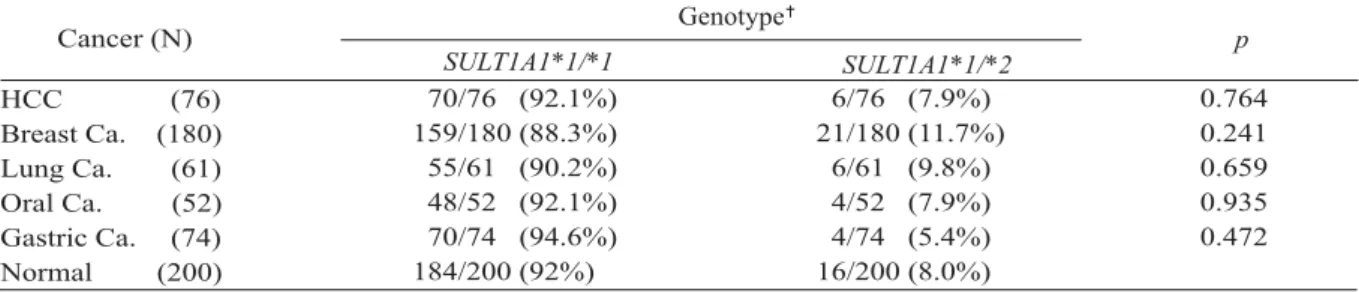
breast, lung, oral and gastric cancer patients were genotyped, respectively, as well as 200 healthy subjects (Table 2). Among the 643 individuals, there were no homozygous SULT1A1*2 cases detected in these samples.
SULT1A1 Genotype and Age
After analysis of the data from the patients and the healthy controls, the average age of individuals with the SULT1A1*1/*1 or SULT1A1*1/*2 appeared to be different (Table 1).
The age distributions in the cancerous groups were further analyzed, and the results showed that the young patients with breast cancer (< 39 years old) had higher allelic frequencies of SULT1A1*2, which was statistically significant (p = 0.012, OR = 3.35, 95% CI = 1.25 – 8.98) (Table 3). However no difference was observed between breast cancer patients and normal controls in the older-age group (p = 0.320) (Table 4). Since only a few cases of SULT1A1*2 were
Figure. PCR-RFLP analysis of SULT1A1 polymorphisms. A: The PCR products containing codon 213 Arg (CGC) were digested into two fragments (lanes 2, 3, 6 and 7 for homozygotes, lane 4 for heterozygote), and only one fragment of 281 bp was observed for the one with codon 213 His (CAC) (lane 5) after Hha I digestion; B: The PCR products of codon 223 Met (ATG) released two fragments of 205 bp and 76 bp (lanes 2-7 for homozygotes), and the uncut fragment 281 bp was observed for the one with codon 223 Val (GTG) after Nla III digestion. In summary, lanes 2, 3, 6 and 7 are homozygous SULT1A1*1, lane 4 is heterozygous SULT1A1*2, and lane 5 is a selected case of homozygous SULT1A1*2. M: marker; Lane 1: uncut.
SULT1A1*1/*1
58 (29 51 (15 61 (24 56 (36 64 (36
81) (70) 84) (159) 78) (55) 75) (48) 83) (70)
55 (39 48 (23 67 (60 55 (36 61 (47
64) (6) 76) (21) 72) (6) 82) (4) 70) (4) SULT1A1*1/*2 Table 1. The average age of cancer patients
Genotype
HCC (76)
Breast Ca. (180) Lung Ca. (61) Oral Ca. (52) Gastric Ca. (74)
Cancer (N)
Average age (range) (n)
found in hepatoma, lung, oral and gastric cancer patients, we neither stratified the age group nor analyzed the effect for these cohorts.
D
DIISSCCUUSSSSIIOONN
SULT1A1 is a drug-metabolizing enzyme which catalyzes the sulfation conjugation in phase II metabolism [12]. The frequency of this genotype varies widely among different ethnic groups. The major polymorphism of SUL1A1 in Taiwanese is SULT1A1*1, which completely dominates the other SULT1A1 polymorphisms, SULT1A1*2 and SULT1A1*3. Chinese women selected from Shanghai, PRC, showed a completely dominant SULT1A1*1 allele (91.6%) with very few SULT1A1*3 [10], which was not observed in the Taiwanese population in this study. From the data that have been reported,
Taiwanese have the highest frequency of the SULT1A1*1 allele (approximately 96.0%).
Although SULT1A1*1 is also the major form of SULT1A1 in Caucasians (65.6%) and African Americans (47.7%), SULT1A1*2 and SULT1A1*3 are also significantly present in these populations [10].
Products of the SULT1A1*1 show much higher activity and greater thermostability than those of the other alleles, indicating that it may increase the excretion of xenobiotics as well as activation of procarcinogens [4,9]. We compared the frequencies of five cancerous groups with those of healthy individuals. In comparison with the normal subjects, we observed that the frequencies of SULT1A1*1 and SULT1A1*2 were not significantly different in these patients, indicating that the risk of hepatoma, lung cancer,
Mean33 45 55 63 75 51
No. of cases 31 58 40 35 16 180 200
SULT1A1*1/*2 77.4%
89.3%
92.5%
88.6%
93.8%
88.3%
92%
(24) (52) (37) (31) (15) (159) (184)
22.6%
10.7%
7.5%
11.4%
6.3%
11.7%
8%
(7) (6) (3) (4) (1) (21) (16) SULT1A1*1/*1
Table 3. Age-related variation in SULT1A1 allelic frequencies in Taiwanese breast cancer patients Age range
15 40 50 60 70 15 Control
39 49 59 69 84 84
p = 0.012, OR = 3.35, 95% CI = 1.25 – 8.98; no difference between different age groups.
Age range 70
> 85 70
80
84
Chromosomes 308
84 32
SULT1A1*1/*2 92.2%
97.6%
96.9%
(284) (82) (31)
7.8%
2.4%
3.1%
(24) (2) (1) SULT1A1*1/*1
Table 4. Comparison of SULT1A1 allelic frequencies of the old age group between breast cancer patients and normal controls
Old age-normal
Breast cancer p = 0.320.
SULT1A1*1/*1 70/76 (92.1%) 159/180 (88.3%) 55/61 (90.2%) 48/52 (92.1%) 70/74 (94.6%) 184/200 (92%)
6/76 (7.9%) 21/180 (11.7%)
6/61 (9.8%) 4/52 (7.9%) 4/74 (5.4%) 16/200 (8.0%)
0.764 0.241 0.659 0.935 0.472 SULT1A1*1/*2
p Table 2. The genotypic frequencies of SULT1A1 polymorphisms in different cancers in Taiwanese
Genotype
HCC (76)
Breast Ca. (180) Lung Ca. (61) Oral Ca. (52) Gastric Ca. (74) Normal (200)
Cancer (N)
no case of SULT1A1*3 was found in this study.
breast cancer, oral cancer, and gastric cancer does not correlate with the SULT1A1 genotype.
However, in terms of lung cancer, our results differed from Wang et al [13]. They found that the genetic polymorphism of SULT1A1 may be associated with increased lung cancer risk in Caucasians. Our results were consistent with those reported by Seth et al [14], but different from the data presented by Zheng et al [15]. Seth et al demonstrated that the SULT1A1 genotype does not effect the risk of breast cancer; however, they revealed that the SULT1A1*1 allele behaves as a dominant allele in early onset breast cancer patients; Zheng et al suggested that homozygosity for the SULT1A1 His 213 allele may be a risk factor for breast cancer. These discrepencies in observation may be due to ethnic and lifestyle differences. Environmental factors and food consumption habits may also be important reasons for the differences. In addition, among the normal population, Coughtrie et al also observed a statistically significant increase in the frequency of the SULT1A1*1 allele with increasing age, compared with the SULT1A1*2 allele [16]. After analyzing the average age of the cancer patients with the SULT1A1*1/*1 and those with the SULT1A1*1/*2 genotypes, we found the same trend among breast cancer patients: the average age of the SULT1A1*1/*1 patients was about 4 years older than that of SULT1A1*1/*2 patients;
however, it was not statistically significant.
Bamber et al suggested that the SULT1A1*1 genotype reduced the risk of colorectal cancer in subjects under 80 years old [17]. The data provided by Nowell et al, Wang et al, and our study were not in concordance with their results, suggesting that the environment-gene interaction may play an important role in cancer risk [18,19].
Numerous drug-metabolizing genes have been shown to influence the development of different cancers. Consequently, the risk of cancer may not be dependent on a single gene. In addition, diet also influences the risk of cancer.
For example, soya products, tea, and many fruits are known to protect against a variety of human cancers [20]. It has been shown that phenolic dietary compounds such as flavonoids and
isoflavonoids competitively inhibit the activation of procarcinogens by SULTs [20]. On the contrary, well-done steak containes PAH, a carcinogen, so individuals with the active allelle SULT1A1*1 who eat well-done meat have a greater risk of developing cancer than those without the allele [15]. In humans, high expression of the SULT1A1 enzyme was regarded as efficient metabolism and excretion of xenobiotics, and high risk of the bioactivation of toxins including procarcinogens. It is still not clear whether SULTs do more good than harm, and determining the answer is difficult because genotoxins may vary depending on environment and diet. In this study, we also showed that the SULT1A1 genotype is not associated with the risk of hepatoma, breast, lung, oral, and gastric cancer in Taiwan. However, we did not demonstrate the correlation between the SULT1A1*1 allele with the age of onset for these cancers due to the small sample size. Therefore further study is warranted.
A
ACCKKNNOOWWLLEEDDGGMMEENNTTSS
We thank Miss W. L. Chan for editing the manuscript. This study was supported in part by a grant from the National Science Council, Taiwan, ROC (NSC 90-2320-B-039-013 for Chang JG) and a grant from the China Medical College Hospital (DMR-91-120).
R
REEFFEERREENNCCEESS
1. Falany CN. Sulfation and sulfotransferases.
Introduction: changing view of sulfation and the cytosolic sulfotransferases. [Review] FASEB J 1997;
11:1-2.
2. Weinshilboum RM, Otterness DM, Akosoy IA, et al.
Sulfation and sulfotransferases 1: Sulfotransferase molecular biology: cDNAs and genes. FASEB J 1997;11:3-14.
3. Jakoby WB, Ziegler DM. The enzymes of detoxication.
[Review] J Biol Chem 1990;265:20715-8.
4. Glatt H. Sulfotransferases in the bioactivation of xenobiotics. [Review] Chem Biol Interact 2000;
129:141-70.
5. Glatt H, Boeing H, Engelke CE, et al. Human cytosolic sulphotransferases: genetics, characteristics, toxicological aspects. [Review] Mutat Res 2001;
482:27-40.
6. Williams JA. Single nucleotide polymorphisms, metabolic activation and environmental carcinogenesis: why molecular epidemiologists should think about enzyme expression. [Review]
Carcinogenesis 2001;22:209-14.
7. Schoket B, Papp G, Levay K, et al. Impact of metabolic genotypes on levels of biomarkers of genotoxic exposure. Mutat Res 2001;482:57-69.
8. Coughtrie MW, Johnston LE. Interactions between dietary chemicals and human sulfotransferases- molecular mechanisms and clinical significance. Drug Metab Dispos 2001;29:522-8.
9. Raftogianis RB, Wood TC, Weinshilboum RM.
H uman phenol sulfotransferases SULT1A2 and SULT1A1: genetic polymorphisms, allozyme properties, and human liver genotype-phenotype correlation. Biochem Pharmacol 1999;58:605-16.
10. Carlini EJ, Raftogianis RB, Wood TC, et al. Sulfation pharmacogenetics: SULT1A1 and SULT1A2 allele frequencies in Caucasian, Chinese and African- American subjects. Pharmacogenetics 2001;11:57-68.
11. Chang JG, Chen PH, Chiou SS, et al. Rapid diagnosis of beta-thalassemia mutations in Chinese by naturally and amplified created restriction sites. Blood 1992;80:2092-6.
12.William EE, Relling MV. Pharmacogenetics:
translating functional genomics into rational therapeutics. [Review] Science 1999;286:487-91.
13. Wang Y, Spitz MR, Tsou AM, et al. Sulfotransferase (SULT) 1A1 polymorphism as a predisposition factor
for lung cancer: a case-control analysis. Lung Cancer 2002;35:137-42.
14. Seth P, Lunetta KL, Bell DW, et al. Phenol sulfotransferases: hormonal regulation, polymorphism, and age of onset of breast cancer. Cancer Res 2000;60:6859-63.
15. Zheng W, Xie D, Cerhan JR, et al. Sulfotransferase 1A1 polymorphism, endogenous estrogen exposure, well-done meat intake, and breast cancer risk. Cancer Epidemiol Biomarkers Prev 2001;10:89-94.
16. Coughtrie MW, Gilissen RA, Shek B, et al. Phenol sulfotransferase SULT1A1 polymorphism: molecular diagnosis and allele frequencies in Caucasian and African populations. Biochem J 1999;337:45-9.
17. Bamber BE, Fryer AA, Stranger RC, et al. Phenol sulfotransferase SULT1A1*1 genotype is associated with reduced risk of colorectal cancer.
Pharmacogenetics 2001;11:679-85.
18. Nowell S, Coles B, Sinha R, et al. Analysis of total meat intake and exposure to individual heterocyclic amines in a case-control study of colorectal cancer:
contribution of metabolic variation to risk. Mutat Res 2002;506-507:175-85.
19. Wong CF, Liyou N, Leggett B, et al. Association of the SULT1A1 R213H polymorphism with colorectal cancer. Clin Exp Pharmacol Physiol 2002;29:754-8.
20. Pai TG, Suiko M, Sakakibara Y, et al. Sulfation of flavonoids and other phenolic dietary compounds by the human cytosolic sulfotransferases. Biochem Biophys Res Commun 2001;285:1175-9.
Sulfotransferase 1A1
1,2,* 1,* 3 1,4 1 1 1 1
1 2
3 4
*
SULT1A1 SULT1A1
PCR-RFLP SULT1A1
76 180 61 52 74
SULT1A1*1 96.1% 94.2% 95.1% 96.1% 97.3%
SULT1A1*2 3.9% 5.8% 4.9% 3.9% 2.7%
SULT1A1*3
SULT1A1 (SULT1A1*1 96.0% SULT1A1*2
4.0%) SULT1A1 (p =
0.012 OR = 3.35 CI = 1.25 8.98) 2003;8:59-65
SULT1A1
404 2
2003 1 9 2003 3 11
2003 3 14