• 沒有找到結果。

Electrodeposition of Cu-Zn alloy from a Lewis acidic ZnCl2-EMIC molten salt

N/A
N/A
Protected

Academic year: 2022

Share "Electrodeposition of Cu-Zn alloy from a Lewis acidic ZnCl2-EMIC molten salt"

Copied!
6
0
0

加載中.... (立即查看全文)

全文

(1)

Zinc and its alloys are good materials for corrosion-resistant coatings. The electrodeposition of zinc or its alloys is normally per- formed in aqueous electrolyte solutions. 1,2 However, electrodeposi- tions carried out in aqueous electrolyte solutions can often be com- plicated by problems involving hydrogen embrittlement and low cur- rent efficiency. As a result, aprotic solvents such as molten salts wherein the codeposition of hydrogen is precluded may be good alternatives to aqueous plating baths for the electrodeposition of zinc and zinc alloys. However, it is difficult to use conventional inorgan- ic molten salts because these melts can be employed only at high temperatures with special apparatus.

Mixtures of certain quaternary ammonium chloride salts, such as 1-ethyl-3-methylimidazolium chloride (EMIC), and metal chlorides generally form ionic liquids that exhibit melting points much lower than the conventional inorganic metal chloride molten salts. 3-5 The most well known example is the aluminum chloride-1-ethyl-3-methyl- imidazolium chloride ionic liquid system, which is liquid at ambient temperature. 3 Chloroaluminate molten salts have proven to be useful solvents for applications such as batteries, chemical synthesis, and electrodeposition. 3 Many examples of electrodeposition of pure met- als 6-10 and aluminum alloys 11-16 from chloroaluminate melts can be found in the literature. Nevertheless, the deposition of aluminum-free alloys from chloroaluminates has not been reported. This may result from the fact that aluminum can be electrodeposited on metals such as copper, cobalt, nickel, etc. through underpotential deposition, 11-16 and thus, the electrodeposition of alloys such as Cu-Zn and Co-Zn would be contaminated with Al if chloroaluminates are used as electrolyte.

The combination of equal moles (50.0-50.0 mol %) of zinc chlo- ride and EMIC produces a low-temperature molten salt that is liquid at 40 8C. 17 This melt can be considered as a Lewis acidic melt be- cause there are not enough chloride ions in this melt to fully coordi- nate with zinc and thus, the coordinately unsaturated Zn(II) species like ZnCl 3 2 , Zn 2 Cl 2 7 , and (ZnCl 2 ) n , 18-20 are chloride acceptors. It is found that the cathodic electrochemical window of this melt is deter- mined by the reduction of zinc(II) to zinc metal. This fact makes it possible to electrochemically deposit zinc metal and its alloys from this melt.

Cu-Zn alloys are widely used for decorative purposes 21 as well as for promoting rubber adhesion to steel. 22 Because the commercial procedure that uses cyanide baths for electroplating Cu-Zn alloys would cause environmental problems, many efforts have concentrat- ed on the development of procedures that use various noncyanide

baths. 23,24 However, no report about this topic in molten salts has appeared. In this article, the electrodeposition of copper metal and copper-zinc alloys from the 50.0-50.0 mol % ZnCl 2 -EMIC melt con- taining Cu(I) is investigated. The effects of the Cu(I) concentration, deposition potential, and temperature on the electrodeposition are described.

Experimental

Apparatus.—All electrochemical experiments were conducted inside a Vacuum Atmospheres glove box filled with dry nitrogen. The moisture and oxygen level in the box was kept lower than 1 ppm. The electrochemical experiments were accomplished with an EG&G model 273A potentiostat/galvanostat controlled with EG&G model 270 software. A three-electrode electrochemical cell was used for the electrochemical experiments. The tungsten working electrode was fabricated by sealing a piece of tungsten rod (Stream, geometric area 0.079 cm 2 ) into a Pyrex tube followed by cutting off the tip of the tube to expose the tungsten surface. The electrode was polished succes- sively with increasingly finer grades of emery paper followed by sili- con carbide grit, and finally to a mirror finish with an aqueous slurry of 0.05 mm alumina, rinsed with distilled water, and dried under vac- uum. The nickel working electrode (geometric area 0.071 cm 2 ) was purchased from Bioanalytical Systems, Inc. Bulk electrodeposits were prepared on nickel foils (0.5 3 0.5 cm, Aldrich 99.99%). For voltammetry, the counter electrode was a zinc spiral (Aldrich, 99.99%) immersed in pure 50.0-50.0 mol % ZnCl 2 -EMIC melt con- tained in a fritted glass tube. For electrodeposition experiments, the counter electrode was a narrow copper foil directly immersed in the bulk solution. The reference electrode was a Zn wire placed in a separate fritted glass tube containing pure 50.0-50.0 mol % ZnCl 2 - EMIC melt. A Hitachi S-4200 field effect scanning electron micro- scope (SEM) with energy-dispersive spectroscopy (EDS) working at 15 kV was used to examine the surface topography and the elemental compositions of the electrodeposits. A Shimadzu XD-D1 X-ray dif- fractometer was used to study the crystalline phases of the Cu-Zn alloy electrodeposits.

Chemicals.—The EMIC was prepared and purified according to the method described in the literature. 3 The 50.0-50.0 mol % ZnCl 2 - EMIC melt was prepared in the glove box by mixing equal moles of ZnCl 2 (99.99%, Aldrich) and EMIC in a beaker followed by heating at 90 8C for 2 days. The resulting melt was a colorless liquid at a tem- perature near 40 8C. Anhydrous CuCl (99.995%) and anhydrous pro- pylene carbonate (98%) that was used for washing the electrode- posits were purchased from Aldrich and used as received. A standard Cu-Zn foil (70:30 wt %) was received from Alfa/Aesar).

Electrodeposition of Cu-Zn Alloy from a Lewis Acidic ZnCl 2 -EMIC Molten Salt

Po-Yu Chen, Mei-Chen Lin,* and I-Wen Sun** ,z

Department of Chemistry, National Cheng Kung University, Tainan, Taiwan 70101

The electrodeposition of copper and copper-zinc alloys was investigated on tungsten and nickel electrodes in a Lewis acidic 50.0- 50.0 mol % zinc chloride-1-ethyl-3-methylimidazolium chloride molten salt containing copper(I). The composition of the elec- trodeposited Cu-Zn alloys can be varied by deposition potential, temperature, and Cu(I) concentration of the plating bath. Analy- sis of the chronoamperometric transient behavior during electrodeposition suggests that pure copper electrodeposition proceeds via three-dimensional instantaneous nucleation with diffusion-controlled growth. However, as the deposition potential crosses from Cu metal into the alloy-forming range, the nucleation process changes to three-dimensional progressive nucleation with diffusion-con- trolled growth. Analysis of the X-ray diffraction patterns indicates that the electrodeposited Cu-Zn alloys exhibit a and b phases.

The surface morphologies and the compositions of the electrodeposited Cu-Zn alloys were studied with scanning electron microscopy (SEM) and energy-dispersive spectroscopy (EDS).

© 2000 The Electrochemical Society. S0013-4651(00)01-119-8. All rights reserved.

Manuscript submitted Januaray 28, 2000; revised manuscript received May 23, 2000. This was in part Paper 2290 presented at the Honolulu, Hawaii, Meeting of the Society, October 17-22, 1999.

** Electrochemical Society Student Member.

** Electrochemical Society Active Member.

*

z

E-mail: [email protected]

(2)

Results and Discussion

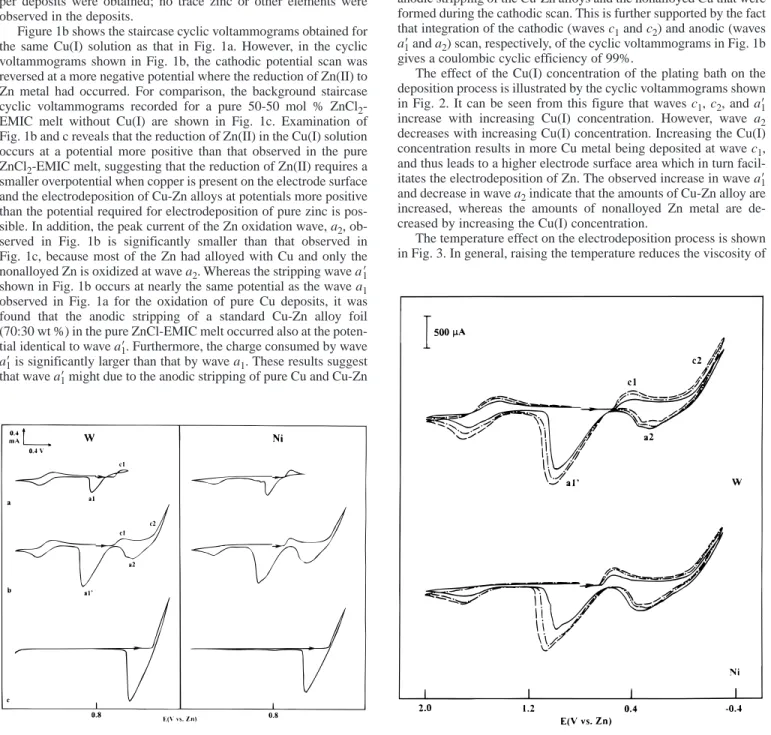
Voltammetric results.—Copper(I) can be introduced into the 50.0-50.0 mol % ZnCl 2 -EMIC melt by the controlled potential coulometric anodization of a copper wire electrode at a potential of 1.3 V. Calculations based on the charge passed and the weight loss of the electrode resulting from anodization confirmed that copper(I) is the oxidation product. Alternatively, Cu(I) solutions are prepared by direct addition of anhydrous CuCl which dissolves easily into the melt. Staircase cyclic voltammograms of 200 mM Cu(I) in the 50- 50 mol % ZnCl 2 -EMIC melt were recorded at tungsten and nickel electrodes in a potential range between 2.0 and 0.3 V. Some typical voltammograms are shown in Fig. 1a. This figure shows that Cu(I) can be reduced to Cu metal (wave c 1 near 0.6 to 0.5 V) and that the resulting Cu deposits can be reoxidized (wave a 1 near 0.65 V). Re- sults from X-ray diffraction (XRD) and EDS analysis of the Cu de- posits that were obtained by constant potential electrolysis at poten- tials right after the Cu(I) reduction peak indicated that very pure cop- per deposits were obtained; no trace zinc or other elements were observed in the deposits.

Figure 1b shows the staircase cyclic voltammograms obtained for the same Cu(I) solution as that in Fig. 1a. However, in the cyclic voltammograms shown in Fig. 1b, the cathodic potential scan was reversed at a more negative potential where the reduction of Zn(II) to Zn metal had occurred. For comparison, the background staircase cyclic voltammograms recorded for a pure 50-50 mol % ZnCl 2 - EMIC melt without Cu(I) are shown in Fig. 1c. Examination of Fig. 1b and c reveals that the reduction of Zn(II) in the Cu(I) solution occurs at a potential more positive than that observed in the pure ZnCl 2 -EMIC melt, suggesting that the reduction of Zn(II) requires a smaller overpotential when copper is present on the electrode surface and the electrodeposition of Cu-Zn alloys at potentials more positive than the potential required for electrodeposition of pure zinc is pos- sible. In addition, the peak current of the Zn oxidation wave, a 2 , ob- served in Fig. 1b is significantly smaller than that observed in Fig. 1c, because most of the Zn had alloyed with Cu and only the nonalloyed Zn is oxidized at wave a 2 . Whereas the stripping wave a 9 1

shown in Fig. 1b occurs at nearly the same potential as the wave a 1 observed in Fig. 1a for the oxidation of pure Cu deposits, it was found that the anodic stripping of a standard Cu-Zn alloy foil (70:30 wt %) in the pure ZnCl-EMIC melt occurred also at the poten- tial identical to wave a 9 1 . Furthermore, the charge consumed by wave a 9 1 is significantly larger than that by wave a 1 . These results suggest that wave a 9 1 might due to the anodic stripping of pure Cu and Cu-Zn

alloy. However, because the reduction of Cu continues after the potential is swept past the peak current of wave c 1 into the Zn elec- trodeposition region (wave c 2 in Fig. 1b), the “extra” charge con- sumed by this Cu deposition process must be included in any com- parison between the charges for wave a 9 1 and a 1 before the difference in these charges can be ascribed to alloy formation. For this purpose, the Cu reduction current in the Zn electrodeposition region was esti- mated by assuming that the current past the peak potential of wave c 1 follows Cottrell behavior. The “extra” charge was then obtained by integrating this estimated current. The total of this “extra” charge and the charge under wave c 1 gave the total charge consumed by the Cu deposition during the cathodic scan, and this total charge would be the maximum charge that should be obtained for the anodic stripping of the Cu deposits. Analysis of several typical cyclic voltammograms showed that the charge consumed by wave a 1 9 is indeed more than the total charge expected for the stripping of the Cu deposits. Taken together, the results suggest that wave a 1 9 in Fig. 1b is due to the anodic stripping of the Cu-Zn alloys and the nonalloyed Cu that were formed during the cathodic scan. This is further supported by the fact that integration of the cathodic (waves c 1 and c 2 ) and anodic (waves a 9 1 and a 2 ) scan, respectively, of the cyclic voltammograms in Fig. 1b gives a coulombic cyclic efficiency of 99%.

The effect of the Cu(I) concentration of the plating bath on the deposition process is illustrated by the cyclic voltammograms shown in Fig. 2. It can be seen from this figure that waves c 1 , c 2 , and a 9 1

increase with increasing Cu(I) concentration. However, wave a 2 decreases with increasing Cu(I) concentration. Increasing the Cu(I) concentration results in more Cu metal being deposited at wave c 1 , and thus leads to a higher electrode surface area which in turn facil- itates the electrodeposition of Zn. The observed increase in wave a 9 1

and decrease in wave a 2 indicate that the amounts of Cu-Zn alloy are increased, whereas the amounts of nonalloyed Zn metal are de- creased by increasing the Cu(I) concentration.

The temperature effect on the electrodeposition process is shown in Fig. 3. In general, raising the temperature reduces the viscosity of

Figure 1. Staircase cyclic voltammograms for the 50.0-50.0 mol % ZnCl

2

- EMIC melt on tungsten and nickel electrodes at 80 8C, (a) and (b) with 200 mM Cu(I), (c) without Cu(I). Scan rate 50 mV/s.

Figure 2. Staircase cyclic voltammograms for the 50.0-50.0 mol % ZnCl

2

-

EMIC melt containing (—) 200, (— ?) 250, and (– –) 300 mM Cu(I) on tung-

sten and nickel electrodes at 808C. Scan rate 50 mV/s.

(3)

the melt and thus, increases the mass transport of Cu(I) and Zn(II).

Consequently, the voltammetric currents are increased by increasing the temperature.

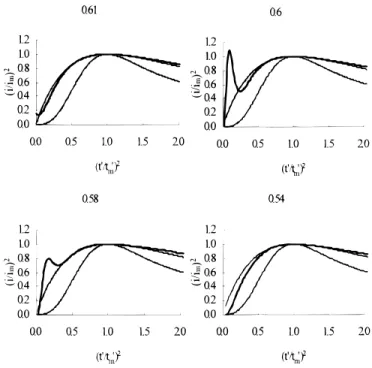
Nucleation studies of Cu metal and Cu-Zn alloy electrodeposi- tion.—Chronoamperometry experiments were carried out in order to investigate the Cu metal and Cu-Zn alloy nucleation/growth process in more detail. These experiments were performed at a nickel disk working electrode in a 50.0-50.0 mol % ZnCl 2 -EMIC melt contain- ing 200 mM Cu(I). For each experiment, the working electrode potential was stepped from an initial value where no reduction of Cu or Zn would take place to potentials sufficiently negative to initiate the nucleation/growth process after a short induction time, t o . The ex- perimental chronoamperometric current-time transients exhibit the classic shape for a nucleation process, i.e., after the decay of a sharp electrode double-layer charging current, the current increases due to the nucleation and growth of the nuclei. This rising current eventual- ly reaches a current maximum, i m , as the discrete diffusion zones of each of the growing crystallites begin to overlap at time t m . The experimental current-time transients were fit to the well-known three- dimensional (3D) nucleation/growth, as described in the litera- ture. 25,26 In these models, the nucleation process is fundamentally classified as “instantaneous” or “progressive.” To determine the nucleation behavior, the experimental data is first normalized to i/i m

and t/t m . Then, the normalized experimental data are plotted as (i/i m ) 2 vs. t/t m and the resulting plots are compared to the theoretical (i/i m ) 2 vs. t/t m curves derived for instantaneous and progressive nucleation.

Before normalization and plotting of the experimental data, the ex- perimental time was corrected for the induction time, t o , by redefin- ing the time axis as t 9 5 t 2 t o and t 9 m 5 t m 2 t o . Figure 4 shows the representative experimental (i/i m ) 2 vs. t 9/t9 m plots for Cu metal elec- trodeposition overlaid with the theoretical curves. Clearly, the depo- sition of Cu metal on the nickel electrode fits well to the model for 3D-instantaneous nucleation with diffusion-controlled growth.

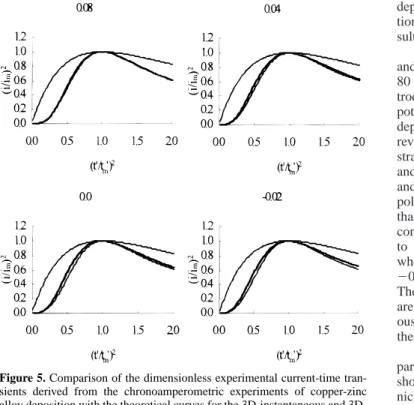
Nucleation of Cu-Zn alloy electrodeposition was also studied with chronoamperometry experiments in which the working elec- trode potential was stepped to a value where the codeposition of Cu- Zn would take place. A series of plots of (i/i m ) 2 vs. t 9/t9 m that were constructed from these chronoamperometric data are displayed in Fig. 5. This figure shows that as the deposition potential crosses from Cu metal into the alloy-forming range, the nucleation process shifts from a 3D-instantaneous to a 3D-progressive model. A previ- ous study 17 showed that similar to the electrodeposition of Cu metal, the electrodeposition of Zn metal in the 50.0-50.0 mol % ZnCl 2 - EMIC melt proceeds via 3D-instantaneous nucleation/growth. Thus, the results shown in Fig. 5 indicate that the nucleation process for the electrodeposition of Cu-Zn alloy is very different from that for the electrodeposition of pure Zn or Cu. Because the progressive nucle- ation model refers to the case in which the nucleation rate is rela- tively slower with respect to the instantaneous nucleation model, the difference between Fig. 4 and 5 may indicate that in the alloy-form- ing potential range, the Cu(I) and Zn(II) ions compete for the nucle- ation site and result in a reduced nucleation rate.

Preparation and characterization of Cu-Zn electrodeposits.—

Cu-Zn alloy electrodeposits were prepared at 50, 80, and 100 8C, re- spectively, on thin nickel foils (0.5 3 0.5 cm) at potentials ranging from 0.11 to 20.01 V from 50.0-50.0 mol % ZnCl 2 -EMIC melt solu- tions containing 200, 250, and 300 mM Cu(I), respectively. For all the deposition experiments, the same charge density was used to ensure that the nominal thickness of these deposits would be rela- tively constant. Following each deposition experiment, the nickel foil electrode was rinsed with dry propylene carbonate, ethanol, and deionized water in succession to remove residual melt. The compo- sitions of these deposits were analyzed by EDS. The composition results of these deposits expressed as a function of deposition poten- tial and temperature are displayed in Fig. 6. At each temperature, the atomic ratios of Cu in the Cu-Zn deposits decrease as the deposition potential becomes more negative. This is not surprising because at these potentials the reduction of Cu is mass-transport limited and further increase of the deposition overpotential would only increase the amount of Zn being deposited. Figure 6 also shows that the Cu atomic ratios in the deposits increase as the temperature increases.

Figure 3. Staircase cyclic voltammograms for the 50.0-50.0 mol % ZnCl

2

- EMIC melt containing 300 mM Cu(I) on tungsten and nickel electrodes at (—) 50, (— ?) 80, and (– –) 1008C. Scan rate 50 mV/s.

Figure 4. Comparison of the dimensionless experimental current-time tran-

sients derived from the chronoamperometric experiments of copper deposi-

tion with the theoretical curves for the 3D-instantaneous and 3D-progressive

nucleation. Values for the applied potential (V) are given above each plot.

(4)

Because at the potentials where these deposits are made, the reduc- tion of Cu is mass-transport controlled whereas the reduction of Zn is still charge-transfer controlled, an increase in the temperature would enhance the deposition rate of Cu by increasing the mass- transport rate of Cu(I). Figure 7 illustrates the effect of the Cu(I) concentration of the plating bath on the compositions of the Cu-Zn

deposits. Clearly, plating baths containing higher Cu(I) concentra- tion results in deposits with higher Cu atomic ratios. These EDS re- sults are consistent with the cyclic voltammetric results.

The color of the electrodeposits changes from reddish to yellow and grayish brown as the Cu content in the deposits decreases from 80 to 70 and 60 %, respectively. The surface morphology of elec- trodeposits prepared on nickel foils at four different deposition potentials from a 250 mM Cu(I) solution is shown in Fig. 8. Pure Cu deposits prepared at 0.6 V have a polygonal appearance (Fig. 8a), revealing their crystallographic nature, but adhere poorly to the sub- strate. When the deposition potential is made more negative to 0.11 and 0.03 V, and the Cu content in the deposits is lowered to ca. 80 and 70%, respectively, the deposits (Fig. 8b and c) still retain their polygonal shape, but the grain size of the Cu-Zn deposits is smaller than the pure Cu deposits because the nuclear density is higher. In contrast to pure Cu deposits, the Cu-Zn deposits adhere fairly well to the substrates. The surface morphology changes dramatically when the deposition potential is made even more negative to 20.01 V at which the Cu content in the deposits is lowered to 50%.

The deposits obtained at this potential become irregular in shape and are covered by small needles. Similar needle deposits have previ- ously been observed for the pure Zn electrodeposits obtained from the 50.0-50.0 mol % ZnCl 2 -EMIC melt. 17

The XRD patterns from Cu-Zn electrodeposits that were pre- pared on nickel substrate at four different deposition potentials are shown in Fig. 9. Also shown in Fig. 9 are the XRD patterns from the nickel substrate, pure copper electrodeposit, and pure zinc electro- deposit. It is known that electrodeposited copper-rich Cu-Zn alloys exhibit two phases: the a and b phases. 27 The a phase is a solid solu- tion that has an equilibrium solubility limit of about 35% Zn in Cu with a face-centered cubic (fcc) structure. The b phase is an inter- mediate phase that has a composition corresponding to Cu-Zn with a body-centered cubic (bcc) structure. Figure 9 shows that XRD pat- terns from the Cu-Zn electrodeposits are different from those of pure Zn and Cu, indicating crystalline alloys are indeed formed in these Cu-Zn electrodeposits. Furthermore, the b phase diffraction lines in- crease in intensity as the deposition potential becomes more nega- Figure 5. Comparison of the dimensionless experimental current-time tran-

sients derived from the chronoamperometric experiments of copper-zinc alloy deposition with the theoretical curves for the 3D-instantaneous and 3D- progressive nucleation. Values for the applied potential (V) are given above each plot.

Figure 6. EDS analysis of Cu-Zn alloys electrodeposited on nickel foils in 50.0-50.0 mol % ZnCl

2

-EMIC melt containing 200, 250, and 300 mM Cu(I), respec-

tively. (r) 50, (j) 80, and (m) 1008C.

(5)

tive; in other words, the b phase increases as the Cu content in the electrodeposited Cu-Zn alloy decreases.

Conclusion

The electroreduction of copper(I) in the Lewis acidic 50.0- 50.0 mol % zinc chloride-1-ethyl-3-methylimidazolium chloride melt at tungsten and nickel electrodes leads to pure copper or copper- zinc depending on the deposition potential. The copper content in the Cu-Zn alloys increases as the Cu(I) concentration in the plating bath and/or the deposition temperature increases and decreases as the deposition overpotential increases. Chronoamperometric behavior indicates that the electrodeposition of pure copper proceeds via 3-D instantaneous nucleation and diffusion-limited growth, whereas the electrodeposition of copper-zinc alloys proceeds via 3-D progressive nucleation and growth. Analysis of XRD patterns reveals that the copper-zinc alloy exhibits two phases, a and b phases, with b phase

predominating in copper-zinc alloys obtained at more negative depo- sition potentials.

Acknowledgment

This research was supported by the National Science Council of the Republic of China, Taiwan, under grant no. NSC89-2113- M006-016.

The National Cheng Kung University assisted in meeting the publication costs of this article.

References

1. D. Pletcher, Industrial Electrochemistry, p. 187, Chapman and Hall, London (1984).

2. R. W. Mackey, in Modern Electroplating, F. A. Lowenheim, Editor, p. 418, John Wiley & Sons, Inc., New York (1974).

3. (a) J. S. Wilkes, J. A. Levisky, R. A. Wilson, and C. L. Hussey, Inorg. Chem., 21, 1263 (1982); (b) C. L. Hussey, in Chemistry of Nonaqueous Solvents: Current Progress, G. Mamantov and A. I. Popov, Editors, p. 227, VCH, New York (1994).

4. S. P. Wicelinski, R. J. Gale, and J. S. Wilkes, J. Electrochem. Soc., 134, 262 (1987).

5. M. K. Carpenter and M. W. Verbrugge, J. Mater. Res., 9, 2584 (1994).

6. J. Robinson and R. A. Osteryoung, J. Electrochem. Soc., 127, 122 (1980).

7. X.-H. Xu and C. L. Hussey, J. Electrochem. Soc., 140, 618 (1993).

8. X.-H. Xu and C. L. Hussey, J. Electrochem. Soc., 140, 1226 (1993).

9. W. R. Pitner and C. L. Hussey, J. Electrochem. Soc., 144, 3095 (1997).

10. E. G.-S. Jeng and I-W. Sun, J. Electrochem. Soc., 145, 1196 (1998).

Figure 7. EDS analysis of Cu-Zn alloys electrodeposited on nickel foils in 50.0-50.0 ZnCl

2

-EMIC melt containing ( r) 200, (j) 250, and (m) 300 mM Cu(I).

Figure 8. SEM micrographs of copper and Cu-Zn alloy deposited from 50.0- 50.0 mol % ZnCl

2

-EMIC melt containing 200 mM Cu(I) at 80 8C. The elec- trodeposition potentials are (a) 0.6, (b) 0.11, (c) 0.03, and (d) 20.01 V.

Figure 9. XRD patterns (Cu Ka) of Ni substrate and electrodeposits from

200 mM Cu(I) in 50.0-50.0 mol % ZnCl

2

-EMIC melt at 80 8C. The elec-

trodeposition potentials are shown in the plot.

(6)

11. T. P. Moffat, J. Electrochem. Soc., 141, L115 (1994).

12. W. R. Pitner, C. L. Hussey, and G. R. Stafford, J. Electrochem. Soc., 143, 130 (1996).

13. J. A. Mitchell, W. R. Pitner, C. L. Hussey, and G. R. Stafford, J. Electrochem. Soc., 143, 3448 (1996).

14. R. T. Carlin, P. C. Trulove, and H. C. De Long, J. Electrochem. Soc., 143, 2747 (1996).

15. B. J. Tierney, W. R. Pitner, J. A. Mitchell, C. L. Hussey, and G. R. Stafford, J. Elec- trochem. Soc., 145, 3110 (1998).

16. R. T. Carlin, H. C. De Long, J. Fuller, and P. C. Trulove, J. Electrochem. Soc., 145, 1598 (1998).

17. Y.-F. Lin and I-W. Sun, Electrochim. Acta, 44, 2771 (1999).

18. R. B. Ellis, J. Electrochem. Soc., 113, 485 (1966).

19. W. Smith, J. Brynestad, and G. P. Smith, J. Chem. Phys., 52, 3890 (1970).

20. H. Hayashi, K. Uno, Z.-I. Takehara, and A. Katagiri, J. Electrochem. Soc., 140, 386 (1993).

21. F. A. Lowenheim, Electroplating, p. 378, McGraw-Hill, New York (1978).

22. W. J. van Ooij, Rubber Chem. Technol., 57, 421 (1984).

23. A. Brenner, Electrodeposition of Alloys, p. 457, Vol. 1, Academic Press, New York (1963).

24. Y. Fujiwara and H. Enomoto, Plating Surf. Finish., 80, 52 (1993).

25. B. Scharitfker and G. Hills, Electrochim. Acta, 28, 879 (1983).

26. B. R. Scharifker, in Electrochemistry in Transition, O. J. Murphy, S. Srinivasan, and B. E. Conway, Editors, p. 499, Plenum Press, New York (1992).

27. M. Hansen and K. Anderko, Constitution of Binary Alloys, p. 649, McGraw-Hill,

New York (1958).

數據

Figure 1b shows the staircase cyclic voltammograms obtained for the same Cu(I) solution as that in Fig
Figure 3. Staircase cyclic voltammograms for the 50.0-50.0 mol % ZnCl 2 - -EMIC melt containing 300 mM Cu(I) on tungsten and nickel electrodes at (—) 50, (— ?) 80, and (– –) 1008C
Figure 6. EDS analysis of Cu-Zn alloys electrodeposited on nickel foils in 50.0-50.0 mol % ZnCl 2 -EMIC melt containing 200, 250, and 300 mM Cu(I), respec- respec-tively
Figure 7. EDS analysis of Cu-Zn alloys electrodeposited on nickel foils in 50.0-50.0 ZnCl 2 -EMIC melt containing ( r) 200, (j) 250, and (m) 300 mM Cu(I).

參考文獻

相關文件

More precisely, it is the problem of partitioning a positive integer m into n positive integers such that any of the numbers is less than the sum of the remaining n − 1

6 《中論·觀因緣品》,《佛藏要籍選刊》第 9 冊,上海古籍出版社 1994 年版,第 1

Teachers may consider the school’s aims and conditions or even the language environment to select the most appropriate approach according to students’ need and ability; or develop

(a) Giving your answers in standard form, estimate (i)the total mass of the population of Europe.. (ii)how many more people live in Asia than

For 5 to be the precise limit of f(x) as x approaches 3, we must not only be able to bring the difference between f(x) and 5 below each of these three numbers; we must be able

In stating Green’s Theorem we use the convention that the positive orientation of a simple closed curve C refers to a single counterclockwise traversal of C...

[This function is named after the electrical engineer Oliver Heaviside (1850–1925) and can be used to describe an electric current that is switched on at time t = 0.] Its graph

• Density is varying in the medium and the volume scattering properties at a point is the product of scattering properties at a point is the product of the density at that point