i
國立臺灣大學企業管理碩士專班 碩士論文
Global MBA College of Management
National Taiwan University Master Thesis
企業微博能否取代電子郵件?
Can Enterprise Microblogging Replace Email?
A Comparative Analysis of Email and Microblogging Based on Web 2.0
戴柏毅 Boaz Daniel
指導教授:盧信銘,教授 Advisor: Hsin-Min Lu, Professor.
中華民國 100 年 7 月 July, 2011
ii
iii I. Abstract
Over the past few years, microblogging has become an integral part of business
communication, following the increased popularity and reliance on social networks in daily life.
Previous research on microblogging platforms has mainly focused on the blog itself or bloggers, but there is little research on the role of microblogging in streamlining business processes and improving productivity. The objective of this research is to attain a more thorough understanding of the benefits of intra-office microblogging as compared to other modern methods of
communication, especially email, by analyzing the differences in user interface, knowledge and task management, and facilitating dialogue.
This paper presents the findings of a qualitative study between microblogging and email, paying close attention the behaviors and needs of platform users. The author intends to
demonstrate the ways in which microblogging is superior to email in terms of productivity, and can even improve upon intra-office communication. The theoretical framework will be based on the concept of Enterprise 2.0, or the use of emergent social software platforms within companies.
This paper will compare microblogging and email as intra-office communication with the three principles of Web 2.0 technology in Enterprise 2.0: simple and flexible platforms of self- expression, customizable platform structure, and easy message management. The findings will assist executives, managers and employees understand how workers are likely to use
microblogging in an enterprise.
iv II. Table of Contents
I. Abstract ... iii
II. Table of Contents ... iv
III. Table Of Figures ... vi
Chapter 1 Introduction ... 7
1.1 Background ... 7
1.2 Research Question ... 9
1.3 Research Motivation ... 10
1.4 Literature Review ... 11
1.5 Methodology and Organization ... 14
Chapter 2 Theory and Framework ... 15
2.1 Enterprise 2.0 ... 15
2.2 Web 2.0 Technology ... 16
2.3 Enterprise 2.0 Technology Principles ... 17
2.4 Framework Structure ... 18
Chapter 3 Overview of Microblogging and Email ... 21
3.1 Microblogging Background ... 21
3.1.1 Blogging ... 21
3.1.2 Microblogging ... 23
3.1.3 Microblogging In Business Communication ... 28
3.2 Email Overview ... 31
3.2.1 Email Overload ... 31
3.2.2 Email Management ... 34
3.3 Conclusions... 39
Chapter 4 Supplementing Email with Microblogging as Primary Intra-Office Communication... 41
v
4.1 Simple and Free Platforms of Self-expression ... 42
4.1.1 Self-expression and Influence Inside the Company ... 42
4.1.2 Informal and Easier Method of Communication ... 42
4.1.3 “One-to-Many” and “Many-to-Many” Communication ... 44
4.1.4 Collaboration over Distance and Increased Task Awareness ... 45
4.2 Customizable Platforms Structure Rather Than Imposed ... 45
4.2.1 Customizable Features ... 46
4.2.2 Creating Tools to Monitor and Control ... 47
4.3 Ability to Quickly Sort and Prioritize Information ... 47
4.3.1 Using Microblogging Platforms to Control Information Flow... 48
4.3.2 Keeping Threads in Context ... 48
4.3.3 Concise Messages ... 50
4.4 Conclusions... 51
Chapter 5 Conclusion and Discussion ... 53
5.1 Discussion ... 53
5.2 Managerial Implications ... 55
5.3 Limitations and Suggestions for Future Research ... 55
5.3.1 The Business Model of Microblogging Service Providers ... 56
5.3.2 Implementation of the Microblogging Platform in the Office ... 57
5.3.3 Microblogging Platforms for External Business Use ... 57
Bibliography ... 58
Appendix I List of Microblogging Platforms Service Providers... 62
vi III. Table Of Figures
Figure 1 Top 10 Sectors of U.S Internet time ... 7
Figure 2 Theoretical Framework ... 19
Figure 3 Growth in Number of Blog Users (2003-2006) ... 22
Figure 4 The growth of Twitter ... 24
Figure 5 Development of tweeting behavior ... 25
Figure 6 Adoption of Yammer in a corporation ... 30
Figure 7 The Amount of Time Wasted on Interruptions ... 35
Figure 8 Sorting and Filtering ... 39
Figure 9 Proposed benefits of informal communication... 43
Figure 10 Employees Perceived Values from Yammer ... 44
Figure 11 User Interface Designed to Keep Conversation in Context ... 50
7
Chapter 1 Introduction
1.1 Background
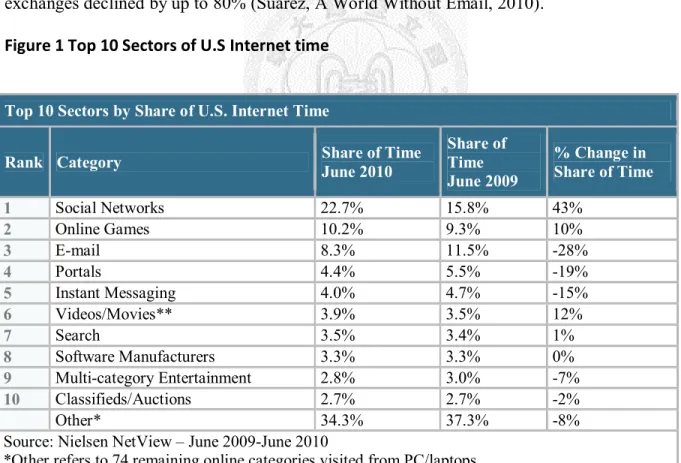
In recent years, the use of microblogging has become integral to daily electronic communication, while conversely email usage has begun to decline. One explanation for this phenomenon is a growing number of people are shifting from email and other traditional forms of digital message exchange to more effective and comprehensive communication software, such as social network services, including weblogs and microblogging platforms. According to
statistics, the average American reduced email usage by 28% in 2010 (Nielsen, 2010).
Enterprises have also reported that after the introduction of microblogging platforms, email exchanges declined by up to 80% (Suarez, A World Without Email, 2010).
Figure 1 Top 10 Sectors of U.S Internet time
Top 10 Sectors by Share of U.S. Internet Time
Rank Category Share of Time
June 2010
Share of Time June 2009
% Change in Share of Time
1 Social Networks 22.7% 15.8% 43%
2 Online Games 10.2% 9.3% 10%
3 E-mail 8.3% 11.5% -28%
4 Portals 4.4% 5.5% -19%
5 Instant Messaging 4.0% 4.7% -15%
6 Videos/Movies** 3.9% 3.5% 12%
7 Search 3.5% 3.4% 1%
8 Software Manufacturers 3.3% 3.3% 0%
9 Multi-category Entertainment 2.8% 3.0% -7%
10 Classifieds/Auctions 2.7% 2.7% -2%
Other* 34.3% 37.3% -8%
Source: Nielsen NetView – June 2009-June 2010
*Other refers to 74 remaining online categories visited from PC/laptops
**NetView’s Videos/Movies category refers to time spent on video-specific (e.g., YouTube, Bing Videos, Hulu) and movie-related websites (e.g., IMDB, MSN Movies and Netflix) only. It is not a measure of video streaming or inclusive of video streaming on non-video-specific or movie-specific websites (e.g., streamed video on sports or news sites).
8
Microblogging is essentially a passive broadcast method associated with blogging, with posts consisting of a short text, link or graphic. Microblogs differ from more conventional weblogs, in that the content is more condensed. Microblog service providers can adjust privacy controls to decide which readers have access to content as well as design posting methods differing from the web-based user interface.
The widespread political and social ramifications of new social media platforms were apparent during the recent uprisings in Northern Africa and the Middle East. The Jasmine Revolution culminated in a wave of widespread demonstrations and civil resistance throughout countries like Tunisia, Egypt, Syria, Yemen and Iran. Also known as the Twitter or Facebook Revolutions (mejias, 2011), these protests employed conventional methods of civil resistance, such as demonstrations, rallies and marches. However, the innovative use of social media platforms, such as Twitter, YouTube, and Facebook, to freely express opinions, receive news in real time and organize protest activities was essential to overthrowing several dictatorships.
Many enterprises have already foreseen the potential of microblogging, particularly in regard to improving collaborative work within organizations, and have successfully integrated them into their intra-office communication systems. Concurrently, software designers are catering to the growing demand for microblogging services by specially designing platforms for business use (see Appendix I for list of enterprise microblogging platforms). However, despite the recognized potential of microblogging, there is still currently little systematic research on the subject, furthermore, a comprehensive list of the advantages to using microblogging in the workplace has yet to be compiled and analyzed.
The predominant trend in communication technology has been to streamline response time and widen one’s sphere of connections and influence. Over the past two decades, workplace
9
communication styles have shifted noticeably from face-to-face conversations to online communication, in the form of email, instant messaging and other Internet-based tools.
Regardless, some have argued that email is a time-consuming and ineffective form of intra-office communication. For instance, lengthy ‘email chains’ can arise from the correspondence between two or more individuals that become involved in prolonged communication about basic topics, such as arranging a meeting. The ‘one-to-many’ and ‘many-to-many’ broadcasting feature of microblogs permits users to avoid lengthy discussions and communicate more directly.
This paper will analyze the role of email and microblogging in the office, in order to ascertain the most productive and effective mode of intra-office communication. Andrew McAfee’s Enterprise 2.0 concept states that the role of Web 2.0 technology, or advanced interactive Internet technology and applications such as microblogging, wikis and blogs, within an enterprise is to simplify or facilitate business processes (McAfee, 2006). Since older
technologies are continuously compared to newer ones to evaluate their continued relevancy, this paper will evaluate the roles of email and microblogging in office communication according to the objectives of Web 2.0 technology, namely streamline business processes, and determine whether email is still the most effective method of business communication.
1.2 Research Question
The main question posited by my research is how can companies increase their productivity by shifting intra-office communication traffic from email to micro blogging?
Moreover, the author will ask what are the key flaws of email usage and how will these problems be resolved once email systems are replaced with microblogging platforms. And what are the other added values of replacing email with microblogging features in office communication?
10
The discussion of these questions will help give companies some perspective on the benefits of microblogging and how to effectively integrate it into preexisting company communication structures, so as to enhance productively. In this case, productivity will be measured by how technology can enable us to do what we already do more efficiently.
1.3 Research Motivation
The main motivation behind this research is to provide managers with more information when choosing an adequate IT system for inter-office communication. My research will offer an in-depth comparison of intra-office communication tools and platforms through an in-depth comparison of the advantages of microblogging and the shortcomings of email to help managers tailor-make an enterprise communication system specifically for their company’s needs.
Moreover, this paper may be able to lay the foundation for further studies involving companies and platform providers in devising implementation plans for microblogging, which will need to include pricing strategies, user interface designs and training programs to assist employees adjust to new communication platforms.
Corporations also need to better understand the growth opportunities that stem from the use of internal blogging, since many are still unsure that the benefits of microblogging tools will outweigh the costs. A common question is should management invest the employee time and IT infrastructural costs that are necessary to support blogging? And is it possible to measure the value of the social interactions that occur? Another challenge is to understand how these platforms should be used. More crucially, are the current advantages of microblogging translatable to a corporate setting?
11
My research findings may be more beneficial to SMEs rather than larger enterprises, since one of the main challenges currently facing smaller companies is how to effectively increase the productivity of virtual teams working on the same project with relatively low budgets. SMEs tend to rely on simpler IT systems rather than IT departments or specialists, therefore the micro blogging platforms could serve as an inexpensive and easy solution to the communication needs of smaller companies.
The paper may also prove useful to managers operating in an increasingly international business environment, where enterprises often employ multinational work teams. Research conducted by Cross et al. revealed that IT products designed to facilitate global cooperation, such as email, can sometimes be counterproductive for these tasks (Rob Cross, 2010). This paper will examine whether microblogging is more effective in improving the transfer and exchange of information between a company's international locations.
1.4 Literature Review
Given that microblogging is a fairly new technology and its influence on modern business processes may not be fully understood for several years, it is understandable that presently there is a lack of wide-ranging and detailed research on the subject on the topic. The current research on microblogging can be mainly divided into three types of research, namely, studies analyzing the flaws in using email as a communication tool, case studies examining the use of microblogging platforms in a specific company, and research on blogging and
microblogging as a collaborative tool.
12
Several researchers have pointed out the serious flaws in relying on only email for intra- office communication. Some industry experts, like Luis Suarez, even claim that emails can reduce productivity, and new forms of communication, like instant messaging, blogs, and wikis, can be a more effective method to transfer information and facilitate dialogue. New forms of social media can nearly eliminate the need for emailing, with the possible sole exception of sending personal or confidential content (Suarez, A World Without Email, 2010; Mayfield, 2008;
Gode, 2010). Another industry insider, Ross Mayfield even refers to this medium as “email hell,”
emphasizing that email usage results in a broken business model, and calls for technology and behavioral modification to cope with it (Mayfield, 2008). Meanwhile, New York Times writer, Matthew D. Richtel explains how larger technology firms like Microsoft, IBM and Google are banding together to devise innovative ways to tackle problems related to email usage (Richtell, 2008).
Steve Whittaker and Candace Sidner performed a more quantitative and analytical study that explored the reasons for email overload, concluding that email systems today has been diverted from their original purpose, therefore causing counterproductive overload (Steve Whittaker, 1996). Ethan Yarbrough elaborated on this point by arguing that email systems no longer will serve as a fundamental tool for communication, but rather act as signals when there have been updates to a discussion in a corporate media forum, such as SharePoint (Yarbrough, 2010).
There are also case studies that investigate how companies are incorporating microblogs to streamline intra-office communication channels. A case study by Jun et al conducted a quantitative analysis on the early adoption and use of Yammer1 in a fortune 500 company (Jun Zhang, A case study of micro-blogging in the enterprise: use, value, and related issues, 2010).
1 Yammer is a service provider of micro blogging for the enterprise (see appendix I)
13
The study utilized several independent data sources that included five months of empirical microblogging data, user demographic information from corporate HR records, a web-based surveys, and interviews. The results revealed that users vary in their posting activities, reading behaviors, and perceived benefits. One of the first studies conducted in this field was by Zhao and Rosson (Dejin Zhao, 2009), in which they interviewed 11 Twitter users in a large IT company. They investigated the potential impact of employing microblogging at work, and provided valuable insight into why and how people microblog and how to support microblogging in an organizational context.
Lastly, a growing number of academics are researching the role that microblogging plays as a communicative tool. Martin Ebner & Herman claimed that online discussions via
microblogging can result in deeper and more thought provoking discussions, due to the more user-friendly format of microblogging platforms that are conducive to fast-paced and all- encompassing conversations (Martin Ebner, 2008). Moreover, a number of researchers lament the lack of more adequate collaborative communication methods that support global work processes. This will become a more imperative problem for companies operating in an increasingly multi-national setting (Henri pirkkalainen, 2009; Rob Cross, 2010).
This paper will delve into this topic from a different point of view, and will conduct a direct comparison of email and microblogs in the workplace. This type of thorough analysis has yet to be carried out on an academic level. Understanding the flaws of email usage will enable us to see how the microblogging platforms can be beneficial to intra-office collaboration and
supplement preexisting communication channels, such as email and telephones. While
enterprises experimenting with internal blogs they occasionally do not understand how their uses might be different from other traditional communication channels like email. Until now there has
14
been no analysis of how to integrate microblogging with email to achieve a more comprehensive communication system. Since email will continue to serve as the primary form of office
communication for the time being, it is important to question its current role in the workplace through a comparison with newer social mediums, such microblogging.
1.5 Methodology and Organization
The objective of this research is to demonstrate that email is no longer an effective method of intra-office communication, and that microblogging platforms can serve as an efficient and productive replacement. This paper will adopt a qualitative approach to analyzing and critiquing the roles of microblogging and email in the corporate context.
In the first chapter, the author has introduced the key research questions that will be answered in this paper, provided a general overview on previous research, as well as described motivations for undertaking this research. In the second chapter, the author will explain this research’s theoretical framework, which will be based upon Andrew McAfee’s Enterprise 2.0 concept. This theory states that Web 2.0 technology when used in a business environment simplifies and enables key business processes, enhancing communication between managers, employees, customers and suppliers.
The third chapter will go on to explain the technological and behavioral advantages of the microblogging platforms and categorize a list of features that enhance office productivity. In the second half of the third chapter, the inherent flaws of email platforms will be discussed. Then, the fourth chapter will subsequently present a discussion of the added values of the
microblogging platforms. Lastly, the fifth chapter will include research results, conclusions and implementation suggestions.
15
Chapter 2 Theory and Framework
This paper seeks to identify the problems connected with using email as an enterprise’s main form of intra-office communication, and explain the advantages of integrating
microblogging platforms into office communication systems. The theoretical framework will be based on the concert of Enterprise 2.0, or the use of emergent social software platforms within companies, to demonstrate the drawbacks of email and the ways in microblogging can replace email as the main mode of internal business communication.
2.1 Enterprise 2.0
The Enterprise 2.0 concept is defined as the utilization of Web 2.0 technologies within a company to streamline or facilitate business processes. These technologies are also able to enhance intra-office communication by connecting employees through social media tools. The objective of Enterprise 2.0 is to link employees, customers and suppliers together through the fastest and most efficient communication mode possible, allowing them to share, organize, and discuss information (Cook, 2008; McAfee, 2006).
Enterprise 2.0 is rooted in the idea that companies should exploit social networks, wikis, blogs, tags, collaborative filtering and digital brainstorming. These tools can serve as powerful new tools of communication that span across organizations and unleash new dimensions of human capital potential. Moreover, this type of collaborate loosens rigid office hierarchies and gives more creative flexibility to the employees that can lead to innovation, lower cost structures, and improved responsiveness, thereby enhancing a company’s competitive advantage (Cook, 2008).
16 2.2 Web 2.0 Technology
The phrase Web 2.0 technology describes web applications that offer participatory information sharing and collaboration on the Internet. A Web 2.0 site allows users to interact with each other in a virtual setting, creating and exchanging information simultaneously, in contrast to a website that merely provides information. In comparison to Web 2.0 technology or web applications, Web 1.0 sites only allowed users to retrieve information, rather than contribute to an ongoing dialogue and exchange of knowledge.
Web 2.0 or advanced digital mediums designed to generate, share, disseminate, and redefine information are already popular social networking platforms. The concept of Enterprise 2.0 only concentrates on how Web 2.0 technology can be adapted to the workplace. In order to be considered a Web 2.0 technology, the platforms should possess the following components (McAfee, 2006):
1.) Search: for any information platform to be useful, users must be able to find what they are looking for. The best way to do it is by using keywords and tagging.
2.) Links: posting links acts as a guide for the search engines to determine what is important and what is not. In this structure, the best and useful websites are the ones that are most commonly linked to.
3.) Authoring: ability to elevate employees’ presence in the company is one of the main objectives of integrating a web 2.0 technology in an organization. Despite most companies’
reliance on one-way mass-media communication methods (such as magazines, newsletters, emails), employees prefer to receive information from their immediate managers.
17
Furthermore, better feedback helps employees feel more satisfied at work. This would appear to indicate that broadcasting one-way internal messages to staff is ineffective. In order to facilitate actual dialogue, the intra-office communication needs to be framed in a way that encourages engagement. In addition, employees who do not believe that their organization is helping them to become fully integrated in the company will be reluctant to contribute to that company’s success (Cook, 2008).
4.) Tagging: using tags enables better categorization of content, by attaching simple, one word descriptions. Thereby, categorization appears as a direct result of the users’ actions.
This type of categorization is called folksonomy, reflecting the information structures and relationships that people actual use, instead of the ones that are planned for them in advance.
5.) Extensions: related to smart algorithms that perform automatic categorization and pattern matching by making use of tags, keywords and user traffic.
6.) Signaling: in order to stay updated on relevant information, technology should be able to signal the users wherever a new relevant content emerges. Signaling can come by RSS. The signals will consist of brief headlines that link back to the full content (McAfee, 2006).
2.3 Enterprise 2.0 Technology Principles
As Web 2.0 becomes increasingly commonplace in the business setting, the boundaries or
“groundrules” of these technologies and the Enterprise 2.0 concept become more clearly defined.
McAfee has limited Web 2.0 technology in Enterprise 2.0 by three main principles (McAfee, 2006). The first is communication tools should be easy to use and user-friendly, not requiring advanced knowledge of computer, web programming, and so on. Secondly, the platform should not be rigid or seek to impose predetermined preceptions onto the user. Instead, the user should
18
be free to build the tools around their needs and output. This principle marks an important paradigm shift in the development of digital platforms, in that traditionally platforms, like
intranets or knowledge management systems, are highly structured. Lastly, Web 2.0 technologies allows users to build content over time, sorting and organizing new data as it comes in.
Communication platforms based on Web 2.0 technology have the potential to be “a constantly changing sturucture built by distributed, autonomous and largely self-interested peers.” (McAfee, 2006, p. 26)
2.4 Framework Structure
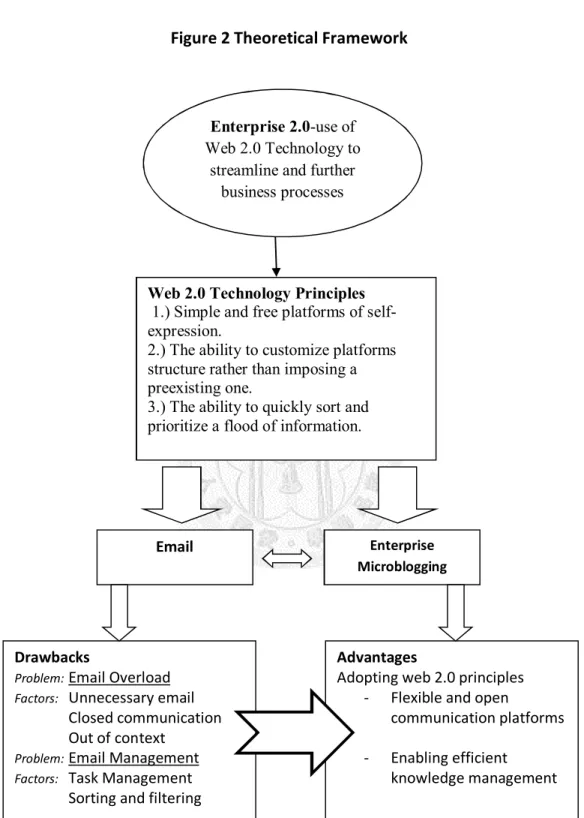
Enterprise 2.0 states that Web 2.0 technologies can simplify and enhance business processes, especially intra-office communication, mainly through the use of microblogging and related platforms. This paper will compare microblogging and email as intra-office
communication based upon the three principles of Web 2.0 technology in Enterprise 2.0 (McAfee, 2006): 1.) Simple and free platforms of self-expression; 2.) The ability to customize platforms structure rather than imposing a preexisting one; 3.) The ability to quickly sort and prioritize a flood of information.
19
Figure 2 Theoretical Framework
Enterprise Microblogging Enterprise 2.0-use of
Web 2.0 Technology to streamline and further
business processes
Web 2.0 Technology Principles 1.) Simple and free platforms of self- expression.
2.) The ability to customize platforms structure rather than imposing a preexisting one.
3.) The ability to quickly sort and prioritize a flood of information.
Advantages
Adopting web 2.0 principles - Flexible and open
communication platforms - Enabling efficient
knowledge management Drawbacks
Problem: Email Overload
Factors: Unnecessary email Closed communication Out of context
Problem: Email Management
Factors: Task Management Sorting and filtering
20
Older technologies are commonly held up to the higher benchmark set by newer,
advanced technologies to determine whether they are still relevant and useful. Therefore, email, as the tradition mode of office communication, will be reexamined through the technical
standards of Web 2.0 to assess its importance and future function in the workplace. This study will try to extend the idea of the Enterprise 2.0 to form a better foundation of comparison
between the email and micro blogging platform. The key question posed in this study is how can technology improve productivity and enable employees to perform daily office task more
efficiently. The next chapter will introduce the features of microblogging platforms and email in order to set a base for the subsequent analysis in the fourth chapter.
21
Chapter 3 Overview of Microblogging and Email
The purpose of this chapter is to first provide a general background of microblogging and email usage, then identify the advantages of microblogging and shortcomings of using email as an office’s main communication method.
3.1 Microblogging Background
In this section, the development, functions and advantages of microblogging will be explored, in order to show how microblogging streamlines intra-office communication. First, the growth of blogging and its connection with microblogging will be examined, then the author will explain the motivations behind using microblogging. Finally the role of microblogging in a business setting will be discussed.
3.1.1 Blogging
In order to fully understand the applications and role of the microblogging, the evolution of the blogging phenomenon must first be examined. Firstly, social media is defined as the media based upon social interaction through highly-accessible and advanced technology platforms, usually web-based and mobile technology that facilitates interactive discourse. There are many types of social media platforms, which include internet chat forums, podcasts, wikis, blogs and microblogging.
Weblogs as we know them today appeared around the second half of the 1990’s. The word “Blog” was shortened from “web-log” and entered into common usage around 1999 (Economist, It's the Links, stupid, 2006). The most common definition for blog is a “personal online journal,” a place where one does regularly add new posts which tend to be short; others
22
provide updates or commentary on a specific subject. A blog post may contain text, images, videos or hyperlinks to articles, websites or other blogs. Most blogs are interactive, in that, readers can leave comments through widgets on the blog, allowing them to interact with blog’s writer as well as other visitors. Its interactive nature has contributed to blogging rapidly gaining popularity worldwide over the past few years (Blood, 2000).
Figure 3 Growth in Number of Blog Users (2003-2006)
The blog, as the next chapter will show, is not as an isolated phenomenon, but rather is a part of a broader spectrum of cyber-cultural behavior, which provide individuals with new ways of communicating and thinking. In the next section, the use of blogs as a conversational tool will be discussed.
3.1.1.2 Blog as a Conversational Tool
One of the strongest advantages that blogs have over other electronic platforms is the ability to develop an in-depth, continuous conversation throughout web pages. When authors, Steven Levitt and Stephen Dubner, reluctantly started a blog in response to the popularity of their
23
book, Freakonomics, they were surprised to find a large audience willing to bounce ideas back and forth, explaining that “a blog, as it turns out, is an author’s perfect antidote to the seeking feeling of being dead in the water once a manuscript has been completed…there is nothing more intoxicating than to be able to extend those (the book’s) ideas, to continue to refine and
challenge and wrestle with them…” (Steven D. Levitt & Stephen J. Dubner., 2005).
So why do blogging platforms serve as a relatively good means of web-based
communication? The two main principles of blogging are monologue and dialogue (O'Donnell, 2006). A reaction to an opening monologue is not only directed to the sender but also to other readers. The blogger frequently receives feedback from unexpected sources, then, new
relationships and context emerge. This often undirected communication develops into open and engaging activities. A single blogger could engage in several of these conversations
simultaneously, returning to various dialogues over time. Next, each post can trigger a conversation with others that in turn results in new rounds of discussions as well. Stephen Downes urges us to think of blogging as “something defined by format and process, not by content” (Downes, 2004), therefore emphasizing the effect of the post and the after-discussion to the overall context.
3.1.2 Microblogging
The next sections will show the reasons why people started using microblogging platforms by explaining how and why the microblogging platforms evolved and what advantages they have over other communication platforms.
24 Figure 4 The growth of Twitter2
Microblogging is a condensed, minimalized form of blogging, since users post brief text about events in their personal lives or work activities. It is a relatively new phenomenon provided by several services including Twitter, Jaiku and more recently Pownce. These tools provide a light-weight, simple form of communication that enables users to broadcast and share opinions, ideas or information (Akshay Java, 2007). One of its main characteristics that differs microblogging from blogging is the limited amount of letters in every post, ensuring that posts are short and succinct. Another distinction between the blogging and the micro blogging is that the later incorporates social networking and personal relationships (Bensen, 2008). The ‘follow’
option of microblogs, allows users to receive post updates from other microbloggers, while posts can be sent to a single individual or specified group as well as the general public. Thus, the essence of microblogging is establishing or developing relationships based on the speedy and concise exchange of content.
2(Akshay Java, 2007)
25 Figure 5 Development of tweeting behavior3
Six Apart (6A), a blogware developer, explains why its the pioneering microblogging software, LiveJournal is different from blogging, stating “LiveJournal, is a very different kind of blogging... Many of the posts are about who snogged whom last night and what happened next, why I'm sad, how adults don't get it, and so forth. Other posts ask things like, “Anybody want to catch King Kong at 8:00?” and have the replies in the comment pane below within minutes. That is because many adolescents consider e-mail passé, and instead are using either instant
messaging (IM) or blogging for their communications…Like blogging, e-mail was supposed to be “asynchronous”, meaning that the people taking part do not have to be online simultaneously.
But today's adolescents have never known e-mail without spam and see no point in long trails of
“reply” and “cc” messages piling up in their in-boxes. As for synchronous communication, why adults would send e-mails back and forth instead of “IM-ing” is beyond them (Economist, It's the Links, stupid, 2006). 6A’s description of LiveJournal’s role in modern communication is also applicable to other microblogging platforms.
3 (compete.com)
26
3.1.2.1 Why Do People Use Microblogging Platforms?
A study conducted on the topic (Dejin Zhao, Mary Beth Rosson, 2009) depicts the motivations behind for using microblogging platforms, which include “staying in touch with friends and colleagues, raising the awareness of important subjects among one’s social network, gathering useful information for one’s profession or personal interests, seeking help and
opinions, and releasing emotional stress”. These motives seem similar to the reasons reported in studies on other forms of social media, like instant messaging platforms, weblogs and RSS feeds.
Since the motivations for using microblogging platforms is similar to other forms of social media, the widespread popularity of this medium must be rooted in specific behavioral and
technological advantages, namely, faster communication, more personal and customized information, and greater online presence.
3.1.2.1.1 Faster Communication
As opposed to the weblogs, posting tweets is less time consuming (Akshay Java, 2007) and gives users the feeling of “real time communication,” in other words microblogging is a more constant and continual form of blogging. Tweet length is usually restricted by character count and there is very little overhead in sending or receiving a tweet. This brevity is regarded as both, technological and behavioral advantage of the microblogging. The restricted character count forces bloggers to post brief and to the point texts. Conversely, brevity allows users to efficiently and quickly scan large amounts of updates, making these platforms an extensive and concise source of information. The result is an effective exchange of information in a speedy and concise manner.
3.1.2.1.2 More Personal, Customized Information Exchange
27
In contrast to other forms of technology, microblogging permits bloggers to carry out a personal conversations in a richer social context, in other words, individuals usually choose to follow microbloggers with common interests or in similar industries, which facilitates direct, concise dialogue on a specific topic. One way that microblogging has proven useful in the
workplace is by keeping track of current threads on new trends in a specific industry (Dejin Zhao, 2009). Web-based services, such as Facebook or LinkedIn, also convey new ways in which to form interpersonal relationships that are transparent and observable. Users can easily connect to their friends and business acquaintances as well as keep them up to date with events in their lives.
As a result, they can now probe for others in the same networks based on queries like "who knows someone who knows someone who knows the person" (Oinas-Kukkonen, 2010). In microblogging platforms, profiles are customizable in that users can choose what information to display and where it is displayed on the page. Profiles also show the bloggers activity and postings on the site (Joan DiMicco, 2008).
Microblogging combines the posting function of blogs with social networking tools, similar to LinkedIn and Facebook. Within microblogging platforms, users can scan, read and respond to posts in real time, and thereby initiating thought-provoking topic-specific
conversations with a virtual social network. Individuals connect online based on real life
relationships or similar interests and opinions. After connecting, microblogging platforms make it easy to receive threads and news from a group of microbloggers that share the same interests as the user. Therefore, social networks including microblogging sites have attracted significant attention among the business community because these sites have made interpersonal
relationships more visible and quantifiable than ever before (Economist, A world of connections, 2010).
28 3.1.2.1.3 Online Presence
Online presence refers to companies conducting some form of social media advertising to expose their services or products on the web. However, online presence also refers to individuals that share ideas, thoughts, and knowledge online, in order to attain a feeling of acceptance and greater recognition.
Attention is a driving force of writing web content, as only a few blogs become popular and most languish in obscurity. Bloggers often begin posting content online to gain the
acknowledgement and recognition from members of an online community, organization or social circle. Thus, bloggers are primarily guided by an incentive-driven model, in which the amount of attention generated by a blog post translates to a greater online presence. Among participants in a study, the content of a reply was often less important than the value of the acknowledgement that someone receives from readers. (Sarita Yardi, 2009).
An individual’s desire for attention stems from a fundamental social and emotional need for friendship, support, and connectivity. This need does not only originate in mircoblogging, but long pre-dates the web. However, the participatory culture of microblogging platforms lowers entry barriers, thereby making it more difficult for a specific blogger to attain notoriety in an ever-growing social community (Sarita Yardi, 2009).
3.1.3 Microblogging In Business Communication
Microblogging platforms as a new and advanced communication medium have attracted widespread attention from the business world, and variants of Twitter have already begun to appear in the corporate setting. Microblogging can facilitate and support intra-office knowledge
29
sharing and communication within corporations (Jun Zhang, A case study of micro-blogging in the enterprise: use, value, and related issues, 2010).
Taking note of the popularity and interactiveness of profiles on Facebook and MySpace, companies wanted to bring this level of user participation and community to their offices.
Managers observed that personal and expressive information sharing was generally lacking from their own corporate intranet, and that their business directories had employee listings that were void of important information. In addition, maintaining up-to-date employee profiles was a significant challenge for many human resources departments (Joan DiMicco, 2008).
Enterprise microblogging platforms usually differ from regular microblogging platforms in several ways. First, only employees with a valid company email addresses can join a
company’s microblogging network and they are not limited to work-related postings. Secondly, many enterprise platforms do not have character count restrictions on messages, like Twitter’s 140 character limit on messages, which permits employees to write lengthier messages. Third of all, some enterprises platforms support attachments to messages, therefore integrating a
documentation sharing function into their microblogging platforms, while others have
microblogging services that allow users to create private and public groups (Sarita Yardi, 2009;
Jun Zhang, A case study of micro-blogging in the enterprise: use, value, and related issues, 2010).
Lastly, since those platforms are used in the corporate environment, they sometimes come with blogging guidelines, including rules of general business conduct, copyright compliance
requirements, fair use and financial disclosure laws, confidential material reminders, and directives against the use of writing inflammatory language and covering controversial topics, such as politics and religion (Anne Jackson, 2007).
30 Figure 6 Adoption of Yammer in a corporation4
In 2010, Gartner, a leading global information technology research and advisory
company, revealed a few predictions on the future of social networking software in the business sector (Gartner, 2010). One of the predictions stated that by 2014, social networking services will replace e-mail as the primary vehicle for interpersonal communications for 20 percent of business users. Greater availability of social networking services, coupled with changing work styles will result in social networking mediums becoming the core of their business
communications. In the next several years, as Gartner predicted, most companies will be building their own internal social networks. Social networking will prove to be more effective than email for certain business activities, such as status updates and brief information-sharing. Gartner indicates that enterprise microblogging should not be a standalone technology, and should integrate features from other forms of communication. In other words, microblogging platforms will gain a competitive advantage if they incorporate other communication functions, such as security settings, file sharing, smartphone synchronization and even traffic analytics tools.
4 (Jun Zhang, A case study of micro-blogging in the enterprise: use, value, and related issues, 2010)
31 3.2 Email Overview
Email, or electronic mail, is the transmission of digital messages over the Internet or other computer networks. The forerunner of today’s email systems was more similar to instant messaging, in that the sender and the receiver needed to be online at the same time. Now emails can be received, sent and stored through email servers. In addition to email client software, email can also be accessed through webmail, allowing users to connect to their mailbox online. Some email service sites are primarily designed to be accessed only through the Internet, and these sites are usually free and very user-friendly, such as Gmail. With the advent of email,
interpersonal communication has become more convenient, accessible and fast, however, the increased usage and reliance on electronic mail as a primary form of business communication has given rise to several email-related problems that hinder its general effectiveness. In the following section, a number of problems associated with email usage will be discussed.
3.2.1 Email Overload
Although email is the most popular method of communication today, it still has several serious flaws disadvantages. From its first use in the 1960s (Gode, 2010), emailing technology evolved as one of the most efficient and convenient forms of communication. Email rose to prominence in the late 1980s through the late 1990s with services including CompuServe, AOL, as well as client/server computing. It grew into a mature technology with the advent of Microsoft Exchange and Outlook (Forcey, Arts and Letters, 2010). It is designed as an asynchronous communication to create, send and store textual data in digital form over a network. The general opinion of email as a communication tool among users today is still very, as it enables users to collaborate with others across time and distance (Steve Whittaker, 1996). Many users will also
32
point out its advantages over other modes of communication, such as the telephone and even face-to-face interaction. Email has resolved business and communication problems that companies encountered as they expanded globally. The functions of emails systems have expanded to include a wide variety of features, such as contact and schedule management, becoming a staple of daily office operations.
Regardless of email’s pivotal role in the modern office, certain persistent shortcomings render the technology inefficient and expound the need for microblogging platforms to
complement email systems in the workplace. Due to the abundance of information widely
available online, individuals are expected to provide better quality writing, while readers demand easier and quicker access to content. The mounting demand for the rapid exchange of high- quality and informative interactive has resulted in overflowing email inboxes (Sarita Yardi, 2009). Studies have shown that corporate users experience major problems reading and replying to email in a timely manner, dealing with backlogged and unanswered emails, and in locating information in their email accounts (Steve Whittaker, 1996). This inability to effectively manage one’s communication platform translates to lost information and reduced response times, both of which could prove to be very costly for businesses and negatively impact individual and
corporate productivity.
3.2.1.1 Unnecessary Emails
Commercial email spam filters and virus protection are very effective at weeding out potentially harmful or frivolous distractions. Thus, nowadays computers and emailing systems are operate more efficiently, however, workers are increasingly distracted by technology, so in this case, the problem is not email but rather how we use it. According to the Gartner Group, 30%
of email is "occupational spam," characterized by the excessive use of CCs, BCCs and Reply-
33
Alls (Mayfield, 2008). From a sender’s point of view, email is free and widely accessible, and the recipient lacks any control; anyone can push an email to your inbox at near zero cost to themselves, which is why email is considered a “Push Technology.”5 But from the receiver’s point of view, the same message could translate to a loss of time, money and overall productivity.
The sender is motivated by the fact that sending his email to the greatest possible number of recipients directly multiplies his desired result, thus the sender disregards the potential impact on the reader’s time, in pursuit of his desired outcome from sending the email. In practice, this behavior leads to infinite number of newsletters, general announcements such as birthday messages, chain letters, and advertisements that reduce overall productivity.
3.2.1.2 Closed Communication Channel
Employees oftentimes find themselves cooperating with a limited numbers of coworkers through email. However, widening the collaboration or seeking expertise from a broader range of coworkers within an organization requires other methods of communication. Trying to
accomplish this task with email would result in long mailing lists that may even include all of a company’s employees. Another way is to contact a third party, for instance, send an email to a colleague asking for a recommendation: “who can I talk to on your team who knows X?”
In addition, another common interruption is from redundant emails discussing a problem that has already been covered in other employee emails (Yarbrough, 2010), for example a reoccurring IT problem or paycheck issue. All of the problems raised in this section stem from the closed nature of email systems. Since, knowledge is accumulated and stored in separate email inboxes, rather than open for all colleagues in an organization.
5 Push technology describes a style of Internet-based communication where the request for a given transaction is initiated by the publisher or central server (Wikipedia)
34 3.2.1.3 Out of Context
An additional frequent problem with emails is that the context of ongoing email conversations is often lost, even if the relevant previous emails can be located, the context is sometimes still hard to recall. Information in context (as in a newspaper) is much easier and faster to understand than fragments of information sent as emails over an extended period of time.
Since, communicating in context can only be achieved when both parties have a full
understanding of the context and issue in question, at times email conversations can cause certain key issues or facts to be overlooked.
Studies have found that 8% of an employee’s work time is spend on scrolling through their inboxes trying to locate content in email threads (Victoria Bellotti, Nicolas Ducheneaut, Mark Howard, Ian Smith, 2003). The same study explained that a sense of email overload was related to the number of threads and the length of time between messages in those threads. The inability to find necessary or backlogged emails in a timely manner greatly reduces productivity.
3.2.2 Email Management
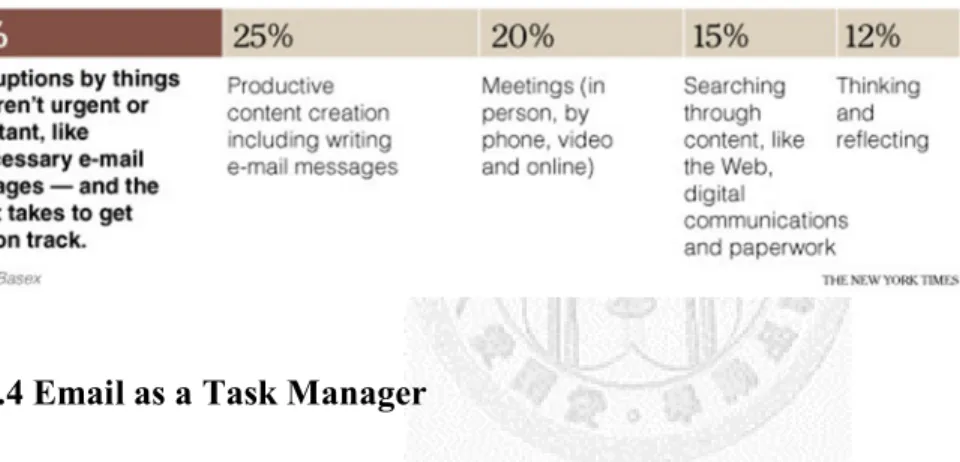
A study performed by Steve Whittaker and Candace Cinder points that today’s email systems are no longer just used for asynchronous communication, in which data is transmitted intermittently rather than in a continuous steady stream, but for other tasks like task management and personal archiving (Steve Whittaker, 1996). Reading, organized and responding to emails, as the below figure shows, can be not only time-consuming activity in itself, but also one of the main interruptions at the workplace. Paradoxically, the need to manage one’s emails actually results in less effective time management and more diminished productivity.
35
According to statistics published in a New York Times article, 28% of our time is wasted on interruptions (Richtell, 2008). The article goes on to say that many of these interruptions stem from emails. The problem had grown to a critical level, causing leading technology firms,
including Microsoft, Intel, Google and I.B.M., to form a nonprofit group to study the problem, publicize the results, and devise ways to help workers cope with the digital deluge.
Figure 7 The Amount of Time Wasted on Interruptions6
3.2.1.4 Email as a Task Manager
Email systems have evolved from simple email inbox provides to personal information management systems. Given that email functions as our main mode of communication in the modern world, it is not difficult to believe that many individuals receive 100+ emails per day.
One study explains that users receive a large volume of messages daily because email is now the basis for many different office tasks, serving as the place in which work is even received,
delegated and prioritized (Steve Whittaker, 1996). However, the volume of incoming mail and the use of email inboxes as task management tools can be detrimental to productivity, causing a
“breakdown in the one-touch model.” The simple one-touch model for email use is based on the
6(Richtell, 2008)
36
assumption that email can be divided into two categories, namely, informational and
correspondence. Informational emails do not require a response, and thus can be deleted or filed, whereas incoming messages that are correspondence are answered and then either filed or deleted, thus only unread and filed messages are kept in an inbox. The one-touch model assumes a user’s inbox will consist of only a small amount of unread messages, and the rest are filed items.
Conversely, data collected by Whittaker and Sinder demonstrated that by using email inboxes for task management negates the one-touch model. Although users attempt to process information at once, there are several reasons why immediate responses are not possible or suitable, thus a large number of emails remain in the inbox. One main reason is that the user may be short on time, and postpones his response. The user may need a longer amount of time to process or write the email, or need to respond to other emails first, resulting in a large number of unanswered messages left in the inbox or other folders. Potentially more urgent messages tend to garner faster responses, while emails of moderate or no importance often become consistently overlooked. There are also specific types of messages that are often not dealt with immediately:
3.2.1.4.1 “To Do” Messages
“To do” messages requires that users execute some type of action. In some cases, the message may involve the user to engage in further complex activities which may take days to complete. The user does not wait to read an email until these actions are finished, so “to do”
messages are commonly kept in the inbox as reminders of unfinished tasks, serving as a form of task management.
3.2.1.4.2 “To Read” Messages
37
Alternatively, some messages may consist of lengthy texts. Although these are often informational and do not require a reply, they still take time and effort to read, and users often postpone reading them, thus an inbox may contain unread or partially read documents for an extended period of time.
3.2.1.4.3 Messages of Indeterminate Status
One issue with informational messages is that users are often unsure of the significance of an incoming message when it first arrives. Rather than investing valuable time in reading it, they delay dealing with it until some later on when they are more certain of its importance. What makes immediate decisions difficult is that the value of a given message may depend on events that occur after the message has been received: receiving related messages on the topic may reveal its importance, or else it may turn out to be a "dead-end" with no follow-up. Rather than delete it immediately, users often keep the message until its importance can be ascertained.
3.2.1.4.4 Ongoing correspondence
Finally the inbox is sometimes used for ongoing, but incomplete, threads of asynchronous conversations. The user may delay responding to a question from another person because a careful reply is necessary, which requires more time than is currently available. Alternatively, users may be unable to reply immediately, because they currently do not have the answer, and they await further information from other people.
For more complex interactions involving multiple exchanges over an extended time period, users may also track and sometimes save, both their own and other people's contributions to the conversation. An issue may take several email exchanges to be resolved, or users may require the responses of multiple individuals in order to gather opinions or reach consensus. A
38
major problem with email correspondence is that there are no agreed conventions about whether to include the context or history of prior messages in an ongoing correspondence, thus
information from previous conversations or threads may be excluded. Oftentimes this context is extremely important, especially in the workplace setting, because it is necessary for interpreting what each subsequent message means.
3.2.1.5 Archiving and Filing Email Messages
A major aim of filing emails into folders is to reduce the huge number of undifferentiated inbox items into a relatively manageable set of folders, each containing lists of related messages.
Many emails users find it difficult to move messages out of the inbox and filing them into folders of related messages (Richard B. Segal, 2000). First of all, generating and maintaining these folders requires a considerable effort. Secondly, and more importantly, the resulting list of folders is not necessarily very helpful in message retrieval. Filing is a cognitively difficult task and a successful filing system is dependent on being able to imagine future retrieval needs. It is hard for a user to anticipate his future retrieval needs when creating, naming and organizing folders. On the other hand, some users may not file messages because they are concerned that they might not remember where an important email has been filed, or want to delay deciding which folder an email should be filed in. Users do not want to archive information that may be potentially useless.
Folders may also not be very useful once they have been created. A key problem is that users may not be able to remember folder labels, especially after a long period of time has elapsed. Users might create too many specialized folders, making email retrieval time-
consuming and difficult. The small amount of content in very specific folders also reduces their
39
usefulness. Folders that are too broad and consist of too much information complicate message retrieval, defeating the purpose of filing emails into folders in the first place.
Figure 8 Sorting and Filtering
Quantitative studies on email use have shown employees spend 10-18% of their workday filing email into folders to save important conversations or postpone responses (Victoria Bellotti, Nicolas Ducheneaut, Mark Howard, Ian Smith, 2003; Steve Whittaker, 1996). However, between 21-35% of the time used to file emails is spent on “failed folders”. Therefore, the user has the triple time overheads of (a) first creating folders, (b) remembering folder names and meanings when filing a new inbox item, and (c) trying to retrieve a relevant email item.
3.3 Conclusions
In this chapter the functions of microblogging and emailing were explaining and contrasting, focusing mainly on the benefits of new microblogging technology and listing the drawbacks of using email as the sole digital form of intra-office communication. The first section
40
enumerated the benefits of microblogging in the office. The main advantages of microblogging include the ability to conduct real time communication, more in-depth and focused conversations, and expand an online presence.
The second section of chapter 3 described the problems associated with email overload, in order to more specifically pinpoint the detrimental effect that this digital epidemic has on business efficiency. Several factors that contributed to the inefficient use of email systems were discussed, including unnecessary emails, closed channels of communication, misplaced or lost information, and a lack of context in extended email threads. Another reason for decreased productivity is the increased usage of email systems as a task management tool or an online filing cabinet. The reliance on these secondary functions of email inboxes makes searching and retrieving messages time-consuming and inefficient.
The following chapter will incorporate this paper’s theoretical framework to analyze the shortcomings of email systems, and explain how the unique functions of microblogging can replace email in the workplace.
41
Chapter 4 Supplementing Email with Microblogging as Primary Intra-Office Communication
Many industry leaders will testify that shifting some of their daily email communications to Enterprise 2.0 platforms would increase overall productivity (Suarez, I Freed Myself From E- Mail’s Grip, 2008): “I stopped using e-mail most of the time. I quickly realized that the more messages you answer, the more messages you generate in return. It becomes a vicious cycle. By trying hard to stop the cycle, I cut the number of e-mails that I receive by 80 percent in a single week. It’s not that I stopped communicating; I just communicated in different and more
productive ways. Instead of responding individually to messages that arrived in my in-box, I started to use more social networking tools, like instant messaging, blogs and wikis, among many others.”
A more qualitative approach was taken by Matt Cain, vice-president of research at Gartner, suggested that the increasing reliance on social media tools to accomplish office tasks will grow, in that “the rigid distinction between e-mail and social networks will erode. E-mail will take on many social attributes, such as contact brokering while social networks will develop richer e-mail capabilities. While e-mail is already almost fully penetrated in the corporate space, we expect to see steep growth rates for sales of premises- and cloud-based social networking services“(Gartner, 2010).
How then will microblogging platforms challenge more established communication tools like email? The following chapter will take McAfee’s three Web 2.0 principles as discussed in the theoretical framework to answer this study’s main questions:
What are the flaws of email usage that can be resolved by implementing micro blogging
42 platforms?
What are the other added values of replacing email with microblogging features in the inter office communication?
4.1 Simple and Free Platforms of Self-expression
As discussed in the theoretical framework, employees will find Web 2.0 technologies, like microblogging, easy and simple to use. Thus, they will voluntarily switch over to the more effective communication methods, making behavioral modification and training to adapt to the new systems irrelevant.
4.1.1 Self-expression and Influence Inside the Company
As opposed to a closed and nonpublic communication tool like email, microblogs can be used to share ideas, expertise and comments on the work of others in a more public forum. By that, it enables employees to create a digital footprint in the online environment, demonstrating their existence and contribution to others. This footprint helps them to build a digital reputation or eminence, allowing them to stand out in the company (Shah, 2011). Reputation plays a pivotal and fundamental role in the business culture. For an individual employee microblogging
provides a means to make accomplishments and performance visible. For example, posting updates related to a project can give an indication of one’s contributions as well as capabilities.
From an individual’s viewpoint, elevated status may contribute to greater self-assurance and confidence in interactions with colleagues and clients. In this context, reputation provides a general basis for greater productivity (Valentin Schöndienst, 2009).
4.1.2 Informal and Easier Method of Communication
43
Writing an email can be time-consuming and technical, whereas posting tweets regarding work matters is an informal and fast way to share information between employees.
Microblogging can increase the collaboration opportunities among colleagues, and encourage the transmission of office culture and maintenance of consensus and connectedness between
coworkers. Researchers have suggested that informal communication at work may play important roles for organizational innovation (Dejin Zhao, Mary Beth Rosson, 2009).
Figure 9 Proposed benefits of informal communication7
In various studies on employees’ response to microblogging in the enterprise, many valued the opportunity to engage with coworkers more freely and across geographic and work- group boundaries (Sarita Yardi, 2009; Anne Jackson, 2007). Employees often responded that the main benefit of blogging is ‘communication,’ which is interesting in that communication is usually viewed as a tool to accomplish a task, rather a ‘benefit’ in itself. Viewing the ability to communicate as a ‘benefit’ emphasizes that the participants of this study recognized blogging as a way to connect with other individuals, and not just a tool to exchange information. (Anne Jackson, 2007).
7 (Dejin Zhao, Mary Beth Rosson, 2009)
44
4.1.3 “One-to-Many” and “Many-to-Many” Communication
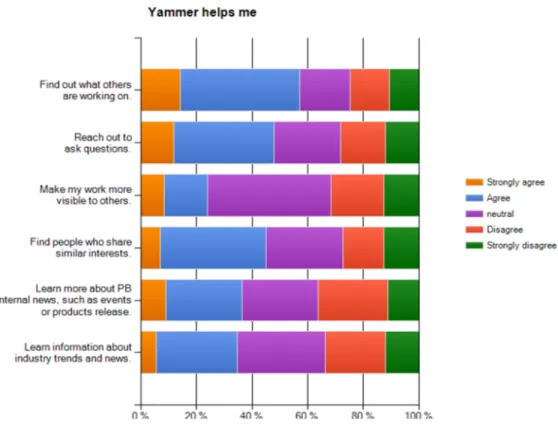
Employees that use email tend to collaborate in specific teams, departments or branches, and keep internal communication between them. Management is usually the only outsider to come in and get involved with the team. However, this traditional communication model, where management engages in one-way dialogue to employees can be supplemented with peer-enabled access to information through blogging platforms. (Sarita Yardi, 2009). In fact in the study conducted by Jun Zhang et al., many employees reported that Yammer was very helpful in letting them “find out what other people are working on” (Jun Zhang, 2010).
Figure 10 Employees Perceived Values from Yammer8
Open communication will encourage a cross-team collaboration environment, wherein users can put forth questions to the entire company and get an immediate response; very often
8 (Jun Zhang, 2010)