國立臺灣大學理學院大氣科學系 碩士論文
Department of Atmospheric Science College Science
National Taiwan University Master Thesis
平衡渦旋模型之熱與動量動力效率
Dynamic Efficiency of Heat and Momentum in Balanced Vortex Model
許天耀 Tien-Yiao Hsu
指導教授:郭鴻基博士 Advisor: Hung-Chi Kuo, Ph.D.
中華民國 104 年 7 月
July, 2015
誌謝
一篇作品的完成不只需要個人努力,亦需有旅途中各方貴人的相 助。
感謝郭老師給予的指導,討論,支持與肯定。這是我前進的動力。
美雲超過兩年的關懷與照顧,無法用三言兩語表達,除了感謝還是感 謝。維毅,虹叡,郁涵,徐驊,世顥,佑宇,政友,王珩,立中,佳 瑩,映如等人給予的協助點滴在心。這是一間溫暖且包容的實驗室,
有緣於此停泊,甚感幸運。緣分的推演人無可知,而我感謝這些安排。
我要感謝家人與韋龍,在這些日子裏承擔我的任性。
最後,我要感謝自己,完成當初的承諾。這些日子裡,你更認識了 自己,接受自己的缺點,也知道自己可以成為甚麼樣的人――你比過 去更有能力參與自己的人生,謝謝你。
寫下這些文字的同時,窗外蟬聲唧唧,正如同兩年前的今天一樣,
瀰漫著慵懶與未知。不同的是我即將完成學業離開此處。走入未來,
如同走入森林,失去方向,充滿恐怖與不安,卻帶點雀躍和悸動。何 處存在美麗的瀑布與甘泉?尋得之時必然知曉,因吾等已然品嘗。
2015/06/25 天耀 於一片唧唧蟬聲
摘要
觀 測 資 料 顯 示 眼 牆 置 換 (ERC) 過 程 會 產 生 不 同 的 結 果。Kuo et al. (2009) 發 現 在 置 換 過 程 結 束 後, 大 約 28% 的 颱 風 會 繼 續 增 強。Yang et al. (2013) 針對雙眼牆置換完成後的演化,發展出四個分 類。他們指出不同分類的颱風在強度的演化上有明顯的不同,於 T-V 圖中亦具有不同的演化路徑。
Hack and Schubert (1986) 提出熱動力效率 η (r, z, t) 之概念。此物理 量能夠定量描述總位能 (P) 轉換到總動能 (P) 之能量轉換速率 (C),並 以加熱 (Q) 最為量度基準。該文獻指出儘管總加熱量 (H) 維持一樣,
不同的渦漩結構會產生極為不同的轉換效率。在此研究中,我們將利 用熱動力效率,來測試單雙眼牆颱風 Francis (2004) 之轉換效率反應。
我們發現外眼牆在動力上能夠透過減少羅士比長度而提高渦漩的能量 轉換效率達 50% 至 400%,而改變內外眼牆之加熱率比重 (從 1 : 2 至 2 : 1) 則可以強化能量轉換效率達 100% 至 600%。
除了此研究主要使用的圓柱座標外,本論文也推導在準地轉理論 (卡式座標),卡式座標,球座標與淺水模型之動力效率,可供參考與應 用於其他尺度平衡動力研究之用。
關鍵字:平衡渦漩、熱動力效率、動量動力效率、雙眼牆、次環流
ABSTRACT
The observation data shows that the eyewall replacement cycle (ERC) re- sults in different consequences. Kuo et al. (2009) found that approximately 28% of typhoons strengthen after the formation of secondary eyewall. Yang et al. (2013) developed four categories to classify the situations after the for- mation. They found these four categories exhibit different behaviors on in- tensity and routes on T-V diagram.
“Dynamic efficiency of heat” η (r, z, t)) developed by Hack and Schu- bert (1986) is to examine the effect of heating on the energy conversion rate (C) converting total potential energy (P) into total kinetic energy (K) They also pointed out that efficiencies vary under different vortex structures while total heating remains the same. In this study, we would apply dynamic effi- ciencies to examine the response of concentric eyewall cyclone Francis (2004).
We find that the presence of outer eyewall enhances the efficiency response by approximately 50% to 400% through reducing Rossby length (λR) while changing the heating ratio between inner and outer eyewalls from 1 : 2 to 2 : 1 enhances the efficiency by 100% to 600% (total heating is fixed).
Apart from cylindrical coordinates, we also derive the dynamic efficien- cies in quasi-geostrophic theory (Cartesian coordinates), Cartesian coordi- nates, spherical coordinates, and shallow water model for potentially appli- cation to other balance dynamics in different scales.
Keywords: balanced vortex, dynamic efficiency of heat, dynamic efficiency of momentum, concentric eyewall, double eyewall, secondary circulation
CONTENTS
口試委員會審定書 ii
誌謝 iii
摘要 iv
Abstract v
1 Introduction 1
2 Formulation 3
2.1 Efficiency in Quasi-geostrophic Theory . . . 4
2.2 Efficiency in Cartesian Coordinates . . . 9
2.3 Efficiency in Cylindrical Coordinates . . . 15
2.4 Efficiency in Spherical Coordinates . . . 21
2.5 Efficiency in Shallow Water Model . . . 25
3 Numerical Method 29 4 Numerical Experiments 34 4.1 Diagnose Procedure . . . 35
4.2 Vortex and Heating Settings . . . 35
4.3 Single eyewall cyclone . . . 37
4.4 Concentric eyewall cyclone . . . 45
4.5 Eye with hub cloud . . . 46
4.6 Internal structure of moat and outer eyewall . . . 53
4.7 Position of maximum heating . . . 54
4.8 Pre-existing baroclinity . . . 54
4.9 Sensitivity of baroclinity on the operator . . . 55
5 Summary 56 A Derivation of Quasi-Geostrophic equations 58 A.1 Perturbation Method . . . 58
A.2 Balanced Condition . . . 60
B Waves and the Eliassen-Sawyer Circulation Equation 63
C Boundary Conversion 71
D Similarity between cylindrical and spherical coordinates 72
E Application Programming Interface 77
Bibliography 81
LIST OF FIGURES
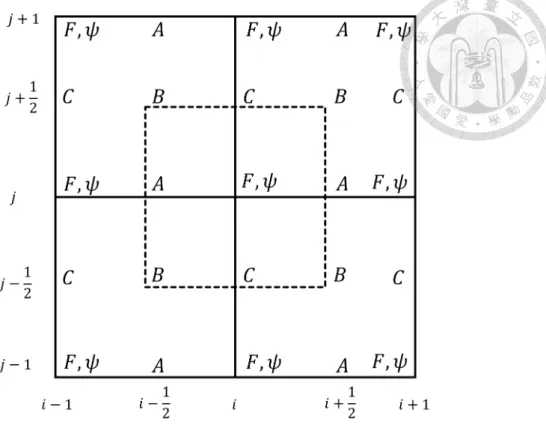
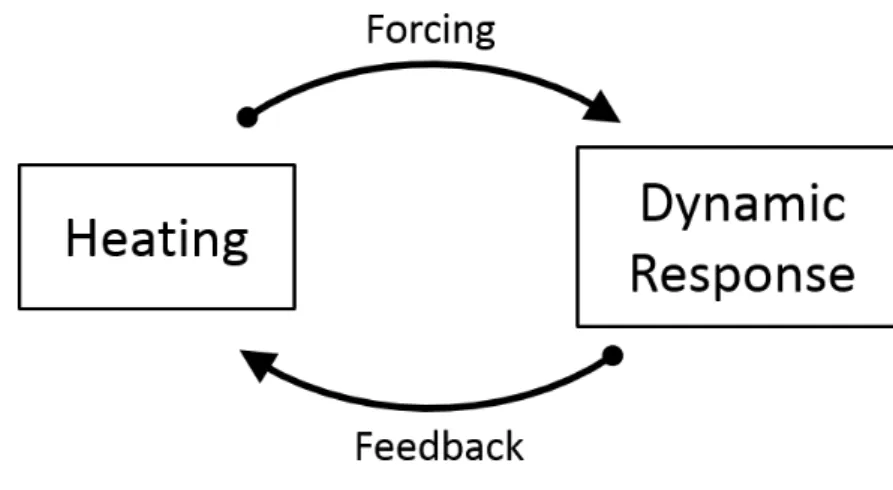
1 Finite-difference grid for solutions of (3.1) . . . 33 2 General scheme of a tropical cyclone system. Heating is treated as a forc-
ing to generate dynamic response which feedbacks to heating at the same time. Our work is to diagnose the effect of the heating and to discuss its dynamic response. . . 34 3 The flowchart of a two-regioned barotropic model which represents a sin-
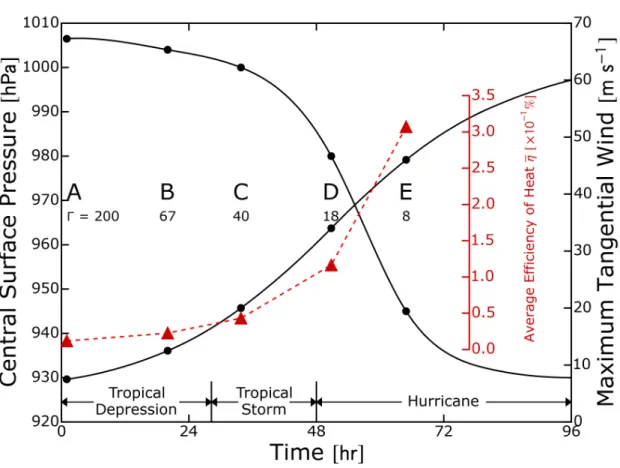
gle eyewall tropical cyclone. (a) Tangential wind profile (m s−1). (b) In- duced streamfunction rψ (×1013 kg day−1). (c) Local heating rate ∂T /∂t (K day−1). (d) ∂T /∂r (×10−3 K km−1). Time interval is one hour. (e) Corresponding solution rχ (×1010 kg). (f) Dynamic efficiency of heat (%). Shades in all graphs are adiabatic heating (K day−1). The model set- ting is adapted from Schubert and Hack (1982) and is listed in table 2 (case D). . . 39 4 Evolution with repect to total time (hr) of average efficiency of heat η
(×10−1%, red line), maximum wind speed (m s−1), Γ = √
A/C (labeled under each stage) and central pressure (hpa) of five stages during a typi- cal tropical cyclone development. Time interval is one hour. The model settings are adapted from Schubert and Hack (1982) and are listed in table 2. 40
5 Isolines of total heat response (∫b2
0
∂T
∂trdr/∫b2
0 Qrdr, black line) and aver- age efficiency η (%, red line) in terms of core size a (km) and core rotation strength (ˆµ− µ) /µ with different heating region b2 = a± 50km. A, B, C, D and E represent five stages of typical tropical cyclone. The model settings are the same as Fig. 4 . . . 41 6 The flowchart of a five-regioned barotropic model which represents a dou-
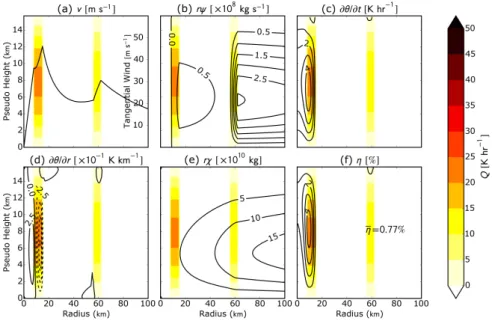
ble eyewall tropical cyclone. (a) Tangential wind profile (m s−1). (b) In- duced streamfunction rψ (×108 kg s−1). (c) Local heating rate ∂T /∂t (K hr−1). (d) ∂T /∂r (×10−1 K km−1). Time interval is one hour. (e) Corresponding solution rχ (×1010 kg). (f) Dynamic efficiency of heat (%). Shades in all graphs are adiabatic heating (K day−1). The model setting is adapted from Rozoff et al. (2008) and listed in table 4 (case Adyn+ Aheat). . . 42 7 The flowchart of a five-regioned barotropic model which represents a dou-
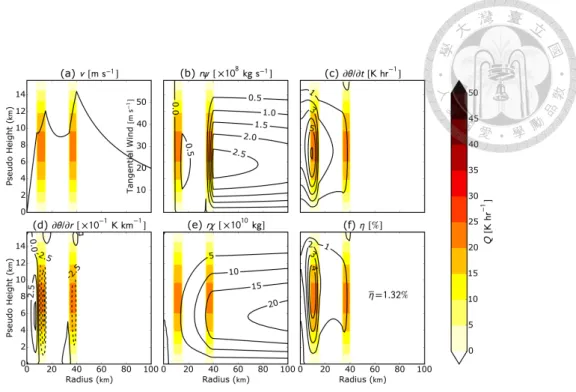
ble eyewall tropical cyclone. (a) Tangential wind profile (m s−1). (b) In- duced streamfunction rψ (×108 kg s−1). (c) Local heating rate ∂T /∂t (K hr−1). (d) ∂T /∂r (×10−1 K km−1). Time interval is one hour. (e) Corresponding solution rχ (×1010 kg). (f) Dynamic efficiency of heat (%). Shades in all graphs are adiabatic heating (K day−1). The model setting is adapted from Rozoff et al. (2008) and listed in table 4 (case Bdyn+ Bheat). . . 42 8 The flowchart of a five-regioned barotropic model which represents a dou-
ble eyewall tropical cyclone. (a) Tangential wind profile (m s−1). (b) In- duced streamfunction rψ (×108 kg s−1). (c) Local heating rate ∂T /∂t (K hr−1). (d) ∂T /∂r (×10−1 K km−1). Time interval is one hour. (e) Corresponding solution rχ (×1010 kg). (f) Dynamic efficiency of heat (%). Shades in all graphs are adiabatic heating (K day−1). The model setting is adapted from Rozoff et al. (2008) and listed in table 4 (case Cdyn+ Cheat). . . 43
9 Three settings of tangential wind speed profile (m s−1, solid lines) and heat constant ˆQ (K hr−1). The coupled results of average efficiency η (%) are listed in the top-right table. Time interval is one hour. The model settings are adapted from Rozoff et al. (2008) and are listed in table 4. . . 43 10 The wind profile (m s−1, solid line), heating (K hr−1, shading) and result
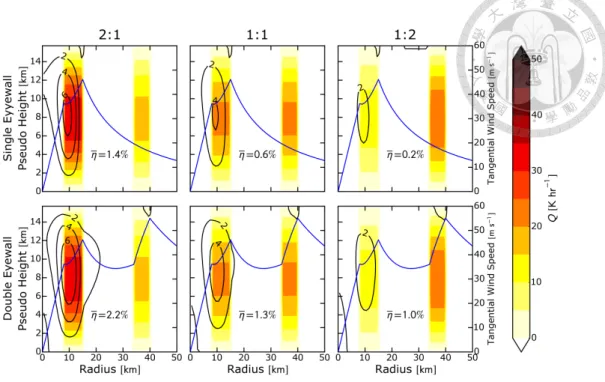
efficiency η (×10−1%, contour) of six different cases. The wind profiles represent single (Adyn) and double (Cdyn) eyewall and in the first and sec- ond rows, respectively. The heating ratios between inner and outer eye- walls are 2 : 1, 1 : 1 and 1 : 2 (shown in table 4) in the first, second and third columns, respectively. . . 44 11 The wind profile (m s−1, solid line), heating (K hr−1, shading) and result
efficiency η (×10−1%, contour) of six different cases. The wind profiles represent single, double, and larger double eyewall (Adyn, Bdyn and Cdyn) in the first, second and third columns, respectively. The heating is totally on inner eyewall and outer eyewall (80.9, 29.3 and 18.4 K hr−1) in the first and second rows, respectively. . . 44 12 Four cases to compare hub-cloud profile’s efficiency. The first row is
wind profile, heating (K hr−1, shading), and result efficiency η (×10−1%, contour), the second row shows the induced vertical motion w (m s−1) and local heating rate ∂T /∂t (K hr−1). The model settings are adapted from Schubert et al. (2007) and are listed in table 3 . . . 47 13 Average dynamic efficiency of heat η (%) in various height of maximum
heating zmax(km). Heating thickness is half of the atmosphere height. A, B and C represent wind profile as in Fig. 9 Notice that heating is now totally in the first eyewall. . . 48 14 Distribution of dynamic efficiency of heat (%, contour) under pre-existing
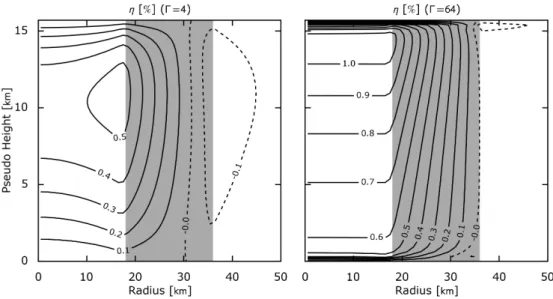
baroclinity (shaded) with different Γ (4 and 64). B = 1× 10⁻⁶s−2in both cases. . . 48
15 Distribution of dynamic efficiency of heat (%, contour) solved under barotropic (upper panel) and baroclinic (lower panel) conditions. . . 49 16 Distribution of dynamic efficiency of heat (%, contour) solved under barotropic
(upper panel) and baroclinic (lower panel) conditions. . . 50 17 Average dynamic efficiency of heat η (%) in terms of relative rotation
strength ˆµ4/ˆµ3 and outer eyewall position r3 (km). Total local heat re- sponse is 12.6% throughout the domain. . . . 51 18 Average dynamic efficiency of heat η (%) in terms of wind shape param-
eter λdyn and heating shape parameter λQ. Nine thumbnails are drawn in the right. Total local heat response is 12.6% throughout the domain. . . . 52 19 A stable configuration of m and b. The red and blue arrows are buoyancy
restorcing force and inertial restoring force, respectively. . . 70 20 An unstable configuration of m and b. The red and blue arrows are buoy-
ancy restorcing force and inertial restoring force, respectively. . . 70 21 The comparison between cylindrical and spherical coordinates. . . 73
LIST OF TABLES
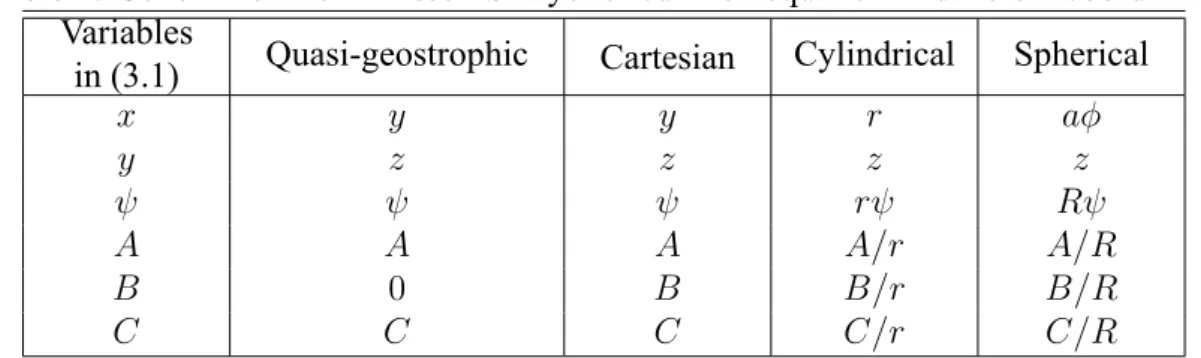
1 General form of Eliassen-Sawyer circulation equation in different coordi- nates . . . 29 2 Two-regioned model settings for typical development of tropical cyclone.
H0= 10 K day−1 (250km)2 . . . 38
3 Three-regioned model settings for u-shaped wind profile. H0 = 125 K day−1 (50km)2 38 4 Five-regioned model settings for decoupled wind and heating profile. H0=
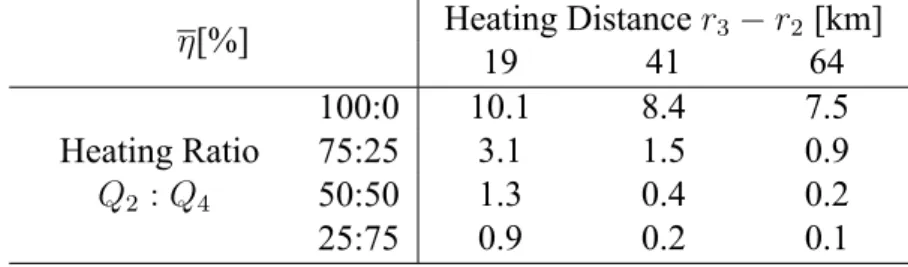
125 K day−1 (50km)2 . . . 38 5 Average efficiency η (%) with respect to heating distance r3−r2(km) and
heating ratio Q2 : Q4 between inner and outer eyewall. . . 46 6 General form of Eliassen-Sawyer circulation equation in cylindrical and
spherical coordinates . . . 76
CHAPTER 1
INTRODUCTION
A cyclone intensifies itself by storing the available potential energy through latent of water vapor and releasing it into kinetic energy. Charney and Eliassen (1964) proposed Condi- tion Instability of the Second Kind (CISK) to explain the initiation of the tropical depres- sion. Later, Schubert and Hack (1982) demonstrated that pre-existing vortex is another important factor for constructing a warm core for it reduces Rossby deformation length (λR). It is also known that given the same amount of energy input, not necessarily every cyclone grows. By observation data, the eyewall replacement cycle after the generation of outer eyewall (some hypothesis were given by Rozoff et al., 2008) have different conse- quences (Kuo et al., 2009; Yang et al., 2013). The work above suggest the need of finding a way to quantify the effect of structure of heating and wind profile on kinetic energy of a cyclone.
Assuming an air column is heated uniformly by 10K per day (equivalent to the latent heat produced by 40mm per day) and its mass is 104kg per 1 m2. Energy released in 1 m2 is
∆T · cp· Mass = 10 K · 1004 J kg−1K−1· 104kg≈ 108J. (1.1) If 1% of heating energy can be converted into kinetic energy, then we have
108J· 1% = 1
2 · 104kg· (vfinal− vinitial)2, (1.2)
where vinitialand vfinalrepresent the initial and final velocities of the air column.
Let vinitla= 0, then we obtain
vfinal = 10√
2 m s−1≈ 14 m s−1. (1.3)
Since wind speed over 17m s−1 will be identified with tropical storm in Saffir–Simpson hurricane wind scale, heating efficiency about 1% is significant enough in our studies.
To quantify the effect of heating, Hack and Schubert (1986) developed the idea of dynamic efficiency η (r, z) to describe the efficiency of heating at particular position with the aid of Eliassen-Sawyer circulation equation. This tool is especially convenient for it requires only temperature profile θ (r, z) so that we can discuss without considering too much issue about adiabatic heating Q.
Contents in later chapters are structured as follows: Eliassen-Sawyer circulation equation and dynamic efficiency of heat and momentum will be derived in chapter 2. Re- laxation method used in this paper in order to solve Eliassen-Sawyer circulation equation will be introduced in chapter 3. In chapter 4 will introduce our diagnose procedure, ex- periment settings and results. Summary is in chapter 5.
CHAPTER 2
FORMULATION
We will derive dynamic efficiencies in five different realms. Sec. 2.1 is the derivation in quasi-geostrophic theory of Cartesian coordinates, which serves as an friendly open- ing to readers unfamiliar with this topic since this theory is well-known to most of the meteorologists. Sec. 2.2 is the derivation in Cartesian coordinates without scaling like quasi-geostrophic theory. Sec. 2.3 is the derivation in cylindrical coordinates, which we apply to analyze tropical cyclone in particular. Sec. 2.4 is the derivation in spherical co- ordinates, showing that dynamic efficiencies can also work in planetary scale. In the end, the intrinsic shared properties of derivation above can be seen in the shallow water model of cylindrical coordinates, where we will also derive dynamic efficiencies for it, too.
Readers might note that the governing equations in Secs. 2.2-2.5 have no turbulent fluxes. In fact, turbulent fluxes can be included in external forcings (diabatic heating and momentum source), so dynamic efficiencies are essentially symmetry dynamics. As a result, it is better to keep turbulent fluxes away to avoid confusion in these sections. We keep, however, turbulent fluxes in Sec. 2.1 to retain connections to other studies because turbulent fluxes are essential to quasi-geostrophic in most applications.
In our basic framework, the system is closed, i.e., no air can go across the bound- aries. App. C discusses the situations when bottom boundary is connected to the planetary boundary layer and is not closed.
Of theory interest, inertial buoyancy waves can also be combined with Eliassen- Sawyer circulation equation to get a clearer understanding of balanced systems. It can be shown that the product of maximum and minimum frequencies of inertial buoyancy wave is a constant which is related to the Jacobian determinant of absolute angular momentum
and buoyancy force. These discussions are presented in App. B.
2.1 Efficiency in Quasi-geostrophic Theory
Quasi-geostrophic theory successfully describes the mid-latitude dynamics and is widely taught in basic meteorology class. So it is necessary to derive dynamic efficiencies in Quasi-geostrophic theory. Readers might notice that we keep the turbulent fluxes in the forcing terms. It is because while turbulent fluxes are not the essentials of dynamic ef- ficiencies, they are still very important to Quasi-geostrophic dynamics so it is better to keep them in our equations. Sec. 2.2 uses similar framework but it retains the advection of main circulation and the horizontal advection of potential temperature.
Derivation
Consider a zonally periodic, longitudally balanced flow on an β plane. The quasi-geostropic theory (App. A) gives the governing equations as
Zonal wind: ∂ug
∂t − f0va= F∗, (2.1a) Geostrophic balance: ug =−1
f0
∂ϕ
∂y, (2.1b)
Hydrostatic: ∂ϕ
∂z = b, (2.1c)
Continuity: ∂va
∂y + ∂ρw
ρ∂z = 0, (2.1d)
Thermodynamic: ∂b
∂t + w∂b
∂z = g
θ0Q∗, (2.1e)
(2.1f)
where z = (cpθ0/g)[1 − (p/p0)κ] is the pseudo-height, (· ) is the zonal average, ρ = ρ0(p/p0)(1/κ)−1is the pseudo-density (Hoskins and Bretherton, 1972), ugis the geostropic wind speed in zonal direction, vais the ageostrophic wind speed in longitudinal direction, w is the vertical components of velocity, b is the buoyancy force and ϕ is the geopotential.
By (2.1b) and (2.1c), we derive the thermal wind relation
f0
∂ug
∂z =−∂b
∂y. (2.2)
After taking time derivative of (2.2), we get
f0 ∂
∂t
∂ug
∂z =−∂
∂t
∂b
∂y. (2.3)
We define
Static stability: ρA = ∂b
∂z, (2.4a)
Inertial stability: ρC = f02, (2.4b)
to write equation (2.1a) and (2.1e) as
f0∂ug
∂t − ρvaC = f0F∗, (2.5a)
∂b
∂t + ρwA = g
θ0Q∗. (2.5b)
According to (2.1d), we define the streamfunction ψ such that
(ρva, ρw) = (
−∂ψ
∂z,∂ψ
∂y )
. (2.6)
After adding ∂(2.5a)/∂z and ∂(2.5b)/∂y to eliminateg time derivative with the aid of (2.3) and substituting (2.6) into it, we obtain diagnostic equation known as the Eliassen-Sawyer circulation equation
Lψ = g θ0
∂Q∗
∂y − f0
∂F∗
∂z , (2.7a)
where
L (· ) = ∂
∂y (
A∂ (· )
∂y )
+ ∂
∂z (
C∂ (· )
∂z )
, (2.7b)
and is elliptic if AC > 0. The boundary conditions for (2.7a) are that ψ = 0 on top bottom, left, and right boundaries.
From a balanced system, we have the following energy equations dP
dt = H− C, (2.8a) dK
dt = C + M, (2.8b) where
P =
∫∫
cpT ρdydz, (2.9a) K =
∫∫ u2g
2 ρdydz, (2.9b)
H =
∫∫
cpΠQ∗ ρdydz, (2.9c) C =
∫∫
wb ρdydz, (2.9d) M =
∫∫
F∗ug ρdydz. (2.9e) Substituting (2.6) into (2.9d), we obtain
C =
∫ b∂ψ
∂y dydz. (2.10)
After integrating by parts, (2.10) becomes
C =−
∫ ψ∂b
∂ydydz. (2.11)
Now we define a quantity χ which satisfies
Lχ = ∂b
∂y, (2.12)
with the same boundary condition as (2.7a). Substituting (2.12) into (2.11) and applying self-adjoint property, we obtain
C =−
∫
ψLχ dydz =−
∫
χLψ dydz. (2.13)
Substituting (2.7a) into (2.13) and integrating by parts again, we get
C =−
∫ χ
( g θ0
∂Q∗
∂y − f0
∂F∗
∂z )
dydz
=
∫
cpΠQ∗ηHρdydz +
∫
F∗ugηM ρdydz, (2.14)
ηH = g ρcpΠθ0
∂χ
∂y, (2.15a) ηM =− f
ρug
∂χ
∂z. (2.15b)
We refer to ηH as dynamic efficiency of heat, and ηM as dynamic efficiency of momentum which represent the conversion efficiency from potential to kinetic energy due to heating and momentum source.
If we let A and C in (2.4a) to be constants, then homogeneous part of (2.7a) becomes
A∂2ψ
∂y2 + C∂2ψ
∂z2 = 0. (2.16)
Letting
ψ (y, z) = Ψ (y) Φ (z) , (2.17) plugging (2.17) into (2.16), and move functions of r and z to different sides, we obtain
1 Ψ
d2Ψ
dy2 = −1 Γ2Φ
d2Φ
dz2 = µ2, (2.18)
where µ2 is a constant (it is positive otherwise solutions on z direction would not satisfy boundary condition), and
Γ =
√A
C, (2.19)
denoting the ratio between static stability and inertial stability.
Solving for Ψ, we obtain
d2Ψ
dr2 = µ2Ψ, (2.20)
whose solution is
Ψ = c1eµy+ c2e−µy. (2.21)
We thus define µ−1as “Rossby length” (also sometimes referred to as “Rossby radius of deformation”) characterizing horizontal length scale of the system.
Solving for Φ, we obtain
Φ = c1sin (µΓz) + c2cos (µΓz) . (2.22)
With ψ = 0 on top and bottom boundaries, we further get
Φ = c1sin (µΓz) , (2.23)
and
µ−1 = Γz∞
nπ , (2.24)
where z∞is height of top boundary, and n is a non-negative integer. We again define
γ−1 = 1
µΓ, (2.25)
as “Rossby depth” characterizing vertical length scale of the system. Indeed, (2.25) can also be rewritten as
γ−1 µ−1 = 1
Γ, (2.26)
showing that the aspect ratio of the system is controlled by Γ, i.e. the ratio between static stability and inertial stability. To get more details about Γ, Schubert and McNoldy (2010) gave a great discussion about the application of Γ to tropical cyclones.
Concluding Remarks
In this section, we derive the Eliassen-Sawyer circulation equation (2.7a), dynamic effi- ciency of heat and momentum (2.15) for quasi-geostrophic theory. The last part of this section shows that the geometry of operator L is controlled by parameter Γ (2.19). This section can be compared with section 2.2 in which bacoclinity exists to get deeper insight.
2.2 Efficiency in Cartesian Coordinates
Cartesian coordinates is suitable for discussing physics without dealing with geometry factor. The difference between this section and Sec. 2.1 is that we retain the advection of main circulation and the horizontal advection of potential temperature, hence keeping the effect of baroclinity on the secondary circulation.
Derivation
Consider a zonally symmetric, longitudinally balanced flow on an f plane. The governing equations are given as
Zonal wind: du
dt − fv = F , (2.27a)
Logitudinal wind: f u =−∂ϕ
∂y, (2.27b)
Hydrostatic: ∂ϕ
∂z = θ
θ0g, (2.27c)
Continuity: ∂v
∂y + ∂ρw
ρ∂z = 0, (2.27d)
Thermodynamic: dθ
dt = Q, (2.27e)
where z = (cpθ0/g)[1− (p/p0)κ] is the pseudo-height, ρ = ρ0(p/p0)(1/κ)−1 is the pseudo- density (Hoskins and Bretherton, 1972), u, v, w are the zonal, longitudinal, and vertical components of velocity, θ is the potential temperature, ϕ is the geopotential, F is the external force on zonal wind, and Q is the diabatic heating.
Noticing that v = dy/dt, (2.27a) becomes
du
dt − fv = d
dt(u− fy) = du∗
dt , (2.28)
where u∗ = u−fy is the transformed zonal wind, a technique similar to “semi-geostrophic coordinate” in Hoskins and West (1979). Substituting (2.28) into (2.27b), we get
f u = f (u∗+ f y) =−∂ϕ
∂y. (2.29)
Expanding total derivative, governing equations become
Absolute angular mometnum: ∂u∗
∂t + v∂u∗
∂y + w∂u∗
∂z = F , (2.30a) Gradient wind balance: f (u∗+ f y) =−∂ϕ
∂y, (2.30b)
Hydrostatic: ∂ϕ
∂z = θ θ0
g, (2.30c)
Continuity: ∂v
∂y + ∂ρw
ρ∂z = 0, (2.30d)
Thermodynamic: ∂θ
∂t + v∂θ
∂y + w∂θ
∂z = Q, (2.30e)
By (2.30b) and (2.30c), we derive the thermal wind relation
f∂u∗
∂z =−g θ0
∂θ
∂y. (2.31)
After taking time derivative of (2.31), we get
f ∂
∂t
∂u∗
∂z =−g θ0
∂
∂t
∂θ
∂y. (2.32)
We define
Static stability: ρA = g θ0
∂θ
∂z, (2.33a)
Baroclinity: ρB =−g θ0
∂θ
∂y = f∂u∗
∂z , (2.33b)
Inertial stability ρC =−f∂u∗
∂y , (2.33c)
to rewrite equation (2.30a) and (2.30e) as
f∂u∗
∂t − ρvC + ρwB = fF , (2.34a)
g θ0
∂θ
∂t − ρvB + ρwA = g
θ0Q. (2.34b)
According to (2.30d), we define the streamfunction ψ such that
(ρv, ρw) = (
−∂ψ
∂z,∂ψ
∂y )
. (2.35)
After adding ∂(2.34a)/∂z and ∂(2.34b) to eliminate time derivative with the aid of (2.32) and substituting (2.35) into it, we obtain the diagnostic equation known as the Eliassen- Sawyer circulation equation
Lψ = g θ0
∂Q
∂y + f∂F
∂z, (2.36a)
where
L (· ) = ∂
∂y (
A∂ (· )
∂y + B∂ (· )
∂z )
+ ∂
∂z (
B∂ (· )
∂y + C∂ (· )
∂z )
, (2.36b)
and is elliptic if B2 − AC < 0. The boundary conditions for (2.36a) are that ψ = 0 on top, bottom, left, and right boundaries.
From a balanced system, we have the following energy equations dP
dt = H− C, (2.37a) dK
dt = C + M, (2.37b)
where
P =
∫∫
cpT ρdydz, (2.38a) K =
∫∫ u2
2 ρdydz, (2.38b)
H =
∫∫
cpΠQ ρdydz, (2.38c) C =
∫∫ g
θ0θw ρdydz, (2.38d) M =
∫∫
F u ρdydz. (2.38e) Substituting (2.35) into (2.38d), we obtain
C =
∫∫
θg θ0
∂ψ
∂y dydz. (2.39)
After integrating by parts, (2.39) becomes
C =−
∫ ψ g
θ0
∂θ
∂ydydz. (2.40)
Now we define a quantity χ which satisfies
Lχ = g θ0
∂θ
∂y, (2.41)
with the same boundary condition as (2.36a). Substituting (2.41) into (2.40) and applying self-adjoint property, we obtain
C =−
∫
ψLχ dydz =−
∫
χLψ dydz. (2.42)
Substituting (2.36a) into (2.42) and integrating by parts again, we get
C =−
∫ χ
(g θ0
∂Q
∂y + f∂F
∂z )
dydz
=
∫
cpΠQηHρdydz +
∫
F uηMρdydz, (2.43)
where
ηH = g ρcpΠθ0
∂χ
∂y, (2.44a) ηM = f
ρu
∂χ
∂z. (2.44b) We refer to ηH as dynamic efficiency of heat, and ηM as dynamic efficiency of momentum which represent the conversion efficiency from potential to kinetic energy due to heating and momentum source.
If we let A and C in (2.33a) to be constants, B = 0, then homogeneous part of (2.36a) becomes
A∂2ψ
∂y2 + C∂2ψ
∂z2 = 0. (2.45)
Letting
ψ (y, z) = Ψ (y) Φ (z) , (2.46)
plugging (2.46) into (2.45), and move functions of r and z to different sides, we obtain
1 Ψ
d2Ψ
dy2 = −1 Γ2Φ
d2Φ
dz2 = µ2, (2.47)
where µ2 is a constant (it is positive otherwise solutions on z direction would not satisfy boundary condition), and
Γ =
√A
C, (2.48)
denoting the ratio between static stability and inertial stability..
Solving for Ψ, we obtain
d2Ψ
dr2 = µ2Ψ, (2.49)
whose solution is
Ψ = c1eµy+ c2e−µy. (2.50)
We thus define µ−1as “Rossby length” (also sometimes referred to as “Rossby radius of deformation”) characterizing horizontal length scale of the system.
Solving for Φ, we obtain
Φ = c1sin (µΓz) + c2cos (µΓz) . (2.51)
With ψ = 0 on top and bottom boundaries, we further get
Φ = c1sin (µΓz) , (2.52)
and
µ−1 = Γz∞
nπ , (2.53)
where z∞is height of top boundary, and n is a non-negative integer. We again define
γ−1 = 1
µΓ, (2.54)
as “Rossby depth” characterizing vertical length scale of the system. Indeed, (2.54) can
also be rewritten as
γ−1 µ−1 = 1
Γ, (2.55)
showing that the aspect ratio of the system is controlled by Γ, i.e. the ratio between static stability and inertial stability. To get more details about Γ, Schubert and McNoldy (2010) gave a great discussion about the application of Γ to tropical cyclones.
Concluding Remarks
In this section, we derive the Eliassen-Sawyer circulation equation (2.36a), dynamic ef- ficiency of heat and momentum (2.44) for Cartesian coordinates. The last part of this section shows that the geometry of operator L is controlled by parameter Γ (2.48). When compared with Sec. 2.1, the main difference is the existence of baroclinity B in (2.36a) because we retain the vertical advection of zonal wind and horizontal advection of tem- perature (or buoyancy in Sec. 2.1). In general, baroclinity makes little difference since A and C are usually much more significant than B.
2.3 Efficiency in Cylindrical Coordinates
Cylindrical coordinates is suitable to deal with any rotation system on a plane, and TC problems use this coordinates intensively. Schubert and Hack (1982) gave a different perspective other than CISK to emphasis on the dynamical structure of a vortex which enhances the warming of the core. Hack et al. (1989) used dynamic efficiency of heat to point out the importance of horizontal structure of heating. Rozoff et al. (2008) discussed the effect of a contracting and intensifying concentric eyewall.
Another fact is that governing equations in cylindrical coordinates and spherical coordinates are conceptually the same. The linkage between them will be elaborated more in App. D.
Derivation
Consider an axisymmetric, balanced flow on an f plane. The governing equations are given as
Radial wind: ∂ϕ
∂r = f v + v2
r , (2.56a)
Tangential wind: dv
dt =−fu − uv
r + F , (2.56b)
Hydrostatic: ∂ϕ
∂z = θ θ0
g, (2.56c)
Continuity: ∂ru
r∂r + ∂ρw
ρ∂z = 0, (2.56d)
Thermodynamic: dθ
dt = Q, (2.56e)
where z = (cpθ0/g)[1− (p/p0)κ] is the pseudo-height, ρ = ρ0(p/p0)(1/κ)−1 is the pseudo- density (Hoskins and Bretherton, 1972), u, v, w are the radial, tangential, and vertical components of velocity, θ is the potential temperature, ϕ is the geopotential, F is external force on tangential wind, and Q is the diabatic heating.
Noticing that u = dr/dt, we multiply (2.56b) by r to get
rdv dt + du
dtv + fdr dt = d
dt (
rv + 1 2f r2
)
= dm
dt , (2.57)
where m = rv + 1/2f r2 is the absolute angular momentum. Substituting (2.57) into (2.56a), we get
f v + v2 r = 1
r2v(
rv + f r2)
= 1 r3
( rv + 1
2f r2− 1 2f r2
) (
rv + 1
2f r2+ 1 2f r2
)
= 1 r3
(
m2− 1 4f2r4
)
. (2.58)
Expanding total derivative, governing equations become
Radial wind: ∂ϕ
∂r = 1 r3
(
m2− 1 4f2r4
)
, (2.59a)
Absolute angular momentum: ∂m
∂t + u∂m
∂r + w∂m
∂z = rF , (2.59b) Hydrostatic: ∂ϕ
∂z = θ
θ0g, (2.59c)
Continuity: ∂ru
r∂r + ∂ρw
ρ∂z = 0, (2.59d)
Thermodynamic: ∂θ
∂t + u∂θ
∂r + w∂θ
∂z = Q. (2.59e)
By (2.59a) and (2.59c), we derive the thermal wind relation
g θ0
∂θ
∂r = 1 r3
∂m2
∂z . (2.60)
After taking time derivative of (2.60), we get
∂
∂t g θ0
∂θ
∂r = ∂
∂t 1 r3
∂m2
∂z . (2.61)
We define
Static stability: ρA = g θ0
∂θ
∂z, (2.62a)
Baroclinity: ρB =−g θ0
∂θ
∂r =−1 r3
∂m2
∂z , (2.62b)
Inertial stability: ρC = 1 r3
∂m2
∂r , (2.62c)
to rewrite (2.59b) and (2.59e) as
1 r3
∂m2
∂t + ρuC− ρwB = 2mF
r2 , (2.63a)
g θ0
∂θ
∂t − ρuB + ρwA = g
θ0Q. (2.63b)
According to (2.59d) we define the streamfunction ψ such that
(ρu, ρw) = (
−∂ψ
∂z,∂rψ r∂r
)
. (2.64)
After subtracting ∂(2.63b)/∂r from ∂(2.63a)/∂z to eliminate partial derivative of time with the aid of (2.61) and substituting (2.64) into it, we obtain the diagnostic equation known as the Eliassen-Sawyer circulation equation
Lψ = g θ0
∂Q
∂r − 1 r2
∂2mF
∂z , (2.65a)
where
L (· ) = ∂
∂r (
A∂r (· )
∂r r + B∂ (· )
∂z )
+ ∂
∂z (
B∂r (· )
r∂r + C∂ (· )
∂z )
, (2.65b)
and (2.65b) is elliptic if B2−AC < 0. The boundary conditions for (2.65a) are that ψ = 0 on top, bottom, and inner boundaries and ψ→ 0 as r → ∞.
From a balanced vortex system, we can derive the following energy equations dP
dt = H− C, (2.66a) dK
dt = C + M, (2.66b)
where
P =
∫∫
cpT ρrdrdz, (2.67a) K =
∫∫ v2
2 ρrdrdz, (2.67b)
H =
∫∫
cpΠQ ρrdrdz, (2.67c) C =
∫∫ g
θ0wθ ρrdrdz, (2.67d) M =
∫∫
F v ρdrdz. (2.67e) Substituting (2.64) into (2.67d), we obtain
C =
∫∫
θg θ0
∂rψ
∂r drdz. (2.68)
After integrating by parts, (2.68) becomes
C =−
∫∫
ψ g θ0
∂θ
∂r rdrdz. (2.69)
Now we define a quantity χ which satisfies
Lχ = g θ0
∂θ
∂r, (2.70)
with the same boundary condition as (2.65a). Substituting (2.70) into (2.69) and applying self-adjoint property, we obtain
C =−
∫∫
ψLχ rdrdz =−
∫∫
χLψ rdrdz. (2.71)
Substituting (2.65a) into (2.71) and integrating by parts again, we get
C =−
∫∫ g θ0
∂Q
∂r − 1 r2
∂2mF
∂z rdrdz
=
∫∫
QcpΠηH ρrdrdz +
∫∫
F vηM ρrdrdz, (2.72)
where
ηH = g ρc Πθ
∂rχ
r∂r, (2.73a) ηM =− 2m
ρvr2
∂χ
∂z. (2.73b)
We refer to ηH as dynamic efficiency of heat, and ηM as dynamic efficiency of momentum which represent the conversion efficiency from potential to kinetic energy due to heating and momentum source.
If we let A and C in (2.62) to be constants, B = 0, then homogeneous part of (2.65a) becomes
∂
∂r
(∂rψ r∂r
) + 1
Γ
∂2ψ
∂z2 = 0. (2.74)
Letting
ψ (r, z) = Ψ (r) Φ (z) , (2.75) plugging (2.75) into (2.74), and move functions of r and z to different sides, we obtain
1 Ψ
(d2Ψ dr2 +1
r dΨ
dr − 1 r2Ψ
)
= −1 Γ2Φ
d2Φ
dz2 = µ2 (2.76)
where µ2 is a constant.
Solving for Ψ, we obtain
r2d2Ψ
dr2 + rdΨ dr + Ψ(
1 + µ2r2)
= 0, (2.77)
which is modified Bessel’s differential equation. We thus define µ−1as “Rossby length”
(also sometimes referred to as “Rossby radius of deformation”) characterizing horizontal length scale of the system.
Solving for Φ, we obtain
Φ = c1sin (µΓz) + c2cos (µΓz) . (2.78)
With ψ = 0 on top and bottom boundaries, we further get
Φ = c1sin (µΓz) , (2.79)
and
µ−1 = Γz∞
nπ , (2.80)
where z∞is height of top boundary, and n is a non-negative integer. We again define
γ−1 = 1
µΓ, (2.81)
as “Rossby depth” characterizing vertical length scale of the system. Indeed, (2.81) can also be rewritten as
γ−1 µ−1 = 1
Γ, (2.82)
showing that the aspect ratio of the system is controlled by Γ, i.e. the ratio between static stability and inertial stability.
Concluding Remarks
In this section, we derive the Eliassen-Sawyer circulation equation (2.65a), dynamic ef- ficiency of heat and momentum (2.73) for cylindrical coordinates. The last part of this section shows that the geometry of operator L is controlled by parameter Γ (2.81). No- tice that the efficiency of heat involves horizontal geometry, so efficiency of heat must be sensitive to its position in radial direction. This might suggest that TC’s properties may change rapidly when its heating position fluctuates radially in small radius.
2.4 Efficiency in Spherical Coordinates
Spherical coordinates can be used when dealing with planetary scale problem. For exam- ple, Hack et al. (1989) explained why the Hadley cell is stronger in the winter hemisphere, Schubert et al. (1989) studied the trade-wind inversion to enlight problem from subtropical latitude to tropics.
Another fact is that governing equations in spherical coordinates and cylindrical coordinates are conceptually the same. The linkage between them will be elaborated more in App. D.
Derivation
Consider an axisymmetric, balanced flow on a sphere. The governing equations are given as
Absolute angular momentum: ∂m
∂t + v ∂m
∂(aϕ) + w∂m
∂z = RF , (2.83a) Longitudinal wind: sin ϕ
R3
(m2− Ω2R4)
=− ∂G
∂(aϕ), (2.83b) Hydrostatic: ∂G
∂z = θ θ0
g, (2.83c)
Continuity: ∂Rv
R∂(aϕ)+ ∂ρw
ρ∂z = 0, (2.83d)
Thermodynamic: ∂θ
∂t + v ∂θ
∂(aϕ)+ w∂θ
∂z = Q, (2.83e)
where a is the radius of Earth, ϕ is the latitude, R = a cos ϕ is the radius relative to the rotation axis, z = (cpθ0/g)[1 − (p/p0)κ] is the pseudo-height, m = Ru + ΩR2 is the absolute angular momentum, ρ = ρ0(p/p0)(1/κ)−1is the pseudo-density (Hoskins and Bretherton, 1972), u, v, w are the zonal, longitudinal, and radial components of velocity, θ is the potential temperature, G is the geopotential, F is external force on zonal wind, and Q is the diabatic heating.
By (2.83b) and (2.83c), we derive the thermal wind relation
g θ0
∂θ
∂(aϕ) = − sin ϕ R3
∂m2
∂z . (2.84)
After taking time derivative of (2.84), we get
g θ0
∂
∂t
∂θ
∂(aϕ) = − sin ϕ R3
∂
∂t
∂m2
∂z . (2.85)
We define
Static stability: ρA = g θ0
∂θ
∂z, (2.86a)
Baroclinity: ρB =−g θ0
∂θ
∂(aϕ) = sin ϕ R3
∂m2
∂z , (2.86b)
Inertial stability: ρC =−sin ϕ R3
∂m2
∂(aϕ), (2.86c)
to rewrite (2.83a) and (2.83e) as
sin ϕ R3
∂m2
∂t − ρvC + ρwB = sin ϕ
R2 2mF (2.87a)
g θ0
∂θ
∂t − ρvB + ρwA = g
θ0Q (2.87b)
Notice that since m = 0 on ϕ =±π/2 (north and south pole), the following integral
∫ π/2
ϕ=−π/2−ρCR3
sin ϕ d(aϕ) =( m2)
π/2
ϕ=−π/2
= 0, (2.88)
must be satisfied.
According to (2.83d) we define the streamfunction ψ such that
(ρv, ρw) = (
−∂ψ
∂z, ∂Rψ R∂(aϕ)
)
(2.89)
After adding ∂(2.87a)/∂z and ∂(2.87b)/∂(aϕ) to eliminate partial derivative of time with the aid of (2.85) and substituting (2.89) into it, we obtain the diagnostic equation known
as the Eliassen-Sawyer circulation equation
Lψ = g θ0
∂Q
∂(aϕ)+sin ϕ R2
∂ 2mF
∂z , (2.90a)
where
L (· ) = ∂
∂(aϕ) (
A∂R (· )
R∂(aϕ) + B∂ (· )
∂z )
+ ∂
∂z (
B ∂R (· )
R∂(aϕ) + C∂ (· )
∂z )
, (2.90b)
and (2.90b) is elliptic if B2−AC < 0. The boundary conditions for (2.65a) are that ψ = 0 on top, bottom, inner, and outer boundaries.
From a balanced vortex system, we can derive the following energy equations dP
dt = H− C, (2.91a) dK
dt = C + M, (2.91b)
where
P =
∫∫
cpT ρRd(aϕ) dz, (2.92a) K =
∫∫ u2
2 ρRd(aϕ) dz, (2.92b)
H =
∫∫
cpΠQ ρRd(aϕ) dz, (2.92c) C =
∫∫ g
θ0wθ ρRd(aϕ) dz, (2.92d) M =
∫∫
F v ρRd(aϕ) dz. (2.92e) Substituting (2.89) into (2.92d), we obtain
C =
∫∫
θg θ0
∂Rψ
∂(aϕ) d(aϕ) dz. (2.93)
After integrating by parts, (2.93) becomes
C =−
∫∫
ψ g θ0
∂θ
∂(aϕ) Rd(aϕ) dz. (2.94)
Now we define a quantity χ which satisfies
Lχ = g θ0
∂θ
∂(aϕ), (2.95)
with the same boundary condition as (2.90a). Substituting (2.95) into (2.94) and applying
self-adjoint property, we obtain
C =−
∫∫
ψLχ Rd(aϕ) dz =−
∫∫
χLψ Rd(aϕ) dz. (2.96)
Substituting (2.90a) into (2.96) and integrating by parts again, we get
C =−
∫∫ g θ0
∂Q
∂(aϕ)+ sin ϕ R2
∂ 2mF
∂z Rd(aϕ) dz
=
∫∫
cpΠQηH ρRd(aϕ) dz +
∫∫
F uηM ρRd(aϕ) dz, (2.97)
where
ηH = g ρcpΠθ0
∂Rχ
R∂(aϕ), (2.98a) ηM = 2m sin ϕ ρuR2
∂χ
∂z. (2.98b) We refer to ηH as dynamic efficiency of heat, and ηM as dynamic efficiency of momentum which represent the conversion efficiency from potential to kinetic energy due to heating and momentum source.
Concluding Remarks
In this section, we derive the Eliassen-Sawyer circulation equation (2.90a), dynamic effi- ciency of heat and momentum (2.98) for spherical coordinates. This coordinates is widely applied to study large-scale dynamics.
2.5 Efficiency in Shallow Water Model
The linear shallow water equations an be view as a vertical mode of the linearized prim- itive equations. This implies the essentials of dynamic efficiencies lies in the horizontal structure of the rotating system.
Derivation
Consider an axisymmetric, balanced flow on an f plane. The governing equations are given as
Radial flow: g∂h
∂r = f v + v2
r , (2.99a)
Tangential flow: dv
dt =−fu − uv
r + F , (2.99b)
Continuity: ∂h
∂t +∂hru
r∂r = Q, (2.99c)
where u, v are the radial, and tangential component of velocity, h is the height of the surface, and F is the external force on tangential flow.
Noticing that u = dr/dt, we multiply (2.99b) by r to get
rdv dt + du
dtv + fdr dt = d
dt (
rv + 1 2f r2
)
= dm
dt , (2.100)
where m = rv + 1/2f r2 is the absolute angular momentum. Substituting (2.100) into (2.99b), we get
f v + v2 r = 1
r2v(
rv + f r2)
= 1 r3
( rv + 1
2f r2− 1 2f r2
) (
rv + 1
2f r2+ 1 2f r2
)
= 1 r3
(
m2− 1 4f2r4
)
. (2.101)
Expanding total derivative, governing equations become
Radial flow: g∂h
∂r = 1 r3
(
m2− 1 4f2r4
)
, (2.102a)
Angular momentum: ∂m
∂t + u∂m
∂r = rF , (2.102b)
Continuity: ∂h
∂t + ∂hru
r∂r = Q. (2.102c)
After taking time derivative of (2.102a), we get
g ∂
∂t
∂h
∂r = 1 r3
∂m2
∂t . (2.103)
We define
Inertial stability: ghC = ∂m2
r3∂r, (2.104)
to rewrite (2.102b) and (2.102c) as
1 r3
∂m2
∂t + ghuC = 2mF
r2 , (2.105a)
g∂h
∂t + g∂rhu
r∂r = gQ. (2.105b)
We define a variable ψ as
ψ = uh. (2.106)
After subtracting ∂(2.105b)/∂r from (2.105a) to eliminate time derivative with the ad of (2.103) and substituting (2.106) into it, we obtain the diagnostic equation
Lψ = ∂Q
∂r − 2mF
gr2 , (2.107a)
where
L (· ) = ∂
∂r
(∂r (· ) r∂r
)
− C ( · ) , (2.107b)
and boundary conditions for (2.107a) are that ψ = 0 on inner boundary and ψ → 0 as
r→ ∞.
From a balanced vortex system, we can derive the following energy equations dP
dt = H− C, (2.108a) dK
dt = C + M, (2.108b)
where
P =
∫ gh2
2 rdr, (2.109a) K =
∫ v2
2 hrdr, (2.109b)
H =
∫
gQ hrdr, (2.109c) C =−
∫
gh∂ruh
∂r dr, (2.109d) M =
∫
F vh rdr, (2.109e) Substituting (2.106) into (2.109d), we obtain
C =−
∫
hg∂rψ
∂r dr. (2.110)
After integrating by parts, (2.110) becomes
C =
∫
ψg∂h
∂r rdr. (2.111)
Now we define a quantity χ which satisfies
Lχ = g∂h
∂r, (2.112)
with the same boundary condition as (2.107a). Substituting (2.112) into (2.110) and ap- plying self-adjoint property, we obtain
C =
∫
ψLχ rdr =
∫
χLψ rdr. (2.113)
Substituting (2.107a) into (2.113) and integrating by parts again, we get
C =
∫ χ
(2mF
gr2 + ∂Q
∂r )
rdr
=
∫
QηH hrdr +
∫
F vηM hrdr, (2.114)
where
ηH =−1 h
∂χ
∂r, (2.115a) ηM =− 2mχ
ghvr2. (2.115b) We refer to ηH as dynamic efficiency of heat, and ηM as dynamic efficiency of momentum which represent the conversion efficiency from potential to kinetic energy due to heating and momentum source.
Concluding Remarks
(2.107a) is different from Eliassen-Sawyer circulation equation, but it shows the similar idea; inertial stability controls the response of the system to source and sink. Indeed, if C is constant, then this is a second-order differential equation whose homogeneous solution is modified Bessel equation
r2d2ψ
dr2 + rdψ dr − ψ(
1 + Cr2)
= r2∂Q
∂r − 2mF
g , (2.116)
where√
C−1is the Rossby length of this balanced system.
CHAPTER 3
NUMERICAL METHOD
Although Eliassen-Sawyer circulation equations in different frameworks have different coefficients and geometry factors, they can still be rewritten as a general form as
Lψ = F , (3.1)
where
L (· ) = ∂
∂x (
A∂ (· )
∂x + B∂ (· )
∂y )
+ ∂
∂y (
B∂ (· )
∂x + C∂ (· )
∂y )
. (3.2)
Table (1) tells us how to replace x, y, A, B, and C in (3.1) to morph into different equations.
(3.1) is solved by relaxation method in this study.
Derivative along x and y directions at grid point (i, j) are discretized as
∂ (· )
∂x = (· )i+1/2,j − ( · )i−1/2,j
∆x , (3.3a)
∂ (· )
∂y = (· )i,j+1/2− ( · )i,j−1/2
∆y , (3.3b)
where ∆x and ∆y are grid spacings.
Table 1: General form of Eliassen-Sawyer circulation equation in different coordinates Variables
in (3.1) Quasi-geostrophic Cartesian Cylindrical Spherical
x y y r aϕ
y z z z z
ψ ψ ψ rψ Rψ
A A A A/r A/R
B 0 B B/r B/R
C C C C/r C/R
![Table 3: Three-regioned model settings for u-shaped wind profile. H 0 = 125 K day −1 (50km) 2 Case (r 1 , r 2 ) [km] (δ 1 , δ 2 ) Qˆ 2 [K hr −1 ] A (10, 20) (140.0, 140.0) 43.4 B (10, 20) (40.0, 144.2) 43.4 C (30, 40) (70.0, 70.0) 18.6 D (30, 40) (13.3, 84](https://thumb-ap.123doks.com/thumbv2/9libinfo/9603446.629804/51.892.157.731.873.1126/table-regioned-model-settings-shaped-wind-profile-case.webp)