國立臺灣大學理學院物理學所 碩士論文
Graduate Institute of Physics College of Science
National Taiwan University Master Thesis
標準模型之實數純量擴展:
電弱相變之規範與方策依賴探討
Standard Model with a Real Singlet Scalar: An Investigation of Scheme Dependence and Gauge
Dependence in Electroweak Phase Transition
李彥頲 Yen-Ting Li
指導教授:蔣正偉 博士
Advisor: Cheng-Wei Chiang, Ph.D.
中華民國 107 年 11 月
November, 2018
誌謝
感謝 蔣正偉老師的指導,我很感恩在他碩班所教導的一切,也很 幸運有一位學術上要求嚴格但個性上充滿溫暖的指導老師。我十分感 激 Senaha Eibun 的仔細且細心的教導,無論是多細微的問題都請囊相 授,其受用無窮。感謝口試委員 何小剛 與 吳建宏老師在口試時提供 有趣的問題,讓我可以從不同的面向思考。感謝郭安立學姊幫我校正 英文上的錯誤,和提供有關未來物理研究上的想法。感謝黃程楷學長 與我一起討論 Mathematica 上的問題。感謝林于翔學長提供我如何使 用 MicrOMEGAs 計算 relic density。
最後我要感激家人給予經濟上與精神上的支持,也感謝我許多的朋 友在一路上的幫助。
Acknowledgements
I would like to express my great appreciation to Prof. Cheng-Wei Chiang for everything he told me in this period. I am fortunate to have a supervi- sor who is strict in academic and also is empathetic in personality. I would like to offer my deep gratitude to Dr. Eibun Senaha for his patient and ded- icated guidance. I learn numerous valuable lessons from him. He devotedly discusses every trivial question with me which I benefited vastly. I would also thank Prof. Xiao-Gang He and Prof. Kin-Wang Ng for providing useful critiques in the oral defence.
I would also like to extend my thanks to my seniors. Thanks Dr. An- Li Kuo for improving my English grammar, and I am also appreciated her for providing useful advise for the future research path. Thanks Mr. Cheng- Kai Huang for discussing and solving theMathematica problems with me.
Thanks Mr. Yu-Xiang Lin for teaching me how to use the MicrOMEGAs for calculating relic density. Many thanks to countless friends for helping me go through the master degree.
Finally, I wish to thank my parents and sister for their long-lasting support and encouragement throughout my study.
摘要
為了實現兩步電弱相變,此碩論探討了將標準模型擴增一個實數 單態粒子。我們利用許多不同方策 (scheme) 去探討且量化模型中的方 策以及規範依賴。在考慮第一階圈圖計算時,on-shell (OS)-like 方策 中的 Nambu-Goldstone 波色子需要被重求和以避免紅外發散,而我們 量化其重求和後對電弱相變的影響。在 OS-like 以及 MS 方策中, 兩者 所計算的電弱相變之臨界溫度相當一致。在規範依賴的探討中,採用 High-temperature 以及 Patel-Ramsey-Musolf 方策來做比較。在某些方策 中,分析出的結果對重整化能量尺度有依賴性,此顯示了高階修正是 必須的。但無論是對規範有依賴或無依賴的方策,最終資料分析顯示,
兩者都在理論誤差以內。
關鍵字: 有效場論,微擾理論,規範依賴,規範場論,重整化,重求 和,電弱作用,臨界現象,數值計算,數值方法
Abstract
In this thesis, the standard model is extended with a real singlet scalar S to achieve a two-step electroweak phase transition (EWPT). The model is investigated with several schemes to quantify the scheme dependence and the gauge dependence issue. In on-shell(OS)-like scheme, at the one-loop order, Nambu-Goldstone boson contributions are needed to be resummed to circumvent the IR divergence; their effects in the EWPT are studied and quan- tified. The critical temperatures and critical vacuum expectation values of the EWPT in the OS-like and the MS schemes are highly consistent to each other;
we also compare the results with two gauge-independent schemes (the high temperature and the Patel-Ramsey-Musolf schemes). Even though higher or- der corrections are needed for scale-dependent schemes, the general trend of the results are consistent and the analyses show the differences of gauge- dependent and -independent schemes are within theoretical uncertainties.
Keywords: effective potential, perturbation theory, gauge dependence, gauge field theory, renormalization,resummation, electroweak interaction, critical phenomena, numerical calculations, numerical methods
Contents
口試委員審定書
誌謝 ii
Acknowledgements iii
摘要 iv
Abstract v
1 Introduction 1
2 Model: SM + Real Singlet Scalar 8
2.1 On-shell-like Scheme (OS-like) . . . 10
2.2 MS Scheme . . . 12
2.3 Thermal History and Thermal Potential . . . 13
2.3.1 Standard method of searching TC and critical VEVs . . . 14
2.4 High Temperature (HT) . . . 15
2.5 Patel-Ramsey-Musolf (PRM) Scheme . . . 15
2.5.1 Gauge-independent TC and VEVs . . . 16
3 Numerical Analysis 18 3.1 Critical Temperature and Critical VEV . . . 19
3.2 (non)Thermal Gauge and NG Boson Contribution . . . 20
3.3 Scheme Dependence Comparison . . . 22
3.4 Scale Dependence of TC . . . 24
4 Discussion and Conclusion 26
4.1 Discussion: Dark Matter, Vacuum Stability and Perturbativity . . . 26
4.2 Conclusion . . . 27
A Generating Functional of 1(not 1)-PI 28 B Effective Potential in One-Loop 31 C Approximate Thermal Function 36 C.1 Boson . . . 36
C.1.1 HTEB (a < 0.35) . . . . 37
C.1.2 PFFB (0.35≤ a ≤ 9.0) . . . 37
C.1.3 LTEB (a > 9.0) . . . . 38
C.1.4 Bessel Approximation for a∈ iℜ . . . 38
C.2 Fermion . . . 39
C.2.1 HTEF (a < 0.32) . . . . 39
C.2.2 PFFF (0.32≤ a ≤ 9.0) . . . 39
C.2.3 LTEF (a > 9.0) . . . . 40
C.2.4 a∈ iℜ . . . 40
D Field-Dependent Mass 41 D.1 Higgs Bosons . . . 41
D.2 NG Bosons . . . 42
D.3 Gauge Boson . . . 43
D.4 Top Quark . . . 44
E An Illustrative Application PRM 45 E.1 Gauge-invariant TC . . . 52
Bibliography 54
List of Figures
3.1 The contour plots of the HT effective potential in the plane of ⟨ϕ⟩ and
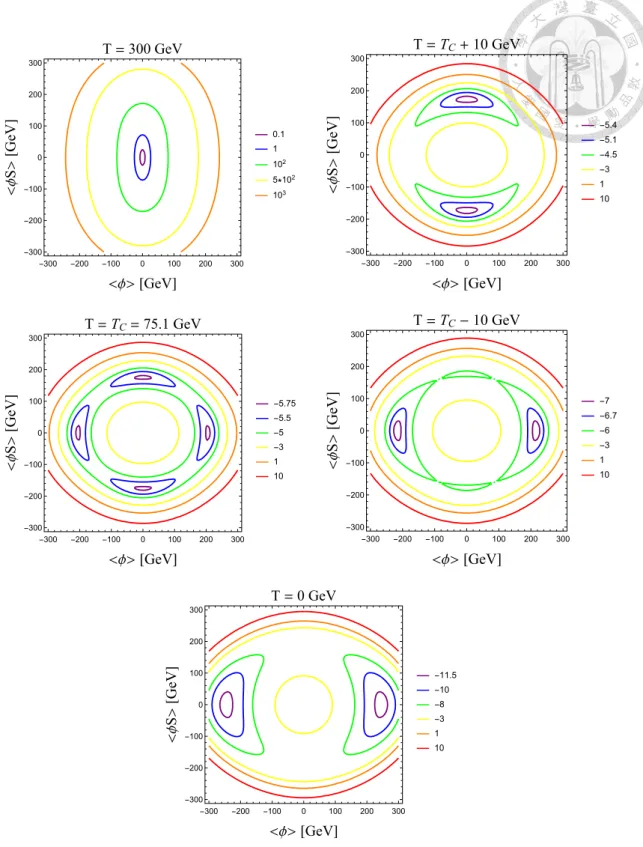
⟨ϕS⟩ at T = 300 GeV (Upper Left), T = TC + 10 GeV (Upper Right), T = TC = 75.1 GeV (Middle Left), T = TC−10 GeV (Middle Right) and T = 0 GeV (Lower). The parameters are, mS = mH/2 and λHS = 0.4.
Note that all the plot legends are in the unit of 107 GeV. . . 21
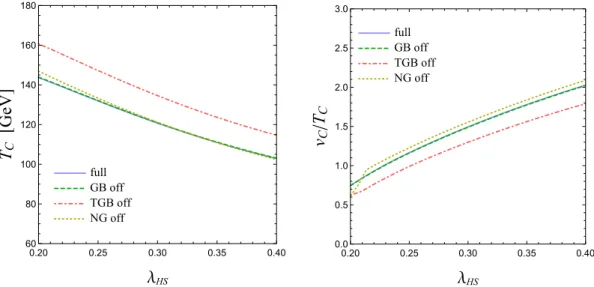
3.2 The effect of thermal (TGB off, red dot-dashed), non-thermal gauge (GB off, green dashed) and NG bosons (NG off, yellow dotted) contributions on TC (Left panel) and vC/TC (Right panel) in the OS-like scheme. The blue solid line includes all the contributions. . . 22
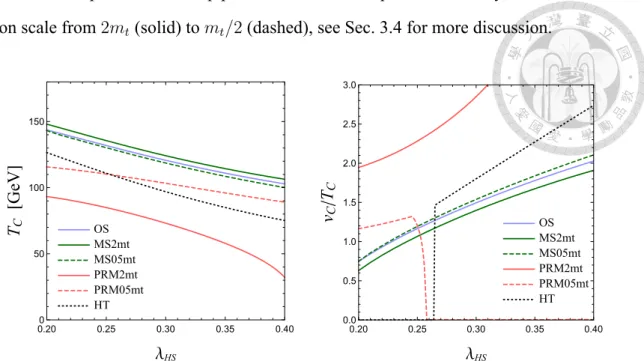
3.3 Comparison of scheme-depended results and investigation of scale depen- dence. Left: Critical temperature as the function of λHS. Right: vC/TC as the function of λHS. The OS-like scheme with NG resummation and the HT scheme are depicted as the blue solid and black dotted lines, re- spectively. For the MS and the PRM schemes, the style of lines are green and red, respectively. In the legend, “MS2mt (MS05mt)” represents that the MS scheme’s renormalization scale is at 2mt(mt/2). Same notation is also applied to the PRM scheme. . . 23
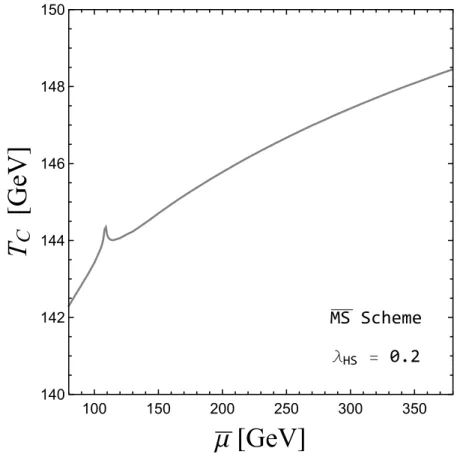
3.4 Critical temperature as the function of renomalization scale in the MS scheme. The parameter settings are λHS = 0.2 and mS = mH/2. The spike around 109 GeV is expected to be an accidental cancellation among contributions of different particle contents, not any physical or theoretical interest. . . 25
List of Tables
3.1 The input parameters in all schemes. Note that, besides the MS scheme (see Sec. 2.2), µH, µS, and λH satisfy the tree-level relations: µ2H = m2H/2, µ2S =−m2S+ λHS/2v02and λH = m2H/2v02. . . . 18 3.2 Summary of the scheme settings. . . 19 3.3 The percentage of the effects on the EWPT by turning off specific channel. 22
Chapter 1 Introduction
Cosmic baryon asymmetry (BA) problem [1, 2] is a long-standing and ongoing topic in particle physics and cosmology. Electroweak baryogenesis (EWBG), one of the most promising mechanisms to solve BA, requires a strong first-order electroweak phase tran- sition (EWPT) which creates electroweak(EW)-symmetry-breaking bubble. CP-violating interactions occur at the bubble wall and induce a net density of left-handed fermions. This process makes EW sphalerons produce unequal amounts of baryons and anti-baryons. For a successful EWBG theory, the baryon-number-changing processes have to sufficiently suppress inside the expanding EW-breaking bubbles in order to prevent the wash out. The criterion for above is*
critial vacuum expectation value, vc
critical temperature, TC > ζsph(TC), (1.1) where ζsph(TC) depends on the sphaleron configuration (or topology) [3] and the fluctu- ation determinant [4], etc. The current model [5] has showed that ζsph(TC) ≃ 1.1 − 1.2, where the one-loop effective potential with thermal resummation is used to evaluate the sphaleron energy. However, EWBG cannot be achieved by the standard model (SM) alone, since the discovered Higgs boson with 125 GeV [6] is incompatible to the mech- anism required. To be more specifically, in the SM, the first-order EWPT cannot take
*The critical phenomenology occurs when the potential energy of minima are degenerated and the tun- nelling process happens, i.e. ,the first-order phase transition from EW-symmetry vacuum to EW-breaking vacuum takes place.
place; instead, the EWPT is a smooth crossover [7]. Further, baryon number will be erasured due to the sphaleron processes. By extending the scalar sector with an SU(2)L singlet scalar(S), this simplest extension can provide a viable parameter space that makes the first-order EWPT possible. Furthermore, S can also be a dark matter (DM) candidate by imposing a Z2symmetry [8, 9].
In principle, every physical observable should be independent of any artificial effect.
For exanple, the full Higgs potential should be a gauge-independent quantity. Neverthe- less, in pratice, one has to truncate the calculation at a certian level since the full exact an- alytical form of potential cannot be obtained (in other words, full-loop calculation cannot be achieved). Perturbative effective potential is widely used to analyse EWPT; especially, one- or two-loop expansions are often adopted for various analyses. However, it is well known that any result from this method is depended on the gauge fixing parameter (ξ) [10]. For instance, the Higgs vacuum expectation value (VEV) is varying as one changes ξ. Furthermore, this gauge-dependent issue will contaminate the calculation of baryon- number preservation criterion, Eq. (1.1). As a result, any phenomenological claim and consequence is inherited this ξ dependence. Therefore, the gauge effect should be regu- larized. To be note that one of the exceptions is when the EWPT is driven by the scalar thermal loops or the tree-level barrier where the ξ dependence can be neglected. How- ever, in the singlet extended Abelian-Higgs model, as [11] found that the ξ dependence cannot be ignore even when the presence of the tree-level barrier. This issue is seldom investigated deeply in the context of studying EWPT by SM plus real singlet model.
Apart from the artifical gauge problem, another issue in the effective potential calcula- tions is the occurrence of infrared (IR) divergences. The Higgs mass is obtained from the second derivative of the effective potential. If one adopts a renormalization scheme that one-loop level potentials do not affect the tree-level mass relation, the second derivatives of the Nambu-Goldstone (NG) bosons one-loop potential are ill-defined when ξ in the Rξ gauge is set as zero. Thus, the Higgs mass is IR divergent in this case. One prescription to resolve is to inculde higher order terms into the NG boson masses [12, 13], i.e., resumming the NG boson masses. In the later, we will show that after the NG masses are resummed,
their contributions to the Higgs mass are relatively minor compared with other effects.
Nevertheless, their numerical effects on vC/TC are unexplored.
In this thesis, the EWPT is revisited in the context of the SM with a real singlet scalar.
To unfold the gauge problem aforementioned, we first analyse the degree of effect on vC/TC by subtracting both thermal and non-thermal gauge boson contributions from the effective potential. Even though the exact ξ dependence in the potential cannot be shown in this simple analysis, one can demonstrate numerically the importance of gauge channels in the successful first-order EWPT (vC/TC ≥ 1), as the ξ dependence mainly comes from the gauge contributions. This method stands as a criterion for whether the investigation of ξ dependence is necessary. Meanwhile, the numerical impact on the NG resummation in the on-shell(OS)-like scheme†is also analysed.
To avoid the scheme dependence issue, three commonly adopted schemes in the lit- erature are also investigated: (1) the MS scheme, (2) the high-temperature (HT) scheme and (3) the Patel-Ramsey-Musolf (PRM) scheme [4]. In the first scheme, unlike the OS- like scheme, the tree-level NG boson masses are non-zero, since the tree-level relations have been modified because of different tadpole conditions; thus, the aforementioned NG resummations are not required. The potential of the second scheme is defined as: the tree-level potential plus the scalar thermal mass terms only. Obviously, the potential is gauge-independent, because the thermal masses are free of the ξ dependence. In the last scheme, the Nielsen-Fukuda-Kugo (NFK) identity [15, 16] is adopted to obtain the gauge- invariant TC; vC is evaluated at the HT potential at TC in order to keep gauge-invariant.
In the last scheme, taking different potentials to obtain TC and vC may seem inconsistent.
However, this treatment grantees the results are strictly gauge-invariant. Note that the numerical comparison between the PRM scheme and the other gauge-dependent schemes has not performed yet, this is one of our goals to complement this work.
The effective potential is the major ingredient of analyzing EWPT and spontaneous symmetry breaking. For completeness, we briefly introduce the derivation of the effec- tive potential from the partition functional (see [17]) by using the Feynman path integral
†In [14], this scheme is called the on-shell scheme. Because this is not the genuine on-shell renormal- ization, we call this scheme the on-shell-like scheme instead.
method [18]. The effective potential in a more specific terminology should be called the generating functional for zero-momentum one-particle irreducible (1PI) Green function.
To begin with, we first recall W [J ],
Z[J] = eiW [J ] (1.2)
which is the generating functional for connected Green’s functions (the detail of generating functional of connecting Green function is shown in Appendix A). Expressing the partition functional,Z[J], with an external source field, J(x), in the path integral representation, we have
Z[J] =N
∫
Dϕ ei∫d4x[L(ϕ)+J(x)ϕ(x)] =⟨0+|0−⟩, (1.3) where N−1 =
∫
Dϕ ei∫d4x[L(ϕ)]. (1.4)
The second equality of Eq. (1.3) is a reminder that the partition function represents a state starts with a no particle state at +∞ position and end with a no particle state at −∞
position. The VEV of ϕ in the presence of J can be defined by
ϕc(y) = δW [J ] δJ (y) =
∫ Dϕ ϕ(y) exp( i∫
d4x [L(ϕ) + J(x)ϕ(x)])
∫ Dϕ exp( i∫
d4x [L(ϕ) + J(x)ϕ(x)]) ,
=⟨0+|ϕ(y)|0−⟩J,
(1.5)
the last equality shows that ϕcis actually a classical field. The physical VEV is
φ(y) = δW [J ] δJ (y)
J =0
= N
∫
Dϕ ϕ(y)ei∫d4x[L(ϕ)] =⟨0+|ϕ(y)|0−⟩. (1.6)
Furthermore, if we assume that the vacuum has a translational symmetry, the VEV does not depend on the spacetime position any more, i.e.,
ϕ =⟨0|ϕ(x)|0⟩ = ⟨0|eiP x1ϕ(0)e−iP x2|0⟩ = ⟨0|ϕ(0)|0⟩ = constant field. (1.7)
Motivated by the idea that finding a generating functional provides 1PI connect Green
function, the effective action provides the exact role. The effective action is defined as a Legendre transformation of W [J ],
Γ[ϕc] = W [J ]−
∫
d4x ϕc(x)J (x),
=−i {
lnN
∫
Dϕ exp [
i
∫
d4x (L(ϕ) + J(x)ϕ(x)) ]}
− i {
ln exp [
(−i)
∫
d4x J (x)ϕc(x) ]}
,
=−i {
lnN
∫
Dϕ exp [
i
∫
d4x (L(ϕ) + J(x) (ϕ(x) − ϕc(x))) ]}
.
(1.8)
In addition,
δΓ[ϕc]
δϕc(x) = J [x], (1.9)
which can be proved straight forward. The advantage of effective function can be under- stood from the following: while the source field is turning off, ϕcthat satisfies Eq. (1.9) is the lowest energy configuration of the theory. This solution has particularly interest in the spontaneous symmetry breaking analysis. The same idea is also applied to the effective potential which will be demonstrated in the later. By shifting the field, ϕ′ = ϕ−ϕc(the po- sition index is omitted hereafter), and using the definition of action: S(ϕ) =∫
d4xL(ϕ), Eq. (1.8) becomes
Γ[ϕc] =−ilnN
∫
Dϕ′ exp {
i [
S(ϕc+ ϕ′) +
∫
d4xJ ϕ′ ]}
. (1.10)
The small shifting of the field can be approximated by expanding the action around the classical field (ϕc),
S[ϕc+ ϕ′] = S[ϕc] +
∫
d4x δS[ϕc+ ϕ′] δϕ
ϕ′=0
ϕ′ + 1
2
∫
d4xd4y ϕ′(x)δ2S[ϕc+ ϕ′] δϕ(x)ϕ(y)
ϕ′=0
ϕ′(y) +· · · .
(1.11)
The action satisfies the variational principle; hence δS[ϕc+ ϕ′]
δϕ
ϕ′=0 = δS[ϕc]
δϕc = 0, δ2S[ϕc+ ϕ′] δϕ(x)δϕ(y)
ϕ′=0 = δ2S[ϕc] δϕc(x)δϕc(y),
= iG−1(x, y; ϕc),
(1.12)
where G is the two-point Green function. Then Eq. (1.11) can be arranged into
S[ϕc+ ϕ′] = S[ϕc] + 0 + 1 2
∫
d4xd4y ϕ(x)iG−1(x, y; ϕc)ϕ(y) +· · · . (1.13)
Because S[ϕc] is independent of ϕ, one can bring it out of the integral; then the effective action becomes
Γ[ϕc] = S[ϕc]− ilnN
∫
Dϕ′ exp {1
2
∫
d4d4y ϕ(x)G−1(x, y; ϕc)ϕ(y) }
+· · · . (1.14)
The second term can be evaluated by utilizing the equality,
∫ ∞
−∞
d⃗p e−12⃗p†A⃗p+⃗I†⃗p =
√(2π)n
detAe12⃗I†A⃗I, (1.15)
where n is the d.o.f. of p. In our case, ⃗I = 0 and A = iG−1. After absorbing√
(2π)nand N into Dϕ′, the effective action is
Γ[ϕc] = S[ϕc] + i
2lnDet iG−1(x, y; ϕc) +· · · , (1.16)
= S[ϕc] + i
2Trln iGˆ −1(x, y; ϕc) +· · · , (1.17)
= S[ϕc] + i 2Trln
∫
d4xd4y δ(x− y)iG−1(x, y; ϕc) +· · · , (1.18)
where the operator Det acts on the spacetime, (x, y) and also any internal space, e.g., color space or spinor space, etc. An identity is used: DetA = exp( ˆTrlnA), where ˆTr acts on the same space(s) as Det. Additionally, if the operator A is a function of spacetime, the functional trace has the property: TrA =∫
d4xA(x, x) which is adopted in Eq. (1.18).
We can simplify the above further by performing the integral and expressing the Green
function in the momentum space, which is convenient for the later use,
Γ[ϕc] = S[ϕc] + i 2Trln
∫
d4x iG−1(x, x; ϕc) +· · · , (1.19)
=
∫
d4xL(ϕc) + i 2
∫ d4p
(2π)4Trln iG−1(p; ϕc)
∫
d4x +· · · , (1.20)
=−V0(ϕc)
∫
d4x + i 2
∫ d4p
(2π)4Trln iG−1(p; ϕc)
∫
d4x +· · · , (1.21)
where we have assumed that ϕc is a constant field, so that kinetic term is absent. Since the tree-level potential is independent of spacetime, it can be brought out of the integral.
Finally, the effective potential is defined as the following:
Γ[ϕc]≡ −Veff(ϕc)
∫
d4x, (1.22)
Veff(ϕc) = V0(ϕc)− i 2
∫ d4p
(2π)4Trln iG−1(p; ϕc) +· · · , (1.23) V1(ϕc) =−i
2
∫ d4p
(2π)4Trln iG−1(p; ϕc), (1.24)
where V1 stands for the general one-loop potential of different particle contents. We can now easily understand what the name of effective potential represents: besides the dom- inant tree-level potential, the effective potential represents the potential that includes all the higher order corrections. In our analysis, we require the level of correction isO(¯h) which corresponds to the one-loop level. The detail of derivation of the one-loop level potential for each particle species can be seen in the Appendix B.
The thesis is organized as the following: In Chap. 2, we introduce our model, renorm- lization schemes and tadpole conditions in each scheme. In addition, the pattern of the EWPT and the method of searching TC and vC is outlined. Chap. 3 demonstrates our nu- merical analyses and we discuss the renormalization-scale dependence on TC. In the end, we discuss the DM issue in the Sec. 4.1; our results are summarized in the Sec. 4.2.
Chapter 2
Model: SM + Real Singlet Scalar
We consider a model in which SU(2)Lreal singlet scalar S is added to the SM. S can be the dark matter candidate by imposing the Z2 symmetry on the Lagrangian [9] (i.e., it is invariant under S → −S). We require S can only couple to the Higgs sector (the higgs portal). The tree-level Higgs potential of the theory is the following:
V0(H, S) =−µ2HH†H + λH(H†H)4− µ2S
2 S2+ λS
4 S4+λHS
2 H†HS2, (2.1)
where H is the usual complex Higgs doublet. It is written in terms of the components as
H(x) =
G+(x)
√1
2[ϕ + h(x) + iG0(x)]
, (2.2)
where ϕ which will eventually develop the non-zero VEV at≃ 246 GeV represents the constant background field (translational symmetry) of H. The real part of the neutral component of H is h(x), the 125 GeV Higgs boson. G0,±(x) stand for the NG bosons.
The superscripts refer to the electric charge of the fields. Presenting the potential in terms
of components, we have
V0 = −µ2H
2
{(ϕ + h)2+[
2G+G−+ (G0)2]}
+λH 4
{
(ϕ + h)4+ 2(ϕ + h)2[
2G−G++ (G0)2] +[
2G−G++ (G0)2]2}
−µ2H
2 S2+λS
4 S4+ λHS 2 S2{
(ϕ + h)2+[
2G+G−+ (G0)2]}
.
(2.3)
The tree-level effective potential can also be represented by using only the constant background fields (denoting background field of S as ϕS), by turning off quantum fields (h and G0,±),
V0(ϕ, ϕS) = −µ2H
2 ϕ2+λH
4 ϕ4−µ2S
2 ϕ2S+ λS
4 ϕ4S +λHS
4 ϕ2ϕ2S. (2.4)
In order to bound the potential from below, λH and λS must be greater than zero. In addition, another condition is necessary if λHS < 0. In the region that both ϕ and ϕSare large, we can denote ϕS = ϕδ, where δ is a number. The relevant terms in the potential become
V0 ∼ 1
4(λH + λSδ4 + λHSδ2)ϕ4. (2.5) To keep the bracket always greater than zero for arbitrary δ, we require
λ2HS < 4λHλS, if λHS < 0. (2.6)
Note that a local minimum in the S direction will appear as µ2S > 0. The EW-broken vacuum should be the global minimum in the present universe: V0(v, 0) < V0(0, vsymS ), where the superscript means that the singlets VEV is in a EW-symmetry phase. This condition requires that
−µ2H
2 v2+λH
4 v4 < −µ2S
2 (vSsym)2+ λS
4 (vSsym)4. (2.7)
By the minimum conditions at the tree level, vSsym = √
µ2S/λS and µ2H = λHv2, we can
rearrange above into
λS > λHµ4S
µ4H ≡ λminS . (2.8)
In the numerical analyses, we took λS = λminS + 0.1. This choice makes first-order phase transition possible and it is also adopted in [14]. Tadpole conditions are scheme- dependent. The general form is
Th(S)≡
⟨∂Veff
∂ϕ(S)
⟩
= 0, (2.9)
where⟨· · ·⟩ denotes that the term inside the bracket is evaluated in a vacuum and all quan- tum fields are taken as zero. The order of level of the effective potential (tree or loop, etc.) is evaluated depends on the corresponding scheme. The Landau gauge (ξ = 0) is taken when evaluating the gauge contributions, except the PRM scheme.
2.1 On-shell-like Scheme (OS-like)
The OS-like scheme requires that the loop corrections hold the tree-level relations when the one-loop corrections are added. Therefore, the renormalization conditions are*
⟨∂(VCW+ VCT)
∂ϕ
⟩
= 0,
⟨∂2(VCW+ VCT)
∂ϕ2
⟩
= 0,
⟨∂2(VCW+ VCT)
∂ϕ2S
⟩
= 0, (2.10)
where VCT are the counter terms, and VCW is the Coleman-Weinberg potential [19]:
VCT =−δµ2H
2 ϕ2− δµ2S
2 ϕ2S, (2.11)
VCW(m2i) = ∑
i
ni m4i 4(16π2)
( logm2i
µ2 − ci
)
, (2.12)
which is regularized in the MS scheme (see Appendix B). mirepresents different background- field-dependent masses (see the Appendix D for detail); its subscript stands for a particle’s species. We include the Higgs bosons (H1,2, eigenstates of the scalar sector), NG bosons
*Note that checking the first derivative of the one-loop potential with respect ϕSis trivial, since the Z2
symmetry guarantees it is zero.
(G±, G0), the gauge bosons (W, Z) and top quark (t). The degree of freedom (d.o.f.) and its statistic of the particle is denoted as ni: nH1,2,G0 = 1, nG± = 2, nZ = 3, nW = 6 and nt=−12. For the scalars and the top quark, c = 3/2, and for the gauge bosons, c = 5/6.
µ represents the renormalization scale.
The tadpole conditions for the OS-like scheme at the tree level are
Th ≡
⟨∂V0
∂ϕ
⟩
= v (
−µ2H + λHv2+λHS 2 vS2
)
= 0, (2.13)
TS ≡
⟨∂V0
∂ϕS
⟩
= vS
(
−µ2S+ λSv2S+λHS 2 v2
)
= 0, (2.14)
where v and vSare the VEVs of the doublet Higgs and S, respectively. For the Z2-invariant EW-broken vacuum (ϕ = v0, ϕS = 0), µ2H = λHv20 and vSBr = 0. Therefore, the Higgs boson masses in the vacuum are
m2H =
⟨∂2V0
∂ϕ2
⟩
=−µ2H + 3λHv02, (2.15) m2S =
⟨∂2V0
∂ϕ2S
⟩
=−µ2S+λHS
2 v02. (2.16)
NG Resummation
If we use Eq. (2.12) to evaluate the second condition of Eq. (2.10), one can notice that while mi equals to zero, which is the case for the NG bosons at the electroweak vacuum, a IR divergent term appears: λ2Hϕ2(log m2G/µ2)|ϕ→v0; regardless of what the value of µ is.
However, the existence of a IR problem often indicates that a theory is incomplete. In this case, it shows that the necessity of including the higher order correction to the NG boson masses, i.e., we need to resum the NG boson contributions. We adapt the same procedure as [12, 13], mG → MG = mG+ ΣG, where ΣG is the one-loop self-energy of the NG
boson with the vanishing external momenta:
ΣG= 1 16π2
[
3λHm2H1 (
log m2H1 µ2 − 1
) + 1
2λHSm2H2 (
logm2H2 µ2 − 1
)
+3g22 2 m2W
(
logm2W µ2 −1
3 )
+3(g22+ g21) 4 m2Z
(
log m2Z µ2 − 1
3 )
− 6yt2m2t (
logm2t
µ2 − 1)]
,
(2.17)
where g1 and g2 are the gauge couplings of U(1) and SU(2)L, respectively, and ytis the top Yukawa coupling. To solve δµ2H, δµ2S and µ numerically, we need to mG → MGin the NG boson channels of Eq. (2.12), and combine the CT terms (Eq. 2.11); finally, solve the renormlization conditions Eq (2.10), simultaneously.
2.2 MS Scheme
In the MS scheme, the tree-level relations are modified when the higher-order corrections are added in. In the other words, Eq. (2.15) and Eq. (2.16) will be modified by one-loop level contributions. We impose the tadpole conditions on the one-loop level,
Th ≡
⟨∂(V0+ V1)
∂ϕ
⟩
= v (
−µ2H + λHv2+λHS 2 v2S
) +
⟨∂VCW
∂ϕ
⟩
= 0, (2.18) TS ≡
⟨∂(V0+ V1)
∂ϕS
⟩
= vS (
−µ2S+ λSvS2 +λHS 2 v2
) +
⟨∂VCW
∂ϕS
⟩
= 0, (2.19)
by using the same solution like above (ϕ = v0, ϕS = 0); as a result, we have relations
µ2H = λHv20 + 1 v0
⟨∂VCW
∂ϕ
⟩
, (2.20)
⟨∂VCW
∂ϕS
⟩
= 0. (2.21)
The Higgs masses are
m2H =
⟨∂2(V0+ V1)
∂ϕ2
⟩
= (
−µ2H + 3λHv2+ λHS 2 v2S
) +
⟨∂2VCW
∂ϕ2
⟩
, (2.22) m2S =
⟨∂2(V0+ V1)
∂ϕ2S
⟩
= (
−µ2S+ 3λSv2S+λHS 2 v2
) +
⟨∂2VCW
∂ϕ2S
⟩
. (2.23)
Rearranging above by inputting the solution (ϕ = v0, ϕS = 0) and using Eq. (2.20), we have
m2H = 2λHv20− 1 v0
⟨∂VCW
∂ϕ
⟩ +
⟨∂2VCW
∂ϕ2
⟩
, (2.24)
m2S =−µ2S+λHS
2 v02+
⟨∂2VCW
∂ϕ2S
⟩
. (2.25)
We can solve µS, µH and λH through Eq. (2.24), Eq. (2.25) and Eq. (2.18), numerically.† Note that we set the renormalization scale of Eq. (2.12) at the range from 2mt ∼ 0.5mt. Since the NG boson masses are non-zero at the electroweak-broken vacuum, we do not need resummation as the OS-like scheme.
2.3 Thermal History and Thermal Potential
Like [20] pointed out that a two-step phase transition pattern increases the accessibility of EWBG. The pattern of two-step phase transition we are interested in is the following:
the global vacuum of the early hot universe was (ϕ, ϕS) = (0, 0). While the universe was cooling down, a primary phase transition (PT) occurred, the global minimum are transited to singlet direction (S) at (0, vSC), an EW-symmetry-preserving minimum. As the universe approached a critical temperature (TC) where the potential energy of doublet (H) and singlet minima are degenerate, the global vacuum tunnelled (required to be a first-order PT) to an EW symmetry-breaking minimum (vC, 0). At the present universe whose temperature is approximately zero, the vacuum arrived at (v0 ≃ 246 GeV, 0).
To investigate above scenario, the dynamic of thermal potential is essential for study-
†In Eq. (2.24), actually, the basis of the scalar sector for calculating VCWdoes not limit to the mass eigenstates; h, S basis is also available, due to the absence of hhS coupling. On the other hand, in Eq. (2.25), one must use mass eigenstates because of the existence SSh coupling.
ing the evolution of the universe. In the OS-like, the MS and the PRM (Sec. 2.5) schemes, we use the finite-temperature one-loop effective potential given by [21]:
V1T(ϕ, ϕS, T ) = ∑
i
ni T4 2π2IB,F
(m2i T2
) ,
where IB,F(a2) =
∫ ∞
0
dx x2ln (
1∓ e−√x2+a2) .
(2.26)
In the numerical computation, we use the approximated functions (see Appendix C) for computational efficiency. In addition, since the perturbative expansion is invalid when temperature is high, the thermal potential needs to be resummed. We replace m2i with thermally corrected masses,
m2i −→ m2i + Σi(ϕ, ϕS, T ), (2.27)
where Σi(ϕ, ϕS, T ) are the thermal masses (a more refined resummation method can be refered to, e.g., [22]), the exact forms can be found in the Appendix D. Notice that although thermal resummation is performed in the OS-like and the MS schemes, it is not performed in the PRM scheme; since we consider onlyO(¯h) = 1 in the PRM scheme (see Sec. 2.5 for detail) and the thermal resummation isO(¯h) = 2 effect.
2.3.1 Standard method of searching T
Cand critical VEVs
For a successful two-step EWPT, vC, TC, vSCBr and vSCsymare found numerically through the following equations and satisfying the inequalities:
Veff(ϕ = vC, ϕS = vBrSC, TC) = Veff(ϕ = 0, ϕS = vSCsym, TC), (2.28)
∂Veff
∂ϕ
vC, vBrSC, TC
= ∂Veff
∂ϕS
0, vsym
SC , TC
= 0, (2.29)
∂2Veff
∂ϕ2(S)
vC, vBrSC, TC (0, vsym
SC , TC) > 0, (2.30)
det
∂2Veff/∂ϕ2 ∂2Veff/∂ϕ∂ϕS
∂2Veff/∂ϕS∂ϕ ∂2Veff/∂ϕ2S
vC, vBrSC, TC (0, vsym
SC , TC)
> 0, (2.31)
where the last two inequalities assure that the minima are not saddle points. In Sec.2.5, we will discuss that why the standard method of determining TC and VEVs depends on the choice of gauge.
2.4 High Temperature (HT)
Both the OS-like and the MS schemes have gauge-dependent potential at the one-loop level. The high temperature approximation scheme provides a gauge-free and efficient method to investigate EWPT. This scheme simply includes the tree-level potential and the Higgs thermal mass terms which are taken from high temperature approximation at the O(2) of Eq. (C.1.1):
VHT(ϕ, ϕS, T ) = V0(ϕ, ϕS) + 1
2ΣH(T )ϕ2+ 1
2ΣS(T )ϕ2S, (2.32)
where ΣH and ΣS are the Higgs thermal masses which are gauge-independent [23], see Eq. (D.5, D.6) for detail. Because this scheme is gauge-free and ignores all the other loop contributions, we can obtain the gauge-invariant TC and VEVs from this potential in relatively efficient way compared with previous schemes. In the PRM scheme (Sec. 2.5), we also use this potential to evaluate VEVs.
2.5 Patel-Ramsey-Musolf (PRM) Scheme
The main goal of the PRM scheme is to get gauge-free results. Unlike the HT scheme, the PRM scheme takes the one-loop order corrections and the thermal effects into account. As the tadpole conditions are set at the tree level, the tree-level conditions are preserved. The renormalization scale is set same as the MS scheme which is varied from 2mt ∼ 0.5mt. In the next subsection, we elaborate how the PRM scheme utilizes NFK identity to get gauge-free results.
2.5.1 Gauge-independent T
Cand VEVs
The NFK identity [15, 16] tells us that‡
∂Veff(ϕ, ξ)
∂ξ =−C(ϕ, ξ)∂Veff(ϕ, ξ)
∂ϕ , (2.33)
where C(ϕ, ξ) is a functional. In fact, TCcan be proved formally to be gauge-independent with the identity and Eq. (2.28)[4] as long as we are working on the full order of the effec- tive potential. However, in the practical calculation for TC, one could only calculate the potential up to some order. For example, like in our previous standard method of deter- mining TC includes only the one-loop order effect; thus, this causes an artificial violation of the NFK identify, even though the full order formalism is gauge-invariant. In order to regulate this issue, we have to keep tracking whether the identity is valid in each order of
¯
h. In the perturbation theory, in principle, we can expand Veffand C in the power of ¯h:
Veff(ϕ) = V0(ϕ) + ¯hV1(ϕ, ξ) + ¯h2V2(ϕ, ξ) +· · · , (2.34) C(ϕ, ξ) = c0+ ¯hc1(ϕ, ξ) + ¯h2c2(ϕ, ξ) +· · · . (2.35)
By inserting them into Eq. (2.33), we get
¯
h∂V1(ϕ, ξ)
∂ξ + ¯h2∂2V2(ϕ, ξ)
∂ξ2 +· · · = − c0
∂V0
∂ϕ − ¯h (
c1(ϕ, ξ)∂V0(ϕ)
∂ϕ + c0∂V1(ϕ, ξ)
∂ϕ )
+O(¯h2) +· · · ,
(2.36)
where we had expressed Eq. (2.33) in ¯h order. Since the tree-level potential is free of ξ-dependence, c0 = 0. AtO(¯h),
∂V1(ϕ, ξ)
∂ξ = c1(ϕ, ξ)∂V0(ϕ)
∂ϕ . (2.37)
‡Even though our potential is a two dimensional (ϕ, ϕS) function, the procedure is straight forward: by taking the other dimensions as zero, one can get a pair of Eq. (2.33). Using the same method described in above, one can get similar results.
Eq. (2.37) shows that as long as we are working onO(¯h), the gauge dependence of V1(ϕ, ξ) is vanished at stationary point(s) of the tree-level potential. On the contrary, TCand VEVs determined by the standard method are evaluated in the tree-level plus one-loop potential minima; as a result, those results are gauge-dependent. Extending above to our model, the ξ dependence of V1(ϕ, ϕS, ξ) disappears while we evaluate TC at the tree-level minima:
(ϕ = vtree = 246 GeV, ϕS = 0) and (ϕ = 0, ϕS = vtreeS = √
µ2S/λS). For the two-step EWPT, the gauge-independent TC can be obtained from the following:
V0(vtree, 0) + VCW(vtree, 0) + V1T(vtree, 0, TC)
= V0(0, vStree) + VCW(0, vStree) + V1T(0, vStree, TC).
(2.38)
Note that as we are working onO(¯h), the thermal resummation, a two-loop order O(¯h2) effect, is not performed. Going beyondO(¯h) requires two-loop contributions which is out of scope of our current analysis. In the Appendix E, we give an example to explicitly show how the gauge dependence disappears when the potential is evaluated at the tree- level minima.
The minima, vC and vSC, are inherited gauge dependence which can easily be un- derstood from the NFK identity: in Eq. (2.33), the field value minimizing the effective potential is gauge-dependent. To get gauge invariant VEVs in the PRM scheme, we have to utilize the HT potential, Eq. (2.32), by finding the minima at TC, i.e., find the minima of VHT(ϕ, ϕS, TC).
Chapter 3
Numerical Analysis
In our model, mS, λS and λHS are the free parameters. We take mS = mH/2 which is within DM experiment bound and phenomenology (see Sec. ?? for the discussion), and choose λS = λminS + 0.1, see Eq. (2.8); thus only λHS is varied in the analyses. Aiming to investigate the gauge dependence, a range of λHS is selected where the tree-level po- tential is relatively minor compared with gauge loop contributions to the potential barrier.
Furthermore, this particular range meets the conditions of the two-step strong first-order EWPT (vC/TC ≃ 1 and several inequalities in Sec. 2.3.1). For clarity, our input param- eters are listed in Table 3.1, and we summarize the settings of the each scheme in Table 3.2.
In Sec. 3.1, we list a detail procedure of finding TCand vC; in addition, their precisions in the analyses are also shown. Our analyses can be divided into two parts: Sec. 3.2 focuses on the effect of gauge and the NG boson channels in the OS-like scheme, Sec. 3.3 demonstrates how the scheme dependence influences the results.
Parameter
mH v0 mW mZ mt Value [GeV] 125 246 80.4 91.1 173.2
Table 3.1: The input parameters in all schemes. Note that, besides the MS scheme (see Sec. 2.2), µH, µS, and λH satisfy the tree-level relations: µ2H = m2H/2, µ2S = −m2S + λHS/2v02 and λH = m2H/2v02.
Scheme
OS-like MS HT PRM
Tadpole Condition Tree 1-loop Tree Tree
NG resummed √
- - -
Thermal resummed √ √
- -
ξ dependence √ √
- -
Table 3.2: Summary of the scheme settings.
3.1 Critical Temperature and Critical VEV
Two s of method of finding TC are used; For the PRM scheme, TC is found by Eq. 2.38.
For the OS-like, the HT and the PRM schemes, TC is searched by the bisection method whose details of procedure are listed in the following*:
1. choose two initialized temperatures, Tmax(e.g., 200 GeV) and Tmin(100 GeV). To use the bisection method, one also needs a middle value, Tmid = (Tmax+ Tmin)/2 (150 GeV),
2. calculate the energy difference, ∆E, between the potential energy of minima in singlet’s, E(ϕmin), and doublet’s, E(ϕminS ), directions†at Tmid, i.e.,
∆E(Tmid) = E(ϕmin, Tmid)− E(ϕminS , Tmid), (3.1)
3. calculate ∆E at Tmin, that is
∆E(Tmin) = E(ϕmin, Tmin)− E(ϕminS , Tmin), (3.2)
4. if ∆E(Tmid)× ∆E(Tmin) < 0, we can redefine Tmin → Tmin, and Tmax → Tmid, otherwise Tmin→ Tmidand Tmax→ Tmax,
5. take the new Tmidand Tminback to the step 2. and go though the procedure again.
The above is calculated iteratively until
*We useMathematica to analyse our model.
†We use theFindminimum, the optional methods InteriorPoint and PrincipleAxis are chose.