243
Journal of Biomolecular Structure & Dynamics, ISSN 0739-1102 Volume 29, Issue Number 1, (2011) ©Adenine Press (2011)
iSMART: An Integrated Cloud Computing
Web Server for Traditional Chinese Medicine
for Online Virtual Screening, de novo Evolution
and Drug Design
Introduction
Traditional medicines and herbal medicines, while having different approaches from conventional western medicine, have been recognized worldwide for their therapeutic values. The 2003 World Health Assembly (WHA) has enlisted tradi-tional medicine as one of the major health care issues. The World Health Organiza-tion’s (WHO) 2002-2005 Traditional Medicine Strategy reported that the traditional medicine industry worldwide has a net value of over $60 billion US dollars, and was still increasing. Particularly, Traditional Chinese medicine (TCM), which is a vast knowledge bank of 5000-year medical practices, played an important role among traditional medicine. In Eastern World, TCM never ceased its popularity and influence among the society. Recent global TCM and herbal medicine have market values of approximately $20 billion in US dollar, have annual growth rate of 10-20%. Moreover, TCM user population is also increasing at 20% annual growth rate. In addition, the “WHO International Standard Terminologies on Traditional Medicine in the Western Pacific Region” has published standard translation of over 3,000 TCM terminologies for medical practice and scientific researches. Despite the increased documented importance of TCM, studies in TCM drug discovery remained a minor part of pharmaceutical researches.
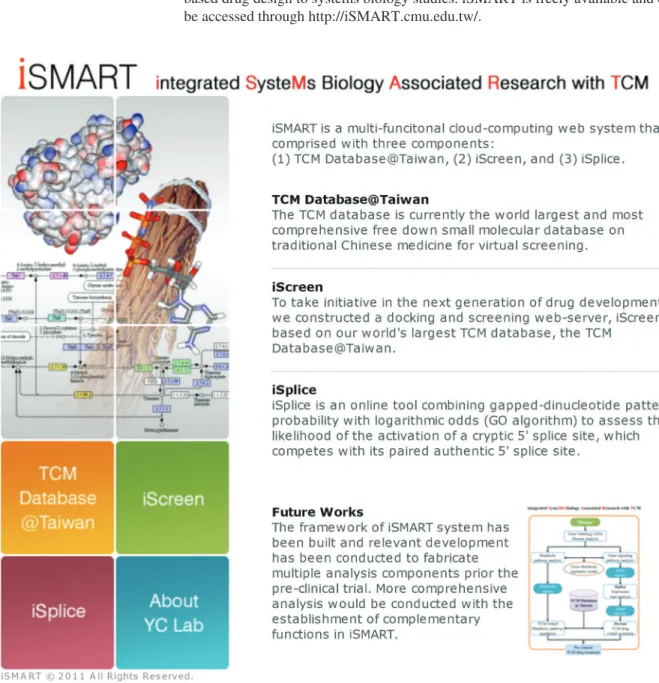
With the progress of computer and information technology, recent development of pharmacology has adapted the in silico analysis, such as virtual screening, computer-aided drug design, and molecular dynamics, as critical leading steps for drug discov-ery. This in silico protocol has also been employed for drug design (1-13). However, there was no strong evidence for significant correlation between TCM and systems biology. The concept of bridging TCM and systems biology has been proposed as early as year 2005. Although this concept could be beneficial to the development of TCM, many issues were raised while joining the two medical systems. Nevertheless researchers, predominantly in the Eastern World, have found correlations between TCM studies to systems biology in certain medical aspects (14-16). The increasing popularity of TCM studies is becoming an unneglectible trend worldwide. For the globalization of TCM studies and user-friendly online analysis server, we intro-duced a multi-purpose, cloud computing-based web server, the “integrated SysteMs Biology Associated Research with TCM” (iSMART) (Figure 1).
iSMART was developed for online TCM analysis focused on drug design. This server system was further implemented with genetic research features aimed to
*Phone: +1-617-353-7123 E-mail: [email protected] [email protected]
Kai-Wei Chang
1Tsung-Ying Tsai
1Kuan-Chung Chen
1Shun-Chieh Yang
1Hung-Jin Huang
1Tung-Ti Chang
1Mao-Feng Sun
1,2Hsin-Yi Chen
3Fuu-Jen Tsai
2,3Calvin Yu-Chian Chen
1,3,5,6*1Laboratory of Computational and Systems Biology, School of Chinese Medicine, China Medical University, Taichung, 40402, Taiwan
2 Department of Acupuncture, China Medical University Hospital, Taichung, Taiwan
3Department of Bioinformatics, Asia University, Taichung 41354, Taiwan
4Department of Medical Genetics, China Medical University, Taichung 40402, Taiwan
5Department of Systems Biology, Harvard Medical School, Boston, MA 02115, USA
6Computational and Systems Biology, Massachusetts Institute of Technology, Cambridge, MA 02139, USA
Open Access Article
The authors, the publisher, and the right holders grant the right to use, reproduce, and disseminate the work in digital form to all users.
Key words: AIDS: Traditional Chinese medicine (TCM); Cloud-computing; Docking; Screening; Systems biology.
244
Chang et al.
identify erroneous splicing events. Functions with regard to the TCM and disease analysis in systems biology aspects, including items such as disease-pathway net-work and TCM drug netnet-work would be brought online in near future. We aim iSMART to become a comprehensive web system that bridges TCM and computer-based drug design to systems biology studies. iSMART is freely available and can be accessed through http://iSMART.cmu.edu.tw/.
TCM Database@Taiwan
Following the description of the in-house developed TCM Database@Taiwan (17), this database maintains and organizes over 20,000 compounds originated from TCM substances. The source, basic molecular properties, 3D compound structure, and references were recorded. Relevant search and browse modules were implemented.
iScreen
iScreen is an online virtual screening web server focused on identifying compatible TCM compounds as well as their derivatives to the target protein. This web server was implemented with multiple molecular docking algorithms from the PLANTS
Figure 1: The title page of iSMART. iSMART is built as a pioneering system for realizing the concept of bridging TCM studies to systems biology researches.
245
Webserver for Traditional
Chinese Medicine
docking package (18) and the de novo compound evolution function from LEA3D ligand-design software (19). In addition, iScreen was also able to perform protein preparation services to utilize the molecular docking process.
iSplice
iSplice is a web server designed to identify the activation and the strength of cryptic 5’ splice site on that may lead to disease development. An input DNA sequence would be evaluated by novel gapped-dinucleotide pattern probability and logarith-mic odds algorithm (GOA), which have been validated within our research team. A total of 189, 249 5’ splice sites from human genome (20) were employed for training the prediction model implemented in iSplice.
TCM Drug Network
The TCM drug network identified pair-wise TCM drug relationships based on their association in metabolic pathways. Drugs under the same TCM classification were grouped for cluster analysis. TCM linked Gene Ontology (GO) analysis (21), Kyoto Encyclopedia of Genes and Genomes (KEGG) networks (22), and Online Mendelian Inheritance in Man (OMIM) database (23) were employed for data min-ing and network construction. The drug-drug correlation is calculated based on the traditional mutual information (MI) entropy (24), which was defined as equation [1] for drug x and drug y.
MI x y P x y P x y P x P y , , log ,
(
)
=(
)
⋅(
)
( )
⋅( )
[1]The average distance (d) between TCM drugs was evaluated by equation [2] for drug x and drug y.
d x y I x y i d x y i I x y i , ( , , ) ( , , ) ( , , )
(
)
=∑
⋅∑
[2]A scoring system (sco) is hence built for evaluating the relationships between a pair of TCM drugs by equation [3] in which larger value represents stronger correlation, and vice versa.
sco x y MI x y
d x y
, ( , )
( , )
(
)
[3]What Does iSMART Offer?
iSMART is an integrated multi-functional cloud computing web server aimed for performing comprehensive analysis for TCM-associated studies. Present system is comprised with three major components: (1) TCM Database@Taiwan, (2) iScreen, and (3) iSplice.
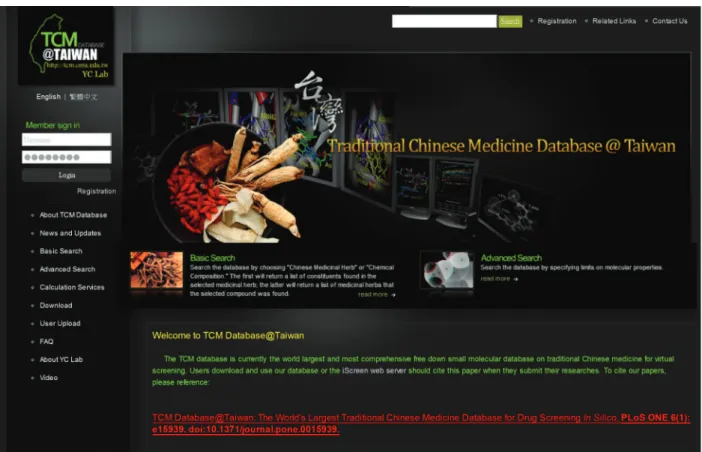
TCM Database@Taiwan offers both 2D and 3D structures of small molecules from TCM (17) (Figure 2). The TCM sources are arranged based on the TCM clas-sification. Relevant molecular properties and references were documented for all compounds. In addition, the database is incorporated with advanced search and browsing functions that can extract data based on compound name, origin, molecu-lar properties, and partial 3D structures. TCM Database@Taiwan is continuously expanding toward a more comprehensive database that comprised not only TCM compounds, but also compounds from natural sources. In addition, TCM Data-base@Taiwan is the core database component for relevant online components such as iScreen and the underdevelopment TCM-linked networks.
246
Chang et al.
could be determined and downloaded for further analysis. In addition, iScreen also allows advanced users to define the TCM compound derivatives through de
novo evolution. The compatibilities of the TCM derivatives to the targets would be evaluated. iScreen is a direct application of the in-house TCM Database. This web server provides an overview of potential TCM functions in molecular level. The identified compounds as well as their TCM origins could be tested for the therapeutic values.
Nevertheless, iSMART is not limited to TCM based drug design and relevant researches directly from the given protein targets. For the identification of potential disease-causing targets, iSplice was developed to evaluate genetic components that may lead to diseases. More specifically, iSplice identifies the activation and the activity strength of cryptic 5’ splice sites due to mutation (Figure 4). Follow-up evaluation of the results from iSplice could lead to the identification of disease-causing targets due to genetic aberration. iSplice is also one of the components that may lead the TCM studies toward genetic components and regulations.
Figure 2: TCM Database@Taiwan, the world’s largest traditional Chinese medicine database for drug screening in silico. This database main-tains over 20,000 TCM compounds based on TCM classification. Simple molecular properties and molecular structure of each compound were recorded and ready for search and browse.
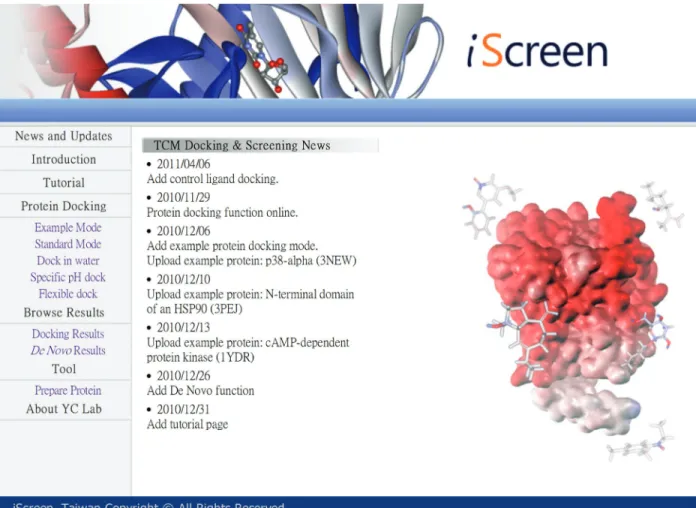
For utilizing the uses of the TCM database, we implemented iScreen for online TCM-based drug design (Figure 3). The web server is able to identify sets of TCM compounds that fit into the proteins of interest. For utilizing the molecular docking procedure, iScreen provides protein preparation service that cleans up additional components from the original protein data. For customized molecular docking and screening, iScreen simulates multiple docking conditions, including stan-dard, with simulated water, with specific pH condition, and with flexible protein residues. A set of TCM compounds could be identified, relevant docking scores
247
Webserver for Traditional
Chinese Medicine
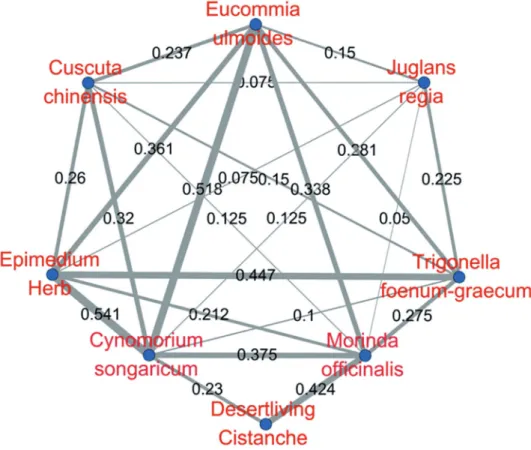
iSMART is not limited to the three components described above, this system is also expandable for adapting addition components and creating associative links for providing more comprehensive analysis services. The relationships between the TCM components have been established based on the TCM drugs networks. For example, Figure 5 illustrates a relationship network between yang-tonifying TCM substances. The association strengths between TCM substances could be determined
in pairwise analysis based on such a network. Similar protocol would be further applied to build the relationship networks between TCM formulae. With more functions established in the foreseeable future, iSMART would be able to establish networks between diseases, signaling pathways, and metabolic pathways. Associa-tive TCM compounds could hence be identified accordingly.
Conclusion
iSMART is developed in the hope to become a central hub for TCM studies and systems biology research. Although this web-based system is at its infant stage, its components, TCM Database@Taiwan, iScreen, and iSplice, have been established and used by researchers interested in TCM studies. The TCM Database@Taiwan is the central component for storing data of TCM small molecule. This database has been adapted by iScreen as well as other network system components cur-rently not established. The iScreen is a user-friendly web server for TCM-based
Figure 3: iScreen, the world’s first cloud computing web server for TCM drug screening and De Novo design. For molecular screening/docking, iScreen provides 4 docking modes: standard, in water, in specified pH, and with flexible ligands, as well as 1 demonstration docking module. The compounds from the screening results can be further derived based on the De Novo drug design function. Both docking results and De Novo results are visible in the queuing system. iScreen is also implemented with protein preparation tool to reduce errors caused by excessive information in the raw input data.
248
Chang et al.
molecular screening that could increase the efficiency in TCM-related drug design. The iSplice server is the first iSMART component for genetic analysis. At pres-ent, iSMART is a multi-purpose cloud computing web system for TCM-associated analysis.
Future Development
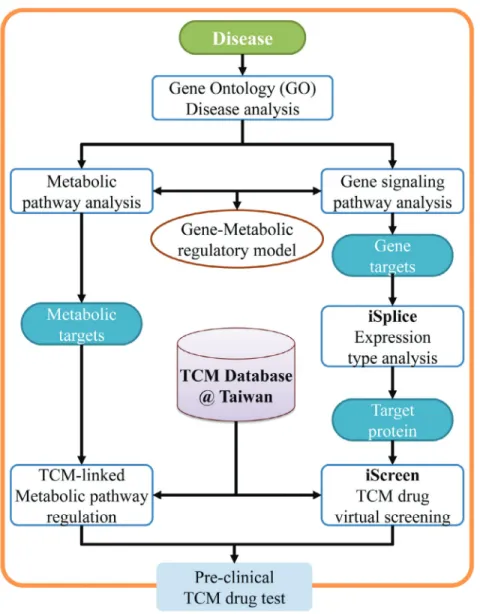
The framework of iSMART system has been built and relevant development (Figure 6) has been conducted. We define iSMART as a TCM-based online resource that fabricate multiple analysis components prior the pre-clinical trial in a standard drug development procedure. With the establishment of the
comple-Figure 5: Correlation network of 8 TCM drugs categorized under yang-tonifying class. 8 TCM drugs were included in this group. Each line represents the correlation between a pair of TCM drugs. Line width and the attached value indicated the correlation strength between a pair of TCM drugs.
Figure 4: iSplice, a web server for predicting the activation of cryptic 5’ splice site. It is a unique component in iSMART for a specific class of genetic analysis. Users can identify both authentic and cryptic 5’ splice sites, and their relevant activation strength based on the input gene sequence and point of mutation.
249
Webserver for Traditional
Chinese Medicine
Figure 6: The schematic framework of iSMART’s component relationships. Systems biology analy-sis functions were implicitly defined based on the establishment of the analyanaly-sis components. For analysis, a disease would be categorized and its associative signaling and metabolic pathways would be defined accordingly. The genetic defects, such as cryptic 5’ splice site activation, would be identified, and relevant targets would be extracted for drug design. On the other hand, the therapeutic targets along the metabolic pathway would be identified accordingly. iScreen would be applied to identify potential TCM compounds from TCM Database@Taiwan against the designated targets. The analysis results and their medical relevance would be validated through pre-clinical tests.
mentary functions as indicated in the framework diagram, more comprehensive analysis could be conducted through iSMART. iSMART is built as a pioneer-ing system for realizpioneer-ing the concept of bridgpioneer-ing TCM studies to systems biology researches. The development of iSMART could be a milestone for the globaliza-tion of TCM development.
Acknowledgements
The research was supported by grants from the National Science Council of Tai-wan (NSC 99-2221-E-039-013-), China Medical University and Asia University (TCM, S-02, ASIA-25, ASIA-26 CMU99-ASIA-27 CMU99-ASIA-28). This study is also supported in part by Taiwan Department of Health Clinical Trial and Research Center of Excellence
(DOH100-250
Chang et al.
TD-B-111-004) and Taiwan Department of Health Cancer Research Center of Excellence (DOH100-TD-C-111-005). We are grateful to the Asia University cloud computing facilities.
References
C. Y.-C. C. Kuan-Chung Chen.
1. Soft Matter 7, 4001-4008 (2011). A. M. Andrianov.
2. J Biomol Struct Dyn 26, 445-454 (2009). A. M. Andrianov and I. V. Anishchenko.
3. J Biomol Struct Dyn 27, 179-193 (2009). M. T. Cambria, D. Di Marino, M. Falconi, S. Garavaglia, and A. Cambria.
4. J Biomol Struct
Dyn 27, 501-509 (2010). C. Y. Chen.
5. J Biomol Struct Dyn 27, 627-640 (2010).
C. Y. Chen, Y. H. Chang, D. T. Bau, H. J. Huang, F. J. Tsai, C. H. Tsai, and C. Y. C. Chen. 6.
J Biomol Struct Dyn 27, 171-178 (2009).
E. F. F. da Cunha, E. F. Barbosa, A. A. Oliveira, and T. C. Ramalho.
7. J Biomol Struct Dyn
27, 619-625 (2010).
L. I. D. Hage-Melim, C. H. T. D. da Silva, E. P. Semighini, C. A. Taft, and S. V. Sampaio. 8.
J Biomol Struct Dyn 27, 27-35 (2009).
H. J. Huang, K. J. Lee, H. W. Yu, C. Y. Chen, C. H. Hsu, H. Y. Chen, F. J. Tsai, and C. Y. 9.
C. Chen. J Biomol Struct Dyn 28, 23-37 (2010).
H. J. Huang, K. J. Lee, H. W. Yu, H. Y. Chen, F. J. Tsai, and C. Y. Chen.
10. J Biomol Struct
Dyn 28, 187-200 (2010).
A. K. Kahlon, S. Roy, and A. Sharma.
11. J Biomol Struct Dyn 28, 201-210 (2010).
C. Koshy, M. Parthiban, and R. Sowdhamini.
12. J Biomol Struct Dyn 28, 71-83 (2010).
T. T. Chang, H. J. Huang, K. J. Lee, H. W. Yu, H. Y. Chen, F. J. Tsai, M. F. Sun, and C. Y. 13.
Chen. J Biomol Struct Dyn 28, 309-321 (2010).
M. Wang, R. J. Lamers, H. A. Korthout, J. H. van Nesselrooij, R. F. Witkamp, R. van der 14.
Heijden, P. J. Voshol, L. M. Havekes, R. Verpoorte, and J. van der Greef. Phytother Res 19, 173-182 (2005).
P. Li and L. P. Yang.
15. Journal of Chinese integrative medicine 6, 454-457 (2008).
A. B. Burgin, O. T. Magnusson, J. Singh, P. Witte, B. L. Staker, J. M. Bjornsson, 16.
M. Thorsteinsdottir, S. Hrafnsdottir, T. Hagen, A. S. Kiselyov, L. J. Stewart, and M. E. Gurney. Nat Biotechnol 28, 63-70 (2010).
C. Y.-C. Chen.
17. PLoS ONE 6, e15939 (2011). O. Korb, T. Stutzle, and T. E. Exner.
18. J Chem Inf Model 49, 84-96 (2009).
D. Douguet, H. Munier-Lehmann, G. Labesse, and S. Pochet.
19. J Med Chem 48, 2457-2468
(2005).
K. Sahashi, A. Masuda, T. Matsuura, J. Shinmi, Z. Zhang, Y. Takeshima, M. Matsuo, 20.
G. Sobue, and K. Ohno. Nucleic Acids Res 35, 5995-6003 (2007).
M. Ashburner, C. A. Ball, J. A. Blake, D. Botstein, H. Butler, J. M. Cherry, A. P. Davis, 21.
K. Dolinski, S. S. Dwight, J. T. Eppig, M. A. Harris, D. P. Hill, L. Issel-Tarver, A. Kasarskis, S. Lewis, J. C. Matese, J. E. Richardson, M. Ringwald, G. M. Rubin, and G. Sherlock. Nat
Genet 25, 25-29 (2000).
M. Kanehisa, S. Goto, M. Furumichi, M. Tanabe, and M. Hirakawa.
22. Nucleic Acids Res 38,
D355-360 (2010). V. A. McKusick.
23. Am J Hum Genet 80, 588-604 (2007). D. Beeferman, A. Berger, and J. Lafferty.
24. Mach Learn 34, 177-210 (1999).
Date Received: March 26, 2010