明新科技大學 校內專題研究計畫成果報告
綠色產品之環境資訊的平台建置
The Construction of Environmental Information Platform for
the Green Products
摘要
依循延長生產者責任(EPR)及整合性產品政策(IPP)之思維,歐盟近年來陸續公 佈多項環保指令或規範(RoHS、WEEE、EuP 等),直接管制進入歐洲市場之產品生 產者或製造商應符合特定之環保要求,並間接造成了貿易或技術上之障礙。而近 期國際各貿易區間的競相呼應(如美國加州、中國、日本、韓國等),更使得市場機 制因而產生變異。面對上述貿易限制或變化,產業及其供應鏈體系不僅須即時因 應,更須積極於產品設計階段,整合環境考量面導入生態化設計(Ecodesign)或環境 化設計(Design for Environment)理念及技術。自 94 年起,經濟部工業局即於相關輔導計畫項下,持續規劃「環境化設計 (Design for Environment, 簡稱 DfE)」之輔導,由台灣產業服務基金會負責執行。 本研究歸納生態化設計推動要項,期提供相關產業因應 EuP 指令之參考: 1. 彙整國際環保規範:建議參考歐盟相關環保指令及標章產品規範,做為產品 生態化設計查核要項。 2. 評估產品生命週期環境衝擊:可參考產品環境績效評估指標、整合產品環境 考量面進行量化數據蒐集後,與產業均值比較或自行評比;另,亦可參考 ISO 14040 進行實際盤查,並代入生命週期評估工具軟體(如 SimaPro、Gabi 或 EcoReport 等)初估相關環境衝擊程度。 3. 研擬生態化設計策略:逐一檢視產品相關環保規範符合性,及生命週期各階 段環境衝擊程度,據以擬訂生態化設計策略,並依技術、可行性及成本, 設定改善目標與方案。 4. 量化改善之環境績效:分別針對改善方案進行環境績效量化,可利用投入、 產出之各物理量進行估算。
z 資訊需考量其他歐盟指令要求(ex. 2002/96/EC)
第二章 參考文獻
截至目前為止,EUP 的實際的實施方法尚未完全確認,不過國內目前大部分 的人皆認為 EUP 包含 ROHS,WEEE,Energy saving,及 LCA 的各項議題,如圖 1 所示: Environmental Impact On mode Sleep mode Off mode Pb, Cr+6, Cd, Hg, PBB, PBDE
DfE Report for LCA DfE Report for
Energy LCA Data Energy Data Environmental Information 3R Report
DfE Report for WEEE
DfE Report for RoHS
RoHS Data
Eco-Profile
(Environmental Data Sheet)
LCA Energy Saving RoHS WEEE EuP
圖 2. LG. Philips 公司所宣告的產品回收率
另外,HP 公司也具體以拆解報告針對其所生產之產品,說明其產品之易拆解 設計,請參閱圖 3。在圖 3 中,HP 分別依其所生產之產品標示如何拆解產品,並 分別說明其 WEEE 指令的附錄二的零組件。
Product End-of-Life Disassembly Instructions
Product Category: Calculators Marketing Name / Model [List multiple models if applicable.]
Name / Model #1 Name / Model #2 Name / Model #3 Name / Model #4 Name / Model #5
Purpose: The document is intended for use by end-of-life recyclers or treatment facilities. It provides the basic instructions
for the disassembly of HP products to remove components and materials requiring selective treatment, as defined by EU directive 2002/96/EC, Waste Electrical and Electronic Equipment (WEEE).
1.0 Items Requiring Selective Treatment
1.1 Items listed below are classified as requiring selective treatment.
1.2 Enter the quantity of items contained within the product which require selective treatment in the right column, as applicable.
Quantity of items Item Description Notes included in product
Printed Circuit Boards (PCB) or Printed Circuit With a surface greater than 10 sq cm
圖 3. HP 公司之拆解報告
Assemblies (PCA)
Batteries All types including standard alkaline and lithium coin or button style batteries
Mercury-containing components For example, mercury in lamps, display backlights,
scanner lamps, switches, batteries
Liquid Crystal Displays (LCD) with a surface greater than 100 sq cm
Includes background illuminated displays with gas discharge lamps
Cathode Ray Tubes (CRT)
Capacitors / condensers (Containing PCB/PCT)
Electrolytic Capacitors / Condensers measuring
greater than 2.5 cm in diameter or height
External electrical cables and cords
Gas Discharge Lamps
Plastics containing Brominated Flame Retardants weighing > 25 grams (not including PCBs or PCAs already listed as a separate item above)
Components and parts containing toner and ink, Include the cartridges, print heads, tubes, vent
including liquids, semi-liquids (gel/paste) and toner chambers, and service stations.
第三章 研究方法
圖 3.1 3R 回收拆解資料庫系統流程圖
3.1 供應商盤查(Survey)
3.2 WEEE 零件資料 各公司都會記錄自己的產品資訊,但並不會對上游零件供應商之零件資料作 太詳細的記錄,由於 3R 計算必須知道體積、材質等詳細資料,因此本研究設計資 料從各供應商處獲得,且這些資料也是供應商手邊本來就有的,並不會對其造成 太大的困擾。經由供應商所提供的物料清單(BOM)可收集到下列資料: (1) P/N:即 Product Name,為代表此供應商產品之代碼。若供應商之代碼與 料資料接收方之代碼不相同時,需經過代碼替換。舉例如原供應商之產 品代碼 10021 對應該公司之代碼 A0101,10022 對應 A0102…依此類推, 即使料號不同依然可各自記錄正確對應之零件資料。 (2) Part class:即零件類別,一般公司會將零件區分為包裝材(Package)、機構 件(Machinery)、及電子件(Electron)三大類。在本系統中之 Part class 即分 為此三大類別。
Report 即研發人員選料後之用料清單報告。 Material class 即前述之產品類別。
Material 即前述之材質。
Ideal recycle rate 理想狀態下各材質所對應之回收比率。即取文獻中各 材質回收比率之最大值。
Ideal recovery rate 理想狀態下各材質所對應之回復比率。若回收比率取 最大值則此回復率亦為理想值。
Ideal disposal rate 理想狀態下各材質所對應之廢棄比率。若回收比率取 最大值則此廢棄率亦為理想值。
Pessimistic recycle rate 悲觀狀態下各材質所對應之回收比率。即取文獻中各 材質回收比率之最小值。
Pessimistic recovery rate 悲觀狀態下各材質所對應之回復比率。若回收比率取 最小值則此回復率亦為悲觀值。
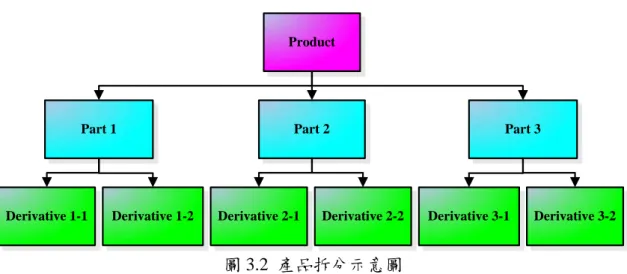
Product
Part 1 Part 2 Part 3
Derivative 1-1 Derivative 1-2 Derivative 2-1 Derivative 2-2 Derivative 3-1 Derivative 3-2
圖 3.2 產品拆分示意圖
依據圖3.2之產品拆分關係,接著將依序說明回收率是如何由衍生物往上滾算 回到完整產品的;而理想回收率與悲觀回收率之計算方式相同,因此下述計算過 程不做理想或悲觀之區分:( :Product,P PaX:Part, DX−Y:Derivative, Pr:Process,
X =1,2,3,Y =1,2) Step 1. 第三階衍生物之回收重量計算: te Recycle_ra _ Re 1 1 1 1 _ Re 1
1− cycle weight
=
(
D
−Weight×
D
− cycle rate)
∗
Pr
D
ate Recovery_r _ Re 1 1 1 1 _ overy Re 1 1 1 1 _ overy Re 11− c weight =(D−Weight ×D− c rate)+(D−Weight ×D− cycle rate)∗Pr
D ate Disposal_r _ Re 1 1 1 1 _ Disposal 2 1 2 1 _ 1Disposal
1− weight =(D− Weight ×D− rate)+(D−Weight ×D− cycle rate)∗Pr
D te Recycle_ra _ Re 2 1 2 1 _ Re 2
1− cycle weight
=
(
D
− Weight×
D
− cycle rate)
∗
Pr
D
ate Recovery_r _ Re 2 1 2 1 _ overy Re 2 1 2 1 _ overy Re 21− c weight =(D− Weight ×D− c rate)+(D− Weight ×D− cycle rate)∗Pr
D ate Disposal_r _ Re 2 1 2 1 _ Disposal 2 1 2 1 _ 2Disposal
1− weight =(D− Weight ×D− rate)+(D− Weight ×D− cycle rate)∗Pr
Weight weight cycle rate cycle
P
P
P
Re _=
Re _Step 4. Recovery rate之計算原理同Step 1~Step 3;
Weight weight ery rate ery
P
P
P
Recov _=
Recov _Step 5. Disposal rate之計算原理同上Step 1~Step 3;
Weight weight Disposal rate Disposal
P
P
P
_=
_3.7 3R Report
此節將介紹綜整 3.5 節及 3.6 節之訊息產出格式;此報告是拆解報告中最核心 亦是最費時費力之資料,但經由此系統可在研發釋出前順利而省時的產出。3.8 連結關係分析及附錄二材質之標示
依據 WEEE Directive 2002/96/EC Article 7-Recovery,拆卸報告需含拆卸流程 之說明,本研究認為以圖片之連結最為清楚,亦可避免回收處理業者對於名稱上 的判斷錯誤。在系統流程中,藉由 RD 在研發過程中所拍的照片,分析各零組件之 連結關係後製成拆卸流程圖,並且將附錄二之材質標明出來。其示意圖如圖 3.3 所 示: Picture Product Name Picture Part 1 Name Picture Part 2 Name Picture Part 3 Name A B C A-1 A-2 B-1 B-2 C-1 C-2 Picture Derivative 1-2 Picture Derivative 2-2 Picture Derivative 3-2 Picture Derivative 1-1 Picture Derivative 2-1 Picture Derivative 3-1
圖 3.3 拆卸流程示意圖
相同類型的產品建立過拆卸流程圖後可當作模子建立成模組,於將來再出現 同類型產品時,叫出檔案並替換照片、修改名稱即可縮短製圖時間。
3.9 建立拆解報告
依據 WEEE Directive 2002/96/EC Article 7-Recovery,建立拆解報告方式如下: (1) Production Description
該產品之簡略描述,如產品名稱、產品規格、產品重量、產品圖片等。 (2) Disassembly Flow
即 3.8 節所述之拆卸流程圖。
(3) Result and Account、Recycle Assessment
3R Report 即包含拆卸結果、說明以及回收評估等資訊。 (4) WEEE ANNEX II
附錄二材質之標示已於拆卸流程圖中標明,因此該要求亦已達成。 (5) Green Product Suggestion
表 4-5 Materials 資料表格式及說明 欄位 格式及說明 Material _class 此欄位記錄該材質是屬於哪一 種類別的材質。 Material _id 此欄位內容為材質之代號。格式 為@@-@@@之英文字母、數 字。 Material 此欄位記錄該公司所用到之所 有材質名稱;由於必需提醒使用 者是否有附錄二材質存在,因此 所有附錄二材質皆必需列於此。 Ideal_recycle_rate Ideal_recovery_rate Ideal_disposal_rate 此三欄位記錄理想狀態下之回 收、回復、廢棄比率。格式為數 字,依據質量平衡原理,此三欄 位之加總必須為 100 pessimistic_recycle_rate pessimistic_ recovery _rate
pessimistic_ disposal _rate
(7) Disassembly_tools Table: 表 4-7 Disassembly_tools 資料表格式及說明 欄位 格式及說明 Disassembly_tools _id 此欄位內容為拆解工具之代號。格 式為@@-@@@之英文字母、數 字。 Disassembly_tools 此欄位內容為拆解工具名稱,有尖 嘴鉗、斜口鉗、螺絲起子…等。 (8) Disassembly_action Table: 表 4-8 Disassembly_action 資料表格式及說明 欄位 格式及說明 Disassembly_actio _id 此欄位內容為拆解動作之代號。格 式為@@-@@@之英文字母、數 字。 Disassembly_actio 此欄位內容為拆解動作名稱,分為 垂直與水平方向之拉、剪、推、移、 旋轉等作做。
(9) tmpReport Table、Report Table:
圖 4.2 3R 材質資料表
圖 4.3 外加工資料表
圖 4.4 3R Report Excel 表
第五章 實例操作
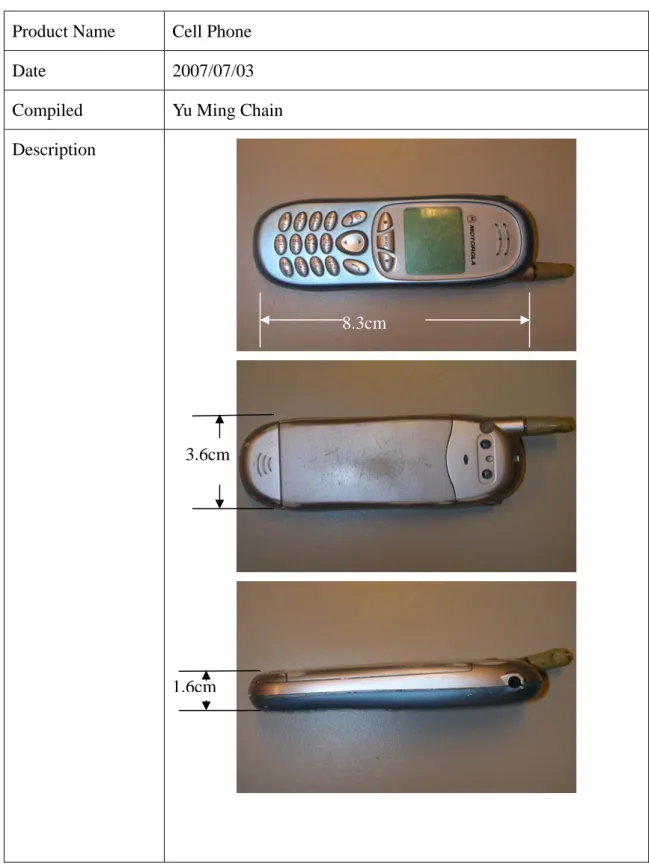
為證明該軟體之實用性,本章節將以手機為例,實際操作如何運用本軟體來 產出 3R Report 並製成拆解報告。依據 WEEE Directive 2002/96/EC Article
事項。
5.1 拆解簡介
表 5.1 用於說明該產品之代表名稱、外觀、規格、以及該報告之編輯者。 表 5-1 拆解簡介
Product Name Cell Phone
Date 2007/07/03 Compiled Yu Ming Chain
Description
1.6cm 3.6cm
5.4 Disassembly Result
利用軟體所匯出之 3R Report 即可直接貼於拆解報告上,或者要做些簡單的加工來使其更美觀亦可。拆解之結果如表 5.2 所示: 表 5-2 拆解結果表 總重量(g) Total Weight(g) 85.9g(因實際拆解成品,因此過程中會有碎削掉落並遺失,若以本論文研究之系統來收集資料並產出,則不會 有此問題) 拆解工具 Disassembly Tools尖嘴鉗(Long nose pliers)、斜口鉗(Plier)、螺絲起子(Screwdriver) 徒手(Free hand)、電子磅秤(Electron scales)、皮尺(Measuring tape)
拆解時間(sec) Disassembly
Time(sec)
264.09sec(此數據並非必需性,因為拆解時間因人而異)